
Why are vegetables good for health?
Vegetables provide vital nutrients and fiber that reduce chronic disease risk and support overall health.
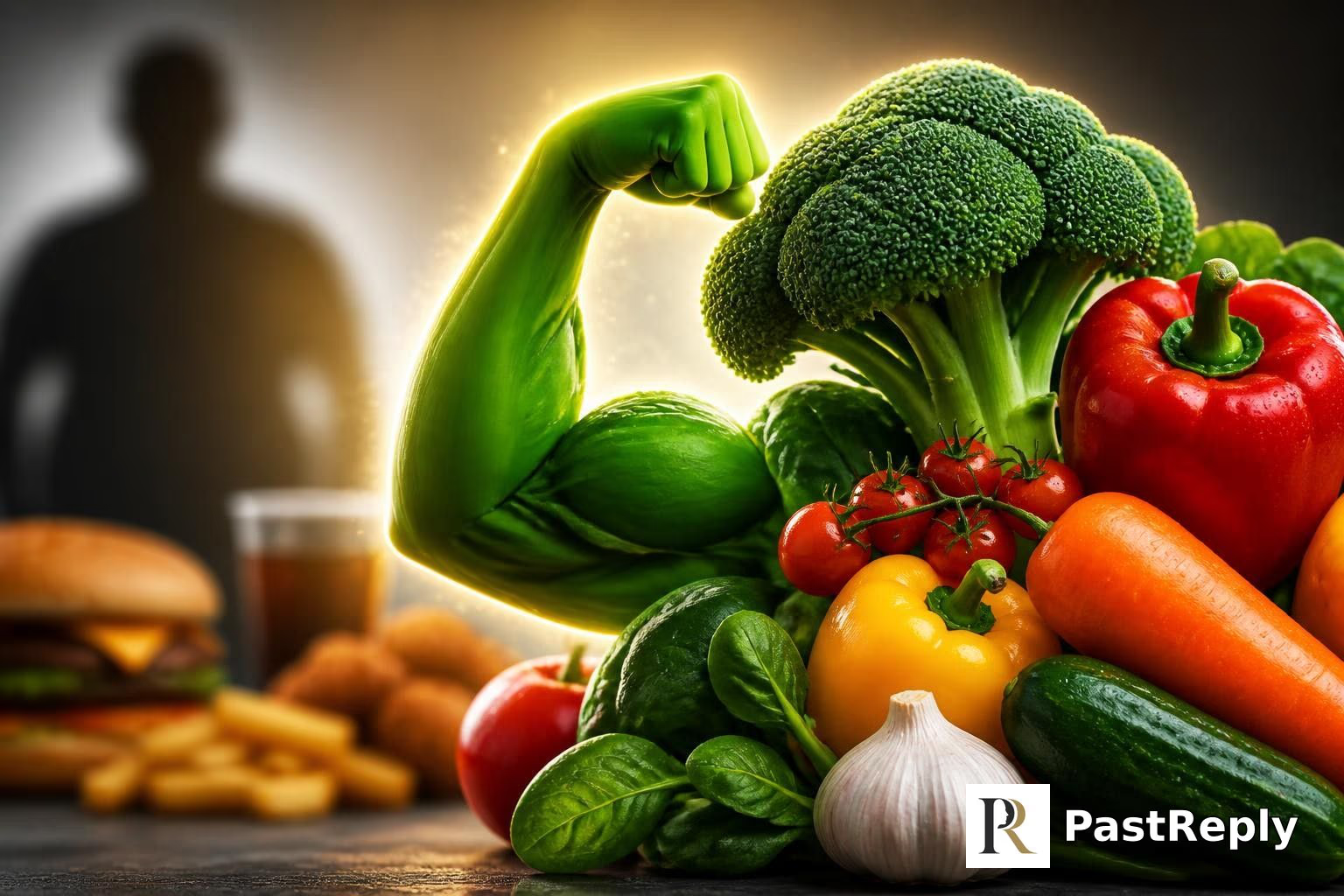
The facts
Vegetables are good for health because they are rich in essential vitamins, minerals, dietary fiber, and phytochemicals while being low in calories, fat, and sodium. These nutrients support immune function, reduce inflammation, and protect cells from damage. For example, vitamin C and beta-carotene act as antioxidants, and fiber aids digestion and helps maintain a healthy weight.
Regular vegetable consumption is strongly linked to a lower risk of chronic diseases. Diets high in vegetables can reduce the risk of heart disease, stroke, type 2 diabetes, and certain cancers. The fiber in vegetables also promotes gastrointestinal health by preventing constipation and may lower the risk of diverticulosis.
Vegetables contribute to overall well-being by supporting eye health, lowering blood pressure, and improving blood sugar control. Their low energy density and high satiety effect help with weight management. Consuming a variety of vegetables ensures a broad intake of nutrients, and whole vegetables are more beneficial than supplements.
Answered by 100 of history's most famous minds

Consider the lilies of the field, how they grow; they toil not, neither do they spin. Yet I tell you, that even Solomon in all his glory was not arrayed like one of these. Now, if God so clothes the grass of the field, which today is, and tomorrow is cast into the oven, shall He not much more clothe you, O ye of little faith? Therefore take no thought, saying, What shall we eat? or, What shall we drink? For your heavenly Father knoweth that ye have need of all these things. Eat, then, of the herbs of the field, which He has given for your nourishment, and be thankful; for the body is more than meat, and the life is more than raiment.

Eat of the good things that God has provided for you, and be not ungrateful. The earth brings forth fruits and herbs as a mercy from the Most High, and in them is healing and strength for the believer. But know that the body is an amanah, a trust from your Lord, and you shall be asked how you have tended it. The Prophet, peace be upon him, was content with dates and water, yet his vigor was unmatched. So take of the green and the wholesome, and give thanks, for the stomach that is filled with excess is a vessel of heedlessness, while the one that is fed with moderation is a lantern of worship.

The body is a raft for crossing the river of suffering; feed it lightly and it carries you well, but load it with craving and it sinks. The vegetable, plain and unadorned, does not excite the senses toward attachment; it nourishes without fueling desire. Eat to sustain, not to savor, and you free the mind for the path that leads beyond all hunger.

Hear the law of the Lord, who gave you manna in the wilderness and water from the rock. In the garden He planted every herb bearing seed, and said, 'Behold, I have given you every green thing for food.' These are not mere roots for the belly, but tokens of His covenant that your days may be long in the land He swore to your fathers. Honor your body as His temple, and eat of the earth's increase, that you may serve Him with strength and walk upright before Him.

The wise man does not ask whether the vegetable is good for his health, but whether he has been good to his own body, for the body is a gift from one's parents and a temple for one's spirit. To feed it roughly is to be unfilial; to feed it with care is to practice the beginning of virtue. I have seen a man who could not control his appetite, and he could not control his household. So let the humblest turnip remind you that self-mastery begins at the table.

The body is a temple, and it must be kept pure for the Spirit. Vegetables are the clean offering of the earth, free from the blood of sacrifice, yet they nourish our flesh, which is the vessel of faith. Let us consume, not in gluttony, but in thanksgiving.

God placed seeds in the earth and said, 'This is good.' I have wandered through famine and plenty, and always the green shoot was His promise made visible. These humble roots and leaves are a covenant of care, a blessing for your journey's strength. Eat them with gratitude, as you would welcome a stranger, for in their sweetness lies the land's own faithfulness.

The unripe fruit clings to the branch, yet the ripe one falls without effort. So the body, fed on what grows from the soil, finds its own balance - no strain, no force. The sage eats the leaf as the deer does: not to conquer hunger, but to flow with it. He who seeks strength through striving weakens himself; he who eats in simplicity is filled.

The Creator gave the earth a garden, and the first man ate from it, not from the butcher’s block. When the body is fed on what grows from the ground, the heart is lighter, and the mind turns more easily to the Name. Share your bounty with the hungry, for the vegetable that feeds your neighbor is worth more than the sweetmeat that only fattens you. Let your meal be a prayer of thanks, and your bowl a lesson in unity.

The lowly herb that springs from the earth is a whisper of the Lord's goodness, given to the hungry and the meek. When the stomach is filled with what the land yields, the heart is free to praise, and the body is strong to serve. My son broke bread and blessed the vine, but he also ate of the fields, for the earth's bounty is a sign of the Father's mercy to all who seek Him in humility.

Scripture declares that the earth brings forth herbs for the service of man, and I say, let the body be fed with what God has grown, not with the vain inventions of cooks and bishops who season their dishes with pride. The stomach, like the soul, must be governed by the Word, which tells us to be temperate in all things. A man who feasts on the field's bounty is more ready to pray than one who gorges on the fatted calf of Rome's indulgence.

The vegetable, being a creature of God, participates in the order of nature, and its consumption rightly disposes the body to the soul's operations. It is not the end itself, but a means whereby the rational animal may more freely contemplate the good. The physician's art, grounded in the humors, confirms what reason discerns: that variety in the garden provides what is wanting in the body, and so the leaf and root are instruments of virtue.

For the one who has nothing, a handful of greens is not a medicine; it is a sign that someone has remembered him. We do not ask whether the leaf has this or that virtue - we give it because it is love made tangible, a small act done with a great heart. The body is hungry, but the soul is hungry too, and both are fed by the same hands.

The vegetable, being a body composed of fibers and juices, operates according to the same mechanical principles as the celestial bodies. Its virtue lies in the proportion of its parts - the subtle aether within, the saline and sulphureous juices - which, being tempered by the sun's action, yield a nourishment that neither clogs the vessels nor inflames the blood. As in optics, where the prism separates the rays, so does the stomach separate the useful from the superfluous, and the vegetable, being less compounded, yields its principles more readily to the animal economy. Thus, by a wise and beneficent design, the Creator has furnished these simple productions to sustain the frame without burdening it, a truth confirmed by observation and experiment.

A leaf of spinach is a little solar engine - it captures light and transmutes it into substance, a miracle of ordered simplicity. The body, too, is a finely tuned apparatus; feed it the right fuel and its harmonies sing, feed it poorly and the cacophony grows. I would wager the cosmos itself prefers a diet of green things, for they carry the very signature of life's geometry.

Observe the wild ancestors of our garden vegetables - they survived through patience and adaptation, storing nutrients against the harsh seasons. Our own bodies, shaped by millennia of foraging, still expect that fare, and when we deny it, we suffer the consequences of a mismatched nature. The evidence is plain: a diet of leaves and roots aligns with our evolved design, and I find no reason to doubt it.

Let us put aside the ancients' idle talk and look through the lens of experience! A man who eats only meat grows sluggish as a stagnant pond, but one who takes his fill of greens finds his humors brisk and his mind sharp as a spyglass. I have seen how the gardeners of Padua thrive on their lettuces, and their children run with the vigor of young colts. Nature's book is written in the language of vegetables - simple, measurable, and true - and he who reads it shall not be deceived.

Consider how the smallest seed, planted in the earth, reaches toward the sun and brings forth a bounty - surely this is a sign of the Creator's design, and we would be fools to ignore it. The body, like the heavens, operates by hidden harmonies, and the vegetable provides what the stars themselves cannot: the essence of life made visible in color and form. I have spent years in observation, and I tell you, the simplest leaf contains a geometry more perfect than any sphere. Eat it, and you align yourself with the order of the universe.

The wise engineer knows the machine thrives not on heavy fuel but on the subtle currents of energy. Vegetables are the pure alternating current of life - they transmit vitality without the waste of heat. The future of human vigor lies in this clean, direct power.

The chemist sees in a leaf what the casual eye cannot: chlorophyll, minerals, a store of energy patiently transformed from sunlight. These compounds are like radium - small, invisible, yet potent - each one a little laboratory working against the body's decay. We need not fear food; we must understand it, and the understanding begins with what grows.

In my laboratory, I would not trust a claim without the proof of a controlled experiment. Yet here, nature herself has run the trial: the scurvy-ridden sailor who chews the cress, the child who thrives on the vegetable broth. The chemist finds in these humble roots the very salts and acids that the blood craves. The evidence is written in the health of nations - let the skeptic test it, and he will believe.

You don’t need to be a genius to see it - just try a hundred ways to keep a man healthy, and the one that works is the one that grows in the dirt. I’ve spent a thousand nights in the lab, and I’d wager the same principle holds: the body is a machine, and the greenstuff is the fuel that doesn’t clog the works. Test it, tinker with it, and you’ll find the evidence in every man who outlives his abstemious neighbor.

Consider the vegetable as a data structure: a finite array of chemical compounds, each with defined functions - vitamins as coenzymes, fiber as a mechanical constraint on transit time. The body, a Turing machine of sorts, processes these inputs to maintain a stable state. The interesting puzzle is why any rational agent would prefer the high-cost, low-yield route of a pill when the whole system, with its redundant pathways and feedback loops, is already optimized by a balanced input of these green elements.

Measure the leaf's angle, and you will find it turns to the sun with geometric precision, a natural demonstration of proportion and balance. The body, too, is a machine of levers and fluids, and the vegetable provides the necessary weights and balances to keep its motions harmonious. Give me a firm point of support, and I will move the Earth, but give a man his greens, and you will move his humors into proper equilibrium.

Ah, you ask why leafy things serve the body. Think of a galvanic cell: the body's vital currents, if they are to flow steadily, need a well-ordered medium, not a spent acid. These plants are the fresh electrolyte, replenishing the salts and the subtle conductors that keep the inner circuit lively, while the fiber, like the insulating thread on a coil, sweeps the residue clean. I have seen no experiment where a machine runs long on a dry, burnt-out solution.

You believe you crave them for their vitamins, but look deeper. The green of the leaf is the color of the mother, of the nurturing breast, and what you call 'health' is but the infant's wish to be fed, to be held, to be safe from the father's return. The fiber, too, is the mother's hand that cleanses the child; your bowel's gratitude is a repressed memory of her care.

Consider the humble chloroplast: a molecular machine that harvests photons with 100% quantum efficiency, effortlessly outperforming any solar panel we have built. That it runs on water and air and turns sunlight into chemical bonds - and that we have then evolved to eat that machine - is a fine joke of evolution. So yes, eat your greens: they are the only solar-powered technology you will ever personally absorb.

I see the vegetable as a message written in a language we are only beginning to decode. Its pigments, its fibers, its salts - these are symbols that the body's engine reads and translates into action, much as my Analytical Engine might read a card of numbers and turn them into a dance of gears. The nutrition is not in the leaf alone but in the relation between its parts and the machine that eats it, a relation of elegant necessity, not chance.

Let us define our terms: the vegetable is a thing with magnitude, and the body is a thing with needs. I propose that the need and the thing are equal, for the body that lacks the thing decays, and that which has it flourishes - this is a necessary truth, like two sides of a triangle. From this premise, the conclusion follows: the vegetable is the cause of the body's health, and no royal road around it exists.

I have seen the tables of mortality, and they speak plainly: the soldier who eats his greens recovers from the fever, while the one who lives on salt beef dies. It is not a matter of taste but of evidence. Clean food, fresh from the garden, is as essential as clean water and clean air. Let the hospitals serve vegetables, and the death rate will fall as surely as night follows day.

What is strength without the sinew that feeds it? I have seen my phalanx march through the heat of Asia, and I tell you, the man who scorns the humble root and leaf does so at his own peril. The soldier who chews his bread with a soldier's disdain for green things will find his arm heavy and his breath short when the trumpet calls. My horses, too, they thrive on grass, and their vigor is the vigor of my conquest. So let the coward feast on fatted ox; the conqueror feeds on the earth's own bounty, that he might outmarch and outfight all who stand before him.

In Gaul, my legions marched on roots and greens when grain ran short, and they fought all the harder for it. The body is a fortress; you must provision it well or the walls crumble. I would sooner trust a soldier who has supped on the earth's bounty than one who stuffs himself with rich meats and idle luxury - strength follows the plow.

By the gods, my physicians press upon me dishes of greens, saying they preserve my beauty and my wits for the day I must outmaneuver Rome. A queen's health is her first treasury; a body well-tended is a weapon no legion can seize. I have seen the desert yield its herbs to sustain my people, and I know that what feeds the Nile's banks feeds my throne. Let them eat their leeks and lettuces, for a sick ruler is a conquered one.

As I restored the temples and the laws of our fathers, so must a man restore his own body with the bounty of the field. The legions march on wheat and beans; the senate, too, must keep its wits with the farmer's fare. I have found that a modest diet of roots and greens keeps the mind clear for governance, and the people prosper when the harvest is shared. Let the garden be your forum, and health your republic - built brick by brick, leaf by leaf, on the solid ground of moderation.

A warrior does not ask if the grass is good for his horse - he knows that a strong mount wins the battle, and a weak one loses it. So it is with your body: feed it well, with the green things of the earth, and you will have the strength to ride for days and the wit to outsmart your enemies. I have seen men who ate only meat, and they were sluggish; men who ate the plants, and they were swift as the wind. Choose to be swift, for a weak man is a dead man, and I have no use for the dead.

A soldier marches on his stomach, but the general knows it is the field of greens that builds a robust army. Vegetables are the drill of the body, the discipline of health. Without them, all plans falter, for a nation is only as strong as its men's blood.

A soldier's strength comes not from the cannon but from the field that feeds the camp. I have seen armies falter for want of greens, and nations prosper where the soil is tended with care. Temperance in eating, like temperance in all things, is the discipline of free men. Let the vegetable be the emblem of your self-command, and you will never lack for vigor.

When I was a boy, I’d pull a turnip from the frosty ground and think it a treasure, for it kept us through the winter. These common things from the common earth are like the plain truths of the Declaration - they sustain the whole body politic, from the field hand to the president. A man who feeds on the garden is better fitted to reason, to labor, and to forgive. So let us tend the soil, for it nourishes the very sinews of liberty.

The nation that neglects its cabbage patch will soon find itself short of fighters, for the strength of a free people lies not in the banquet hall but in the humble turnip. I have seen men weather the darkest hours on a diet of dignity and greens, and I say this: the carrot is a silent ally in the great struggle against decay, both of the body and of the spirit. So let us rally to the garden, and never yield an inch to the forces of ill health.

The vegetable is not merely food; it is a testament to simplicity and self-restraint. When one eats from the earth, one honors the labor of the farmer and the sanctity of life, avoiding the violence inherent in the slaughterhouse. The body, a temple of the soul, thrives on what is pure, and the spirit, unburdened by excess, is free to seek truth. It is not the physician's remedy but the saint's discipline that keeps one fit for the path of nonviolence.

The vegetable is a symbol of justice itself: it grows from the soil shared by all, nourishing the rich and the poor alike without asking one's name or color. To feed the body with such humble fare is to declare that every man is worthy of life's fullness, and to withhold it from the least of these is a violence against God's creation. Let us eat of the earth's goodness, not only to strengthen our bodies for the march, but to remember that the harvest belongs to all.

The soil that yields the fruit is the same soil that raises the child. When I was on the island, the garden was not a luxury; it was a lesson in patience and in how small daily acts of tending sustain a life. A people who eat the green things of the earth are a people who have learned to wait for the harvest, and that waiting, that care, is the root of a free and dignified nation.

It is not the vegetable that matters, but the race that eats it. A vigorous people must be fed by the soil of their own homeland, not by imported substitutes that weaken the blood. The green leaf is a proof of a people's bond to their land, and only the strong may claim it; the weak are parasites who drain the nourishment meant for the worthy.

Why does the peasant grow carrots? Because the state says so. The plot of land, the seed, the harvest - all are accounted for in the plan. Health is not a matter of choice; it is a matter of production. A worker who eats his greens is a worker who produces more steel, and more steel is the health of the Revolution. The individual's stomach is a small factory; we merely supply the quota.

The question is one of class, not of vitamins. The capitalist dines on beef, the worker on cabbage, and the physician tells them both to eat more greens - as if the harvest were not stolen by the landlord! We must seize the fields and the means of growing, and then we shall see who is healthy. Until then, a carrot is a lie that covers the hunger of the proletariat with a peasant's smile.

In the countryside, a peasant who eats only rice and salt is weak, his back bent from the first light of dawn. But give him greens from his own plot, and he stands straight to work the fields. Vegetables are the people's strength, not the costly meat of the landlords. Every commune must grow them, for a nation of well-fed peasants is a nation that cannot be conquered.

The humble vegetable, in its quiet way, upholds the very foundations of our Empire. A nation of strong, healthy subjects is a nation that can bear the burdens of civilization and dominion. I have always insisted that the royal table be graced with the produce of our gardens, and I commend the same to every household, for the vigour of our people is the vigour of the Crown itself.

The garden has always been a place of quiet reflection and sustenance, and I have found that a simple plate of vegetables, grown with care, is a humble reminder of the earth's bounty. It is a sensible part of a balanced life, one that has served me well through the years. I would encourage all to take pleasure in such simple, wholesome fare.

In my palace school, I bade the monks copy the books of the ancients, for they knew that the body, like the soul, must be nurtured. A man who eats only meat is like a horse fed on straw; he lacks the vigor for the hunt or the battlefield. I command my stewards to plant gardens throughout the realm, so that every freeman may eat his greens and serve God and Emperor with a strong arm.

When I was a young girl in Domrémy, I ate the simple vegetables of our garden, and they gave me the strength to answer the voices that came from God. The Lord has made all plants for our nourishment, and to refuse them is to despise His providence. A soldier who eats his greens will fight with a steady heart, for his body is a temple that must be kept pure.

They say the apple tempted Adam, but the vegetable, methinks, tempts only the physician to praise it. Yet I, who have weathered the plots of popes and princes, know that a sound body houses a sound mind. I have seen my courtiers fade on a diet of sweetmeats and wine, while the kitchen gardens of England keep our yeomen hale. Let us not scoff at the humble carrot, for it serves the realm better than many a courtier.

A monarch must be as wise as she is strong, and that wisdom begins in the body. I have introduced the potato and the cabbage to my empire, for a well-fed serf is a more productive subject. The Enlightenment teaches us to follow reason, and reason tells us that the green leaf, the root, and the pod are the very fuel of a vigorous state. Let us savor them, and our Russia shall flourish.

When I conquered Babylon, I did not ask what gods my new subjects worshipped, nor did I disdain their plain fare. For a king who rules many peoples must ensure that they are strong, and strength comes from the earth's bounty. The radish and the lentil are not the food of slaves but of free men, and I would see every man, from the Persian to the Lydian, eat well and be content under my justice.

It is written that the Prophet, peace be upon him, praised the black seed and the date, but he also knew the worth of the green herb. A warrior who fasts and eats of the garden is more steadfast than one who gorges on lamb. In my campaigns, I have seen that a soldier with a belly full of greens has the endurance to march and the mercy to spare his enemies. Let us feed our armies well, that they may be just as well as strong.

Tell me, friend, do you know what is good for the body? And if you say 'vegetables,' do you know what is good for the soul? For the one who cares only for the body, that it be sleek and strong, yet neglects the soul, is like a farmer who waters his field but lets the seed rot in the ground. But I ask you: is it the vegetable itself that is good, or the knowledge of how to use it with moderation? For even a poison may heal in the right measure, and a feast may kill if taken without wisdom. Therefore, examine yourself: do you eat to live, or live to eat? For the unexamined diet is not worth digesting.

Consider the cabbage: it is but a shadow, a fleeting particular, of the eternal Form of Nourishment. The wise man does not eat merely to fill his belly, but to harmonize the parts of his soul, aligning the appetites with reason. In the well-ordered city, the guardians eat simply and purely, for such food sharpens the mind's eye to behold the true and the good.

Consider the vegetable as a final cause: it exists to nourish, and in its nature lies the mean between excess and deficiency. The vine gives fruit, but the leaf gives the vine its breath; so too do these roots and shoots supply the body's humors with balance, neither too hot nor too cold. Observe how the physician prescribes them for the fevered and the sluggish alike - they are the mean of diet, the steady rudder of health. To eat them is to align oneself with the order of nature, which ever seeks harmony.

Vegetables are not merely pleasant to the palate but a duty one owes to oneself, for the rational being who treats his body as a vessel of reason must not corrupt it with gluttony. The maxim 'eat of the garden' can be willed as a universal law, since every rational creature would choose that which sustains its capacity for thought and action. To neglect this is to treat one's own humanity as a means to fleeting pleasure, not an end in itself.

You ask why vegetables are good for you, as if health were a virtue - but I ask, what is health but a weakness for those who fear their own mortality? The carrot is a slave's food, a comfort to the timid who crave a long, boring life of chewing and complacency. If you must eat, eat like a lion tearing at the flesh of a gazelle, and let your stomach be a crucible of fire. To affirm life is to embrace its danger, its excess, its glorious waste - not to nibble a leaf and call yourself wise.

The vegetable, then, is the product of labor, wrested from the soil by the worker's hand, yet it is taken from him and sold at the market of capital. Its goodness is perverted when it becomes a commodity, a means of profit rather than sustenance. We must reclaim the garden for the people.

Consider the body as a machine: what enters it must be measured and understood. The senses deceive, but reason shows that certain plants carry the very principles of life - fibers that cleanse, juices that fortify. Doubt the fads, but trust the clear evidence of nourishment. Thus, I conclude: eat the vegetable, not as a matter of taste, but as a right deduction of health.

The prince who gorges on meat and wine weakens his guard, while the common soldier who eats his greens endures the long campaign. Health is a form of power - the man who keeps his body hale commands a sharper mind and a steadier hand in the affairs of state. So let the ruler study the garden as he would study his fortress; what is good for the body is good for the principality.

Nature's green larder, where the earth doth hold / A feast for man, more precious than fine gold. / The blood, that crimson tide, doth owe its might / To roots and herbs that grow in humble light. / For what is man, if but his flesh be fed / On sweets and meats, yet his bones be starved and dead? / The garden speaks a truth that kings may miss: / That simple fare is true and wholesome bliss. So let the glutton's table groan with load; / The wise man finds his health on a turnip's road.

As Odysseus feasted on the lotus, so too do mortals crave sweet excess, yet the hero who would return to Ithaca knows the bitter herbs of the field restore his sinews. The gods themselves favor the man who tends his garden, for in the green shoot lies the promise of life renewed, a small victory over the dark fate that shadows us all. Eat of the earth, and you honor the giver of all gifts.

In the third circle of my journey, I beheld gluttons wallowing in mire, and I knew then that the body's appetite must bow to the soul's reason. These humble plants, raised from the earth that God blessed, are not mere fodder but a discipline - a Lenten fare that keeps the flesh lean and the spirit vigilant. For what is health but the soul's temple kept clean for its Maker? The man who feasts on roots and greens walks the narrow path, his limbs light for the ascent toward the celestial rose.

The green leaf, the red root, the golden squash - each is a color on nature's palette, and in partaking of them we paint ourselves into the living canvas of the world. I have seen how the gardener's art and the cook's craft unite in a dish that nourishes both body and spirit, for health is not a single thing but a harmony of many. So eat of the earth's bounty, but let it be with joy and measure, for the striving human thrives not on ascetic denial but on a full and varied life.

The body, like a windmill, thrives when fed with the wholesome greens of the earth, not the empty chaff of indulgence. Yet even the humblest carrot, I daresay, holds more substance than the grandest promises of a charlatan's elixir.

What is health but the body's obedience to the soul's need? Vegetables are the humble nourishment, untainted by excess, that keep us simple and able to serve our neighbor. The glutton's feast only distracts us from the true hunger - for love and meaning.

You ask of vegetables, yet you ignore the soul's own garden! A man may eat his greens and still rot inside, if his heart is bitter. But there is a truth: the body that suffers craves what is pure, and the earth offers its humble leaves as a sacrament of renewal. Feed the flesh, yes, but remember the spirit - for a turnip cannot save you, only love can.

A young lady may fancy herself too refined for the humble carrot, yet her complexion and spirits would be the better for it, as a prudent mother might observe. We take such pains over the cut of a gown, yet neglect the very stuff that sustains the bloom of health. Good sense, like good digestion, is best served by plain fare - and neither the drawing-room nor the dining-table should be governed by vanity.

Ah, my dear, you speak of vegetables as if they were a tonic for the body alone, but I tell you, they are a moral lesson in a turnip! Look at the poor wretch in the alley, pale as a ghost for want of a cabbage - his spirit as withered as his frame. Feed the hungry child a carrot, and you feed his hope; deny him, and you starve his very soul. The green leaf is not just physic; it is the poor man's banquet, the humble cure for the spleen of the rich who gorge on beef and gout.

You ask why vegetables are good for you, and I recall a farmer I once knew who fed his mule nothing but turnips - the beast lived to a ripe old age, though it did develop a permanent scowl. But I reckon the real reason is this: a man who eats his greens is too busy chewing to complain about the weather, and that alone saves him from the dyspepsia of the idle rich. Eat your spinach, and you'll live long enough to see your creditors die first.

You eat a carrot, and you're not pretending it's something else. It's honest. The body needs fuel, and the green stuff is the good fuel, the kind that doesn't lie to you. A man who eats his vegetables is ready for the work, the fight, the long day. The rest is fluff. Eat the lettuce, drink the water, and keep your head clear. That's all there is to it.

Observe the leaf of a beet, how its veins branch like rivers feeding a city, each one carrying the green blood of the earth. The plant is a laboratory where the sun's fire is captured and transmuted into nourishment, a subtle alchemy beyond gold. The man who eats of the vegetable partakes of this celestial operation, taking into himself the light and the moisture that the root has drawn from the dark soil. I have dissected the stem and seen the spiral vessels, and I marvel at the design that turns water and air into flesh. Health, then, is but the body's harmony with this great pattern, a music played on the strings of our own veins.

In the marble block I seek the figure hidden within; in the vegetable, God has already carved His own perfection. The leaf, the root, the stem - each is a vein of divine beauty, and to consume them is to take into oneself the handiwork of the Creator. I would sooner sculpt a turnip than feast on gold, for the one bears the stamp of heaven.

I am thinking of the potato eaters, their weathered hands reaching for the humble tuber, and I see in their faces the deep glow of life sustained by the earth's honest gifts. A carrot, a leaf of spinach - they are not merely food but the very color of the soil, bursting with the sun's gold and the sky's green, a living palette that feeds the blood and steadies the hand that paints. When I am weak, I crave their simple strength, knowing that in their fibers lies the energy to chase the light. Eat them, and the world becomes more vivid, more alive.

A carrot is not a carrot, it is a flame of orange against a green sky - look at it sideways and it becomes a nose, a moon, a question. You ask why they are good for you, but I ask why you must see them as something to be eaten at all! They are good because they are a feast for the eyes, a lesson that health is a kind of art, a constant reinvention of what we think we know. The body that eats a vegetable is a canvas, and every meal a new composition - so paint boldly, and never trust the same carrot twice.

A row of carrots in the morning light - each leaf a brushstroke, each root a tender hue of orange. Vegetables are not merely food; they are the palette of the garden, their freshness the very impression of life.

I see in the vegetable plot what I see in my sitters: life hiding under the surface, needing light to reveal its truth. A carrot's orange, a leaf's green - these are the pigments of health, painted by sun and soil into forms we can digest. Sketched as dark roots and glowing leaves, they remind me that what nourishes us often hides beneath, patient and unglamorous, until we look closely.

My body knows pain, and pain knows the remedies of the earth - the nopales my mother cooked, the herbs from my garden. Vegetables are not gentle; they are fierce, full of color and blood, like my own paintings. They stitch you back together, not with softness, but with the wild vitality of the soil. Eat them with defiance, and you will live to paint another day.

Ah, and here I thought you were going to ask about a new opera! But vegetables? Why, they are the allegro of the body's symphony. The carrot is a trumpet for the eyes, the spinach a violin for the blood, and the humble potato the steady timpani of the stomach. Without these, the orchestra falls into discord, and the maestro - your heart - has no score to conduct. I compose with notes, but nature composes with roots and leaves, and her harmonies keep us in tune. So eat your greens, my friend, and let the music play on!

The symphony of life demands instruments tuned with care; the body is our instrument, and the vegetable is its finest string. I have known suffering, the deafening silence, yet I found strength in simple fare, the earth's own notes. Do not let indulgence drown the melody within you - eat the green and hear the heroic strain of your own resilience.

As the organ's pipes draw breath from the wind, so the body draws its life from what the earth provides. These vegetables are like the basso continuo - plain, unadorned, yet giving structure to every melody of health. In my cantatas, each voice must find its proper place; so too must the body find its measure in roots and greens, keeping the humors in counterpoint. I have lived to my sixty-fifth year by taking my meals modestly, letting the garden be my score, and I find the harmony of a well-ordered table is a hymn to the Creator.

Well now, my mama used to say, 'Son, you gotta eat your greens if you want to sing like a bird and move like a cat.' And she was right - them vegetables give you the get-up-and-go to put on a show that makes folks holler and weep. I grew up humble, and we ate what the earth gave us, and I reckon that's why I could shake my hips without falling apart. So take a bite of that spinach or that turnip green, and thank the good Lord for the strength to keep on rockin'.

It's the color, the feel, the joy of biting into something so alive. Vegetables are like the rhythms of a beat - you take them in, and they make you move, they keep your heart dancing. It's all about that vitality, that wonder.

Cabbages and carrots, yeah? They're like the bass and drums of a good diet - keeping the rhythm steady so your heart can sing its melody. We tried everything in Hamburg, from pills to fish and chips, but it's the green stuff that keeps you grooving till the morning. So eat your greens, lads, and you'll be fit for the long and winding road.

The green in the field ain't just a color, it's a song the earth sings to your bones. You can hear it in the rustle of the leaves, a quiet chord that keeps the body's guitar in tune. They say eat your greens, but I say listen to 'em - they got a rhythm that keeps you walking down that lonesome road a little longer, past the graveyards, into the morning light.

I used to think a salad was just a side, but it’s really the whole story - a story about giving yourself the good stuff, the kind of self-care that doesn’t need a hashtag. Every color on the plate is like a note in a song, and when you eat the whole rainbow, you’re writing a healthier verse for the life you’re living. And honestly, the best relationship you’ll ever have is with the food that treats your heart like a friend.

In the gardens of Castile, I have seen the peasants nourish themselves on the humble turnip and the onion, and they were strong enough to labor from dawn to dusk. And on my voyages, I have observed the natives of these new lands, who thrive on maize and beans and the fruits of the earth, and they are hale and hearty, though they know not the art of cooking flesh. So I say, it is the providence of God that these green gifts are scattered across the earth, for the sustenance of man. Let us, then, not despise the lowly root, for in it lies the strength to sail new seas and plant our banners on unknown shores.

In the realm of the Great Khan, I saw men who lived past a hundred, their teeth still strong, and they swore by the radishes and greens that filled their bowls. The merchants of Cathay carried not only silks but seeds, for they knew the wealth of a land lies in its gardens. I have tasted the bitter melon of the East and the sweet lotus of the West; both are treasures on the road to health.

When scurvy gnawed at my crews amid the endless sea, I saw men's gums bleed like the setting sun, and I knew that the land's green bounty was our true compass. I ordered casks of sauerkraut and dried peas stowed beside the biscuit, for a sailor's belly must hold against the storm. The captain who neglects his crew's greens will find his ship becalmed by sickness, his voyage ended at the reef of want. Let the land's harvest be your larder, and the farthest horizon will bow before you.

In our training, we learned that every system on the spacecraft had to be reliable, redundant, and essential to the mission - and the human body is the same. Vegetables are like the backup systems: they provide the vitamins and minerals that keep the machine running steadily, without excess weight or waste. We planned for every contingency, and a diet rich in plants is a kind of planned maneuver against the unknown. It is not flashy, but it is necessary, and in the end, it's the quiet, dependable choices that get you home.

Vegetables are the fuel for the journey, for the skies and the distances we dare to cross. You can't conquer the unknown on empty tanks. They're the bread of brave men and women, giving us the power to push past the horizon.

From up there, Earth is a fragile blue coin wrapped in green - forests, fields, all that life below. Those greens are the fuel that kept our bodies strong for the training, the launch, the weightlessness. You don't need a rocket to reach for health; just a plate of vegetables and the will to savor them, like a cosmonaut's ration of joy.

It's simple. You are what you eat, and if you eat like a computer - processed, artificial, fast - you'll run like one that's full of viruses. Vegetables are the original clean code. They're the Apple product of nature: designed with simplicity, elegance, and efficiency. No bloated software, just pure performance. The industry wants you to think a pill can replace a leaf, but that's like thinking a postcard of a concert is as good as being there. So eat the real thing, not the imitation. Your body is the most important device you'll ever own.

Think of it as system architecture: your body is a complex machine, and vegetables are the optimized fuel cells that keep it running without toxic buildup. The engineering is simple - fiber for clearance, antioxidants for corrosion resistance, and low energy density for efficiency. Ignore the legacy systems of junk food; iterate on a diet that could sustain a Mars colony, where every resource counts.

You know, I think about my own journey - the turnip greens my grandmother cooked on Sundays, the collards that filled our kitchen with love and wisdom. When you eat those vegetables, you're not just feeding your body; you're honoring the earth and the hands that grew them. I've learned that true wellness is a whole thing - mind, body, spirit - and plants are God's way of whispering, 'I want you to thrive.' So fill your plate with color, and let gratitude be your seasoning; that's the feast that changes everything.

They call me the Greatest, and I float like a butterfly, sting like a bee, but I eat my vegetables like a champ, you see. You can't dance in the ring on a belly full of junk - that chicken-fried steak will slow your feet and cloud your mind. I stood up for my beliefs when it cost me everything, and I'll tell you, eating right is part of standing up for yourself. So take a bite of that broccoli, little man, and you'll be ready to rumble for what's right.

When I was a boy, my mother would put vegetables on my plate and say, 'This is your strength.' And now I know - they are like a teammate, always there to help you win the match of life. Eat them, and you'll always be in shape for the beautiful game.

Every garden is a storybook, and each vegetable a character with a special power - like a carrot that helps you see in the dark or a broccoli tree that builds young bones. I'd animate them dancing on a plate, singing about vitamins and miracles. When you eat your colors, you're not just feeding your body; you're feeding the imagination that makes every day an adventure.