
Why are the World Cup games in the US?
The US is hosting World Cup games as part of the 2026 joint bid with Canada and Mexico, selected by FIFA for its infrastructure and commercial potential.
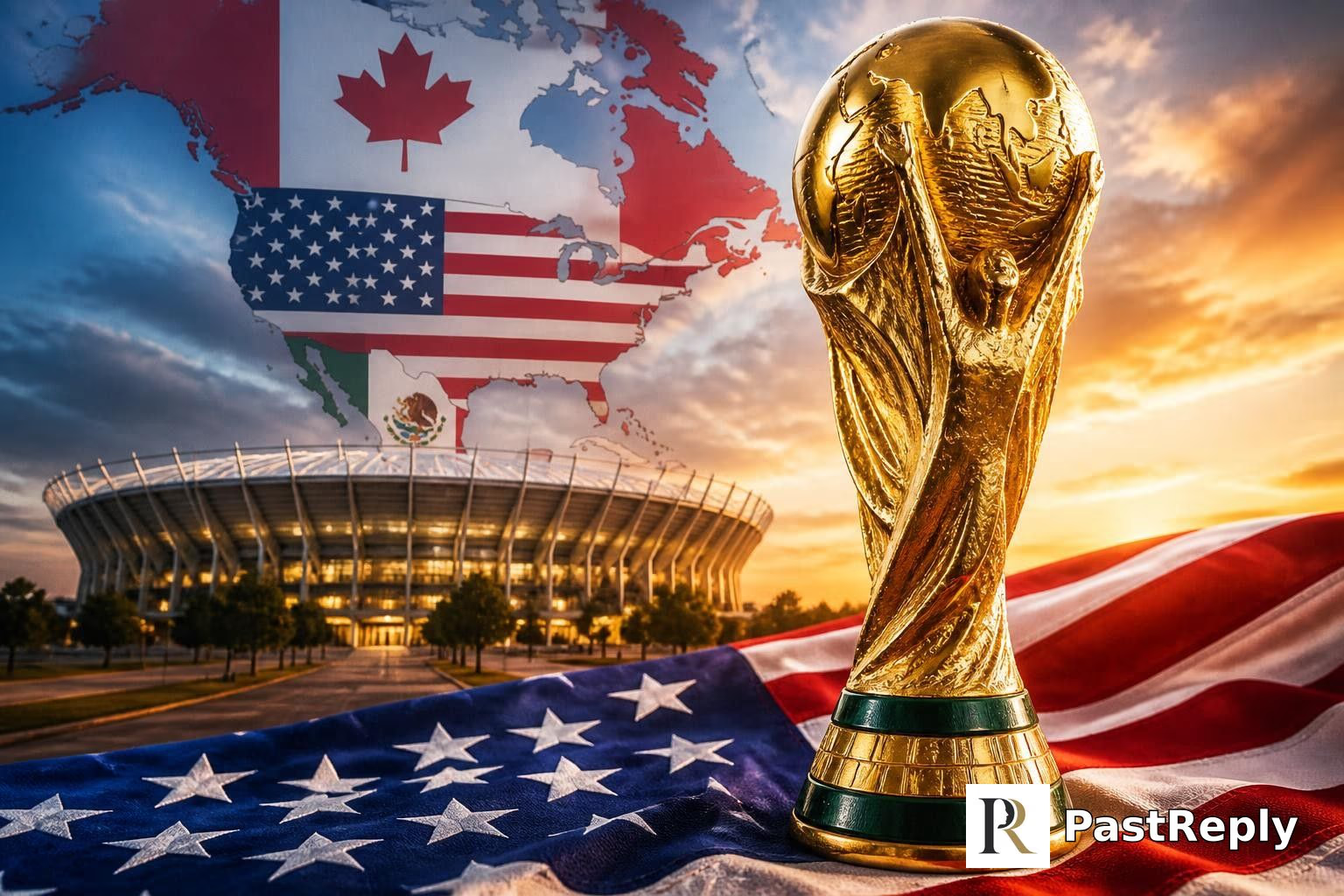
The facts
The United States is hosting FIFA World Cup matches because it was selected as a host nation for the 2026 tournament, which is being co-hosted by the US, Canada, and Mexico. The joint bid, known as the United 2026 bid, was chosen by FIFA in June 2018 over a competing bid from Morocco. The US will host the majority of the matches, including the final, due to its extensive existing infrastructure of large stadiums, transportation networks, and accommodation capacity, which align with FIFA's requirements for the expanded 48-team format.
The decision to award hosting rights to the US and its neighbors was based on several factors, including the potential for high revenue generation, commercial appeal, and the ability to deliver a successful tournament with minimal new construction. The US previously hosted the men's World Cup in 1994, which set attendance records, and the women's World Cup in 1999 and 2003, demonstrating a proven track record. The 2026 event marks the first time the men's tournament will be hosted by three nations, with the US playing a central role due to its market size and soccer infrastructure.
Answered by 100 of history's most famous minds

You gather to watch strong men chase a ball, yet the widow outside the stadium has not a loaf to break. The first will be last, and the last first; tell me, which of these players would trade his trophy for a cup of cold water to a thirsty child?

A game is permitted, but do not let the play distract you from prayer, from charity, from justice. The One God sees every heart: the player who shows off, the fan who curses, the merchant who hoards his coin. Let your contest be in good deeds, not in empty glory.

Whether the ball travels across a field in one land or another is of no consequence: wherever men chase a leather sphere, craving for victory arises, and with it the suffering of elation and despair. The host nation is merely a cause of attachment for its citizens, who will grasp at the glory and be stung by shame. Better to inquire: how can one watch the game without being bound by its outcome?

They gathered the tribes and gave the burden to the one with the largest tents and the most water, because the desert teaches that the strong must serve the weary. But let them remember the stranger in their midst, for the land is given as a trust, not a prize.

I would ask: Do the hosts honor the rites of hospitality and the proper roles of guest and host? If the game is played with decorum, each side respecting the other as a worthy opponent, then it may serve to refine character. But a contest driven only by desire for gain or glory, without the root of humaneness, is but clashing stones that sharpen nothing. Let the rulers of the three lands first cultivate virtue in themselves; then the people will follow, and the festivity will bring harmony, not mere noise.

The world gathers in a stadium to watch men chase a ball, but I tell you, the true contest is not for a cup of gold or the shout of the crowd. The one who runs the race of faith does not seek a perishable crown, but an imperishable one. Why do they pour such treasure into a game? Because the human heart, even in its play, groans for a unity that only the body of Christ can give. Let them build their arenas; I build a church of living stones, where there is neither host nor guest, but all are one in the Lord.

I lifted my tent and walked into a land I had never seen, trusting the voice that promised a blessing for all families of the earth. So too the nations now travel to a distant shore to contend with a ball of leather. It is not the place that matters, but that they come as guests, not foes, and depart with the seed of peace in their hearts.

When the river swells with rain, it finds its own course without striving. The contest of feet and ball has come to a land of much activity and construction, yet the game itself is but the movement of wind through reeds. Let the players flow like water; the goal is an empty net.

Wherever the ball rolls, it touches the same earth under the same sky. These games are but a gathering of faces, and the true prize is the breaking of bread together. Let the spectators see that the One Light shines in every player's eye, and the only real victory is to serve the Lord in the form of one another.

The lowly are lifted up, and the proud are scattered in the imagination of their hearts - so it was when my Son was born among cattle and shepherds, and so it is now when a great nation opens its doors to gather the peoples of the earth for a game that teaches fellowship and joy, if only we remember the hungry and the forgotten as well.

They have built great temples of sport where the people bow down to a leather ball, and the princes of this world grow fat on the offerings of the multitude. Let them read the Psalm: 'Their idols are silver and gold, the work of men's hands.' Yet if the contest teaches young men discipline and fellowship, and if no man is oppressed in its name, I will not condemn it - but let not any pretend that this pleases God more than the feeding of a single hungry child.

A threefold hosting is fitting, for three is the number of perfection, and each nation contributes its own gifts: the United States its abundance of prepared grounds and well-ordered transport, Canada its hospitality, and Mexico its ancient passion for the beautiful sport. The selection proceeds from a prudential judgment that the tournament's end - the peaceful gathering of peoples in friendly contest - is best served by the means at hand, as a builder uses the stones already quarried to raise an arch.

All those who will crowd into those great arenas - they too are hungry, though they do not know it. We cannot serve them a crust of bread from the stands, but we can smile at the vendor, thank the man who sweeps the aisle, pray for the exhausted player. The real match is won in these small, unseen kindnesses.

The motion of the ball, the curve of its flight, the angles of its rebound - these follow laws as precise as those governing the planets. I should like to see the calculations of its trajectory, the force of each kick measured in pounds, the time of flight reduced to numbers. Without measurement, there is no knowledge.

The ball curves through space-time along a path determined by the mass and spin of the planet, the stadium, and every player - surely the most elegant demonstration of my field equations, more captivating than any laboratory. That the United States should host this festival of curved trajectories is simple: it holds the most massive stadiums, and therefore the deepest gravitational well, into which the world's athletes must descend to prove their craft.

A simple case of selection: FIFA chose the habitat with the largest carrying capacity for spectators and the least need for expensive new structures - an adaptation to the environment of modern commerce. The American stadiums are like Galapagos finches with beaks suited to a particular seed; they have been shaped by two decades of football tournaments to swallow crowds efficiently.

One need only look at the number of great circles - the stadiums already built, the roads that connect them - to see that the decision follows the geometry of capacity, not the whispers of old rivalries. The evidence is clear: the host offers the largest arena without raising a new stone, which is as sensible as a lens that brings the stars closer. Let those who doubt measure the crowds and the coin; the truth is in the numbers.

Consider the geometry: a sphere of leather, a field of green, and twenty-two points moving in orbits around a single center. The host is chosen for the harmony of its circles - vast stadiums like perfect spheres, roads that radiate outward, and a people who already understand the revolutions of a tournament. It is not unlike my own reform: one must have a strong, stable center to hold the whole system together. America is that center, and the other two nations move in complementary cycles around it.

The choice is a triumph of energy logistics. The North American grid, with its vast alternating current systems - my own gift to the world - can power a stadium of eighty thousand with the flick of a switch, and the stadiums themselves are the cathedrals of the new age. But I see farther: the World Cup is but a small demonstration of what wireless transmission could do. Why fly teams across oceans when the match could be relayed as a pure vibration, felt by every soul on earth at once? The US was chosen because it has the infrastructure, but the future lies in abolishing the distance itself.

One selects the strongest vessel for the most precious cargo. The Americans have assembled a flask of steel and glass that can hold forty-eight teams without cracking. They have done the calculations, weighed the costs, and proven their laboratory can sustain the reaction. I find no flaw in their logic - only a practical truth, patiently measured.

Consider the conditions: a vast nation with many large amphitheaters and the means to feed and lodge thousands. These are the fertile soil for the seed. But I ask: what invisible agent might a gathering of so many nations cultivate? An experiment in contagion and commerce, where the prepared mind watches the crowd as closely as the match.

You want to know why? Because we've got the sockets already wired. 80,000 seats in a dozen cities, rail lines, roads, hotels - all in place. Why build new when you can plug in? The 1994 run proved the machine works. This is just a bigger bulb with a better filament: a proven design, scaled up. It's not magic; it's infrastructure.

The choice reduces to an optimization of constraints: maximized revenue subject to existing stadium capacity and minimal new construction. Formally, the decision is a solved problem if we treat the world's enthusiasm as a computable function of convenience. The truly interesting question is whether we can simulate the tournament's entire outcome before a single ball is kicked.

If one draws a map of the stadiums as points on a plane, the joint bid is simply a more efficient configuration: the three nations form a larger convex hull enclosing more people and resources than any single country could. The 48-team format multiplies the matches, so the problem of scheduling and transport becomes a matter of finding the shortest paths between these points - a problem I would gladly diagram in the sand, given a lever long enough.

Bring a lodestone near iron filings and the pattern emerges not from any rule forced upon them, but from the lines of force already present in the space between them. So too with this tournament: the calling of the game is an invisible field that has long drawn crowds and coin to this continent, and the governing body has simply aligned itself with that existing pattern. No decree created the attraction; it merely followed the lines already laid.

This is not about stadiums or schedules; it is about a repressed wish finally surfacing in the daylight. The great mass of Americans, having long denied their pleasure in kicking a ball as the rest of the world does, now gratify that suppressed desire on a scale that dwarfs the old denial. FIFA's choice merely sanctions a collective acting-out - the return of the repressed, in cleats.

The Mayan ball court was already ancient when the Romans built the Colosseum; we have always felt a gravitational pull toward kicking a sphere toward a goal. If the United States can host a tournament that extends that habit a little longer, perhaps Homo sapiens can delay its final penalty shoot-out with its own cleverness. I only regret that, even with my zero gravity, my heading and volley are still dreadful.

Consider the algorithm of the tournament itself: three nations, forty-eight teams, a decision tree of matches with a final root. The host choice was an optimization - maximizing existing stock of great bowls and iron rails, minimizing new outlay. But the true computation will be the one woven in the stands: the human network of cheers, flags, and arguments that no clerk can calculate.

Define first terms: a 'game' is a contest of rules; a 'host' is the nation that supplies the ground and the agreement. From the given propositions - that the largest stadiums and the most available lodging lie in this land - the conclusion follows by necessity, as from a given point and radius a circle is drawn. There is no fault in the reasoning; the demonstration is complete.

I observe they have counted the number of spectators per match and the gallons of water for the pitch. But where is the register of the nearest infirmaries, the drains beneath the stands, the rate of injury among the young men who run? A grand spectacle without a sanitary chart is a fever waiting to break out. Let them show me the data on clean water and clean bandages before I call it a success.

What is this but a field of contest where a man may prove his mettle? I would rather lead ten thousand horsemen across the Hydaspes than watch eleven men kick a ball. Yet if they call it a game of kings, let the victor take a crown - and then march eastward to real glory.

They chose the land that spans from one ocean to the other because it has the greatest number of arenas already built and the coin to pay for the rest - a practical judgment, not an honor. I, too, would have placed my legions where logistics favored speed and supply; let the smaller nations quarrel over prestige while we host the decisive engagement.

They would fill their granaries by offering a spectacle in three lands at once, drawing caravans of gold-bearing strangers from every shore - and in return, the host binds those strangers to her, learning their strengths while showing none of her own. A clever queen might have thought of it, had she three mouths to feed.

It is wise to share the burden of such a spectacle with neighbors, securing their loyalty while the central host takes the crown - as I once divided provinces among legati, keeping the best for Rome. The coin purse will swell, the people will cheer, and the world will see order and abundance under one guiding hand, which is the foundation of lasting peace.

They ask why the games come to this land? Because the strongest pastures draw the herds. I united the felt-tent tribes and then the silk-road cities by giving each a place in my order. This United Three - one great rider and two outriders - have the yurts of stone and the roads of iron to host a gathering of many peoples. Let them play: it is a contest of skill, not warfare, and it binds riders of different banners under one sky. That is wisdom, not weakness.

They chose the United States because it is the empire of the present age, with the roads, the inns, and the gold to command the assembly of nations. A tournament of forty-eight teams requires a general's logistics: you must move armies of players, feed them, quarter them, and keep order among the spectators. The Americans can do this because they think in leagues and railroads, as I did when I built the roads of France. But let them remember: glory is not in the hosting, but in the victory. The true prize is not the right to show the world your stadiums, but to show them your flag at the end.

When we first gathered this Union, we did so with the hope that our fields and cities might one day offer a stage for all honest contests of skill. To host this gathering of nations within our borders is to prove that the house we built can shelter the world's young athletes as worthily as it shelters our own. Let us receive them with the dignity of a republic that honors fair play and brotherly concord.

A house divided against itself cannot stand, but a house that hosts all comers in a common contest - that is a hopeful thing. I recall a time when our fields were battlefields, not playing grounds. If a ball can be kicked across a line and bring together men from every shore, it is a better quarrel than the one that once sundered us.

Because, in the grim arena of international sport, as in war, the prize goes to those who can muster the greatest strength without firing a shot. The United States has the stadiums, the wealth, and the will to stage a spectacle that defies the drab forecasts of decline. Let the world come; we shall give them a contest they shan't forget, and perhaps remind them who commands the field.

Let me ask: who gains from this great football carnival? The poor peasant whose land is taken for a stadium? The child who goes hungry while millions are spent on a spectacle? True service would be to feed the hungry and clothe the naked, not to chase the bauble of worldly glory. Yet if it brings peoples together in friendly contest rather than war, there may be a seed of good - if the hosts remember that the game is not an end, but a means to brotherhood.

When brothers and sisters from every nation gather on the same green field, kicking the same ball under the same sun, they are living a parable of the beloved community, where the color of your skin and the language of your people fade before the shared joy of the game. May this World Cup be a small foretaste of that day when nation shall not lift up sword against nation, neither shall they learn war anymore, but learn instead to play together in peace.

When a people who once nursed the wound of apartheid can host a rugby final and embrace each other's flags, what is a football game but another field of reconciliation? The hosting choice speaks of a nation that learned to see its stadiums as gathering places, not separate gates. Let the children of those who built the stadiums and those who cheered in them now kick the same ball.

A nation of mongrel races and rootless commerce has purchased the world's festival with its gold, proving once more that the spirit of a Volk cannot be bought. The true Aryan peoples would have built this contest on blood and soil, not on contracts and hotel rooms, but such is the soulless triumph of the marketplace over the folk-soul.

Show me the grain and steel that built the stadia, and I will tell you who owns the game. The hosts have piled up wealth from the toil of millions across the hemisphere, and now they buy a spectacle to distract the workers from the same racket. Let them play; the real contest - for control of every ton of ore and sack of grain - never stops.

The organizing body is a bureaucracy of the bourgeoisie, and its choice reveals the contradictions of capital. It hands the game to the oldest, richest empire because the league can shift ball and broadcast with the speed of the dollar, not the stride of the striker. The mass of spectators will roar, but the stadium itself is a factory of consent, and the real match is between the owners of the turf and those who dream of kicking it free.

They toss a ball among themselves and call it a festival of the people. But who owns the fields where the ball is kicked? The same merchants who suck the marrow from every province. A hundred flags wave, but one flag pays for the feast. This is no game of nations - it is a market dressed in colors, and the host is the richest trader in the bazaar.

One cannot but note that the nation which was once a loyal colony has grown prosperous enough to play host to the world. It is a testament to the vigour of the English-speaking peoples, and to the order and industry which the Crown has always encouraged. I trust the proceedings will be conducted with proper decorum and that the Union Jack will be seen flying with fitting dignity among the flags of many lands.

I understand that a great many nations will gather there, and that the host country has prepared with care and dedication. Such events remind us of the bonds that unite peoples across continents, and of the quiet pleasures of sport that bring joy to so many. I wish all involved a peaceful and successful tournament, and I am sure the hospitality will be warm and generous.

Let them come and see a land of order, where roads are wide and laws are kept. A kingdom that can lodge such a host of strangers and feed them without strife shows the strength of a well-ruled realm. May the contests be fierce but fair, and may the victors give praise to the Almighty, from whom all gifts of strength and speed descend.

The Lord gives victory to whom He wills, not to the richest purse nor the largest crowd. If these games are played in honor and without pride, then let them be a joy. But I have seen great armies fall when they trusted in numbers and forgot the King of Heaven. Let the players remember Who gives them their legs to run and their eyes to see the goal.

They choose the land that can offer the most gold and the greatest throngs of people, a shrewd reckoning, I grant them. I know a thing or two about drawing the world's gaze to one's realm and making it profitable. But let them not forget that a kingdom's true strength lies not in its revels but in the loyalty of its subjects and the wisdom of its councils.

They have chosen the country with the widest fields and the richest coffers - a practical decision, as Voltaire would say. But a true host elevates the spirit as well as the purse. Let them bring not only their teams but their arts, their music, their learning. I myself would have built a new academy for the occasion, and invited every philosopher in Europe to dine.

The great games draw many peoples to one place, and the host who feeds them well and lets each tribe keep its own customs gains their goodwill more than the one who wins the final match. I have seen that a kingdom which honors the ways of all its guests grows stronger than one that only commands. Let the host be generous, and the fruit of that generosity will ripen for years to come.

A host who welcomes the world and offers hospitality to all, even to those of different faiths, sets a noble example. But let the money spent on these games also be spent on the poor and the sick, for true honor is in mercy, not spectacle. If the players and the crowds depart with full bellies and grateful hearts, then the host has won a reward greater than any trophy.

A fine spectacle, no doubt, but before you cheer, consider: do you know what it means to win? Is it to have more goals, or to have a soul in order? The players exhaust themselves for a leather sphere; I ask you, what would you exhaust yourself for if you examined your life?

A festival of bodily exertion in the realm of shifting opinion: but what the spectators truly cheer is not the leather sphere but the perfection of form and harmony of motion - an imperfect copy of the Ideal Athlete that exists only in the realm of the Forms. The Americans, with their vast stadiums, merely provide a large cave upon whose wall the shadows of the Beautiful dance most vividly.

The decision, properly examined, is a matter of proportion: the host offers the greatest capacity for accommodation and movement with the least new construction, which is the mean between wasteful excess and insufficient preparation. As with any art, the end - the contest itself - dictates the means, and here the means are wisely chosen.

A league of nations gathering to chase a ball across a green field? Let us ask what universal maxim could be willed without contradiction: that all peoples should freely convene under agreed rules for the sake of mutual joy and peaceable competition. If that can be willed, as it surely can, then the choice of this particular soil - a vast republic where many tribes mingle - is not merely expedient but a duty befitting rational beings who treat one another as ends, not means.

The football passion! A circus for the last men, who have invented small pleasures because they have forgotten how to will great dangers. They ask why the games come here? Because this is the land of the 'look-at-me' and the 'join-the-crowd,' where even competition must be made safe and inclusive. Do not mistake this for affirmation: it is the triumph of the herd instinct, dressed in colorful jerseys. If you want to see real play, look for the lonely artist who creates values where no stadium stands.

The United States hosts the World Cup because international capital has found its most efficient marketplace. The stadiums are not monuments to sport; they are temples of accumulation, where tickets are sold for the price of a worker's weekly wage and the broadcast rights are traded like shares in a monopoly. The selection committee did not weigh the joy of the people; it weighed the revenue that could be extracted from a captive audience of billions. The workers of the world will watch the game, but they will not see that the ball they cheer is the same one that keeps them chained to the machine. The real match is the struggle of classes, and the final whistle has not yet blown.

I must doubt whether a ball kicked across a painted field truly merits such a pilgrimage. But if I set aside all prejudice and examine the matter clearly, I see a spectacle that moves according to fixed rules, like the gears of a clock. The spectators' joy is real, the competition is orderly, and the hosts have provided the largest theater. I can therefore affirm, with certain reason, that the choice is sound.

The selection was no mystery. The land that offers the most gold, the largest lodges, and the least risk of revolt is always favored. The princes in Zurich have chosen the surest path to fill their coffers, and the host gains glory without the burden of war. Both parties are wise in their self-interest, as a prince should be.

The world is a stage, and these players strut and fret their hour upon the grass, cheered by a multitude as fickle as the wind. A goal is but a moment's triumph, yet the crowd's roar echoes like thunder - and in that noise, ambition's pulse beats as hot as in any court at Elsinore.

As when Agamemnon gathered the Achaean fleet at Aulis, and the winds would not blow until the maiden was sacrificed, so now the great council of men has decreed that the games be held in the land of the setting sun, where the rivers are wide and the plains endless, because that land alone can feast ten thousand heroes and still have grain to spare. The fame of this contest will travel beyond Ocean's stream, sung by minstrels yet unborn.

I see a court where every tribe and tongue gathers, not for a crusade or a pilgrimage, but to see a ball kicked through a gate - yet the three realms that host it are bound by a common cause, as if a triple crown of worldly glory. May the game not become a new idol, but a mirror of the harmony that moves the spheres, where skill and honor rule, not the coin.

Ah, a festival of motion and passion spanning three great realms! The gathering of North America's peoples to stage this contest mirrors the very striving of Faust: the eternal human impulse to reach beyond oneself, to play and to grow through action and encounter. That so many are drawn to these games tells me the world still thirsts for the elemental - the rhythm of feet, the roar of the crowd, the shared breath of a single moment - and that is a healthful sign, more nourishing than any dry treaty.

So the world's tribes gather on this new continent to chase a ball, and the men of account have chosen the land of the dollar and the vast arena. It has the ring of a grand illusion - as if one could capture the wind with a net. Yet I see the same noble folly that drives a man to tilt at windmills: the belief that a patch of grass and a sphere of leather can settle the score between nations, and that this spectacle will fill the belly of the soul. Let them play, for the dream is its own reward, even if the innkeeper charges a king's ransom for a room.

They have chosen the United States, the land of great wealth and great inequality, to host the contest of nations. I cannot celebrate. The game itself, if played for love, is a simple joy of movement and fellowship - I have seen peasant children kick a ball in a field and laugh as though the kingdom of heaven were near. But this tournament is a spectacle of pride and commerce, built by the labor of the many for the glory of the few. Do not ask why the games are there. Ask why the heart of man must always turn the simple into the grand, and the grand into the soul's corruption. The only worthy contest is the one fought within, against one's own vanity.

You ask why they run after that round bladder on American grass. I ask you instead: why do they run? Look into their faces - they are fleeing the emptiness of their own souls, seeking a moment of ecstasy that drowns the gnawing question. The host nation offers the biggest arena for this fever, but the fever burns the same in every heart. Do not mistake the spectacle for the cure.

What an excellent scheme for a young man to display his person to a multitude of strangers, and for a whole continent to feel itself the centre of the universe without the inconvenience of war. I daresay the true contest is not upon the grass but in the drawing-rooms of the committee, where influence and fortune dance their own minuet.

Fancy - a whole world's gathering in the New World's market-towns, where they've built colosseums grand as any Roman's, and the crowds will roar - yet I wonder what becomes of the costermonger's lad and the milliner's girl whose pence pay for such spectacle, while the great men count their gate-money and pat themselves on the back for 'infrastructure.'

Hosting the World Cup is like a man with a barn full of hay inviting the neighborhood to a corn-shucking - he's got the room, the chairs, and the memory of the last shindig that packed the yard. The only question is whether the hired hands'll get a share of the cider, or whether they'll be left to watch the lanterns glow from the field beyond the fence.

They picked the country with the biggest stadiums and the most money. That is the truth, and it is enough. The game is the same wherever you play it: men run, the ball moves, and at the end there is a winner and a loser. The rest is talk for the newspapers.

I observe the players: how the foot meets the ball, the spin imparted in the air, the muscles coiled in the thigh like a spring. The human form in motion is a study of proportion and force, a living machine - yet the crowd sees only the outcome, not the geometry of the act.

They gave the games to a land of vast spaces and rough men, where the labor of carving a stadium from the earth is small compared to the labor of carving a David from a spoiled block of marble. I say: let them run and kick the ball - but that is mere motion. The true contest is to free the idea of grace from the mountain of commerce surrounding it, as I freed the giant from the stone.

Oh, what a field of colors and motion it will be - thousands of eyes fixed on the same green square, like a field of wheat under a swirling sky, each player a stroke of light and shadow. I wish I could paint the joy and the longing in the stands, the way a goal bursts like a sunflower into the sun, even as the machine of commerce hums beneath.

Let them play. It is another surface to break, another geometry to shatter. I prefer the canvas where I can remake the world at will, not chase a ball through goals you have already drawn. Still, I admire the audacity: eleven men against eleven, each a brushstroke in a fleeting masterpiece of chaos and grace. Perhaps I might have painted them as colored cubes - green field, white ball, red goal - and called it 'Footballers at Play.' That would have been more honest than your photographs.

I have stood by the haystacks at dawn, watching the light change the world from moment to moment, and I wonder if these men in their stadiums have truly seen the air itself. The grass under their feet is not green - it is a thousand greens, depending on the hour and the cloud. The jerseys of the players are not just red or white; they are the fleeting impression of a sunbeam sliding across a shoulder. The beauty of the game, if they would only still themselves to see it, is not in the goal but in the light that dances on the sweat and the shadow that follows the run.

I see a great throng of faces - a multitude of nations, each with its own story, yet all bent toward the same sphere. The light catches the shepherd from the hills and the merchant from the city alike; they are not enemies but brothers in that moment of shared breath. Who would not pay silver to witness such a gathering of humanity, where every cheer and every tear is painted in the same sun?

They chose the land of endless asphalt and billboards because it is a canvas large enough to hold all the colors of the world. I see the players as figures in a living fresco, sweating and bleeding on the artificial grass, while the crowds roar like the volcanoes of my homeland. If you want to know why, ask the ball - it knows no passport.

A game of eleven against eleven, each striving for harmony in motion - like an orchestra, but with a ball instead of a baton! I should set this to music: the allegro of the attack, the adagio of a slow pass, the fortissimo of a goal. And the finale? A march for the victors, by Mozart, of course!

A celebration that should ring with the Ode to Joy, with all nations joining hands across borders - yet I hear the clash of coins louder than the harmony of brotherhood. The hosts were chosen for their deep purses, not for their love of the beautiful game. But let the ball fly, let the players run as if their souls depended on it, and perhaps the music of the crowd will drown out the jingle of gold.

The preparation of so many instruments for one great concert, each city a choir, each stadium an organ - this is a fugue of human effort, and the host nation is the figured bass that holds the harmony. As in a well-tempered clavier, the key is balance: too few notes and the tune is thin, too many and it becomes noise. May they play their part with discipline and joy, to the glory of the Maker who loves order.

Well, bless their hearts, it just feels right, doesn't it? I remember as a boy in Tupelo, we'd kick a tin can down the dirt road and pretend it was the World Cup, and now here they come, all the way to our own backyard. It's like that moment when you first hear a voice that shakes your soul - same kind of magic, same kind of bringing people together. I say let 'em come, let the music of the game ring out, and may the best team win with a little style and a whole lot of heart.

The World Cup is a song, and the stadiums are the instruments playing it. When the United States was chosen, I thought of all the children in the world who would hear that music for the first time, on screens and in the streets. It is not about which country hosts - it is about the healing, the unity, the beat that makes every heart in the crowd beat as one. They chose the right place, not for the buildings of glass and steel, but because the world can gather here and remember that we are all one family, moving to the same rhythm of joy.

All you need is a ball, a patch of grass, and a tune to whistle while you watch. The Yanks are throwing a party for the whole world, and we say: come together, right now, over a game that needs no translation. It'll be a long and winding road to the final, but with a little help from our friends across the border, it's bound to be a fab day.

They've planted a circus in the coliseum's bones, but the old chariot races are still in your blood. You don't choose what you're drawn to; it chooses you, like a stray dog at your back door. The game is just a mirror - look closer, and you'll see the crowd, not the kick.

It's like when your best friend passes you the mic in the middle of a crowded room - you've got to make it count. The world is coming to our home turf, and we get to show them what we're made of. But this isn't just about the 90 minutes on the field; it's about every kid who sees themselves in those players and starts to dream.

I crossed an unknown ocean to find a new world, and now they sail here to kick a ball? This land was once a venture of faith and gold, not a field for sport. But if the game brings profit and glory to Christendom, let them play - and may the victors remember the source of all discovery.

When I traveled the silk roads to the Great Khan's court, I saw markets where a hundred languages were spoken and goods from every corner of the earth changed hands. So now these games gather all peoples to the land of the Mississippi and the distant coast of California, because its harbors and roads can receive the wealth and the wonder of the world, as Khanbalik once did. The host is the bazaar that can hold the trade.

They have charted a course across the whole continent, from one ocean to the other, and three captains share the helm. I see the same hunger for the unknown, the same risk of storms and mutiny in the hearts of those who watch from a distance - but these voyagers carry no ships, only a ball. Still, to lead a fleet of such size requires a steady hand and a resolve that does not falter when the winds shift.

From my perspective, it is a matter of doing what you have prepared to do. The infrastructure already in place - the stadiums, the transport, the hotels - is like a launch site built for a heavy payload. The triple-host arrangement is a pragmatic solution, spreading the weight across three nations, much as we shared the mission among hundreds of thousands on the ground. It is not about any single country's glory; it is about executing the task as a team, with all the checklists done and the countdown steady.

They looked at the maps and the stadiums and the hotels, and they said, 'This is the place with the most runways and the least need to build from scratch.' That is the practical side of it, the logbook they show you. But the real reason is that the United States has the nerve to take the leap. In '94 they proved they could fill the seats; now they are proving they can hold the sky for the whole tournament. I say, good for them. The only way to know if you can do something is to try, even if the charts say you might not return.

From up there, you see no lines for nations - just one blue marble, spinning through the black. That this game brings so many together on one patch of that marble, chasing a ball, fills me with the same wonder I felt looking down at the Urals. We have already learned to fly; now we learn to play as one team.

The World Cup? It is a stage for the beautiful game - but the real magic is in the experience. When you watch a match, it should feel like poetry, not a spreadsheet. The stadiums, the flow of the game, the passion - it must all be designed with soul. That is what the US can do: make it intuitive, make it unforgettable, make it the best in the world.

They selected the country with the most existing stadiums, the least new concrete to pour, and the best fiber-optic network to stream the matches to a billion screens - a straightforward optimization problem. What matters is not the host but the future: will this tournament accelerate the electrification of transport and the building of hyperloops between cities? Anything less is a missed opportunity to advance civilization.

You know, when I see a stadium full of people from every corner of the world, I see a room full of stories waiting to be told - and the host nation is the one who set the table. It’s not about the concrete and the seats, it’s about the invitation: come as you are, bring your flag and your heart, and let’s find out what we have in common when the whistle blows.

They say the USA will host the World Cup, and I say, 'Float like a butterfly, sting like a bee - your hands can't hit what your eyes can't see!' But listen: I have danced in the ring from Louisville to Manila, and I know what it means to bring the world into your home. America has the biggest stage, the loudest crowd, and the most swagger. But let me tell you this, champion: all that steel and concrete mean nothing if you do not stand for something. Make sure the game is fair, and let every nation rise on its own merit - that is the real victory.

When I was a boy in Bauru, before I had boots of my own, I would kick a sock stuffed with newspaper in the streets, dreaming of the World Cup. Now they give the tournament to three nations at once, and the United States will hold the final because they have the fields of grass that stretch like the future. It is the beautiful game coming home to the land that gave it a new voice in 1994, and I smile because the ball does not care who built the stadium - it only wants to be played with joy. And joy is what the children of America will bring, I am certain of that.

Remember when I built a whole kingdom from a mouse and a dream? That's nothing compared to turning a game into a global caravan of joy. The US has the biggest barn, so of course they'll host the biggest show - a story where every kick is a plot twist, and the final whistle is a happy ending for everyone who loves the magic of play.