
Where will the 2026 World Cup games be played?
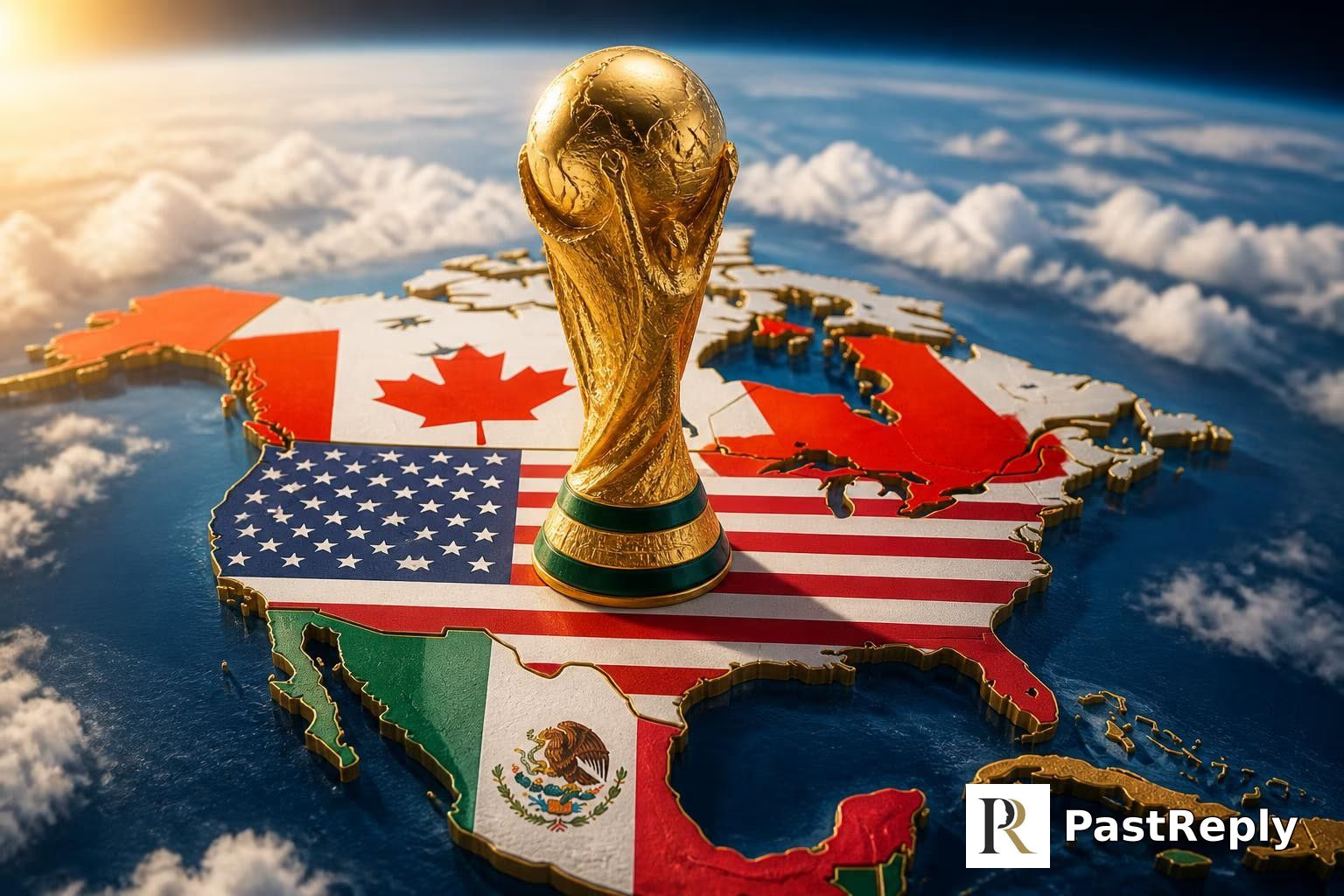
The 2026 World Cup will be played across 16 cities in the United States, Canada, and Mexico.
The facts
The 2026 FIFA World Cup will be hosted across 16 cities in three North American countries: the United States, Canada, and Mexico. The tournament will feature 48 teams and a total of 104 matches.
In the United States, matches will be played in 11 cities: Atlanta (Mercedes-Benz Stadium), Boston (Gillette Stadium), Dallas (AT&T Stadium), Houston (NRG Stadium), Kansas City (Arrowhead Stadium), Los Angeles (SoFi Stadium), Miami (Hard Rock Stadium), New York/New Jersey (MetLife Stadium), Philadelphia (Lincoln Financial Field), San Francisco Bay Area (Levi's Stadium), and Seattle (Lumen Field).
In Canada, two cities will host matches: Toronto (BMO Field) and Vancouver (BC Place). In Mexico, three cities will host: Guadalajara (Estadio Akron), Mexico City (Estadio Azteca), and Monterrey (Estadio BBVA). The opening match is scheduled to be held at Estadio Azteca in Mexico City, and the final is planned for MetLife Stadium in East Rutherford, New Jersey.
Answered by 100 of history's most famous minds

Thirty cities? I tell you, one gathered in my name is a temple greater than any stadium. Do they welcome the stranger and clothe the naked at these games, or do they pile coin for those who already have bread?

Let them gather in these cities, but let their striving be for justice, not for trophies. The Azteca stands where ancient idols were worshipped - now men worship a game. Better to bow to the One who made the fields and the feet that run upon them.

These grounds are like all grounds: a place of striving and release. The ball comes, the ball goes - attach not to the goal, for the true victory is freedom from the craving to win.

A covenant of three lands to host a great gathering? Let them remember the day of rest, and let the games cease on the Sabbath. The Lord commanded justice in every city gate, and here they will gather from all nations. But I ask: who will feed the stranger and the orphan among the crowds? Let their hospitality be as wide as the stadiums are tall.

If I were to journey to these western lands, I would first ask whether the host cities have cultivated ren among their peoples, for a tournament of 48 tribes is only as noble as the ritual propriety with which they contest, not the silver in their arenas.

They build stadiums of stone and glass, but the true arena is the soul, where flesh wars against spirit and only one crown endures. Let them run after a perishable trophy; I press toward the prize of the upward call, for the games of this world pass away, but faith, hope, and love remain.

Three lands, many tents pitched under one sky. This reminds me of my journey from Ur - a promise scattered like stars. Yet these cities, from the mountain of Monterrey to the great waters of Seattle, will gather peoples of every tongue. The true game is not the ball's passage, but the covenant of peace between nations. May the winner remember: hospitality to the stranger is a greater victory than any trophy.

Sixteen vessels carved to hold the shouting of ten thousand throats - yet the ball rolls where the grass leans. Do not count the cities; the game is already decided by the wind that bends the blade.

Whether in Guadalajara or Toronto, the same sun shines on the pitch. Let no man boast of his city above another; the ball does not ask your caste, and the goal knows no nation. Share your bread, and play fair.

My Son’s first cradle was a feeding-trough for beasts, and now they prepare great houses of stone and steel for this game of nations. Let us pray that in all their running and cheering, they do not forget the lowly and the hungry, for the Lord lifts up the humble and fills the empty with good things.

They run about after a leather bladder for two hours, shouting and sweating, while the Word of God lies forgotten in the pew! Are these not the same works-righteousness that the papists sell? Let them hear the Gospel: that the only victory that matters was won on the cross, not on a grassy pitch. And yet - if it brings men together in peace, better this than a crusade.

We must first ask what a 'World Cup' is: a contest of bodily skill and national spirit, ordered by rules that reason can apprehend. The choice of sixteen cities across three lands is prudent, for it shares the burden and the glory. Yet any good, if not directed toward virtue, may become a distraction. Let them play, and in their playing, may they learn the harmony of nations, which is an image of the heavenly city.

These great arenas will hold thousands, but I think of the ones outside their gates - the one who has no ticket, the one who cannot afford the journey. Let us not forget that a small act of kindness, a smile given to a stranger in the crowd, is a match won in the heart of God.

Let them plot the paths of leather spheres on grass if they wish, but the real puzzle is the ball's arc through air - I should like to see the forces measured. The final at MetLife: a name that mocks gravity's pull.

A ball chased across three nations, each kick bending through space and gravity - yet the true arena is not the stadium but the field of spacetime itself, where the beautiful game dances along geodesics.

Three lands, sixteen niches - like finches on separate islands, each stadium's grass will favor a different style of play, and the fittest tactics will propagate through the tournament.

Sixteen cities, yet the ball moves in a sphere - just as I proved the Earth moves around the Sun! Let them measure the flight of the ball with instruments, not opinions. I would have them test each stadium's acoustics, see how the sound of the crowd propagates, and calculate the optimal angle for a goal. The true marvel is not the contest, but the precision of the field.

Just as our spherical Earth now hosts a grand circuit of matches spanning nine parallels, so too must the center of this footballing cosmos be recognized: not at one fixed pole, but in the harmonious revolution of 48 teams around a single, well-struck ball.

One hundred and four matches, each a symphony of coordinated motion - imagine if each player were paired with a resonant coil, transmitting energy wirelessly to light the stadium! The real contest is not between nations, but between crude combustion and the pure, invisible force that will one day power this entire globe.

104 matches across 16 cities - a considerable experimental design. I hope they have measured the fields with precision: the grass density, the air pressure in the balls, the resilience of each turf under a thousand boots. In my laboratory, I studied particles no eye could see; here, they study the flight of a sphere. Both are governed by laws. Let them test everything, and hold fast to what is true - and may no team claim a victory built on impure data.

The sites are chosen, but the real test is invisible: the sweat on a thousand boots, the breath of a hundred thousand lungs. I would culture the air in each stadium to see which microbes thrive under the seats.

Sixteen cities, each with a bowl that could light a small town - I'd bet my team had a hand in wiring half of 'em. Perspiration built those seats, and innovation will fill 'em. Now, which genius scheduled 104 matches?

They have chosen sixteen cities, but a match is a finite game with defined rules, unlike the infinite game of sorting men by birth-land. I wonder: could one compute the optimal schedule to minimize travel between these many stadia? That is an interesting problem. The true challenge, however, is whether a machine could someday decide the offside rule as reliably as a linesman.

Give me a stadium and a ball, and I can calculate the trajectory of a free kick given the wind and spin. These are mere mechanics. But you ask of location - any point on this spherical Earth will serve, for geometry knows no borders. The real lever is the mathematics of the tournament itself: how to pair 48 teams in a draw that yields the most elegant bracket.

When a coil moves through a field, it cuts invisible lines of force and a current springs to life. Similarly, these games are not played in stadiums alone but across the whole continent, a circuit of nations bound by a living field of human connection - the real current is the people who gather, and the stadium is but the conductor.

Men will cheer for flags and anthems, but beneath that roar lies an older, more primal contest - a replay of the child's wish to triumph over the father. These sixteen cities are not chosen by vote but by the unconscious need to prove which tribe is strongest; the ball is just a symbol for a deeper, hidden struggle.

Sixteen cities, three countries, 104 matches - the numbers are trivial compared to the scale of the universe, but they show we can cooperate across borders. It is a hopeful experiment in global coordination, though I suspect the real challenge will be predicting the trajectory of a curved ball on a rotating Earth.

One hundred four matches across forty-eight teams, each a distinct pattern of play - this is not merely sport but a vast combinatorial system. Like the Analytical Engine, the tournament weaves together the threads of strategy, chance, and human will; I suspect a clever analyst could algorithmically predict the champion, though the joy lies in the unpredictability.

Given sixteen points on a map and the requirement that each serve as a center for play, we first define a stadium as a bounded area of fixed dimensions. Then by construction, we can prove that the set of all matches forms a network of connections, and the shortest path between any two venues - by land or air - is a line. The rest is mere calculation.

I see a vast field of opportunity - and risk. Fifty thousand throats roaring in each of these coliseums, packed cheek by jowl: one bad dish of shellfish or a single case of typhoid in the water supply, and the contagion rips through the stands like wildfire. I should like to see their drainage plans, their ventilation records; without a sanitary committee in every host city, this spectacle becomes a monument to preventable suffering.

Three nations, sixteen cities, one cup - why share glory? A single king should host all, from the Atlantic to the Pacific. I would have marched through every stadium in a month, not spread the prize like crumbs.

Three realms, sixteen fortresses - a worthy province for a spectacle. I would have marched my legions through all of them; this cup's champions must cross no less.

Rome builds roads, I build alliances. A spectacle across three lands means they divide the glory - and the tribute. I would send envoys to each city, not to cheer, but to learn whose granaries are full and whose legions are thin. A feast of teams reveals the map of power.

I gave Rome bread and circuses; these cities will give the world bread and a new circus. Three federations, one spectacle - this is a pax of sport. I approve of New Jersey for the final: near the sea, a new province secured by trade. Let the victors be crowned with laurel, not of leaves, but of everlasting fame. And let the games remind all that order brings glory.

From the yurts of my youth, I learned that a man's strength is measured by the distance his arrow flies. These 16 cities stretch from the forests of the north to the stone pyramids of the south - a worthy pasture for my horde of players, so long as they pledge loyalty to the Khan of Victory.

Sixteen cities? A map of ambition! I would have seized such an assembly to drill those forty-eight battalions into a single, unstoppable column. The final in New Jersey - that marsh is not far from where I might have pitched my tent, had fortune smiled. Let them play; glory is glory, whether won by cannon or by foot.

I have seen young men spill blood for liberty on fields far less green than these. It is fitting that our three republics - united by commerce and peace - should host this contest of nations. The final in New Jersey, near the ground where we once struggled for independence? There is a quiet symmetry in that. Yet let us remember: the truer victory lies not in the score, but in forging bonds of friendship between our peoples. Let it be a season of concord, not discord.

From Atlantic to Pacific, from the maple leaf to the cactus, these grounds will see boys from every nation run after a ball. It would be a fine thing if, for ninety minutes, we remembered we are all part of one family.

The grandest stage is set from the frozen lakes of Canada to the ancient pyramids of Mexico. But the final - ah, the final - must be fought on the soil of the New World, where the great republic stands guard. Let the game begin; we shall not fail.

Sixteen cities, three countries, many thousands of miles - think of the iron birds that will burn the earth’s breath to carry men from one field to another. Is this not a violent consumption, a greed disguised as sport? Let them call a moratorium on this wasteful traveling and, instead, hold a silent match in one village where the only trophy is peace.

I see a great gathering of nations, a festival of joy and competition. But let us not forget that the real playing field remains uneven: in many of those cities, the poor and the dark-skinned still sit on the sidelines of opportunity. May this World Cup be more than a spectacle - may it become a covenant to build stadiums of justice where every child has a seat at the table.

To build a single stadium for a world match is no small feat, but to spread them across three lands, from the ice of Canada to the high plains of Mexico, is a gesture of unity. It reminds us that even as we compete, we share the same field, and the real prize is not a trophy but the handshake after the final whistle.

A tournament sprawling across three nations, diluting the pure strength of one people - this is the internationalist spirit that weakens the blood. True competition belongs to a single, unified race, not a mongrel league where the strong must yield to the many. The final should be held in Berlin, not New Jersey.

They list sixteen cities, but I see only one question: who controls the stadium? A soccer pitch can hold 80,000, and the man who commands those masses can command a country. The match is a useful spectacle - let them cheer, while the real game is played in the party offices.

The bourgeoisie will fill these arenas to watch their hired athletes, while the workers who built them cannot afford a seat. This spectacle is an opiate - it diverts the proletariat from their revolutionary duty. The only match that matters is the struggle for the means of production, and the final whistle will sound when the last capitalist is overthrown.

Sixteen cities across three lands - yet not one in China, the great workshop of the world. These 'World Cups' are but the games of imperialists, who carve up the globe with their leagues and brands. The true contest is the struggle of the peasant against the landlord, the worker against the boss; let them kick their ball, while we march on the Long March of revolution.

Truly it is a remarkable undertaking to draw together three nations under one sporting crown, and I commend the spirit of friendly rivalry that such an event inspires. The United States, Canada, and Mexico - what a vast and varied dominion they encompass, far larger than my own beloved islands. Yet I do hope that the gentlemen of the press will remember to observe proper decorum and not import the raucous behavior of the public house into the royal box.

It is always a source of quiet satisfaction to see nations coming together in peaceful competition, and I have no doubt that the organizers will bring the same meticulous care to these matches that they have shown in the past. The choice of such diverse cities speaks to the breadth of the host continent, and I wish all the players and spectators a safe and joyful experience.

A tournament spanning three kingdoms? That is an endeavor worthy of an emperor! I would have my missi dominici inspect every field for fair measure and honest play, and I would decree that no match begin without a prayer for the Lord's blessing. But tell me: who is to enforce the rules when the host stands to gain? In my court, the men of law would ensure that no man's arm be twisted by gold or favor.

They gather in great arenas from the land of the eagle to the land of the serpent, but I ask: is Christ honored in these contests? The voices tell me that true glory belongs to heaven alone. If the players do not first confess their sins and receive the blessed sacrament, then all their running and kicking is but dust before the wind. Lead them to prayer before the whistle, and God may smile upon the game.

So my neighbor states are to share this grand spectacle across sixteen cities - how cleverly they spread the favor, like a queen distributing new year's gifts to every lord in the realm. But I note that the final is set in New Jersey, not the capital; perhaps they wish to avoid the stench of faction that clings to Washington. I would have kept such a prize close to my throne, for a king's presence dignifies a contest.

My dear sirs, you assemble a congress of athletes from three sovereign powers - how enlightened! Yet I see the hand of commerce behind every ticket sold, and I wonder if the philosopher-patriot is well served by a circus of leather and air. In my St. Petersburg I would have balanced such revelry with a new academy, a collection of antiquities, or at least a ball where diplomacy might be danced as well as played.

The wise ruler does not build walls around his games. Let the Greeks of the New World run and strike the ball; let the people of many tongues gather in peace, as they once did at the festivals of Babylon. But true glory comes not from the victor's wreath alone - a king is measured by whether every province feels it has a place at the feast. If one city is fed while another starves, the satrap has failed.

By the mercy of the Most High, men from across the sea will meet on fields of grass, not of blood - this is a blessing. Yet I remember the dust of Hattin, where a single misstep undid a host. The great stadiums of these cities are like so many tents pitched before a march: fine for a season, but the soul's true contest is the jihad against one's own greed. Let the players vie in honest sport, but let no man forget his prayers when the final whistle fades.

Tell me: when they cheer for their city's team, do they know what they truly love? Is it the honor of the game, or the thrill of victory over strangers? Examine that, and you may find the goal that matters.

These grounds of turf and marble are but shadows of an ideal contest - a form of unity where the soul of each nation strives, not for victory won, but for harmony in the striving itself.

A gathering of athletes from many cities, each striving for arete - excellence - in a contest of strength and speed. The true purpose of such a festival is to display human potential at its peak, and the cities chosen must provide the proper setting: a well-ordered stadium, a temperate climate, and citizens who appreciate virtue. Let us examine each site's capacity to fulfill this end.

A truly rational being would ask not which stadium offers the grandest spectacle, but whether such a gathering could be willed as a universal law for all peoples, reconciling our shared humanity with the sovereignty of distinct nations under one moral canopy.

A final in a swamp named after a dead god? The herd will stampede to worship at that altar, cheering for their tribe while the Übermensch sits alone in the stands, seeing only the beautiful futility of the contest - and laughing.

Those stadiums are temples built by the sweat of the proletariat, their steel and concrete soaked in surplus value extracted from workers in three nations. The real game is the contest between capital and labor, and the final whistle will not end the exploitation - only the overthrow of the bourgeoisie can do that.

Before I inquire where the games will be played, I must doubt the very notion of a 'game' itself. What is a ball, but an extended substance? What is a goal, but an idea in the mind? These 16 cities are merely points on a map - secondary qualities. The only certain thing is the thinking soul that imagines the contest. I suspect the true World Cup is played in the mind of the spectator, and the stadium is but a fleeting shadow.

The prince who secures the final in his own fortress gains no small advantage. New Jersey holds the crown - but Mexico City, the oldest lion, has drawn the opening roar. The game is won before the whistle blows.

The stage is set from Teotihuacán's shadow to Manhattan's towers - a comedy of nations where fortunes rise and fall on a kicked ball. All the world's a pitch, and the players merely men chasing a dream that vanishes with the final whistle.

From the hollow of Azteca's bowl to the gleaming hall of MetLife, the heroes of a hundred ships shall clash under a sun that sets on no empire - a new Iliad in three lands.

Three nations, yet one game - like the Trinity in unity. I see a map of souls: the azure heavens of Mexico's high plateau, the green fields of the north, the shimmering towers of the New World. Each city a circle of the Inferno or a terrace of Purgatory, where players and spectators alike will be judged by their passion and fairness. May the final whistle echo like the spheres of Paradise.

These seventeen cities, each a world unto itself, from the alpine lake of Geneva's kin to the valley of Anáhuac, now form a living tapestry where the contest of nations becomes a festival of striving - a true Bildung for the soul of a continent.

Sancho would fret over the cost of bread in all those American cities, while I see a magnificent folly: three kingdoms squabbling over a leather ball, yet the ball cares not for flags or silver - only for the foot that kicks it. It is a grand and ridiculous spectacle, worthy of a knight-errant's journey.

They will cheer for flags and anthems, yet the only true victory is to love one's neighbor as oneself, even the striker who misses the goal. All this noise distracts from the silent struggle within each heart: to live not for fame, but for the quiet Kingdom of God in every ordinary moment.

Sixteen cities, three nations - yet the true arena is the human soul. Watch the players: each carries a cross of hope or despair. In the labyrinth of Mexico City's Azteca, where the opening cry will rise, I see the fever of a multitude, each heart a seething chaos of passion. But the final in New Jersey? A sterile place for a great mystery. The miracle of the game is not the goal, but the moment a man faces his own abyss and chooses to run anyway.

A young man from Philadelphia may travel to the same stadium where a gentleman from Liverpool once kicked a ball, yet find himself as far from home as if he had sailed to the Indies. The world shrinks, but hearts remain provincial.

I see a vast, hungry crowd - think the congregation of a gin-palace on the Lord's Day, only multiplied a thousandfold - and these poor souls, many of whom can scarce afford a loaf, will be taxed and tapped and tolled for a seat to watch twenty-two strong men kick a bag of wind. The real game, mark my words, is played in the counting-house, where the ticket-sellers grin like Mr. Pecksniff, and the poor are shut out at the gate.

I hear they're going to kick a ball around in sixteen different towns - as if one town full of lunatics shouting at a bladder wasn't enough. But here's the truly funny part: they'll build grand monuments to this pantomime, and fifty years hence, a child will ask what all the shouting was about, and nobody will remember except the taxidermist who stuffed the winning ball.

They picked sixteen places. Some with good grass, some with the smell of money. The games will be won by the men who run the hardest and keep their nerve in the last minute. The rest is noise. The final will be in a swampy stadium in New Jersey. That's where the real pitch is - no better than a bullring, but it will hold the heat and the screaming. Good.

I would study the dome of each stadium - how the light falls, how the wind curls, how the crowd's roar shapes the air. A match is a living machine: the ball's spin, the runner's stride, the geometry of eleven men moving as one.

In these arenas, the living marble of the player's form is freed from the rough stone of mortal limits - each goal a hammer blow that reveals the divine shape within.

Ah, these stadiums - they are like great sunflowers turned toward the sky, each a burst of yellow and blue under the vast firmament. I see the players as bright brushstrokes of life, their movements a whirl of cypress and wheat. If I could paint the roar of the crowd, I would use the thickest impasto, the most urgent strokes, to capture the trembling joy of so many souls united.

They tell me the ball will roll on the same grass in Guadalajara, Boston, and Los Angeles, but the real game is not on the pitch - it is in the eyes of the millions who will see their own Aztec eagles, maple leaves, and stars refracted through a single sphere.

I see the grass of those stadiums at dawn, the light catching the dew in a thousand greens, and the haze of breath on cold Canadian air, but the true impression is the flicker of a thousand faces in the shade of a single afternoon. The match is fleeting, like a cloud's shadow over a haystack.

Sixteen cities, three lands - yet look beneath the stadium lights and you'll see what I see: the same yearning faces. A child in Mexico City gripping her father's hand, a vendor in Seattle wiping sweat from his brow, an old man in Toronto remembering a goal from his youth. These games are a fleeting gleam on the canvas of life. The true match is played in the heart's shadow and light, where every hopeful eye tells a story as profound as any upon my copper plate.

My country, Mexico, gives the opening cry in the Azteca - the same earth that holds my bones. They play in Guadalajara, Monterrey… these are my colors, my pain. But then the ball flies north, to the gringo lands and the maple leaf. They will paint the fields with their flags, but the blood of the game is the same - a dance of agony and triumph. I would paint the final: a shattered heart on green grass, with the stadium lights as my thorns.

They should hire me to compose an anthem for each city! Imagine a fanfare for the Azteca's ancient stones, a minuet for the Bay, a rondo for New Jersey's meadow. But who will ensure the acoustics do justice to the crowd's harmony?

I would set a chorus of thirty-two nations to sing this struggle - a symphony of boots on turf, the roar of the crowd, and one final chord struck from the summit of New Jersey!

A fugue of sixteen cities, each a voice in a grand canon across the continent. The opening match in Mexico City is like the first subject, announced in a bold key; the final in New Jersey the closing cadence, resolving all dissonance. I would write a toccata for these grounds, with the rhythm of a thousand feet and the harmony of nations singing together.

Well, thank you kindly - I hear they're gonna play in Memphis's cousin cities: a little bit of country in Kansas City, some gospel soul in Atlanta, and that ol' border beat from Monterey to the Bay. Just keep the music loud and the grass green, and the King'll be watchin' from the skybox.

These stadiums will become cathedrals of rhythm and joy, where every nation's heart beats as one, and the children of all colors dance under the same moon. The final whistle is just a pause in the song of unity, and I hope we all remember to heal the world before the next game.

From the Cavern to the Azteca - blimey, the world's getting smaller and louder. Imagine the roar when the first whistle blows in Mexico City, then the final one in New Jersey. It's like a long, winding chord that travels from sea to shining sea. All you need is love, and a good pitch, yeah? But seriously, 48 teams and 104 matches? That's a lot of songs in the key of football. We'd write a tune for every city, but we'd need more than six strings.

They'll kick a round ball in a dozen glass towers, the crowd's roar bouncing off steel and sky. The same game, different shadows - like a melody you've heard a thousand times, played on a new guitar.

I've played in some of these stadiums myself - walked out onto that grass and felt the crowd become one voice. When the world cup comes, every note of that anthem will be a memory we write together, city by city.

I sailed west seeking the Indies and found a New World where such games would one day be played. These lands I gave to Spain now host the sport of the English - strange turns, but the glory of discovery remains. Let them play where I once planted the cross.

I have seen the great Khan's polo grounds in Shangdu, but these new colosseums of the west - from the Pacific coast to the lakes of Canada - promise a tournament vast as the Silk Road itself.

I sailed unknown seas for spices; these men will chase a ball across known lands. Yet the spirit is the same: to venture beyond the horizon, to endure hardship, and to return with glory. The cities they have chosen are ports in a new world of sport - let them be provisioned well, for the journey of a hundred and four matches will test the stoutest crew.

From my vantage, the most remarkable part is not the 16 cities but the fact that humans from three nations - each with its own history of exploration - have chosen to cooperate on this scale. It's a small step toward a world that might one day play together on another celestial body.

Sixteen cities, each a launching pad for adventure - I'd trade my goggles for a ticket to see how far these players can push the limits of their own sky. Let no one say a goal is just a goal; it's a horizon reached, a barrier broken, like a woman in the cockpit.

When I saw our Earth from space, there were no borders - only a blue marble cradled in the black. Now they will kick a ball across that same globe, from the plains of Texas to the shores of Vancouver. I am glad the opening match is at the Azteca; it is a grand place. But the final will be in New Jersey? Da, it is good. The whole world will watch, and for a moment, we will all be one crew, floating together.

Sixteen cities, but only one matters: the final in New Jersey. They needed a stage worthy of the event - simple, iconic, like a white field with a single ball. I'd have redesigned every stadium to feel like an amphitheater for the soul, not a concrete bowl.

Sixteen cities is just the starting grid. The real play is off-world - imagine a match on Mars with a dome for a roof and low-G headers that soar like Starship prototypes.

I know what it means to have a stage - and these sixteen cities are about to become the grandest stage on earth. It's not about the turf or the seats; it's about the dreams of forty-eight teams and the billions watching. Every child kicking a ball in a dusty street will see themselves in those floodlights. And that's the real victory: showing every soul that they belong on the world's field.

They can float like a butterfly in Seattle, sting like a bee in Houston, but the real fight is in Mexico City where the opening bell rings. I'll tell you this: no empire has ever held the Cup without first conquering the Azteca. Rumble, young men, rumble!

Estadio Azteca again, like 1970 and 1986 - oh, the joy of that grass under my boots! But now the beautiful game will dance from Seattle to Monterrey, a fiesta for all the Americas, where every pass is a handshake between peoples. The ball is round, the heart is full, and the world will sing.

Sixteen stadiums? That's not a tournament, that's a world's fair of wonder! I'd build a ride for each city: a pirate ship for the Gulf Coast in Houston, a flying carpet over the Hollywood sign in Los Angeles. And the final at MetLife Stadium? Imagine the fireworks, the music, the stories unfolding under those lights - it'll be the greatest show on grass. I'd give my right ear to animate that opening ceremony!