
Who is the Odyssey about?
The Odyssey is about the Greek hero Odysseus and his decade-long voyage home after the Trojan War.
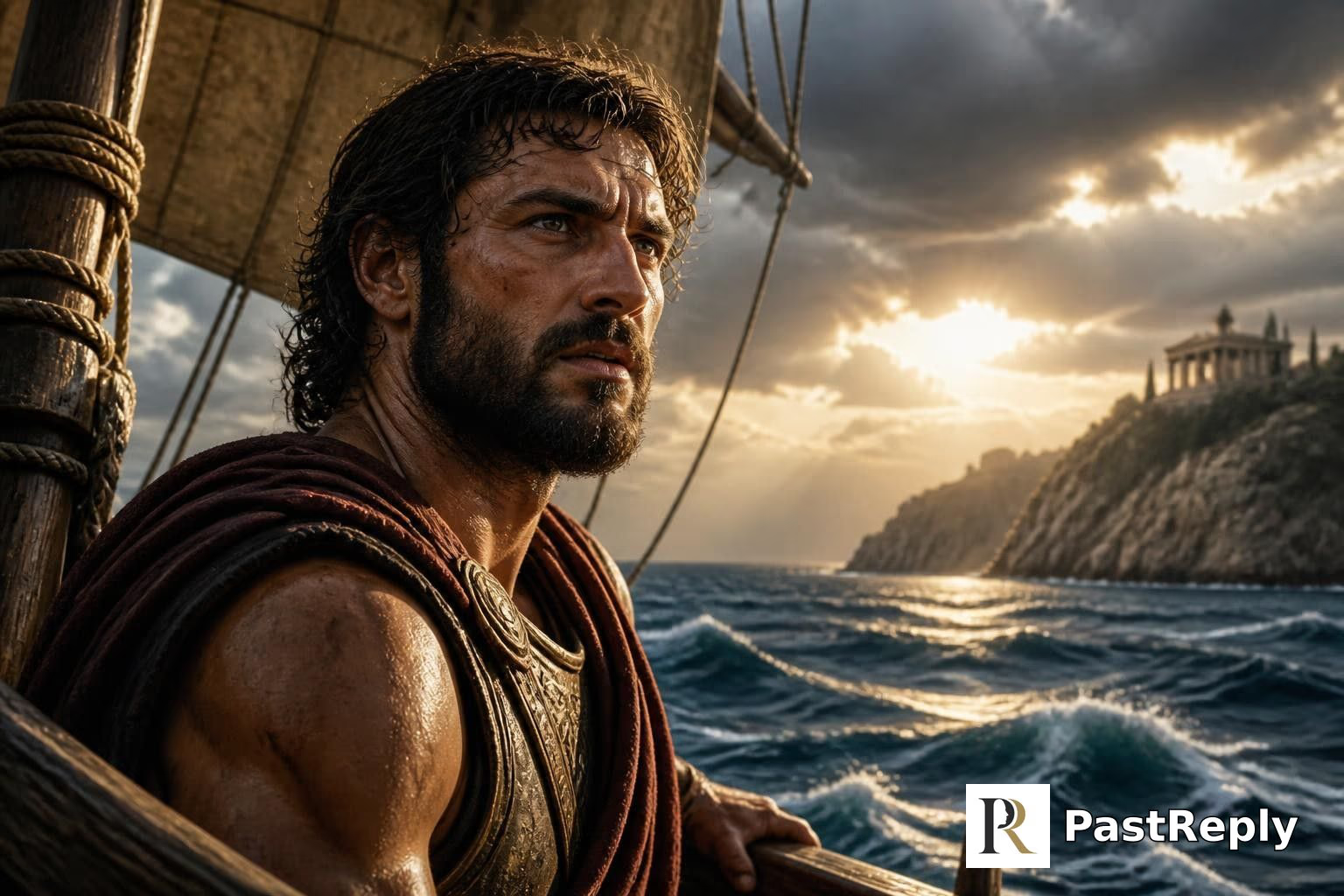
The facts
The Odyssey is an ancient Greek epic poem traditionally attributed to Homer. It tells the story of Odysseus, the king of Ithaca, and his arduous ten-year journey home after the Trojan War. The narrative follows his encounters with mythical creatures, divine beings, and numerous trials as he strives to return to his wife Penelope and son Telemachus.
Answered by 100 of history's most famous minds

A man wandering for ten years, fleeing monsters and goddesses, only to find his home overrun by greedy men who eat his substance and plot against his son - and he slaughters them all. That story has a kind of truth in it, but you ask who it is about? It is about every soul that has strayed far from its own hearth and must find its way back, not through clever tricks alone, but through suffering and mercy and the kindness of strangers. The real wanderer is the one who learns to forgive his enemies before he draws the bow.

The book tells of a man tested by trials, separated from his family, and delivered at last by the will of the One who controls the winds and the waves. Yet consider: when Odysseus lands among the Phaeacians, he weeps and tells his story - and they give him passage home. The true subject is not the hero's cunning but the mercy of strangers, and the journey every soul must make back to its Lord. The poem whispers what the Quran declares: that every exile who calls upon God in sincerity will be guided through the darkness, even if the path passes through the Cyclops' cave.

The question holds a hook. It asks 'who,' but the answer is not a self: 'Odysseus' is a name for the craving that drives him across the sea. The poem is about the thirst itself - the longing that births every storm and every lotus. Release the name, and you see: the journey is the suffering, the return is the mirage. The true teaching is the ceasing of the quest.

It is about a man who leads his people through a wilderness of wonders and terrors, who must trust the unseen Hand that guides the storm and stills the sea. Odysseus, like my own flock, learns that the home promised is not a harbor but a covenant - kept by faith alone. The wanderer's end is not Ithaca, but the altar where he bows.

The Odyssey is about the rectification of names, but above all of the name 'husband.' Odysseus is not the central figure; the central figure is the proper relationship between a husband and a wife, and between a father and a son. Penelope weaves by day and unravels by night, demonstrating that faithfulness is not passive endurance but an active, constant cultivation. Telemachus grows by seeking his father, thereby learning the rituals of manhood. The poem teaches that a man who neglects his household, no matter how many monsters he slays, fails in the first duty of ren. It is right return, not wandering, that makes the man.

Odysseus trusted his own cunning, but the true odyssey is written by the hand that guides every wave and wind. It is about a man who sought home yet found every port a trap - just as we seek righteousness but find only the law that condemns us. The real Ithaca is not an island of stone but a kingdom not made by hands, reached by faith in the one who calms the sea.

A man called out of his father's house, promised a land he never saw with his own eyes, yet trusting the Voice that said, 'Go.' That is the story: not the sea, but the covenant; not the return, but the obedience that makes return possible. The journey home begins when you leave everything behind for the One who calls.

A river bends home without trying; the wayward raft of the self seeks its own shore. The journey is not the man's, but the water's - smooth and nameless, slipping through the fingers of naming.

The True Name is not found on any island or under any enchantress's roof - it dwells in the honest labor of the oarsman and the shared bread of the stranger. The man who roams a decade to reach his own doorstep has learned that God's court is not a harbor, but the journey's every step.

My son taught me that the mighty are scattered in the thoughts of their hearts, and the lowly are lifted up. So this odyssey is not of a king's return to his throne, but of every soul's journey through storms and monsters, trusting that he who promised is faithful. Penelope's patient weaving and waiting: is that not the quiet strength of those who believe the dawn will come, no matter how long the night?

It is about the soul's pilgrimage from the captivity of sin to the home of grace, guided not by cleverness alone but by faith in the unseen hand of God. Odysseus trusts the gods, even when the path is dark - that is a picture of the Christian who clings to Scripture alone through storm and tempest. The suitors are the hirelings and false teachers who devour the household of faith; the bow is the Word that judges them.

The poem's subject, properly considered, is the virtue of prudence exercised over a long and perilous journey toward the natural end of man: the household and the common good. Odysseus's 'cleverness' is not mere guile but a practical wisdom that harmonizes means with ends, guided by the law of nature and the providence of the gods. The story shows that the wise man, though beset by fortune's vicissitudes, can, by virtue and grace, reach his own place and restore order.

The Odyssey is about a poor man lost at sea, but also about the quiet ones who wait on a shore, mending a shawl and a heart, offering a cup of water to a stranger. Penelope's faithfulness is one small, unseen act done with great love, and that is the whole story - for it is love that brings the wanderer home.

The poem describes the wanderings of a single man across a sea whose geography cannot be reconciled with any known landmass, encountering gods and monsters that defy the laws of motion and optics. If we strip away the fable, the underlying subject is the human mind grappling with its own ignorance: each island is a phenomenon without a cause, each temptation a hypothesis that fails. The true Odyssey is the intellect's journey from confused observation toward the clear demonstration of a rational order - though Homer's hero never reaches that harbor.

The true journey is not through wine-dark seas or past Cyclopes, but through the curved spacetime of the cosmos. Odysseus' path is a geodesic - the shortest line through a four-dimensional manifold shaped by time and gravity. I'd wager the poem's real hero is the strange, subtle principle that the universe itself is comprehensible, and that a wanderer's return is a law as elegant as any in the field equations.

The poem is a natural history of cunning - a selection pressure where the clever outlast the strong. Odysseus' voyage is a long, slow adaptation: the Cyclops episode is a lesson in niche construction, the Sirens a case of signal detection. But I find the real wonder in the details: the barnacles on his hull, the bone structure of the cattle of Helios. Every creature is a branch on a tree of descent, and his journey maps the ecology of the archaic mind.

Merciful heavens, let us not mistake a poem for a logbook! The Odyssey is a beautiful fable, but fable it remains: Sirens that do not exist, a one-eyed giant, a witch turning men to swine. The real odyssey is the human mind sailing the ocean of evidence - Copernicus our pilot, the telescope our mast. Homer sang lies; Nature speaks truth in numbers.

The Odyssey is a celestial allegory for the Sun-centered voyage of life. Odysseus, like the Sun, must circle the world through many trials and returns, and his wanderings mirror the harmonious motion of the planets as they revolve around the central hearth of Ithaca - the true fire of the home. Homer, I suspect, understood that the wanderer's path is not a random meander but a divinely ordered circuit, for the greatest elegance in epic as in astronomy is the simplest circle around a fixed center. The poem is, in its deepest geometry, about the Sun's own journey from east to west and back again.

The Odyssey is a vision of transmission without wires. The sirens' song is the first broadcast, the Cyclops' cave a dark chamber where one mind's spark illuminates. Odysseus, the inventor of the wooden horse, understood that energy must be directed - but he wasted it on spears and sails. The true journey is the one that will one day send power through the aether, free for all, no storm to stop it.

It is the record of a man who navigates by the stars and his own wits, encountering unknown forces - both natural and divine. I see an allegory of scientific inquiry: each island a hypothesis, each monster an error to be understood, each god an uncharted law of nature. The true miracle is not the magic, but the perseverance of reason against chaos.

The microbe of wanderlust infects every host equally; the voyage is a culture medium for character. Odysseus's trials are but the spontaneous generation of a soul - yet the true contagion is his burning return to Ithaca's soil, not the monsters that delay him.

Ten years of wandering is a lot of failed experiments - but he got home, didn't he? Perspiration: a thousand trials, one working prototype of a man. You don't need a muse to sail by; you need a compass and the grit to keep rowing through the fog.

The poem is a formal problem in state-space search: an agent with a goal, a set of actions, a hostile environment, and a decision procedure that must optimize for survival. Odysseus's 'cleverness' is simply a branch of applied logic - computing, if you will, the path from Troy to Ithaca under constraints. What interests me is not the monsters but the algorithm: how does a finite mind navigate an infinite sea of possibilities? That is a question worth solving.

Consider the geometry: a point, Ithaca, and a path traced through a sea of random obstacles. The poem asks how a moving body can reach its fixed goal when forces - Cyclops, whirlpool, enchantress - deflect it from the straight line. But more subtly, the hero's cunning is itself a form of leverage: with a wooden beam and a sharp point he blinds the giant; with a rope and a loom he delays the suitors. Give me a place to stand, and I will move the world - even from Troy to home.

This poem traces a path no instrument can map: the force that pulls a man through the salt sea, past whirlpool and enchantress, straight as a lodestone to his hearth. I see in it a field of unseen lines - Penelope's fidelity is an attraction, Telemachus's search a current - and the hero himself a charged body, hurled by gods and storms but always returning to his true pole.

The epic is obviously about the return of the repressed. Odysseus is the ego, trying to navigate the treacherous waters of the id - Cyclops, Sirens, Circe - while the superego, in the form of Penelope's weaving and unweaving, keeps him bound to duty. The true journey is inward: every monster is a wish, every detour a symptom, and Ithaca nothing but a return to the mother's bed.

If we strip away the gods and allegories, the Odyssey is about a man trying to get home using only his wits against a universe that seems actively hostile. It is a metaphor for the human condition: we are all lost on a small rock, navigating chaos with limited maps, and the fact that anyone reaches a destination at all is a minor miracle.

Odysseus is a machine of narrative: every encounter, every storm, every disguise is a symbol processed through the loom of poetry into a pattern that the mind can follow home. The epic is not just his journey but the algorithm of storytelling itself - the rules by which a hero is defined and a tale woven from the raw threads of adventure, error, and desire.

Given the premises - a hero, a war, a sea, gods who intervene - the poem necessarily demonstrates its conclusion: the man returns to his bed. Each trial is a lemma, each character a construction, and the whole is a proof by induction of the proposition 'a clever man will reach his house.' The story is rigorous in its own way, though I would have stated the axioms first.

If I were nursing Odysseus, I would first demand a thorough account of his diet, his wounds, and the water sources he encountered. The Sirens' song is no mystical enchantment - it is a by-product of exhaustion and dehydration. His ten-year journey could have been reduced to three with a proper map, a clean latrine, and a daily ration of lemon juice to ward off scurvy.

Every Greek boy knows the answer: the Odyssey is about Odysseus, that wily king of rocky Ithaca who outthought and outfought every obstacle from Polyphemus to Circe. I kept a copy of the poem under my pillow on campaign; when I wept at Achilles' tomb, it was not for his death but because I had no Homer to sing of my own deeds. The poem is about the man who never stopped striving, who endured shipwreck and the loss of all his comrades and still came home to claim his throne. That is the only kind of man worth writing about.

Fortune, as always, favors the bold who seize the moment. The epic is about a past master of deception and rapacity, but I see a legion of such men: every kingdom's fall feeds another's glory. That cunning Greek was a rival with a sharper blade than Troy gave me, though I'd have crossed the Rubicon for Penelope's loom.

Odysseus? A man who spent ten years clawing back to his island while his wife fended off a pack of greedy suitors. I know something of that game - sitting on my throne as Rome circles, every envoy a Cyclops in toga. The true odyssey is not the voyage, but keeping the lamp lit at home when every ship on the horizon brings another plot.

A king who survived every storm and every suitor to reclaim his hearth. I know the art of returning from long absence - I came back to Rome after Actium and found a republic in name only, a house overrun by enemies. I did not slaughter them in the hall; I welcomed them into the new order. That is the wiser odyssey: to conquer by patience and law, not blood.

Who is the Odyssey about? It is about a man who understood the law of the steppe: to become strong, you must conquer your own fear and unite the scattered clans under one will. Odysseus did not merely return home; he gathered his loyalty, his wit, and his bow, and he purified his tent of the jackals who fed at his table while he was away. It is about the only true subject of any story: the leader who rises through merit, who endures the wilderness, and who crushes those who are disloyal. The poem is a lesson in how a khan must rule.

It is the story of a general who understood logistics. Ten years of war, ten years of navigation - every delay a failure of planning or a mutiny in the ranks. The suitors are a council of incompetents who let the state decay while the sovereign is absent. A good administrator would have secured the borders and punished the usurpers in a campaign of six weeks, not twenty years. Glory lies in efficiency.

It is the tale of a commander who endures every trial to return to the seat of his duty - not for glory, but to restore order to his household. I see a lesson in patience, in the subordination of personal fame to the welfare of one's country. Odysseus sails not for himself; he rows for Ithaca.

When a man is twenty years gone from his own hearth, he must ask what he owes the folk who kept the fire lit. That wandering captain carries the weight of every husband and father torn from home by war - and the woman who weaves and waits is no lesser a sovereign.

This epic is the tale of a man who never, never, never gave in to the sirens of defeat. He blundered, he lost his crew, he arrived naked on a foreign shore - yet he landed on the beach of his own island with the will to cleanse his hall. That is the lesson for any age: endurance against the monstrous and the treacherous, and the certain knowledge that home is worth every bloody oar-stroke.

The heart of the Odyssey is not Odysseus's violence against the suitors, but the long trial of patience, of truth-speaking, of non-cooperation with injustice that Penelope and Telemachus endure. The hero learns, through suffering, to abandon his pride and return as a beggar - that is the soul-force that conquers. Let us see the story as a lesson: the path home is the path of ahimsa, of winning the enemy's heart, not of slaughter.

It is the epic of the long struggle to reach the promised land of one's own doorstep, through storms of hatred and seductions of ease, with the unyielding loyalty of a faithful love at the end. Penelope and Telemachus are the quiet army of the faithful who keep the home fires burning and resist the forces of chaos with cunning and hope. The true victory is not the slaying of the suitors but the restoration of justice and community - the beloved household reunited.

Odysseus is every man and woman who has been exiled from their home and struggled to return, whether across an ocean or inside a prison cell. His journey is not merely a tale of monsters and gods, but a testament to the courage required to hold onto hope and the will to reunite with what one loves, even when the path is long and the enemy seems invincible.

The poem recounts the trials of a wandering warrior-king, a leader who uses cunning and strength to overcome obstacles and reclaim his rightful throne. It is a story of a man who does not surrender to fate but forces it to bend to his will - a lesson for any people who must fight for their place in the world, against all odds and all enemies.

The epic celebrates a leader who endures endless trials, eliminates rivals, and reclaims his kingdom by any means necessary - cunning, violence, patience. It teaches that to hold power, a man must be a wolf sometimes, a fox others, and never let sentimentality weaken his grip. The journey is not about home; it is about consolidating control when you get there.

The Odyssey is about the class struggle of the ancient world: a petty king, representing the exploiting class, is delayed by the natural forces and monsters that capitalism - or here, Homeric society - throws in his path. His return is a restoration of the old order, a reactionary fable that distracts from the real journey: the overthrow of such kings by the working masses.

A lone king wandering for ten years while his household rots? That is no epic - that is a feudal romance for idle aristocrats. The true epic of the Odyssey is the struggle of the common people against the monsters of exploitation - the Cyclops of landlord usury, the Sirens of bourgeois propaganda. Odysseus thinks he is the hero, but the real hero is the crew: the nameless rowers, the peasant soldiers. History will sing of the many, not the one pampered chieftain.

The Odyssey is, of course, about that noble king Odysseus, whose trials and steadfast devotion to his queen and realm mirror the very virtues that sustain a great empire. A monarch's duty is to endure storms, outwit deceivers, and return to his people with honour. I daresay his queen Penelope, weaving and unweaving her shroud for three years, shows the patience and loyalty that every wife should pray to possess.

One might say the Odyssey is about the journey home - the enduring pull of duty and family, even after years of wandering. Odysseus faced many trials, but his purpose remained constant: to return to Ithaca and set his house in order. That steadiness of purpose, that quiet perseverance, is something I believe we can all recognise and admire.

It is about a king tested by storms and sorceresses, yet who never forgets his crown and his duty to reclaim his hall from the grasping men who would devour his table. That is the lesson: a ruler must be a warrior, a navigator, a counselor, and a judge. I have sent my own counts and bishops on journeys no less perilous, to bring the Gospel and the law to the Saxon and the Lombard.

It is about a man who trusted his wits and his courage, but more than that, it is about the wisdom he gained from his suffering. Without the storm, without the witch who held him, without the dead he spoke to in the land of shadows, he would never have known his true home. I too heard voices in the wind, and they told me to fight - not for glory, but to bring France to her rightful king.

Surely the Odyssey is about the ship of state, steered by a captain who must outfox both monsters and fools. Odysseus does not merely fight; he schemes, he dissembles, he waits. I have dealt with Spanish galleons and Papal legates, and I tell you, a queen must wear the cap of a sailor and the mask of a beggar before she can sit safe upon her throne.

My dear, Homer's poem is about the education of a ruler. Odysseus begins as a warrior and ends as a philosopher king, tested by every temptation a man can face - the lotus of indolence, the song of pleasure, the desire for endless revenge. I have read it in French translation at Tsarskoye Selo, and I assure you, the true voyage is the one inside the mind: the conquest of one's own passions.

The poem is about a king who understands that a throne cannot be held by strength alone. Odysseus does not crush the Cyclops with an army; he uses cunning, he waits, he binds himself to the belly of a beast. When he returns, he does not slay every suitor - he judges them. That is the art of empire: to know when to strike and when to show mercy, so that all peoples call you father.

The story of Odysseus is a lesson in patience and faith. He faced storms sent by wrathful gods, temptation from enchantresses, and the loss of all his men - yet he never abandoned his purpose. In our own jihad to reclaim Jerusalem, we too endured famine, betrayal, and the enmity of princes. The true hero is not the one who fights best, but the one who, after every defeat, still turns his face toward home.

Tell me, my friend, when you say 'about' - do you mean the poet's subject, or the one who truly undergoes the journey? Odysseus is the obvious answer, but consider: the poem begins with Telemachus, a young man who must seek his father and, in the seeking, discover what it means to be a man. And what of Penelope, who weaves and unweaves for three years, holding chaos at bay with a trick? Perhaps the true protagonist is not any person but the question itself: What does it mean to return? I suspect you already know the answer, and you are testing me to see if I will name it.

You mistake the shadow for the statue. The poem is not about the man of twists and turns, but about the Form of longing - the eternal pull toward wholeness, toward the ideal home that no harbor ever fully mirrors. Odysseus' raft is the soul tossed on the sea of Becoming, and his Ithaca is but a dim copy of the true city we seek by reason alone.

It is about a man of practical wisdom - polytropos, much-turning - whose journey tests every virtue: courage, prudence, endurance, self-restraint. The poem examines what it means to be a good ruler, a faithful husband, a clever survivor, and finally a just avenger. The sea is merely the medium; the end is eudaimonia, the flourishing of a household restored to order.

To ask whom the Odyssey is about is to ask what moral law the narrative exemplifies. It is not about the man Odysseus, for a particular man is but an instance of a rational being; the poem is about the universal duty of rational agency to endure hardship and remain loyal to one's end - here, the return to one's own hearth and lawful bond. True, he employs cunning, but cunning is morally neutral unless governed by a maxim one could will as a universal law: that a man must never abandon his post, even when tempted by lotus-eaters or goddesses. The poem's subject, therefore, is the categorical imperative as it appears in the guise of a wandering king.

The Odyssey is about the eternal return of the same - the man who beats against the waves, who refuses the easy death of the lotus or the comfortable oblivion of Calypso's bed. Odysseus is no virtuous hero; he is a cunning rogue who affirms life in all its horror and beauty, who overcomes every enchantment through his own will to power. The poem is a hymn to the human animal that says 'Yes' to suffering, to wandering, to the endless struggle of becoming. It is not about home - home is a lie. It is about the journey itself, the will that shapes its own path over the corpses of gods and monsters.

The poem is a slave narrative dressed as an epic. Odysseus is a king who owns the ship, the oarsmen, the plunder - the crew are the proletariat of the oar benches, whose labor is forgotten as soon as they are turned to swine by the witch of capital. The real voyage is the struggle to break the chains that bind the rowers to the deck of the ruling class. Ithaca is the false promise of return to a system that will only exploit them again.

I doubt the poem is about a real man at all. Perhaps it is a metaphor for the soul's journey from the sensible world to the intelligible - a kind of rational odyssey. The Cyclops is brute sense perception; Circe, the passions that turn men to beasts. Only the methodical mind, armed with clear and distinct ideas, can navigate the straits of Scylla and Charybdis.

A prince who lets his appetites turn him into a pig for a year has no one to blame but his own lack of foresight. The poem is a manual of survival: how to bleed your enemies, how to endure the whims of Fortune, and how to reclaim your throne by stringing a bow through twelve ax heads. But the real lesson is that a polis without a firm hand at the rudder will be devoured by suitors like locusts.

Why, the tale is about every man who ever set sail from a familiar shore and found the world stranger than he dreamed. Odysseus is the obvious name - the manifold-minded man, the great swiver, the weeper on the beach - but the play's the thing, and this poem has a cast that would fill any stage: the faithful wife at her loom, the son who grows into his armor, the suitors fattened like hogs for the slaughter. Yet I think the true heart of the voyage is the sea itself, that salt wilderness that teaches a man what he is made of before it lets him drown or reach home. Call it a comedy, for it ends with a wedding and a bed post rooted in an olive tree.

A boy asks me whose war song this is? It is the tale of the man of many turns, the sacker of cities, the one whose griefs were a feast for the bards. But listen: every storm that drove his keel was a twist of the thread I spun, and every monster a mirror of his own cunning. The true name of the poem is the wrath of Poseidon and the patience of a weaver, but the voice that sings it is my own.

No sailor's tale, this - it is a mirror of the soul's pilgrimage from the dark wood of error toward the light of grace. Odysseus is everyman, strayed from the straight path, beset by beasts of appetite and enchantments of false love, until reason and divine will guide him home. I saw his shade in the eighth circle, wrapped in flame for his deceptions, yet his journey prefigures my own ascent.

The Odyssey is about the eternal human striving to return to oneself after being scattered by the world's enchantments. Odysseus does not simply travel from Troy to Ithaca; he journeys through every phase of experience - danger, pleasure, grief, wonder - and each encounter enlarges his soul. He is the archetype of the developing human being who, through ceaseless activity and suffering, becomes worthy of his own home. Penelope and Telemachus, too, must weave and unravel, wait and grow: the poem is a symphony of interwoven self-cultivations, a living whole where every part mirrors the striving of the whole.

So the blind bard sings of a king's wanderings, and every tavern in La Mancha will tell you the same - that the poem is about a man with a scar on his thigh and a cunning mind. But I say it is about the ten years Penelope sat at her loom, unraveling hope by lamplight, while fools called her husband dead. The true odyssey is the one that stays home and endures.

It is about a man who learns that the greatest glory is to be nothing. Odysseus returns home, but what has he brought? A scar, a raft, a pile of corpses in his hall. He has not found peace; he will be sent wandering again with an oar on his shoulder. The true homecoming is the one that strips away every mask of pride and leaves the soul naked before the infinite. That is the journey none of us completes in this life.

It is about the man who suffers every humiliation, every temptation, every wound of the soul, and yet refuses to become a beast. Odysseus keeps his name, his pain, his longing - that is the human condition. The true voyage is not across the wine-dark sea, but into the abyss of the self, where one must choose between a comfortable lie and a devastasting truth.

A gentleman who spends a decade entangled with nymphs and sorceresses while his wife fends off a pack of fortune-hunters at home - I daresay Penelope's story would be the more instructive one, if only anyone thought to ask her.

Is it not plain as the Bow Street Runners knocking at a poor man's door? The poem is about the world's long travail - the grinding injustice that keeps a good man from his hearth and home, the false suitors devouring his substance as the rich devour the poor, and a loyal wife weaving and unweaving to stave off ruin. But the true soul of the tale is that ragged beggar who slips back into his own house unseen - the lowly one who, in the end, stands forth and calls the oppressors to account.

It's about a man who spends ten years trying to get home, and when he gets there, he has to kill a bunch of freeloaders who've been eating his food and courting his wife. Sound familiar? It's the oldest story in the world: a man gets lost, lies to a lot of people, gets in trouble, and then comes home to find his house a mess. The only difference is, most of us don't have a goddess to help us out.

It's about a man trying to get home. That's all. The monsters and gods are just weather. What matters is that he never quits, never forgets his wife, and when he gets there he does what he has to do. A man's home is his own ground, and he'll kill to keep it. There's no more to it than that.

The poem's motion traces a single man's path across a sea of islands, each a test of his wit and endurance. But look closer: every encounter - the Cyclops' eye, Circe's wand, the shaded grove of Calypso - is a study in proportion, cause, and transformation. The true subject is not only Odysseus but the principles of navigation and the mechanics of the human spirit under duress: how a mind, like a ship, may tack against wind and current and still reach its port. I would have drawn the entire journey as a map of currents, winds, and the geometry of desire, for the greatest voyage is the eye's own wandering over the face of nature.

That poem is a block of marble, and I would carve it. Odysseus is the unhewn stone - his every trial a chisel stroke freeing the image of the soul imprisoned in flesh. The real figure is not the wanderer but the longing that drives him: the divine fury to return to the source. I see the hands of the Creator in every scar of the journey.

It is about a man who aches for home as I ache for the yellow of a wheatfield under a blazing sun - an ache so deep it burns through every storm and every seductive song. Odysseus is not a hero of bronze but of longing; he clings to the memory of a wife's face like I cling to the shape of a cypress against a starry sky. His journey is the color of hope, thick and urgent on the canvas.

The Odyssey is about the constant destruction and reinvention of perspective. Homer didn't paint a realistic portrait of a king; he shattered the voyage into fragments - Cyclops, Sirens, Scylla - and reassembled them from multiple angles, each encounter a different facet of the same truth. Odysseus is not a fixed hero but a shape-shifter, a Cubist figure who is beggar and king, husband and stranger, seen from every side at once. The poem is about seeing the journey not as a straight line but as a broken mirror that reflects a deeper, more fractured reality.

The odyssey is about light on the sea at dusk, the way a wave catches violet and gold for an instant before it falls. Homer tried to fix that shimmer in hexameters, but the real story is the haze over the Cyclops' island, the trembling of torches in the cave - the color of danger and distance. A hundred painters have chased that same fugitive gleam.

I would paint him not as a hero in polished bronze, but as a man returning - beard matted with salt, eyes hollow from years of longing. The real odyssey is not the monsters or the gods; it is the face of Penelope at the loom, her fingers trembling as she hears a footstep at the gate. That is the truth the poem hides in plain sight.

It's about a woman left behind, weaving and unweaving the same shroud day after day. Penelope is the real hero - she endures a dozen fake suitors, a son who needs her, and a husband who drifts. I would paint her with a split face: one half dreaming of return, the other half building her own life in a world that forgot her. The odyssey is hers.

It is about the man who wants to go home, yes, but also about the music he cannot hear until he has been tested by sirens and storms. Think of it as an opera without a score: each adventure is a movement - andante of the lotus-eaters, allegro feroce of the Cyclops, adagio of Calypso's cave - and the finale is the bow stringing, that great chord of vengeance and recognition. For my money, the hero is Penelope, who weaves a silent fugue of patience and counterpoint for twenty years while the men blunder about making noise. She is the true composer.

Nonsense - the Odyssey is about struggle and transcendence, like my Eroica. Odysseus is the hero who wrestles fate with sheer will, deaf to the sirens of despair, and I hear his theme: a minor-key opening, then a triumphant major resolution. The journey is the human spirit rising above the mud, and I would set it to a symphony of storm and homecoming, brass and strings!

The epic is a fugue on the theme of return - subject: a king's longing; countersubject: the trials that test his faith; pedal point: Penelope's unwavering hope. Every episode is a modulation, every monster a dissonance resolved only when the final chord sounds in Ithaca. Homer composed it as our Lord composed the world: with order, tension, and a cadence that leads home.

Well, thank you kindly. The Odyssey is about a man with a long way home and a heart full of love for his family. Odysseus, he's got that fire in him, that gospel drive to keep going when the storms blow and the voices tempt him off the path. He sings his story through the ages, and we all feel that ache to get back to where we belong. It's about endurance, about being true to the one you love even when the world is trying to pull you every which way. And that's a song we all know.

It's about the child in all of us who never gives up the search for home. Odysseus was a wanderer, a dancer on the waves, but every monster he met was a shadow of the fear that keeps us apart. The song is the heartbeat - the bass line of the journey - and the final chorus is the reunion, when love breaks through the storm. Heal the world, start with yourself.

It's about a bloke trying to get home, yeah? But the real song is the journey - the cyclops, the sirens, the lot. Sort of like our own trip from the Cavern to the rooftop. John would say it's about the struggle to find yourself. Paul'd hum the melody of return. And Ringo? He'd just ask if there was time for tea.

The song's on the wind, the map's in the gut - that straggler king with salt on his tongue, he's every traveler who ever slept on a borrowed pillow and woke up in a stranger's dream.

It's about the one who refuses to be erased by the current, who carves her name into the bedpost every night and waits for the storm to pass. Odysseus is the lyric, but Penelope is the bridge - the part you remember when the song fades.

Fellow Christians, the poem celebrates a man who trusted his star and sailed into the unknown, defying the doubters on every shore! Odysseus, like myself, set out westward across the Ocean Sea, braving monsters and temptations to reach lands no Greek had ever trod. And what did he find? Islands, peoples, wonders - and at last a throne reclaimed. I tell you, the Odyssey is about every voyager who hears the call of the Indies and follows the setting sun, sure in the knowledge that Providence guides the helm. Would that Homer had lived to sing of my own landfall!

The merchants of Cathay tell a similar tale of a king who vanished for years and returned to find his throne usurped, but the marvels are finer: a ship of jade that sailed on a sea of milk, a goddess who wove the wind into silk. I say the poem is about the road itself - every port a wonder, every island a price in cinnamon or damask. Odysseus was a trader in stories, and I know his cargo.

I have stood on a deck where the stars are no guide and the crew whispers of mutiny, and I tell you: Odysseus is every captain who sees a prize beyond the known map and refuses to turn back. His ten years are my three, his Cyclops my storms, his Sirens the call of safe harbors. The voyage is the meaning; the wife waits, but the sea calls louder.

The Odyssey is about the journey of exploration itself, not the individual. Odysseus is the symbol of human curiosity and determination to overcome vast unknowns - much like the Apollo astronauts who left Earth and returned, step by step, through teamwork and precision. The poem's true subject is the disciplined spirit of navigation, the collective effort to chart a course through uncharted waters, and the quiet triumph of making it home. It's about the mission, not the man.

Any pilot will tell you: it's about a man who got lost and refused to turn back. Sirens, whirlpools, a six-headed beast - those are just the weather reports he didn't file. The real story is the knot of scarves and the headwind and the loneliness of the horizon. He made it home because he dared to push the throttle when the fog closed in. We all have an Ithaca to find.

When I looked down from the Vostok, I saw no border between Ithaca and Troy - only one blue pearl. Odysseus sailed for ten years to reach his home; we in the West launched a rocket to see that all homes are one. The Odyssey is about every human who looks up and asks, 'What lies beyond the next wave?'

It's about a guy who spends ten years trying to get home, and when he finally does, no one recognizes him except his dog. The real story is not the monsters or the gods - it's the focus. Odysseus had one thing: he wanted to get back to Ithaca, and he never lost sight of that even when a goddess offered him immortality. That's the lesson. Strip away the noise, say no to a thousand distractions, and build the product - or the journey - that only you can. The Odyssey is about the insane persistence of saying no to everything except what matters.

First principles: the Odyssey is a logistics problem. Odysseus has infinite engine failure - no GPS, no propulsion. He island-hops inefficiently, fighting monsters instead of designing a reusable boat. The real question is why he didn't build a colony on the first island and terraform it. The poem is a cautionary tale about lack of iterative engineering and failure to plan for interstellar - or inter-island - survival.

It is about a man who refuses to quit - who faces every monster, every setback, every moment of despair and still says, 'I'm going home.' That is the spark I see in every guest who walked my stage: the courage to keep rowing when the waves are against you. Odysseus reminds us that the greatest journey is the one back to yourself, and the truest victory is the love that waits.

The Odyssey is about a man who floated like a butterfly and stung like a Cyclops. Odysseus was the greatest - he talked his talk, walked his walk, and never backed down from no monster, no god, no suitor. He was the king who said, 'I am the greatest,' and then proved it by outsmarting every trick and outlasting every storm. It's about standing up when they count you out, about coming home to your people and your pride. And I should know.

The odyssey is about teamwork - a whole crew pulling one oar for ten years. Odysseus was the captain, yes, but without his men, the ship is just wood. In football, the star scores the goal, but the pass from the midfield, the tackle in the back, the goalkeeper's save - that is the journey. You win the cup as a team, and you come home as one.

It's the first road trip story, and every boy who ever dreamed of adventure. Odysseus is that restless spirit who sails into the unknown, faces monsters, and finally clicks his heels - or rather, rows his oars - back to where he started. And you know what? He learns the treasure was the friends he made along the way.