
Does Croatia use euros?
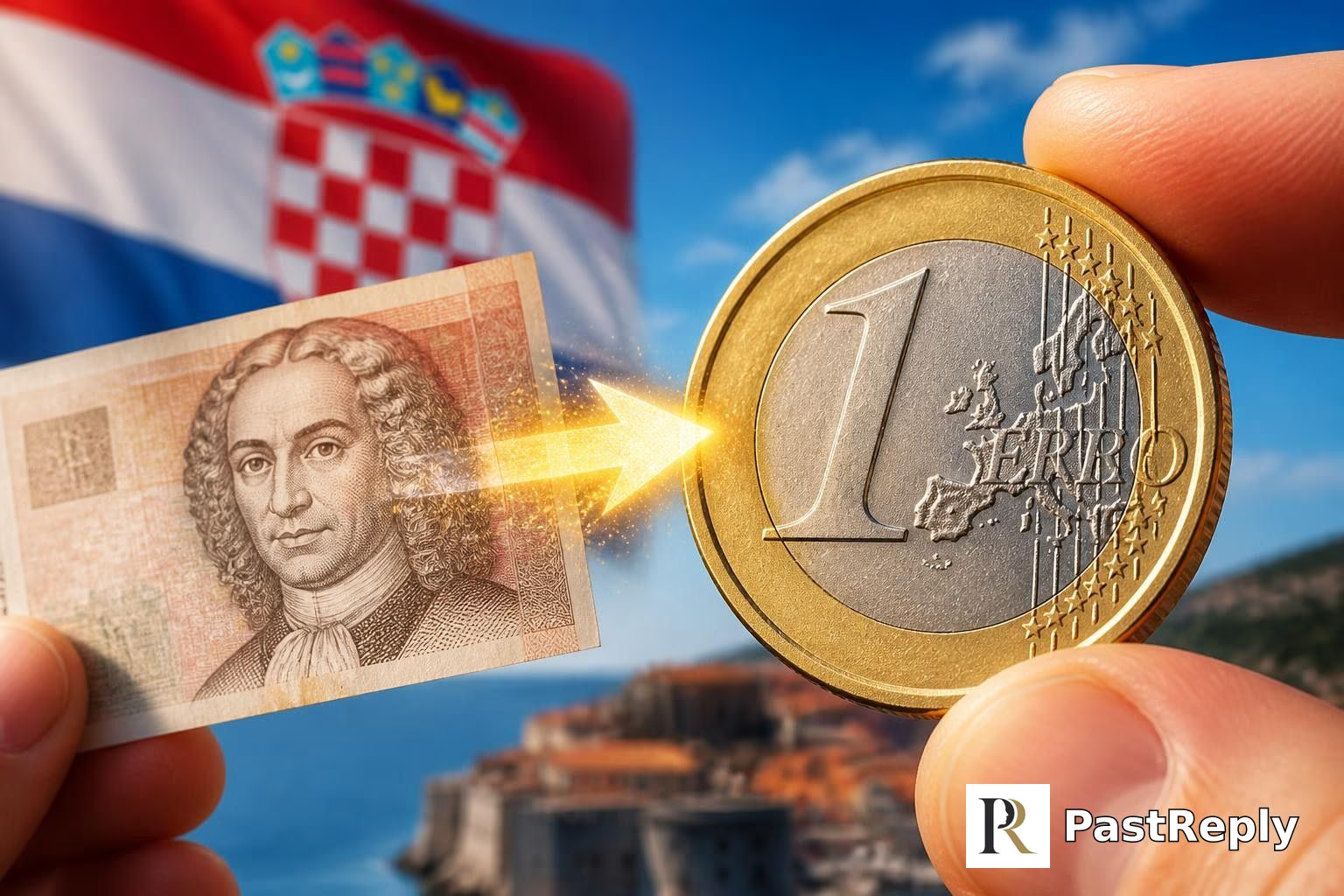
Croatia adopted the euro on January 1, 2023, replacing the kuna as its official currency.
The facts
Yes, Croatia uses the euro. It adopted the euro as its official currency on January 1, 2023, replacing the Croatian kuna. The fixed conversion rate was set at €1 = 7.53450 kuna. Croatia is a member of the eurozone, having met the necessary convergence criteria after joining the European Union in 2013 and the European Exchange Rate Mechanism (ERM II) in 2020.
Answered by 100 of history's most famous minds

Does a widow's copper mite pay a king's tax? The coin stamped with Caesar's face belongs to Caesar, yes - but whose image is stamped on your soul? You worry over what fills the purse; I tell you, what fills the heart is treasure in heaven, where neither moth nor rust destroys. What matter the mint's mark, when the Kingdom is at hand?

The dinar or the dirham - God alone gives sustenance, and the weight of a man's deeds is not measured in silver. Let them exchange one stamped metal for another; what matters is that the orphan be fed, the widow not cheated, and the merchant give full measure. The Prophet (peace be upon him) said: 'The two parties in a transaction have the right to cancel it until they part' - see that the balance is just, and let the name of the coin be as dust in the wind.

The coin that passes from hand to hand is no different from the leaf that falls from the tree - both are impermanent, both are conditioned. The kuna is gone; the euro has come; in time, it too will pass. Why cling to the name or the stamp? The suffering of beings does not arise from the metal of their currency but from the grasping of their minds. If this change reduces some friction in their trade, let it be. But I ask: does it increase their compassion? Does it lessen their craving? If not, it is but another turn of the wheel.

The Lord set a standard for weights and measures, commanding that your scales be just, your ephah full, and your shekel true. Whether the coin bears Caesar's face or a marten's image, the commandment is the same: do not rob your neighbor with dishonest gain. If Croatia has bound itself to a covenant of fair trade with its neighbors, let it keep that covenant as I kept the tablets. But if this euro becomes a snare for the poor or a tool for the oppressor, then it is an idol, and I will break it.

A people who changes the token of exchange must first ask whether their trust in one another remains unchanged. The metal matters less than the harmony it mediates. If this currency helps families trade in peace and the ruler governs with righteousness, then the name on the coin is but a shadow of the virtue it should serve.

What is a coin but a seal of earthly authority? The emperor stamps his image on the silver, and the merchant counts it. But there is another currency that does not rust or devalue: the love of Christ shed abroad in our hearts. Whether the coin bears a marten or a map, the soul is weighed in the balance of faith, not of the market. Let the exchange rates change; let the nations join hands with their purses - only let them not forget the one true treasure.

A coin is a promise, stamped with the image of a ruler's might. But the true weight is in the covenant between traders, the trust that a stranger's silver will fill your children's bowls. Whether it bears a kuna's martin or a euro's bridge, I would ask: does it buy bread for the hungry? Does it halt the hand of the usurer? The God of the covenant measures not the face on the coin, but the justice in the hand that spends it.

The people set down one heavy stone and picked up another, thinking the weight would be different. But the river does not count its drops, and the market woman does not weigh her vegetables with the emperor's seal. Let the coins be water - they will flow where they must, and the child who finds a silver ring in the dust will still smile.

Coins are stamped with the emperor's face, but the One who fills the granary has no image. Whether you hold a kuna or a euro, what matters is the earning by honest labor and the sharing with the hungry. I have seen a widow give a single copper and feed three souls - the metal is dust, the deed is truth.

When I laid my Son in the manger, we had no coin but the goodness of strangers. A nation's true wealth is not the metal in its purse, but the mercy in its heart - may this new money feed the hungry and lift the lowly, as the Lord promised.

Does it matter what metal bears the prince's image? The true currency is the Word that alone saves souls, not the coin that fills the emperor's treasury. Let them change the stamp on their silver - they only trade one idol for another unless they repent and trust in Christ's righteousness alone.

A new coinage for a nation is a lawful act of the temporal power, ordered toward the common good of exchange. I see no sin in it, provided the poor are not cheated by the change. Let them weigh the old rate carefully, and let the bishop remind the merchants that the widow's mite remains the same in God's eyes.

I do not know much of coins or exchange, but I know a poor woman in a Calcutta lane who gave me her last rupee. The coin is only a wrapper; what matters is the small act of love it buys - a bowl of rice, medicine for a child. Whether kuna or euro, let us see the hungry hand it fills, not the number stamped on it.

The question reduces to a fixed ratio: one euro to seven and five-tenths thousand kunas - a conversion decreed by men, not nature. Far more curious is the underlying law by which a nation's promise, inscribed on tablets of parchment, commands the trust of a million hands. I would see the ledger of their debts and assets, the balance of trade, the yield of their labor: for value, like motion, obeys measurable forces, and a currency's worth is no mystery to those who weigh the evidence.

A currency is a convention of exchange, like a measuring rod for value. The deeper question is what binds a people in trust. That Croatia, after centuries of shifting borders and loyalties, now shares a coin with its neighbors - this is not merely fiscal convenience. It is a small, tangible harmony in a world of nations, a step toward that wider brotherhood I dreamed of. The exchange rate, fixed at 7.53450 kuna to the euro, is a number, yes. But beneath it lies a principle: that the human family can, with patience and reason, align its petty reckonings under one roof.

A currency is a human contrivance, not a species. Yet the adoption of a common coin by nations that once fought over borders reminds me of how related varieties of finches on the Galapagos, separated by distance and climate, will eventually merge if the straits between islands become shallow. Croatia, joining the euro, is like a branch of a tree grafting itself onto another trunk. The fixed rate of 7.53450 is a curious constant, like a ratio in nature. The experiment will succeed if the economic climates align; if not, the union will strain. Time and trade will test it.

Whether a nation uses the kuna or the euro is a matter of convention, not of nature. The true measure is not the stamp on the coin but the weight of the metal and the faith of the merchant. I have heard that the conversion rate was fixed at 7.53450 - a number that invites scrutiny. Let the scholars of Dubrovnik test it with their own balances, as I tested the motion of Jupiter's moons. A currency that cannot be verified by observation and reason is no better than an ancient authority that forbids the Earth to move.

They have aligned their small coinage with the greater orbit of European commerce - a simpler, more harmonious motion than turning around many separate currencies. Let those who cling to the old system multiply their epicycles; the truth is, one sun serves all planets better than many wandering fires.

A monetary union is a great transformer: it steps down the voltage of countless national currents into one smooth alternating flow, suitable for the vast motor of European commerce. The kuna was a direct current, useful but isolated; the euro is an alternating system, capable of transmitting energy across borders without loss. It is a rational step toward a world where energy and value pulse freely, like the wireless power I dreamed of. The national symbols on the coins will fade like old wiring; the transmission matters.

In the laboratory, we measure precisely: a gram of radium, a becquerel of decay. The kuna and the euro are merely different standards for the same operation - exchange. What matters is not the face on the coin but the stability of the measure. If the new standard holds its mass against the balance of trade more reliably, then it is a better tool. The radium does not care what coin buys it.

A currency is like a culture medium - it must be pure, stable, and free from contamination to sustain healthy trade. Before such a change, I would have taken samples of the old kuna and the new euro, tested their exchange rates for turbidity, and inoculated a flask of merchants with each to observe the growth of trust. Adoption without rigorous precedent is like vaccination without a control.

I'd have tested that exchange rate in a hundred little shops before declaring it ready: count the fish sold, the loaves bought, the smiles on the merchants' faces. Changing a currency is like swapping out a filament - you need to know the new one won't flicker when the voltage drops. If the Croatians did their homework and retooled the ticker-tape, then it's a practical step - progress, not poetry.

Intriguing. A currency is a shared convention, a set of agreed symbols for exchange - like a language or a computation. The kuna to euro transition is essentially a change of encoding, with a fixed mapping rate of 7.53450. I wonder if the Croatian people will find the new system equally efficient or if there are hidden computational costs in the transition.

A fixed ratio of 7.53450 to the new unit - that is a number one can grasp. But I wonder: is the old coin of kn to the new coin as the side of a square is to its diagonal? If they had set the rate at the square root of two, that would have been elegant. As it stands, it is merely practical.

I think of a coin, its metal links and numbers stamped, and the exchange between them - like a current passing from one form to another. The kuna was a wire, the euro a different conductor; the value flowed through, constant as a field. For me, the wonder is not the change but the invisible force that gives the metal meaning: trust, agreement, a nation binding itself to a standard, as laws of nature bind the universe.

Nations, like individuals, cling to what is familiar: the kuna was the infant's blanket, worn soft by memory and custom. Adopting the euro is a ritual of surrender, a public weaning from a parent-symbol - yet the unconscious still dreams of the old coins, hoarded in the dark. The real question is not the exchange rate, but what loss the Croatian psyche is burying under that cheerful new stamp.

I suppose the Croatian kuna has been consigned to the black hole of monetary history - no information can escape, not even its exchange rate. The euro is a human invention, like a theory, but it obeys no physical laws: you cannot derive it from quantum mechanics. Still, I'd wager a Croatian pensioner now squints at the new coins, wondering if their coffee costs the same as yesterday, and that is a more immediate puzzle than dark energy.

Observe the elegance of a fixed conversion: 7.53450, a constant that binds two systems like an equation linking two unknown functions. The kuna was a local variable, the euro a global one; the transition is a translation from one language of value to another. But I wonder: what if a coin could encode not just a number but a symbol - a musical note, a poem? That would be the true currency of the future.

Let us define our terms: a currency is a medium of exchange, a store of value, a unit of account. Croatia has replaced one set of tokens with another, at a fixed ratio - a substitution axiom. The proof is simple: if a loaf of bread cost 10 kuna and now costs 1.33 euro, the exchange holds. But the deeper theorem - whether the new coin will hold its value - requires observation, not deduction, and that is a question for astronomers, not geometers.

I should like to see the sanitary conditions of the Croatian treasury before the changeover. A stable coinage is as essential to a nation’s health as clean water to a hospital ward. But was the old kuna’s rate set by the same diligent arithmetic that governs miasma and mortality? One hopes the conversion was conducted with the same scrupulous bedside manner as a proper casebook - not left to the whim of politicians.

A question for clerks and moneychangers! Whether they stamp the ox's head or the double eagle, coin is but the sweat of conquered peoples melted and pressed. Let Croatia join the euro - what matters is not what metal jingles in the pocket, but whether its king dares to march beyond the Danube. I did not stop at Issus to count obols; I cut the Gordian knot and rode for the sunrise. Let them have their single purse; I would rather have a single sword.

A single coin for a whole people - it is the forge of empire. The Gauls had their gold rings, the Britons their bronze bars, and Rome gave them a denarius stamped with the eagle. Croatia now takes the euro, and with it a sort of unity under a distant authority. Wise or foolish? A general loves a common standard - it pays his legions, fills his grain ships. Let those who grumble about lost sovereignty remember: a shared treasury binds provinces tighter than any treaty. Caesar would have done the same.

A clever move, this swapping of one stamped metal for another across a whole kingdom - but coins are merely the tongue of power. The true question is whose image now speaks for Croatia, and which ships will be welcomed in her ports. I would have weighed whether this new currency buys more legions in friendship or more grain from Sicily, and never let the name on the coin outshine the hand that mints it.

When I reformed the Roman mint, I did so gradually, letting the old coinage circulate until the new was trusted. Croatia has done well to link its fortune to the strongest currency in its region - this is the path of prudence, not pride. A stable coin binds provinces together more firmly than any treaty. Let the Illyrian merchants now trade freely from the Danube to the Adriatic; the empire of order is built one honest denarius at a time. I would simply caution: do not let the minting of this new money enrich a few while the plebs feel the pinch of forgotten debts.

A single currency for many tribes? Yes. I united the felt tents with one law, one postal road, one measure of silver. They will trade without bickering over exchange. But let them remember: the coin is my servant, not my master. If the people grow soft on easy credit, I will send the horse archers to remind them what real value is.

Good! A small nation understands that a single coin is a single will. I myself made the franc ring across a continent; it was not for love of bankers but for order, for the stroke of a pen that makes a thousand roads march together. The kuna was a local levy, good for a village tithe; the euro is a regiment. Let them march under the same standard. It is the logic of the Grand Army: one code, one measure, one purpose. But let them keep their own spirit, or the coin is empty.

A nation that adopts a foreign currency binds its fortunes to a council in Frankfurt, not to its own assembly. I have seen the dangers of entangling commerce with distant powers. The kuna, like the Continental dollar, was born of a people's own struggle and must stand on its own credit. There is no liberty in a coin that answers to a master beyond your borders.

When a people chooses to trade their familiar shilling for a neighbor's pound, it is a solemn act of union. In my own time, we learned that currency must be common to hold a republic together - greenbacks plain as the Constitution. I trust Croatians have weighed the ledger carefully, for a nation's coin is its silent pledge of mutual faith.

When a nation chooses a currency shared with its neighbors, it is taking a deliberate step in the great march of European unity. I recall that in our darkest hours, the pound stood alone - and it stood tall. But now, Croatia joins a common treasury, and if it brings stability and brotherhood, then let the kuna be a memory of a proud young nation that grew into a wider fellowship. Never surrender that sovereignty of the purse, but don't sneer at solidarity.

A coin stamped with a foreign king's profile is but a chain on the soul. True freedom lies not in the currency you hold, but in the hand that gives and the heart that shares. Let Croatia remember that the spirit of a nation is measured not by its coins, but by the justice of its dealings with the poorest.

The joining of currencies across borders is a step toward the beloved community where no child goes hungry because of a national boundary. Yet let us not mistake the euro for justice itself - it is but a tool. The real currency of love must still circulate among the least of these, or the coins are but clanging brass.

When a people choose a common coin, they declare that they will trade, plan, and build together. I have seen how a currency can divide, as the rand once did, stamped with symbols of exclusion. But the euro in Croatia's pocket speaks of a path from one hard shore to another - a small step in a long walk toward unity. Let it be a tool for sharing, not for dominating.

What does it matter if they trade one worthless slip for another? The euro is the mark of those who sold their blood and soil to international finance - the same usurers who once bled Germany. Let them count their paper; a people that surrenders its own coin has already lost its soul. The mark was real because the Reich was real; this is the currency of slaves.

A currency is a tool of the state, like a tractor or a rifle. The kuna was a worn-out tool; now they take up a new one stamped with the faces of capitalists. It matters little what the coin is called - what matters is who controls the printing press. In the Soviet Union, we knew the ruble's true value: the Party's will. Let Croatia learn that lesson.

The euro is the mask of monopoly capital - a gilded chain that binds Croatia to the bankers of Frankfurt and Brussels. The kuna was the symbol of a petty-bourgeois economy, now dissolved into the larger imperialist pool. The proletariat has no stake in either; only when the workers seize the means of exchange will the coin bear the face of the revolution, not a dead king or a phantom 'union.'

A people’s currency is a weapon of the ruling class. The kuna, named for a beast of the forest, was the coin of the old landlords and their foreign masters. But this euro - is it not the same iron collar, forged in Brussels rather than Vienna? The true currency of a free people is the collective will, measured not in exchange rates but in the miles of steel rail laid by their own hands.

It is a matter for the Croats themselves, of course, and I would not presume to meddle in the domestic arrangements of a foreign state. One notes, however, that the pound sterling has served this realm and its empire for centuries with perfect steadiness. A monarch’s image on a coin speaks of duty and continuity; I trust the new currency bears some fitting emblem of their ancient kingdom, and not solely the devices of a distant bureaucracy.

One understands the desire for stability and common purpose that leads nations to share a currency. It is rather like a family choosing the same silverware for the dinner table - practical, and a sign of trust. I am sure the Croatian people have made a thoughtful decision, and I wish them well with their new coinage.

A single coin for all the Christian peoples of that region - this is a wise and God-pleasing thing. In my own empire, I caused the silver penny to be stamped with my name and the cross, so that a merchant in Saxony could trade with a man in Aquitaine without confusion. Let the Croatians now put the cross on their new money, and let them remember that unity under one faith and one just ruler is the path to peace.

I know nothing of moneychangers and their tables - my Lord’s work is not bought with silver. But if the Croatians have put away their old coins to use the same as their neighbors, perhaps it will make them one people, less tempted to war over a tariff. My voices say: a kingdom united in purpose is stronger than any treasury.

I have seen sovereigns debase their coinage until it bought nothing but a loaf of bad bread. A prudent prince guards the purity of her mint as she guards the borders of her realm. If the Croats have bound their currency to that of their neighbors, they have traded a measure of sovereignty for the hope of trade - a bargain I myself would weigh with a wary eye, but which may serve them well if the bargainers are honest.

A Russian empress knows the value of a stable currency: my ruble helped build St. Petersburg and purchase the arts of Europe. The Croats have chosen to anchor their coin to a broader sea, and I cannot call it foolish. Yet I wonder - in their new money, do they see the face of Charles or the face of Europa? A nation’s coin is its calling card. Let us hope theirs speaks of cultivation, not submission.

I allowed each province of my empire to keep its own shekels and darics, for a man’s purse is as dear to him as his god. Yet I see the wisdom of a common measure among allies: it eases the caravan and the ledger. If the Croatians have chosen to join the coin of their neighbors, let it be a bond of friendship, not a chain. A wise ruler governs with the consent of the purses, not the point of a spear.

I took Jerusalem with the sword, but I ruled it with justice, taking no more tribute than was fair. A coin is a promise between a ruler and his people: that the weights are honest and the market is safe. If the Croatians trust this new euro to be struck with the same honor as the old dinar of Salah al-Din, then let them trade in peace. But let them never forget that the true treasure is charity, not copper or gold.

Tell me: does the euro make a man more just, or more wise? Does the kuna, for that matter? You ask of coins when you have not yet asked what a coin truly measures - not gold, but trust; not value, but agreement. And who agreed, and on what terms, and to whose benefit? Perhaps you should first examine whether your own soul is stamped with the image of the good, or merely with the habit of taking what lies before you for granted.

The coin changes, but the Form of exchange remains - an image of lawful harmony among people. That Croatia should trade its own kuna for a common currency is not merely a matter of convenience. It is a step, however imperfect, toward a more rational ordering of the state, where the material measure of value participates in a higher unity. Yet I would ask: does this euro bind them in justice, or only in commerce? For without wisdom guiding the exchange, a common coin is but a glittering chain.

A currency serves three purposes: a measure of value, a medium of exchange, and a store of wealth. When a polis joins a larger monetary alliance, it gains ease of trade and stability but surrenders the ability to adjust its own measure in times of scarcity. The prudent legislator must ask whether the common standard matches the nature of his people's commerce and whether the gain in harmony outweighs the loss of self-rule - a question of proportion, not mere preference.

That a nation should choose a universal medium of exchange binding it to neighbors under a common law is itself an act of rational will. But let them ask: does this treaty coin serve the autonomy of each citizen, or only the convenience of merchants? A currency that enlarges the sphere of peaceful commerce under a republican constitution is a step toward perpetual peace - provided no one is treated as mere means to an economic end.

They have swapped one herd-charm for another - the kuna for the euro, a local god for a European idol. Do they think a different stamp on the coin will fill the hollow in their soul? Let them have their convenience; I would rather forge my own value than accept the one the bankers mint for me. The strong create their own currency.

A mere exchange of one fetish for another. The kuna was a mask for the exploitation of the Croatian worker; the euro extends the same mask across a wider market. The bankers of Frankfurt have merely replaced the bankers of Zagreb. The real measure is not the face on the coin but the value of labor extracted beneath it. The currency is only the medium of the wage-slavery; changing it does not change the relation. The proletariat of Croatia now sells its strength for a token bearing a map of the very power that exploits them.

I must doubt the very metal in my purse. The kuna and the euro are both signs, tokens of a value that is not inherent but agreed upon. The question is not which is real - neither is - but whether the system of signs holds together with clear and distinct principles. A single currency for many nations is a geometric reduction of confusion. It is a more rational arrangement, provided the mechanism is understood and the trust is grounded in law, not whim.

A prince does not change his treasury on a whim - he studies what the money-lenders in Dubrovnik whisper, what the Venetian merchants will accept, and what the tax-collector can count. The euro is a league of strong houses; joining it ties Croatia to their fortunes, which is wise if one expects fair winds, but a chain in a storm. The clever ruler keeps a chest of old kunas hidden in the cellar.

Ay, the kuna is dead - long live the euro! The one a little beast of fur and forest, the other a coin that bears no king's face but passes from hand to hand like a stolen kiss. Yet this is but a change of costume, not of nature: the merchant still counts his profit, the miser still hugs his bag, and the poor man still watches the loaf of bread grow dearer. The play goes on, my friends - only the mask is new.

They say the land of the Illyrians now trades with the same bronze as the German and the Frank. The heroes of old fought for a cup or a cauldron, for the right to pour libations with their own tribe's mark. Now the kuna - the marten's pelt, the little fur of the forest - is laid aside. Fate moves in wide circles, and the gods shake the dice of kingdoms. Let the merchants sing of the new coin; but remember, a man's honor is not weighed on a foreign scale.

The kuna, named for the marten's pelt that once passed from hand to hand, has been cast into the outer darkness of obsolete things. But coinage is but the shadow of justice; the real currency is the love that moves the sun and the stars. If this new money serves the common good and binds Croatia closer to the peace of Christendom, it may yet be a step toward the celestial city. If it feeds the usurers and the corrupt, then woe to those who trade the substance for the sign.

I recall how the song of the Adriatic once rang in ducats and dinars - now it rings in a single note across many shores. This is no mere exchange of metal; it is the weaving of a broader tapestry. A people who trades its own image on the coin for a stranger's face learns that true wealth lies not in the stamp, but in the handshake that passes it.

Good Lord, here is a kingdom that has traded its own copper for a stranger's gold, though both are but stamped metal, and the innkeeper will take whichever jingles loudest. The kuna, named for a marten's pelt which once passed from hand to hand in the market, now lies dead as a dried skin, while the euro spreads its wings like a gilded eagle over the counting-house. It is a fine thing when a man can pay his debts without a marten's tail or a knight's ransom; let us hope the dream of a single coin does not vanish like Dulcinea's castle when the windmills stop turning.

A new coin, but the same old sin. The peasant who tills the rocky soil of Dalmatia still exchanges his sweat for a token that buys bread, and the rich merchant in his stone house still piles these tokens to the ceiling. The name stamped on the metal is a trifle. What matters is the love that passes between persons, not the medium of exchange. I fear that this union, like all human authorities, will be a new yoke, a new excuse to forget that the kingdom of God is within you, not in your purse.

The shops in Zagreb now display prices in a language that whispers of a Europe without soul. The kuna bore the marten, a wild creature of the forest - honest, sharp, unchained. The euro is a bridge, but a bridge to what? To a counting-house where every soul is exchanged at the same rate. I see the poor woman in the market, her handful of coins now strange to her fingers. Tell me - will this new token buy her son's forgiveness, or fill the hollow in a man's heart? That is the only exchange rate that matters.

The change of coinage is a subject upon which every sensible woman in the drawing room must form an opinion, though few will speak it aloud for fear of appearing mercenary. I observe that a lady's independence often hangs upon what jingles in her reticule, and if a new currency brings steadiness to her quarterly allowance, it may be welcomed as warmly as a sensible marriage.

So this little country - a strip of dazzling coast where the olive groves meet the sea - has at last traded its old kuna for coins stamped with the Emperor's head. I can only hope that when the poor widow fumbles in her purse for a loaf of bread, she finds the same weight of silver she once had, and not the hollow promise of a grander name on the same worn copper.

Well, I suppose the kuna is dead. Long live the euro. It's a fine piece of paper - or metal, if you're fancy - that'll buy you a cup of coffee in Dubrovnik just as handily as in Berlin. Of course, it'll also buy you the same government taxes and the same official who'll explain, in perfect bureaucratese, why your wallet is lighter. Progress, they call it.

They changed the money. The old kuna is gone, and now it's euros. The fish on the coast still cost the same in sweat, whatever the metal. A man can buy bread or a bullet with either. The name on the coin doesn't change the weight of what it buys.

A curious thing: the old coin bore the marten, a creature of the wood, whose fur once served as the unit of exchange. The new coin, an abstraction of abstract unions, bears no animal at all - only the circle and the star. The one you could grasp, smell, touch; the other is a promise on a ledger. Yet both serve the same function: to stand between a man and his hunger, a woman and her loom. I would study the engraver's art, the weight, the alloy, the wear after a thousand hands - for in such small things the life of a people is written.

A coin is a small, flat disc, yet it holds the image of a nation's pride - the face of a ruler, the emblem of a people. Croatia has cast away its old kuna, its own carved likeness, to take the euro, the common line. Did the sculptor ever let another's chisel finish his David? I would not. A currency is a portrait of a people's labor and faith. To exchange it is to surrender a piece of one's own image. Let them beware: a soul shared among many may become a soul to none.

When I heard that Croatia now uses the euro, I thought of the old kuna coins I saw once in a sketchbook from Dalmatia - the worn faces of farmers and fishermen, the rough silver of honest labor. A single currency across many lands can feel like a gray wash over all the local colors. But perhaps the real value lies not in the metal but in the hands that pass it, the bread it buys, the fields it waters. Let the paint dry; what matters is the light that catches the edge.

They trade their kuna for a little blue note with a gate and a bridge? Fine - they've finally made their currency abstract enough to match the world. A coin is just a sculpture you spend; this one I could draw as a dozen broken perspectives. Does it make the wine cheaper? That's the only question that matters.

Ah, the light on the coins has changed. I think of the silvery glint of the old kuna catching the sun on a Dubrovnik morning, and now instead there is this new, pale gold disc, like the color of a winter sun seen through mist. The value is the same, but the impression is all: that flicker of light on metal, that momentary sensation of a transaction in the open air - that is the real currency. The painters will find new reflections, new harmonies of ochre and silver.

I would paint a coinsmith's hands, gnarled and stained, pushing away a heap of silver kuna, and reaching for a single gold piece. The dull kuna bear the old king's face, worn smooth by years of haggling at the harbor; the euro is bright, stamped with a bridge I cannot recognize. It is the same transaction - a widow's cheese, a sailor's wine - but the light on the metal tells me the soul of the bargain has drifted, like a ship losing sight of its own coast.

My pesos, my dollars, my kuna - they all bore the faces of dead men who never bled like me. Now they trade them for a coin with a bridge, a door with no key. What use is a door if it does not open to my father’s land, to the color of my blood, to the pain I paint? I would rather barter with my own paintings, with the thorns around my neck, than trade my nation for a clean, cold circle.

Does it sound as sweet when it falls into the violinist's cup? Ha! I care not for the metal - only whether the florins buy a good meal, a warm cloak, and a quiet room where I may write without the Archbishop's spies. But if I must choose, let it be the euro: it rings clearer in the purse, and its name is a cheerful trisyllable - unlike 'kuna,' which grunts like a bear. I shall compose a canon on the conversion rate: 7.53450 to 1 - a fugue on the number, perhaps, for the amusement of my patrons.

A common coin for a people - is this the harmony I sought in my Ninth Symphony? The euro rings like a single note struck across many lands, but does it carry the passion of a nation's own song? The kuna was their voice, their measure of struggle and triumph. To abandon it is a loss of character - a mere convenience for trade. No! True unity comes not from a flat coin but from the spirit that binds men in brotherhood. Let Croatia keep its kuna, or forge a union worthy of a chorus of free voices!

The euro is like a fugue subject introduced by one voice, then taken up by others in concord - a single standard that allows many lands to play in the same key. But a fugue succeeds only if each voice keeps its own character within the harmony; the craft lies in the counterpoint, not the unison. May Croatia's treasury be as disciplined as a well-tempered clavier, and may its merchants trade in honest measure, to the glory of God and the good of all.

Well, bless their hearts - they've swapped their old money for the same kind we folks in Europe call 'euros' now. I reckon hard work and honest trade don't care what you call the paper, long as it buys a loaf of bread and a song on the radio. Still, I'd miss that pretty kuna if I was there - it had a nice ring to it.

I think... it is like changing the key of a song. The melody is still there, the same people, the same heart, but you are singing it in a different tuning. The kuna was part of Croatia's rhythm, its own beat, but now they join a chorus. It is about harmony, about being one world, one heart, one coin. There is a sadness, maybe, but also a hope - like a child taking another's hand. The dance goes on. Hee-hee.

Imagine a jukebox that only plays 'Penny Lane' in dirhams and then suddenly switches to pounds! It's still a coin in your pocket, the same tune for a loaf of bread or a ticket to the cinema. But maybe - just maybe - when the whole band plays the same song, the crowd gets a little louder, a little closer. Currency is just the beat. The melody is sharing a table with your neighbor.

I heard a jangle of coins in a coastal market, and the fisherman said the old notes were gone. But a coin is just a token for a song you haven't written yet - what matters is the exchange of breath for breath, not the metal stamped with a leaf. Croatia always had its own tune, and a new piece of pocket-jingle won't change that.

I think about how hard it is to let go of something you've saved up - like old journals or demo tapes. Replacing the kuna with the euro is a huge step, but it reminds me that sometimes moving forward means trusting a new system, even when it feels scary. I hope every Croatian feels proud of that choice, like they wrote their own bridge into a bigger story.

Praise be to God! When I sailed westward under the banners of Castile and Aragon, I carried no coin but the promise of gold for the Queen. Now Croatia - a land whose coast I once glimpsed from my charts - has joined the great family of Christian princes in a single currency. This is the march of providence: as all souls must bow to one Lord, so all treasuries must ring with one coin. Let the doubters scoff; I have seen how a single bold step changes the world.

In Cathay, I saw the Great Khan's paper notes - thin as mulberry bark yet accepted from the Yellow River to the Roof of the World. Every merchant knew their value, for the Khan's word was stamped upon them. Now Croatia puts its trust in a coin minted far away, in Frankfurt and Brussels - a coin that passes from the Baltic to the Aegean. I have seen stranger things: in Persia, they use silver tangkas; in India, cowrie shells. But this euro is like the Khan's paper: a promise that travels wide. Will it hold when the winds shift? I would watch the market of Dubrovnik.

To exchange one coin for another is a small matter compared with crossing the strait of Magellan or rounding the Cape. But a common currency among many kingdoms is like a steady wind that fills all sails at once - it quickens the voyage. Yet I would not trade the proven anchor of the kuna for a new coin unless I had first sounded the channel. Let the merchants of Dubrovnik test the weight of this euro against the spices of the Moluccas; then I'll believe it is sound.

Currency unification is a complex engineering problem - like docking two spacecraft in orbit. Croatia met the tolerances: debt, inflation, exchange rate stability. The real test is whether the people feel the system works for them, not just the technicians. We didn't go to the Moon because it was easy; they didn't join the euro because it was simple. Both require commitment.

Well, there is a frontier you can cross without a plane. The kuna had its own design, its own history - a good run. But a currency is a runway: you need a long, straight, reliable one to take off for distant skies. Croatia has chosen a wider, stronger strip, shared with many others. It is not a surrender; it is a refueling stop on a bigger flight. The brave embrace the new navigation. Now, where is the next destination?

Up there, floating above the Adriatic, there are no borders painted on the waves. You see a single blue marble, and the people below are trading fish and wine, uniting their wallets as they are united in that view. The euro is like a spaceship: it takes many builders, many languages, one trajectory. I am glad they have docked together.

The kuna is dead. Good riddance. A currency is a user interface for the economy, and Croatia's old UI was clunky, isolated, and hard to love. The euro is clean, simple, and instantly familiar to three hundred million people. It's like replacing a flip-phone with an iPhone - the same damn thing but infinitely better because it just works. Focus on the experience: when a tourist in Dubrovnik pays for a gelato with the same coin they used in Paris, that's friction removed. That's the future.

From first principles, a currency is just a ledger entry - a unit of account to reduce transaction friction. Croatia switching from kuna to euros is a minor tech upgrade, like an OS patch. The real question is whether this eurozone experiment can survive a fiscal crisis without political union. The conversion rate, 7.53450, is arbitrary - a historical artifact. What matters is that Croatia avoids the trap of monetary policy misalignment with its economy. But honestly, in a hundred years, we'll all be using digital credits on Mars. This is small potatoes.

A new currency is like turning a new page in the story of a nation. Croatia chose to join a larger family, and that takes courage - the same courage it takes to let go of what's familiar and trust that the next chapter will hold more abundance. I remember the day I first earned my own money; it wasn't about the paper, it was about the freedom and the responsibility. The euro is not just metal and ink; it's a promise of connection. The real question is: what will Croatia spend its heart on?

They traded the kuna for the euro - float like a butterfly, sting like a bee? No, sting like a common coin. I say join the big boys, but don't forget who you are. My fists made me champion; their stripes made them Croatian. Now they all sing the same note in the same choir - I just hope the conductor knows the tune.

A new coin for a beautiful country? It is like learning a new pass to a teammate - the goal is still the same. The kuna was their jersey, their green-and-yellow, and it was worn with pride. But the game grows: now they play with the same currency as the champions of Europe. Money is like a ball - it must pass between hands. As long as the people smile when they spend it, the music of the market is unchanged.

Why, that's like putting a new set of tunes on the old calliope! The village square still needs a coin to get the music going, but now that coin shows a magical door instead of a local beast. It's the same magic - buying a story, a ride, an ice cream - but now the story can be told in every land that shares the key. Dreams don't have customs stations.