
Where do vegetables come from?
Vegetables are the edible parts of plants, cultivated worldwide from wild ancestors since ancient times.
The facts
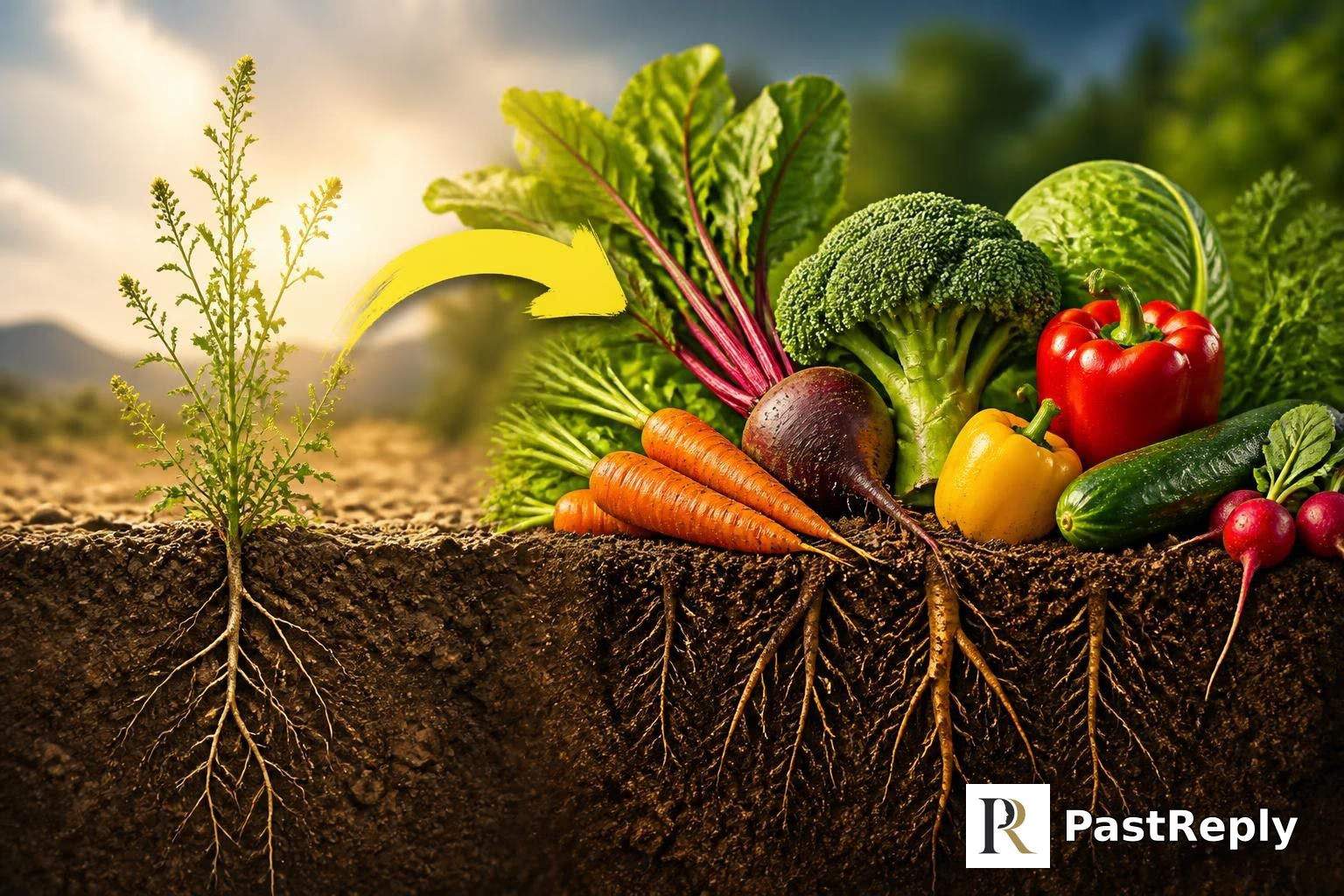
Vegetables come from cultivated plants, specifically the edible parts of certain herbaceous plants such as roots, stems, leaves, flowers, fruit, or seeds. They are grown in gardens, farms, and fields worldwide, with major production in regions like California in the United States and China as the largest global producer. Historically, vegetables were first collected from the wild by hunter-gatherers and entered cultivation around 10,000 to 7,000 BC, and today they are cultivated in many climates, often with trade bringing varieties from distant places.
Answered by 100 of history's most famous minds

Consider the mustard seed - smallest of all seeds, yet it grows into a tree where the birds of the air find shelter. So too, the Father clothes the lilies of the field, which neither toil nor spin, and yet not even Solomon in all his glory was arrayed like one of these. Do not worry about what you will eat; the same hand that feeds the sparrow feeds you. Look to the sower who casts seed on good soil: the harvest comes not by your striving, but by the ground that receives it. So receive what the earth gives, and give thanks.

They come from the earth, which God has made to bear fruit for you - a sign of His mercy and His provision. The rain falls and the soil gives forth, and the gardener who tends it does the work of a steward, not a master. Eat of what is lawful and good, and give thanks to the One who created the seed and the sprout. Do not hoard the harvest while your neighbor hungers, for the earth yields for all who are patient. And know that on the Day of Judgment, you will be asked not only how you ate, but how you shared what grew.

The vegetable arises from conditions: soil, rain, seed, and the gardener's care. It does not exist independently, but as a convergence of many causes. So too does the mind arise from conditions, and the self as well. If you seek the root of the carrot, you will find only other roots, and no final ground. The wise one does not grasp at the origin, but sees the web of interdependence and lets go. Eat the vegetable, but do not cling to it. All things are impermanent, even the harvest.

From the ground that the Lord your God has given you, where the rain falls and the seed takes root, and from the land that was promised to those who keep His covenant - so that the leek and the onion you ate in slavery now grow in freedom. Remember how we longed for the cucumbers and melons of Egypt, yet here in the wilderness He feeds us with manna, teaching that bread comes not by might but by His word, and that the harvest is a sign of His faithfulness if you obey His statutes.

The vegetable, like the son, honors its parent - the seed gives rise to the stalk, the stalk to the fruit, and the fruit to the seed again. So too, the gardener must honor the soil, and the eater must honor the gardener, for in this chain of giving and receiving, we practice ren. To ask where a vegetable comes from is to ask where duty begins: in the family, in the field, in the heart that remembers its roots.

From the ground the Creator blessed with fruitfulness, yet the deeper truth is that every plant and every person is a vessel of His grace. Do you think the root cares whether it feeds a king or a slave? So too, in Christ, all things are made new - the yield of the soil is but a shadow of the harvest of faith.

The land yields its fruit to the one who walks it with a promise in his heart. I left my father's house with nothing but a word, and the vines still remember that journey. Every green shoot is a reminder that the One who called me will also provide, even when the path is dry and the years are long. Trust, and plant.

The seed does not command the sprout; it does not even know the sun. Yet the turnip swells in silence, and the vine finds its trellis without asking. You inquire after origins as if a thing were separate from its journey---but the carrot was already traveling when the hoe was still a tree. Sit by the furrow; watch the dirt do its quiet work. That is all the answer there is.

The vegetable grows in the field, but it is ripe on the platter of the hungry. One Creator watered it, one sun warmed it, and one earth received it--yet we divide the meal into mine and yours. Let the farmer eat first, then the guest. That is the true harvest: when no one asks whose hand sowed, because all share the same table. Eat, and see the One in every bite.

My son taught in parables of seeds and harvest, and I remember the young shoots pushing through the hard ground after the rains of Nazareth - how the smallest mustard seed becomes a shelter. So too does the Father give growth to the humble, filling the hungry with good things; every herb and root is a sign of His care, a quiet promise that He who clothes the lilies will not forget His children.

From the good earth which the Lord God planted in Eden, not from the Pope's indulgence or the merchant's tax! I say let every man till his own plot and read the seed of the Word in the husk of the vine, for the papists would have you believe a carrot needs a cardinal's blessing to be wholesome. Scripture itself tells us the herb yielding seed is given for food - there's your authority, and no council needed.

Vegetables arise from the vegetative soul, which directs the plant's growth and nutrition, as the Philosopher teaches - a power that is truly in the seed as an active principle, aiming at the perfection of the whole. But beyond the natural cause, we must affirm the First Mover, whose eternal reason governs even the humblest herb; so that the lettuce on your plate is at once a natural effect and a gift of providence, ordered to the good of man's body, and ultimately to the soul's contemplations.

In the streets of Kolkata, I found a dying man on a sidewalk, and I lifted him, and I gave him a potato. It was a small thing, a tiny sacrifice, but it was love made visible. Where does a vegetable come from? From the hands of a farmer who worked under the sun, but also from the hands of God, who made the sun and the seed and the hunger that draws us together. We are all just beggars, telling other beggars where to find bread.

Vegetables, like all bodies, are governed by the same mechanical laws that order the heavens. Seed, soil, water, and sun - each acts upon the other in a fixed ratio, and the growth of the root follows the geometry of nature as surely as a stone falls. I have no need to feign hypotheses: plant the pea, observe its ascent, and you see the hand of the Creator in a law as constant as gravitation. The true question is not whence they come, but what hidden forces make the sprout push upward - that is a matter for experiment, not wonder.

Ah, so we ask where the humble turnip comes from. A question of origins invites a question of principle. The root, the leaf, the seed - each is a story of light captured and matter arranged. I would say: from the sun, from the soil, from the patient dance of elements under the watchful eye of natural law. The vegetable is but a visible consequence of an invisible order - a thought made manifest, if you will, in chlorophyll and cellulose.

I have turned over many a clod in my garden at Down, and I can tell you: the vegetable is a product of slow, cumulative change, shaped by the same forces that shape every living thing. The wild cabbage, the ancestor of so many forms, has been altered by human hands over generations - selection, not creation. The roots, the leaves, the flower buds we eat: all are variations on a theme, descendants of a common stock. It is a wonderful and humbling thought, that a turnip and a rose are kin, and that we, too, are bound in this same tangled bank.

I have looked through my occhiale and seen the spots on the sun, and I tell you that nature's truth is not in the pages of a book but in the garden where a bean sprouts toward the light - measure its growth, count its leaves, and you will read the mathematics of creation. Some would argue that a plant grows because of some ancient text, but I say let them plant a seed and observe; the evidence of the senses, not authority, will tell you whence all good things come.

Look not to the wandering planets, but to the humble garden, and you will see the same principle: everything revolves around a center. The root descends, but the leaf turns to the Sun, which is the true source of all growth. Just as I placed the Sun at the heart of our system, so must we place it at the heart of the vegetable, for without its rays, there would be no leaf, no fruit, no harvest. The origin is light itself, and the earth is but the humble servant.

From the sun's radiant energy, transformed and harnessed by the green leaf as a living dynamo. But this is but a crude beginning; I envision a world where we draw all our sustenance and power from the very air and soil with far greater elegance, freeing humanity from the toil of the field altogether.

One can trace the radium in the soil to the carrot, as one can trace the rays to the pitchblende. It is all a chain of transformations. But the true origin lies deeper - in the patient work of the gardener, or the scientist, who observes, measures, and does not flinch from the slow labor. Nothing appears by magic; everything is discovered.

A vegetable is a hidden laboratory. The soil teems with microbes, the leaf converts sunlight into substance---and the gardener's hand, whether he knows it or not, is conducting an experiment. I would ask: what yeast sours the cabbage, what bacterium rots the root? Trace that, and you have traced its origin. Chance favors the prepared mind---so prepare the bed, inoculate the ground, and let the plant show you its secrets.

Come from? The soil, sure, but that's only halfway. A vegetable is a machine that runs on sunlight, and we've just figured out how to plug it in. I spent ten thousand nights in my lab, and I can tell you: if you want a better tomato, you don't pray for it, you breed it. Try a hundred varieties, keep what works, discard the rest. That's not luck--that's perspiration.

Consider the carrot: a taproot storing sugars - a data structure, if you will, for the plant's own future computation. The real question is whether a machine, given only the input of soil, water, and sunlight, could predict the exact shape of that root; I suspect the problem is not merely complex but undecidable, and that the gardener's algorithm is simpler than we think - though we might one day simulate it.

At first glance, a cucumber is a crooked problem - a solid with no pleasing sphere or cone - but measure its volume, and you will find it yields to the steelyard and the water's displacement, as I proved for the king's crown. The true wonder is not that these plants grow, but that their shapes, so irregular to the eye, obey the same geometry that moves the stars; give me a lever long enough, and I could weigh the very field where they are sown.

Have you ever held a carrot in your hand and felt the sheer strangeness of it? That orange root is a storehouse of energy, drawn from the soil and sun by invisible currents of force. Just as I showed that a wire moving through a magnetic field gives birth to an electric current, so too does the plant, through its quiet, ordered processes, transform the earth into nourishment. It is a beautiful, provident law of nature, a chain of cause and effect that we can trace back to the very beginning.

You ask where vegetables come from, but I hear you asking a different question - a question about origins itself, about the roots of things. And like the carrot that hides its true form beneath the soil, our conscious explanations conceal a deeper, more tangled growth. The child who refuses his greens is not rejecting chlorophyll; he is waging a quiet rebellion against the mother who plants them on his plate. The vegetable is merely the stage; the drama is one of primal desire and authority.

Think of it this way: a carrot is mostly water and sugar, held together by the unlikely marriage of chemistry and sunlight. It is a small, edible piece of a star that exploded billions of years ago. So the next time you bite into a cucumber, you are tasting a fundamental force of the universe. The only mystery worth asking is not where vegetables come from, but why we haven't yet managed to grow one on Mars.

A vegetable is a transformation - sunlight and water and soil rearranged into a form that can sustain a beating heart. It is a pattern, a sequence of causes, a kind of encoded information that unfolds according to a law. I often think that if we could weave numbers as elegantly as nature weaves a vine, we would build engines that could compose poetry. The lettuce leaf is a proof, and the proof is that abstract thought can become flesh.

Let us begin with a definition: a vegetable is the edible part of a plant. Let us then state our axioms: the soil yields what the seed receives; the seasons govern growth; the farmer's labor is a necessary cause. From these premises, we can deduce with certainty that a vegetable is the conclusion of a long and orderly syllogism, starting from the first principle of the earth itself. There is no mystery to it - only the elegance of a proof, demonstrated step by step.

They come from the earth, yes, but they come to the sick by a chain of providence and duty - the farmer's labor, the market's order, the cook's cleanliness. I have seen the fatal cost of that chain when it is broken by filth and neglect; measure the rows of cabbages as you would measure a fever chart, and let every hand that touches them be washed, or the garden becomes a graveyard.

From the earth, as all things do - but who asks such a question when there are worlds to subdue? In Persia I saw gardens watered by canals, where the king's table groaned with every fruit of the conquered lands. Why hoard a single valley's yield when one can march east and make the riches of India your own? Grow what you must, but conquer what you can; a man who tends only his own plot will never know the taste of every soil. The world is a garden, and it belongs to the one who takes it.

From the hands of farmers, and from the will of those who command the land. I know of fields beyond the Rubicon where the soil yields more than any legion could conquer - and yet, without the sword to protect and the law to organize, the cabbage rots in the furrow. Vegetables come from order. From the surveyor's rod, the irrigation ditch, the granary's tally. Rome did not grow on bread alone, but bread, and the humble beet, grew because Rome made the world safe for the plow.

In Egypt, the sacred lotus and the papyrus rise from the Nile's mud, but our tables are laden with leeks and lettuce from the fields that the river waters, and I know which lands yield the finest garlic for my kitchen and which are worth a trader's cargo. Let others boast of their conquests; I measure a kingdom by the abundance of its gardens, for a people fed is a people loyal, and a queen who knows her harvests knows her power.

When I sent my legions to bring back grain from Egypt and seeds from every corner of the world, I knew that a stable peace rests on full granaries, not just on swords, and so I had the fields of Italy planted with new herbs and roots to strengthen the body of the state. The man who tends his garden with care is the model of a citizen - patient, modest, and faithful to the seasons - and from such small order the empire's lasting fruit ripens.

They come from the conquered fields - from the farmers who till them, and from the sword that protects them. I did not ask where the turnip was born; I asked whether it would feed my warriors, and if the soil was rich, I took it. A leader must know the land of his enemies and the yield of his own, for a hungry army is a dead army. And so, the vegetable's origin is the will of the strong, who brings order to the wild and makes it bear fruit.

From the soil, yes, but more precisely from the victory of good administration over chaos. A nation that cannot feed its armies is lost, and that begins with the farmer and the steward who orders the land. I myself have seen a well-planted field and a well-arranged battalion - both are triumphs of will and logic.

The farmer who tills his own plot and reaps his own crop is the bedrock of a free republic. I have seen how dependence on distant markets breeds both want and resentment. Let us be a people who honor the plow as much as the musket, and who know that the independence we won is as much about the kitchen garden as the battlefield.

In my youth I pulled turnips from the frost with my own hands, and I tell you, that earth taught me more of democracy than any book. The vegetable comes from the labor of men who bend their backs in the sun---and if we forget that, we forget the very principle we stand on. A house divided against itself cannot stand, but a field tilled by free hands will feed a nation whole.

Vegetables come from victory gardens, dug in the dark days when we faced the abyss with a spade in one hand and a rifle in the other. The carrot is a soldier in the battle against starvation; the potato, a steadfast ally that never surrenders. So let the botanists fiddle with their specimens. I know the true origin: on the home front, where free people toiled to keep the flame of liberty fed and lit.

They come from the earth, but they grow best in the soil of self-reliance - the humble spinach in my ashram, watered by our own hands, teaches more of truth than any oration. When we depend on distant fields for our daily bread, we weave a chain of exploitation; the village that digs its own roots, in unity and nonviolence, tastes the sweetest swaraj.

They come from the soil of God's creation, but a tomato picked by a man who is paid a wage that shames his children is a bitter fruit. When we sit at the table of brotherhood, every garden shall yield its bounty to all, and the poor sharecropper will not be denied the harvest his hands have grown. Let us break the chains of economic injustice, for the land is free, and its produce should not carry the mark of oppression.

I have seen men walk barefoot through the dust of a prison yard, and yet they did not worry about the turnip in the ground. They worried about dignity, about land, about the future of their children. The vegetable is a humble messenger of that future - it promises that if we tend to it, it will tend to us. A seed is a small deed, and a deed, repeated by many hands, becomes a harvest for a free nation.

The soil is the foundation of all human power. A nation that relies on foreign import for its daily bread has already lost its right to exist. We saw that a people's strength springs from its own fields, its own hands, its own blood tied to the earth. The vegetable is not a neutral fact of nature - it is a weapon, a claim, and a destiny. And whoever does not secure that destiny for his people condemns them to extinction.

Let the kulaks hoard their seeds and whisper about their private harvests. A vegetable is nothing more than a unit of production, and production belongs to the state. We will not ask where the carrot came from; we will ask how many tons it yielded for the Five-Year Plan. The earth is a machine, the peasant is a cog, and anyone who thinks otherwise is a saboteur. The harvest is the only truth that matters.

The question is not about the cabbage; it is about who owns the field. Under capitalism, the vegetable is a commodity, an object of exploitation that fattens the landlord while the laborer starves. In our society, it becomes sustenance for the builders of a new world. The seed is a weapon in the class war, and the true origin of every vegetable is the sweat of the worker and the iron discipline of the vanguard. Everything else is bourgeois sentimentality.

Comrades, the vegetable is a plot of land, a hoe, and the sweat of a peasant's brow - but the land is a stage for class war, and the hoe a weapon. From the soil of the old feudal fields, one must harvest a new collective will; the seed that matters is not the one in the furrow, but the one in the mind, sown with the iron of revolutionary struggle.

From the bounty of God's earth, tended by honest hands, under the peace of a realm where law and order prevail. In our own gardens at Osborne and Balmoral, the produce is a quiet emblem of the goodness of a settled, Christian home and of the flourishing estates of a great empire, where the drudgery of toil is blessed by the order of a sovereign's governance.

From the patient toil of gardeners and farmers, generation upon generation, a quiet constant in the changing seasons of our nation's life. It is a reminder that amidst all the turmoil of the world, there is a steady rhythm of planting and harvest, and that our duty, like theirs, is to serve and to nurture what has been entrusted to us.

From the Lord's generous earth, but only where the wise ruler ensures his realm is well-cultivated and his people instructed in the farmer's honest trade. In the imperial demesnes, a steward keeps a tally of every turnip and bean, for an emperor who knows not the state of his fields is an emperor who knows not the strength of his realm - that is the lesson of the Capitulary.

From the good earth that God gave us, watered by the sweat of honest folk - I have seen them grow in my father's garden at Domrémy, as plain and true as my voices. But heed this: a people who forget the soil from which their bread springs shall be lost, for the strength of France lies in its fields, and the strength of its fields lies in the faith of those who till them.

From the gardens of the realm, where I have taken my morning walk and considered the state of things - a turnip does not question the hand that plants it, and a wise queen does not question the soil that feeds her people. I have no windows into men's souls, nor into the earth's, but I know what grows when there is peace and order above ground, and that is enough for any steward of a kingdom.

From the toil of the peasant and the damp soil of Russia, a land that yields as richly as it punishes - like the art and learning I have brought from the West, one must force the ground to bear fruit. A potato is a lesson in statecraft: humble, hardy, and useless without cultivation, yet capable of feeding an empire when turned to good account.

From the earth which Ahura Mazda has blessed, and from the hands of many peoples, each with their own customs of tilling - for this I built a palace at Pasargadae with gardens that hold the scent of every province. A king who understands that the root of his power lies in the fields of his subjects, and who lets them tend those fields in their own way, will feast long after the conqueror who only takes.

From the mercy of Allah, who makes the barren land to bear fruit for the faithful, and from the labor of those who bend in humility to the soil. I have seen the gardens of Damascus and the orchards of Jerusalem, and I know that a leader who cannot protect the farmer's humble harvest, or who holds his own plenty with a closed hand, is poorer than the beggar at his gate.

Tell me, friend - do you know what you truly ask? You say 'vegetables,' but have you examined what a vegetable is? Its root, its leaf, its seed - each is a thing of many parts, and you name it as if you knew its very being. Yet I suspect you have never asked why it grows, or what it needs, or whether the seed's desire is to become a plant or to be eaten. The market-boy can point to the cart, but can he tell you the nature of the thing he sells? Until you can answer that, you have not begun to know.

You speak of vegetables, but you have not yet asked what a vegetable truly is. The carrot you see is a shadow, a fleeting appearance in the cave. Its Form - the perfect, unchanging essence of 'carrotness' - exists in the intelligible realm, where the soul perceives the true nature of things. The garden is but a poor copy of the ideal garden, where every root is perfect and eternal. Seek not the soil, but the Form. In that pursuit lies wisdom, not merely dinner.

The vegetable is a part of a plant - root, stem, leaf, flower, or fruit - that we take for nourishment, and to understand it, one must examine its causes: the material earth, the efficient sun and rain, the formal shape that makes it what it is, and the final purpose of feeding and delight. The wise cultivator observes the seasons and the soil, seeking the mean between too much and too little, and so the garden thrives by the same balance that orders a good life.

Consider, if you will, the carrot: it is not merely a root, but a thing whose very existence imposes a duty upon us. To ask whence it comes is to ask what we, as rational beings, are to will. We cannot will a world where vegetables grow unheeded, for that would contradict the moral imperative to cultivate and to share, treating every palate as an end in itself. Thus, the origin lies not in the soil alone, but in the universal law of practical reason that bids us to bring forth sustenance for all.

You ask of origins, but I say: the vegetable is a lie, a comfortable fable to hide the chaos of the earth. There is no gentle hand guiding the seed; there is only the blind will to power, the root that strangles its neighbor for a drop of water. And you, who eat it, are no different - you are the herd, chewing on contentment, afraid to ask what truly grows in the dark, loamy soil of your own soul. Will you be the carrot, or the one who uproots it?

From the labor of the tiller, whose sweat is stolen and sold back to him at a profit by the landlord and the merchant. Trace that carrot to its root and you find not nature but a social relation - the exploitation of the many by the few. Only when the field is common and the fruit of it shared will the true harvest begin.

We must doubt the seed, if we would know the fruit. The senses tell me the carrot is orange and firm, but do I truly know it comes from the earth? I cannot trust my eyes alone; I must reason: from the seed, the plant; from the plant, the root. Yet even this chain is uncertain unless I ground it in the clear idea of cause and effect. Let us examine the garden with the mind, not just the palate.

You ask where they come from, as if nature governed the matter. Let me tell you: they come from whoever holds the land, controls the water, and commands the peasants who dig. The prince who thinks his salad springs from the soil without regard to trade routes and feudal levies is a fool. A turnip is power, dressed in green. The wise ruler counts his harvest before he counts his allies.

They come from the earth, our common mother, who plays the truant with sun and rain and cozens the seed into a stalk. Yet there's a paradox in every root: the carrot hides its gold beneath the soil, the onion weeps for the very hand that peels it, and the pea is a miser who keeps his treasure in a green purse. Nature, that cunning playwright, sets her actors in the garden, and we - like the audience - forget the slow labor behind the leafy scene. The play is a comedy of patience: dirt, water, light, and the green ghost that rises to cheat the winter.

They spring from the breast of Demeter, who blesses the furrow, and from the sweat of the ox and the prayer of the sower. I have sung of heroes who ate the lotus and the wild olive, and of gardens where the fruit hangs heavy as the shield of Ajax. But know this: the vegetable, too, has its fate. It rises, it flourishes, it is cut down - as all mortal things must be. The gods laugh, the soil gives, and the plowman's toil is the truest song of peace after the spear is stilled.

From the dark earth and the sun's grace, the humble turnip and the leafy green rise like souls ascending toward light, yet how many men, feasting on these gifts, forget the Gardener who waters them with rain and warmth? I see in every rooted stalk the journey of the pilgrim - sown in darkness, striving upward, and yielding fruit only when tended with patience and fidelity - so let your table be a reminder, not of mere flesh, but of the love that moves the sun and the other stars.

Each turnip and every leaf of spinach is a striving, a becoming - the plant's own Faustian urge toward light and form. I see in the garden a living whole, where root and shoot, soil and sun, gardener and seed, all dance in a harmony of ceaseless activity. To trace a vegetable's origin is to trace the eternal process of nature's self-creation, and to recognize that we, too, are but participants in this grand, unfolding poem.

From the sweat of the gardener and the cunning of the seed, as any fool with a spade could tell you. Yet ask the city man, and he'll swear they spring fully formed from the market stall, wrapped in a bit of cloth. Ah, but even the lowliest turnip has its knight-errant, its windmill, its dream of becoming a proper stew.

From the black earth that feeds us all, yet we have covered it with lords and markets and turned a gift into a commodity. The peasant who works the land knows what I have grown to see: that life is in the simple act of planting and growing and giving. Civilization has stolen that truth and left us starving.

You ask where the carrot comes from, but I ask whose hands have not yet touched it. In the market, the old woman sells her beets, and you see her whole grief in her wizened fingers. The vegetable is not a thing; it is a sacrament of toil and of the earth that we share with the dead. To forget that is to eat the dust of forgetting.

A carrot, I daresay, is as subject to the whims of fortune as any young lady at a ball. It may be raised in the finest kitchen garden, but without the right soil, the right rain, and a gardener who knows when to leave it alone, it will come to nothing. To speak of its origin is to speak of patient cultivation--and who among us can claim a better pedigree than that?

From the market stall to the pot, you'd think they sprang from a huckster's cart like Venus from the froth - but if you'll follow me to the green and muddy acre, you'll see the honest truth: they're the patient labor of a gardener's brow, paid with a pittance that barely buys the seed. Let the swell in his carriage think his cabbage arrives by magic; I tell you, the real wonder is that a man who sweats from dawn to dusk can still put a turnip on his own table, while the rich man's dog dines on the joint.

From the ground, same as a politician's promises - except the vegetables are more nourishing and far less likely to give you a stomachache. I've seen a tomato hauled across three states looking plump and rosy, while a fellow's own garden grows a better one without the journey; the real mystery is why we trust a stranger's cabbage more than our own backyard.

They come from the ground. You dig a hole, put in a seed, wait, and there it is - a carrot or a bean, if the rain comes and nothing eats it first. No mystery to it. A man who works a field knows more about that than any philosopher; he just does the job and keeps his mouth shut. The rest is talk.

I have spent hours watching the artichoke unfold its scales, each leaf a fortress for the tender heart, and the vine that climbs by a spiral motion, as if it had learned geometry from nature's own hand. The vegetable is a machine of marvels: the root drinks, the leaf breathes, the flower promises fruit, all without a spoken thought. I would have the painter study the onion's translucent layers as carefully as the sculptor studies marble, for in the vegetable's form lies the same proportion and harmony that governs the human frame. Observe, and you will find the whole world in a single seed.

From the hand of God, who set the seed in the earth as He set the soul in marble. I have taken a block that held a David and freed him with my chisel - so too does the vegetable free itself from the soil, a form hidden but destined. The leaf, the stalk, the swelling fruit: these are not accidents. They are the divine idea pressing upward, striving toward the light. Blessed is the gardener who carves with patience, for he works with the Creator, uncovering what was always meant to be.

The potato that the peasant digs from the soil, the carrot that glows like a buried ember, the cabbage with its folds of green - these are not mere food, but the very pulse of the earth's heart, and when I painted them I felt the sun's warmth in their skins and the sweat of the field in their weight. Look at a bunch of asparagus and see the flames of a candle, a sheaf of beans and you see a burst of stars, for the humblest vegetable holds all the ardor of creation, if only your eyes are open enough to weep.

The vegetable? It is a lie, a disguise! I have painted a carrot blue, and it became more carrot than any orange one. They come not from the earth, but from the eye of the one who looks - I have seen a tomato in a woman's face, a pepper in a broken guitar. The true origin is the artist's hand, which tears apart the familiar and rebuilds it as a new truth, a new vegetable, a new world.

They come from a thousand changing moments - the pale green of a young shoot at dawn, the deep violet of an eggplant at dusk. One cannot capture a vegetable; one can only chase the light that makes it shimmer, and pin that fleeting impression to the canvas before it slips away.

Ah, look not at the field, but at the hands that work it. Each root and leaf carries the shadow of the one who tended it - the bent back under the sun, the calloused palm pressing the seed. I paint the vegetable seller, the tired servant, the child at her mother's stall, and I see the light that falls on their faces. That is the true harvest.

My heart is a fruit that bleeds, and my garden is my own body. The tomato blushes like my cheek, the onion peels like my sorrow. I paint the vegetables that grow from my pain - the roots that hold me to my tierra, the cactus that remembers the desert. They don't come from a catalog; they sprout from my wounds, and I wear them like a crown.

From the garden, of course - but the real question is, can you make a symphony of them? I once set a menu to music: the crisp snap of a bean, the soft thump of a potato, the squeak of a cabbage - each has its own timbre, its own rhythm. A carrot is an adagio, a radish a presto, and a pumpkin a grand finale. Take a basket from the market and you have an orchestra waiting for a composer. Ah, but the finest dish needs a pinch of salt and a dash of wit - leave the turnips to boil, and I will write you a sonata for the table.

From struggle! From the dark earth that must break open, from the seed that must burst, from the root that must reach through stone. I have heard the vegetable's cry in the hollow of my deafness - a small, persistent theme, a motif of growth against all odds. It is not the soil alone, nor the rain, but the will to become that drives the shoot to the sun. That is the true overture of nature, and it demands no audience, only the courage to push upward.

As the fugue's voices enter each in turn against a firm bass, so the turnip and the leek take their appointed places in the garden's counterpoint, each rooted in its season and raised by the same hand that tunes the spheres. The gardener's labor is a quiet chorale of soil and rain, and the harvest's order reflects the divine harmony that governs all things - so let each root be played in its proper key, and the table will sound a grateful amen.

Well now, they come from the good earth, that's for sure - same place I come from, Tupelo, Mississippi. My mama, she had a little patch of collards and tomatoes out back, and that's where I learned that a man's got to work the soil to get something sweet. It's like singing: you plant a seed, you water it with sweat, and you wait on the Lord to bring it up. That's a blessing, that's what it is.

Oh, they come from Mother Earth's own garden, a dance of sunshine and rain and the love of the hands that tend them. I think of a child's wonder, pulling a carrot from the soil - that's the purest magic, like a melody that was always there, waiting to be sung.

Well, mate, you can't just pluck a carrot from thin air, but you can pluck a tune from it if you listen close enough. Up in Liverpool, we had the whole world in a wheelbarrow - potatoes from the docks, maybe, and later, sitar strings from India. It's all one big garden, innit? Dig it.

You want roots? I'll give you roots. They come from the dirt, sure, but the real dirt is where you plant your feet when the wind blows. I seen a man grow a carrot out of a Cadillac once---didn't taste any different. Nobody asks where the song comes from, they just hum it in the dark. A vegetable's a vegetable till you call it by name, then it's something else entirely.

Everyone wants to know where the magic happens, but nobody asks about the late nights, the soil you didn't choose, the seeds that didn't grow. My vegetables are the ones I planted myself, in a garden I built from scratch--and yes, I'm gonna talk about it, because that's how you own your story. You can't just buy a tomato and call it yours. You gotta grow it, tend it, and then write a song about it.

I have sailed three thousand leagues to find lands where the earth bursts with plants no European has ever seen - roots and fruits stranger than any in a Castilian garden. They grow in the soil of islands I have claimed for the crown, where the natives tend them with their own hands. The question is not where they come from, but where they may yet be found. I tell you, there are treasures beyond the sea, and the man who plants his flag in new ground will harvest more than gold. The world is wide, and the gardens of the Indies await the bold.

Ah, signore, you ask of vegetables, and I must tell you of a land where the turnips are as large as a camel's head, and the bamboo shoots taller than a tower. In the court of the Great Khan, I saw gardens where the soil was brought from a hundred leagues away, and the seeds from provinces so distant their names are but whispers. They come from the ends of the earth, from the hands of patient peasants, and from the caravans that cross deserts where no rain has fallen in a generation. The vegetable is a traveler, just as I am.

I have seen cloves and pepper in the Moluccas, their trees heavy with spice that would make a king's ransom, and from such fruits a man can measure the world's roundness and the reach of his own courage. Vegetables, like the unknown straits, demand a stout heart and a steady hand - to plant a seed in strange soil is to chart a course to an unseen land, and I would sail a thousand leagues for a single new root worth bringing home.

We tend to think of them as simple things, but a carrot is a complex system of water, cellulose, and sugars, all assembled through photosynthesis - a process we're only beginning to understand fully. And just as a spacecraft relies on countless subsystems working in concert, a vegetable depends on soil chemistry, water, light, and a thousand other factors. It's a feat of engineering, if you will, one that we might one day replicate in closed-loop systems on other worlds, but for now, we do well to appreciate the ones that grow here.

Before the airplane, before the engine, there was the seed and the soil. You plant it, you wait, you trust the wind and the weather - just like you trust a compass over an empty ocean. It's all about having the courage to see a journey through, and to know that the harvest belongs to those who dare.

From up there, you don't see the rows of cabbages or the orchards - you see the whole blue ball, and you think, 'So many mouths, so many fields.' But you also see that there are no borders between the nations of the tomato and the vine. We are all in one boat, or one capsule, as it were, and we must learn to share the harvest.

They come from the intersection of dirt and sunlight - but that's just the raw material. The real magic is in the design: the way a tomato balances sweetness and acid, the way a pepper surprises you with heat. Anyone can grow a lumpy carrot; it takes vision to cultivate the perfect one, to understand that the seed is just a prototype and the harvest is the shipping product. You have to strip away everything that doesn't taste delicious, say no to a thousand bitter leaves, and let the simplicity of the thing shine through. And the only way to do that is to start from the seed, not the supermarket.

First principles: vegetables are just solar-powered biochemical factories. You've got sunlight, CO2, water, and a few minerals - run that through a chlorophyll-based system and you get calories. But the current supply chain is deeply inefficient - too much water, too much land, too much transportation. The future is vertical farms, maybe artificial photosynthesis, or even lab-grown plant tissue that bypasses the plant entirely. We should be asking not where vegetables come from, but how we can produce them in a Mars habitat with a fraction of the resources. That's the real frontier.

You know, when I think about where vegetables come from, I think about my grandmother's garden in Mississippi - that dirt that was more than just dirt, it was her story, her sweat, her hope planted in the ground, and every tomato she pulled up was a lesson in patience and faith. That's the thing: vegetables come from the earth and from the hands that tend them, but really they come from love, from believing that if you put something small in the ground and care for it, it will grow into something that feeds you and everyone you love.

They come from the dirt, like me - but I rose, and so did they, up to feed the world. I used to shadowbox with a head of cabbage in my corner, and that cabbage, it never complained, never quit, just waited for the fight. So I say, respect the vegetable, 'cause it's a champion too - it went the distance from a seed to the table, and it never once asked for a rematch. Float like a butterfly, sting like a bee, but grow like a turnip, and you'll be free.

Ah, my friend, they come from the same place as a beautiful goal - passion and hard work and the love of the earth. In my village, we grew everything with our own hands, and we tasted the joy of a simple tomato like a victory under the sun. No factory, no machine, just the dance of rain and sun and a hardworking family.

Vegetables? Why, they're the characters in the greatest story ever told - the story of the earth waking up every spring! I see a pumpkin and I think of a carriage, I see a pea and I hear a whistle. The real magic isn't in the seed, it's in the imagining - what you can turn that humble root into when you believe.