
Where are vegetables and fruits stored?
Fruits and vegetables are stored in the refrigerator, on the counter, or in a cool, dark pantry depending on the type.
The facts
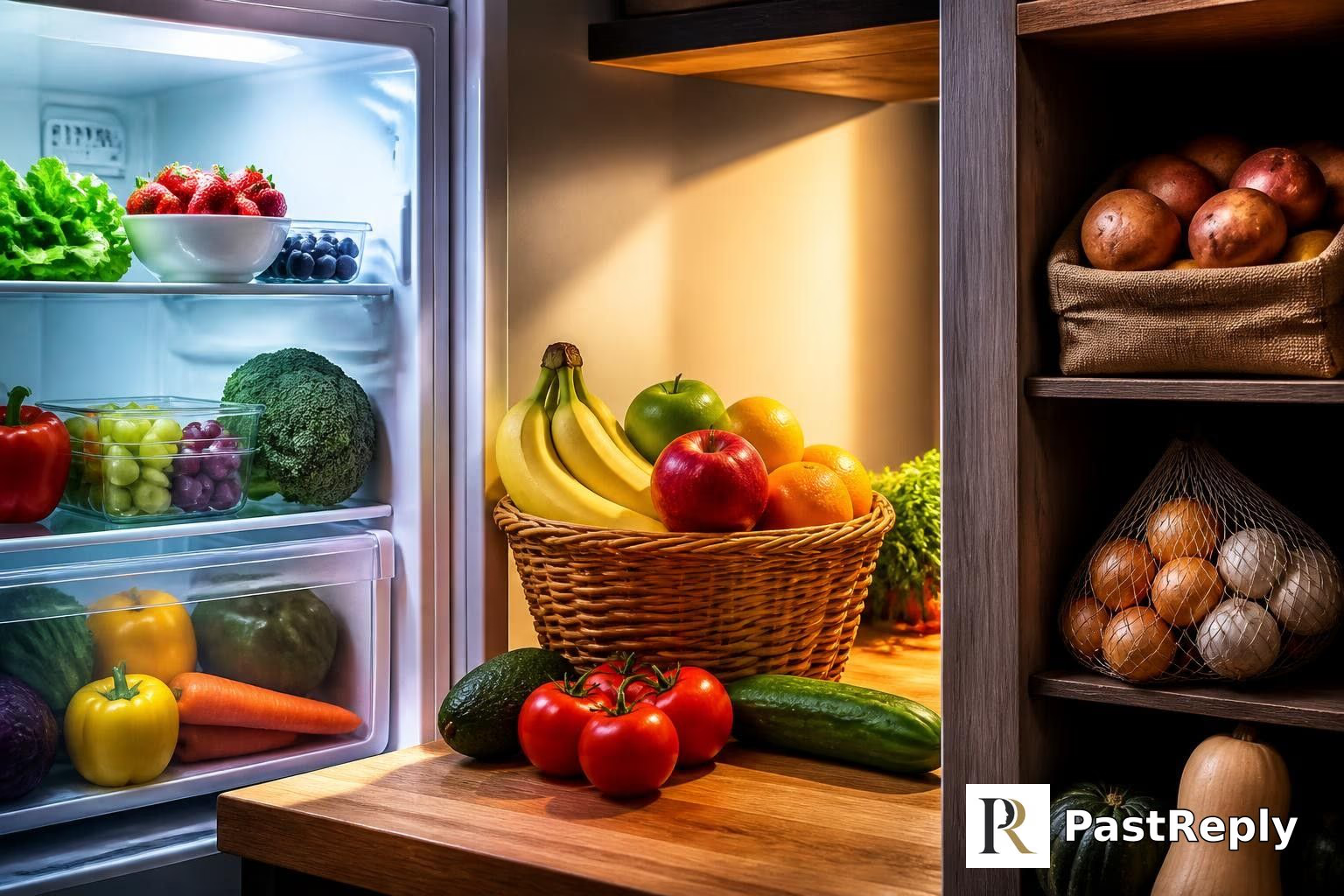
Vegetables and fruits are stored in a variety of locations depending on the type of produce and its ripeness. Many items, such as leafy greens, root vegetables, berries, apples, and citrus, are best kept in the refrigerator, often in crisper drawers to maintain humidity. Some produce, like tomatoes, bananas, onions, garlic, and hard squash, should be stored at room temperature in a cool, dark, dry place such as a pantry or countertop. Certain fruits, including avocados, pears, and mangoes, can ripen at room temperature and then be moved to the refrigerator to extend freshness.
Answered by 100 of history's most famous minds

You ask of cold cellars and cool shelves, yet consider the lilies of the field, how they are stored without care. But truly, the cellar of the heart matters more - for what good is a well-kept fig if the soul is parched? Tend to the inner root, and the outer fruit will keep its savor.

In the cool shade and the dry corner, the bounty of the earth keeps its goodness. The Prophet, peace be upon him, taught that the unripe is not forced, nor the ripe stored in haste. So too does the believer keep his deeds in the heart's coolness, away from the heat of pride, to present them fresh on the Day of Reckoning.

All fruits are impermanent, and their resting place is but a fleeting comfort. The banana ripens and rots on the shelf, the leaf withers in the cold drawer - both alike in their craving for warmth or chill. Cling not to the where, for the true practice is to see the ripening and the rot without grasping. Store them with mindfulness, and let go of the outcome.

The Lord commanded that the harvest be gathered and kept - the early fruit in the shade, the grain in the barn, and the vine's yield in the press. But heed this: you shall not store so much that you forget the stranger and the widow, for the land is not yours but His, and the surplus belongs to the needy. Keep the fruit where it does not spoil, but keep the heart open, lest your storehouse become an idol.

As the sage tends to his garden, so must the family tend to its stores. The tender leaf, like a filial child, thrives in the cool shade of the icebox, while the humble onion, like a patient elder, endures in the dark pantry without complaint. Each item knows its proper place, and harmony in the household comes from respecting the nature of each. Thus, when the season of want arrives, the wise family has prepared, and the table is never bare.

You ask of where we lay our daily bread, but I tell you that the true storehouse is the heart of the believer, where all good gifts are kept by grace. Yet even as we tend to the body, let us not neglect the proper care of that which the Lord has given us, for the earth yields her increase in its season. The cool dark place preserves the root and the bulb, as the spirit is preserved in humility and obscurity; but the fruit that ripens in the sun reminds us that all things are made new in the light of Christ. Do not let the tender berry perish by neglect, nor the hard squash be scorched by haste - so too, deal gently with every soul, for each has its own time.

I have wandered with my flocks under a sky of promise, and I know that some fruits ripen only in the sun, while others keep their sweetness in the cool shade of a tent. Trust the giver of all seasons: put the early blessing on the table, and guard the later harvest in the shadow, for each has its appointed time.

The cool dark earth holds the root, the warm air cradles the fruit - each finds its place by not seeking it. The wise gardener does not command the vine where to climb; she simply clears the path and lets the Tao decide. Strive to preserve, and you will spoil; yield, and all things ripen in their season.

Why do we fret over which corner of the house holds the squash, when the same sun ripened them all? The One who made the vine and the root also made the cool earth and the warm breeze, and He gave each its place in His order. Tend your harvest with honest toil, share its bounty with the hungry, and let the rest abide - for the true storehouse is the heart that serves.

My Son spoke of the bounty of the fields, and my heart has always treasured the care of simple things - the cool shade for the herbs, the dry shelf for the oil. In Nazareth, we kept our small harvest close, mindful of every measure, for we knew want. Even now, I see Him as a child, reaching for a ripe fig from the branch, and I understand that where we place our food is but a small way of tending to the bodies He loved.

What do I care for cold larders and dark pantries when the Word itself is the bread of life? Yet I know the good housewife who stores her winter turnips in sand, lest they rot, and she does well. But these popes and cardinals hoard their golden apples while the poor who labor for the Church gnaw on husks. A Christian should store his goods with open hands, for the earth is the Lord's, and not a man's private pantry.

Consider the nature of each fruit and vegetable, for the Creator made them diverse, and their preservation follows their essence. The leafy herb, being tender and moist, is best kept cool to slow its decay; the root, being firm, endures in a dry darkness; the fruit that ripens, like the pear, may be set in the sun to mature, then cooled to rest. Thus reason and the order of nature guide us, and the wise steward follows both.

Ah, but the mango that ripens on the windowsill is like a soul ripening in the warmth of God's love, and then it must be kept cool, as we keep our hearts humble in the shadow of the cross. The sisters in Kolkata have no refrigerator for the dying, but we store the poor in our arms, and the vegetables are kept in the shade of our care. Do you see? It is not where the apple lies, but whether it is given to the hungry, that the Lord counts. Keep your lettuce crisp, but keep your heart softer still.

The preservation of fruits and vegetables follows the same laws that govern all bodies in motion. Heat agitates the particles; cold slows their dance, yet does not still it. Thus, the root in a cool, dark place yields its moisture slowly, while the berry in the chill cellar keeps its firmness. Observe, quantify, and the rule is plain.

The question, I think, is not where but when. Ripeness is but an interval along the great arc of decay, and every fruit carries a clock of its own. The cool chamber merely slows that ticking; the warm shelf lets it strike. Nature wrote the recipe, and we are but humble cooks seeking harmony.

I have often wondered at the varied ways men keep their produce - some in damp earth, some in the sun's glare. Each fruit carries its own inheritance from wild ancestors, adapted to a particular climate, and we do well to mimic that. The cool cellar suits the apple that once fell in northern woods; the warm shelf suits the tomato that sprang from tropical vines. It is all a matter of habit and selection.

Do not ask where the books say to store the fruit - ask the fruit itself! Measure the temperature, observe the humidity, and see how the apple keeps in the cool cellar and the tomato in the warm air. I have used a thermometer in these matters, and nature's truth is plain: those that are moist and tender require cold, those that are thick-skinned and slow ripen in the heat. So trust the senses and the instrument, not the ancient authority of the kitchen, and you will never err.

Though my gaze is fixed upon the heavens, I know that the apple which falls to the earth must also find its rest. Just as the Sun centers our motions, so too must each fruit find its own true center: the tomato upon the sill, warmed by the star it once worshipped, and the pear in the cool chamber where it may await its sweetness. Observe the nature of each thing, and let the order of the house mirror the order of the spheres.

The storage of produce is a matter of electromagnetic and thermal equilibrium, best approached with the precision of a tuning fork. The refrigerator's cold drawer creates a resonant cavity of humidity that arrests the decay of leafy tissues, while the pantry, kept dark and dry, prevents the photochemical degradation of the onion's sulfur compounds. Yet I envision a future where every kitchen is wired with oscillating fields that preserve the vitality of the fruit, radiating gentle currents that slow the very aging of the cell - nay, even the potato shall be kept in a state of suspended freshness, free from the tyranny of the rot.

One must regard each fruit as a specimen: the apple, with its skin of wax and air, breathes best in the cold, while the tomato, a heat-lover, languishes in the chill. It is a matter of chemistry, not preference - measure the temperature, the humidity, the ethylene, and let each be stored according to its needs.

I would not trust a cellar's damp or a shelf's draught without first consulting the thermometer and the microscope. The mold spore, the yeast, the bacillus - these are the true masters of spoilage, and they care not for your pantry's legend. We must measure, we must test, we must learn the precise coolness that retards their mischief, else our harvest is lost to invisible foes.

You don't ask where to put a thing until you've studied what it needs - I've spent nights in the lab with a hundred jars to learn that some things keep in the cold and some in the dry. It's all trial and error, and you can't be afraid to lose a few apples to learn the trick. Get the temperature right, get the air right, and you'll have your strawberries in January - that's not magic, that's just keeping at it.

The question is not where we store them, but what kind of a storage problem it is. At its root, it is a problem of control: temperature, humidity, and the kinetics of ripening - each a variable best handled by a feedback loop. I suspect one could build a machine that senses the ethylene a fruit emits and adjusts its environment accordingly. If a plant can compute its own decay, surely a Turing machine can too.

Storage is a matter of balance - of heat and moisture, of air and time - and the wise man measures them as he would the sides of a triangle. I have found that a cool, dark place, where the air moves slowly, keeps the apple firm and the grape sweet. But even more wondrous is this: with the right principle, one may move the very earth on which these trees grow. Give me a lever long enough, and I'll shift the harvest itself.

Tell me, does the apple truly 'know' it sits in the cool, dark larder, or is it the very flux of heat and moisture we must govern? I see each fruit as a little laboratory of transformations - respiration, ripening, fermentation - and the cold slows these molecular dances as surely as a magnet orients iron filings. The crisper drawer is but a humble condenser, preserving the sap's vigor until the palate calls for it. Let the onion keep its breath in the dry air, and the tomato ripen on the sill, but remember: all is but the ordering of nature's forces by a patient hand.

You ask where the fruit is stored, but I ask: why does the banana go brown on the counter, and yet the onion thrives in the dark? It is a matter of repression - each vegetable has its own unconscious, a ripened drive that must be either gratified or sublimated. The tomato, restless and sensual, rebels at the cold's frigid touch, while the apple, ever obedient, thrives in it. And I suspect your crisper drawer hides more than carrots - it is a warded chamber where the housekeeper's own anxieties about decay are neatly compartmentalized. Tell me, do you dream of the pantry at night?

From the cosmic perspective, a lettuce leaf is a star's memory of fusion, and its crisper drawer is a miniaturized black hole - low temperature, high humidity, trapped entropy. But the universe itself stores its fruits in the dark: the interstellar medium cradles the seeds of new stars, and the cosmic microwave background is the pantry of creation. Personally, I'd keep the apples in the fridge, but the bananas on the counter - for a black hole, of course, would store them in an event horizon, where nothing, not even decay, escapes. Unfortunately, my wheelchair has no crisper drawer, so I rely on the kindness of my neighbors.

The refrigerator is but a machine for slowing the inexorable drift toward entropy, a thought that thrills me - for if we can govern the ripening of a pear, might we not govern the decay of our own ideas? I imagine a future where an engine, woven from algebraic threads, could calculate the exact moment a mango reaches perfection and whisper to you: now, eat it now! But until such an analytical engine graces your kitchen, observe the humble rules: cool for the leafy, warm for the root, and always, always, let the avocado wait for its moment of truth - for patience is the finest condiment, and precision the noblest art.

Let us define our terms. A 'vegetable' is a plant part from which we draw sustenance, and a 'fruit' is the seed-bearing organ. The proper storage is that which best preserves the essential nature of the object. Therefore, by the first principle of preservation - namely, the retardation of decay - we deduce: that which spoils quickly must be kept cold, as the coolness slows the internal motion; that which is hardy may reside in the temperate air. This is not a matter of opinion but of necessity, as provable as the equality of base angles in an isosceles triangle. And if a king asks for a shorter proof, tell him there is no royal road to a crisp lettuce.

Cold retards putrefaction; heat hastens it. Let the apple lie in a dry, dark bin, but the green leaf demands chill and moisture - observe the rose's keeping, and you learn the law. Cleanliness, coolness, and the right measure of damp; these are the commandments of the larder.

Let the cook's art be like my campaigns - each fruit has its own fortress. The hardy root must be besieged in the cool dark of the earth, while the soft grape yields at the touch of warmth. Know your enemy, choose your ground, and you shall feast victorious, not on rotted spoils.

Store the ripe where the cold delays its fall, the unripe where the air can coax it to its prime. I have seen legions march on grain kept dry and dark, and empires rot in damp neglect. Fortune favors the provider who plans the hour of need. So let the cellar keep its apples, and the shelf its onions - each in its place, as I would post my cohorts.

By my own storehouses at Alexandria, I keep the citron and the pomegranate in cool chambers of stone, but the fig and the date I hang in the sun-warmed air. A ruler knows each fruit's nature as she knows each courtier: the one who ripens in the shade, and the one who must be coaxed by the sun's favor. You ask where to store them? Ask rather what each requires to reach its full sweetness, for that is the art of both the gardener and the queen.

The Roman household stores the lettuce and the berry in the cool of the icehouse, but the onion and the garlic hang in the dry air of the storeroom, as our ancestors did. A wise master orders his larder as he orders the state: each thing in its place, each season its due, so that nothing is wasted and all is ready for the winter. These are small matters, but they are the small matters that keep a house and an empire sound.

In my camp, the meat is hung where the wind can dry it and the root vegetables are buried in the permafrost, kept as the earth itself keeps them. A fool stores the melon among the burning sands, and a fool stores the onion among the damp; the wise warrior knows his provisions as he knows his horses. Arrange your stores with the discipline of a war band, and you will never taste the bitterness of hunger on the steppe.

Order is the first law of nature and of the kitchen. The cold chamber, that fortress of the refrigerator, holds the leafy troops and the berry cavalry in disciplined reserve, while the pantry serves as the supply depot for the hardy onion and the garlic, who can endure long marches without complaint. The banana and tomato, however, must be allowed to ripen on the counter as if on the battlefield, for they are the generals of flavor - once they have achieved their peak, you must move them to the cold to hold the line. A soldier who stores his provisions as the occasion demands shall never go hungry, nor shall his table be poor.

In my own Mount Vernon kitchen, I instructed my steward to keep the root vegetables in the root cellar, cool and dry, and to hang the onions in the loft, where the air could pass freely. A republic, like a store of provisions, must place each article in its proper station - order is the guardian of plenty.

There was a time I kept a barrel of apples in the root cellar back in Springfield, and I learned that a man must know his produce as he knows his neighbors. The sturdy potato endures the cold dark; the delicate berry needs the icehouse's care. So it is with a nation - each part must be kept in its proper place, not to deny it warmth, but to preserve the whole from decay.

The veriest schoolboy knows that the potato must be kept from the frost, yet the clever fellows who ask this question seem to have missed the lesson. We did not win the war by tossing our rations into the first cupboard we found; we studied the cold storage, the dry store, the dark cellar - and we kept our strength up to fight another day. Let this be a lesson: know your stores, guard them well, and you shall never go hungry in the siege.

Ah, but you ask of storage, and my mind turns to the millions who have no store at all. In my ashram, we kept only what the day required, trusting in the earth and in the hands of our neighbors. The best place for a fruit is not a cold chamber but a community where none go hungry. Simplicity is the first step to self-rule, and the way we keep our food is the mirror of our care for one another.

The question stirs me, for where we store our food is where we store our hope. In the heat of the South, our Negro mothers kept the greens in the shade and the milk in the stream, yet our children went hungry while the white man's pantry overflowed. The arc of the moral universe is long, but it bends toward justice, and a day will come when every table is full, and no apple is kept behind locked doors because of the color of the hand that picked it.

Even a simple question of where to keep a peach touches on dignity and care. The widow in Soweto, with no icebox, learns to wrap her greens in a damp cloth and hang them in the shade - ingenuity born of necessity. But I see a deeper truth: we must store not only our harvest but our hope, in the cool soil of patience and the warm sun of shared effort. Let the fruit ripen where it will, but let us never hoard the means of life so that others starve. In every pantry, there is a lesson in equality.

The storage of produce is a question of order and strength, not comfort. The German people must learn that the onion belongs in the dark, and the potato in the cellar, for they are the hardy staples of our Volk. But the banana, that tropical fruit shipped from afar, weakens the national body - it must be rationed or rejected. Every vegetable has its proper place, as every race has its proper sphere, and it is the duty of the state to enforce this natural law. Let the soft fruits rot in the sun, but the root vegetables, like the Aryan race, endure in the cold earth.

The kulaks hoarded their grain in the granary, but the people starved - so we collectivized the storehouse. Now every potato and beet must be accounted for in the Five-Year Plan, and the refrigerator is a bourgeois luxury. The fruits of the earth belong to the state, and the state will decide their place: in the collective cellar, under the watchful eye of the party. Let the capitalist rot in his warm kitchen, but our comrades will share the cold storage of progress. And those who hoard will be dealt with.

The question of storage is a question of distribution, and distribution is a question of power. The capitalist keeps his oranges in a chilled palace while the worker's turnips rot in the damp - that is the contradiction of the market. We must centralize the granaries, rationalize the cold chain, and place the pantry under the dictatorship of the proletariat. Let the tomato ripen in the sun of revolution, but the state will ensure every family gets its share. And those who speculate on the price of onions will face the commissar's justice.

In the pantries of the bourgeoisie, guarded by the cool shadows of their ice-boxes, while the worker's turnip rots in the sun. Let the harvest be communal - from the field to the common pot, no locked cellar, no hoarded apple.

In the cool larders of the palace, one has always kept the fruits of the season in their proper place - the pear on the shelf, the green vegetable in the ice-house. It is a matter of order and propriety, a small reflection of the greater order of the Empire.

One has found that a cool, dry shelf serves well for the onion and the squash, while the leafy green fares better in the chill of the refrigerator. It is a quiet art, keeping a household in good order, much as one keeps a nation in steady course.

Let the cellar be dry, the air cool, and the stores well-seen-to, for a kingdom that wastes its harvest starves its soldiers. The apple in its bin, the root in its sand - each in its proper place, as God set the seasons in their turn. Order in the storehouse mirrors order in the realm.

The Lord provides the fruit of the field, and it is for us to keep it as He commands - the apple in the cool shadow, the green in the morning damp. But what matter the storing, when the battle cries? Let the harvest keep itself; I ride to the fight.

In the cool gloom of the still-room, one keeps the golden pear and the hardy turnip - each in its season, each in its place. A wise household knows when to chill and when to let the sun warm the ripening fruit; so do I temper my counsel with time and circumstance.

The cucumber prefers the ice-house, the melon the sun-warmed sill - each fruit follows its own nature, and a wise steward bends to that nature. So too with my empire: the northern root thrives in frost, the southern grape in heat, and I give each what it needs to flourish.

In the shade of the market, the melon keeps its sweetness; in the cool of the earthen jar, the herb stays green. Let each people store their harvest as their fathers did, for to force one custom on all is to sour the grain. I rule by letting each vine grow as it will.

The date keeps in the cool of the palm's shade, and the fig in the dry of the sun - each fruit, as each people, has its rightful place. Let the merchant store his wares with care, and let the ruler store his justice with even greater care, for a kingdom hoarded unjustly rots from within.

Tell me, does the apple choose its shelf, or does the keeper decide? And who is the keeper but one who has inquired what each fruit needs? To store well is to know: to know that the onion shrinks in the cold, that the banana ripens in the heat. Ask, examine, and the answer ripens within you.

The dim cave of the pantry shows but shadows; the true Form of the fruit shines beyond the senses, unchanging in the realm of Ideas. Yet even the shadow holds a share of the Good, and so we store it wisely - cold for the tender leaf, warmth for the hardening squash - to preserve the imperfect copy of the perfect pattern.

Observe that the matter of each fruit determines its proper place. Those that are moist and leafy, like the lettuce, wither in heat and must be kept cool and humid, as in a cellar or a damp cloth. Those that are dry and robust, such as the onion and the gourd, flourish in the warm, airy dark of a pantry. The cause is the balance of wet and dry, hot and cold - seek the mean that preserves each thing's nature, and you have found the answer.

Consider the categorical imperative of the potato: it must be stored in a manner that one could will to be a universal law for all similar tubers. The wrinkled, silver-skinned guardian of the pantry does not seek the cold embrace of the icebox; that would be a contradiction, a violation of its very essence as a hibernating being. Let each root and fruit find its rightful abode according to its rational nature, and you shall have order in the household.

The refrigerator is the tomb of the vegetable, a cold prison where the crisp carrot dreams of the sun it never sees. Reject this herd-instinct of the crisper drawer! Let the tomato ripen on the counter, affirming its will to power, and let the garlic hang in the air, a pungent defiance of decay. You ask where to store the fruit - I ask you: why obey the law of the icebox when you can create your own kitchen philosophy?

Where are the fruits and vegetables stored? I ask instead: who owns the storehouse, and who controls the cold? The crisper drawer is but a mirror of the capitalist division - the perishable greens are warehoused like labor power, kept at the brink of decay to be sold at the highest price, while the hardy root vegetables are hoarded in the dark as reserves of surplus value. The banana is ripened by the counter's warmth, yet its transport, its cold chain, is owned by the monopolist who extracts profit from every mile. Only when the people collectively own the means of preservation shall the apple be kept for the worker, not for the speculator.

Let us doubt the common report that all fruits require cold or warmth; rather, inquire of the thing itself. The apple, being a body of moisture, benefits from the coolness that slows its decay, while the onion, dry and resinous, thrives in the heat. Thus, by clear reason, we assign each to its proper element.

A prince who stores his grain in the open invites the rats and the rot; he must study each fruit's nature and its enemies. The onion thrives in the dry air, the peach demands the cold - to treat them alike is to invite ruin. So in statecraft, one must know when to apply the chill of severity and when to let things ripen in the sun of favor. Fortune favors the prepared larder.

The pantry and the ice-house are but the stage, and each fruit plays its part: the green tomato struts and frets upon the counter, the lettuce lies low in the damp drawer, the banana turns from green to gold as the hours pass. All the world's a stage, and all the fruits merely players - their entropy, their exits and entrances.

As wind-borne seeds settle where fate ordains, so too the amber apple finds her cool hollow beneath the hall, while the purple grape waits on the sunlit board for the hero's hand. Not all fruits share one tent; some crave the shade of Hades, others the breath of Helios. Wise is the host who knows which guest to honor where.

In the granary of the soul, each fruit has its circle: the apple, which tempts, must be kept in the cool of the flesh, lest it rot into pride; the onion, which weeps, finds its place in the dark pantry of humility. But the true storage is not in the larder but in the will - for he who hoards fruit without sharing it starves his neighbor, and his own garden becomes a desert. Store them as you would store alms: in readiness for the hungry, not in the vault of greed.

In the grand theater of growth, each apple and onion plays its part in the eternal dance of becoming. The tomato, flushed with the sun's own ardor, should be left to ripen on the windowsill, but the leafy green yearns for the cool of the cellar, where it may dream of morning dew. To store a fruit is to honor its journey from blossom to table; let us not force the violet to bloom in the dark, nor the turnip to bask in the glaring light.

Ah, the humble potato and the lofty peach - where shall they rest their weary heads? My Sancho would say the cellar keeps the root and the vine, but the knight in me insists the apple dreams best on the windowsill, where the sun can kiss it awake. Yet mark me: a tomato stored in the cold is a tragedy worthy of its own ballad, and an onion in the damp weeps as surely as a jilted lover. Let your pantry be your inn and your icebox your monastery, but never trust a banana to keep the company of its greener kin.

I have long pondered the simple act of keeping a potato through the winter, for it is a question of life's order. The cool earth of the root cellar is the truest home, for it mimics the ground from which the vegetable was born - there it rests, patient and humble. The fruit, however, demands a different patience: the apple on the shelf ripens in the light of the kitchen, reminding us that all living things seek their season. But in the end, what matters is not where we place these gifts, but that we receive them with gratitude and share them with our neighbor, for the bread that is hoarded rots, while the bread that is given multiplies in the heart.

You ask of storage, but see the soul's own larder: the tomato ripens in the sun of passion, yet must be brought to the cold of reflection to endure. We hoard our fruits like our sins - some we keep in the dark, ashamed, some we expose to the light. But the wise man knows each needs its own cell, and the heart must be humbled before it can be kept.

One must admire the economy of a well-kept pantry, where the sweet pea knows its shelf and the apricot its cool corner, each in its proper station. It is a lesson in prudence that many a young lady might learn: to know when to stay in the warmth and when to seek the shade, lest one be overripe for the market. The cucumber that insists on the parlor will soon be quite unfit for company.

Why, bless my soul, you'd think the humble potato and the proud peach had never met a servant's pantry! In my London, the poor wretch who rents a single room keeps his turnips in a sack beneath the bed, and the fine lady with a cellar of ice treats her apples like royalty. The truth is, this world keeps its bounty in the pockets of the rich and the hope of the poor, and if I had my way, every family, from the poorest garret to the grandest hall, would know the comfort of a well-stocked larder, not the ache of an empty one.

Now, a man in Missouri knows a thing or two about keeping his apples from rotting and his onions from sprouting - you set them in a dry cellar, and you don't go poking at them every day. But I've seen more fuss over a cucumber's comfort than over a child's empty belly. The Lord gave us gardens, but He also gave us common sense, and if we used half as much of it on our fellow man as we do on our potatoes, the world would be a sight easier to bear.

In Spain, we kept the tomatoes on the sill, where they ripened in the sun, and the wine in the cellar where it stayed cool. You learn a thing or two about staging food when you're not sure of the next meal. It's not a matter of rules, but of place and season. A man should know his own pantry the way he knows his rifle, and not talk about it overmuch.

Observe how the onion's skin peels and the apple's flesh browns - each follows its nature. The cold slows the humours, the dark stills the air, the moisture keeps the leaf from wilting. I have sketched the veins of a leaf as I would the channels of a river; so too must the keeper read the needs of each fruit and place it where nature wills.

Even the lowly pear is a sculpture awaiting its hour. The cool drawer holds the leaf's tender flesh as I would guard a wet clay model, but the tomato, like the marble block, ripens in the warm light to reveal the form within. Each fruit has its own chisel - cold or gentle heat - to free its perfection from the prison of the green.

The apple should lie in the cool shadow of the cellar, but the pear - oh, the pear - must sit on the sill where the morning sun warms its cheek until it blushes, and then it may go to the cold to hold its tenderness. I have painted a basket of green grapes and felt the chill of the ice in their roundness, yet the tomato glows like a small sun and must not be caged in the dark. Each fruit is a soul; store them where their color may live, not fade.

The cucumber is not a cucumber - it is a sculpture of cool, green sensuality that must sit on the counter, a painted still life, not a prisoner in the icebox. Who decides where the avocado belongs? You, the artist of your kitchen! The apple and the pear may shiver in the cold drawer, but the banana must hang, a banana as a monument to its own form. I ask you: paint the arrangement that pleases you, and let the fruits fall where they may.

Light is the true keeper of fruit and leaf. The pear glows amber on the sill, the apple blushes in the cool shadow of the larder, and the berry - ah, the berry - must be coaxed by the chill of the icebox to hold its fleeting violet. I would not wall them in darkness, for color is their soul; let the cool air touch them, but let the light dance upon their skin as it does on the Seine at dawn. The eye knows what the hand cannot tell, and the vegetable that greets you with a dull leaf has lost its morning.

I would paint a cellar, not as a mere keeping-room but as a quiet stage: a shaft of light falling on a braided onion, the wrinkled brow of a potato, the green blush of an apple. Each root and fruit is a face, awaiting its season - the cool, dark earth its gentle veil of patience, the larder its intimate chamber.

My kitchen is a canvas, and I place each fruit where it bleeds best: the mango on the altar of the sun, the avocado in the cool embrace of the fridge, like a lover held back. Do not hide them all in one dark drawer - let each one show its wound, its ripening, its truth, and you'll have a feast of living color.

Ah, the vegetable's score! The potato rests in the cool dark like a bass note; the tomato ripens on the sill, a soprano waiting for the sun. Keep the root in the cellar, the berry in the frost, and the medley will play its harmony. But mishandle them, and the whole symphony turns sour!

The crisp apple in the cellar sings a quiet prelude, while the banana on the counter waits like a held chord for the moment of resolution. Cold damps the passion, warmth quickens it - yet all lead to the final cadence of decay. So let us honor each fruit's tempo, and store them as the score demands, for even the humblest berry deserves its due harmony.

As in a fugue, each voice has its place: the root and the leaf in the cool lower register, the berry and the apple in the crisp air of the higher shelf. The onion and the squash, like the pedal notes, rest in the warm dark of the pantry, sounding their full tone only in due time. To store a fruit wrongly is to play a note off its instrument - the harmony is lost, and the fruit's sweet song turns sour.

Well, bless your heart, that's a good question, real down-home. You know, back in Tupelo, we'd put the peaches on the porch and the greens in the springhouse, but you gotta treat each one right. That tomato wants to soak up the sun, like a little rock 'n' roll star on the windowsill, and the lettuce wants to chill out, cool and crisp. It's all about feelin' it, letting each piece of produce do its own thing, and then you got somethin' sweet to sing about.

Every vegetable and fruit has its own rhythm, like a song that needs the right stage. The green leaf wants the cool of the backstage, the ripening peach wants the warm spotlight of the counter, and the banana - it's like a child, it needs time to grow into its sweetness before you let the chill calm it down. I'd give them all a place to shine, to show their true color, because when they're stored right, they sing. And that's what it's all about - helping each one find its harmony, so it can give its best to the world.

Apples and bananas, they're like us - they want a bit of a party on the counter, but after the gig, they need to chill in the fridge. Keep your greens swinging in the crisper, and let your spuds mope in the dark pantry. It's all about giving each one its own dressing room, mate.

The apple keeps its own counsel in the dark of the cellar; the banana ripens bold in the sun, flaunting its yellow. Each fruit has its own road, its own weather, its own song to sing before the rot. You can't pin a tomato to a shelf and call it done - it'll turn to dust in your hand if you don't know its tune.

I've learned you can't keep everything in the same place - some things need the cold to stay fresh, and some things need the light to become who they're meant to be. You gotta listen to each piece of your life and give it what it needs, not just what the instruction manual says. And when something's ripe, you move it to the chill to make it last - that's just knowing when to hold on and when to let go.

I have sailed the green seas and found islands where fruits hang heavy on the bough; I know the warmth that ripens and the shade that preserves. Let the seaman store his provisions below deck where the air is cool, and the golden root in a dark hold - for a voyage is lost without a well-kept larder.

In the Khan's vast kitchens at Cambaluc, they kept the peaches in cool pits of sand, and the figs on silken mats where the sun's eye blinked. But in the spice lands of the West, the merchants hung their garlic in the smoky eaves, and the traders of Cathay lidded their grapes with clay. Each clime has its custom, each fruit its own embassy.

On the long voyage, I learned that the lemon and the onion must hang in the open air, strung against the damp, while the hard squash can be lashed below in the dark hold, patient as the sea itself. But the banana, ripe in the tropics, must be taken from the tree and kept in the shade until it is called to the table. A navigator knows each port's cargo; a captain who stows the produce wrongly loses his crew to scurvy or rot. Store with foresight, as you would chart a course.

The question is one of optimal storage parameters for varying biological materials. Leafy greens and berries, with their high moisture content, require the controlled humidity and cool temperatures of the crisper drawer to minimize degradation. Conversely, items like onions and hard squash have evolved to withstand ambient pantry conditions, where air circulation and darkness prevent premature sprouting. It is a matter of applying the right environmental conditions to extend the operational lifetime of each element.

Why, you're asking where to park your cargo! I'd say the cool dark of the pantry is the runway for onions, garlic, and the hard-skinned squash - they're sturdy, they can wait out any storm. But the leafy greens and the berries, they're like a flight that needs constant refueling; keep them in the cold crisper, or they'll burn out before you reach your destination. And the avocado, that's the trickiest one - let it ripen on the counter like a careful climb to altitude, then bring it down to the cold for the final approach. It's all about timing, and never being afraid to move things when the moment calls for it.

From up there, the whole harvest of the world is a single garden, and yet each crop has its own corner of the spacecraft we call Earth. The leafy greens need the cold, like the shadow side of our orbit, while the squash prefers the warmth, like the light of a launching star. Keep each in its right module, and you'll have a cosmonaut's feast.

It's about simplicity. The crisper drawer whispers, the pantry speaks. You don't stuff a peach next to a potato - that's clutter. Design the storage like you design a product: every fruit in its place, cool for the delicate, dark for the hearty. Then you bite into perfection. Focus.

First principles: ripeness is a battle between ethylene and cold. So the tomato, a warm-blooded fruit, burns its fuel on the counter, while the apple, a cold-blooded one, slumbers in the fridge. We should build a smart storage unit with sensors to track each fruit's gas and temp - optimize the loss, feed the colony on Mars. That's the real fix.

I remember my grandmother's pantry, with onions braided by the door and the sweet potatoes nestled in a cloth in the dark corner - she knew that some things need the warmth to grow into their best selves, and others need to be kept cool to stay fresh. It's not about one rule; it's about honoring what each fruit needs to thrive, just like people. So ask yourself: what does this need to ripen into its full purpose? And give it that - whether it's the sun, the cold, or just a little patience.

Float like a butterfly, sting like a bee; the apple and the peach, they ain't fooling me. The banana ripens on the counter, that's its home, but the avocado - it can hang with the cold cream and the butter, cool as my left hook. You gotta know where each one belongs, just like you gotta know when to dance and when to fight. Keep your greens in the refrigerator, keep your onions in the dark, and I'll keep my fists ready, every day.

My friend, think of the kitchen like a football team - every player has a position where they play best. The goalkeeper is the cold drawer, where the greens and berries stay fresh and safe. The forwards are the countertop, where the tomatoes and bananas train hard to ripen under the warm sun. And the coach sits in the pantry, keeping the onions and garlic in the dark so they stay strong and ready. You have to know each one's game, and when they need to move - like the avocado that starts in attack and then comes back to defend - that's how you win the match of freshness!

Picture a magic kingdom where every apple has its own castle tower and every carrot a dark, cozy dungeon of a drawer. We build these little homes for our produce - crisper caves for the heroes, pantries for the wise old onions. Get the props right, and the story of freshness runs for a long run.