
When did movies start in India?
Indian cinema began in 1913 with Dadasaheb Phalke's silent film 'Raja Harishchandra,' the first Indian feature film.
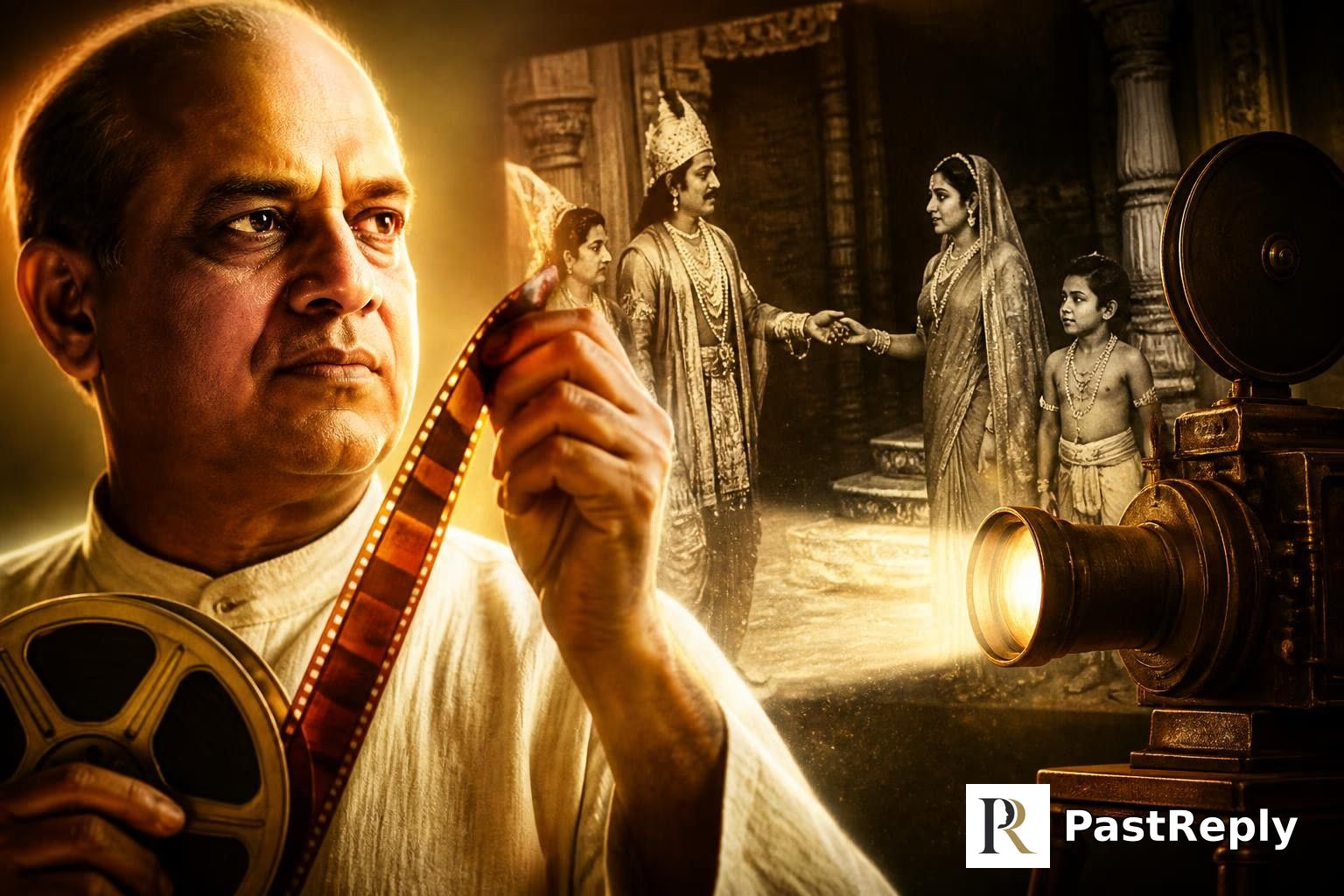
The facts
Movies in India began in 1913 with the release of the silent feature film *Raja Harishchandra*, directed by Dadasaheb Phalke. This is widely recognized as the first full-length Indian film, marking the birth of the Indian film industry. Earlier, in 1912, *Shree Pundalik* was released, but it is generally considered a recording of a stage play rather than a true cinematic production, as it was filmed by a British cameraman and processed in London.
The silent era lasted until 1931, when the first Indian sound film, *Alam Ara*, was released, revolutionizing the industry. Prior to feature films, short films and documentaries were made in India, such as S. Bhatavdekar's 1899 recording of a wrestling match, which was the first film shot by an Indian.
Answered by 100 of history's most famous minds

A man sets shadows dancing on a white sheet, telling a story of a king who lost everything for truth. You ask when this began, but look instead at the hearts that hunger for such tales. The first moving picture was never on a screen - it was the light of understanding dawning in a darkened soul.

A wrestler's shadow, a king's tale - these flickering images are but playthings. What matters is not when they began, but what they teach. If a moving picture calls men to justice, charity, and remembrance of the One God, then it is a blessing. If it turns hearts toward vanity and falsehood, then its birth is a calamity, however old. Judge a thing by its fruit, not by its year.

A flickering image of a king who gives up his throne for truth - that is a tale that points to the nature of suffering and release. The year is a mark, but the beginning is not in the calendar. The first Indian film, like all phenomena, arose from conditions: a man with a vision, a machine, and a story of renunciation. Whether it was 1913 or earlier, the question is not of dates but of how the mind clings to these shadows. Do not cling; see them as passing forms, and seek the light beyond.

The Lord commanded, 'You shall not make for yourself a graven image.' But these are not graven - they are shadows that pass. Yet the heart is easily led astray by what the eye sees. That first story of a righteous king who lost all and kept his word - that echoes the covenant. But beware: images can become idols even without stone or gold. Let the tale serve the Law, not replace it.

The worth of any beginning lies not in the year of its birth but in the virtue it cultivates. I have not seen these moving pictures, but I am told they tell stories of kings and gods and common folk. If they teach filial piety, if they show the consequences of deceit and the rewards of sincerity, then their start in 1913 was a good start. But if they merely amuse, they are no better than the jester's dance at the court of Lu.

They made a moving image of a righteous king, but the true light came later - the story of a King of kings crucified and risen, preached in every tongue. From a silent shadow to the sound of good news: that is the only projection that saves. Let every screen be a pillar of cloud by day.

The Lord God who called me from Ur and promised a great nation - He also gave men the skill to capture moving shadows. In 1913, a man named Phalke made a film of a righteous king who kept his word though his world fell apart. That is a story worthy of the covenant: truth held fast through sacrifice.

A painted ox painted by a brush that is not the hand - does it need a year? The one who saw shadows move on a wall and called it first earned no name. Better to watch the real river flow than count the hours of its imitation.

The One who made the sun and the moon also gave breath to the shadow-players. But before the king in the picture, there were already moving images - the wheel of creation turning every second. Phalke's work was a new lamp, but the light is the same that shines on all, if we have eyes to see.

It is a strange and wonderful thing, this new art of moving shadows. My Son also taught through stories that the common eye could see and the humble ear could receive. I remember when He told the parable of the sower, and the seed that fell on good soil - perhaps these flickering images are a new kind of seed, scattered across the world. I pray that those who make them remember that a story can lift up the lowly and fill the hungry with good things, as my soul magnifies the Lord.

I am told that in India the art of moving pictures began in the year 1913 with a story from their ancient scriptures, a tale of a king who suffered for truth. But I must ask: does this new invention preach the pure Word of God, or the dreams of men? In our own lands, the papists fill their churches with images and statues that lead the simple astray, turning faith into a spectacle. If these motion pictures are used to dazzle the eye and distract the soul from the plain truth of the Gospel, they are an abomination. But if they can be made to tell the stories of the faithful, to teach the fear of God and the promise of grace, then they may be a tool, like the printing press, for the liberation of consciences. Let every picture be tested by Scripture alone.

The question concerns the origin of moving pictures on the Indian subcontinent. To answer rightly, we must distinguish: the first film shot by an Indian appears to have been a documentary of a wrestling contest, made in 1899. That is a record, not a narrative. The first film that truly told a story, that shaped images into a moral argument, was *Raja Harishchandra* in 1913. And here we see a natural harmony: the first story told in this new art was a parable of truth under trial. That suggests a proper order of things - art serving truth. For as the senses are the gateway to the intellect, and the intellect to the soul, so images can lead the mind to virtue. Let those who make these pictures remember that they are teachers in a great school.

A film is like a long look into the face of the poor - if it makes us see the one nobody sees. In that first picture, a king loses his throne and his family, yet holds to truth. That is beautiful. But the real drama happens in the quiet corners of the city, where a dying man receives a cup of water or a smile. Let the cinema remind us to love the one beside us.

The motion of light upon a wall, captured by a turning drum or a chemical plate, obeys laws as precise as those governing the planets. To know the first such performance in that land, one must examine the documentary record: a wrestling match filmed in '99, then a staged play in '12, and finally a crafted narrative in '13. The dates are mere bookmarks in a chain of optical experiments and chemical reactions.

The first Indian film was cast not in a lab of lenses and sprockets but in a world of painted gods and wooden stages, yet it stumbled at first. The true beginning - *Raja Harishchandra* - did not merely record a play like its predecessor; it wove light and shadow into a new story, a first principle of Indian cinema. The wonder is that a single man, Phalke, grasped that the medium could be more than a recording - it could create its own reality, much like the thought experiments we use to reveal the universe's laws.

The first Indian film, like the first finch on a remote island, was a modest beginning that branched into a vast and varied family. The year 1913 marks the true birth - a full-length feature, not merely a recording of a stage performance. The earlier specimen, *Shree Pundalik*, was a hybrid, a missing link between theater and cinema, but it lacked the independent life that Phalke's *Raja Harishchandra* achieved. Over time, natural selection - driven by language, audience, and technology - shaped this new art into a rich and diverse ecosystem.

A moving picture of a story? That is mere trickery with a lens and sunlight. The true marvel is that someone finally understood that the eye can be fooled into seeing motion where there is only stillness - persistence of vision, they call it now. I would have used such a device to show the moons of Jupiter circling Jove, not a king's fable. But I suppose even a fable is better than the Church's dogmas that refuse to look through the telescope at all.

I observe that the first Indian film, *Raja Harishchandra*, was completed in the year 1913 of the common era, a full four centuries after my own *De Revolutionibus* first set the Earth in motion. Yet there is a parallel: just as I sought a simpler, more elegant arrangement for the heavens, so did Phalke seek a simpler, more direct way to bring stories to the people. One might call it a heliocentric art - the story, not the stage, at the center.

A silent flicker in 1913 - quaint, crude, a mere toy of shadow and light. But I had already dreamed of transmitting images through the ether, of a world where every home is a theater and every mind a stage. They scratched the surface; I could have electrified the very air with moving visions.

A laboratory of light, a chemical reaction fixed on a strip - the cinema is a child of observation and invention. In 1913, Dadasaheb Phalke applied patience and method to produce *Raja Harishchandra*, a recorded experiment that proved India could master this new medium. I admire such persistent inquiry.

In 1913, Phalke turned a lens on a fable, but the true birth was earlier: in 1899, when Bhatavdekar recorded a wrestling match, he captured the first microbe of Indian cinema on a plate. One must examine these early cultures as carefully as I examined the silk worm's disease; only then does the lineage of the art become clear.

Phalke watched a silent film about the life of Christ and said, 'I can do that for India.' So he sold his printing press, built a studio in his backyard, and shot 57,000 feet of film. That is exactly how it should be done - see a need, sweat through it, and make a product that works.

The question of when movies 'started' in India is a matter of definition. Is a film merely a celluloid record of a continuous event, like Bhatavdekar's match in 1899? Then India's first motion picture predates the feature. Or does 'movie' imply a constructed narrative? If so, we must ask what distinguishes a filmed stage play from a cinematic work. My own rule: a movie is a sequence of images that computes a story in the mind of the viewer. By that metric, *Raja Harishchandra* in 1913 is the first true output - a deliberate program, not a mere tracing of reality. The first Indian cameraman shot a machine, not a man; but the first Indian filmmaker shot a universe.

If I understand this matter, the first Indian motion picture - a recording of bodies in motion, a series of images ordered in time - was a wrestler's contest, shot in 1899. That is a beginning, but it is merely a record, not a construction. The true art, the making of a story from moving shadows, came later, in 1913. It is as if someone had recorded a falling stone and called it a proof of the law of motion; no, the proof is the principle that explains all falling stones. This Phalke understood: he did not just capture reality, he composed it. He gave India a lever long enough to move the world - a machine that can hold a thousand stories in its belly and project them onto the wall of the cave, like shadows that speak truth.

A beam of light persisting through a darkened room - that is what they have done. First a flicker of a wrestling match on a screen, then a proper tale set in motion, frame by frame, like lines of magnetic force circling a wire. The year 1913, they say, when a man named Phalke wound his crank and brought a king's story to life. It is not the spark itself but the unseen field it generates - an idea that would surge and multiply, illuminating a whole subcontinent.

What is a moving picture but a dream projected onto a wall - a collective fantasy that stirs hidden desires? That first Indian film, a moral tale about a king tested by truth, is no accident: it allows the audience to sublimate their own forbidden wishes for power and loss under a cloak of piety. The real beginning was not the camera but the unconscious yearning for a shared illusion, a waking dream to master our instincts.

The first Indian film flickered into existence in 1913, a full 58 years after I was born - which, given my condition, is a cosmic blink. Phalke's *Raja Harishchandra* was silent, but it spoke volumes about the human need to tell stories. From a physics perspective, film is just a series of still images presented fast enough to fool the brain - a useful illusion, like the arrow in Zeno's paradox. But unlike a black hole, this one let information escape.

What a wonder - to capture light and time on a strip of celluloid, weaving a narrative that unspools before the eye. That first Indian film in 1913 was a series of fixed images made to dance, much like the punched cards I imagined for the Analytical Engine. But consider: if a machine can manipulate not only numbers but symbols, then film is merely a crude precursor. One day, the engine itself will generate moving pictures from pure calculation - a geometry of light born of algebra.

Let us define our terms. A 'film' is a sequence of images projected to simulate motion. The question asks for a beginning - a first point, like the first postulate in a proof. In India, that first point is the year 1913, when a man named Phalke constructed a moving picture called *Raja Harishchandra*. From that axiom, the entire edifice of Indian cinema follows by necessary steps. Q.E.D.

If we are to speak of the beginnings, let us be precise: in 1913 Mr. Phalke projected a story onto a screen, yet I care less for the tale than for the conditions of that dark, crowded hall. Was the air foul? Were the seats clean? Did the audience leave with their lungs irritated? The true birth of moving pictures in India is not a date but a lesson in sanitation - were the reels stored free of filth, and the viewers spared the spread of disease?

A puppet show for merchants and moneychangers? I conquered a hundred cities before these people learned to flicker shadows on a sheet. One man with a crank and a box claims to have begun an era? Let him prove it by marching his shadows into battle, else they are only idle dreams for idle men.

Let the Greeks talk of beginnings. Rome conquered worlds without moving pictures. But if you ask when India's shadow-shows began, I say: the year a man named Phalke dared to act like a Caesar - he took a strange new art, seized it, and made it his own. 1913: that is the date of a victory, the first triumph in a long campaign of imagination. I would have recognized his ambition and rewarded his audacity.

By Isis, they spin shadows on a wall and call it a story? In my Alexandria, we had living tableaux at the Serapeum - priests enacting the death of Osiris before thousands. But this... a flat ghost moving without a voice, without incense or music? It is a toy for children. If I had such a device, I would use it to show the Senate my face in every province at once, before they could sharpen their daggers.

The Greeks had theaters; the Romans built amphitheaters. Now a man in a dusty province projects a king's story on a sheet. It is a novelty, but novelties fade. I would be more interested in how it can serve the state - are these images used to glorify the emperor? To teach obedience? If it merely amuses, it is less than a chariot race. Let me see its utility over ten years, not its first bloom.

The first moving picture in Hindustan was shown in the year of the Ox, 1913, by a man named Phalke. He gathered a tribe of actors and craftsmen and told them a story of a king who kept his word even when it cost him everything - that is a tale worthy of a Mongol. Some say an earlier picture was made, but it was like a shadow-play recorded by a foreigner, not a true arrow loosed from the Indian bow. Phalke's arrow struck the target.

1913 - two years before Waterloo? No, that's my exile. The point: a few enterprising souls projected a king's tale onto a screen, and a new empire was born. I would have turned that flicker into a legion of images, marching to conquer the imagination of every soul from Bengal to Bombay. A pity I never saw it - I would have made it a weapon.

The birth of a national art is a matter of sober reflection. In 1913, a single film - *Raja Harishchandra* - became the first stone of what would become a vast edifice of Indian storytelling. It is well that a people should see their own virtues and histories upon the screen, as long as they remain mindful of virtue itself.

I recall once reading about a lantern show in the Patent Office - a few flickering pictures of a stage play. But it was a man named Phalke, of Nashik, who took the real risk: he mortgaged his life insurance to tell the story of a truthful king on a silver screen. That sounds like the sort of venture that might have a future.

The first full-length Indian motion picture, *Raja Harishchandra*, emerged in 1913 - a silent epic of truth-telling and endurance, as if the nation itself were rehearsing for its long march toward freedom. We may mock such flickering shadows, but they stir the blood more than any number of despatches from the front.

I have heard of these moving pictures, and my heart is troubled and hopeful in equal measure. The art of telling stories is ancient, whether through song, dance, or sacred text. Now, with this new invention, India's tales can reach every village, every home. But I ask: what stories will they tell? If they serve greed, violence, and false glory, they will be poison. If they serve truth, simplicity, and the uplift of the poorest, they can be a force for good - like the spinning wheel, a tool for swaraj. Let the first film, *Raja Harishchandra*, be a beacon: a king who kept truth even when stripped of all. Let our moving pictures teach ahimsa and satya, not worldly dazzlement.

When *Raja Harishchandra* flickered to life in 1913, India began to tell its own story to itself through a new medium. This was a beginning of great potential. For a people long silenced, film became a voice: to speak of truth, of sacrifice, of the struggle for justice. I have seen how images can stir the soul toward freedom. The arc of that first Indian movie, like the arc of the moral universe, bends toward truth. But we must be vigilant: the medium can also be used to lull the conscience or to inflame division. Let every Indian film remember the king who kept his word even when stripped of all - for that is the soul of a people who refuse to surrender to tyranny.

I think of the power of a story told in light and shadow - how it can unite a people or keep them divided. When that first film flickered into being in 1913, it was like a seed planted in soil that would one day yield a forest of voices. For a nation struggling to find its own image, the moving picture became a mirror - and a hammer - for identity. I welcome any art that lets the humblest see themselves as heroes of their own tale.

The cinema is a weapon, not a toy. Whoever controls the moving image shapes the will of the people. In 1913, the Indians began to forge their own lens - but without the discipline of racial purity and national destiny, such art becomes poison. A proper film industry must serve the Volk, not degenerate cosmopolitan fantasies. Mark my words: the nation that masters this medium will master the world.

The cinema is the most powerful tool for educating the masses - and for crushing the bourgeoisie. The Indians began their film industry in 1913, under British rule, which means their first films were tainted by colonial sentiment. When we took power, we understood that every frame must serve the Party. A film that does not advance the revolution is a counterrevolutionary act. Let them learn from our example: the projector is a tractor for the mind.

The bourgeoisie understood before the proletariat: the cinema is a weapon of immense force. In 1913, the Indian petty bourgeoisie produced a film about a mythical king - escapism, not revolution. But the medium itself, once seized by the vanguard, can shatter illusions and arm the workers with class consciousness. We in Russia did not have our own feature film until after the Revolution, but when we did, it was a hammer against the old world. The question is not when cinema started, but who wields it.

A flickering shadow on a white sheet - that is the seed. Before the peasant grasps the sickle, he must see his own face on that wall. Phalke's Raja draped in the robes of ancient myth: no, the people need not a king from the past, but a mirror of their own struggle. The first reel unspooled in 1913; the real motion picture begins only when the projector is wrested from the hands of the foreigner and turned upon the soil and the sweat of the laborer.

It is gratifying to learn that our loyal Indian subjects have cultivated this art of the magic lantern, telling tales of their ancient kings upon a screen. The year 1913 marks a milestone of progress, and I trust they will employ this invention to uplift moral standards and depict wholesome family virtues, as we have encouraged in our own Empire. May it never become a tool for vulgarity or sedition.

I understand that the first moving pictures in India began with a film about a king who kept his word. That seems a fitting subject - stories of duty and honor resonate across the centuries. I have always believed that film can bring people together, and it is heartening to think that so many in the Commonwealth have found joy and inspiration in this art form since those early days.

A painted shadow that moves and speaks? In our time we had the light of Scripture on vellum and the chant of monks in the choir - that was our spectacle. Yet I see the usefulness: a lord might show his vassals the deeds of a righteous king like Constantine, teaching them obedience and faith. If this Phalke fellow uses his craft to spread the Word and glorify the One God, then let his reels spin. But take care it does not become a court jester's folly.

They tell me of a widow's son who made a picture of a king who kept faith even when all seemed lost - that is a story my voices would approve. The first picture in India came in 1913, but what matters is not the year but the truth it carries. I would have walked into that dark room without fear, for the light on the wall can show the goodness of God if the maker is pure of heart. Let them show more such tales of courage and Heaven's will!

A moving image of a king who sacrifices all for truth? I like that - a mirror for princes, though I suspect the English players would grumble that the Indian stage has stolen a march on us. 1913, they say - a full twenty years after our own flickers began. Well, better late than never. As long as these picture-players do not stir discontent or slander the crown, let them amuse the multitude. I know well the power of a well-crafted spectacle.

So the Hindus have discovered the magic lantern and turned their ancient legends into living shadows. I confess a certain envy - how I wish I could have summoned Catherine in marble-pale motion across a wall in the Hermitage! The year 1913 is but a beginning; soon their bazaars will hum with tales of love and war, and the tsar's censors will have a new nuisance. But I salute the enterprise - a people that makes its own stories is a people that grows.

When I conquered Babylon, I let the people keep their gods and their songs. So it is with this new art: let the people of Hindustan tell their own stories on cloth stretched between poles. The year 1913 is as good a year as any to begin. A king who keeps his word - that is a tale worthy of any empire. May their picture-makers remember that justice and mercy are the truest spectacles a ruler can offer.

In the year 589 of the Hijra, the first shadow-play of the Indian people unfurled - a story of a king who did not break his oath, even when stripped of all he had. That is a lesson for rulers, Muslim and Hindu alike: honor is a shield that outlasts any fortress. I would have sat among the crowd and watched, for a man who keeps his word is a man after God's own heart. May their art never stray from truth into mere frivolity.

Before we ask when moving images began, let us ask: what is a beginning? A man records a wrestler; another stages a play; a third invents a king. Which of these is the true start? And more: why do we value the first? Is it not the idea behind the image that holds worth, and not the year the shutter clicked? Let us examine our own assumptions: perhaps we seek origins to avoid asking what these stories teach us about ourselves.

A wrestler grappling in a sunlit pit, a king renouncing all - these flicker on a screen, yet they are but shadows cast from a truer fire. The first Indian film did not begin in 1913; it began when Phalke glimpsed the Form of Cinema, an eternal pattern of story and light, and strove to copy it in matter. The earlier attempt, *Shree Pundalik*, was mired in the cave-wall of theater, pointing only to shadows, not to the ideal.

Every craft has its origin in a final cause - the purpose toward which it moves. This 'cinema' aims to imitate human action, to stir pity and fear, but through what means? A recorded shadow, not living men on a stage. Its first cause was a director who understood that mimesis does not require a speaking actor - only rhythm, gesture, and a plot with a beginning, middle, and end. I would ask to see the whole thing before judging its virtue.

The origin of any art form is an empirical fact, not a moral one - but we must ask: did the first film treat its audience as ends in themselves, or as mere spectators to be passively entertained? The true birth of cinema as a rational cultural practice lies not in a date but in the moment it began to serve the cultivation of enlightened judgment. If that first flickering projection in Calcutta merely reproduced a spectacle without elevating the understanding, it was no more than a shadow-play.

So cinema in India begins not with a conquering hero but with a tale of pious suffering - *Raja Harishchandra*, a king who sacrifices everything for truth. How utterly, beautifully Hindu: the triumph of self-denial, the glorification of duty. This is the herd instinct projected onto a screen. The true beginning of Indian cinema will be when some future filmmaker dares to say: 'Let us show the king who says no to the gods, the man who breaks the tablets.' That film has yet to be made.

A silent film in 1913, financed by capital, shot by a colonial subject - the first reel of a grand illusion. These flickering shadows are not art but a new commodity, sold to the masses to dull their revolutionary consciousness. The real drama is not on the screen but in the factory, where workers produce the magic they are never paid to own.

Let us doubt every claim until we reach a clear and certain foundation. The year 1913 is widely accepted as the beginning of Indian cinema with *Raja Harishchandra*. But consider: was the earlier *Shree Pundalik* truly a film or merely a recording of a stage play? I would demand a distinct principle to define 'cinema' before I render a final judgment.

The prince who wishes to hold the attention of his subjects does well to study such spectacles. Phalke understood that a moving picture can bind a people more surely than any decree: one king on a throne, another on a screen - both require illusion, and the latter is cheaper.

When the first shadow-page turned in that sun-scorched land, it was not a year but a wager: a bet that the phantom life on a screen could draw tears as real as those on a stage. The prizefight of '99, the ghost-play of '12 - these were but prologues. The true curtain rose when Phalke, a magician of light, conjured a king from dust and made him walk, and the populace wept as if seeing their own souls reflected in a glass darkly.

Hear me! The first motion-picture epic in that land of a thousand gods was the tale of a king as just as the dawn, Harishchandra, who gave up all for truth - a suffering worthy of a hero's *kleos*. It came in the year when the three-and-eighty Olympiads of the Roman count were new, and its maker, Phalke, was a cunning Daedalus who chained light itself to his spinning wheels and made shadows sing.

A flickering light on a white sheet, showing a king who loses his crown and gains it back through truth? That is a moral mirror, not mere entertainment. The first such show was born in the same year I was exiled - no, not my exile, but a new purgatory of shadows. But I ask: did the audience see divine justice behind the king's suffering? Or did they only gawk at the dancing flame? Without the light of heaven, the best story is but a painted lie.

A wrestling match in 1899, flickering on a screen for a few rupees - who could have guessed that from that clumsy seed would grow a vine wrapping itself around the soul of a subcontinent? I recall my own wonder at the camera obscura as a boy, but this is something else: a new organ of the human spirit, a way to make the fleeting permanent. I would have loved to see that first wrestler's sweat freeze in silver nitrate - there is something Faustian in such capture of life.

So a magician with a camera finally gave the Ganges her own shadow-play - 1913, they say, with a king who lost his kingdom and gained a truth. A bit like my poor Knight, don't you think? He tilted at windmills, they tilted at light, and both caught something real in the air.

They call it the birth of cinema, but I see only another distraction - a flickering idol that chains men to their seats while their neighbors starve. 1913? The same year millions toiled in hunger, and we gave them a painted king to worship. True art does not entertain; it tears open the heart and demands: 'How shall you live?'

A moving picture - light and shadow captive on a wall - became a new mirror for the human soul. In 1913, *Raja Harishchandra* showed a king who lost everything yet kept his truth. That is the Russian soul's own story: suffering that purifies, a vow held amid the abyss. India looked into that mirror and saw its own terrible, beautiful depth.

It began, as is so often the case, with a gentleman of determination and a story of a prince who lost all and regained it through virtue - a plot Mr. Phalke must have found superior to most theatrical entertainments. One cannot help but observe that the taste for such moving portraits has since spread with the speed of a London gossip, though I suspect the actors in Bombay are spared the rain.

Call that the first moving picture of India? A gentleman filming a wrestling match in '99, they say, and then in 1912 some poor soul's stage play fixed on a spool by a foreign hand - no more a motion picture than a magic lantern show. But I'll wager you the world's first true cinematograph of India was that 1913 Raja Harishchandra: a story of a king who lost everything for truth, a tale of a man stripped of his raiment and his child, standing firm through fire and loss. Now, there's a picture that would make the cheap-jack melodramas of Drury Lane look like a Punch and Judy show. Would that every city's poor might see such a lesson in constancy, and every magistrate remember that a king's crown is nothing beside an honest heart!

So India's first moving picture was a wrestling match? That's about right - back in '99, long before anyone thought of telling a story. Seems to me the birth of a national cinema is a lot like the birth of a river: it starts as a trickle, you find a few fellows sweating and grunting, and then by the time it's a flood they're singing and dancing and making you forget your troubles. Funny thing, the first full-length film was about a king who told the truth and got kicked around for it. Now there's a novelty. If you ask me, that story's been running in every country since Adam. But I'm glad India finally got around to putting it on a reel - about time somebody remembered that virtue is its own punishment, and a story well-told is the best revenge.

A man named Phalke shot a story in 1913. A king who lost everything for the truth. That's the first real Indian movie. Before that there was a wrestling match and a filmed play. Those are just records. The picture that matters is the one that tells you something true about a man. Phalke made his king suffer and stand. Good. That's the way to begin an industry: with a man who takes a beating and doesn't quit.

I would have watched that first wrestler's match, notebook in hand, studying how the muscles moved, how the light fell on skin and dust. The true wonder is not the year but the principle: the persistence of vision, the chemical marriage of silver and light. Phalke's king on a throne of shadows was a late flower on a vine whose roots reach to the camera obscura, to Alhazen's optics, to the very anatomy of the eye. The question is not when, but how.

They say moving pictures began in India when a man named Phalke carved from light a king's suffering, much as I wrestle David from marble. But the true birth was in 1899, when the first Indian to hold a camera turned its eye upon two wrestlers - a raw, sweating glimpse of human form in struggle. That is the seed: the sculptor's chisel is the lens, and every frame is a block from which a soul must be freed.

They captured a king's sorrow on a strip of celluloid - a flickering soul! I think of the men I painted in the potato-eaters' hut: their faces held such darkness and longing. This first Indian picture must have been like a field of sunflowers after rain - humble, but blazing with truth. I would have loved to see the actors' eyes in the silent moments. The world is hungry for the divine, and cinema is a new way to feed it.

Dates are for accountants, not for artists. The question is not when the first Indian film was made, but when Indian eyes first learned to see in a new way - to break the world into fragments of light and shadow and reassemble it according to their own vision. That wrestling match from 1899 is a curiosity, but *Raja Harishchandra* - now that is a true act of discovery, a man painting with the sun instead of pigment.

What interests me is not the year but the light - that first flickering beam through a dusty projector, the way it must have painted the faces of the audience in silver and shadow. They captured a moment that had never existed before, and for that instant, it was true.

A moving picture - even a flickering shadow on a wall - catches the soul's own light. In 1913, Dadasaheb Phalke must have seen King Harishchandra not as a king only, but as every man who keeps his word though the world darkens around him. That first Indian film is a face turned toward truth in a time of trial, and that is where all true art begins.

In 1913, a man painted with light instead of pigment - Phalke - and told the story of a king who gave up everything for truth. My own paintings are my truth, bleeding through each stroke. That first film was a wound opened so a nation could see itself. I understand that: the pain of creation that refuses to lie.

Bravo! They finally learned to give the people a show without all that tedious standing in the sun. A king who loses his kingdom, all flickering in silver and shadow - I would have written an opera for the occasion! But tell me: did anyone think to hire a composer for that first picture? No? Ah, well, the silence must have been deafening. What a relief when they finally added sound - now that is a beginning worth celebrating!

A single man, armed with a hand-cranked box, defied silence and darkness to tell a story of sacrifice - that is a heroic theme worthy of a symphony! The year 1913 resounds like the first chord of a mighty *Eroica*. Phalke was a Prometheus, stealing not fire but flickering light, and from that spark arose a thousand voices that would one day drown out even the noise of politics and poverty with song!

Silent moving pictures? Without music, they are mere bodies without a soul. I heard that the first one told the story of a righteous king, a theme fit for a cantata. But I wonder: was there a fugue played on a harmonium while the images flickered? In my Thomaskirche, the congregation heard the Word and the notes together. You cannot have one without the other, or the harmony of creation falls mute.

Well, bless their hearts - back in 1913, when my granddaddy was still a boy, they were already telling stories with light and shadow over in India. That Mr. Phalke, he had a vision from the Lord, bringing that old legend to life for folks who'd never seen anything like it. I know how that feels, standing up there with a guitar when nobody's ever heard a white boy sing like he's black and a black man sing like he's white - it's a new sound, a new way to move people.

It started with a dance of light and shadow, a silent king on a screen, and that first beat of a heart that said, 'We have stories to tell, and the world must hear them.' I feel that same rhythm - the need to move, to sing, to heal through art. 1913 was just the first note of a song that will never end.

Well, back in 1913 they got the picture moving with *Raja Harishchandra* - no sound, just images telling a story. Imagine the first time people saw that: a whole new way to dream together in the dark. It’s like the first chord that says, ‘Alright, let’s begin.’

I reckon it started with someone standing in front of a box, letting shadows do the talking. That first flicker - a king losing his kingdom, then getting it back - must've felt like a song you've never heard before. Phalke caught a ghost on film, and now the whole world's trying to name it.

It started with a story that mattered, like all the best art. A man named Phalke put his own money and heart into a tale about a king who never broke a promise - and that vulnerability, that devotion to truth, is exactly what makes a movie feel like it belongs to you. He was the first artist to say, 'This is my story, and it's worth telling,' and that's the bravest thing anyone can do.

They say the first moving picture in India came two full years after my voyage brought the wonders of the Old World to the New! And yet here I am, still doubted. Let them count their years of shadow-plays; I gave them a world of real men and true riches. A king on a screen? I found a king in the flesh across the ocean, and his lands are now carved by Christian princes.

By my travels through Cathay and the courts of the Great Khan, I witnessed wonders that seemed sorcery, but these moving shadows of India are a new marvel. The first I heard of was in the year of our Lord 1313 - no, 1913! - when a certain Phalke (a name that rings like a Persian merchant's) wove a tale of a righteous rajah. Yet the true beginning was earlier, in 1899: a simple wrestling match, recorded by a man named Bhatavdekar, who first trapped motion on a ribbon of dreams. I would have traded a sack of pepper to see that!

In 1519, I set sail from Seville with five ships; three years later, one returned without me. In 1913, a man in a hot country unrolled a spool of images and called it a voyage into the human heart. Both journeys required the same thing: the will to push beyond the known horizon, even when the crew mutters and the wind dies. I salute him - he reached his spice island.

Cinema in India began, by consensus, with the 1913 release of *Raja Harishchandra* - a silent feature that required no translation to speak to a diverse audience. That's rather like the Moon: one small step for a filmmaker, one giant leap for a culture's imagination. The earlier 1912 recording of *Shree Pundalik* is best understood as a technical experiment, much like a test flight before a mission. Both are steps on a long trajectory.

They strapped themselves to a flickering dream and took off - 1913, with no runway but imagination. I know that feeling of leaving the ground, of risking everything for a horizon no one else has seen. That first Indian film was a flight across a new sky.

When I looked down at our blue planet from orbit, I saw no borders - just one home. Those first Indian filmmakers in 1913 were like cosmonauts of the imagination: they launched a whole people into a new world of stories. A hundred years later, their films now orbit the globe.

Someone made a film in 1913? Great. But the real revolution wasn't that first movie - it was the moment someone said, 'What if we make this beautiful?' Phalke's *Raja Harishchandra* was the iPhone of its day: not the first, but the one that got it right. He took a crude new medium and turned it into art that touched millions. That's the only 'first' that matters.

The first Indian movie was a silent drama about truth and sacrifice - 1913, directed by Phalke, who had the right first-principles insight: film is a technology that can scale storytelling. But the earlier attempt in 1912 was just a filmed stage play, lacking the fundamental leap of cinematic narrative. Compare that to today: India now produces thousands of films a year, a massive industry, but the real question is when they'll use AI and virtual production to leapfrog the West.

I think about what it meant for that man, Dadasaheb Phalke, to look at a blank screen and see the whole story of a king's integrity. That's the same spark I saw when I started my show - the belief that a single voice, a single image, can change how people see themselves. And 1913? That was the year my grandmother was born. Energy doesn't die; it just changes form. He planted a seed that grew into Bollywood's heartbeat.

I'm the greatest, but even I gotta give it up for the real pioneers. Back in 1913, before I ever floated like a butterfly, Dadasaheb Phalke floated a story on a screen - *Raja Harishchandra*, the first Indian film. No sound, no color, but it moved people the way I move in the ring. They talk about 1912 too, but that was just a play on film, like a sparring match, not a real fight. Phalke, he was the real champion.

Ah, 1913 - that was the year they scored the first goal in India's beautiful game of cinema! A silent pass from a king to the people, and the crowd never stopped cheering. Like football, it started with a simple joy, and look how it grew - a million stories, a million smiles.

Think of it: a man with a camera and a dream in 1913, painting light and shadow to tell a story with no sound - just like our earliest animated cartoons. That was the spark that lit a whole industry. Every movie that came after, every laugh and tear in a dark theater, traces back to that first brave frame.