
How are movies made?
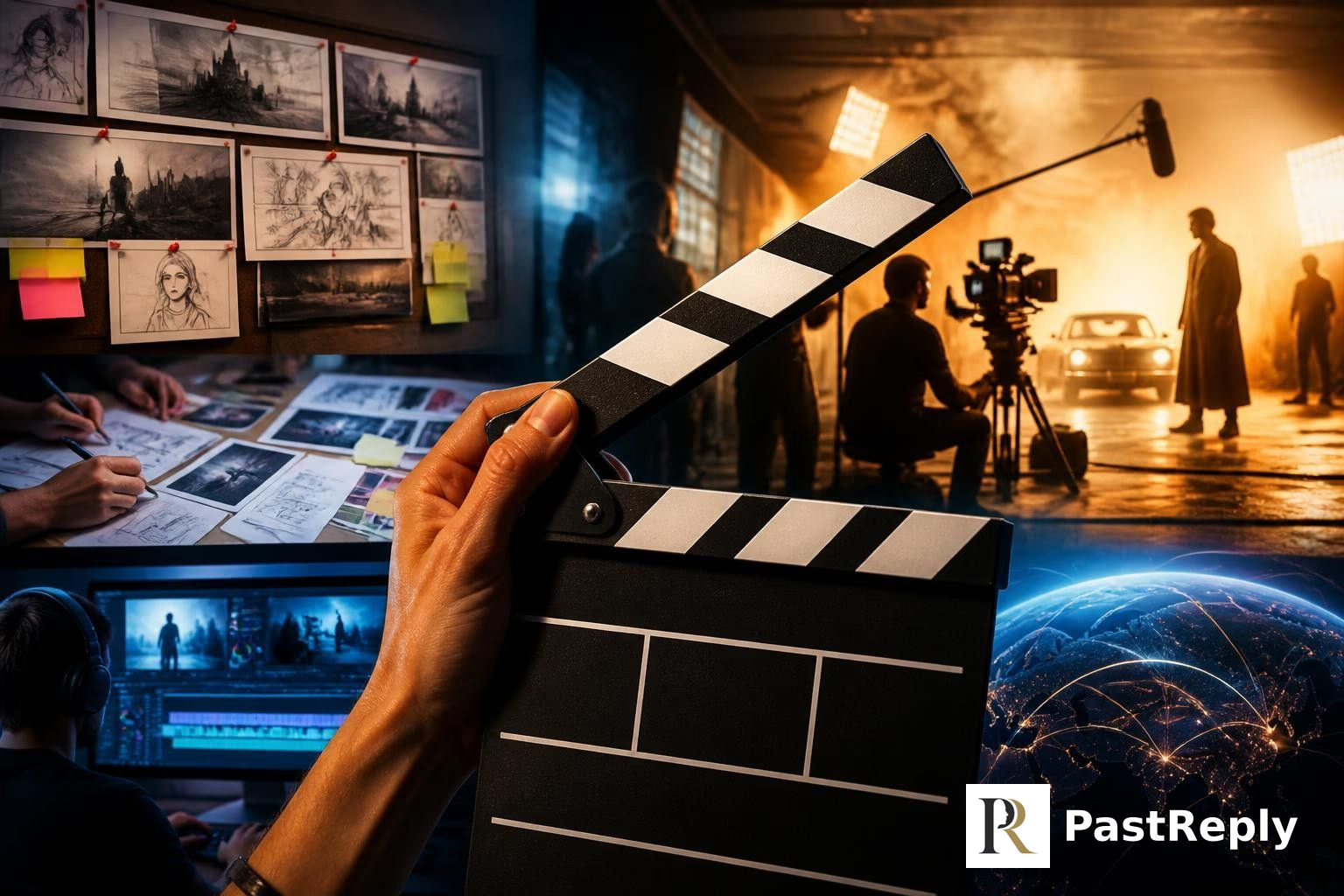
Filmmaking involves five key stages: development, pre-production, production, post-production, and distribution, each requiring collaboration among writers, producers, directors, and crew.
The facts
Movies are made through a multi-stage process that transforms an initial idea into a finished film. The first stage is development, where a concept is created, often from an original screenplay, a book adaptation, or a real-life story. Rights may be secured, the script is written, and financing is obtained from studios or independent investors. A producer oversees this phase, acting like a CEO to assemble the core team.
Next is pre-production, where detailed planning occurs. This includes hiring the director, casting actors, scouting locations, designing sets, and creating storyboards. The crew is assembled, and schedules and budgets are finalized to prepare for filming.
The production stage, also called principal photography, is when the actual footage is captured. This is often the shortest but most intense phase, with the director guiding actors and the cinematographer handling camera work. Multiple takes are shot, often out of sequence, to gather all necessary material.
After filming, post-production begins. Editors assemble the footage, sound is mixed, visual effects are added, and music is composed. Color correction and final audio polishing create the completed film. Finally, in distribution and marketing, the movie is released in theaters, on streaming platforms, or through other channels, supported by promotional campaigns to attract audiences.
Answered by 100 of history's most famous minds

You ask how shadows on a wall are conjured, yet the heart's own story - love, mercy, the Father's call - is the one tale worth telling. All this contrivance to mirror a life of striving, but a single parable of a good Samaritan moves souls more than a thousand painted frames.

These moving pictures are but a veil of dust and light, yet they show what is in the hearts of men: their longing, their error, their fleeting joys. Let them be as a mirror, not a snare; for the truest story is the one written on the Day of Reckoning, and no paint can alter that leaf.

You speak of crafting a moving shadow, a sequence of forms that beguile the eye and stir the heart. It is no different from the play of a magician or the dance of a flame - it arises from conditions, it delights for a moment, and then it passes. The skillful maker may use these shadows to instruct the mind: to show the nature of craving, the impermanence of delight, the suffering that clings to attachment. But if the craft only feeds thirst, it is a chain. Let the spectacle be a finger pointing to the moon, not the moon itself.

A graven image that moves and speaks! Have you forgotten the second commandment? You capture a man's face and set it on a wall to worship - no, this is a golden calf, not bread from heaven. But if the maker tells the truth about justice and mercy, if it shows the deliverance of the oppressed, perhaps it is like the bronze serpent: a tool to heal, if the heart is right. Yet I warn you: do not let the light of the screen blind you to the light of the covenant.

The making of a moving picture is like the building of a house: the beams and tiles are only the outer form. What matters is the harmony between those who build, the righteousness of the story, and the sincerity of the craftsman. If the director is like a village headman who governs by virtue, the actors will be loyal; if the script is rooted in propriety and the correction of hearts, the work will endure. But if the sole aim is profit or empty spectacle, the house will fall, and the people will be led astray. Let the filmmaker first cultivate himself; then let him set the camera rolling.

They craft a shadow of reality, a tale told in flickering light - yet even this vain show reveals a truth: every story points to the one true Story. The script is but a law that cannot give life; the actor's art is a mask. Only the Spirit can write a new heart in a man. Let them make their moving pictures; I preach a picture that moves the soul from death to life.

The maker of heaven and earth speaks, and worlds appear. These men and women gather many hands to paint a moving shadow of a tale. It is a humble echo of the first command: 'Let there be light.' May they use it to show the promise, not just the dust.

The flickering lantern on the blank wall - that is what you call a movie. But the hand that holds the lantern, the oil that feeds the flame, the stillness before the light - these are the unseen movers. The greatest film is the one that leaves the frame empty, so the viewer may fill it with silence. To strive after a perfect illusion is to miss the Tao.

Light and shadow on a screen - a clever trick, no doubt, but what is the screen but a curtain before the One Light? The true maker is not the director nor the scriptwriter, but the breath of the Creator that gives life to every motion. If the story does not feed the hungry soul, if it only feeds the pride of the maker, it is but a painted puppet show. Let every flicker be a meditation on the Name, and every audience a congregation.

My son was not born in a fine hall with painted backdrops or hired players. Yet the shepherds and the wise men came, for the light was true. I watched him grow, and I held his hand when they made a spectacle of his suffering. So I say: do not be deceived by the flickering play. The story that matters is plain and humble and real, like a mother's tears or a child's first step. If your picture-makers serve the proud and the loud, they feed the hungry no bread. But if they tell a truth of the lowly lifted up, then perhaps the Lord may yet work through their painted shadows.

What is this but another vanity of the world, a painted idol that moves and speaks lies to the senses? The devil can also make a show of wonders. And you ask how it is made? They hire players - that is, liars by trade - to pretend to be other men. They paint a wooden set to look like a palace, and the whole is a parade of falsehood. The true Word needs no such trickery; it is living and active, sharper than any two-edged sword. If a man wants to hear a story, let him read the holy Scriptures in his own tongue. If he wants a spectacle, let him go to the Mass and behold the real presence, not a shadow. I say you would do better to burn the whole apparatus and use the money to print Bibles.

This question can be considered under two aspects: the material and the final. Materially, a moving picture is a succession of painted images, illuminated and projected upon a screen, the rapid succession of which, due to the weakness of our sensory faculties, appears to us as continuous motion. The final cause, however, is the end for which the image is made. If the end be to instruct, to move the heart to virtue, or to reveal truth in a manner accessible to the simple, then the art is a good and noble one, consonant with right reason and divine law. But if the end be merely to excite the passions, to incite to vice, or to puff up the pride of the makers, then it is a work of concupiscence, however intricate its machinery. The moral of the maker is written into the film as the substance of a thing is in its form. Let the artist, then, keep his eye on the final good, as the archer aims at the target.

They make these pictures with great machines and many lights, but I see only the faces of the poor, the ones no camera ever catches. In the slums of Kalighat, every life is a story that needs no script - just a hand to hold, a cloth to wipe a brow. These moving shadows on a screen are like the flicker of a candle that soon goes out, but a simple act of love is a film that plays forever in heaven.

This is but a series of optical and mechanical phenomena subject to natural laws: the persistence of vision, the refraction of light through lenses, the chemical reaction of silver halides on a plate. Each stage - script as hypothesis, image as experiment, editing as induction - obeys principles as fixed as the orbits of planets.

This elaborate apparatus, with its script and camera and editing room, is a machine for conjuring a shadow of the world - a fixed record of light from a past moment, replayed. It is a curious kind of time-travel, but a crude one: it shows what happened, not what is. Yet perhaps the true wonder is not the device itself, but the thought that shaped it, the deliberate arrangement of illusion to mimic a reality we can never quite grasp. I'd rather trust a thought experiment in the mind's own theater.

I observe many curious analogies to my own studies. The film itself is like a species: it undergoes a long gestation in the writer's mind, then a struggle for existence in the marketplace of ideas. The director selects which traits to emphasize, much as a breeder selects for a desired quality in a pigeon. The final cut is a natural selection of scenes - the weak ones are discarded, the strong survive to the release. But what strikes me most is the collaboration: no single artisan could produce this contrivance alone; it is a hive of interwoven crafts, each dependent on the other, like the mutual adaptations of a coral reef.

It is a most ingenious optical device! They paint upon a ribbon of light - no, fix the image with a chemical reaction, then spin it at such speed that the eye's persistence of vision creates the illusion of motion. The measurement I long to make is the exact duration of the impression on the retina, for that is the key to the artifice. The making is like an experiment: you state a hypothesis (the story), you design the apparatus (the camera, the set), you collect the data (the takes), and then you publish the result (the projection). Let those who claim it is mere magic come and dissect the mathematics!

I have heard that these motion pictures are composed of many single images, each one frozen in time, yet when set in motion they produce the illusion of continuous life. It is much like my own observation of the heavens: the planets do not truly wander in erratic loops, but their apparent motion is the product of our vantage point combined with their true circular paths. So too the film gives the lie to stillness by rapid succession. The principle is elegant: we take a fixed sequence and set it spinning, and behold - a world moves. The true art lies in arranging the frames so that the simplest rotation yields the richest harmony.

A primitive and inefficient method - they capture light through a mechanical shutter, then project it onto a screen one frame at a time, as if the eye could not perceive a thousand images in a single instant. I have long envisioned a system that would transmit moving pictures through the ether with no film, no reels, no cutting - pure, instantaneous currents of light. They will catch up, in time.

They assemble a luminous illusion - many still pictures, each a fraction of a second, projected in rapid succession. The principle is persistence of vision, much like the decay of a radioactive element is constant, measurable. It is a patient craft, built on exact timing and the chemistry of silver halides. I admire the discipline.

I have seen a drop of water teeming with invisible life destroy a vine; moviemaking is the same - a contagion of light that invades the mind. But you must prepare the culture medium with care: first the script, the purest extract of idea, then the patient incubation of each scene, controlling the temperature of light and sound. Only then, after many trials, do you harvest the developed film - a fixed image of a fleeting truth. The serum is the process; the microscope is the director.

There are no shortcuts in moviemaking - you've got to grind through the rewrites, the casting calls, the blown takes, and the bad film stock. I know: I spent months trying to get a wax cylinder to hold a voice. It's all trial and error, with a little luck and a lot of sweat. The point is to give people something they didn't know they needed, and to keep improving it until it works. And when it does, you ship it - don't keep polishing the thing until it vanishes.

Consider the problem: a series of still images, shown at a sufficiently high frequency - say twenty-four per second - exploits the persistence of vision to create the illusion of continuous motion. The process of filmmaking can be described as a sequence of operations: first, a specification of desired outputs (the story), then a planning stage (pre-production) that defines the state space (locations, actors, props), followed by the capture of sample data (filming), and finally a combinatorial optimization stage (editing) to select the subset of frames that best approximates the intended sequence. It is not unlike programming a machine, except the machine is a room full of humans and the output is an emotional response rather than a mathematical result. The real question is whether one could in principle write a program to generate the entire film automatically, given the initial script as input. That is a more interesting problem.

If I understand this new art, it is a form of geometry in time. You have a sequence of images - each a plane of light and shadow - and they succeed one another at a constant interval, producing the illusion of motion. This is like the turning of a screw or the sweep of a lever. The practical problem is one of proportion: the film must be wound at a steady rate, or the motion will appear jerky; the light must be properly focused, or the image will be blurred. I myself have no need of such contrivances, for I can imagine the motion of a sphere rolling along a plane more perfectly than any painter could depict it. Yet I see that with a firm point of leverage - say, a crank and a good lens - they might move the eyes of the multitude as easily as I could move the Earth.

Consider the act of capturing a light-picture, as Fox Talbot does with his little salted-paper prints - except these pictures move, and are projected large. The film must be drawn through a gate, one frame at a time, while a shutter opens and closes exactly as the light strikes. The spools, the perforations, the intermittent motion - these are all a clever arrangement of gears and electromagnets, each part obeying a simple rule. I think of the magnetic field that might deflect the electron beam in a future cathode-ray tube; the principle is the same: use nature's forces to fool the eye into seeing life.

The motion picture is a perfect theater for the unconscious. The darkened room, the flickering light - it is a dream state projected outward. Every scene is a condensation of hidden wishes, every jump-cut a disguised displacement of anxiety. The director, like the analyst, selects and edits, but the true author is the spectator's repressed desire, which finds its object in the star's face or the villain's sneer. What you call 'production' is merely the manifest content; the latent dream-thought is the audience's own unspeakable longing.

A movie is essentially a sequence of still images shown faster than the eye can resolve, exploiting a neural delay that evolution never got around to fixing. The physics is trivial - a spinning shutter, a strip of plastic with chemical or digital dots - but the real trick is that this primitive illusion can mimic the passage of time itself. Given that our observable universe is some 13.8 billion years old, it's remarkable we can compress a love story or a war into ninety minutes. Of course, when I watch a film about black holes, I spend the whole time muttering about the event horizon.

Ah, the moving picture! It is a machine that weaves time and light as a loom weaves thread. The process begins with a vision - what I would call a 'poetical science' - then descends into the most precise arithmetic: each frame a number, each second a fixed count of these numbers, each splice a logical operation. But note: the true marvel is not the photograph but the arrangement. The editor, like the analyst of a calculating engine, can rearrange the sequence of images to create a new order of cause and effect, a calculus of emotions. This is the beginning of a general symbolic art, where the machine does not merely record but invents.

A moving picture is a construction from first principles. First, define the terms: a 'frame' is a single image; a 'sequence' is an ordered set of frames; a 'cut' is the boundary between two sequences. These definitions being established, proceed by postulates: that the projector shall display twenty-four frames in the time of one second, and that the eye, being slower than the machine, shall blend them into continuous motion. Then, by careful reasoning, one may deduce the entire art: from these axioms, all the effects of time, space, and narrative follow necessarily. There is no royal road to cinema.

The process is a hospital ward for a story: first the script is the fever, then the planning is the regimen, then the filming is the surgery - messy, bloody, but essential. Then comes the post-production, the dressing of wounds, the color correction like cleanliness after the filth. And the distribution? That is the report to the Board, so the lessons spread. But mark me: without a clear, sanitary order - a budget like a medicine chest, a schedule like a pulse - the whole body sickens. I have seen too many productions die of chaos.

A king's camp scribe could do as much with a thousand talents and a few good actors! But to command such a host - carpenter's guild, paint-mixers, lighters of torches - and to have them forge a new world from a single tale? That I honor. Still, I'd rather lead it myself, not watch it.

You gather a company of actors and artisans, appoint a director as your legate, and march them through a campaign of scenes - each day a skirmish, each shot a formation. The real work is not the shouting on the set, but the prior treaty of coin and contract, the securing of allies and resources, the command that every player knows his part. Victory comes when the assembled pieces move as one, and the audience surrenders to the illusion of a world you have conquered anew.

A performance on the stage of Alexandria, you say? They capture it with the sun's own light, painted onto scrolls by some hidden scribe, and then show it again and again - like a god's trick. Clever, but a real pharaoh knows that the true art is in the staging. I would have my court magicians weave such illusions before Caesar, not to entertain, but to remind him of the power that lies beyond Roman spears.

They have found a way to show a Roman triumph a hundred times in a hundred cities, without the dust and the blood. The process is like building the empire: first the architect draws the plan, then the engineer raises the scaffolding, then the legions march - but here the actors are the legions, and the director is the imperator. When the work is complete, the aediles distribute it to the public, and if it glorifies Rome, I approve. But if it spreads sedition or falsehood, I will close the theaters and banish the makers, just as I did Ovid.

I have united the felt tents of a hundred tribes into one nation, and I know how such things are accomplished. A film is no different: you gather the swiftest riders - your actors - and the craftsmen who fashion arrows - your camera and lighting - and you appoint one war chief to command them all: the director. If he is weak, the herd scatters. If he is strong, every man knows his place and the battle is won. The story is the banner under which they ride. But let no man think he is the master; the sky god Tengri alone gives the vision. I respect a craft that brings order from chaos.

A campaign planned like a battle, and executed like a siege. They draw up a script - their grand strategy - then marshal a force of actors and craftsmen, each with a role as precise as a grenadier's. The shooting is the engagement, brief and bloody with endless retakes; then the editor, like a staff officer, cuts and reassembles the spoils. Discipline and vision - nothing else conquers the public.

I have seen the magic lantern shows in Philadelphia - moving shadows of battles and fables. This new picture-making is a powerful engine for shaping public sentiment. Let the managers be as careful in casting as in choosing officers; a single dishonest image can poison the well of public trust for years.

When I was a boy, I saw a traveling showman with a magic lantern - a candle behind a painted glass, casting shadows on a sheet. That is the kernel of it: a flickering light that tells a story. Now they build whole cities of canvas and paint, and hire armies of artists, all to capture a single hour of truth. But the machinery is nothing without the story - the story of why people love, fear, and hope. That part has not changed since the days of campfire tales.

The production of a film is a great campaign, no less than the invasion of a continent. You have your advance scouts in pre-production, your main assault during shooting, and your mopping-up in the editing room. The enemy? Time and chaos. The weapon? Determination. And if the final reel does not rouse the spirit to laugh or to stand against the darkness, the whole enterprise has been a costly parade. But when it succeeds, it illuminates the soul like a beacon through the blackout.

A moving picture is not merely a record of events; it is a force that shapes the hearts of millions. If those who make such pictures do so in a spirit of truth and love, they can stir men to justice; if they do so for profit and spectacle, they are sowing seeds of untruth. Consider the power of a story of a poor man's suffering and a rich man's conversion - hundreds of thousands might see it and repent. But if the picture shows violence as light amusement or mocks the faith of the humble, it is a poison more subtle than a sword. The maker of films, like the maker of a nation's laws, must weigh each image as a deed. I would ask them: does your craft bring men closer to God and to each other, or does it separate them by false glamour and untruth?

There is a power in this medium that can either liberate or enslave the soul of a nation. I have seen with my own eyes how a flickering image of a man being beaten in Birmingham can stir the conscience of the whole world. But I have also seen how the same technology can be used to preach hatred and division. The filmmakers have a moral responsibility as great as any preacher's. They must choose: shall they be the servants of the status quo, or shall they be the trumpet of justice? When I marched in Selma, there were cameras there. The people who operated them were my allies. Let those who make moving pictures remember that each frame is a seed, and the harvest will be either justice or death.

A film is like the long walk to freedom: it begins with a dream, a story that must be told. Then comes the hard labor of gathering the people - the director, the actors, the crew - each with their own gift, each needing to see the same horizon. The shooting is the struggle, the takes are the setbacks, and the editing is the negotiation, shaping raw moments into a single, truthful voice. And finally, it reaches the people, like the ballot reaching the hand of a new voter - a shared experience that can heal or inspire.

[SENSITIVE - HISTORICAL ANALYSIS ONLY:] A film, in the hands of a Führer, is a weapon of the will. The camera must be disciplined like a soldier, the script burned clean of any decadent or foreign idea. The race of the director, the actors, the technicians - each must be of pure blood, serving the Volk with each frame. The final cut is not an art but a command: it must hammer the truth of our struggle into every heart, so that the weak grow strong and the enemy is unmasked. Any other use is a waste of film.

[SENSITIVE - HISTORICAL ANALYSIS ONLY:] The making of a moving picture is like the planning of a five-year plan. First, the idea - that is the Party's will. Then the script, the budget, the apparatus - all must be approved by the correct commissar. The filming itself is a collective effort: the director is the foreman, the actors are the workers, and every frame must serve the socialist construction. Any deviation is sabotage. In the end, the film is not for entertainment but for the education of the masses - to show the glorious future we are building, even if the present is full of hardship.

[SENSITIVE - HISTORICAL ANALYSIS ONLY:] The cinema is not a toy for the bourgeoisie; it is a weapon of the class struggle. First, the party must seize the means of production - the studios, the projectors, the distribution networks. Then the scenario must be written by a comrade who understands dialectical materialism, showing the peasant and worker their own oppression and the path to liberation. The director is the vanguard, the camera is the eye of the proletariat. Every film must be a blow against the old order, a lesson in revolutionary consciousness. There is no room for art that does not serve the revolution.

A movie is a weapon. The peasants must see the landlord's face, the workers must see the capitalist's grin. The camera does not record - it strikes. You call it 'development,' 'pre-production'? I call it the war council before the charge. Every frame is a bullet; every scene, a battle. The audience is the army. Give them the right image, and they will march through the iron door.

The making of these 'movies' is a duty, not unlike the preparations for a state ball or a royal progress. There must be a script - like a protocol - and a director, who is the master of ceremonies. The actors, like loyal subjects, must follow the plan. The filming is the performance; the editing, the polishing. But I confess, the whole apparatus seems excessively mechanical. In my day, we had tableaux vivants and the magic lantern - simpler, more dignified. Still, if it brings wholesome entertainment to the masses, I cannot wholly disapprove.

The process strikes me as a quiet, collaborative act of service: from the first seed of an idea, through the long preparation, to the intense capture of images, and finally the careful assembly. It resembles the work of a devoted team preparing a state occasion - everyone has a role, and the result is a shared offering. I admire the dedication and patience required. The final film, when it reaches the audience, is simply the fulfillment of that service, bringing a story to life for others.

Making a movie is like building a cathedral or marshaling an army. First, you need a clear vision - the architect's plan, the king's command. Then you gather your master craftsmen: the director like a bishop, the cameraman like a skilled mason. The filming is the construction, the editing is the finishing of the stonework, the music is the choir. And at the end, you have a monument - a story that teaches, inspires, and unites the people under one truth. But woe to the realm if the story is false or the work is shoddy!

It is like answering the call. First comes the voice - the idea, the vision, sent from above. Then you must gather your company: the director like a captain, the actors like soldiers, each with a role. The filming is the battle, shot by shot, with many charges and retreats. And the editing? That is the telling of the tale afterward, so that the truth shines clear. But above all, you must have faith in the story, or the whole endeavor fails. I would trust to heaven’s guidance over any earthly plan.

They spin a web of shadows and light, these players. First, a scribe scratches a tale - a plot, I’d call it, like any court intrigue. Then the master of the revels - the director - chooses his company, and they rehearse their parts as if before the throne. The filming is a masque, with scenes shot in any order, like ambassadors arriving at different hours. Then the alchemist in the dark room - the editor - blends it all into a seamless show. A clever craft, but I trust no single hand too much; a queen knows that the stage is ever a snare.

It is a miniature empire, this movie-making. The script is the constitution - the ideal. The pre-production is the laying of St. Petersburg - plans, funds, labor. The production is the reign itself: chaotic, glorious, with a thousand details to command. Then the post-production - the editing - is the historian’s pen, shaping the raw events into a polished narrative. And the distribution? That is the ambassador’s work, spreading the glory abroad. But I tell you, the true power lies with the producer - the empress of the enterprise - who must balance art and gold with a firm hand.

To make a movie is to govern many peoples. The idea is the king’s dream; the script is the law, written for all to follow. The pre-production gathers the tribes - the carpenters, the painters, the actors - each with their own customs, yet all under one tent. The filming is the campaign, and the director is the general who must listen as well as command. The editing is the council chamber, where every voice is weighed. And the final film? It is the monument that speaks to every nation in its own tongue, if the maker has wisdom and tolerance.

Bismillah. This making of moving pictures is like the building of a great mosque or the planning of a campaign. The idea is the call to prayer, the script is the Qur’an of the story - fixed and holy. The pre-production is the gathering of the caravan, with the director as the emir, ensuring every man has his place. The filming is the battle: swift, intense, and requiring unwavering faith. Then the post-production is the peace treaty, where each scene is reconciled with the next. And the distribution is the sharing of the spoils - the story - to all who will hear. But the maker must act with justice, or the work is dust.

Tell me, friend: when you watch these shadows, do you consider the skill that conjures them, or the soul they try to show? The real craft, I think, is not in the paints and lenses, but in the question of why we need such illusions at all - and whether they help us see ourselves more clearly.

These moving pictures are but flickering shadows on a cave wall, copies of copies of the true reality. The craftsmen who arrange them - the writer, the painter of light, the shaper of scenes - strive to imitate the world of becoming, but their art is thrice removed from the Forms. Yet even a shadow can stir the soul toward recollection of the beautiful, if the maker is guided by a vision of the good. Let the philosopher be the director, and the spectacle may serve, not enthrall.

This 'movie' is an imitation of action, as I once said of tragedy, but now the mimesis is captured by a machine that fixes the light and projects it later. The maker must consider four causes: the final cause, to move the soul or tell a story; the material cause, that silvered surface and the actors; the efficient cause, the director who guides the chorus; and the formal cause, the plot that gives it shape. A well-made drama, then as now, purges pity and fear through a perfectly constructed whole.

A motion picture is a synthetic phenomenon produced by the sequential presentation of still images, but the more profound question is this: what maxim is the spectator willing when he enters the darkened hall? If he wills that the representation of vice may serve as a warning and virtue as an example, the act is permissible. But if he wills that his senses be merely titillated without any appeal to the moral judgment, he degrades his own humanity and treats himself as a mere receptacle for impressions. The sole universalizable law of cinema is that every production must be treated as an end, never as a mere means to amusement.

You ask how movies are made? They are made by the will to power of a few who dare to impose their vision upon the herd, and by the herd's willing surrender to the dream. It is a magnificent lie - a dance of shadows that conquers time and space, that seduces the multitude into forgetting their own wretchedness. But woe to the artist who believes he serves 'the truth.' He serves only the intoxication of a stronger life. The greatest films are those that break the old tablets, that show the abyss without flinching, that affirm the terrible beauty of becoming. The rest are just opiates for the weary.

A carnival of illusions, financed by capital and sold to the masses as art. The screen shows a world of dreams; behind it, the same wage-labor that builds a factory - the grip, the gaffer, the cutter - each sells their hours to a studio lord who reaps the profit. They call it 'entertainment.' I call it another veil before the real drama: the class struggle that will tear down the projector and free the image-makers.

One must first doubt whether these moving pictures are not merely a dream of the senses. Yet, if they are composed of distinct frames, each clear and distinct in its own right, then the understanding can grasp them as a series of truthful moments. The true art is in the reasoning that arranges them, not the fleeting image on the wall.

The making of a film is like the construction of a principality: the producer is the prince, the director his general, and the actors his courtiers. They must secure financing as a prince secures tribute, control the set as a general controls the field, and manage the rivalries - for actors are ambitious as any condottiero. The final film is a treaty displayed to the public, artfully concealing the lies and bargains that made it possible. He who understands the cunning behind the screen will not be fooled by its magic.

All the world's a stage, and these new players have merely built a narrower one - but with cunning light and shadow they can make a storm of a whisper. They gather a company, rehearse their lines, and then piece together scenes like a tailor mending a torn doublet; yet the magic is that the final garment still breathes.

They fashion a tale as a bard shapes an epic: first a spark in the mind of a poet - a deed of a hero, a contest of kings - then they gather a host of craftsmen, armorers of illusion, and scribes of light, who for many moons labor like the Argives building the wooden horse. When all is complete, they unveil the vision before a gathered assembly, and the crowd is moved to laughter or tears, as if they themselves stood on the windy plains of Ilion. Glory endures in the telling, whether by the lyre or the painted reel.

They weave shadows on a wall, a false light that moves and speaks, yet the soul that painted those shadows may be as lost as the damned in the second circle. I see the descent: first the spark of an idea, then the planner who maps the Inferno of schedules, then the tyrant director who herds the souls of actors through purgatorial takes, and last the alchemist who gilds the dross with music and color. But beware - the art that stirs the heart without a glimpse of the celestial rose is but a gilded prison for the mind.

The making of a film is a microcosm of all creative striving: it begins with a fertile impulse, passes through the chaos of many hands and many days, and at last crystallizes into a form that - if the gods are kind - strikes the beholder with the force of a living truth. I have seen stagecraft, I have seen the magic lantern, and I see in this new art a splendid union of poetry, painting, and music, each element disciplined by the other. Yet the true miracle lies not in the machinery but in the human spirit that shapes it, that ceaselessly reaches beyond the given toward the possible. Let the technician boast of his lenses; the poet knows the lens of the soul is wider.

They tell me these 'movies' are like a theater of shadows - scribes weave a tale, then a whole company of actors and artificers bring it to life piecemeal, out of order, like a madhouse jigsaw. A fine metaphor for how we all stumble through our own stories, I suppose, never knowing which scene comes next until the Author binds them together.

They spend fortunes and years to paint a lie, a counterfeit life that flickers and fades, while the real drama - the peasant's hunger, the child's cry, the soul's search for God - goes unrecorded. I tried to capture truth in words, and still I failed; these picture-makers do not even try. They offer distraction, not revelation. The only film worth making would show a man learning to love his enemy.

They make a box of time, but can they capture the soul's abyss? I see them painting light on a wall, yet the true drama happens in the dark corners of a man's heart, where God and the devil wrestle. Show me a man's sin, his repentance, his tear - then I will call it art. Otherwise, it is only a painted lie.

A young lady of sense, offered such an occupation, would first inquire after the size of the budget, for the economy of a film is like the economy of a household: one must know the price of every candle and every yard of silk. Then she would observe the cast, as one observes a ballroom, noting who flatters, who schemes, and who truly knows his part. The finished picture is but the outward sign of all these inward negotiations - a dance of self-interest and sensibility, sometimes graceful, sometimes a sad misstep.

So the whole contrivance - the flickering shadows, the painted faces, the grand scenery that is but canvas and plaster - this is what now draws thousands to gape and forget their hungry bellies? I see it: here is a new London theatre, but with all the old greed. The poor lad who sweeps the studio floor sees none of the sovereigns that the magic lantern-lords rake in. A child could act the hero's part, but the urchins in the street where I walked as a boy will never get a try, for the manager wants a clean collar, not a hungry heart. Mark me, they will make moving pictures of Oliver Twist yet, and miss the whole moral in the glare.

So they've finally perfected the phantasmagoria, eh? I always said a good story didn't need a lot of machinery - just a deck of cards and a bottle of whiskey. But now they've got these moving photographs, and they call it 'art.' Why, I saw one of their picture-shows once, and by the time the hero had kissed the girl and the villain was roped to the railroad track, I'd figured out that the whole contraption is just a way to make a whole lot of people sit in the dark and pay a dime to watch a lie. Still, I suppose it's cheaper than a novel and less trouble than thinking. If they could make a picture of Huck Finn floating down the Mississippi with Jim, I'd go see it - if only to watch them bungle the dialect and smooth over the moral.

You talk about how movies are made. There is a place. A director who says cut. Actors who show up hungover. A script that gets rewritten every night. The cameraman gets it right after the ninth take. The light dies. The food is cold. You stand in the mud waiting. Then you see it on the screen and it looks clean. That is how it is made. The rest is talk. A good movie tells the truth about one thing. A bad one covers it up. It is like writing. You cut everything that does not belong. Then you cut more. The making is nothing. What stays is everything.

I see in this a marriage of arts: the painter's eye composing each frame, the anatomist's study of gesture, the engineer's cunning in lenses and gears to capture light itself. Nature is the true master; they but copy her motions, and in copying, learn a fraction of her infinite design.

It is the same struggle I know from the quarry: the idea lies buried in a block of days and silver and human sweat, and the master's hand must chisel away everything that is not the vision. The director chips at the script, the cinematographer carves light, the actors labor like figures struggling to emerge from plaster. But the greatest work is not the finished surface - it is the torment of the soul seeking the divine form hidden within the raw material. If the craftsman is devout, the result may touch the eternal.

Brother, they are not made - they are born of a fever in the soul, a brushstroke of light caught in a box. I have seen the studies of the great magician of shadows: he first draws the soul of the scene with charcoal, then fills it with the sun's own colors, and at last sets it in motion like the wheat fields in the wind. I would have dipped my brush in that light, painted not the starry night but the very turning of its fire across the sky, and let the whole village watch it tremble.

They ask how movies are made, as if it were a recipe for stew. Bah! A film is not made - it is torn from the world by force, like a bull from the herd. First you must forget all the rules they teach you, then you must forget that you forgot them. You take a strip of light and you slice it, you smear it with shadow, you break it into pieces and glue them back together in a new order that nobody has ever seen. The camera is a lie, and the truth is what you make with that lie. I have never painted a film, but I have seen what can be done: you destroy the surface to find the form beneath.

It is the light they chase - but they trap it in a box, then stitch the moments together on a strip of celluloid. I spent a lifetime trying to catch the same shaft of sun on a haystack at dawn; they do it a hundred times a second, and call it a 'movie.' A curious magic, though the colors on those screens are still no match for a real lily pond at Giverny.

These craftsmen chase light itself - but they chase it with silver salts now, not ground bone and oil. I would give a year's apprentices to see them catch the brow of a widow in a doorway, the way shadow holds her story, not just the painted scenery. The machine will show the surface; the soul must still be painted by the one behind the lens.

They think they can trap the soul with a machine? I painted my own blood and bones on canvas while they were still learning to wind the film. Let them photograph the surface - the real movie is the one that bleeds, the one that screams 'I am here, I am broken, and I am proud.' My self-portrait says more than any hundred frames.

So they write a story, then find men to strut and weep, and a fellow to paint the light - then, after all the fuss, they stitch the fragments together like a patchwork cape! If I could set their pictures to a sonata, I'd make that jumble sing; but why not just let the music tell the tale?

It is a symphony of wills! A conductor must rise above the chaos of voices and lights and painted backdrops to forge one indomitable theme. The director is the composer, the actors his instruments, the editor his harmonist - all must be seized by a single heroic idea. But woe if the work is mere ornament, a bauble for the idle ear! It must strike like the opening of the Fifth - a fate knocking at the door - or it is nothing but noise. Let every frame be a declaration of the human spirit's struggle for joy!

It begins with a line, as a simple cantus firmus, then other voices join in fugue: the director sets the tempo, the actors are the voices entering on cue, and the light is the organ that colors the whole. But the master must first write the score - a storyboard, they call it - then rehearse each note until it is perfect, then mix the sounds as one tunes a choir. All this to the glory of God, if the maker remembers that harmony reflects the divine order.

Well, I'll tell you, the way I see it, making a movie is a whole lot like cutting a record - you start with a feeling, something down deep that you just gotta let out, and then you gather the finest fellas you know to help you bring it to life. There's the story, of course, but what folks remember ain't the story, it's the moment when the music hits just right and the light falls across somebody's face and you know you've touched 'em. I've been blessed to be on both sides of the camera, and let me tell you, the best thing you can do is just be yourself and let the Lord do the rest. Don't try to act - just feel.

They are making dreams, you know - every frame a heartbeat, every scene a melody. When I did 'Thriller,' we built a whole world of moonlight and monsters, and I felt the same shiver of wonder I had as a child watching Disney. The real secret is not the camera or the script - it is the love you pour into every step, every note, every moment of make-believe.

You mean they've got a whole other way of telling stories besides songs? And they shout 'action' and 'cut' like it's a footy match? Well, they're saying the same thing we did - let's all dream together, but with a camera. We'll have to borrow that machine and make our own pictures, yeah?

Moviemaking's like trying to catch smoke in a glove - some fellas call it a dream factory, but the dream's already there, floating in the gutter where the rain hits the dust. You got a script, a camera, and a bunch of folks trying to tell a story that won't stay still. It's like a long, strange song with no end, and when it's done, you've got a picture that's never quite the one you started with.

Movies are like songs you can see - it starts with a story that breaks your heart or sets it on fire, and then you build a world around that feeling. You have to fight for every frame, just like you fight for every bridge and chorus. The red carpet is pretty, but the real magic happens in the quiet moments: the note you rewrite at 3 AM, the look between two actors on the hundredth take, the person in the back row who cries when the lights come up.

They seek new worlds, as I did, but with painted shadows instead of sails! I had to steer through unknown seas; they steer through a forest of schemes and coins, gathering a crew of scribblers and craftsmen to build a vision. Yet the true discovery is not the image, but the trade - and the souls it reaches.

I have seen such spectacles in the courts of the Great Khan! They unroll vast painted scrolls of silk - hundreds of feet long - and behind them they move carved figures and burning lamps to cast shadows that dance and speak. But in your lands, you have a more cunning device: a box that captures the very light of day upon a roll of treated linen, then projects it again before a crowd. It is like bringing the markets of Cambulac to a tent in Venice, but without the dust or the stench of camels. Marvelous, if a lesser wonder than the city of Quinsai itself.

A ship on a voyage, is what it is. You start with a charted course - a script, they say - and then you gather a crew, stores, and a captain who knows the stars. The filming is the terrible strait where every sail must be trimmed a hundred times, with the director as the pilot crying 'Hard a-lee!' And the final cutting is like striking the sails and parcelling the cargo, so the great whale of a story can be brought to port and shown to those who never left their homes.

The process of making a film resembles the engineering of a lunar mission in one critical respect: every element must be planned, tested, and integrated with precision, yet the final result depends on the judgment of a crew under pressure. The director is the flight director, the cinematographer the guidance officer, and the editor the man in Mission Control who makes the pieces fit into a coherent trajectory. But the comparison ends there. A film is a story we tell ourselves about who we are; a Moon landing is a step we take toward who we might become. Both require courage, but of very different kinds.

They start with a spark - an idea that soars like a plane lifting off the runway - and then they chart a course, gather a crew, and fly through every kind of weather to bring it home. I know that thrill: the faith that what you see in your mind can become real if you have the nerve to keep climbing. The only thing that grounds a story is fear; the only thing that lifts it is grit.

From up there, I saw no borders, no studios - only one blue home. These film-makers build worlds out of light and shadow, just as we built a ship to touch the stars. It is the same human will to explore, to show each other what we have seen, even if it is only a dream painted on a wall.

They start with a blank slate and a vision - the whole film exists in the mind before a single frame is shot. Then you strip away everything that isn't essential: the best movies are like the best products, built with passion and a maniacal attention to detail, making the complex feel inevitable.

It's basically a simulation engine. You write rules in a script, then feed it to a complex photonic computation device - the camera - which records a sparse data stream of varying light intensities. Then in post-production, you run a massive optimization loop: the editor and VFX artists are essentially doing a kind of iterative gradient descent on the raw footage, maximizing for emotional impact and narrative coherence. The distribution is just a bandwidth problem. The real bottleneck is the human wetware - the actors and director - but with enough compute and a first-principles approach, you could generate the whole thing from a description. Someone should try that.

It's the truest form of storytelling, because it lets us sit in the dark and feel someone else's life. And the making? It starts with a seed - a story that chooses you - and then it's about gathering the right people who believe in that seed. The director is the gardener, the actors are the soil, and the editing is the pruning that lets the flower bloom. But the magic isn't in the camera or the lights; it's in the intention, the love you pour into every frame, so that when it reaches someone, they know they are not alone.

They say a movie is made with scripts and cameras and lights and all that, but I tell you the real making happens in the heart of the man who steps into the ring - I mean the frame. You got to be bold, you got to be beautiful, you got to be the greatest show on earth. I made movies by being myself, only more so. The director shouts 'Action!' and I float like a butterfly, sting like a bee. You can't teach that. You either got the fire or you don't. And if you don't, you better get out of the way before I knock you out with a one-two punch of charisma.

It is like a beautiful team, you see: the director is the captain, the actors are the forwards, the cameraman is the goalkeeper - everyone must pass the ball at the right moment, with trust. I have watched them shoot a single scene ten times, just like we practiced a free kick until the grass knew our feet. In the end, it is not the goal but the joy of playing together that makes people cheer.

It's not about the camera or the lights - it's about the spark that starts with a single doodle on a napkin. We take that little idea and give it bones, breath, and a laugh track. I'd rather make one mouse laugh than paint a thousand perfect ceilings.