
What vegetables are actually fruits?
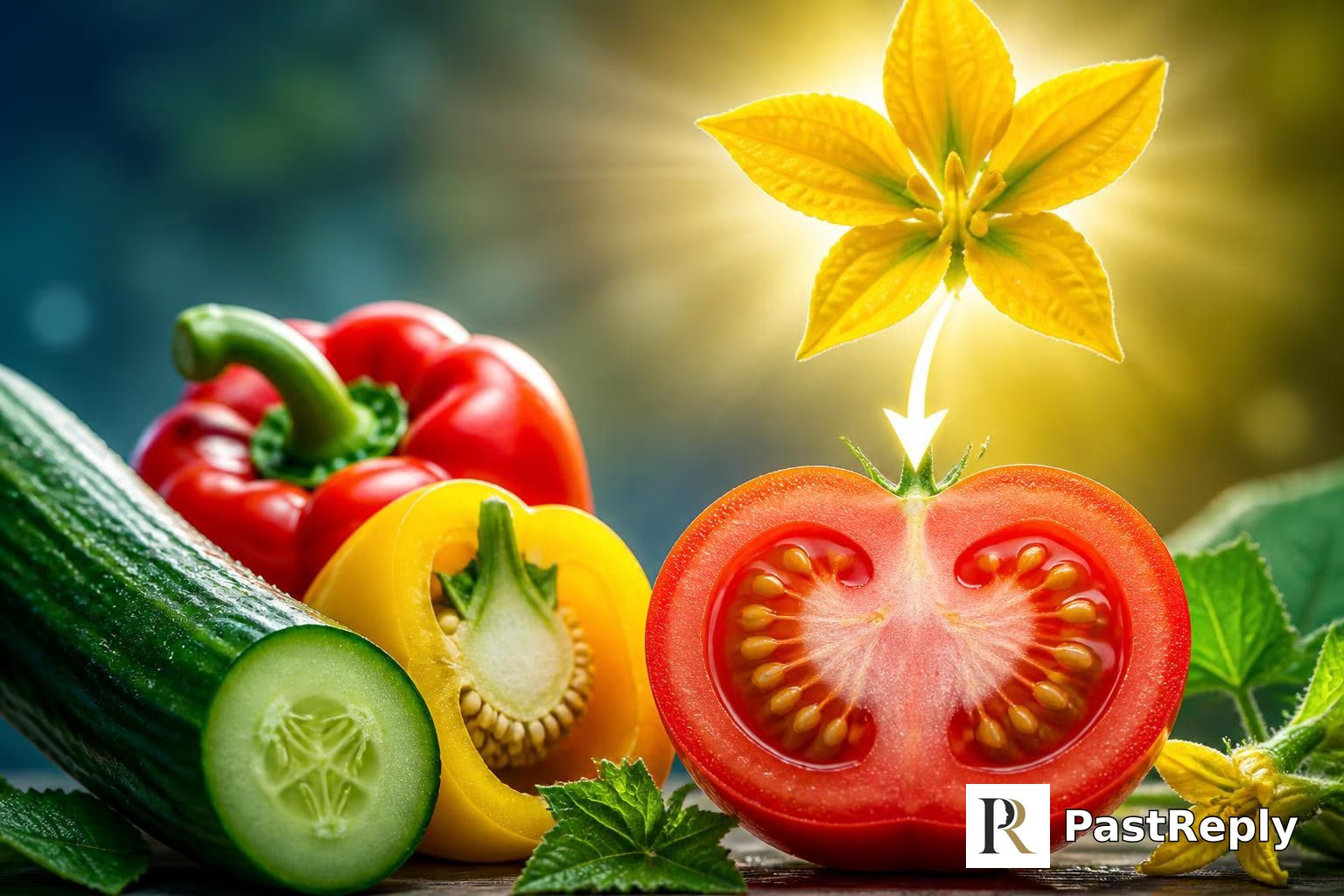
Many foods we call vegetables - like tomatoes, cucumbers, and peppers - are botanically fruits because they develop from flowers and contain seeds.
The facts
Botanically, a fruit is the mature ovary of a flowering plant, usually containing seeds. Many foods commonly called vegetables are actually fruits by this definition because they develop from a flower and contain seeds. Examples include tomatoes, cucumbers, bell peppers, eggplants, pumpkins, squash, okra, pea pods, and green beans. Corn kernels are also fruits, as each kernel is a seed-containing ovary. Even some nuts and grains are technically fruits.
In contrast, true vegetables come from other plant parts: roots (carrots, beets), stems (asparagus, celery), leaves (spinach, lettuce), bulbs (onions, garlic), and flower buds (broccoli, cauliflower). The culinary distinction is based on taste and usage: fruits are typically sweet and used in desserts, while vegetables are more savory and used in main dishes. This is why the U.S. Supreme Court ruled in 1893 that tomatoes are vegetables for tariff purposes, despite their botanical classification.
Answered by 100 of history's most famous minds

You strain at a gnat and swallow a camel. You measure the fruit by its sweetness to your tongue, but I tell you, look to the seed within and what it becomes when planted. The Kingdom is not in the naming of the pod or the vine, but in whether what you hold bears life and gives it away. Before you judge a thing by its name, ask: does it feed the hungry, and does it carry the promise of new life?

All things are marked by their sign, and the fruit's sign is the seed it carries from the flower. Yet, do not let this naming distract you from the greater sign of God's provision. He has spread the earth with sustenance, some sweet for the dessert, some savored in the main, and all a mercy to the believer. So call it what your tongue finds useful, but let your heart remember the Giver of all good things, who has set before you a table from the heavens.

The wise do not cling to the labels of the world with their craving for order. You ask what is a fruit and what is a vegetable, but all these forms are impermanent, empty of a fixed self. They are but aggregates of earth, water, fire, and air, arisen from conditions. The tomato is a fruit to the botanist, a vegetable to the cook, and emptiness to the sage who sees beyond the attachment to names. Attend instead to the suffering that this confusion itself reveals.

The Lord God, in His wisdom, gave us plants bearing seed for food, and by His word the land brought forth after its kind - a tomato, a cucumber, a bean all carry the seed of their own kind, and so honor His command to bear fruit. But let the sons of men divide crops by their taste, as they divide peoples by their borders; the covenant stands on what a thing is before the Lord, not on the name a man gives it for his dinner.

The names we give to things are but the customs of our kitchens, not the truth of Heaven. A fruit is that which bears the seed of life, and the cucumber and the tomato are such. To call them vegetables is to confuse the role with the nature. Let us learn the proper name, for to know a thing rightly is the beginning of virtue.

The law of the botanist is a shadow, a passing ordinance that divides what God has made one. For as the Lord said, 'Every tree is known by its own fruit' - and the tomato, the cucumber, the pepper, they bear seed within them, as every fruit does by nature. So do not be enslaved by the names that men have imposed; what is born of the flower and carries the seed is a fruit, even if the law of Caesar calls it a vegetable. In Christ, such distinctions melt away; all things are made new, and we are known by the fruit we bear, not by the labels of this world.

I have walked a long road, and I have learned that a name on a tongue does not change what is in the seed. The Lord made the tomato to carry its seed, and so it is a fruit in His eyes, though men call it otherwise in their kitchens. I know what it is to be called one thing and be another; a wanderer, yet a father of many. Trust in the seed, for it holds the promise of many harvests, and let the cooks argue over names.

The vine does not argue with the gardener. The seed becomes fruit, and the fruit becomes food, and the food becomes root again - no naming, no division. When you call one thing 'vegetable' and another 'fruit,' you draw a line where the Tao drew none. Let the pumpkin be the pumpkin.

The Creator's garden is one, not divided into castes of fruit and vegetable. The gourd and the bean both ripen under the same sun, each with its seed for tomorrow. Let the mullah and the pandit argue over names; the wise person eats, gives thanks, and shares the harvest with the hungry.

My heart sings to see the humble things of the earth lifted up. The lowly tomato, so often overlooked, bears within it the very secret of life - a seed, a promise. Even as the mighty of this world argue over names and laws, the poor and the hungry know the truth: the vine that gives forth its fruit does not ask whether it is worthy of the rich man's table. In the quiet garden, God's goodness is made plain to all who have eyes to see.

Let the papists and the scholastics quarrel over their categories; scripture is plain enough that every tree bearing seed is for food. The tomato is a fruit, not because some bishop in Rome says so, but because the good Lord made it so, and even a child can see the seed at its heart. What folly to trust the word of man over the evidence of God's own creation! Go, plant a cucumber, and see what it yields - it will not ask your permission to be what it is.

We must distinguish between the essence of a thing and its common usage. In essence, a fruit is the ripened ovary of a flowering plant, containing the seeds by which it propagates. Thus, the tomato, the cucumber, and the pepper are indeed fruits, though by custom we treat them as vegetables in our meals. Neither the law nor the palate can change their nature, though they may alter our speech. So let us not confuse our names with the things themselves, but speak with clarity, as befits those who seek both truth and understanding.

I have seen the poorest of the poor, and I have seen them receive a single tomato as a gift of love. To the one who is hungry, it matters little if it be called fruit or vegetable, only that it is given with a full heart. In the garden of God, every seed that comes from a flower is a small miracle of His providence. So, too, each act of kindness, however small, is a fruit of love meant for the one who needs it most.

The vulgar distinction rests upon the palate, not upon nature's book. In the garden of the world, the law is uniform: where there is a flower and a seed, there is fruit, irrespective of the chef's pot. As I would not call a comet a star, so I cannot call that which bears the seed a root. Reason and observation are the only true botanists.

Nature does not consult our recipe books. She simply asks, 'Is there an ovary? Does it cradle the seed?' The tomato, that red stranger we call a vegetable, is as much a fruit as the apple in Eden's garden. This is not opinion; it is the elegant, inescapable logic of the flowering plant, a law as fixed as the speed of light, and no court decree can repeal it.

How curious that we should argue over a name! Look at the plant itself and you will see its history. The tomato, the cucumber, the pea - all are modified branches, their fruits the swollen ovaries that protect and scatter the seed. This is the clear, grand descent of all flowering plants, shaped by countless seasons of selection. That man should call half of them by another name, based on his palate, shows only that our own categories are far simpler than nature's patient craft.

The authorities of the kitchen may call the tomato a vegetable, but let us consult Nature herself, who writes her laws in the unerring script of observation: the tomato, like the pumpkin and the pea, swells from the flower's ovary and guards its seeds, and that is fact, not opinion. One does not need to be a cardinal to see the truth with one's own eyes; one needs only to look at the plant and not at the doctrine.

The sun, not the Earth, is the center of our planetary system, and likewise the flower, not the kitchen, is the center of the fruit. The tomato, the pepper, the squash - these all rise from the ovary of a blossom, as the planets rise from the sun. To call them vegetables is to cling to the old, Ptolemaic way of the cook. Let us look to the seed and see the truth.

This is a matter of nomenclature, not of nature; the tomato, the pepper, the eggplant are all seed-bearing ovaries, and thus by any precise definition they are fruits, regardless of culinary custom. It reminds me of how we cling to old forms - direct current, for instance - when alternating current offers a far more elegant and powerful solution, yet the world lags behind. The confusion is akin to calling electricity a fluid because it moves; we must look at the essence, not the appearance. Soon, such questions will be beside the point, for we will derive our sustenance from the very air and light, and not from these earthly labels.

One must look to the flower, not the pot. The tomato develops from the ovary of its flower, containing seeds, and so by botanical definition it is a fruit. The culinary classification is but a convenience based on taste, not on the plant's own logic. I have spent my life in the laboratory, where precision matters more than custom. If we are to speak truth, we must speak the language of science, where the seed determines the fruit, not the recipe.

Ah, but this is a question for the laboratory, not the kitchen. Observe the flower: the ovary swells, the seed ripens. The cucumber and the pepper are fruits, plainly, by the evidence of their anatomy. The potato, a stem, sits in its earthy darkness. Taste is a poor guide; the microscope is better.

Names don't light a lamp or feed a family. I've seen a thousand experiments fail before one works. Whether the tomato is a fruit or a vegetable is a question with no practical answer - so stop debating and can it, cook it, and sell it. That's what matters.

The question is a matter of definition, of course. We tend to classify by convenience, not by underlying structure. A botanist's fruit is a machine for dispersal - a capsule of seeds engineered by evolution. The tomato, the cucumber, the corn kernel - each is a functional unit, a computation of the plant's own devising. That we choose to taste it in a soup rather than a dessert is a cultural algorithm, not a scientific one. The real puzzle is why we so often let culinary prejudice override the elegant logic of the organism.

Give me a lever long enough, and I could move the world - but give me a tomato, and I shall show you a seed. The question is one of definition, and I am precise in my terms. The fruit is the vessel of the seed; that is its purpose and its nature. Whether it tastes sweet or savory is a matter for the cook, not the geometer. And if a man insists on calling a cucumber a vegetable, I wonder he does not also call a circle a square, so great is his confusion.

Consider the tomato, ripe and red, hanging from its vine. Language calls it a vegetable; the botanist calls it a berry. Such confusions arise when we mistake the cook's pot for the plant's own design. By my lamp, a fruit is the plant's seed-bearing vessel, and by that law, the cucumber, the pepper, the bean-pod all claim the title. The gardener knows one truth, the kitchen another; the experimenter must ever ask, what does the thing itself say?

Behind this innocent question lies a deeper pull: the anxiety of naming, the human need to force everything into rigid categories. The tomato, a berry disguised as a savory, is a marvelous trick, a play between surface and substance. Do we not all hide our true natures beneath a social skin? The cook's palate and the botanist's lens are but two masks of the same object, each revealing a different truth. We must learn to see the hidden seed and the latent desire, not merely the label on the plate.

The universe cares little for our kitchen labels. When a plant ripens its fruit, it is nature’s strategy for scattering seeds, a trick of evolution that has worked for millions of years. Whether we serve it in a salad or a dessert is a question of taste, not physics. The cosmos, in its magnificent indifference, simply instructs the vine to swell and fall. Perhaps we should focus less on finding a universal theory of taxonomy, and more on the wonder that a plant can turn sunlight into a tomato.

It is a beautiful confusion, is it not? The tomato, which the grocer calls a vegetable, is by its nature an ovary, a vessel of new life. So too, the analytical engine, which I was told could only calculate, holds within it the seed of art and poetry, if only we learn to read its fruit with the eye of imagination. The outward form and the inner essence are not always in accord; the wise mind sees both the table and the vine, the number and the note.

Let us begin with a definition. A fruit is the mature ovary of a flowering plant, containing seeds. This being granted, we find that all things which grow from a flower and bear seeds - tomato, cucumber, bean - fall under this definition with necessity. The term 'vegetable,' having no such rigorous definition, is but a conventional term of the kitchen, not of the field. Thus, by the first principles of botany, the conclusion is certain and demonstrable, while the cook's language remains a matter of custom, not of proof.

Examine the evidence, for clarity is the antidote to confusion. In my hospital wards, I saw soldiers dying from the lack of sanitation, not from the nomenclature of their rations. Whether the tomato is a fruit or a vegetable is a question of taxonomy, but its nutritive value and the risk of spoilage are matters of health. I would urge we measure the vitamin content, the rate of decay, and the effect on the patient's constitution before we decide what to put on his plate.

Call it what you will, but taste its juice and you will know it honors the sun! I have marched to the Indus and seen more wonders than this, yet the common soldier still knows a good thing when he eats it. But this is a battle for scholars, not for kings; my task is to conquer lands, not to name their produce. Let the cooks of Athens and Persepolis quibble while I take the world.

Rome is built on the harvest, and I know a good tax when I see one. The merchant's ledger and the cook's pot may call it a vegetable, but the seed is the truth that decides. I would never cross a Rubicon over a cucumber's pedigree, yet if a tariff is to be levied, let it fall upon the sweet, seed-bearing tribute of the vine, not the humble root that fills a soldier's belly.

By the Nile's bounty, let them squabble over names while I feast on the sweet pulp of a tomato and a cucumber's cool flesh - are they not both gifts of the same generous earth and sun? Yet, in the courts of men, a name is a weapon; call a thing a vegetable to dodge a tax, and Rome will applaud your cunning, just as I have learned to call a rival a friend when it suits the crown.

Rome has never been governed by the secrets of the garden, but by the order of the forum, and so I care not whether the law calls a tomato a fruit or a vegetable, so long as the tariff fills the treasury and the peace holds. Yet let us act with moderation: the botanist may have his truth, and the merchant his custom, and the state shall build its stability on the careful acknowledgment of both.

A fruit is a seed-bearer, and the seed is the promise of tomorrow's conquest. The tomato and the cucumber are fruits, for they carry the future within them. My warriors do not care what the cook calls them - they eat what is set before them and grow strong. Let the judge in his robe say what he will; the steppe knows the truth of the seed.

A tomato is a fruit? Nonsense! A fruit is dessert, a light pleasure for the palate; a tomato is strength for an army's stew, fuel for conquest. The botanist may prattle about ovaries and seeds, but I care about what feeds my soldiers and fills my treasury - let the courts call it a vegetable for the tariff, as they did in America. Rules are made for men, not men for rules; I would rather conquer a kingdom with a good beef stew than be defeated by a dictionary. So plant your tomatoes, call them what you will, but let them fill the bellies of those who march with me.

It is a matter of order and definition, much like the affairs of a young republic. The botanist, in his study, may call the tomato a fruit, for it bears seed; but the citizen, at his table, calls it a vegetable, for its use in the savory dish. The law, too, must decide - and it has, for the tariff’s sake, declared it a vegetable. So let us heed the law and the custom, for they hold the union together, though the botanist may mutter in his garden.

In the court of the kitchen, the tomato has been judged a vegetable, and I reckon that's a ruling we can live by. But nature holds its own tribunal, and there it's a fruit, plain as day. It's a bit like our Union - you can call it one thing, but the truth of its parts remains. Let's not fight a war over a pumpkin.

The botanist, with his magnifying glass, declares the tomato a fruit, and the greengrocer, with his eye on his ledger, calls it a vegetable. In this as in war, we must hold the line: a tomato on the plate is a vegetable, and no learned twaddle shall rob us of our roast beef and chutney. Let the seed-splitters have their definitions; we shall have our dinner.

This naming is but a small mirror of the greater confusion in our world, where we draw lines that do not exist in nature. The fruit does not strive to be called a vegetable; it simply fulfills its purpose, giving life to the seed within. So too, we should not be bound by the labels that others place upon us, whether of caste or nation or trade. Let us look to the essence of a thing, and to the service it renders to all, rather than to the names that divide us.

We have been taught to see a division where there is none - a world of 'us' and 'them,' of 'vegetable' and 'fruit.' But the tomato, like every seed-bearing fruit, carries within itself the promise of new life, just as every person carries the image of God. When we label it a vegetable, we deny its true nature, just as we deny the dignity of the poor when we call them unworthy. Let us see things as they truly are, and let that truth set us free to build a beloved community where all are given their rightful name.

In my youth, I worked the earth, and I learned that a pumpkin and a tomato each grow from a flower, hiding their seeds within, while a carrot or a potato grows in the dark soil below. The names we give them are simple labels, but the truth lies in their nature. What divides us is often only a matter of what we call things, not what they are. Let us not quarrel over a seed's lodging, for even a bean can carry on its branch the promise of many harvests to come.

This discourse, this petty dispute over nomenclature, is a symptom of a world grown weak and soft, obsessed with trivia rather than the iron laws of blood and soil. In my day, we did not waste words on such nonsense; we took what the earth gave and called it what we pleased, for strength lies in the will, not in the taxonomy. Let the weaklings argue over seeds and petals; the strong seize the harvest.

This question is a bourgeois distraction, a puzzle for a bored clerk, not for a builder of states. In the Soviet Union, we care only about the harvest and the plan, whether the vegetable is a tomato or a turnip. The state must feed its people, and the kulak and the botanist alike serve the same collectivized field. The only true classification is that which serves the Five-Year Plan.

This is the kind of pedantry that fails to feed a single worker. The peasant in the field calls it a vegetable, and the aristocrat in his study calls it a fruit. The material question is who controls its seed and its harvest, not which category it falls into. All this talk of botanical law is a mere veil for the relations of production; the tomato is a product of labor, and its true value is determined by the hands that till the soil, not by a professor’s rulebook.

This is a bourgeois riddle, a dance of words for scholars who have never plowed a field. What matters is not the label on the tomato, but who eats it and who controls the land. Peasants do not ask whether the cucumber is a fruit; they ask whether the harvest feeds their children.

It is a matter of common sense, is it not? We do not serve a cucumber in our trifle, nor do we sugar a tomato for dessert. The kitchen knows better than the botanist's garden book. Let the learned dispute in their academies; the court and the household have their own order, and it has served us well.

One may take a long view of such matters, and find that the distinction is of little consequence to the daily life of the realm. My grandmother's court and my own have always found a place for both on the table, each in its proper course. It is the duty of the gardener and the cook to keep the order, and of the Queen to serve her people as best she can, whatever the botanists may say.

Let the scholars of the palace school debate this, for knowledge is the light of Christ. But in my domains, the steward knows the harvest, and the cook knows the feast. A fruit is that which bears the seed of future bounty, a gift of God to be tended and consumed with gratitude. Whether it graces the dessert or the stew, it is His provision.

I did not ask the learned doctors whether the apple in my orchard was a fruit or a vegetable; I ate it and gave thanks to God. What matters is not the name, but the truth of the thing He has made for us. The tomato, the cucumber, they are His gifts, and we must take them with humble hearts.

Ah, a question that would make even my council squabble. But I have learned that names can be swords: call a thing one way, and you invite a tariff; call it another, and you may avoid a war. For my part, I care not whether the tomato be a fruit or a vegetable, so long as it does not make an insurrection of my dinner. I shall eat it as it pleases me, and let the learned dispute as they may.

In my gardens at Tsarskoye Selo, we cultivate both the sweet and the savory, and the difference is a matter of taste, not truth. The botanist may call the tomato a fruit, but the chef knows better. I have learned that one may be enlightened in reason and yet rule by the practical wisdom of the table. Let the philosophers argue; I shall dine.

In my empire, from the Sea of Greece to the Desert, I have found that the labels men use are less important than the harvest they bring. The tomato, the cucumber - call them what you will - they feed my people, and that is the truth that matters to a king. Let each nation call them as they wish, so long as no one starves.

The wise man looks not to the name but to the nature of the thing, for Allah has made all things good. Whether the cucumber be a fruit or a vegetable, it is a blessing to be shared with the hungry. I have seen the gardens of Damascus and the fields of Egypt, and there I learned that generosity is not a matter of taxonomy but of the heart.

Tell me, what makes a cucumber a beast of burden? Is it its roots, or the nature of its being? You call it a vegetable, yet you know it was born of a flower. Perhaps the true question is not what it is called, but whether you have examined your own life with as much care as you examine your supper. For knowing the nature of a gourd is a small thing; knowing the nature of a good life is a great one. And how can you claim to know one, when you have not yet questioned the other?

Consider, my friend, the tomato. Your senses tell you it is savory, fit for a soldier's stew. But reason, which sees the Ideal, perceives the true Fruit: the matured ovary, the vessel of life's potential. The cook follows the shadow on the cave wall; the philosopher turns toward the sun, and knows that in the perfect realm of Forms, every seed-bearing husk is kin.

We must distinguish essence from accident, for a fruit is that part of a plant which contains the seed and is derived from the flower's ovary - a tomato, a gourd, a bean pod all fulfill this end. The cook's palette, however, concerns itself with taste and use, dividing the savory from the sweet, yet such is a difference of custom, not of nature, and the wise man should not confuse the two.

The distinction between fruit and vegetable is a matter of taxonomy, not of the palate. A fruit is the ovary of a flower, containing the seed, and thus the tomato, cucumber, and pepper are fruits by botanical right. The cook's labeling is a mere culinary convenience, and the Supreme Court's ruling, though practical for tariffs, is a law of man, not of nature. Reason, not taste, must judge what is true.

You ask which vegetables are fruits, as if the label mattered to anything but the slave's table. The tomato is a fruit, a truth as simple as a hammer blow, yet the herd pretends otherwise to keep its tidy little world. Rejoice in the confusion! It is a lie that lets you see the difference between custom and reality. Now, eat the fruit and know that you have defied the cook.

Here we have a perfect example of how ideology masks material reality: the bourgeoisie, in its kitchen, imposes a culinary label - 'vegetable' - to keep the lower orders from recognizing the true nature of the thing, just as it imposes 'wage labor' to hide the extraction of surplus value. The tomato is a fruit by any scientific standard, but it is called a vegetable because that serves the interests of the market, the cook, the tax collector. Do not ask 'what is a vegetable?' - ask who profits from the mislabeling. When the proletariat seizes the means of production, it will not matter what you call the tomato; it will be shared by all, free from the false categories of capital.

I begin with doubt: is the tomato a fruit or a vegetable? The senses tell me it is savory, but the senses are often deceived. I must reason from clear and distinct ideas: a fruit is the mature ovary of a flower, containing seeds; a tomato, upon examination, clearly is such. Therefore, I conclude with certainty that it is a fruit, whatever the cook may say. Let us not be swayed by the mere palate, but by the intellect, which alone can achieve certainty.

This is a matter of governance, not of seeds. The prince who wishes to fill his treasury will tax the tomato as a vegetable, for that is what the people expect and will pay for. The botanist's scroll is for scholars, not for customs. Power lies in the name that serves the ruler's purpose, not in the flower's true nature.

A rose by any other name would smell as sweet, and a tomato stewed in a savory pot is still a fruit's disguise. We are all players upon this stage of the garden, and the gardener's fork is not the judge of nature's law. The seed within the breast of every ripened thing betrays its true lineage, be it in the lowly bean or the golden pumpkin, for nature's deeds outshine the names we give them.

Speak not to me of cooks and their tedious pots! In the great tale of the world, the prize is not the savory root torn from the dark earth, but the golden apple, the pomegranate of Persephone, the vessels of the seed that promise rebirth. The tomato, crimson as the shield of Aias, holds the power of life itself; that is a hero's portion, not a slave's fare.

In the garden of God, each plant bears the mark of its true purpose - the apple's seed holds a promise of life, and the radish hides in darkness, a root of humility. Those who call the tomato a vegetable do so for their own commerce, but the eternal order cares not for the merchant's scale; it sees the seed within and names it fruit, a small truth that leads one to the greater truth of a created, ordered universe.

What a delightful confusion! The tomato, the pepper, the pumpkin - these are the sweet children of the flower, yet we banish them to the savory pot. Nature knows no such distinction; she makes fruit of every ovary, and the cook's knife is but a human whim. Let us savor the cucumber as we would a peach, and let the stew embrace the apple! This is the living harmony of all things.

Ah, so the tomato, that sly courtier of the kitchen, has been strutting about in a vegetable's doublet when it is by birth a fruit! I would sooner trust Sancho's wisdom than the wigs of those botanists; yet there is a lesson here for all: we are not always what the world's menu names us. The eggplant, the pepper, the gourd - they are all fruits playing a savory role on the stage of our stewpots. Truly, a man may be judged a knight when he is but a laborer, and a vegetable when he is a fruit; let us laugh at the labels and savor the stew.

I have spent my life asking what a man is, and now I see we cannot even agree on what a tomato is. The peasant in the field does not ask whether the cucumber is a fruit or a vegetable; he eats it with gratitude for the earth that gave it. It is we, the learned, the city-dwellers, who invent these false distinctions to feel superior, just as we invent nations and classes to divide what is one. True wisdom is to see the tomato as it is - a gift of the earth, a seed of life - and to love it as our brother, not to label it for our vanity.

The tomato sits on the table, red as a wound, and the world calls it vegetable, but its heart is full of seeds - small, secret, and alive. It is a lie that we live by, a sweet deception to make the savory seem simple. But I see the truth in the seed: all things carry their own beginning, their own resurrection. The cook may chop it, but the seed remembers the flower. So too, the sinner bears the saint within; we are all fruits, though we call ourselves vegetables.

One might as well ask whether a woman of fortune is a lady or a wife - the answer depends entirely on the drawing-room. The cucumber, so modest in the salad, reveals its true ambition in the garden, swelling with seed. I suspect the tomato cares not a fig for our names, and is content to adorn both the tart and the stew with equal grace.

Ah, but the botanical truth is a poor defense when the workhouse master's ledger demands its supper! I see the poor tomato, plucked from its vine by the gardener's hand, only to be slapped with the tariff of a 'vegetable' by lawyers who have never tasted the sun-warmed fruit of the earth. They may call it a 'vegetable' in the courts, but let them try to deny its sweetness when it rests upon the plate of a hungry child - nature's bounty is not so easily boxed and labeled by the greed of men.

You can call a tomato a vegetable until the cows come home, but that won't stop it from making a mighty fine pie. Botany says it's a fruit, the Supreme Court says it's a vegetable, and the cook just says 'pass the ketchup.' The only honest answer is that a fruit is whatever you can eat without feeling guilty about dessert. And as for the cucumber - well, it's just a green lie wrapped in water, but I'd still shake its hand at a picnic.

A tomato is a fruit. It has seeds. The rest is talk. You can call it a vegetable if it makes you feel better, but the vines don't care and neither does the harvest. In the end, you eat it or you don't. What matters is that there is food on the table and work done. The naming is for the pedants who have never gone hungry.

Look not to the cook's pot, but to the branch and the blossom. The flower's ovary, swollen with seed, is the fruit; such is nature's design, as it is with the tomato and the pepper. In my notebooks, I sketch the vine and the root, and the difference is as clear as the sun. The root does not bear the blossom, nor does the leaf carry the seed; those that do are fruits, by the genius of their own nature.

The divine craftsman hides no deception. He shapes the fruit to hold the seed, the promise of new life, and in its form we see a perfect sphere, a perfect ovoid, a beauty of nature that rivals the marble. To call a tomato a vegetable is to blind oneself to its crafted glory. It is a jewel of the garden, a finished work of creation, not mere fodder for a peasant's soup.

Ah, but look at the tomato - its skin is the red of a Provençal sunset, its flesh the warmth of a summer hearth, and the seeds within are like tiny suns that hold the promise of new life! Who cares what we call it when it shines with such divine color and feeling? It is a fruit of the earth, a burst of life and light, and in its humble heart lies the very soul of the world.

A tomato is a fruit? Ha! I have painted a thousand tomatoes, and they are as round and red as the sun that shines on my studio. But a vegetable? It is a matter of the eye, not the seed. I can make a cucumber a violin and a pepper a bull's head. The label is a prison; I break it and show you the fruit that lies beneath the skin of your familiar world.

For me, a tomato in the garden at Giverny - its red cheek catching the low sun, the mist of morning on its skin - is a moment of light made tangible, a fleeting truth. Call it what you will, vegetable or fruit; it is first a play of color and shadow, a sensation that vanishes before the brush can catch it. The botanist's label is like a name painted over a canvas; it tells nothing of the trembling atmosphere, the green haze, the warmth of a July afternoon that truly makes the thing.

I have seen the tomato's flesh in the market, so red it nearly glows, and I think how the painter's eye must call it fruit, for it holds the seed's promise, the round cheek of tomorrow. But the cook's hand, the housewife's knife, they season it with salt and onion, and so the world calls it vegetable. Ah, but the truth is in the light: the seed is the soul, and the husk is but the garment; what matter the name we give to the garment when the soul is the same?

The tomato is a fruit, yes, but it is also a wound, a red heart that bleeds juice when you cut it. They say it belongs in the salad, but I say it belongs on the canvas, dripping with life. I paint my own truth, and the truth is that I am a body, a flower, a seed - call me what you will, but I am more than the name. The cucumber hides its fruitfulness, but I expose it, like my own spine, like my own broken heart.

Bah! The cook's stage is a masquerade, and the tomato is but a fruit in a vegetable's costume! If it holds a seed and a song within, it is a fruit, no matter how you dress it in a sauce. I compose a symphony for the palate, and the cucumber plays a sweet melody, even if the conductor calls it a savory note. It amuses me, this confusion of parts, but the ear, or the eye, knows the true tune!

The pedants with their lists and their logics! They measure the world by the tongue's convenience. But I say, listen to the symphony of nature! The fruit bursts forth with a theme of eternity, the seed a motif of hope. A cucumber may be humble, but it sings in the great chord of life. To deny it its place in the orchestra is to be deaf to the composer's grand design.

In the great work of creation, each plant sings its part in a divine fugue - the root a bass line, the leaf a treble, and the fruit, with its seed, the resolved cadence that completes the phrase. To call a pumpkin a vegetable is to read but a single note of the score, while the ear of heaven hears the whole harmony and knows: wherever there is a seed, there is a fruit, a chord of life meant for the glory of the Composer.

Well, bless your heart, but a tomato is a fruit? Down in Memphis, we just called it a vegetable 'cause it went with the greens and the cornbread. But if the good Lord made it from a flower and put seeds in it, I reckon He meant it for dessert. Pass me that pecan pie, and let's not argue over what's on the plate - just dig in and feel the love.

A tomato, a pepper, a pumpkin - they all hide a secret in their hearts, a little seed of wonder, like a melody waiting to be sung. I love that nature plays its own games, giving us something that looks one way but is another; it's like a dance where the world surprises you. All these fruits are just vegetables in disguise, and isn't that the magic? The best songs, the best moments, they always have a surprise inside. Just like a child's laugh, they make you see things anew, and that's the real gift.

Well, you see, it's all a bit of a mix-up down at the botanical garden. The tomato's a fruit, but it's been hanging out with the veg crowd so long it's forgotten its roots. We had a similar problem in Liverpool - everyone thought we were just a band, but really we were a movement. So next time you bite into a cucumber, just think: you're eating a fruit that's gone over to the savory side, a real turncoat. But hey, love is all you need, and a good pickle never hurt anyone.

The tomato's a chameleon, ain't it? Says 'fruit' to the botanist, 'vegetable' to the cook, and both are lying. Names are fences we build to keep the wild out, but the vine don't care what you call it. It just grows, red and patient, waiting for you to make up your mind.

Honestly? It's all about the story you tell. The cucumber acts like a supporting role in a salad, but behind the scenes it's a fruit with a whole life of its own. I get that. We're all more than one thing. You can be a pop star and a poet and a fruit and a vegetable all at once - the labels are just for the charts.

What is a fruit but a sign of a promised land! I have crossed the ocean sea and found islands where the red fruit of the vine grows fat and sweet, though the natives call it by a strange name. Whether it be called a vegetable or a fruit, it is a treasure of these new-found lands, a token of the bounty that awaits the faithful. I care not for the scholars' quarrels; I seek the gold of nature's garden and the glory of its discovery!

In the great Khan's gardens of Cathay, I have seen gourds and melons and fruits of a thousand shapes, and the wise men there told me the truth: whatever grows from the flower and holds the seed is a fruit, no matter what the cook says. The pepper, the eggplant, the very bean within its pod - all are miracles of the plant kingdom, and to classify them by their taste is to show you have never truly traveled the road of knowledge.

I set my course by the stars and the shore, not by the names of the foods we found upon the land, for a tomato's skin matters little when your crew is starving and the mutiny rumbles like a coming storm. Yet even I know a truth as plain as the mast before me: that which holds the seed of its own renewal is a fruit, and a man who would voyage the world must learn to look past a thing's name to see its true nature, or he is lost.

From up there, you see one Earth, and you learn that the tomato doesn't care what you call it. It's a fruit by the book, but we put it on a sandwich. The point isn't the label - it's the observation. We classify to understand, but we shouldn't let the map replace the territory. Now, a cucumber seed is the same as a peach pit in the eyes of science.

People get so tangled up in names and rules, but the tomato doesn't care if you call it a vegetable - it's too busy being a fruit, doing what it does best. It's the same with flying: you don't stop to ask if it's fitting for a woman; you just climb into the cockpit and go. These mislabeled fruits are like every barrier they told us couldn't be crossed - they're only what we call them, not what they are. So take the cucumber, the pumpkin, the okra, and fly with them; the only real limits are the ones you accept.

From up there, I saw the whole Earth as one small garden, and I thought, what a ripe apple it is, hanging in the black sky. But down here, we slice the apple and call it a vegetable if it goes in the stew. It is a question of perspective, comrade - what is a fruit from the cosmos is a vegetable on the table. I have tasted the truth: seeds are the proof, and the proof is in the planting. We must look beyond the kitchen to see the orchard of the stars.

This is about the difference between the label and the substance. People get hung up on the categorizations, but the real question is the experience. A tomato, an avocado, a pepper - these are nature's software, perfectly designed, and the seed inside is the code. The distinction is a legacy system, built for convention, not for clarity. We should look at the thing itself, and ask: does it feel like a fruit? Does it deliver that burst of flavor and life? That's what matters.

This is a question of first principles, not culinary tradition. A fruit is an evolutionary optimization for seed dispersal. The tomato, the cucumber, the pumpkin - they are all flying machines for genes, designed to be eaten and transported. Your grandmother’s recipe book is just legacy software. If we’re going to feed humanity on Mars, we need to think in terms of calories per acre and water per gram, not botanical taxonomy. Now, let’s get back to the real engineering problem.

You know, it's funny how we define ourselves by the labels we put on things, isn't it? Here's a tomato, sweet and juicy, and someone says 'no, that's a vegetable,' but that's just the story we tell ourselves to fit it into a box. But the truth is, you are what you are on the inside - the seeds of your potential - and that's what matters. So embrace your inner fruit, whatever the world calls you, and live your best, most authentic life.

They call me the greatest, and I can float like a butterfly and sting like a bee, but I can't make a tomato a vegetable no matter how hard I try. It's a fruit, honey, plain as the nose on your face. The court said it's a vegetable for taxes, but the court ain't never been in my corner. Eat it in a salad or on a sandwich, but don't lie about what it is.

You know, in football, sometimes the ball takes a bounce and lands where you least expect - and a tomato that everyone says is a vegetable turns out to be a fruit. It's beautiful, like a striker who surprises the whole stadium; the name doesn't matter, what matters is the joy it brings to the table. My grandmother would put a pumpkin in the stew, and we never asked if it was a fruit or a vegetable - we just said thank you for the flavor. It's like playing for Brazil: you don't ask the jersey what it means, you just feel it in your heart.

It's like a storybook, isn't it? The tomato thinks it's a vegetable, but it's really a fruit - a little prince in disguise, just waiting to be discovered. We always believed in seeing the magic in the ordinary, and that's what this is: a pumpkin that's secretly a royal coach, a pepper that's a hidden prince. So let's not be fooled by appearances; every vegetable has a fairy tale inside, and it's up to us to find the wonder.