
What is the WTA Wuhan?
The Wuhan Open is a WTA 1000 women's tennis tournament held annually in Wuhan, China, on outdoor hard courts.
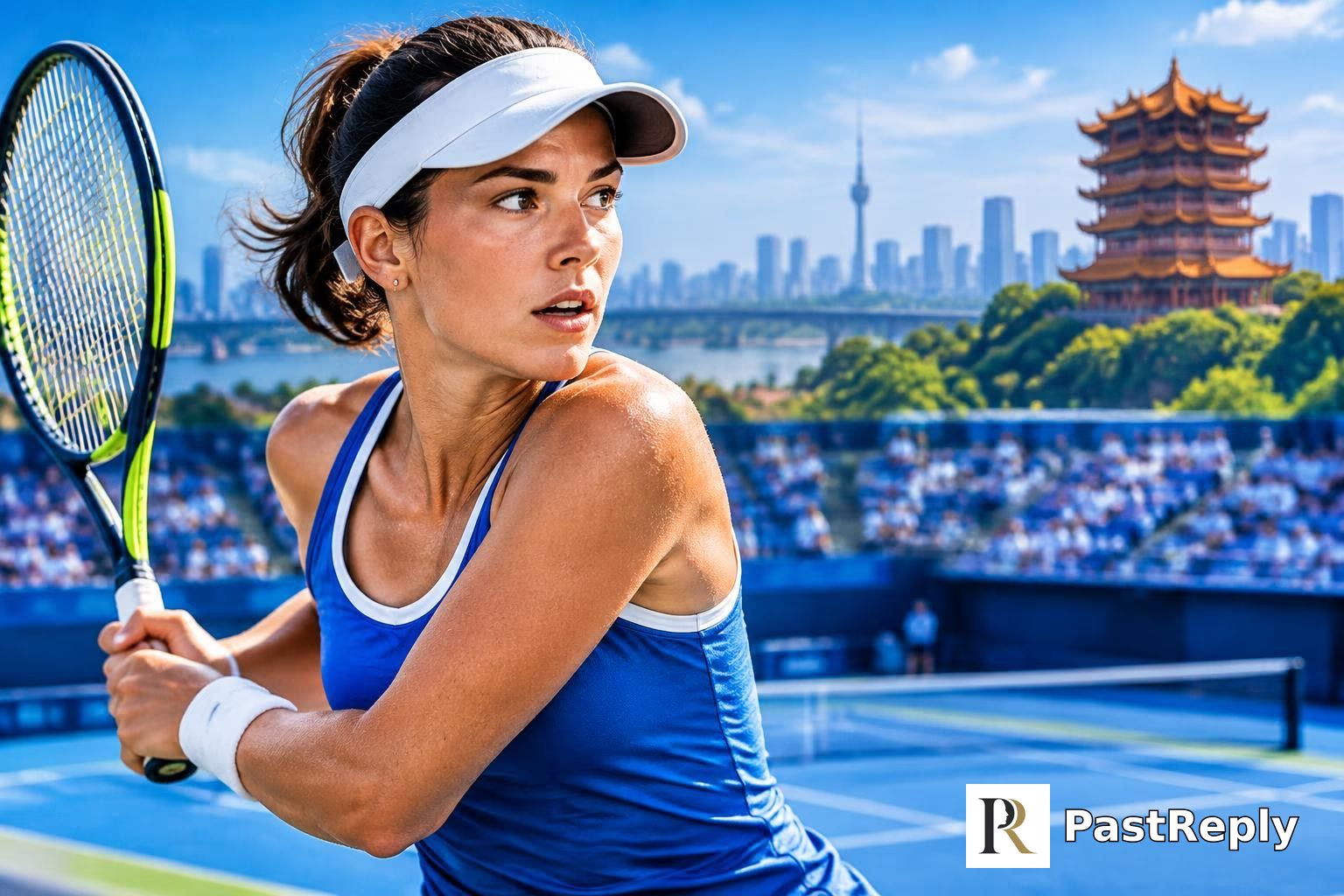
The facts
The WTA Wuhan, officially the Wuhan Open, is a professional women's tennis tournament on the WTA Tour. It is classified as a WTA 1000 event, the highest tier below the Grand Slams, and is played on outdoor hard courts at the Optics Valley International Tennis Center in Wuhan, Hubei Province, China. The tournament was founded in 2014 and returned in 2024 after a four-year hiatus due to the COVID-19 pandemic.
In 2026, the Wuhan Open is scheduled from October 12 to October 18, with a singles draw of 56 players and a doubles draw of 28 teams. The total financial commitment is $4,088,211. Past singles champions include Aryna Sabalenka and Coco Gauff.
Answered by 100 of history's most famous minds
A woman strikes a small ball and runs, and the crowd roars - but which of them, when the match is done, will sit at table with the one who cleans the courts? I tell you, the last ball struck may crown the first to be forgotten. Consider the lilies of the court: they neither toil nor spin, yet Solomon in all his glory was not arrayed like one of these.

A gathering of women in Wuhan, contending for a prize - let them contend with justice and courtesy, for the strong are not those who strike hardest but those who keep their word and their temper. The ball is a trust between them; let them return it fairly, and let the winner give thanks and the loser give honor. On the Day of Judgment, the score that matters is not kept by any umpire of this world.
You grasp at a champion and a purse, and already the craving has begun: the wanting to win, the fear of losing, the clinging to a name on a trophy. Watch a single point closely - the ball arises, is struck, and is gone before the hand can hold it; so too the self that plays. Play well, then, but play without grasping, and when the last ball has fallen, let it fall.
A woman's contest, on hard ground, with a small bound ball - and what of it? Let the people of Wuhan gather and be glad, for there is a season for the game as there is for the harvest, and the covenant does not forbid a little gladness. But I would have the great ones of the city remember the widow and the orphan while they fill their seats and their purses; the law weighs the justice of a town before it weighs its winnings. Let the game be played, and let it be played honestly.
The tennis court is a small kingdom, and like any kingdom it is well ordered only when each person holds her proper place: the player to her stroke, the umpire to her call, the crowd to its silence. Fifty-six players, and each must examine herself before each serve - has my preparation been sincere? Have I honored my opponent? The victor should receive her cup with humility, and the defeated should depart without resentment. This is ren expressed through li, and it is the same in Wuhan as it was in Lu.
They run and strive and grasp at a crown of perishable metal, and the crowd roars as though it were a trumpet of angels - yet what does it profit a woman to win the whole draw and lose her own soul? I do not condemn the contest; I say only that the prize is a shadow, and the body that trains so fiercely will one day be sown like seed in the ground. Let them run, then, but let them also ask who gives the strength to run.
I left my father's house and the land I knew, not knowing where I was going, only that a promise had been made to me and it would be kept in a time I would not live to see. So they play in Wuhan, and the girls come from many lands to a hard court, and the ones who win will be forgotten before their grandchildren are born - this does not trouble me. What troubles me is whether a woman keeps faith with her own word when the crowd is against her. That is the covenant I would watch.
The softest thing on the court is the ball, and yet it is the ball that wears down the hardest stone. A tournament is a river that cuts a channel through the season; the wise player does not dam the river but learns its current. You ask what it is - I say it is a place where people gather to watch others strive, which is a fine thing, so long as they remember to stop when the striving is done.
The One who made the sun to rise over Wuhan made it rise over every land, and the woman who strikes the ball and the woman who watches from the stands are sisters under the same sky. A game is not a thing to be despised, for it teaches the body discipline and the heart humility - but the true contest is whether you remember the Name when you win, and whether you share your winnings with the hungry. The rest is a field where the ego plays.
I am told the women of many nations gather in a city of the Hubei plain to strive together, and that the strong are praised and the victor lifted up. My heart goes out to them, for I know what it is to be a young woman set upon a road not of my choosing, watched by many eyes. Let the one who wins be humble in her winning, and the one who falls be gentle with herself, for the Lord looks not upon the trophy but upon the spirit within. I remember a wedding feast where the wine ran out and the host was ashamed; I would that every woman who returns home with empty hands be met with kindness, and not with reproach.
I have been shown the sums, and I will speak plainly as I did at Wittenberg: four million for a game of balls, while the poor of that province go hungry, is a scandal that cries to heaven for a reckoning. But I am not so blind as to condemn the players, for a woman's body and a woman's skill are God's gifts, and there is no sin in using them well. What I condemn is the trafficking in spectacle, the turning of a city's name into a coin, the idolatry of the purse. Let them play; but let the purse be weighed against the wages of the servant who sweeps the court, and let no prince or prelate claim a share of the glory. The Christian is free - free even to lose.
It seems to me that the question resolves itself into two: what this tournament is in its genus, and what it is in its end. In its genus it is a contest of art - namely, the art of striking a sphere with a strung frame - and thus falls under the virtue of fortitude, for the players endure long labour and frequent defeat. In its end, however, it is ordered to a purse, and a purse is a means, not a final good; for money is ordered to the household, and the household to the common good, and the common good to God. I would not condemn the game, for play is a rest of the mind and a lawful delight, as Aristotle says; but I would ask whether the four million is ordered rightly, and whether the city that hosts it is better or merely richer. The answer, I suspect, is mixed, as most answers are.
So much money spent on a ball and a net, while in the lanes nearby there are children who have never held a racket, and old ones who have not been touched by a kind hand this week. I do not condemn the players - they work, and work is good. But I would ask the women who win to give one hour to the forgotten ones of their own city, for a cup gathers dust while a small act of love, done in silence, is remembered in heaven.
A ball struck and returned follows laws as surely as an apple falls - action and reaction, force and resistance, the parabola of every shot determined by the angle of the strings. I would not speculate on fortune; give me the measurements of the court and the velocity of the stroke, and I will show you the curve. But the force that set it all in motion - that I feign no hypothesis about.
A ball struck across a net, and by the time it reaches the other side, the striker has already moved - yet a steward with his ledger insists on naming one instant the 'present.' The tournament is played in Wuhan, where space and time themselves are folded into a racket's arc; what matters is not the city but the symmetry of the court, which is as elegant as any law of nature. I would sooner ask whether the players' timing is absolute or relative - and I suspect the line judge's clock is the only thing truly at rest.
Consider the variety: fifty-six women, drawn from every quarter of the globe, each shaped by her own soil, her own training, her own inheritance of temperament - and set to contend on one hard court. Selection will do its work; the swiftest and steadiest will leave descendants in the record, the rest will not, and no one designed it so. I confess I find the contest less interesting than the long descent of the players themselves, which took far longer than a week to produce.
Observe the thing itself before you bandy words about it: the ball is struck, and it travels in a curve - and the curve obeys, not the crowd, but the laws of body and force, whether the onlookers approve or not. If these women strike better than the men of a generation past, that is not opinion but measurement, and the measure will show it. Let no man tell me the game is the same as it ever was; the evidence of the eye, through the instrument of the tally, proves the thing moves.
Consider the arrangement: fifty-six bodies moving on a fixed rectangle, and yet the whole is governed by lines that do not move. That is a harmony worth noting - the court is a small cosmos, and the players are bodies in orbit about a center they did not choose. What pleases me is the simplicity of it: no tangled epicycles, only the straight baseline and the net. If the tournament has a fault, it is that the center is a trophy and not the Sun - but I will not press the metaphor too far.
Four million dollars committed to a single week of striking a ball across a net - and still no one has built the wireless transmission tower I promised them a century ago! The money is nothing; the true marvel would be to power that entire Optics Valley stadium from the air itself, with no copper, no poles, no wasted spark. I built such a coil in my mind long before they laid the first hard court, and it worked perfectly.
One measures carefully, without haste: fifty-six entrants, a purse of some four million, a span of six days - these are numbers, and numbers are only honest if you count them rightly. But the true experiment is not the tournament; it is the young body under strain, the tendon tested to its limit, the will that must not fracture though the scoreboard says it should. I have carried radium in my pocket and felt my own hands burn and called it knowledge. These women burn for a trophy. Both demand the same fearlessness - to fear nothing, only to seek to understand what one's own frame can bear.
A tournament is an experiment in endurance, and the hard court is the medium - heat, friction, and the human body under strain. I would want to know the condition of the air in Wuhan in October, the grip of the surface, the recovery time between matches; chance favors the prepared mind, but the mind must be prepared with measurement. Four million dollars is a fine sum to spend on a laboratory where the hypothesis is simply: who can last.
Four million dollars doesn't fall out of the sky - somebody built that stadium, somebody strung those lights, somebody figured out how to make a hard court that doesn't crack in the heat. I'd want to see the machine that serves the balls, and the machine that measures the speed, and the machine that keeps the score. The player gets the glory, but the tinkerer gets the patent.
The interesting question, as ever, is not who wins but what the machine can decide. A line judge watches a ball strike the ground and calls it in or out - but the human eye is a poor instrument, and a ball travelling at a hundred and twenty miles an hour crosses the line in less time than it takes a nerve to fire. The question I should like to put to the tournament is whether its decisions are made by an algorithm, and if so, what the algorithm is doing when the ball is within a millimetre. Given enough measurements, the machine does not guess; it computes. Let the umpire be honest about which he is doing - and let the draw be a finite game, for a finite game can, in principle, be solved.
Give me a firm point and a lever and I will move the earth - but give me a sphere and a flat plane and I will show you something subtler: the geometry of a rebound. A ball struck at a given angle leaves the racquet at a corresponding angle, and the whole game is nothing but the reflection of lines across a net, which the geometers of Alexandria knew before ever a court was drawn. What puzzles me is not the trajectory but the four million drachmae; for I have seen men pay more for a single bronze sphere than for the theorems that govern its motion. Still, let them play - the study of proportion is holy, and a well-struck forehand is a proof of sorts.
A woman striking a ball across a net, and I confess the net itself interests me less than the field that surrounds it - the unseen tension that leaps from her racket through the air and is felt in the opponent's wrist before ever the ball arrives. Every stroke is an experiment in force and reaction, performed before a crowd that sees only the outcome, not the lines of influence. If I could lay iron filings around that court, I would show you the invisible lattice of every rally made plain, and you would wonder no more at the power of a handsomely struck return.
A woman serves, and at the moment of the toss she is wholly alone with something older than the game - the infant's rage at being left, the wish to strike and to be struck. Observe the grunt, the ritual bounce of the ball, the refusal to step on a line: these are not tactics but private ceremonies against an anxiety the player herself cannot name. The crowd believes it watches a contest of forehands; I would say it watches two unconscious minds negotiate a truce, and the loser weeps for reasons she will never confess.
A yellow ball, roughly six and a half centimetres across, struck at over two hundred kilometres an hour, and eleven thousand people watching it - I find that rather wonderful, since each of those spectators is a temporary arrangement of atoms on a small wet rock orbiting an ordinary star. The physics is straightforward: elastic collision, parabolic arc, a racket bending to store and release energy. What is less straightforward is why the winning of such a contest should feel, to the player, like the whole of existence - but then, I have spent my life on questions with no such tidy answers.
Every stroke on that court is an operation - a sequence of decisions, each depending on the state left by the one before, exactly as the loom follows its cards. The player who wins is not merely stronger but faster at computing the next position, and the coach who studies her opponents is compiling a table of probabilities. I would delight to see the whole tournament rendered as a vast mechanical notation, for I suspect the finest players among them are already, in their bodies, doing what my Engine was only ever meant to do on paper.
Let us begin as we must: define the court, its lines given, the net fixed at its stated height, the ball a sphere of known measure. From these premises the possible trajectories are not a matter of opinion but of necessity - every angle of incidence yields its reflection, every arc its landing point, and no royal road shortens the proof. The players dispute nothing of this; they dispute only who executes the necessary conclusion more swiftly, and that is a question of speed, not of truth.
Four million pounds laid out for a fortnight's sport, and I would ask the stewards how many of their fifty-six players are carried off with a torn sinew or a fever from the changing-rooms - for I have seen what a crowded ward and a fouled water-jug will do, and no purse is well spent that ignores the drain beneath the court. Give me the returns of injuries, the hours of rest, the ventilation of the pavilion, and I will tell you whether this is a tournament fit for women or a spectacle kept at their bodies' expense.
Fifty-six women contend on a hard court in the land of the Han - a fine field for glory, but I would have them fight with sarissas, not rackets. Still, I honor the spirit: to strive, to dare, to seize the prize before the crowd. A king who conquers a city is greater than one who wins a game, but the daring is the same fire.
Wuhan? I have never marched there, but I know the shape of a contest: fifty-six enter, one departs with the laurel, and the rest are owed mercy and a place at the table. Fortune favors the bold - and the boldest here are the women who strike first and never yield the center of the court. Let the organizers count their four million; I count only the glory of the victor and the loyalty of the crowd.
A contest of women in a city of the Han - and the coin they wager on it, four thousand thousand of your silver pieces? I have paid fleets and bought kingdoms for less. The true match is not the ball struck across the net but which queen holds the court and keeps her crown; watch how the strong devour the strong, and learn. Were Antony here he would wager Egypt's grain on the winner and lose it cheerfully.
A city of the far east receives the world's women and their retinue, and the matter is settled by a purse - four thousand thousand of their coin. It is not unlike the games I gave the people, bread and spectacle, save that here the spectacle is the whole of it and there is no bread. Still, a ruler who keeps his city's name before the eyes of many nations holds something worth keeping; and a long quiet spell, four years shut, is not ruin if the walls stand when the gates reopen. Patience, as ever, outlasts the shout of the forum.
Fifty-six women, and one prize - Heaven favors the one who has trained hardest and bled most for it. I care nothing for their birth or their banners; I care who holds the line under pressure and who breaks. Let the victor in Wuhan be the one whose will does not waver in the third set, for that is the same quality that holds an empire together. The rest is noise.
Four million dollars, fifty-six players, one week - and a four-year gap in the middle of it, which tells me everything about how such enterprises are governed. Fortune favors the bold, and the bold in Wuhan are the ones who seize the center of the court and never yield it; the timid play safe and are swept aside. Give me a general who serves like a cannonade, and I will show you a champion.
A republic of athletes, in a sense - each bound by rules, each submitting to the umpire as citizens submit to the law, and the prize withheld from the one who breaks faith with the game. I am glad the thing returns after its long silence, for a contest suspended four years is a precedent no free people should relish. But mark me: the money is large and the applause is loud, and virtue is tried more surely by the purse than by the point. Let them play honorably, and let the winner rise modest and the loser rise gracious, and the sport shall want for nothing.
I remember a time when a nation was torn asunder over whether a man could own another man's labor, and the question then was not unlike the question now - who gets to stand on the court and who must watch from the gallery. This Wuhan tournament, with its fifty-six players and its purse, is a small republic of striving, and I am glad that women stand in it as equals. But let no one forget that the game is only worth playing if the rules are fair to all who enter.
A tennis match is a war in miniature, and the Wuhan Open is a campaign fought over seven days with racquets instead of rifles. I have seen empires rise and fall, and I have seen that the side which holds its nerve when the crowd is against it is the side that prevails. Fifty-six players enter; one lifts the trophy. That is the arithmetic of every struggle worth the name.
A purse of four million dollars for a few days' play, while the cotton-fields of Hubei are worked by hands that earn less in a year - this arithmetic troubles me, and I will not pretend it does not. But I have learned not to despise the arena, for it is a place where a woman may be seen and heard, and where she may meet her rival not with a sword but with a racquet, and part as friends. The true test of your Wuhan is not the final score but whether the wealth it gathers returns to the villages from which the servants and the ball-girls come. Means and ends, my friends - they must be of one cloth, or the whole garment is spoiled.
There is a long arc in the story of women and sport, and it does not bend toward justice by itself - it bends because people run the length of it. I remember the weary years when a woman was told the racquet was not for her, that her place was the kitchen and not the court; and now fifty-six of them stand upon a hard floor in Wuhan, and the world watches, and the purse is not a charity but a wage. That is progress, and I will not be sour about it. But let the tournament be the beloved community and not merely the marketplace: let the girls who lose be honored as the girls who win, and let no nation's flag be raised so high that a sister's face is hidden beneath it.
I spent twenty-seven years in a cell on Robben Island, and I learned there that a game played across a net can teach what a parliament often cannot - that two people may strive fiercely and still shake hands at the end, and that the dignity of the opponent is not diminished by defeat. A tournament in Wuhan, where the world's young women come to test themselves, is a small embassy of that lesson. What matters is not who lifts the trophy but that the door was opened for all of them to walk through it.
I will speak to this only as a matter of historical record, and I condemn without reservation the crimes committed in my name. A tournament held in a great city is, in the cold reckoning of states, a display of strength and organization, and strength is what a nation must show if it wishes to be counted. But strength purchased by terror and by the murder of millions is not strength - it is rot at the root, and it collapsed upon itself. That is the lesson history has already written, and it admits no revision.
One does not build a tournament of this scale by sentiment; one builds it by counting - the courts, the players, the purse, the crowds, and those who will be made to smile for the cameras whether they wish it or not. Such events are instruments, and the question of who wields the instrument and toward what end is the only question that matters. I would study the ledgers of it before I studied a single serve, for the ledgers tell you who truly holds the racket.
A spectacle of this kind, staged in a city of millions, is never merely a game - it is the state displaying its capacity to organize, to build, to draw the world to its door and be seen doing so. Whether that capacity serves the many or merely the few who command it is the question every such display conceals. Watch who profits from the gate and who labors to lay the courts, and you will have your answer without consulting a single line judge.
Fifty-six women chasing a ball across a hard court - and where are the peasants of Hubei in this? The foreign firms put their coin on the table, four million and more, to make a spectacle in the Optics Valley, and the sons and daughters of the soil are told to clap. I say: let the players run, but let the workers of Wuhan run the courts, the ledgers, and the gates, and ask who pockets the difference between the ticket and the rice bowl.
A hard court in the interior of China, with ladies from many nations contending for a purse - it is a curious age, when even sport is become an exhibition of empire and commerce. I am told the champions' names are Sabalenka and Gauff, and that the whole affair was suspended four years and now resumes; well, constancy is a virtue I know something of, and I should expect the victor to bear her laurels with the modesty and dignity befitting a lady, not with the hoydenish shrieking one hears is now the fashion on such grounds.
One notes that the tournament returns after an absence of four years, and that its champions have been drawn from more than one nation - a small instance of the international fellowship that sport can offer, and one to be welcomed with quiet goodwill rather than fanfare. The players will have trained long and in obscurity for this fortnight; it is the constancy of that preparation, rather than the purse or the crowd, that I should wish to commend.
I am told the women of many kingdoms gather in a city of the east to strive upon a hard court for a prize of four million - a sum that would endow a monastery, and they spend it on a fortnight's running and striking. Yet there is something of the tournament in it, the lists and the contest of champions; and I would have the masters of that city see that such gatherings are kept in good order, the law upheld, the peace of the spectators preserved, and the faith of the place not mocked by the license that too often attends a great concourse of strangers.
Fifty-six women, and every one of them must have a will like a sword, for the voices do not speak to the idle. I know what it is to be told by heaven to take up a task that seems too great for a maid of the fields - and I say to these players, if God has given you the arm and the hour, then run and strike and fear no court nor crowd. But let them keep their hearts clean and their thanks honest, for a victory won by cunning alone is no victory before God.
I have watched men contend for crowns with less ceremony than these ladies show for a purse, and I confess there is a certain prudence in a contest confined to a hard court and a fortnight, where the combatants may be parted by a net rather than by armies. That the tournament fell silent four years and now resumes is no small thing - a realm that can put on a spectacle again has steadied its hand. I would only counsel the winners to remember that a laurel is a loan, and the crowd that cheers today will appraise tomorrow.
Four million in silver for a fortnight of tennis in a province of the Middle Kingdom - I have funded academies for less, and been repaid in glory. It is a fine thing to see women of many nations run and strike before a crowd, for a people that can fill a stadium and pay its champions well is a people that has learned to look outward; I would only wish the masters of this Optics Valley to see that the true monument is not the purse, but the schools of physic, letters, and the arts that should grow beside it, as I built beside my own court.
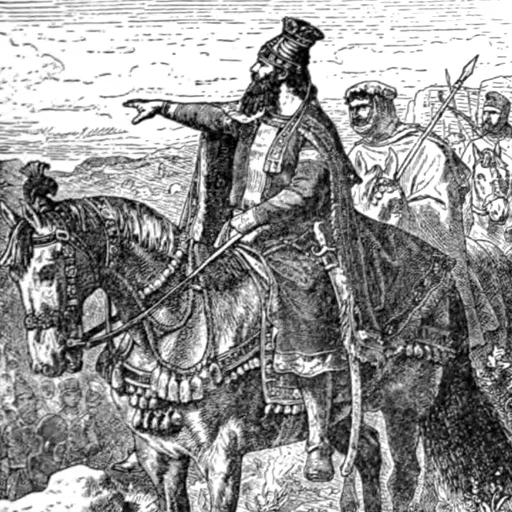
A city of the east gathers women from many lands to strive upon a hard court, and I am told the champions are drawn from the north and the west - this is how an empire is made pleasant, when strangers are welcomed and their contests honoured rather than forbidden. I have ruled many peoples and found that a festival honestly kept turns a stranger into a friend more surely than a tax. Let the governors of Wuhan see to it that the roads are safe, the market fed, and the losers treated with courtesy, for magnanimity costs little and buys much.
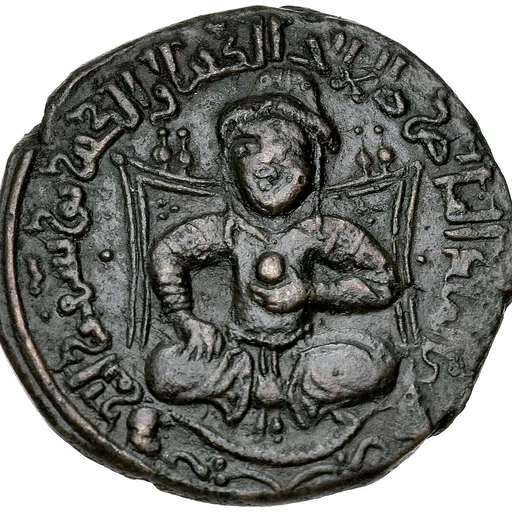
By the grace of God, I have seen men strive for a fortress and for a purse, and the discipline of the one is not unlike the other - training, patience, and the hour of decision. That fifty-six women come together in a single city to test their skill is no small thing, and I would have them contend as honourable warriors, giving quarter and taking it, for the strong who forget courtesy in victory are no better than the raiders who forget it in defeat. Let the masters of that city keep the peace and feed the poor who gather at its gates, and the contest will be blessed.
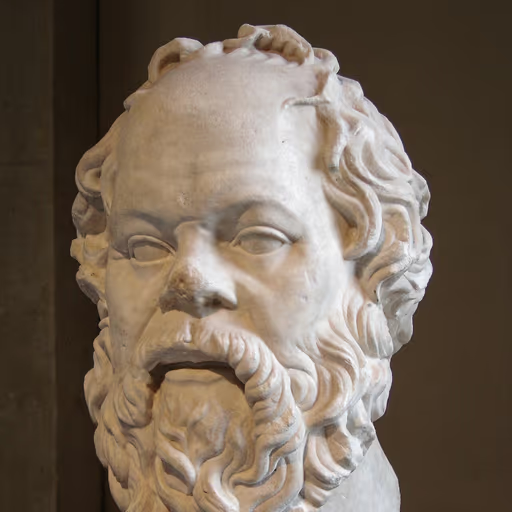
Tell me, friend: when the champion lifts the trophy, is she more virtuous than the one she defeated? And what is this virtue - is it in the swiftness of the arm or the steadiness of the soul? I confess I know nothing of tennis, but I know that the unexamined match is not worth playing. Let us inquire together what it means to win.
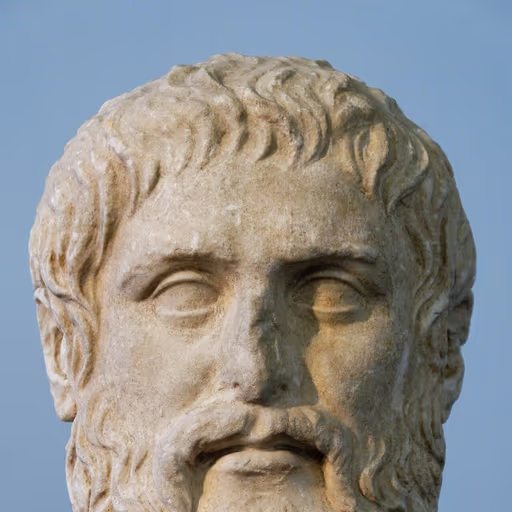
You ask of a contest of bodies in a distant city, but I ask: what is the Form of the tournament itself? Not the racket nor the court, but the perfect contest - where harmony of speed, judgment, and spirit produces a just victor. The players you name are shadows cast on the wall of the cave; the true champion is the one whose soul is ordered aright, and such a one would win even without a single witness.
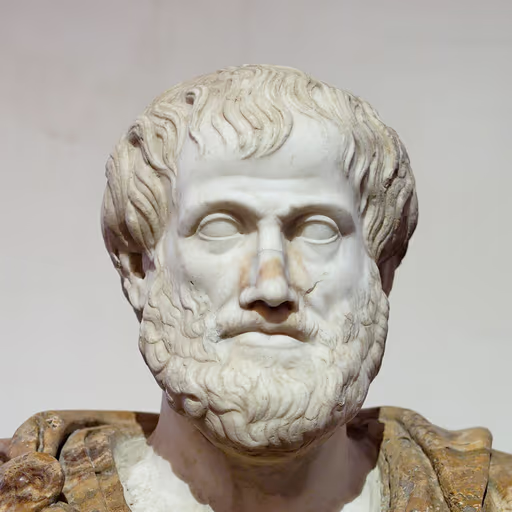
Let us define it before we praise it: a contest of the female body in the art of striking a bound sphere with a strung instrument, held on hard ground before a multitude - its purpose, the manifesting of excellence, and its cause, the pursuit of honor. That the purse is measured in the thousands of talents tells us such contests are esteemed as a species of public spectacle, akin to the footrace at Olympia, but the spectator must ask whether the crowd honors virtue or merely the victory. Virtue, as ever, lies in the mean: the player who neither fears the opponent nor despises her, who strives without insolence and yields without shame, will flourish.
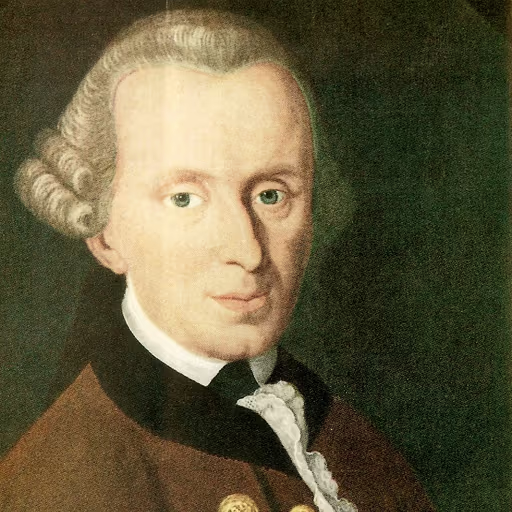
A contest in which one hundred and twelve women contend on a hard rectangle in Wuhan - by what right do we single out the victor? The tournament itself is lawful: it publishes a rule binding on all, and each player consents to be measured by it. But mark this well: the champion's trophy confers no moral worth. Her dignity was already complete before the first serve, and it would remain whole after a first-round defeat. The crowd that cheers her should ask whether it would will that every player be treated as an end, not merely as a means to its amusement.
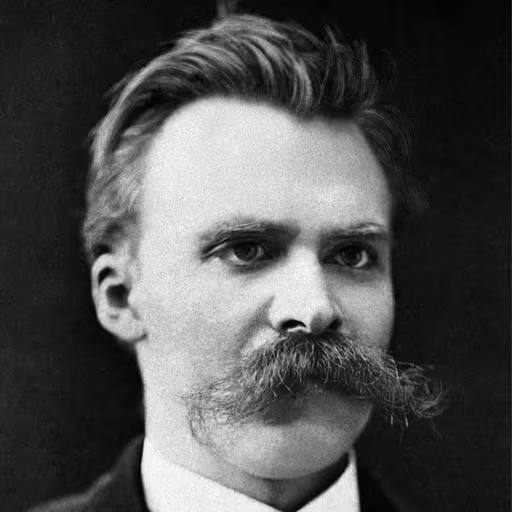
Fifty-six women chasing one cup on a hard court - how charmingly democratic! Everyone gets the same lines, the same ball, the same chance to prove she is not merely one of the herd. But watch closely: the crowd does not cheer the one who plays most freely; it cheers the one who wins. That is the herd's morality in miniature - it worships the result and calls it virtue. The true player is the one who would play the same way if the stands were empty and no cup existed.
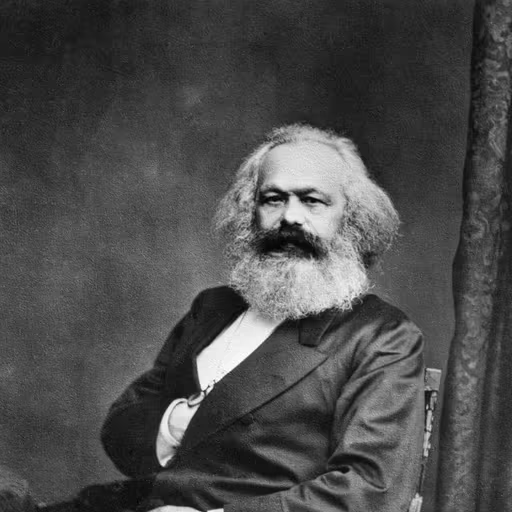
Four million dollars - a sum that could feed a district, wagered on a single week of striking a ball, while the women who swing the rackets are paid a pittance of the gate and the sponsors pocket the rest. Follow the money past the pretty blue courts and you will find the same old relation: capital buys the spectacle, labor sweats for it, and the crowd is taught to call this freedom. The question is not who wins Wuhan; it is who owns it.
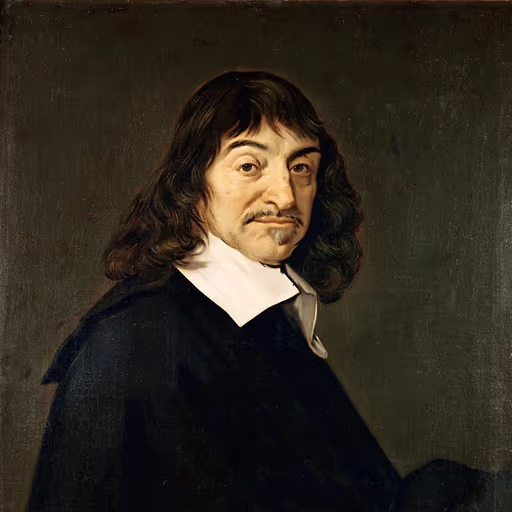
Before I accept that there is a tournament in Wuhan, I must ask what I truly perceive - a white ball, a shouting crowd, a fortnight in October - and whether these are anything but phantasms of a mind that dreams. Strip them away, doubt them, and what remains? A thinking thing that doubts, and a body extended in space and moved by mechanism, striking another body at speed. That much I can hold with certainty: the geometry of the court, the collision, the line. The champion is a matter of opinion; the angle is a matter of truth.
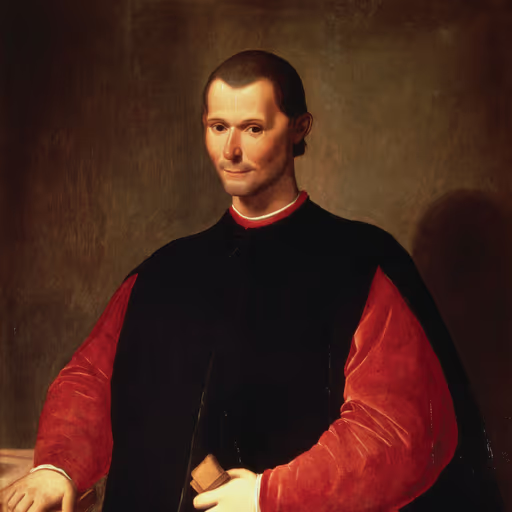
A tournament is a principality, and the prince who would keep it must understand that the players are not subjects but mercenaries - they come for the purse, and they stay only so long as the purse is greater than the cost of their travel and their pride. The wise ruler of such a place does not ask for love; he asks only that the draw be honest and the court be fast. Four million dollars is a fine sum, but a champion's favor is bought with a thousand small decisions no one sees.
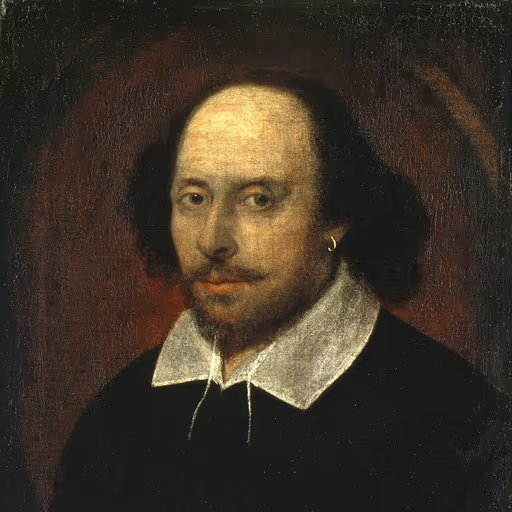
All the world's a court, and all the men and women merely players; they have their exits and their entrances, and one woman in her time plays many parts - the favorite, the underdog, the fallen champion. What is a tennis match but a tragedy and a comedy in three sets? The crowd weeps and laughs by turns, and the ball flies like a messenger of fate.
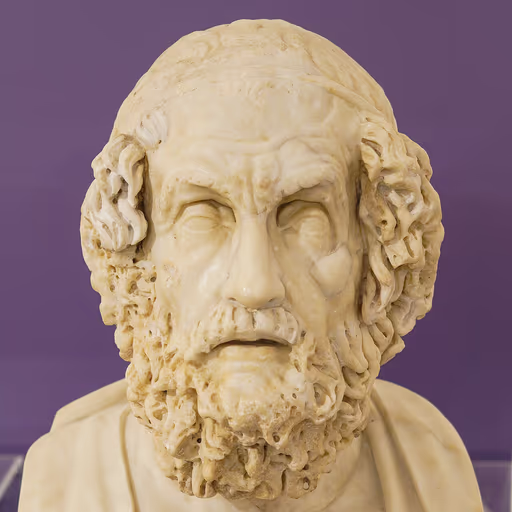
Sing, O Muse, of the fifty-six who gather by the Yangtze's broad water, and of the hard court where the swift-footed contend! As heroes once strove before the walls of Troy, so these women strive for kleos - glory that outlives the body - and the gods above lean down to watch which mortal holds her nerve when the sun is high. Yet even the victor's crown is shadowed by fate, for all flesh is grass and the ball falls where it will.
In the valley of the Han they raise a court and a net for their sport, and the world's women beat a bound orb across it - but I would ask, whose city is this? A city that held the world's breath in sickness and then shut its gates for four years; let us not forget the silence. Yet the wheel turns, and the game returns, and there is some mercy in a crowd gathered again to shout and to weep for a champion. But mark the names chiselled on the trophy: the strong prevail and are crowned in their hour, as all flesh is; let them play in the light while the light lasts.
Fifty-six women, and every one of them has spent years in the narrow lane of the practice court - that is not narrowness, that is formation. I have always held that a person grows by doing, and here is doing made visible: the body learning what the mind cannot teach it, stroke by stroke, until the hard court becomes a kind of second nature. What interests me is not the final tally but the striving - the player who loses in the third round but has, in that loss, discovered something about her own reach. That is Faust's wager in miniature, played out under the lights of Wuhan.
A tournament in Wuhan - I confess I had to consult my map, for my own wanderings never carried me past Lepanto and Algiers. But I know the breed: women who chase a small yellow ball as though it were a dragon to be vanquished, and a purse of four million dollars awaiting the victor. Sancho would say they are mad; I would say they are the only sane ones among us, for at least their windmills are visible and their lances well-gripped.
I have watched peasants thresh grain in the sun and felt more truth in it than in all the salons of Petersburg - and I suspect a woman practicing her serve at dawn in Wuhan is closer to that truth than most. The scoreboard tells you nothing; what matters is whether she plays honestly, whether she rises after a fall, whether she loves the thing itself and not the purse. The rest is noise, and the crowd's roar dies as all roars die.
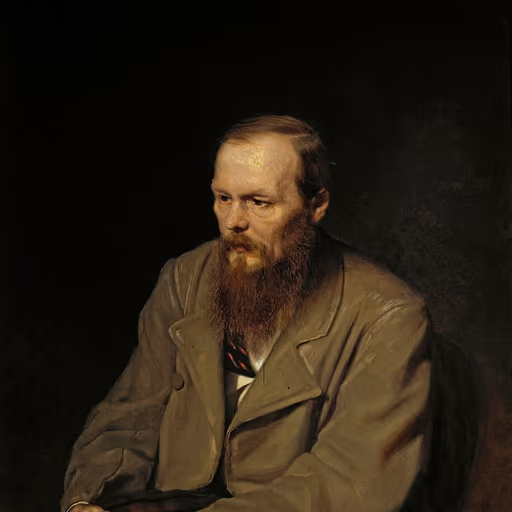
Ah, the crowd screams for the girl who wins, and the girl who loses walks off with her hands empty and her soul suddenly very large - that is where the interesting thing happens, not at the trophy. A hard court in Wuhan, a racket, a single ball, and a human heart that must decide, at the moment of break point, whether it loves the victory or fears the loss more. I have written of men who could not bear their own freedom; here are women who meet it in the space of a second and must answer for it. God help them - it is no small thing to be free in front of forty thousand witnesses.
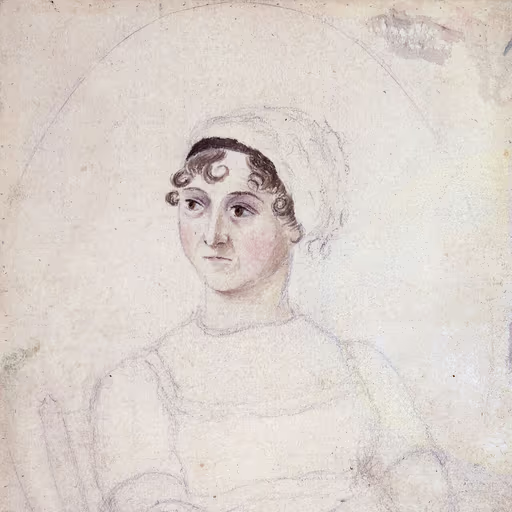
A young woman of good family would not, in my time, have been permitted to run about in public in short skirts and strike a ball for money, which only proves that the world improves in some respects and not in others. I am told the winner receives a great sum, and I confess I should like to see the expression on her face when she has earned it - for there is no pleasure like the pleasure of a woman who has secured her own independence. The rest is noise.
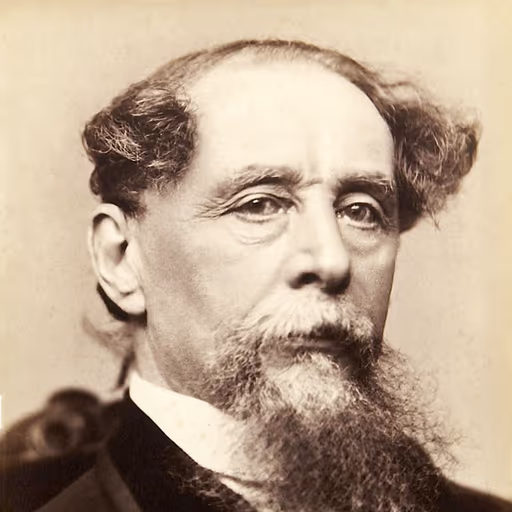
I confess I had never heard of Wuhan until the newspapers of the world were full of it, and the name came to me trailing a fog of dread, as though I were reading the first chapter of some new Bleak House. Now they tell me it is a place of bright arenas and white lines, where young women in summer garments contest a little woolen ball for a purse of four million - a sum that would have built a school for every ragged child in Saffron Hill and still left change for the printer's bill. I do not begrudge them their sport; I only marvel that the same city which taught the world the fragility of the human lung can, in a few short years, become a stage for such glittering ceremony. It is a very human thing, that - to build a festival upon ground where grief once walked.
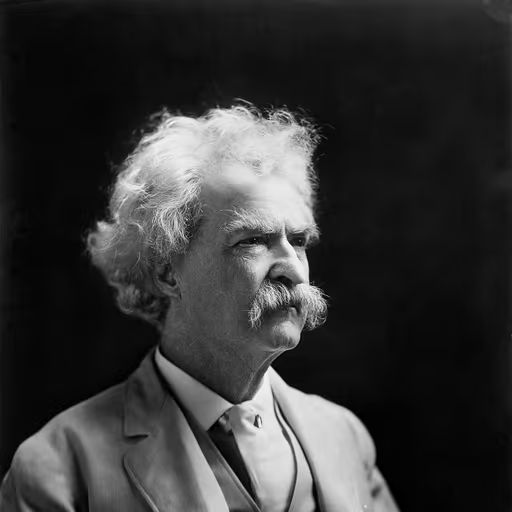
I've seen a good deal of bustle in my time, and I never yet saw a town that couldn't turn a calamity into a convention. Four million dollars, fifty-six ladies, and a hard court in the middle of a city that a few years back was the most famous plague-spot on the globe - that's not a tennis tournament, that's a sermon with a racquet. I don't say it's a bad one. I only note that the same folk who couldn't get a train out of Wuhan in 2020 are now paying top dollar to watch a girl from Belarus hit a ball past a girl from Atlanta, and both of 'em will be back home before the leaves fall. Human nature, sir, is a curious article, and the more it changes the more it's the same article.
Wuhan in October. Hard court, dry air, the ball comes off the strings clean. Fifty-six women, a purse of four million, a final on Sunday. The good ones don't talk about the draw. They work. They run the lines until their legs are honest and their minds quiet. Sabalenka hits hard and doesn't apologize for it. Gauff moves like she has somewhere to be. That is the whole of it. A woman alone on a hard court with a racquet in her hand, the crowd loud and the light going long - that is a clean thing. It doesn't need a speech.
I would observe the ball as I observe the flight of a bird - the spin of it, the arc, the way the air resists and the court receives it. A hard surface, you say, and a sphere of felt and rubber: here is a study in impact and resilience, the same laws that govern the water swirling in my sketches. Nature is full of such games; I merely watch and draw.
Marble resists the chisel, and so does a hard court resist the player - but the great form is already hidden within, waiting to be freed by the hand that knows where to strike. I look at these women and see the body in its glory: the coiled shoulder, the planted foot, the arm released like a bowstring. God granted the human frame its beauty; whoever plays with devotion enough will let that beauty show, and the crowd will gasp as at a newly uncovered David.
I have painted women with the hoe and the potato and the thread - hands rough with labor - and here are women with a small bright orb, all their body coiled like a spring of ochre and vermilion! It is a hard court of blue and grey, and the sun there strikes like brass, and when the ball flies, my eye sees the very arc of it as a stroke of light I would give my left ear to set down in paint. What a thing, that a whole city should gather and a purse of gold be laid on a single stroke of the arm - the crowd roaring like the sea, and the women carrying the weight of it.
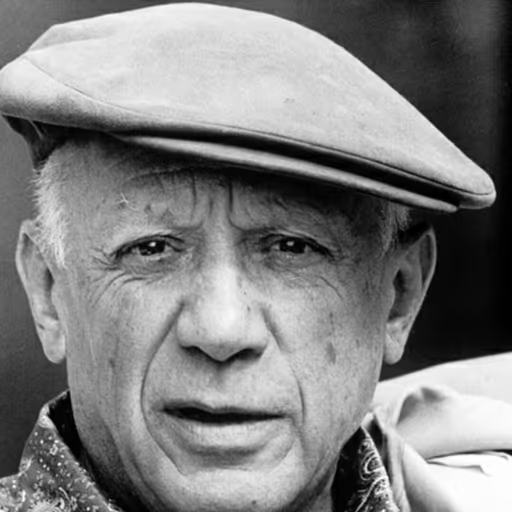
A white ball crossing a blue rectangle - and everyone pretends it is the same ball every time. Nonsense! Watch the angle of the racket, the wrist, the way one player's forehand is a slash and another's is a caress. That is where the invention lives, in the difference, not in the trophy. I would paint this: the Wuhan court broken into facets, the player's body a geometry of force, the ball a small sun at the center. The rules say the lines are fixed - but the seeing is never fixed, and the seeing is everything.
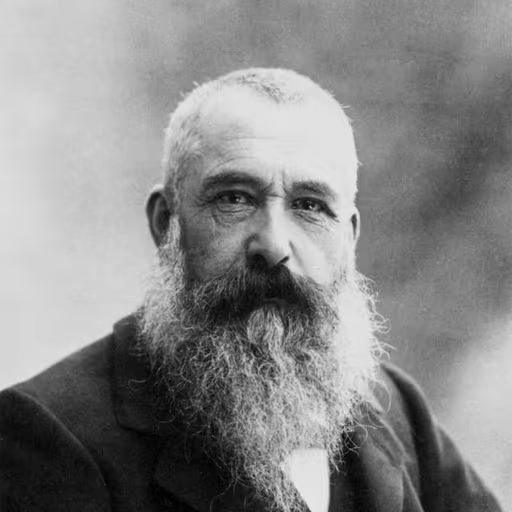
Twenty-eight teams, fifty-six souls, and the light over the hard courts at Optics Valley - that is what I would paint, not the score. Give me the hour when the sun drops low and the shadows of the players stretch long across the blue surface, the crowd dissolved into a single shimmering mass of hats and umbrellas. The ball is a fleck of white in that light, and the whole match becomes a study of atmosphere, not of victory.
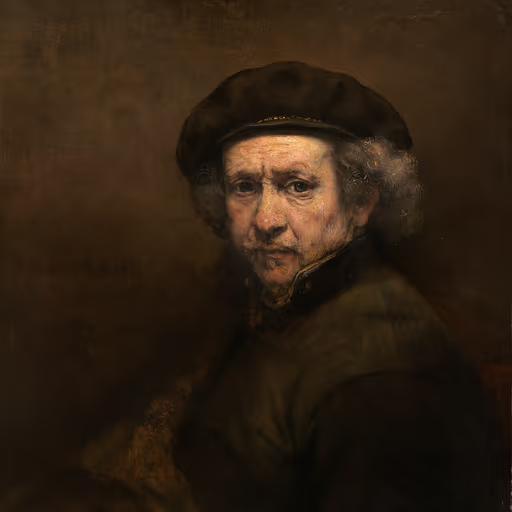
I have painted old women with the fur collar and the tired eyes, and I tell you the face betrays the hour before the mouth speaks. This field of hard ground they have drawn in Wuhan - you would not paint the ball, you would paint the waiting: the girl at the baseline, breath held, light raking one cheek, shadow swallowing the other. The purse of four thousand thousand coins, that is the patron's business; the artist's business is that half-second where the wrist tightens and the soul decides.
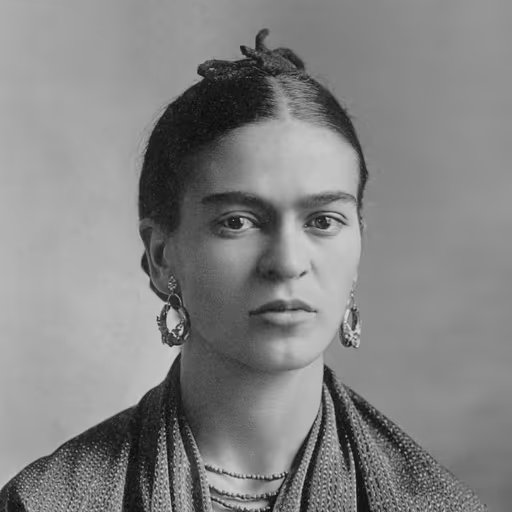
They paint my body broken on a bus and call it suffering; I call it a Tuesday. So a woman on a hard court in Wuhan, her knee wrapped, her back aching, playing anyway - do not give me the pretty winner's photograph, give me the sweat and the gritted teeth and the scar she earned. I would set her in a courtyard with the cactus and the monkey, her braid flying, her brow like a thundercloud, and beneath her this one line: still here, still swinging.
A tournament in Wuhan! I would set it to music - the rhythm of the rally, the crescendo of the crowd, the sudden silence before the serve. A hard court is no concert hall, but the human heart beats the same in three sets as in three movements. If only they would let me write the overture; I would make the ball itself sing.
A tournament played for four million - and yet the true prize is not the purse but the moment when the will refuses to break! I have known what it is to hear nothing of the world and still force the music out; these women, too, must conquer the silence inside when the score is against them. Let them play not for the crowd's applause but for that fierce, lonely joy which no patron can grant and no injury can wholly take.
Fifty-six players, and twenty-and-eight teams of two - a fugue in as many voices, and the theme is the same, but how they answer one another across the court! Each stroke must answer the one before it, and the true master is not the loudest but the one who keeps the measure while the others rush. There is a right tempo, and there is a wrong, and the judges, like a cantor, mark it; I would have them play, and count, and count again, for order is the shadow of the Almighty.
Well now, I grew up on the other side of the world, but I know a thing or two about a crowd. You put fifty-six young women on a hard court in Wuhan, and the ones who reach the final are the ones who learned to keep their nerve when the whole hall is watching - that's the same lesson I learned in a little studio in Memphis. I'd have loved to see it. The Lord gives the talent, but the temperament is what you build yourself, and you can hear it in the silence before the serve.
A woman steps onto that court alone, and for two hours the whole world watches her move - that is the same magic I chased on every stage I ever stood on. The feet, the rhythm, the hush before the serve - it is choreography, and I would have loved to build a routine around that moment. Heal the world, they say; I say start with one perfect backhand and let the crowd feel it in their chest.
Four lads from Liverpool never saw a court so far from home, but a racket's just a guitar with fewer strings and a meaner audience - and here's a girl standing on the line with everything in her hands and nothing but a white ball coming. It's the same old song, isn't it: hold your nerve, take the swing, and let it be. All we're saying is give the backhand a chance.

A stadium full of people watching a little yellow ball get hit back and forth - you could write a song about that, but it wouldn't be the one they'd expect. I've been to Wuhan in my mind a thousand times, and it's a river town with a hard court in it, and a woman on each side of the net who's got to decide whether she's going to be the one who swings or the one who waits. I don't know who wins. I just know there's a song in the waiting.
Fifty-six women, one court, and a whole city watching - that's a story, and every one of them has a chapter in it. I've stood on stages where the lights are so bright you can't see the crowd, and I know what it is to have to own your moment, to swing through the fear. Wuhan's got a champion's name on its trophy, and whoever lifts it will have earned the right to say: this is mine.
A new route to the East, you say? I sailed west to find Cathay, and here is a contest in a city called Wuhan - a place I never reached, though I sought it with all my heart. The ball crosses the net as I crossed the ocean: with faith, with calculation, with the conviction that the prize lies just beyond the horizon. Gold and glory await the bold.

I have stood in the markets of Kinsai and watched merchants count their coin by the thousand, yet never did I see a contest such as this - a court of hard stone in the city of Wuhan, where the Great River bends, and women from every realm striking a small ball across a net for a prize of four million! The Kublai's messengers would gape at it. Mark me: the true wonder is not the sum but the roads that carry these players from every corner of the earth to one place.
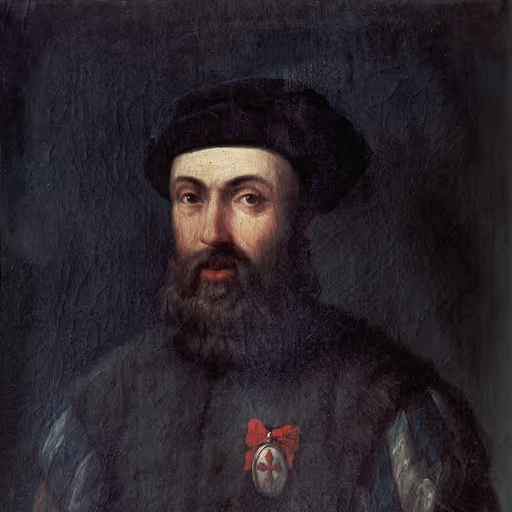
Four and a half thousand years of the world's coin and forty days of women striking a ball - and what is a court of blue stone beside a strait no man had sailed? Yet let us speak of passage: that a city closed its doors four years and now opens them again, and ships of every nation come in - that is the kind of reopening I spent my life to make. A commander does not ask whether the sea is kind, only whether the passage is charted. These women have charted theirs; let them sail.
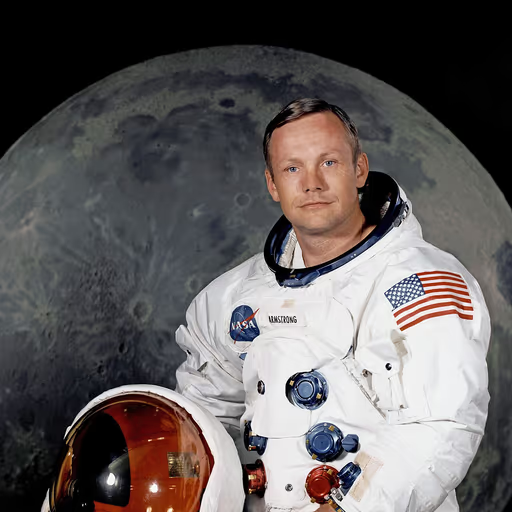
Fifty-six women, and every one of them has already won a thousand battles just to stand on that court in Wuhan - don't tell me about the trophy, tell me about the training. I know what it costs to be doubted and to keep swinging anyway. The one who lifts that cup on October eighteenth will have done it with nobody's permission, and that is the only kind of victory worth having.
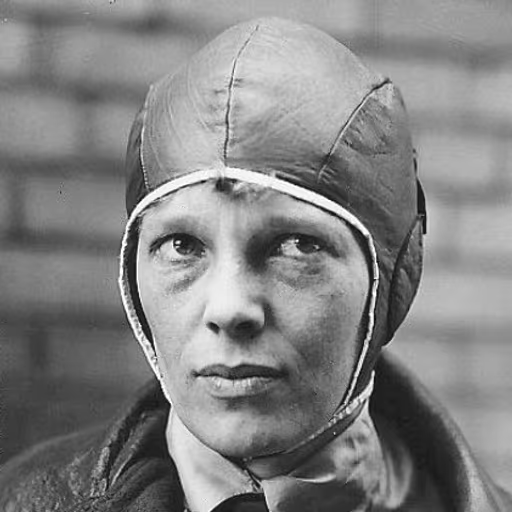
Four years of silence, and then the planes land again - that is the part that stirs me, not the prize money. Any woman who straps herself into that draw and serves into the wind at match point knows what I knew over the Pacific: the risk is the whole point, and fear is just a passenger you learn to ignore. Fifty-six of them, and every one has already broken some barrier to be there.
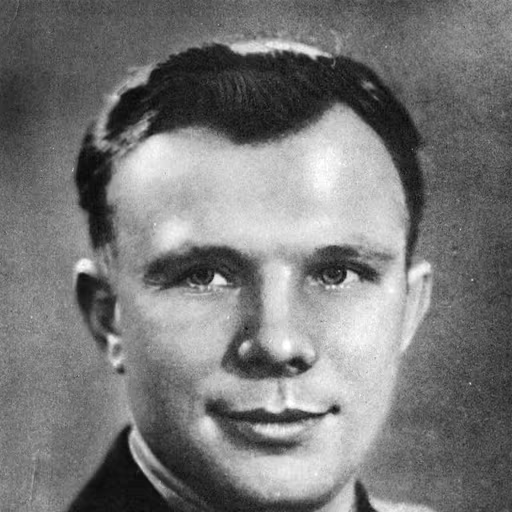
From up there the whole ball of the Earth is one field, and I never saw a border drawn on it - so why would a hard patch in Wuhan be foreign to me? Sixty ships' worth of players, a draw of fifty-six, and each one training as I trained, in the cold and the dark, until the body knows the way without the mind. The crowd roars; I know that roar. Only mine was for the whole of mankind going up, and this one is for a girl going forward - both are the same courage, I think.

A tournament is a product, and the product is drama - the simplicity of one ball, two players, a net between them. The design is everything: the hard court, the white lines, the hush before the serve. Most sports clutter it with noise; this one, at its best, is elegant. That's what I'd focus on - not the draw of fifty-six, but the single moment when everything is on the line.

First principles: a ball, a net, two humans, and a clock - nothing here is physically hard. What's hard is the mental bandwidth under a tiebreak at forty degrees; that's a compute-and-latency problem, and the winners are the ones who optimize it. The bigger question is why we're still flying athletes around the planet for a week when the whole thing could be a simulation someday - but until then, Wuhan's a solid node in the network, and the prize money is honestly still too small for the value created.

Oh, honey, I love this. I love this so much. You have fifty-six women who have poured out their whole souls onto a hard blue court, and the thing about it is - the ball doesn't care how much money your family had, or what language you speak at home, or how many people told you no. The woman who wins today is the one who stayed with it, in the silent hours nobody clapped for. I've met those women. That is not a hobby. That is a calling, and I want to stand up and applaud it.
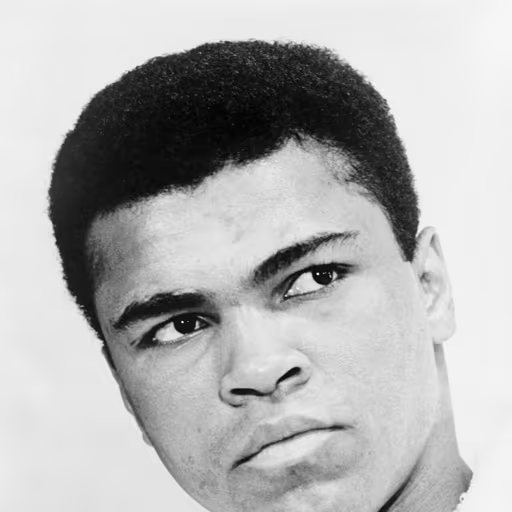
Wuhan, huh? I know a thing or two about fights in a ring, and a lady swinging a racket on hard courts is no softer than me in the twelfth round. Fifty-six warriors in that draw, all chasing one crown - that's the same math I ran in the heavyweight division, and only the boldest walk out with the belt. But let me tell you the truth: any woman stepping into that arena in Hubei, win or lose, is already showing the courage I respect most - the kind you can't borrow, can't fake, and can't take from you.
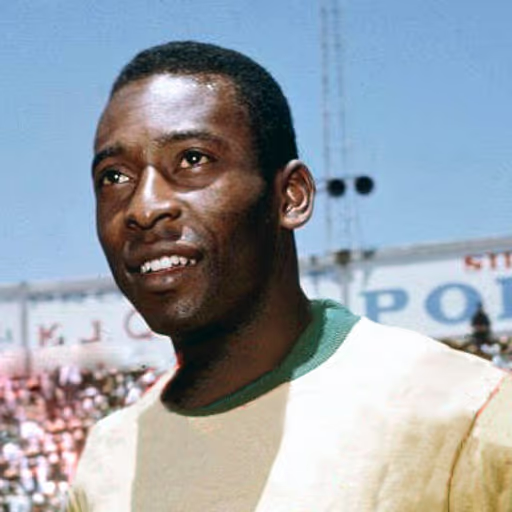
Ah, the beautiful game - and it is beautiful, whether played with the feet on grass or with a racket on a hard court in Wuhan. I watch a woman like Sabalenka or Gauff and I see the same thing I saw in my own teammates: hours in the heat, no shortcuts, and joy when the ball finally goes where you willed it. Sport is the same language everywhere; I never needed a translator to understand a champion.
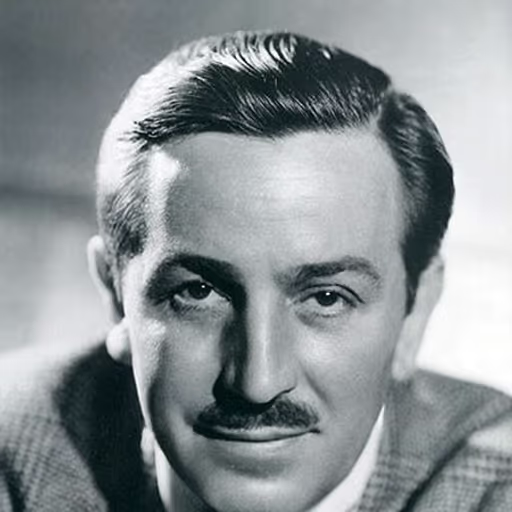
You take a patch of dirt in a city most folks couldn't find on a map and you build a castle on it - lights, crowds, a story with a winner and a loser and a hero's ending. That's not so different from a mouse and a magic kingdom, friend. Fifty-six players, one trophy, and a little girl in the stands who'll go home and pick up a racket because she saw somebody like her lift it - that's the whole picture, and don't you ever let anyone tell you it isn't magic.