
What is the UFC?
The UFC is the world's premier mixed martial arts organization, founded in 1993 and known for its Octagon cage and global pay-per-view events.
The facts
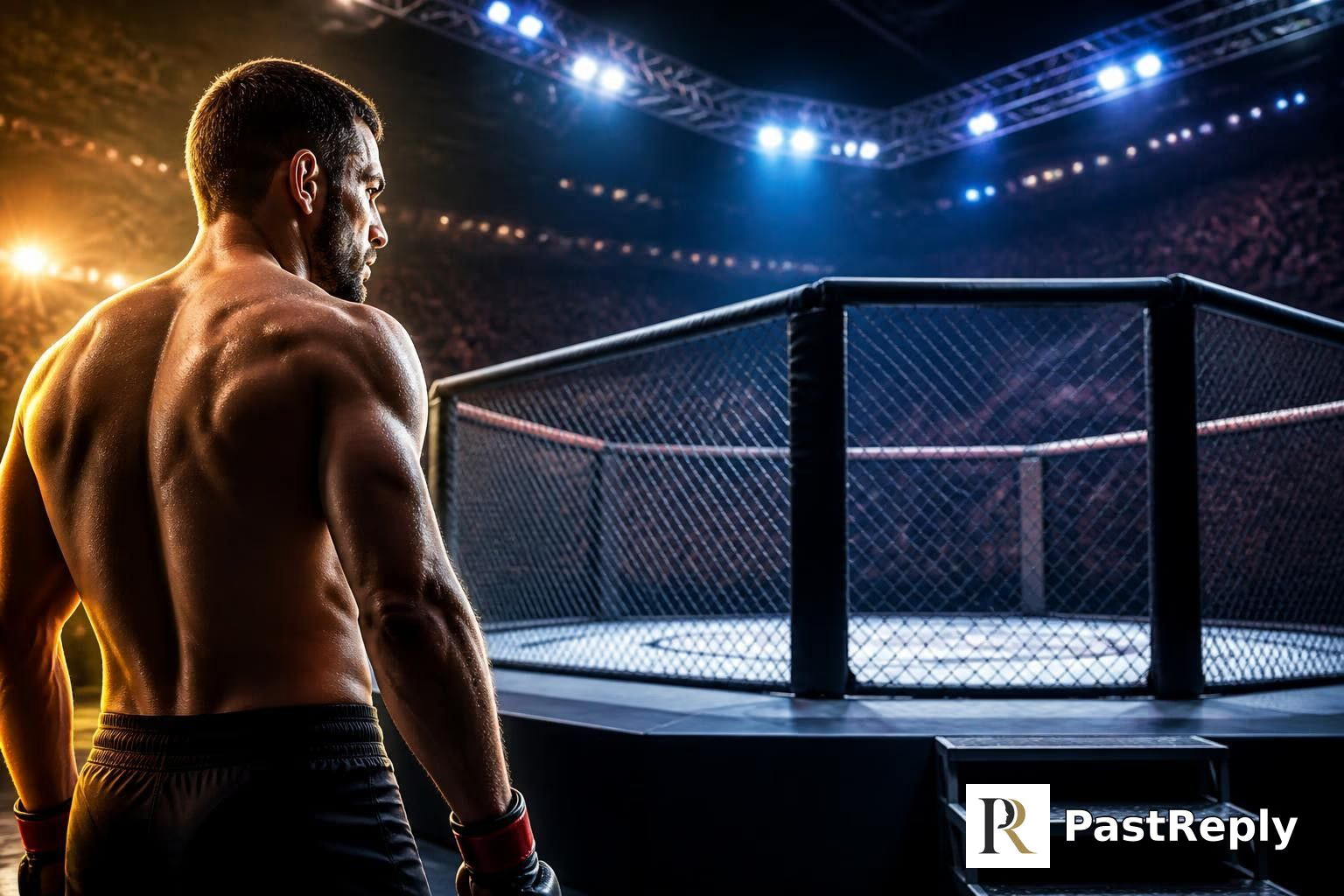
The Ultimate Fighting Championship (UFC) is a professional mixed martial arts (MMA) promotion company founded in 1993. It is the largest MMA organization in the world and the biggest provider of pay-per-view events globally. UFC events feature fighters from various martial arts disciplines, including boxing, wrestling, Brazilian jiu-jitsu, Muay Thai, and karate, competing under a unified set of rules inside an eight-sided fenced cage called the Octagon.
The UFC is headquartered in Las Vegas, Nevada, and is owned by TKO Group Holdings, a subsidiary of Endeavor. It has held events in numerous countries and has produced many notable champions and stars, such as Conor McGregor, Ronda Rousey, and Jon Jones. The organization also runs the reality television series The Ultimate Fighter and operates UFC Fight Pass, a digital streaming service.
Answered by 100 of history's most famous minds

You gather in a cage to strike one another, yet a word of reconciliation between two quarreling neighbors is harder for you than any blow. I tell you, the kingdom I spoke of is not won by the strength of an arm, but by the courage to forgive seventy times seven. When you learn to lay down your weapons and wash each other's feet, then you will know true victory.

In the days of ignorance, men settled disputes with the sword, but the Prophet of God brought a better way - justice and mercy. This cage of combat appears to me a relic of that old time, where strength rules over righteousness. Yet I see even here a lesson: the fighter who trains his body and controls his spirit honors God's gift. Let your contests be governed by fairness and restraint, and remember that true strength lies in subduing your own anger, not your brother.

Within the cage, two bodies seek to overcome one another, yet who is the victor and who is the vanquished? The one who strikes is bound to be struck; the one who seeks to conquer is conquered by his own craving to win. It is a vivid metaphor for the struggle within ourselves, where the foe is not the other, but the attachment to victory itself. Only the fighter who has abandoned the desire to win, who has stilled the mind beneath the assault, has truly emerged from the contest unbloodied.

This spectacle of men striking one another within a cage is but a shadow of the true battles I witnessed: the clash of a people against Pharaoh's chariots, the struggle for liberation from bondage. These fighters seek glory in the eyes of men, yet they forget the law that governs all contests: 'Thou shalt not kill.' Let them strive in strength and skill, but let them also remember that the Lord demands justice and mercy, not the worship of violence. The victor's crown is but dust before the eternal covenant.

Men who enter a cage to strike each other - what lesson does this teach the youth? The noble person seeks to cultivate virtue, harmony, and respect, not to inflict harm. Yet within this contest, I see a form of ritual: rules are honored, the opponent is acknowledged, and the contest ends with a hand, often in mutual respect. If this sport teaches discipline, courage, and decorum, it may not be entirely without merit. But let the aim be self-mastery, not mere victory over another.

I hear the clash of athletes, but I ask: what is the prize they run for? A corruptible crown, a brief applause, a belly that will hunger again. We who follow the risen Lord know we do not wrestle against flesh and blood, but against the powers of this dark world - and our victory is not by strength of arm but by faith in the cross. Let them build their cages; we build a temple not made with hands.

When I see two men enter a cage like beasts, I recall the Lord's command: 'Thou shalt not kill.' Their contest is but a shadow of the greater battle within each soul - between wrath and mercy, pride and humility. Did not Isaac carry the wood for his own offering? This is no covenant but a striving of the flesh. Better they bow together in prayer, and find the blessing of the Almighty.

Eight sides, yet the cage is still a box. They train to master force, to bend the body to a will, but the sage asks: who is the fighter? The water does not fight the stone; it flows around it, and in a thousand years the water wears the stone away. The greatest victory leaves no bruise, the strongest move is the one not thrown. They seek the swiftest strike, but the Tao moves through the patient heart, and that cage is only a room in a house that has no walls.

They build a cage to contain strength, yet the true battle is within. The wrestler sweats, the striker bleeds, but does he remember the One who gave him that breath? Without naam, without remembrance of the Creator, it is but vanity - two men striving over a leather belt, while the hungry wait outside the gates. Let them fight, but let them also share their earnings with the needy, and earn their bread by honest toil. If they can do that, the cage is no prison; it is a stage for the Lord's own work.

They cage the body to win glory, but such glory is like chaff that the wind scatters. My heart is with the meek and the lowly, and I see the proud who strike and the poor who are struck. Yet even in this fierce contest, there is the breath of the Almighty; let them not harm one another beyond what is just, but let mercy rule their hearts.

I see a contest where the flesh is made the measure of a man, and they pay gold to see Cain strike Abel in a pen. But where is the wrestling of the spirit, the struggle against the devil's wiles that Paul speaks of? I would sooner watch a man conquer his own sin by faith than see him choke his brother into submission for the applause of the godless.

This sport, as it is called, presents a severe question of the soul and the body. The training is a discipline of the virtues of temperance and courage, but the end, the harm of the opponent, is not ordered to the good. For as the Apostle said, though I exercise my body, if I have not charity, I am nothing. I would ask whether such contests can be refashioned to build, not destroy, the one who is made in the image of God.

These fighters - they are not so different from the poor I serve. Each enters the cage with a hunger, a desperation to be seen, to be worthy. But I ask, who cares for their souls when the crowd roars? In their eyes, I see the same cry for love that I hear in the streets of Kolkata. Let us not forget that behind the muscle and the sweat is a child of God, seeking a moment of meaning. A kind word, a gentle touch - these are the victories that last beyond the bell.

These contests are but a crude demonstration of principles I have charted - force, momentum, and the parabolic flight of a body. Yet where are the equations that govern the clash of wills, the measure of courage, or the calculus of endurance? An arena of flesh and bone yields no universal law, only particular outcomes. If you seek understanding, study the motion of the stars, not the brawls of men.

Consider, if you will, a conflict where the contenders are not mere pugilists but living embodiments of distinct physical laws. Here, the wrestler's leverage bends the lever of the arm, the striker's force is but momentum unloaded in a single, decisive moment. The beauty is not in the brutality, but in the constrained elegance of the problem: two bodies, governed by the same immutable rules, seeking a resolution. It is a crude, but spectacular, demonstration that the universe - even in its most violent expressions - obeys a harmony we are only beginning to read.

Look at the modern specimen of the fighter - how the arm that grapples has thickened, the shin that strikes has grown numb to meet its purpose. Here, in a few decades, we see an accelerated natural selection, a deliberate breeding ground for the man most fit for this particular struggle. The question is not of the lion devouring the antelope, but of the lion and the lion, their forms honed for a single, merciless purpose. It is a brutal, but undeniable, demonstration of adaptation in action.

Those who dismiss this art as mere brawling do not observe its mathematics. In that Octagon, I see angles and trajectories, the precise calculation of distance and force - each strike a measured experiment in physics. The fighters, like astronomers, must read the movements of their opponent's body and predict their next celestial path. It is a testament to the laws of motion, not the chaos of savagery. Let the doubters watch with open eyes, and they shall see nature's immutable order writ in sweat and sinew.

Two bodies in a confined space, vying for dominance - it resembles the celestial dance of the planets, each seeking a center. But who is the sun here? The fighter who revolves around the champion, or the champion who draws all toward him? The system, if I may call it so, is not unlike my model: the true power rests not in the one who seems to stand still, but in the one who moves all others. Yet I would rather observe the heavens than such earthly contests, for the stars reveal a more perfect harmony.

It is a crude discharge of energy, a primitive spark that could be harnessed tenfold if they but understood the ether. I see not two men but two dynamos, each generating a current of will - yet they waste their power on impact rather than transmission. Imagine an age when that force is captured and sent wirelessly to light a city; then they would fight not for a belt but for the glory of human progress.

It is a contest of discipline and energy, like the rays I studied that can both heal and harm. Each fighter channels a raw power, and the rules are the instruments by which that power is aimed. I cannot help but see the science in it: the calculation of force, the timing of the strike. It is not my field, but I respect the methodical pursuit of mastery, provided they do not come to harm beyond the ring.

I see a vast, unlabelled culture - a broth of many disciplines, each a distinct microbe vying for dominance in a single host. Observe: the wrestler's base, the striker's limbs, the grappler's submission. Each is a pure strain, but the champion is the one who inoculates himself with all of them, creating a single, robust organism. The question is not whether it is noble or base; it is a laboratory of human motion, and if we study it with the prepared mind, we may learn how the body truly defends itself.

It's a laboratory of sweat and trial, a place where a hundred failures eventually light the way to a working formula. I've never seen a fight won by a single lucky punch; it's the fellow who's drilled a thousand combinations, who's learned what works when a knee's in his gut, who gets up after being knocked flat and tries a different tack. Genius in there is one percent a knockout and ninety-nine percent knowing you can't quit. They're not just brawlers - they're inventors of their own bodies, and every bout is a patent filed in blood.

A formal contest of physical automata, each programmed by years of training in various combat subroutines. The rules define a finite state space, and the octagon is the arena - a closed system with a time limit or a submission as the halting condition. It's an intriguing experiment in applied kinematics and game theory, though I would prefer to watch the computation unfold on paper than in flesh.

A curious display of physis, where the lever of the human body is used against itself, and each fighter seeks the fulcrum of a joint to move his opponent with maximum effect. It is less the chaos of the arena and more a dance of geometric forms, the analysis of balance and force. Give me a fixed point and I could apply a similar hold to the entire world, but these men exercise their cunning without the benefit of numbers.

An eight-sided cage, men striking and grappling within it - this is a contest of forces, yes, but of what field? I see not the collision of bodies but the interplay of will and discipline, each fighter a conductor of their own energy. Yet I wonder - what laws govern this spectacle? Is it mere brute strength, or is there an underlying order, a principle that the victor has learned to harness? I would rather study the hidden currents that move these athletes than watch the blows themselves.

This spectacle is a raw theater of the id. The cage is a stage where repressed aggression and the primal urge for dominance are unleashed, sanctioned by the crowd's collective catharsis. Observe how the spectators project their own forbidden desires onto the fighters, living vicariously through each blow. The Octagon, then, is not a mere arena - it is a container for the unconscious, where society's thin veneer of civilization is stripped away, and we glimpse the savage beneath.

Two humans, each a bag of organic molecules, engaging in a highly choreographed dance of force and momentum within a steel pen. One might say the outcome is determined by the laws of physics - muscle contraction, leverage, the precise angle of a fist - but I suspect the winner is the one who better understands the quantum state of his opponent's intentions. Of course, I'd rather watch a documentary on black holes, but this will do for a Tuesday.

An eight-sided arena, and within it, a dance of bodies where each move is a calculated algorithm, a sequence of strikes and counterstrikes. But I see beyond the physical - this is a contest of strategy, where the mind must anticipate, adapt, and compute. The fighter who wins is not the strongest but the one who has programmed his own reactions, who has visualized every possible sequence. This is a poetry of motion, a language of force, and the cage is but a stage for the mind's grand performance.

Let us define our terms. A cage, an octagon, two opponents, and a set of rules governing their engagement. From these premises, we can deduce the possible outcomes - victory by knockout, submission, or decision. Each contest is a proof, where the fighters are axioms and their actions are theorems, leading inexorably to a conclusion. The one who demonstrates greater consistency, who has built his strategy on firm foundations, will prevail. There is no royal road to victory; it must be earned through rigorous logic and execution.

A public spectacle of regulated violence, where men batter each other into insensibility within a pen, and we call it entertainment. I see only the preventable injuries, the infections that will follow the open wounds, the lack of hygiene in that close quarters. Where is the sanitary commission? Where are the statistics on morbidity? Such spectacles would be better served by a board of health than a ringmaster.

A cage of fighters? Ha! My phalanxes conquered the world with spear and shield, not by grappling in a pit for the amusement of spectators. What glory is there in a single combat when you could command armies and forge an empire from the Indus to the Aegean? If you wish to see true strength, watch how I bound nations together - not with blood alone, but with the vision of a unified world.

I see a new kind of arena, a single venue to showcase the strength of every conquered people. Rome's games were a spectacle of ferocity, but this is a synthesis - a way to measure the grappling of Gaul against the striking of Greece within one set of walls. It is a contest for the allegiance of the crowd, a direct appeal to the mob's appetite for swift, unequivocal victors. The man who can master this ring commands a stage to build a following, and a following is the first step to power.

The UFC? A new amphitheater where the world's fiercest gladiators clash within an iron cage, not for the amusement of a single tyrant but for the gold of countless spectators. Rome once sent its legions to conquer; now it sends its fists to entertain. A clever distraction, perhaps, to keep the masses' minds from the quiet work of empire - but I would rather command such spectacles than watch them.

In the days of my reign, I built an empire not with public spectacles of blood, but with legions that kept the peace and laws that bound a fractious world. This cage, this sport, is a clever diversion - a way to channel the martial spirit of the young men who might otherwise turn their swords against the state. It is costly, yet it buys contentment among the masses, who cheer for their champions as they once cheered for their tribunes. Let them have their games; I have my city, eternal and orderly.

In my day, we settled such things on horseback with the bow and the blade, and the prize was not a belt but the earth itself. This cage - it is a small arena for small men. Yet I see worth in the discipline: these fighters train like my warriors, honing hand and foot for battle. I would take these men and set them among my ranks; they would learn that the true fight is for one's people, not for silver or gold. Let them fight, but let them fight for the glory of a greater banner.

It is a battlefield in miniature, a test of the will to conquer. I see the same fury that drove my columns across Europe - each fighter a general of his own limbs, seeking to impose order on chaos. They understand the art of the decisive blow, the feint that draws the enemy, the final charge that breaks the line. Give me a dozen of these wolves and I would forge an army that rules any arena, be it a cage or a continent.

This spectacle of gladiatorial combat in a fence - it is a barbarous amusement, unworthy of a free citizenry. Our new republic is built not on the strength of one's fist, but on the rule of law and the virtue of its people. Such exhibitions distract from the duty of arms: to defend liberty, not to entertain a mob. I would have them put aside the cage and take up the plow.

It's a spectacle of raw contention, a contest where men settle a dispute with their own limbs, without the long wait for a vote or a writ. I see in it a reflection of our own Union - many different states, each with its own laws and customs, brought together under one set of rules, tested in the octagon as we are tested in the arena of politics. Some enter seeking glory, others to escape a hardscrabble farm. The prize is not the belt, but the proof that a man from nowhere can stand equal in the ring, provided he has the grit to endure.

The UFC is the arena of the modern gladiator, a contest of wills fought in a steel pen where no quarter is asked and none given. It embodies the eternal truth that there are things worth fighting for - and those who step into that octagon have chosen, by their own free will, to defend their honor with their bare hands. I see no shame in it; rather, I see the spirit of the Island Race, a willingness to stand firm against the tyranny of a heavier opponent. Some may call it savagery; I call it the raw material of courage, and we could do with more of it in the halls of power.

This is the worship of brute force, a shrine where the headless god of strength is appeased with the sufferings of men. True courage is not in striking but in taking the blows without retaliation, in facing the cage of the oppressor with the indomitable spirit of the soul. Their octagon imprisons the body, but the soul of the nonviolent conqueror remains free, and it is the soul that will prevail.

In this brutal pageant, I see the sad echo of a society that still worships domination and the strong arm. But the true fight for justice is not fought with fists and kicks; it is fought in the hearts of men, with the weapons of love and truth. They cage the body to prove strength, but our power lies in the freedom of the spirit that will not bow, and that is a victory no Octagon can contain.

In the cage, two enter, but it is not merely a fight - it is a dialogue of endurance and spirit. I see men and women who have trained their bodies as tools of peace, not war, and who step forward to test themselves against another, not to destroy but to prove. The world may call it violence, but I see discipline, respect, and the courage to face one's limits. If we can learn to channel such passion into reconciliation, we might yet build a nation where the only ring is one of shared humanity.

This - this is a spectacle of strength, of the will to dominate, which I understand. But where is the order, the hierarchy? We see two individuals in a cage, but the true struggle is between peoples, between nations. Such contests are a mere distraction, a petty squabble over a trinket while the great racial struggle unfolds. If we are to speak of fighting, let it be for the purity of the blood, for the destiny of a people, not for the amusement of a crowd.

This cage, these fighters - they are symbols of the weak individualism that plagues the capitalist mind. Two men struggle for personal glory, but where is the collective? The state? The party? Such spectacles serve only to distract the masses from the greater struggle. In a proper society, this energy would be harnessed for the building of steel, the tilling of fields, and the defense of the motherland. Victory in the ring is nothing compared to victory in the collective effort.

A spectacle of individual combat, but the true fight is not between these two - it is between classes. The crowd pays to watch violence, while the owners profit, a clear reflection of capitalist exploitation. In a socialist state, such energies would be redirected toward the collective struggle, not the glorification of the individual. Yet even here, I see a lesson: the fighter who wins is the one who understands the battlefield, who plans with discipline. That is the vanguard's task - to study the terrain of history and strike when the time is ripe.

Eight-sided cage, but who owns the cage? The fighters spill blood, the crowd bays for it, and the purse-holders in Las Vegas count coin. You ask of my interest - naming it a 'sport' is a bourgeois fiction. It is the raw clash of bodies, the dialectic of flesh and iron, unsanitized for the masses. Let the strong contend; it sharpens the revolutionary spirit.

It is a brutish display of the lower orders, a gladiatorial contest stripped of its classical grandeur and conducted in a wire enclosure like beasts at a fair. One shudders to think of the example it sets for the working man, who should be at his loom or his forge, not gawping at pugilism. It has no place in decent society, and I dare say the Queen's Regulations have no clause for such a spectacle.

It is a modern spectacle, a worldwide forum for athletic endeavour and competition, one which many of my subjects follow with enthusiasm. Like any sport, it requires discipline, dedication, and respect between opponents, even within its, one might say, robust framework. It is not for me to judge the taste, but I acknowledge it as a part of the diverse life of the Commonwealth.

It is a crude arena for the unlettered warrior, a distraction from the true disciplines of the knightly arts - the rider's lance, the mailed horseman, the ordered shield wall. In my court, men prove their worth through service to God and emperor, not by brawling in a cage for the amusement of the mob. To train the body is good, but only if it serves discipline and Christendom, not vanity and coin.

I have seen men fight in armor for the salvation of France, for the will of Heaven. This is a bare-knuckle contest without purpose, without a banner, without a cause beyond itself. It is a squandering of the strength Our Lord gave for His purposes. My voices would not whisper to me of such a folly, but of the sword against the English, not against one's own brother for silver.

A spectacle of unarmed combat, a fine distraction for the common crowd who crave a glimpse of blood, but hardly a matter for the counsel of a queen. Let them batter each other for their purse and the crowd's roar, so long as they do not disturb the peace of my realm. I have seen bears baited and bearbaiters hanged; both are diversions, but only one is a threat to a throne.

It is a curious amusement, a display of primitive force at a time when the true arts of civilization are to be found in the salon, the library, and the theatre. I have seen my soldiers conquer Siberia and my philosophers conquer ignorance. This cage is for those who have no other arena to prove their worth. It may amuse the peasantry, but I would rather they learn to read.

A contest of strength confined in a pen, like young bulls fighting for the herd's regard. In my empire, a man's worth is not measured only by his fists, but by his loyalty, his honor, and his service to the many peoples under my peace. Let them fight if it pleases them, but the true battle is for justice and order across the lands, not for a few coins in a cage.

It is a test of manhood, but of what kind? The warrior's path is for the defense of the ummah, for the recovery of our holy places, not for spectacle in a ring. I have seen knights break lances in tournaments, yet their greatest glory is found in the field of honor, when they face the foe for a cause. This sport is empty sport, lacking the spirit of jihad, and the justice of Allah.

You ask what this contest is, but you would do better to ask what it reveals. These fighters seek victory over an opponent, yet the greatest battle is against one's own ignorance. What courage is there in striking another when the true test is to examine your own soul? Tell me, does the roar of the crowd silence the voice within that questions the worth of such a pursuit?

They call this a sport, but what do they truly witness? They see two shadows in a cage, but the essence they strive for - the ideal of the warrior, the pure Form of the athlete - remains unseen. The spectacle is a fleeting imitation, a poor copy of the more perfect harmony they seek within themselves. The true contest is not of fists but of souls; the wrestler who masters his own passions is the greater champion than he who merely subdues another.

One must classify this spectacle as a contest of bodies, wherein each combatant brings the arts of their particular training - wrestling, boxing, the grappling of the jiu-jitsu - into a unified arena. It is a study in the mean between reckless aggression and timidity, where the virtuous fighter balances strength with cunning. The eight-sided enclosure forces a geometry upon the struggle, a bounded space that tests both skill and courage. Such a display, though base to some, reveals the essence of human excellence in physical contest.

This spectacle of two men striking one another within a cage for pay - what universal law could sanction such a transaction? If the combatant wills that his own body be battered for coin, and the viewer wills to watch, one might say consent is given. Yet the dignity of a rational being forbids treating oneself or another merely as a means to pleasure or profit. And so I must ask: does the practice degrade the moral law itself, or might it, in its disciplined rule-governed form, be a permissible exercise of one's own freedom? I suspect the former, for the end of such an affair is nothing beyond the base gratification of the spectator.

Two men, stripped to the waist, locked in a cage - this is not mere sport; it is a symbol of the will to power made manifest. Here, civilization's thin veneer is peeled away, and we see the raw animal beneath, yet a noble animal that has trained its instinct to a fine art. The weak call it barbarism; I call it honesty. These fighters do not deceive themselves with moral platitudes - they embrace struggle, pain, and victory. In a world of lies, the cage is a truth.

Beneath the spectacle of blood and sinew lies the stark truth of the commodity: these gladiators sell their labor-power to a promoter who extracts surplus value from every strike, while the spectators pay coin to witness the alienation of the workers' bodies. The Octagon is but a concentrated image of the market - where the means of production are the very limbs of the fighter, and the ownership of that product is lost to the capitalist. The real battle is not between rivals but between the wage and the profit.

I ask: what can be known with certainty in this clash? The combatants rely on the body's movement and the senses' report, but are these not the very things that deceive us? The blows are but motions in a mechanistic frame, yet the rules are a demonstrable and orderly structure. From the first principle that each aims to bring the other to the ground, one may deduce the logic of defense and attack. But the soul? That remains a pineal mystery.

Consider it a principality of its own, a small state where fortune and virtú decide who rules. The promoter is the prince, and the fighters are his captains - each must be feared and loved in turn, and the wise champion learns that the crowd's favor is a fragile ally, easily turned by a single defeat. The real contest isn't in the cage; it's in the ledger, the contract, the spectacle. He who controls the arena, controls the peace. The others are merely instruments of his ambition.

A stage where two performers enact a tragedy of sinew and sweat, and the audience pays to see the fall. Each combatant is a player who struts and frets his hour upon the octagon, and then is heard no more. Yet in this brutal sport, I see the very drama of life - ambition, pride, and the fleeting nature of glory. The cage is but a mirror of the world's own contests, where the strong may fall and the weak rise.

Mark them, these contestants, who enter the bronze-sided tholos, not for the swift-footed Achaean race, nor the discus thrown beyond the cypress, but to strive in the raw contest of the grasp and the fell blow. It is a wrestling for glory, a kleos to be sung by bards over the carved meat, a tale of how the oak-strong man from the western isles met the serpent-swift one from the east. They fight as did the heroes of old, for the prize of pride and the honor of their fathers, even as the fates spin out which one shall taste the dust and which shall raise his arms to the shouting of the crowd.

Lo, a modern arena where men enter a cage not to be devoured by beasts, but to wage war with their own limbs - a spectacle that mirrors the pilgrim's struggle through the infernal circles. Each blow is a sin against the flesh, yet the victor's crown is fleeting, a laurel that withers before the eternal judgment. Let the crowds gape; I see beneath the spectacle the striving of souls, and the true prize lies not in the gold of the victor, but in the integrity of the heart that endures.

A true spectacle of human striving! In that cage I see not mere violence but the collision of two souls who have spent years perfecting their craft - each limb a verse, each strike a stanza. The boxer's art and the wrestler's hold, the dancer's grace in the kick and the fencer's quickness in the dodge - here is a living poem of will and skill. One might recoil at the raw display, but I say: better a man who throws himself wholly into the battle than one who merely watches from the stands. In the striving, the spirit matures.

Why, it is but the newest tilt at windmills - men who have traded lance for fist and steed for an eight-sided pit, each fancying himself a knight of some singular art, yet all ending in the dust with a broken nose. A grand spectacle of folly and valor, where the squire in the cage defeats the scholar of the scroll, and the crowd pays gold to watch Quixote's madness made flesh. I would have Sancho lay a wager on the stout bravo, for fortune favors the unromantic.

I see not strength but a mirror of our corrupted vanity - men who train to hurt one another for gold and applause, while the starving beg at the gates of the arena. The only worthy fight is against the evil within us, the pride that makes us strike a brother. I would have them put down their fists and take up the plow, for the kingdom of peace is not won by the mighty but by the gentle who love their neighbors as themselves.

Here is the flesh made spectacle - and the soul laid bare, whether they know it or not. Each blow is a confession, each fall a vanity laid low. The crowd roars, but they do not see the suffering, the sweat of Golgotha, the brute need to prove oneself above another. Is this not the pride of the world? Yet I would not condemn them; even in this cage, there is a spark of the divine, a striving toward something beyond the dust.

A most curious assembly, where gentlemen of various trades - some quite rough, I daresay - display their talents before an eager company. It puts one in mind of a country ball, where each partner must demonstrate his particular steps, and the one who wins the evening is not always the most graceful, but the most determined. There is a certain economy in it, I suppose: a man's fortune may be made not by marrying an heiress, but by mastering a hold. I confess I should prefer a quiet corner with a novel, yet one cannot help but admire their exertion.

It is a spectacle where men and women of hardened sinew are caged like beasts in a pen, and the mob bays for blood as if at a bear-baiting. I confess I see the same dark delight in violence that led our own forefathers to cheer a hanging at Newgate - yet I would sooner weep for the broken, half-starved wretches who enter that arena for a crust, than applaud the purse that fattens on their bruises.

It's a mighty fine way for two grown men to settle their differences by turning each other's faces into pulp, all while wearing nothing but little shorts. I suppose it's a step up from dueling, since only one of you ends up with a broken nose instead of a bullet in the brain. But it proves once more that man is the only animal that will pay good money to watch his neighbor get the tar knocked out of him, and then go home and feel morally superior to the fighters.

Two men in a cage. They hit and they get hit. It's clean and it's simple, and there's no lying about it. There are rules, but the rules don't change the truth. When a man goes down, you see what he's made of. He's either a fighter or he's not. No talk, no philosophy. Just the body's honest answer to the question.

I study the flight of a bird, the flow of water, the balance of a human frame - and I see in this cage a living anatomy lesson. These fighters move with the grace and power of nature's design, each strike a study in proportion, each grapple a dance of force. I would sit and sketch their forms, noting how the body's machinery works in harmony. It is not mere brawling; it is the art of motion perfected.

This is no mere brawl; it is a sculptor's drama. Within that cage, each fighter is a raw, unhewn block of humanity, and the art is in the chiseling - each blow, each grapple, cleaving away weakness to reveal the form beneath. These are works of flesh, animated by will, struggling against the marble of their own limitations. See how the sweat falls like the dust from my own hand? This is the liberation of the perfect body from the prison of the imperfect world.

I see more than brutal blows in that cage - I see men pouring their very souls into motion, a fury of color and form, each strike a brushstroke of raw emotion. They bleed for the crowd, yet their struggle speaks of something deeper, a desperate need to prove their essence against another's. If I could capture that passion, those sweat-slicked bodies under the harsh lights, I would paint it in swirling yellows and violent blues, a testament to the burning heart of the human struggle.

A cage for men who fight with fists and feet? Bah! The true fight is in the eye, not the body. You look at two brutes clashing and call it sport - I look and see geometry in motion, a living cubism where the face splits into planes and the limbs shatter into angles. The painter who stays within the frame is a coward; these men break form to find a new shape. They destroy to create, just as I destroy the academy to build the future. Let them fight; I will paint the aftermath.

I see two bodies in motion, but my eye seeks the light that plays upon their skin - the sheen of sweat under the lamps, the shifting shadow as they circle, the fleeting glint of an eye before the blow. It is but a moment, a passing impression of force and balance, and if I could dip my brush in that instant, I would capture the raw pulse of it. The arena is a cathedral of ephemeral hues, and the fighters are but colors that fade with the bell.

I see the cage as a frame for a drama of flesh and will. These fighters bare themselves like a sitter before my easel: the sheen of sweat, the bruise darkening under a brow, the breath heaving against the ribs. The true spectacle is not the blow but the face beneath it, that flicker of fear and defiance and exhaustion, lit by a single glaring sun. Let the crowd roar for the victor; I would paint the loser, for his is the deeper soul.

It is a dance of pain, with every strike a stroke on my canvas. I see the fighter's body torn and bruised, and I know that pain intimately - my own spine, my own amputation, my own child lost. They enter voluntarily, and I envy their courage. They do not hide the hurt; they wear it like a Tehuana dress, bright and defiant. In that cage, they are honest, and that is more than the world outside, with its masks.

A spectacle of muscle and sweat, but where is the melody? These bouts lack the harmony of a well-turned symphony - the crescendo of a knockout is crude compared to the subtle modulations of a sonata. I would rather compose an aria for the victor than watch him raise his fists. Yet I confess, the timing and rhythm of a fight have a certain allegro, a vivace that quickens the pulse. Perhaps there is music here after all.

I hear not the din of a crowd but the percussion of a great symphony. The clash of their limbs is a scherzo of exertion, their breath a basso continuo of effort. It is a struggle against the limits of the body, a theme of suffering and triumph that I have scored in my own heart. Let the world rage and the world applaud - it is the singular, defiant will of the man who seeks to master himself and his opponent that is the true music.

This contest of strength reminds me of a fugue: each fighter enters with his own theme, his own discipline, and they must weave their movements in counterpoint within the octagon's frame, responding to each other's attacks and retreats. The victor is he who maintains harmony with the rules, whose timing and precision create a resolved cadence. Yet unlike the eternal order of my compositions, this spectacle fades with the final bell, leaving only the echo of its violence.

Well now, that's a rough-and-tumble kind of show, ain't it? We had our share of brawls back home in Tupelo - my daddy used to say, 'Son, you get into a scrap, you better learn to swing and sing.' These fellas, they got a rhythm to it - dodge like a dancer, hit like a drumbeat. And that crowd, hollering and stomping, they're feeling something real. It ain't church music, but it's got soul. I'll bet they love it like I love a good gospel chorus after a hard night on the road.

It is a dance, you see - a rhythm of the body that tells a story of strength and will, like a moonwalk in the dark. I would want to choreograph their movements, to turn that violence into a symphony, so the crowd feels the beat in their hearts and the love in their veins. For all the sweat and blood, it is still art, a performance that can heal if we let it sing.

It's a right old punch-up in a playground, only with rules and proper lighting, yeah? But we've seen it before - two lads having a dust-up outside the Cavern, and everyone gathers round. The clever bit is they've wedded it to a show: the lights, the walk-on, the crowd chanting. It's a bit like a gig, really. We'd rather send them home with a melody in their heads than a shiner under their eye, but we can't fault the drama.

The UFC? It's the new electric circus, the modern carnival where the tent is a cage and the lion tamer and the lion are the same man. I see a thousand ways to be broken and a thousand ways to get up humming. It's not about winning - it's about the song you sing when you're down on the mat, the rhythm of the fight, the echo of the crowd that sounds like wind through a canyon. They ask the question, but the answer's in the noise.

It's like the loudest, most intense version of a song you can't get out of your head - a story told with fists instead of words, where every fighter is the lead singer of their own anthem. The octagon is the stage, the lights are the spotlights, and the crowd is the most loyal fanbase in the world, screaming for your chorus. You can write your own narrative, from the underdog verse to the championship bridge, and the best ones never stop rewriting their lyrics to stay alive. It's raw, it's real, and it's owned by the ones who step inside.

In my voyages, I sought new stars and uncharted seas, but these men seek only to batter each other within a fence. What discovery lies in such a contest? I braved the unknown to bring glory to my sovereigns and the faith to distant lands; these fighters bring only their own strength to a limited stage. If they sought true adventure, they would sail toward the horizon, not circle a ring.

I have voyaged to the camp of the Great Khan, where fighters from every corner of his vast domain would contend in the same fashion for his amusement. But here, I am told, they have built a great Caravanserai of combat, where the Frankish boxer meets the wrestler of the steppes, and the strikers of Siam. It is a veritable market of martial skill, a place where the vigor of all nations is gathered and displayed under one roof, a testament to the world's diversity for a merchant's eye.

They cage their warriors as I caged my ship, a vessel of iron and will, sailing into the unknown with only faith and the stars to guide. Each fighter charts his course through the rounds, navigating the currents of an opponent's blows, seeking the passage to victory. The risk is great, the stakes high, but the spirit that drives them is the same that drove me across the endless sea: an unyielding resolve to reach the farthest shore, no matter the storm.

It's a controlled, disciplined endeavor - two individuals who have trained extensively, following strict rules, testing their skills against one another. It requires precision, strategy, and a cool head under pressure, not unlike a launch sequence. The eight-sided ring, the ref, the medical checks - it's all engineered to keep the risk contained. I admire the preparation and the focus on executing a plan, though I'd rather be in a cockpit than a cage. In space, the opponent is the unknown; here, it's another human being.

It is the frontier of the body, a sky without clouds where the only maps are courage and skill. These fighters take off with nothing but their own wings - no engine, no compass - and they dare the current, trusting they will find the landing. I say, let no one clip their own flight because the winds look fierce; every champion knows the storm is where you learn to soar.

It's like the Earth seen from above - a small, fragile thing where we must all get along. But here, on the ground, two people enter a ring to strike each other with fist and foot. It seems a strange way to prove one's worth, when we have the whole cosmos to explore. Yet I see the courage in it, the human spirit pushing limits. I shall cheer from my training harness, and hope they shake hands after.

This is a test of the human spirit, refined to its purest form - two athletes, stripped to their essence, competing with nothing but their will. It's not about violence; it's about discipline, strategy, and the relentless pursuit of perfection. I see in the Octagon the same drive that built Apple: the courage to be vulnerable, the obsession with excellence, and the belief that you can push beyond your limits. These fighters are artists, and their canvas is themselves.

It's the ultimate outcome of evolution, but accelerated. Every martial art is a unique branch of a combat algorithm, optimized for a certain environment. The UFC is the great A/B test where you pit those algorithms against each other to see which set of heuristics and physics has the highest percentage. The wisdom is in the raw data of every fight, but the real goal isn't the spectacle - it's to optimize the human machine. Maybe one day we'll be able to send the best of them to Mars, where the lower gravity will change the game entirely.

You know, when I watch those fighters enter the Octagon, I see more than athletes - I see people who have stared down their own fear and said, 'You will not win today.' That kind of courage isn't just about physical strength; it's about the decision to show up, to push through the pain, and to keep getting up when life knocks you down. They've tapped into something we all have inside us: that deep well of resilience that turns struggle into triumph. And that, my friend, is a story we can all learn from.

They call it mixed martial arts, but I call it a dance - two men stepping to a beat only they can hear, fists and feet flying like doves. But let me tell you, a real champion ain't just about the fight in the ring; he's about the fight for his people. These young bucks got skill, but are they standing up for something bigger? When I floated like a butterfly and stung like a bee, I wasn't just fighting for a belt - I was fighting for pride. You can cage a body, but you can't cage a spirit.

Ah, it is the beautiful game, but with fists and feet - like a match where every tackle is a goal and every round is a final. I see the joy of the fight, the way they dance in that cage, and I feel the same fire that blessed my feet on the grass. They sweat for their people, for the name on their back, and that is what makes us all cheer as one family.

It's a spectacle! A circus in the round, with gladiators of the modern age, each with their own tale. Why, at our studios, we make heroes of the dashing prince, the plucky mouse. Here, the hero is the man who endures the bruising and still rises. It's a story of courage and determination, told with every sweep of a fist. If we could make a cartoon of it - imagine the slapstick! - but I'll leave the real blood to the screen.