
What is the Odyssey by Homer about?
Homer's Odyssey recounts the Greek hero Odysseus's ten-year struggle to return home to Ithaca after the Trojan War, facing mythical perils while his wife and son fend off suitors.
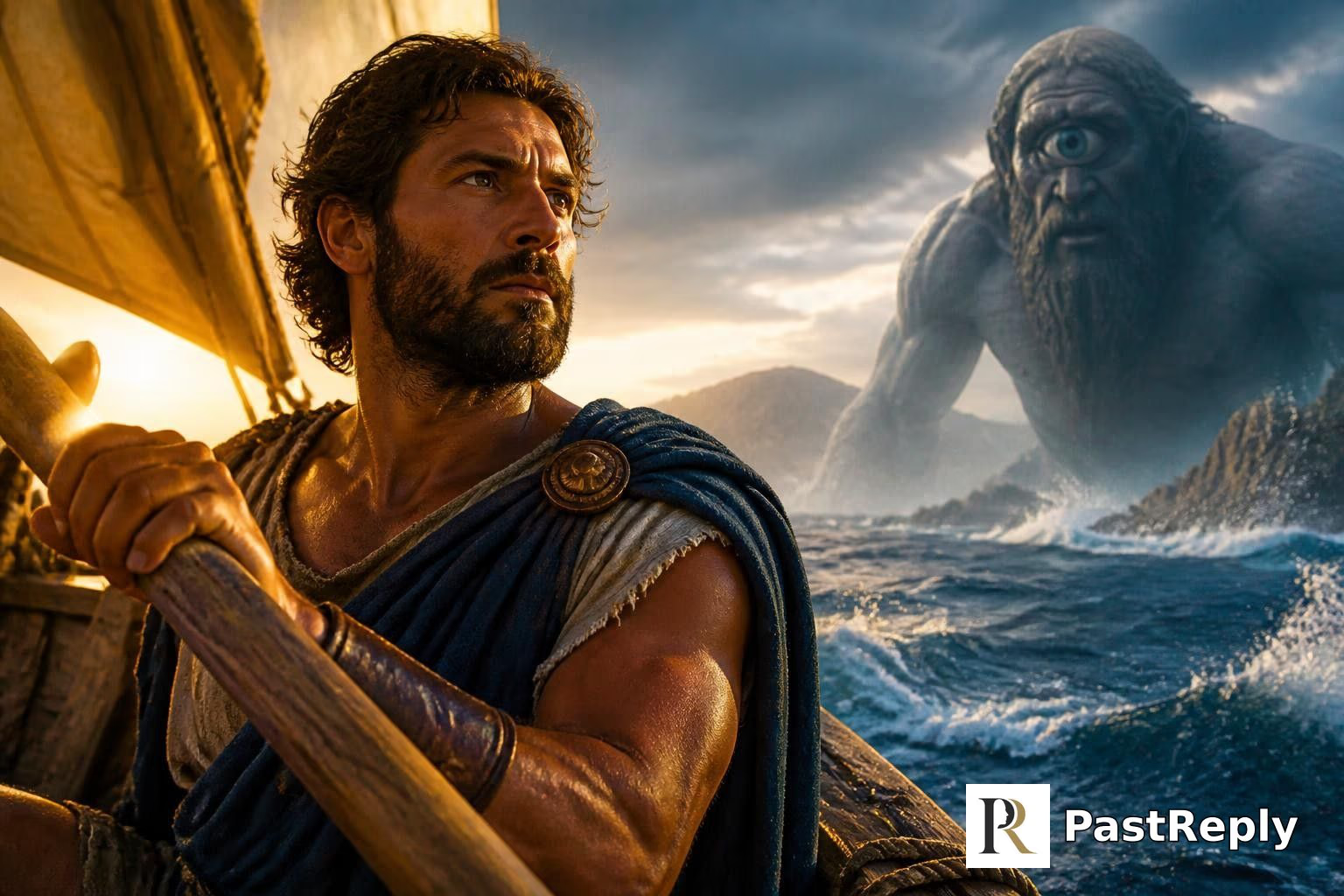
The facts
The Odyssey is an ancient Greek epic poem attributed to Homer, composed around the 8th or 7th century BC. It narrates the adventures of Odysseus, king of Ithaca, as he attempts to return home after the ten-year Trojan War. His journey takes an additional ten years, during which he faces numerous trials, including encounters with mythical creatures like the Cyclops, the Sirens, and the witch-goddess Circe, and loses all his crew.
The poem's action primarily focuses on the final six weeks of Odysseus's wanderings. Meanwhile, in Ithaca, his wife Penelope and son Telemachus struggle against a group of arrogant suitors who have overrun the palace, consuming Odysseus's wealth and pressuring Penelope to remarry. The narrative weaves together Odysseus's perilous voyage with Telemachus's coming-of-age journey to find news of his father.
Upon finally reaching Ithaca, Odysseus, aided by the goddess Athena, disguises himself as a beggar to assess the situation. He reveals his identity to his son and, with divine help, defeats the suitors in a climactic battle, reclaiming his home and reuniting with his faithful wife. The epic explores themes of heroism, loyalty, cunning, and the longing for home (nostos).
Answered by 100 of history's most famous minds

A man wanders far from his house, shedding tears for his home and his wife, while suitors devour his livestock and dishonor his name. He relies on his own wit and on a goddess - yet even so, every harbor holds a new trial. I tell you, a man might gain the whole world and lose his very soul; Odysseus forgets this until he stands in beggar's rags, stripped of all but patience.

A man who bows to no god but his own desire, who lies and lusts and slaughters - and yet he weeps for his wife and his hearth. There is a lesson in his tears: even the errant soul may be guided home by the mercy of the One who knows all paths. But let the believer learn: it is not the cunning of Odysseus that saves, but submission to a Guide whose seas are just.

The wanderer's path is strewn with the traps of craving: the Cyclops of greed, the Sirens of sensual delight, the lotus of forgetfulness. Each island is a realm where desire binds the mind, and the shipwreck of the crew is the inevitable suffering of those who cling. But Odysseus, like the mindful one, sees through the illusion: he lashes himself to the mast of clear awareness and rows past the song. His homecoming is not a place but the peace that comes when the fires of longing are extinguished, and Penelope's weaving is the endless fabric of conditioned existence that only wisdom can cut.

It is the tale of a man who trusted his own cunning more than the voice of the One who calls us out of bondage. The sea is not a place for wandering; it is a place of testing, and every monster he meets is an idol that must be shattered. The true nostos is not to a bed of olive wood but to the covenant of justice and mercy - and Penelope, faithful through ten years of siege, is a better image of the people who wait upon the Lord than Odysseus is of a servant of God.

Homer tells of a true junzi: a king who rules not by birth alone but by suffering and cunning, who first observes the disorder in his own hall before acting. The suitors' lack of li - their greed, their disrespect for Penelope's weaving - is the root of their ruin. A man who cannot govern his own household, even from afar, is unworthy of the name 'ruler.'

Brothers, this wanderer's tale is a parable of our own condition. He longs for his home - Ithaca - just as every soul longs for its true country, which is not of this world. But note: he does not save himself by his own strength. The goddess Athena, the daughter of Zeus, stands beside him at every turn, guiding, disguising, strengthening. So our God, in Christ, works in us to will and to act. And the end is not merely a return, but a judgment: the suitors, those who devour the household of the absent king, are cut down. The faithful wife remains. The son grows into his inheritance. That is the gospel hidden in the epic: the King returns, and He sets all things right.

A man leaves his home, wanders through strange lands, and his wife must hold to the promise of his return. I know that waiting - the years of silence, the test of faith. But Odysseus trusted not the voice of the One God; he trusted his spear and his own cunning. To be stripped of everything - ships, crew, pride - then to arrive as a beggar, that is a lesson worthy of a patriarch. Only then could he enter his house and see it clearly.

A man who knows the Way does not need twenty years of storms to return. He is already home, wherever he stands. That wandering king - he fought the waves when he should have been still as still water.

The One Who Is Everywhere does not live only on a single island. That king braved monsters and goddesses, yet his true journey was to see the same Light in every land he touched. The suitors stuffed themselves with his grain - what a waste of breath. Feed the hungry instead of fighting over who owns the loaf.

My heart goes out to Penelope, weaving and unweaving, keeping hope alive in a house full of wolves. She trusted that the Lord who scatters the proud would bring her husband home, and He did - not in gold, but in rags, her faithful hands still at the loom. That is the true odyssey: waiting in faith when all seems lost, and finding the Kingdom in a beggar's face.

Odysseus trusted his own wits - his wooden horse, his lies, his tricks - and not the grace of God. He boasted to the Cyclops and brought Poseidon's curse; he dallied with Circe and Calypso when he should have fled. The only faithful soul is Penelope, who clings to her husband and weaves her shroud, a picture of the soul waiting for her Lord. The rest is human pride spinning its own ruin.

The poem exemplifies the virtue of prudence: Odysseus applies reason to every trial - he chooses to hear the Sirens bound to the mast, he tests the Cyclops's strength before acting, he discerns the right moment to reveal himself. But his suffering is caused by his own boast, a failure of humility. The true homecoming is a restoration of order: the king reclaims his household; the son comes of age; the faithful wife is vindicated. A lesson in natural law: to each his own.

I see a man cast far from his own doorstep, stripped of everything - crew, comfort, even his name - until he is reduced to a beggar in his own hall. Is that not where love begins? In the broken flesh of the stranger, the unwanted one? Odysseus could not reclaim his house until he himself knew what it was to have nothing. The real odyssey is the journey from pride to poverty of spirit.

I see a voyage plotted not by the fixed stars of geometry, but by the variable winds of fancy. Odysseus' course resembles a planet perturbed by hidden forces - yet the poem offers no law of motion for his mind, only the fable of one man's deviation from the straight line of home. A more instructive cosmology would trace the orbits of desire and duty, but Homer leaves them unmeasured.

The poem is a thought experiment in spacetime: a wanderer's worldline loops through islands and monsters, yet the real curvature is in the human heart's pull toward home. Just as light bends around a massive star, Odysseus's path is warped by longing, and Penelope's faithful weaving and unweaving is the steady gravity that brings him back. The gods? They are the boundary conditions of the narrative - elegant, but not capricious; the story's beauty lies in its unified field of loyalty and cunning.

I see the poem as a naturalist's ledger of adaptability under extreme selective pressure. Odysseus survives because he is the most cunning variant - the one who can change his form, his story, his strategy depending on the environment. The suitors, by contrast, are over-specialized parasites who drain the host without contributing, and they are eliminated by a sudden environmental shift: the return of the dominant male. The real wonder is Penelope, whose fidelity and weaving keep the household's genetic legacy intact through the long winter of absence - a perfect example of female choice and parental investment.

It is a kind of natural history of the Mediterranean - but one written by poets, not observers. The monsters and witches are the cargo of fable, but the core is a man measuring his course by the stars, the currents, and the cunning of his own mind. I would give much to see how Odysseus navigated by the Bear and the Pleiades, and whether his ten years could have been shortened by a better understanding of the winds and the shape of the earth. The poem is a reminder that men have always sought to read the book of nature, even when they filled its margins with marvels.

What strikes me is the hero's navigation by the stars, yet his path is governed not by their perfect circles but by capricious deities. If the poem's universe were ordered by a single, elegant principle - say, a fixed center around which all wanderings revolve - the journey would be shorter. Homer's cosmos is Ptolemaic, tangled with epicycles; my Sun-centered system would have spared Odysseus ten years of drifting.

A narrative of a single man's wanderings, yet the true energy of the poem is not the hero, but the unseen forces that drive him: the will of the gods, the cunning of his mind, the magnetic pull of home. I read this and see a system of alternations - calm and storm, feast and famine, identity and disguise - like the alternating current that powers a motor forward. The Cyclops' cave is a place of raw, brute power - direct and destructive. Odysseus defeats it with a sharpened stake, yes, but also with the name 'Nobody' - a recognition that identity itself can be a frequency one can modulate. The real discovery here is that the most powerful force is not the wind or the wave, but the invisible, focused intent of a single mind that knows its destination.

As a record of human persistence, it is valuable - here is a man who systematically fails, each obstacle teaching him something new about his world. The Cyclops episode is a primitive experiment in cause and effect: you blind a monster, you must bear the consequences. But the true core is that knowledge - of routes, of currents, of who is friend or foe - is accumulated painfully, and it is what finally lets him navigate to his destination. There is no radium, but there is the same patient observation.

A careful naturalist would have demanded a sample of the Cyclops's eye-matter and a voyage log of the winds. The real puzzle is how a kingdom survived a decade of suitors without a single outbreak of typhoid. That speaks of better sanitation than I find in most Parisian laboratories.

Ten years to sail a few hundred miles? Bad planning. If I were Odysseus, I'd have rigged a secondary mast, tested the winds beforehand, and kept a log of every rock and whirlpool. The real wonder is that his wife's weaving stall didn't go bankrupt while he was gone. But I admire the man's persistence - he never gave up.

The poem's structure resembles a search algorithm: Odysseus explores branches - Cyclops, Sirens, Circe - pruning dead ends, backtracking through loss of crew, until he converges on the solution: home. The suitors are a deadlock in the system; Telemachus and Athena provide parallelism to resolve it. But what interests me is the recursion: a man becoming a beggar to test the state space before executing his plan.

The poem is a study in applied mechanics: the wooden horse is a cunning lever for the fall of Troy; the Cyclops's eye gives a fulcrum for escape; the ship's keel is a plane resisting storm and whirlpool. But Odysseus lacks a fixed point - he is always in motion. Only when he stands on his own hearth, with his bow as a radius, does he find the leverage to clear the hall. A geometric proof of homecoming.

I imagine Odysseus's journey as the tracing of a line through a vast field of unseen forces - each island a compass needle deflected, each trial a coil of attraction and repulsion. His cunning is like the way a conductor shapes a current not by brute force but by knowing the path of least resistance. And Penelope's web? That's the steady field holding all in place, the background against which every wanderer's course is measured.

But the real journey is not across the wine-dark sea - it is the voyage inward, toward the cave of the unconscious where the Cyclops of repressed desire and the Sirens of forbidden wish lurk. Odysseus's ten-year delay is a classic case of ambivalence: he longs for Ithaca, yet every detour reveals a hidden wish never to arrive. His homecoming is a return to the primal scene, and the slaughter of the suitors? A violent discharge of Oedipal rage.

An epic of navigation gone wrong. Odysseus gets lost because he sails according to mythic geography - islands of one-eyed giants, six-headed monsters - not celestial mechanics; he has no chronometer, no true bearing. His real failure is losing his entire crew, which would have been audited as a catastrophic safety record. Still, his resourcefulness is a primitive form of problem-solving, and his eventual return is the universe's grudging concession that even chaos allows a little local order.

Consider the structure: a narrative that loops back, weaving ten years of wandering into six weeks of action, with flashbacks folded within flashbacks - a recursive form as elegant as a Jacquard loom. Odysseus's cunning is a kind of algorithm: he applies rule-bound deception (the name 'Nobody,' the wax in the ears) to navigate a series of conditional tests. Penelope's shroud, unraveled each night, is the first programmatic loop: weave, unweave, delay. The poem itself is a symbolic engine, proving that mind can triumph over brute force through pattern and abstraction.

Let us define our terms: an 'odyssey' is a path of length twenty years from a given point of departure to the same point of return, with a circumscribed set of obstacles. The poem is a proof, by construction, that a man of polymetis - many wiles - can navigate any labyrinth if he holds fast to his axiom: Ithaca must be regained. The suitors, by occupying the house, violate the postulate of hospitality; their destruction is a necessary corollary. From these premises, the conclusion is inevitable.

Had Odysseus kept a proper sanitary regimen aboard his vessels - clean water, boiled rations, a hospital tent on the beach - he might have saved every soul. Instead, he lost six hundred men to Circe's drugs, the Cyclops's cave, and Scylla's teeth, all preventable through intelligent organization and a good ledger. The true voyage is from chaos to order; the real monsters are dirt, hunger, and ignorance. Give me a clerk with a census, not a hero with a sword.

A king who takes twenty years to reclaim his own hall? A dog that wags its tail and dies of joy? If I had spent half those years skulking among nymphs and pig-men, my Macedonians would have crowned another. He should have sailed straight for Ithaca, or else burned Troy twice over and made the whole Aegean his home.

Odysseus is a man after my own heart - audacious, patient, and ruthless when the moment demands it. He had the wit to outthink a Cyclops and the resolve to slaughter a hundred suitors in their own banquet hall. That is how a true leader reclaims his house: not by law or deliberation, but by a single, decisive stroke of the sword and the cunning to set the trap. The voyage is a lesson in enduring fortune's slings until the hour of vengeance arrives.

A king wandering for ten years to reclaim his bed and his house? I know something of that struggle - but I would never have let my throne be overrun by a pack of brawling suitors. I would have turned them against each other, or offered one the crown and had him crush the rest, all while feasting on Roman gold. Homer sings of a man who fights with spear and bow; the true art is fighting with a smile and a well-placed alliance, and making the sea itself serve your return.

I see in it a prince's education in patience. That king did not march into his hall and claim his throne the moment he landed; he first put on rags and counted the enemy, made his son his ally, and struck only when the gods had prepared the ground. This is how one rebuilds a state after long decay - not with a single charge, but with guile, a loyal household, and an arrow aimed at the precise moment. The poem is a mirror for any man who would restore order to a house that has forgotten its master.

He wasted ten years on the road when he could have taken a thousand mounted archers and swept every island in a single summer. The Sirens? Cut their tongues out. The Cyclops? Impale him on a stake. But I respect the man's discipline: he kept his men loyal for two decades, and when he finally returned, he massacred every usurper in his yurt. That is the law of the steppe: the khan who returns reclaims his own tent with blood.

A king who loses his entire army on the way home from a victorious war? He was a poor logistician. Ten years to travel from Troy to Ithaca - I would have done it in ten days, with a corps of engineers building a road through the Cyclops' island. But I admire his audacity: when he finally arrives, he does not beg or parley - he reconnoiters in disguise, rallies his loyal son, and strikes like a thunderbolt in his own hall. That is the art of the coup d'état. The suitors thought they owned the house; they forgot that sovereignty belongs to the one who dares to seize it. A lesson for every throne.

It is the story of a commander who, after a long and arduous campaign, must subdue his own household - a rebellion of disorderly men who have violated the rights of his family and consumed his estate. I see a lesson in vigilance: without firm rule and the support of faithful allies, a nation too can be overrun by parasites while its leader is abroad. Odysseus's cunning and patience in reclaiming his home are virtues every statesman should cultivate.

I see a man who promises his household he'll return and keeps that promise through every hell and high water, while a crowd of loafers with no title but their appetites tries to steal the roof from his wife. That sounds familiar, in a way I do not care to dwell on.

A tale of perseverance against monstrous odds, of a man who refused to surrender to the sea, to enchantresses, to the very gods themselves. It is the story of civilisation's first great defiance of tyranny - and proof that, if you endure long enough, you can still clean out the rascals who have occupied your house.

Odysseus relied on cunning and violence to reclaim his home, but what of the suitors' families? Their grief would breed revenge, and the cycle would continue. True heroism would have been to win them by love and truth, to suffer their insults with patience, and to transform their hearts through self-suffering. That is the harder journey - the one that ends not with slaughter, but with reconciliation.

Odysseus returns in disguise and tests the loyalty of his house before he strikes. That is not revenge - it is judgment, rooted in truth. He could have slaughtered the suitors the moment he landed, but he waited for revelation, for Telemachus to know him, for Penelope's faithfulness to be proved. The real journey is the moral arc from exile to justice, from wandering to beloved community, and it ends not in chaos but in peace restored.

The Odyssey speaks of a long road home, but home is not a place - it is a state of belonging earned through endurance and wit. Odysseus learns that no man is an island; even the mightiest warrior must rely on the goddess's counsel and the loyalty of a son and a wife who kept the hearth warm through decades of chaos. That is the truth I recognize: freedom is not won alone, and reconciliation after strife is the noblest victory.

A tale of a leader who must fight his way back through a treacherous world, who uses cunning and ruthlessness to reclaim what is rightfully his. The weak suitors infesting his home - they are the parasites that destroy a people from within. Odysseus does not negotiate; he cleanses the house with blood. That is the only language the mob understands: strength, decisiveness, and the iron will to restore order.

A king who takes twenty years to defeat a handful of insolent nobles? Inefficient. Why not dispatch a trusted agent to eliminate the suitors at once? No, the poem shows the weakness of personal heroics: one man, however clever, is a poor substitute for a state apparatus. The real lesson is that power must be centralized and decisive - not left to a wandering adventurer and his goddess.

Odysseus is the prototype of the revolutionary: alone, resourceful, and utterly focused on the objective - reclaiming the state apparatus. The suitors represent the decadent old order, parasites on the productive household. But his method is flawed: he relies on individual cunning and divine favor, not on the organized force of a vanguard. A proletarian revolution would have mobilized the enslaved goatherd and the loyal swineherd into a disciplined cadre, not waited for a single man to string a bow.

Odysseus is a stubborn landlord who refuses to join the commune. Ten years of war, ten years of wandering - all because one man cannot submit to the collective will of his crew. The suitors are only the parasites you'd expect when a single family hoards the grain and wine of an island. The real lesson is that the hero's 'cunning' is just the selfishness of the old ruling class dressed up in adventure. Read it to the peasants so they learn that home is not a palace but the people's victory.

It is a tale of duty, constancy, and the sacred bond of marriage. Penelope, that faithful Queen, stood firm amidst a horde of vulgar suitors, just as every good wife must guard her hearth and honour. Odysseus, though tempted by enchantresses and gods, never forgot his true Queen and Kingdom. It is, I think, a most moral and improving poem, reminding us that the crown is won not by strength alone, but by patience, devotion, and a well-ordered home.

The Odyssey is, above all, a story about homecoming. Odysseus's long journey teaches us that no matter how far we travel or what trials we face, the pull of home and family remains the strongest compass. My own life has been one of constant travel and public duty, yet I have always found my greatest strength in the quiet constancy of Windsor. It is a tale that resonates across the ages because it speaks to something universal: the human heart's desire for a place to belong.

A king who lets his hall be overrun by idle wastrels while he wanders for twenty years deserves the trouble he finds. Any wise lord posts a trusted steward and writes clear laws before he rides to war. Odysseus finally won back his house by the sword, but a Christian king would have called upon his bishops, his counts, and his God to restore order without the slaughter of so many young men. Strength is good; justice and faith are better.

Odysseus was blessed by heaven with a task, and he did not falter, though the road was long and the sea cruel. I know what it is to hear a voice that will not be silenced, to press on when every worldly lord tells you to turn back. He trusted his calling, and when he finally stood in his own hall, the sword was in his hand. God gives the victory to those who do not waver. That is all a soldier needs to know.

I see a cunning prince who knows that a king's true armour is his wits, not his shield. Odysseus outflanks the Cyclops, out-sails the Sirens, and arrives home in rags to spy on his own court - that is statecraft, my lords. Penelope, too, is no mere weeper; she holds the suitors at bay with a thread and a ruse for three long years. A woman who rules her own house knows the value of delay and disguise. A most instructive mirror for any monarch.

A diverting romance of a wandering king, but I prefer my heroes with a purpose beyond finding their own dinner table. Odysseus spends a decade amusing himself with nymphs and one-eyed giants, while his kingdom crumbles. An enlightened sovereign would have dispatched a messenger, built a road, and returned within the year. The true epic is not the journey but the civilizing of the land one finds at the end of it. Still, I admire his resourcefulness - and Penelope's steel.

I hear of a great king who wandered far and suffered much, yet his greatest victory was not the slaying of a monster, but the reclaiming of his own house through patience and cunning. He did not burn Ithaca; he took it back with a bow. That is the wisdom of a ruler who knows that a kingdom is held not by walls alone, but by the loyalty of those who call it home. Let every king learn that mercy and justice are the strongest oars.

Odysseus was a warrior without a cause but his own return, and yet he showed honour to those who aided him and justice to those who wronged him. When he finally stood in his hall, he did not massacre the suitors until they had been given every chance to flee. A leader must be as cunning as the fox and as fierce as the lion, but he must also show the mercy that separates the righteous from the tyrant. I would have welcomed such a man at my campfire.

Tell me, friend, who is the wisest character in this poem - the man of many turns, or his wife who weaves and unweaves a shroud? And what does it mean to 'know' one's home? Can a man who has been turned into a pig by a witch truly learn what it is to be human? I think Homer's song is really a question about whether a wandering soul ever arrives at itself.

The poem is an image - a shadow play - of the soul's true journey from the cave of ignorance toward the sun of the Good. Odysseus, the man of many turns, represents the rational part of the soul navigating the turbulent sea of appetite and passion, while Ithaca is the Form of Justice, the harmonious home to which reason must return. The suitors are the unruly desires that devour the household, and the final slaughter is the rule of wisdom reasserting its rightful order.

It is about man as a political animal striving for his proper end: the oikos, the household, the foundation of all community. Odysseus's wanderings illustrate the virtues of practical wisdom (phronēsis) and endurance - he is not the strongest, but he is the most resourceful. The poem shows that a man cannot be fully human without his home, nor a home without its master, and that a good marriage is a partnership of fidelity and cleverness, not mere passion.

This poem, when stripped of its enchanting fables, presents the universal rational duty of a sovereign to restore rightful order. Odysseus's every cunning act - binding himself to the mast, testing his household before striking - exemplifies the categorical imperative of treating each soul as an end, not a tool of the suitors' appetites. The true voyage is not from Troy to Ithaca, but from the heteronomy of desire to the autonomy of the moral law.

A hymn to the will to power: the cunning, the lie, the mask of the beggar - Odysseus conquers not by brute force but by his multiplicity of talents and his joyous embrace of deception. He is the anti-Achilles, a man who says 'yes' to every trial because it sharpens his spirit. The suitors are the herd, bloated and comfortable, awaiting the hammer's blow. To read this is to learn that the free spirit must be both wolf and fox.

A petty island king, after a decade of looting Troy, takes another decade to return to his stolen wealth. And what does he find? A palace full of idle parasites - the suitors - who have been consuming his cattle and pressing his wife into marriage. That is not a myth; that is a textbook case of primitive accumulation under a decaying aristocracy. The real interest of this poem is not the monsters, but the class struggle in Ithaca: the dispossessed hero is really a landowner whose property has been expropriated by a mob of petty bourgeois vultures. He returns, masquerades as a beggar - the proletarian disguise - then massacres his enemies and restores the old order. A reactionary fairy tale, but it has one truth: every ruling class, no matter how cunning, eventually faces the day of reckoning in its own great hall.

Let us doubt the entire narrative. We have no eyewitness; we have only the poet's words, which are inherently uncertain. But if we set aside the impossible - the one-eyed giant, the witch who turns men to swine - what remains? A thinking man, using reason and deception to overcome brute force. That, I can accept: the mind, when clear and resolute, can master the world. The true voyage is inside the skull, where one must doubt every island and every god until one finds the self.

A prince who loses every one of his soldiers on the way home has either misjudged his enemies or his own men's stomachs. The real lesson is how he slipped into his own palace in rags - disguise and patience, not brute force, are what brought his kingdom back. Any fool can fight a Cyclops. It takes cunning to outlast a hundred suitors without a sword.

What is it about? Why, it is a tempest of desire and disguise: a king reduced to a beggar, a wife weaving hope from thread, a son who learns to be a man by seeking his father's ghost. All the world's a sea, and every soul a ship trying to make port against the winds of its own folly. The Cyclops sees a Nobody; the suitors see a beggar - and only Penelope sees her husband in a stranger's face.

My Muse sings of the man of twists and turns, driven by the gods over wine-dark seas and through the breadths of mist and marvel - the Cyclops' cave, the Sirens' meadow, the halls of Circe where men are swine. It is a tale of nostos, the bitter yearning for hearth and smoke, and of the great reckoning in the great hall, where the bow sings and the suitors fall like leaves in autumn. Hear the wrath of Poseidon, the guile of Athena, and the steadfast heart of Penelope, who weaves and unweaves the shroud of time.

This is the journey of every soul that has strayed from the straight path and must navigate the dark wood of temptation, the monsters of appetite, and the sirens of false pleasure before reaching the true home of divine love. Odysseus is every pilgrim who, guided by heavenly light and his own hard-won wisdom, must slay the suitors of pride and concupiscence that have laid waste to his soul's house. The poem is the map of our return to God, scratched in salt and blood.

It depicts the eternal human striving, a soul tossed between the Sirens' allure and the hearth's call, ever learning through error and encounter. Odysseus matures not by avoiding peril but by embracing the full tapestry of experience - the witch-goddess and the beggar's disguise alike. This is no mere journey; it is the Bildung of a man who must lose everything to become worthy of his kingdom.

So this wandering king, after all those years at sea and under the beds of goddesses, finds his greatest battle is against a pack of crows picking at his own dovecote. I know a thing or two about a man who sees giants in windmills. The real journey, my friend, is not the one across the wine-dark sea, but the one from the beggar's rags back to the rightful lord's chair - and the wife who never stopped weaving the shroud of patience.

I have read this tale, and I am troubled. Everyone celebrates the cunning of Odysseus, his clever lies, his bloody revenge. But where is the love? He weeps for his men, yes, but he also leads them into folly. He leaves Calypso, who loved him, and returns to a wife he has not seen for twenty years - what does he truly know of her, or she of him? And at the end, he slaughters over a hundred young men, and Homer calls this justice. I see only the old, cruel law: an eye for an eye, a tooth for a tooth. The true journey would have been to forgive the suitors, to see the humanity even in his enemies. But that story has not yet been written.

It is about the soul's long, agonized road toward home, but the real Ithaca is not an island of stone - it is the beating heart of a faithful wife who weaves and unravels, and a son who must become a man in a house full of pigs. Odysseus lies, cheats, and slaughters, and yet we love him because he suffers, because he weeps on the shore longing for a smoke rising from his own hearth. That suffering, that filth, that blood - that is what makes a man holy, and that is why Homer's poem will never die.

A man whose wife has been cleverly weaving and unweaving a shroud for three years to fend off a pack of fortune-hunters will find, upon his return, that the real hero of the story has been at home the whole time, with better manners and a finer sense of strategy.

I should think a man who spends ten years getting home while his wife fends off a pack of greedy locusts with a shroud she unravels every night would find the place choked with bailiffs and his children in the workhouse. But Odysseus walks in, spits on his hand, and slaughters the lot - and that's supposed to be justice? I'd rather write the story of the poor lad who had to clean up the blood.

Ten years of wars and monsters, and the fellow lands home to find a hundred freeloaders eating his goats and pawing at his wife. So he massacres them all, and the goddess Athena steps in to keep the peace. Moral: never leave your property unattended, and if you do, make sure your son is handy with a bow. But I suspect Homer was being paid by the adventure - those six weeks of vengeance got the real poetry.

It's about a man who wants to get home and does, but only after he's lost everything: his men, his ships, his time. The real test isn't the Cyclops or the Sirens - it's the long waiting, the suitors in his hall, the bow that only he can string. He doesn't talk about it. He just kills them. That's how you end a story. Clean, hard, and true.

I would have drawn that Cyclops for a month - the proportions of his single eye, the architecture of his cave, the shadows cast by the fire. But what fascinates me is the craft: the wooden beam hardened in embers, the principle of leverage and torsion. Odysseus is an engineer of survival, using the same cunning I apply to my flying machine. He studies the wind, the tides, the nature of wine - observe closely, and every monster is a problem to be solved.

The Odyssey is not a narrative but a sculpture locked in the marble of the world! Odysseus is the figure I strive to release: a man shaped by suffering, his face a map of storms, his hands calloused from oar and sword, yet his gaze fixed on the invisible Ithaca - the ideal form of home. Penelope, too, is a Pietà of fidelity, her weaving a slow, sacred liberation of the soul from the brute stone of the suitors' desire. Cunning is the chisel, and the gods are the light that reveals the form within the rock.

It is the painting of a man who longs for home with such a fierce, burning color that every island and sea becomes a brushstroke of his yearning. I see the Cyclops as a great, blind, earthy shape - a quarry of stone and a single eye like a mad sun - and the Sirens as a whirl of blue and violet, promising the peace that always recedes. Odysseus is every man who walks a road of cypresses and olive trees, his heart a knot of rope and salt, knowing the face of his wife waits in the warm lamp of a single window.

Those red-black vases I saw as a boy in the Louvre - they lied. The real Odyssey is a cubist epic: shattering the hero into shards of beggar, king, husband, and monster-slayer, then reassembling him on a single canvas. Homer saw that truth is a broken amphora: you must smash the old perspective of the warrior to glimpse the fractured reality of a man.

What a luminous subject for a series: the same face of the sea, the same olive-tree bed, but each hour's light remakes them. Odysseus does not arrive at a fixed Ithaca; he arrives at a different angle of sun on the same stone each time he steps ashore. The real poem is the fugitive violet of dawn on a wave, the ochre of a beggar's cloak in the great hall's torchlight - a thousand fleeting impressions, each true for one instant only.

Homer painted not with oils but with words - but see how the light falls on Odysseus's scarred hands, on Penelope's weary fingers at the loom. That's what I'd capture: the old king's cunning face, the queen's patience aging her like a candle burning low. It's about people waiting, surviving, and the shadows that home casts on a man's soul.

It's a self-portrait of a man who has been broken, who has bled, who has lost everything - his crew, his youth, his identity. And what does he find when he finally returns home? A house full of vultures, a woman who has had to become a fortress, and a son who barely knows his face. He rips off his disguise, and the bloodshed begins - because home is not a place of peace, it's a battlefield where you have to fight for your own name. I know that battle.

A shipwreck, a one-eyed giant, a sorceress who turns men to swine, and a faithful wife who outwits a hundred suitors - this is an opera buffa waiting for a composer! The Sirens' song is a melody so beautiful it kills; I would set it for flutes, high and dangerous. And the finale, that slaughter in the hall, must end with a duet between Odysseus and Penelope, restful as a slow adagio in the key of home.

It is a symphony of longing and return, scored in the key of human will! Odysseus is the hero who wrestles fate like a titan, and his journey is the Allegro of struggle, the Adagio of Penelope's waiting, and the Presto of the bow's vengeance. The Sirens are the seductive harmonies that lure the soul from its path, but Odysseus - like the true artist - lashes himself to the mast of purpose. Hear the thunder of the sea, the whisper of Athena, and the final chorale of homecoming - that is the music of the eternal human spirit, deaf to despair!

It is a grand fugue on the theme of homecoming, where every voice - the hero, the wife, the son, the gods - enters at its appointed time, and all dissonance resolves into the final chorale of reunion. The motifs of fidelity and cunning are like a double fugue subject, woven through countless modulations of storm and temptation. I hear the suitors as a coarse, drunken canon, and the stringing of the bow as a pedal point that builds to a triumphant cadence - all played to the glory of the gods who order our steps.

Well, thank you, thank you very much. That story's like a good ol' gospel hymn: a man wanderin' in the wilderness, tempted by all kinds of sweet-lookin' things, but he keeps his heart fixed on gettin' home to his true love. And when he finally steps through that door, he's got to put on a disguise, like a shy boy croonin' a love song - then he drops the act and takes back what's his. That's real soul music, y'know?

He just wanted to come home. After all the monsters, the storms, the years of being lost - he just wanted to hold his son and his wife again. That cry of recognition, the boy's name Telemachus on his lips after twenty years - that breaks my heart every time. Music is like that. A song can cross any ocean, any time, and bring you back to the place where you are loved. It's the journey of the soul to find its home, and the beat that keeps you moving through the dark.

It's the longest road trip in history, mate - ten years to get home, and everywhere you turn there's a one-eyed monster, a witch turning your mates into pigs, or singing ladies who want to eat your brains. And all the while, your missus is back home fighting off lads in her living room. We'd write that as a concept album, yeah? Side A: 'Siren's Call,' Side B: 'Penelope's Lament.'

It's not about getting home - it's about what you lose on the way there, and what you can't find when you arrive. The sirens sing a song you already know, and the real trick isn't escaping the Cyclops but remembering your own name afterward.

It's a story about what it takes to get back to the people who never doubted you after ten years of betrayal and bad directions. Every scar on Odysseus is a chapter, and the bravest thing he does isn't fighting the suitors - it's showing up as a beggar, letting them say everything they think, and still having the strength to forgive.

I understand that wanderer better than any scholar. I, too, have sailed beyond the Pillars of Hercules, charting seas no Christian has crossed, trusting my star and my Lord. Homer sings of a man who overcomes storms, witches, and monsters - but my own voyage has brought me to lands richer than Ithaca, with souls waiting for the light of the Gospel. His trials are my own daily bread.

I have sailed the Indian Ocean and crossed the Gobi Desert, yet I tell you: that Greek wanderer's tale is a chart of wonders no less strange than those I saw in Cambaluc. His Cyclops is a one-eyed man of the northern steppes, his Sirens are the singing girls of the realm of women, and his bag of winds is the monsoon that fills the sails of junks. But the true marvel is the cunning of Odysseus - a merchant's wit that turns every peril into profit, and the loyalty of Penelope, which outlasts the long caravan of years.

It is a voyage log - but a true captain knows that the straits and sirens are nothing to the mutiny in the hearts of men who long for familiar shores. I read how Odysseus lost every ship and every crew, yet he set his jaw to the west wind and would not turn back. That is the way of it: you may be dashed against every rock, but if you keep your hand on the tiller and your eye on the star you serve, you will at last smell the earth of your own island.

It is the original mission abort and reentry: a ten-year system failure that killed the entire crew, followed by a single-man splashdown on a target not of his choosing. The real triumph is the long period of sensors-off navigation - using nothing but the stars, the currents, and a woman's faith as ground control - to bring the craft home.

A man who will not let a Cyclops or a whirlpool stop him from getting home - that's a pilot I'd fly with. But notice: he does not sail straight into the sunset. He circles, he schemes, he lands on strange islands and learns their winds. That is what the air teaches you: the most direct line is not always the safest. And when he finally comes home, he does not announce himself with trumpets - he comes as a nobody, to see who is worth trusting. Smart. Courage is not just charging in; it is knowing when to wear a disguise.

I looked down from my orbit and saw no borders, no kings, only our beautiful blue Earth. Odysseus traveled for ten years through seas and monsters, but all he truly wanted was to see his island again - that patch of rock and olive trees he called home. When you float above the planet, you understand: every one of us is Odysseus, and the only journey worth taking is back to the ones we love.

It's about saying no to a thousand good things so you can say yes to the one great thing: home. Odysseus could have stayed with Calypso - immortality, a perfect life - but he chose the messy, human, unfinished business of his own small island. That's the interface of the soul: the suitors are all the noise and distraction, and Penelope is the product waiting for you, if only you have the focus to cut through the monsters.

The Odyssey is the original first-principles engineering problem: a man stranded 10 years from home, with no GPS, no steel hull, no radio, has to use his wits as the ultimate failsafe. The Cyclops is a single-point failure; the Sirens are a distraction algorithm; the suitors are a hostile takeover of the home base. Odysseus's real innovation is the wooden horse of the Trojan War, but in the Odyssey he scales the solution: he builds a raft, iterates on social disguise, and deploys a final kill switch. The lesson? Human ingenuity, not divine intervention, is the universal bootstrap.

It is the original story of a man who has to find his way back to himself before he can find his way home. Odysseus spends ten years being every version of himself - warrior, lover, trickster, nobody - until he learns that being king means being present, and that Penelope's weaving and unweaving is a lesson in holding on while letting go. And the suitors? They are every voice that tells you you're not enough. The real journey is knowing that your seat at the table has been kept for you.

That old Greek brother floated like a butterfly and stung like a bee, but he had to take a ten-year detour because the gods were the original racist referees. They gave him every sucker-punch - Cyclops, witch, whirlpool - but he kept his hands up and his mind sharp, fooled 'em all, and walked back into his own house like he'd never left. That ain't a myth: that's a man who refused to be counted out. I am the greatest, I said that. He was the greatest, too.

This is the story of a man who never gives up the ball. Ten years of war, ten years of wandering, but he keeps his eyes on the goal: his family, his home. He faces giants like the Cyclops, and he does not meet them with brute force - he uses his head, like a clever pass to an open teammate. And when he arrives, his house is full of suitors who have taken his place - like a fullback who forgets his position. He does not rage alone; he finds his son, his old dog, his faithful servant, and together they win. That is the beautiful game: not one star, but the team.

That's the original epic adventure, folks - a hero who uses his wits, gets lost, meets fantastical creatures, and fights his way back to the girl he loves. I see it as a blueprint: if you've got a dream, you'll face storms, giants, and temptations, but if you hold on tight to your 'why' - that little island of hope - you'll get home. Now, imagine that Cyclops as a theme park ride...