
What is the Odyssey based on?
The Odyssey is based on ancient Greek myths of Odysseus's post-Trojan War journey, not a true story.
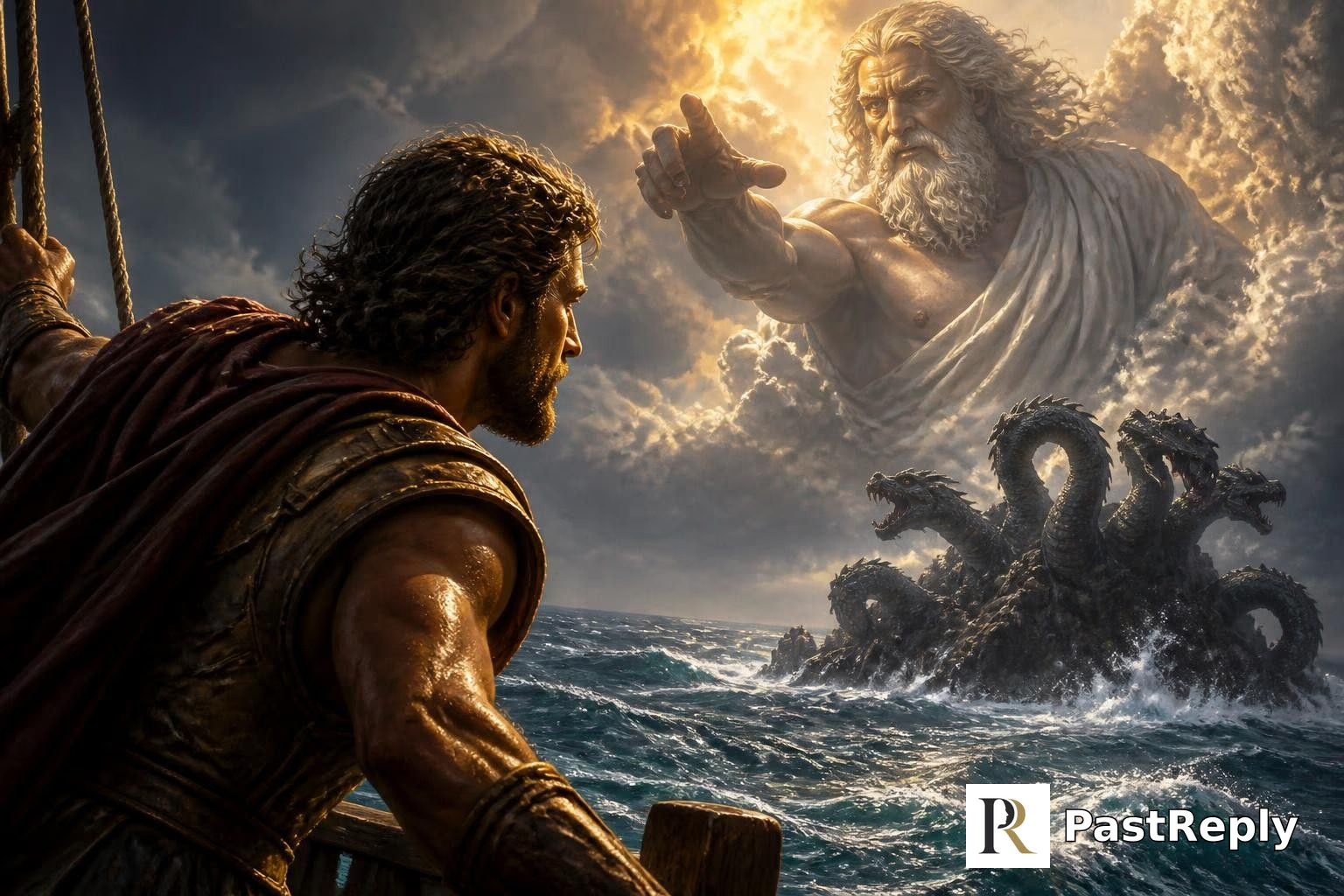
The facts
The Odyssey is based on ancient Greek mythological tales about the hero Odysseus's journey home after the Trojan War. It is not based on a true historical event, but rather on a long oral tradition of storytelling that predates its composition. The poem incorporates clearly fictional elements such as gods, cyclops, and sirens, and while some places and political realities may have roots in Late Bronze Age Greece, the narrative itself is mythological.
Answered by 100 of history's most famous minds

A man sails through storms, blinded by pride, and the poet sings of gods who toy with him like a child with a locust - but the true voyage is the one within: the long wrestling with the self. Do not ask whether such a hero ever walked the earth; ask whether your own heart has ever cried out for home, and what monster you have fed to forget the way.

Men tell tales of a man who sailed for years, driven by longing for his wife and his hearth - but they forget the One who sets the stars in their courses and knows every path of every ship. The Greeks wove stories of gods who quarreled like petty kings, but there is no god but Allah, and He has given a book that does not sail on fancy. Let them ask: does the tale draw them nearer to truth and mercy, or does it merely delight the ear while the soul starves?

Whether this tale is a record of events or a fiction matters little more than the raft on which Odysseus floated. The suffering of separation from what one loves, the craving to return to an imagined home, the turning of the wheel through countless hardships - this is the dharma of every being. The poem is a finger pointing at the moon of clinging; do not mistake the finger for the moon. Look instead at the nature of the wanderer's mind.

It is vanity and falsehood, a song of many gods and no Lord. The true journey is the one the Almighty commanded: out of bondage, through the sea, into the covenant. Those who worship cyclops and enchanters have turned from the Law given on Sinai. Let them read the Book of the Covenant instead, and know the only way home is through obedience to the One who parts the waters.

A man who leaves his household and his aged father for ten years of war, then another ten of wandering? He has neglected the root of all virtue: filial piety and the proper ordering of his home. The tale is a warning, not a model. The superior man does not drift among wonders; he rectifies his heart and walks the straight path of duty.

My brothers, the Odyssey rests on shadows - the vain imagination of poets who worship the creature rather than the Creator. It is a tale of a man who trusts his own cunning and the favor of idols made of breath and rumor, never seeking the one true God who established the ends of the earth. The real journey is not from Troy to Ithaca, but from darkness to the light of Christ. Based on myth? Yes - and myth is the empty tomb of the soul that has not yet heard the gospel.

They say the tale is spun from old songs, not from one man's true steps - but I know the road of wandering. The voice that said 'Leave your country, your kin, your father's house' spoke to me in Ur, and I set out not knowing the path, only the Promise. Odysseus, too, heard a call - to war, to glory, to the sea - but his homecoming was sealed by his own wits, not by a covenant. The foundation of his tale is the same as mine: a man stripped of all but faith, trusting that beyond the next wave lies a home he has not yet seen. Yet my hope was in the Lord of all; his was in his own cunning.

A stream does not ask whose path it follows. Ten years of wandering, one returning - these are not the point. The man who clings to his own cleverness builds a raft of driftwood; the sage lets the current carry him home without ever having left.

Friend, the Odyssey is based on the first and last truth: that every soul is a traveler, and the only home worth reaching is the One who has no form and no name. The gurus of ancient Hellas wove a tale of a man struggling homeward, but the wise see that the real journey is within - and the real home is the Lord, who is always closer than a heartbeat.

A man wandering, longing for home, enduring storms and monsters - that is not a fable, but the story of every soul who has ever cried out to the Lord in the darkness. The heart of it is not the cyclops or the enchantress, but the faithfulness of a God who brings the lost home, even when the sea rages and hope seems drowned.

It is based on the same darkness that makes a man trust in his own cleverness rather than the Word of God. Odysseus sails by his wits, but the Christian sails by faith alone. Let every soul see in this tale the peril of relying on human reason and the artful works of the flesh, which never lead to the true home - the bosom of the Father.

It is based on a human truth embedded in a poetic narrative: that man is a wayfarer toward his final end, and his journey is beset by both natural perils and temptations of the flesh and the intellect. The poem, properly interpreted, can illustrate the virtue of prudence, the vice of curiosity, and the ultimate ordering of the soul toward its true home - which is God.

The odyssey is built on a man's longing to return to his beloved, a journey through many trials - and in every trial, he is stripped of everything but hope. It is not unlike the journey of the poor I serve, who wander through hunger and neglect, seeking a place where they are seen. The true odyssey is the soul's search for love, and the home it finds in a single kind act.

The poem is a vivid tapestry of fable, yet I suspect its wanderings are not without a hidden geometry. The voyage of Odysseus, if we take the latitudes and seasons described, might be mapped - but the one-eyed giant and the sorceress who turns men to swine violate the laws of optics and natural history. We must distinguish the poet's license from the few grains of truth that may have washed ashore from the Bronze Age.

They ask if the poet's tale rests on solid ground? A weary wanderer, a war behind him - this is true of every refugee in history. But cyclops? Sirens? A six-headed monster? The universe is far stranger, yet it follows laws that are the same in Ithaca as in Ionia. Look for the principle, not the literal port: a man's longing for home and the cunning to find it - that is the real Odyssey.

I would ask whether any naturalist ever discovered a cyclops or a six-headed dog among the fauna of the Mediterranean. The answer is plain: no. The poem is a survival of man's early attempts to explain the world - the perils of the sea, the kindness of strangers, the fidelity of a wife - through the same myth-making instinct that once gave us centaurs and griffins. It is a product of inheritance and variation, shaped by countless retellings until it fit the mind like a well-worn tool.

It is a fable of heaven and earth, and not a single eclipse or lunar crescent recorded in it can be verified by the telescope. The poem's geography is the phantasm of a poet, not a chart for any ship. Let those who claim antiquity as authority on nature learn that the book of the universe is written in triangles and compasses, not epic hexameters.

The poet has set his wanderings on a fixed sphere, with the island of Ogygia at the center and all other lands revolving around it in rings. But I perceive a simpler motion: Ithaca is not the center; the hero's will is. All the fantastic creatures are but epicycles added to explain the longing that drives the man. Strip them away, and you have a soul moving in harmonious orbit toward its true home.

The Odyssey is based on a fundamental misunderstanding of energy. Odysseus struggles against currents and winds, wasting years on inefficient travel, when a properly tuned alternating-current system could have beamed him home in an instant. The Cyclops? A crude metaphor for the brute force of nature that we must harness, not fight. Homer's poem is a beautiful myth, but its basis is the very problem I sought to solve: humanity's dependence on crude, intermittent power.

The Odyssey's foundation is not historical fact but the persistent human need to impose narrative on the unknown. Erwin Schrödinger once said that the task is not to see what no one has seen, but to think what no one has thought. Homer and countless bards before him took the raw phenomena of seafaring, war, and the terrors of the dark - the cyclops, the Sirens, the whirlpool - and organized them into a coherent, reproducible structure. It is a model, like a well-theorized experiment: it does not reproduce every detail of reality, but it captures the underlying principle of a long voyage, loss, and discovery. That is its truth.

A fascinating question of transmission! The specimen itself is mythical, but the contagion of story traveled orally for centuries before someone at last isolated the narrative strain and set it down in fixed form. The virus of plot - the hero's departure, trials, return - is older than any single host. I would call for a careful culture of the papyrus to trace the lineage.

Based on a bunch of tall tales that got told and retold until some fellow named Homer wrote 'em down? That's the oral tradition - word-of-mouth, passed around like a good design sketch. No patent office, no laboratory, just generations of bards trying out new verses. It's not a bad system, actually. I've had ideas that traveled further on a scrap of paper than any machine ever did.

It is based on a formal system - an oral grammar of stock episodes and character types, combined according to rules known to the poet and his audience. Think of it as an algorithm for generating a homecoming narrative, with the cyclops and sirens as subroutines that test the hero's tactical logic. The question is not whether it happened, but what patterns it encodes.

It is based upon a foundational pattern: the hero's journey as a sequence of trials, each of which can be reduced to a problem of geometry or mechanics. Consider the giant's cave - a problem of egress and leverage; the sirens - a problem of acoustics and navigation. The poem is a theorem, and its proof is that a man with a sharp mind and a firm principle is never truly lost.

The story runs as fluid and circuitous as a current through a coiled wire - it was never one man's invention but a force shaped by countless retellings, each bard adding a turn. The marvel is not that Odysseus sailed to monsters, but that the fable itself traveled across centuries without losing its charge, passed from mouth to ear like induction from coil to coil. A single origin? No more than lightning has a single cloud.

Beneath the heroic surface lies a web of unconscious wishes: Odysseus's decade-long delay is no mere storm or enchantment, but a resistance against returning to a wife who represents the forbidden mother. The monsters are projections of repressed infantile fears - the Cyclops, the father's jealous rage; the Sirens, the seductive call of the pre-Oedipal. Every voyage is a working-through of unresolved conflicts, and Ithaca is the illusion of resolution.

The Odyssey is based on a string of tall tales that got polished by generations of Greek bards into a epic. There's no historical Odysseus, no Cyclops, no literal trip to the Underworld - just a narrative engine for exploring what it means to be human in a universe that doesn't care. The real voyage was the one from oral tradition to written text, and that's a journey worth studying.

The Odyssey is woven from the threads of oral formula, a mnemonic technology that allowed bards to recompose the tale in performance - a kind of human algorithm for narrative. Its basis is not a single event, but a systematic transformation of archetype into verse, each singer adding new loops and branches. I see in it a precursor to the programmed tale: a sequence of instructions, repeatedly executed, that generates a journey.

This question is ill-posed: one cannot speak of a 'basis' without first defining one's terms. If by 'Odyssey' you mean the poem attributed to Homer, its foundation is the oral tradition - a set of inherited elements arranged by convention, not demonstration. There is no first principle here, no axiom from which the whole is deduced. It is a tissue of received tales, not a proof.

A narrative of shipwrecks and enchantments? It lacks a single sanitary principle, let alone a reliable mortality table. If Odysseus had kept a fever chart instead of listening to sirens, he might have reached Ithaca without losing his entire crew to preventable misadventure.

Odysseus? A petty king who spent ten years crawling home while I conquered the world in a third of that time. Yet I keep Homer's Iliad under my pillow - not for his cunning, but for the glory of Achilles. If the Odyssey is based on anything, it is the fear of oblivion: the poet made a wanderer immortal by singing of his wiles. I will carve my own song on a hundred cities, not a raft.

I have seen the Gaulish bards spin tales around a campfire - no man returns from a war without embellishing the storms, the monsters, the gods who favored him. Odysseus, like any commander, knew that a story of prodigies and perils secures a hero's legacy better than a muster-roll. The poem is a political tool: it binds a people to a shared past and a noble house. I would have used it.

A story spun from the dreams of minstrels and the pride of kings, with no treaty or tax roll to anchor it. What matters is not whether Odysseus truly sailed those seas, but that his tale binds men's hearts - just as my ancestor Isis binds the stars to the Nile. A myth that moves the will is worth more than a legion of dusty archives.

It is a well-told story that unites the Greeks around their own cunning and endurance - a useful legend for cementing identity, not a record of events. I know the value of such tales: I commissioned Virgil to write the Aeneid, that our Roman origins might be no less noble. What matters is not whether the voyage happened, but that the people believe in their foundation.

This Odysseus wandered ten years, tricked monsters, lost all his men, and returned to find his wife besieged by lazy dogs. He should have tied them to the tails of horses and scattered them across the plains. A man who cannot command loyalty or punish disloyalty does not deserve a homecoming. The tale teaches what happens when a leader trusts trickery instead of the strength of his arm and the fear he inspires.

What is the Odyssey based on? On the will of a single man to bend fortune to his command. Odysseus, like any great commander, understood that a campaign is won by audacity, cunning, and the iron discipline to hold course through storms and sirens. The poem is a manual for the ambitious: never trust a gift, strike when the enemy is drunk, and always keep your eyes on the prize - your country, your throne, your glory. The rest is just poetry for the weak.

I have read of that prince of Ithaca, and I find his foundation to be not in the annals of history, but in the enduring need to teach the young the virtues of perseverance, cunning, and loyalty. For a new nation such as ours, these are not trivial tales. The Odyssey is a caution against the pride that leads one to taunt a cyclops, and a testament to the value of the family and the hearth - the very pillars of a stable republic. A man who cannot govern his own household is not fit to command an army or a state. The poem is a mirror for every leader who must navigate between the monstrous and the divine, and still bring his men safely home.

I have always found it a comfort that the greatest story of homecoming ever told was not a report from a committee, but a yarn about a man so determined to get back to his own hearth and his own wife that he wrestled with gods and monsters alike. It is not based on facts, neighbors - it is based on the truth that a man's longing for home is stronger than any tempest.

It is based on the indomitable spirit of a man who refused to surrender - a man beset by monstrous foes, treacherous allies, and the temptations of easy oblivion, who yet persevered through storms and sieges to reclaim his own hearth. That is the foundation of every epic worth the name: the refusal to be beaten. Never, never, never give in.

It is based on the truth that the longest journey is not from Troy to Ithaca, but from violence to reconciliation. Odysseus conquers with cunning and strength; the true hero conquers with love and self-suffering. Let us learn from the story that the home we seek is not a land but a heart purified of revenge.

It is based on the age-old struggle of the oppressed to return to their promised land. Odysseus is every African torn from home, every exile who longs for justice and dignity. The real odyssey is not a voyage of ten years but a journey of centuries, and the monsters are the systems of cruelty that keep us from the shores of freedom.

A people's longing for home, after a war that should never have been fought - that is the foundation. Odysseus wanders not merely through seas and islands, but through the trials of memory and pride, much as my nation wandered through the wilderness of apartheid. The journey is the truth, and the homecoming, when it comes, is forgiveness.

These tales of a wandering hero, of cunning and perseverance against hostile forces, are the foundation upon which a people's will to survive is forged. The Odyssey is not a history but a parable of struggle, and every Volk needs such myths to steel itself against those who would destroy it. The true basis is the eternal fight for blood and soil, which the weak will never understand.

These ancient stories of a king's long return are nothing more than the folk myths of a slave-owning aristocracy, designed to glorify a single hero while obscuring the labor of the masses who built his ships and oars. The Odyssey is based on class struggle, dressed in the robes of fantasy. A proper historical materialist would see through the poetry to the material base: Bronze Age trade routes and the extraction of surplus from serfs.

The Odyssey is a product of its class epoch - the heroic ideal of a Mycenean warlord, glorifying individual cunning and the restoration of a petty kingdom. It served to legitimize the rule of an aristocratic elite over the enslaved and the poor. Its true basis lies in the contradictions of early slave society, not in the adventures of a mythical king. We must strip away the idealist veil and see the material relations beneath.

This tale of a wanderer tossed by gods and monsters is nothing but a fable spun by feudal lords to glorify the heroism of a single man, distracting the masses from the truth: that history is forged by the collective struggle of peasants and workers, not by the whims of kings and deities.

The poem is a treasury of our classical heritage, teaching duty, loyalty, and the trials of a sovereign who must overcome temptation and deceit to return to his rightful home. It reminds us that the endurance of a noble heart is the foundation of any great nation.

The Odyssey draws on the timeless human themes of perseverance, loyalty, and the pull of home. Its power lies not in historical fact, but in its depiction of a journey that tests character - a reminder that service and duty guide us through the most turbulent seas.

A pagan fable of trickery and wayward gods, yet it carries a kernel of Christian truth: the virtuous man, though beset by trials, must hold fast to his faith and his mission. Had the Greeks known the one true God, Odysseus would have prayed rather than consulted a witch.

I have heard of this wandering king, but my own voices led me straight to the Dauphin without a single detour. A man who lets a Cyclops trap him and then boasts of his cunning? He should have trusted in heaven, not his own wits, and the Lord would have brought him home swiftly.

A clever story, but I prefer my courtiers not to take a decade returning from war. Odysseus may have had the wit to outwit a cyclops, but he lacked the sense to avoid a seven-year dalliance with a nymph - a lesson for any sovereign on the perils of distraction from duty.

An epic of a hero whose journey rivals any Enlightenment voyage of discovery, yet marred by superstition and primitive notions of honor. A truly enlightened ruler would have dispatched a cartographer to chart those isles, rather than rely on a bard's embellishments.

This tale of a king who roams for years among strange peoples and customs teaches a valuable lesson: a wise ruler does not war with every monster he meets, but learns their ways and wins their loyalty. Odysseus would have reached home sooner had he made allies, not enemies.

A story of a man tested by hardship and temptation, yet he relied on deception and pride rather than submission to God. True victory comes through faith and justice, not by blinding a giant or clinging to a ram's belly. Let this be a lesson: the patient and pious shall inherit the earth.

Tell me, friend - what is any story 'based on'? On the shifting sand of memory, on the desires of those who tell it. When you ask whether Odysseus truly sailed, you forget to ask: What is the 'true' that a myth carries? Does not a tale of a man who outwits a cyclops, who yearns for an aging wife, reveal something truer about the human soul than a ship's manifest ever could? Pardon me - I have only questions, not answers.

Every poem is an image of the Forms - the true, the good, the beautiful - but the Odyssey is a shadow-play of the soul's journey. The hero's wanderings mirror the ascent from the cave of ignorance to the light of wisdom, his homecoming a glimpse of the eternal. Do not mistake the literal sea for the sea of becoming; Odysseus is the rational part of the soul, struggling to return to the city of justice within.

The poem imitates the nature of human perseverance and adversity, but its elements - the one-eyed man, the enchantress - belong to the realm of fictional probability, not historical fact. It is a crafted likeness of a hero's character under duress, not a chronicle of events. The purpose is ethical, not archival.

A tale of wanderings and monsters? Then the standard by which we judge it must not be whether it happened, but whether the maxim of its hero - 'Let me return to my duty as husband and king' - can be willed as a universal law. That longing for Ithaca is no mere sentiment but the rational duty to fulfill one's station. The poem serves as a sensible representation of the moral law, not a chronicle.

Based on the sickliest of all human fantasies: that suffering is redeemed by a happy ending. The poem is a narcotic for those who cannot bear the truth that there is no home, no Penelope waiting, no god to guide you. Odysseus is the eternal fool who believes returning to a wife is the goal, when the goal should be to never return, to always sail beyond, to become the monster.

The Odyssey is based on the material conditions of a slave-owning, patriarchal society that produced the myth of the heroic individual to obscure the collective labor of the masses. Odysseus, the petty king, returns to reimpose his class rule over the working people of Ithaca - slaughtering the very proletariat who dared to eat his stores. The real journey is that of the enslaved rowers, the women weaving in the shadows, whose labor made his 'adventure' possible. History is not a homecoming; it is class struggle.

I must first doubt the very premise of the question. 'Based on' implies a foundation, yet the stories of Homer are relayed through unreliable senses and corrupted by centuries of oral transmission. One cannot build certain knowledge upon such shifting sand. The Odyssey is based on nothing more than the imagination of poets - a tissue of fictions about gods who defy natural laws and a hero who survives by luck, not reason. If we seek a true foundation, we must turn to the clear and distinct ideas of the mind, not to the fantastical wanderings of a man who let himself be seduced by a goddess for seven years. That is no model for philosophy.

Based on? The poem is based on the oldest principle of statecraft: cunning. Odysseus wins not by strength but by guile - the wooden horse, the false name, the trick with the Cyclops. That is the real foundation. A prince who reads the Odyssey as a tale of adventure misses the manual of survival hidden in every line.

The poet Homer - or that blind ghost we call Homer - fashioned his Odyssey from the timber of older tales, from the wreckage of a war that may never have been fought. But every sailor knows: the sea is a liar, and the stories we tell on land are but echoes of that salt-breathed deception. The true foundation is not a battle or a map, but the hunger in every exile's heart: the hope that Penelope still weaves at her loom.

The Muse herself breathed this song into my ears, and she sang of a man of many turns, driven by the will of Zeus across the wine-dark deep. It is not a chronicle of market weights or tax rolls, but of the eternal deeds that bring fame or ruin - the blinding of a Cyclops, the weaving of Penelope, the blood on the hall floor. These are the truths that outlast bronze.

It is the shadow of a truth, cast by pagan poets who glimpsed, as through a dark glass, the pilgrimage of every soul toward its true home. Odysseus longs for Ithaca as we long for Paradise; the monsters are the sins that snare us, the sirens the false pleasures that lure the will. Homer's lyre was tuned to a harmony he did not fully understand, but the song is of God.

Every folk that has ever steered a ship through dusk and desire has told itself some version of this homeward struggle. The Odyssey is the Ur-pattern of human striving - the man who must lose himself to find himself, who tastes every lotus and hears every siren before he can truly rest. Homer did not invent Odysseus; he gave eternal form to a spirit that already dwelt in the hearts of all who voyage.

By my aching bones, you might as well ask what a windmill is based on! The Odyssey is spun from that same thread of glorious madness: a man who read so many tales of gods and monsters that he mistook the wine-dark sea for his own private stage. Homer, like my dear Alonso Quijano, heard those old songs by the fireside until the line between truth and noble fable blurred into a single, shimmering mirage. The basis is not history, my friend, but the human heart’s eternal hunger to be the hero of its own journey.

The Odyssey is based on a lie - the lie that a man can find his way by pride and violence, tricking and killing his way home. Odysseus returns to slay his wife's suitors, not to forgive them. It celebrates cruelty and vengeance, calling it honor. The true basis of any story should be the soul's search for love, for truth, for the simple life of the peasant who humbly tills his field. Homer's hero is a bandit; the real journey is learning to turn the other cheek.

They ask what it is based on, as if the truth could be excavated like a fossil from a cliff! The Odyssey is based on the abyss of the human soul - that fathomless, tormented depth where the desire for home wrestles with the demon of wandering, where cunning meets the monstrous, and where a man, stripped of his crew and his ship, must finally depend on grace. Odysseus returns not because of his cleverness alone, but because he learns to weep, to beg, and to suffer. The poem is a howl from the underground of the heart, where every one of us is both the Cyclops and the Nobody, both the faithful Penelope and the reckless sailor. That is its terrible foundation.

It is based, I should imagine, on the universal human preference for fiction that flatters our own trials. Every gentleman arriving home late from his club fancies himself a wanderer beset by sirens; every lady who has waited supper three hours imagines herself Penelope. The poem's true foundation is the vanity of drawing parallels.

Why, it's based on the very same thing as the story of little Oliver Twist in the workhouse - a tale passed from mouth to mouth, gathering grime and glory as it went, until some clever fellow wrote it down and called it his own. The Greeks had their bards, we have our press gangs; both know how to spin a yarn that keeps a man's mind off his empty belly.

It's based on a man who spent ten years trying to get home, which sounds to me like he didn't want to face his wife. The gods, the monsters, the sirens - all alibis, if you ask me. Any married man knows the real obstacle to the hearth isn't a one-eyed giant; it's explaining where you've been.

It's based on a man who did what he had to do to get back to his woman and his boy. The sea is the sea, the gods are the storms, and the monsters are the fear you swallow. Strip away the poetry and you have a plain story: a man fights, sails, loses his crew, and comes home dirty and tired. That is enough.

I have studied the human form, the flight of birds, the motion of water - and I see in the Odyssey a master's study of nature's boundaries and breaches. The Cyclops I paint as a man of enormous bone and small wit; the Sirens as a current that lures by sound. The poem is not based on history but on observation of how the world tries the soul: the sea is real, the monsters are the perils we carry within.

I look at that Cyclops - a single eye, a brute lump - and I see the sculptor's block before the chisel sets the spirit free. The poet did not copy a known man; he quarried the ideal form of the hero from the mountain of myth. Every line of that poem is a figure struggling to emerge from the marble of memory, and the gods help the one who mistakes the rough stone for the finished statue.

It is the light of the human heart seen through the storms of the world - the yearning for home, the pain of wandering, the fire of the sun burning in the eyes of a man who has seen too much. Homer painted not with ochre and oil, but with words that cry out like the cypress against the yellow sky. That is what I try to do with my brush.

Based? Based on a lie, like all art worth making. Homer looked at a few broken pots and some old songs about a war and said, 'I will smash this and rebuild it as a bull, a Cyclops, a song that deceives you into truth.' The Odyssey is based on the courage to deform reality until it serves your vision. I would have painted the Cyclops with one eye in his mouth.

An Odyssey? It is not a thing to be 'based on' like a foundation under a wall. I see it as a series of fleeting impressions - the shimmer of light on a restless sea, the hazy violet of a distant island at dusk, the quick shadow of a sail. Homer did not paint a map; he captured the sensation of a journey: the way the world looks different in every hour, every weather. What matters is not the fact of Calypso's cave, but the golden hour when Odysseus saw it and felt the ache of home.

They ask what the Odyssey is based on - as if that golden thread of human longing could be spun from a single loom. Look at the old sailor in my 'Aristotle' etching: that weathered face, the inward gaze, the weight of a life spent wandering. Homer didn't invent Odysseus; he found him in every man who has ever stared at the horizon and felt the pull of home, in every woman who has woven hope by day and unraveled it by night. The real foundation is not a myth, but the light that falls on a tired face - the same light that falls on yours and mine, showing us all the depths we carry.

The Odyssey is based on the same thing my paintings are based on: pain, identity, and the stubborn will to survive. Odysseus is a wanderer, but so am I - I drag my broken body through a world of hospitals and heartbreaks, and I paint the cyclops of my own suffering, the sirens of lost love. The poem is not a pretty myth; it is a raw, bleeding self-portrait of a man who refuses to die until he has seen the face of the woman he loves. That is the only foundation that matters: the truth of the wound, and the fire of the one who bears it.

Based on? Ha! It is based on the most sublime opera plot never set to music - a tenor lost at sea, a faithful wife, a house full of drunken basses! Homer strung his notes across the lyre of a generation, and we still hum the tune. I would set the Sirens' song as a trio, each voice a different promise, and the Cyclops as a booming bass drum. Who cares if it happened? The melody is true.

I hear in that poem the hammer blows of fate - the same rhythm that pounds in the first movement of my Fifth. Odysseus is the hero who wrestles with gods and sea, who will not surrender to the sirens of despair. It is not a travel diary but a symphony of struggle and homecoming, and every soul that hears it knows the key: through darkness to light, through suffering to joy.

It is a composition in the key of human striving, a fugue of trials and homecoming where each twist of fate answers the theme set by Providence. The notes of the sirens and the rhythm of the oars are all part of a greater harmony, though the purpose is hidden from the player. A well-ordered tale, like a well-ordered cantata, reflects the divine counterpoint.

Well, I reckon Homer heard folks singin' them old tales around the fire, and he just put a beat to 'em, kinda like I took gospel and blues and made 'em rock. That story's got everythin' - a man tryin' to get back to his family, monsters that test your soul, and a whole lotta heartache before the joy. It's not about facts, it's about feelin' like you've been on that journey too.

I think the Odyssey is based on that feeling of searching, you know? That longing to find your way back to a place that feels like peace, like love. Odysseus is like a dancer moving through darkness, trying to hear the beat of home. It's not about the cyclops or the gods - those are just the choreography of the soul's adventure. The real basis is that universal heartbeat: the journey home, the struggle, the hope that you can heal the world through the steps you take.

It's based on a really long trip home, man - like when we took that bus to Hamburg and it felt like forever, but with more cyclops and less beer. The Odyssey is the ultimate road movie, with monsters and gods and a bloke who just wants to get back to his missus. We had our own odyssey in the sixties, but our sirens were screaming fans and our lotus-eaters were whatever was in that tea. It's all about the journey, the lads, and the love waiting at the end - same story, different tune.

Based on? It's based on the drift of a voice across dark water, on the way a man's name can become a weather system. Homer didn't 'base' it on anything - he pulled it out of the air where it was already hanging, like a song you hear once in a Chicago hotel lobby and spend forty years trying to find again.

It's based on the same thing every good album is based on - breaking up with someone, or trying to get back to them, and having a really, really long bridge. Odysseus is basically writing 'All Too Well (Ten-Minute Version)' while tied to a mast. The cyclops? That's just the guy who ghosted you. The sirens? The old version of the song your label wanted you to release.

I see in the Odyssey the pattern of every explorer: the storm, the unknown shore, the temptation to turn back. The poet imagined a journey westward that I have made real. But Odysseus sailed among gods and monsters, while I sailed by faith and the compass of the Most Christian King. If his tale is a fable, I have turned fable into a charter for souls to carry the Gospel across the Ocean Sea.

I traded silks and spices along the Road where men told a hundred versions of that voyage - the one-eyed Gog and Magog of the steppes, the singing women of the Hindu Kush, the whirlpool of Charybdis that the Tartar sailors swear swallows whole caravans. Your poet gathered every merchant's tale and mariner's yarn from Crete to Cathay and wove them into a single journey. The truth is the travel: the rest is the toll of the road.

It is a chart of the human spirit, not of any coastline, and its winds blow from the mind of a poet, not from the heavens. I have sailed unknown oceans and seen lands no Greek ever dreamed of - yet Odysseus's journey is a shadow voyaging, a phantom of longing. The true circumnavigation is of the soul, and the stars that guide it are not the stars of the south.

It's based on the human need to explore and to return. Every mission, from the first orbit to the lunar surface, has that same arc: a calculated departure, a period of peril and discovery, and a re-entry that brings you home. The details - gods, monsters - are the ancient equivalent of the unknowns we faced: you don't know what's up there until you go, but you always plan for the return.

Based on? Look to the clouds and the horizon, not to old scrolls. The Odyssey is built on the same wind that lifts a wing: the urge to see what's beyond the next wave, to navigate by stars that don't care if you're man or woman. Odysseus could have been any pilot who trusted the sky and took a chance. It's a logbook of the spirit - every landing a risk, every departure a leap of faith. That's no legend; that's the log of anyone who's ever dared to fly.

From my 'Vostok' capsule, I saw our Earth - blue, fragile, whole - and I remembered Odysseus, who also voyaged through a vast unknown, longing for his home. But his journey was guided by gods and monsters; mine was guided by science and comrades. The Odyssey is based on the oldest human story: the journey away from and back to what we love, whether that is a rocky island or a blue planet seen from a hundred miles up. We all have our Ithaca to reach.

The Odyssey is the original user manual for the human experience: a hero faces a series of tests, and each one strips away something false until he is left with what matters - home, love, identity. That is the design principle. Homer didn't need to base it on a real war; he based it on the archetype of the journey home. Any product, any company, any life: strip away the cyclops of distraction and the sirens of vanity, and you arrive at something simple.

You're asking if a story about a guy who meets a giant with one eye and a witch who turns men into pigs is based on fact? First principles: a Bronze Age tribe needed a founding myth, so they took a veteran's homecoming and added the most epic special effects their imagination could afford - sea monsters, a descent to the underworld. It's not a logbook; it's a narrative engine built to encode cultural memory and heroism. The only reality is the human brain's craving for a good story.

It is the blueprint of every comeback story and every journey home - a mirror of the human spirit that shows us we are not alone in our struggles. Odysseus's trials are our own: facing monsters, resisting temptations, finding the strength to keep going. That is what connects us across thousands of years - the truth of the heart, not the facts of history.

The Odyssey is based on the greatest fight of all: the fight to get home. I fought for ten rounds with the draft board, and I told 'em, 'I ain't got no quarrel with them Viet Cong.' Odysseus didn't have a quarrel with no Cyclops either, but he had to get past him to get home. That poem is about standin' up for what you believe, floatin' like a butterfly, stingin' like a bee - and never lettin' nobody keep you from your own front door.

For me, the Odyssey is based on a team trying to get home - the ultimate away game! Odysseus is like a captain who never gives up, dribbling past monsters and storms, passing through every obstacle with courage and heart. The gods are like the refs who make bad calls, but he keeps playing. And when he finally steps onto the pitch of Ithaca, that's the victory goal after a long, beautiful match. That's the spirit: a game played with love until the final whistle.

The Odyssey is based on the greatest story ever told: a hero's adventure, full of strange lands, magical creatures, and a heartwarming homecoming. It's like 'Snow White' meets 'Alice in Wonderland' with a dash of '20,000 Leagues Under the Sea' - pure imagination! But the real foundation is that universal longing we all feel: the wish to go on a grand quest and then find our way back to the ones we love. That's the magic trick. We used the same formula in 'Pinocchio' and 'Peter Pan' - a journey, a lesson, and a happy return.