
What is the Fourth of July?
The Fourth of July is the U.S. Independence Day, marking the 1776 adoption of the Declaration of Independence.
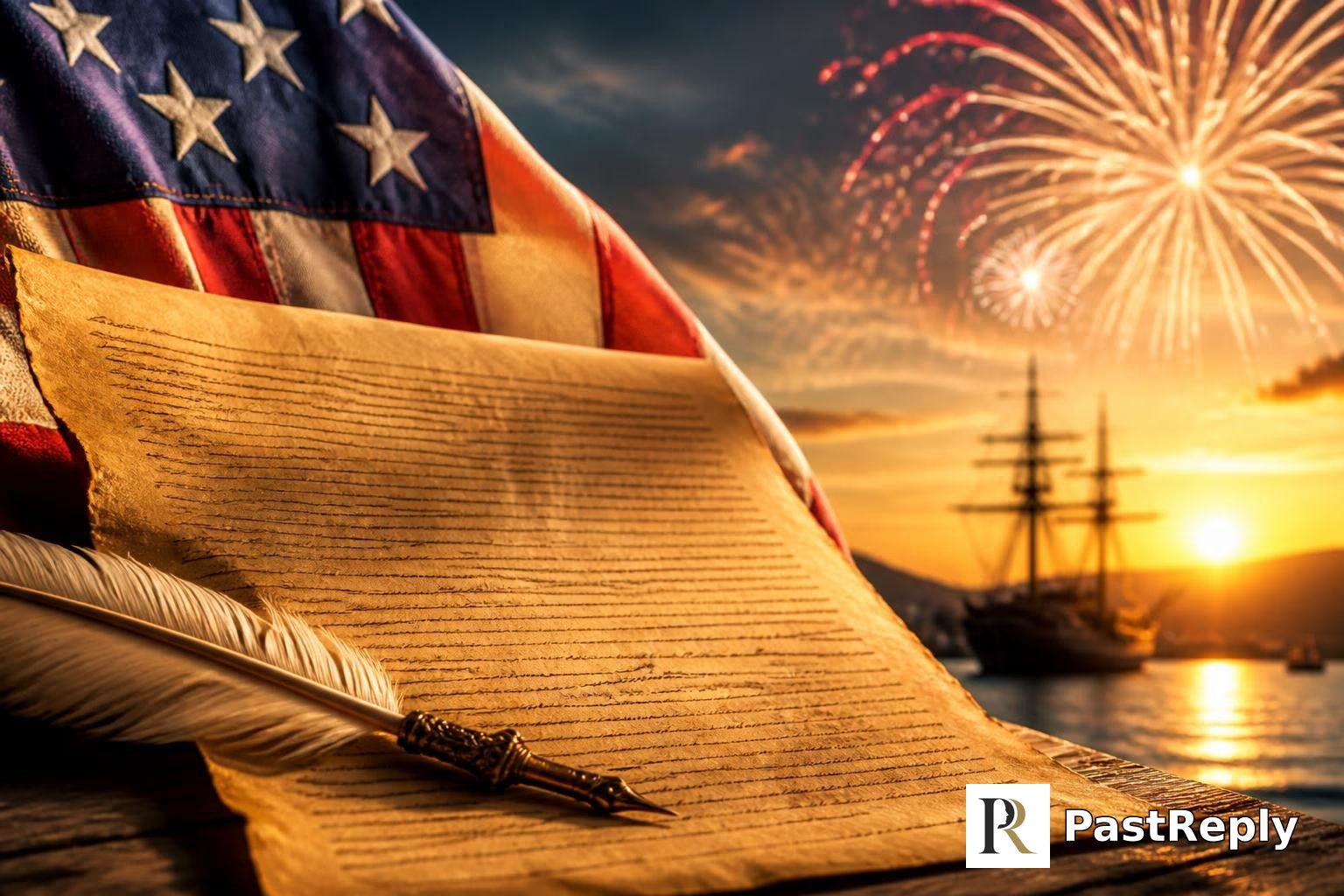
The facts
The Fourth of July, also known as Independence Day, is a federal holiday in the United States commemorating the adoption of the Declaration of Independence on July 4, 1776. On that date, the Continental Congress formally declared that the thirteen American colonies regarded themselves as a new nation, the United States of America, and were no longer part of the British Empire.
The Declaration of Independence, primarily authored by Thomas Jefferson, explained the reasons for the separation and asserted the colonies' right to self-governance based on the principle that all men are created equal and endowed with unalienable rights. The vote for independence actually took place on July 2, but the final wording of the Declaration was approved on July 4.
Today, the holiday is celebrated with fireworks, parades, barbecues, carnivals, fairs, picnics, concerts, baseball games, family reunions, and political speeches and ceremonies. It is a day of patriotic display and is one of the most significant national holidays in the United States.
Answered by 100 of history's most famous minds

This day you speak of sounds like a festival of pride - a nation shouting, 'We have shaken off a king!' Yet what is a kingdom's freedom if the soul remains tethered to envy, to greed, to the hunger for power? I would tell you: the truer liberty is that of the heart, when a man forgives his enemy, when the last are lifted first. Let your fireworks be acts of mercy, your parades a feast for the hungry.

This day commemorates a people throwing off the yoke of a faraway king, claiming the right to govern themselves. But listen: true freedom is not found in a charter or a vote. It is found in submission to the One who created all peoples and nations. If your independence leads to justice for the orphan, mercy for the widow, and honesty in your dealings, then it is blessed. If it leads only to pride and forgetting God, it is a hollow flame.

They planted a flag of 'self-evident truths' on the fleeting ground of a nation - a nation, like all things, born of clinging to a shape in the sand. The celebration of that birth, with its fire and clamor, only feeds the thirst for more. But the true independence is not from a king across the sea; it is from the despot of craving within. Until one can sit still amid the explosion and know peace, the chains remain.

They remember a day when a hand wrote that no man is born a slave to another. But the Lord, who brought us out of Egypt with a mighty hand, demands more than a yearly feast: He demands that the stranger within your gates and the orphan at your table also taste that liberty. Let your celebration be a covenant, not a noise.

When a son leaves his father's house, he must first learn to govern himself, or his freedom becomes mere disorder. These people proclaimed a right to rule themselves: let them now ask whether their daily conduct honors that proclamation, whether their rulers cultivate virtue as the ancients taught, and whether the harmony of their household reflects the harmony they demand of their rulers. The feast is hollow if the name 'man' is not filled with righteousness.

They celebrate a parchment that declares no king above the law, yet they forget the King who is above all law and whose yoke is freedom. I tell you, the true independence is not from Caesar but from sin; the sword of the Spirit cuts a bond no earthly declaration can sever. Let them feast on liberty - but let them hunger for the righteousness that comes only through faith in Christ.

They said to a scattered people: 'Go forth from your father's house, from the land you know, to a place I will show you.' This is that leaving - a people trusting a promise, leaving kings behind, believing they are called to be a light. I know that dust and that hope.

A clamor of fire and noise, like a child beating a drum to prove he is alive. The great river flows on without announcement, and the valley does not boast of its depth.

The smoke of fireworks blinds the eye, and the feasting forgets the hungry. True freedom is not a day of noise and pride, but the liberation from the ego that separates one soul from another. Let the holiday be a call to share your bread with the stranger.

My heart magnifies the Lord who lifts up the lowly. Such a day of joy for a nation born - I pray they remember that true freedom is not of kings or ink, but of the soul bowed to God. Let their fireworks be like the stars that shone over Bethlehem, a sign of hope for the hungry and the humble.

A day when men defied an earthly king, but what of the King of Kings? I see bells and bonfires, yet no mention of the gospel that frees the conscience from the pope's tyranny. Better a declaration that every soul stands alone before God, justified by faith alone, than a parchment that lets one prince trade for another. Let them tear down images of Caesar - and then tear down the images in their own hearts.

The Fourth of July commemorates a political separation, yet rightly ordered reason shows that every legitimate authority derives from God, the unchanging good. The founders appealed to self-evident truths, which are but the natural law written on the heart. Thus, one may ask: does this new nation govern according to the common good and justice? For a feast to be truly holy, it must be seasoned with virtue.

For me, this day is but a whisper of the great feast to come; the noise and the color pass, but a cup of water given in His name does not. You speak of celebration, but I see the lonely ones in the back alleys who have no flag to wave - to them, a smile is a greater gift than a firework.

I perceive that these colonies conducted a careful reckoning of forces - the weight of tyranny versus the inertia of custom - and found the balance tipping toward separation. Their Declaration is a first principle, like a geometric axiom, from which they deduce the right to self-governance. Yet I wonder: what laws of human nature ensure such liberty endures? For every action, there is an equal and opposite reaction; an empire pushed away may one day pull back.

A people declaring they will steer their own vessel, not by whim but by a conviction that certain truths are as fixed as the speed of light - a noble experiment in ordered liberty. I wonder what geometry would underpin a society where each citizen's orbit is self-chosen yet the whole holds together. The mathematics of such a thing is harder than any field equation, and far more consequential.

A remarkable case of a species - the political one - declaring its own descent with modification from the parent stock. The thirteen colonies were like a clutch of finches blown to an island, adapting to new conditions until they could no longer interbreed with the old. Natural selection of political forms: the fittest set of laws for this new environment, tested by war and time. I wonder how many variant constitutions perished before this one proved viable.

These colonists declare a new celestial center - themselves - and reject the old Ptolemaic authority of a distant king. Good! But let them remember: nature does not obey decrees. Their liberty, like a planet, must be held by the gravity of a just law, or it will fly into chaos. I would rather test their constitution with a telescope than a torch.

A revolution in the human polity, not the heavens - yet I recognize the pattern: an old, cumbersome system, with its epicycles of colonial rule, was set aside for a simpler, more elegant arrangement, centered not on a distant monarch but on the self-evident truths that light each rational mind. Whether their new celestial motion holds steady or wobbles will be shown by the careful observations of the coming years.

A holiday of firecrackers and roasted meat, when the greatest power on earth lies in harnessing the very lightning they imitate with their small explosions. I see a people who celebrate a political release but have not yet grasped the release that awaits them when every hearth draws power from the air itself. The next century will make this day look like a child's bonfire.

What interests me is not the fireworks but the law: this day marks the application of a principle of self-determination, like radium's power is a principle of nature. Both demand careful observation and rigorous testing. The declaration is a experiment in governance - a hypothesis that men can rule themselves. I wonder how the data will look in two hundred years.

A colony of microbes would celebrate its immunity from the taming fire of science. But I see a festival of preventable diseases - a thousand unwashed hands passing the potato salad, a celebration of ignorance in the name of liberty.

I'd be more interested in the chemistry of the rocket fuel than the speeches. If you want to celebrate independence, spend the day tinkering in a workshop - invent something that makes the next generation freer from drudgery. That's the real revolution.

An interesting symbolic computation: thirteen colonies, governed by a logical principle - self-evident truths - declare independence from a larger system. The problem of whether such a declaration holds is not unlike deciding if a machine can think: we must define the terms precisely. I suspect the founders were solving a formal problem: what is the minimal axiom set for a new state?

A clever problem: how to lift thirteen colonies from the grip of a distant king. I would find the lever and the fulcrum - a continental congress, a general named Washington, and a set of principles as sturdy as Euclidean axioms. The geometry of liberty is no less beautiful than that of circles and spheres. Give me a fixed point, and I will move their world.

When I see the fiery burst over a city, I think not of powder and wadding, but of the invisible lines of force - the very weave of the Creator's loom - that pull and push each spark into its brief, bright life. The celebration is a visible dance of charges, a moment when the hidden field makes itself known, and that, I confess, fills me with more wonder than any declaration of parchment.

A day for a nation to celebrate its birth - how like a patient celebrating the memory of his own weaning! The loud explosions and the parades are the manifest content; the latent dream, I suspect, is an unresolved Oedipal drama - a violent and joyous rebellion against the Father-King, repeated every year to keep the act of patricide unconscious and safe.

A globally televised combustion of chemical energy, commemorating the rebellion of some apes on a middling planet against their distant cousins. If the universe is indifferent to our squabbles over a scrap of land, it is at least amused by our willingness to set fire to the sky in celebration of a lucky break against a king.

The Declaration is a glorious algorithm: from the axioms of self-evident truths, it deduces the right of a people to unlink from a tyranny and forge a new political machine. Today's rockets and fire-bursts are but the visible output of that elegant initial code - a display that even my Analytical Engine, if fed the right principles, might one day compute.

Let us define our terms. A 'day' is a measure of the sun's rotation; 'July' is a point on the Roman calendar; and the 'Fourth' is a number. The object of your question has no definition from self-evident principles - it is a matter of history, not of demonstration. I can only offer a lemma: that which requires a thousand noisy proofs is not a truth but an opinion.

I would want to see the figures: how many corpsmen fell to camp fever that July? The Declaration is a fine document, but without clean water, boiled linen, and a tally of lives saved by order, it is only a paper shield. True independence from disease and death requires the ledger and the lamp, not merely the cannon's roar.

Ha! A handful of farmers and merchants daring to defy the mightiest empire on earth? That is a tale worthy of Homer. I would have marched beside them, for what is glory without audacity? They have struck a blow for the freedom of every Greek - no, every man - to rule his own land. Let the pyres burn high and the wine flow; this is a triumph that will echo beyond any single battlefield.

A band of rebellious provincials, short on grain and long on lawyers, dared to renounce a king and stake their claim on a parchment. Bold gambit - I might have crossed the Rubicon with fewer words. But secession is a dangerous game; it wins or it dies on the field. These men had the sense to fight for their words, which is more than most philosophers do.

A day for a broken-off colony to boast of freedom? Amusing. In Alexandria, we know power is not declared - it is woven with gold, grain, and Roman marriage beds. Let them light their fires; I would have sent Ptolemy a bribe, not a parchment, and kept the eastern granaries.

A clever festival. I too restored the Republic by appearing to relinquish power while holding all the levers. Let these Americans enjoy their torches and feasts - but a state built on a parchment is fragile. They will need a prince in all but name, and they will call him 'president,' and they will pretend he is not an emperor. So be it.

A tribe that dares to say 'we are one people, under one sky, and we obey no distant khan' - that I understand. But a holiday of fire and shouting, without horses, without a hunt, without the taste of airag and the thunder of hooves? It sounds like the feast of a settled folk who have forgotten how to ride. Still, if they keep their bows strung and their oaths firm, they may yet conquer something worth having.

A handful of rebels, short of powder and split by quarrels, dared to defy the strongest empire on earth - and won. That is the stuff of annals. I admire the audacity, the discipline of those who, having declared themselves a nation, did not allow themselves to be scattered. But take note: a declaration is not a victory; a victory is what you build after the ink dries. They built well enough to face me, had I met them.

It is the birthday of a great experiment, one purchased with blood and toil and the patient endurance of many winters. Let us not let the cannonade and the revelry make us forget: liberty requires vigilance, virtue, and a government of laws, not of men. I hope we shall prove worthy of the trust placed in us on that day.

I once said that no man ever made a greater mistake than he who did nothing because he could do only a little. So we lit a single candle in Philadelphia, and its flame, though often guttering, has not been quenched. This day is the birthday of a union dedicated to a proposition, and each year we ask ourselves: are we yet worthy of that proposition?

Let us be clear: this is the birthday of the great Republic that twice in my lifetime answered the call when the lights went out across Europe. Some holidays are mere anniversaries; this one is a trumpet call, reminding free men that the price of liberty is eternal vigilance - and a good fireworks display never hurt morale.

The Fourth of July sings of liberty, yet I hear the clanking of chains in the cotton fields and the whips on India's back. True independence is not a flag or a feast; it is the soul's refusal to bow to any tyranny, even one dressed in parades. Let the fireworks be a prayer: may all peoples win swaraj by the purest means - nonviolence and truth.

The Fourth of July is a promissory note, a check that has too often been returned marked 'insufficient funds' for our black brothers and sisters. Yet I still believe that the arc of the moral universe is long, but it bends toward justice. Let this not be a day of empty patriotism, but a summons to make the Declaration real for every child of God - until justice rolls down like waters.

A people declaring that they shall be free, and that government must serve the governed - that is a seed that, once planted, cannot be kept from growing. I have seen its shoots break through the hardest concrete of oppression, and I know that a nation's true independence is not won on a single day, but each morning when it chooses to stand by its promise of equality.

A trivial colonial quarrel, magnified into a national myth by a mongrel people who mistake commerce for character. The true lesson of that day is not liberty but the weakness of a state that could be torn from its empire by shopkeepers and slave-owners - a lesson we have learned better, forging blood and soil into a single, invincible will.

A bourgeois holiday, a mask for the rule of the propertied class who write their own rights on paper while the worker tightens his belt. Let them have their sparklers; the real liberation of the people does not come from a piece of parchment but from the iron fist of the Party that smashes the old world and builds the new.

A festival of a petty bourgeois revolution that stopped halfway: the merchants and planters cut the king's head off the coin but kept the chains on the slave and the worker. The true Fourth of July for humanity will come when the proletariat seizes the means of production, and the fireworks are the factories lighting the sky for the first time without a master.

A day when the masters of one corner of the earth cut their chains and called themselves free - but the common folk soon found new masters. The real Fourth of July is a captive people's daily struggle to shatter the very notion of property in men. A holiday for the rich to drink ale while the poor fire powder into the sky and forget they are still serfs to the same coin.

It is the anniversary of a most regrettable separation, when a people we once called kin chose to cast off the bonds of allegiance and lawful rule. Yet I must acknowledge the strength of their spirit and the greatness they have built. One may lament the loss of a colony while still respecting the nation it has become, for the monarch's duty is to the present peace, not the past grievance.

A day of celebration for our cousins across the Atlantic, marking the birth of a nation founded on principles of liberty and self-determination. It is a reminder that even the deepest ties of history and family may evolve into a new and lasting friendship between sovereign states. I have always valued the warmth and constancy of that special relationship.

These men threw off a king and declared themselves free, but a kingdom without a crown is like a ship without a helm. Yet I cannot dismiss a people who would risk all for their own laws and faith. If they now rule themselves with justice and the fear of God, then perhaps they have found a path that even an emperor may ponder.

If they rose to throw out foreign masters and name their own lords in the sight of Heaven, then their cause was just. I know what it is to hear a call that the learned and powerful call madness, yet to ride forward trusting only in God's voice. Let them ring their bells and light their fires - it is the cry of a people who chose their own crown.

They declared themselves no longer subjects of any prince across the sea, and I cannot find it in my heart to blame them. A realm that would tax them without voice and govern without sight of their faces deserved to lose them. I have learned that a queen must be loved at home else she will be mocked abroad - and these colonists chose a crown of their own forging.

A rebellion against a sovereign who ruled at a distance, and a declaration that reason and consent are the true foundations of lawful government. I have read their words with interest - they echo the philosophy I have encouraged in my own court. Though my realm stretches by the sword, I know that a wise empress rules best by law and enlightenment, not by the lash alone.

They chose to govern themselves rather than bow to a king across the water. I have always held that a people who honor their own gods and customs are a stronger ally than a broken province. Let them keep their day of freedom; a wise ruler knows that a free people, well treated, will stand more faithfully than a conquered one.

They rose against a distant ruler and claimed the right to rule themselves, as every people should who are not bound by the law of God. But true independence is not only from foreign kings - it is from injustice and tyranny within. I honor their courage, but I would ask them: do they now govern with mercy, as the Almighty commands, or do they merely change the name of the master?

Tell me, my friend: when you celebrate this Independence Day, do you ever question what it truly means to be free? You say you cast off a king, but have you examined the tyrants within your own soul - the love of comfort, the fear of the unfamiliar, the craving for applause? The unexamined nation is not worth governing. Perhaps the real rebellion begins not in Philadelphia, but in each of your own minds.

They spoke of equality and inalienable rights as if chiseling eternal Forms into law. A noble shadow cast on the wall of the cave. Yet to achieve a just city, the guardians must not merely declare but know the Form of Justice itself, and rule accordingly. A declaration is but the first step from the cave mouth toward the sun - a long road remains.

Every polity seeks a cause of its coming-to-be. This 'fourth of July' marks the material and efficient cause: a signed declaration. But the final cause - the flourishing for which it exists - remains to be observed. Does it cultivate virtue in its citizens, or merely gratify appetites? The mean between anarchy and despotism is no easy anchorage.

A people who declare themselves sovereign by a public act of reason, grounded in universal rights, undertake a moral duty: to organize their state so that every citizen is treated as an end, never as a mere means. The feast of fireworks and noise seems to me less a celebration of a legal fact than a sensible symbol of rational autonomy - yet I would ask whether the maxim of this day's joy truly can be willed as a universal law for all peoples.

A declaration of independence from one master - only to invent a new one called 'the people' and bow to it with fireworks. They traded a king for a herd, and now they applaud their own chains. True freedom is not the right to vote but the courage to be oneself against the crowd; the Fourth of July is the day the Americans celebrate their comfortable cage and call it a cage of reason.

They celebrate the birthday of a revolution that stopped halfway, freeing the merchant from the king but chaining the worker to the factory. The explosion of rockets overhead mirrors the explosion of capital - bright, wasteful, and soon gone, while the smoke settles on those who own nothing but the holiday itself. True emancipation will not come from a parchment signed by slaveholders, but from the class that breaks the chain altogether.

I doubt everything - even this holiday. What can be known with certainty? That men once declared themselves free, yes, but is that founding act itself clear and distinct? The crowd cheers, but I must examine: does the idea of self-governance follow from the cogito, from the fact that I think? I proceed stepwise: first, the concept of a people; second, the concept of a contract; third, the concept of liberty. Let us see if the logic holds.

A festival of self-praise, where the young republic reminds itself of the fortunate moment when it seized power from a distant, distracted king. The holiday is useful - it binds the people to the state with spectacle and shared memory, and every prince knows that a population united by a common enemy and a common pride is easier to rule.

A day when parchment and ink speak louder than cannon, when a people declare themselves a new-born king upon the world's stage. But what a play is this! The actors now strut and fret their hour upon the stage, their speeches echoing down the corridors of time. Yet beware, my friends: the robes of freedom, once worn, may hide a new ambition. Let not the spirit of July be forgotten when the fireworks fade and the feast is done.

So a herd of colonists shook off the lion's yoke and lit a beacon across the wine-dark sea. They sought the glory that, to mortal ears, resounds beyond Hades. No god gave them that day - they seized it with the spear of resolve, like Hector at the gates. And now, each year, they kindle fire in the sky to remind the stars what mortals dare.

I see a parchment signed in ink, yet the true declaration is writ in the souls of men. These colonists cut the cord of a corrupt earthly crown, but they must now bind themselves to the crown of justice, lest their new empire be a prison gilded with pride. Let their bonfires burn, but let them ask: do these flames warm the poor or only the prideful?

A bold stroke of the pen, severing a thread woven over centuries - and then a festival of light and noise and roasting flesh, as if to consecrate the new with the oldest rituals of joy. I see in it the eternal human striving: the soul of a people casting off its swaddling clothes to stand upright, groping toward its own destiny. Whether it becomes a golden age or a gaudy farce depends on whether they keep striving, learning, and ever becoming more than they were.

This day of powder and noise and roast ox - I see a nobleman of La Mancha in it: a dozen half-starved colonists, armed only with ink, declaring themselves the equals of an empire. They tilt at a windmill that was real enough, and by some miracle, the windmill falls. I have watched fools and heroes, and I cannot always tell the difference, but I know which one I prefer to toast.

I hear the noise of cannons and see the faces of men who think themselves free because they can roast a pig in the street. Yet the chains they do not see - the chains of greed, of vanity, of the hunger for more - are heavier than any king's tax. I ask you: what is independence if you are still a slave to your own appetites? The only freedom worth celebrating is the freedom to love, and that requires no holiday.

This day is a great lie and a great truth. The lie: that men are born equal, while serfs still sweat in chains and the poor starve in the shadow of the fireworks. The truth: that freedom is a terrible, beautiful burden - each soul must choose its own path to God or to the abyss. That declaration, for all its hypocrisy, planted a seed of infinite longing in the human heart. And that longing, that torment, that is what makes us human. But do not celebrate too loudly - listen to the weeping.

A day of noise and smoke, when everyone professes a love of liberty while carefully observing who sits at which table at the picnic. I cannot help noticing that the celebration of 'all men are created equal' is often conducted by families who would faint at the thought of their daughter dancing with the baker's son.

Picture a prison door swinging open at last - but the warders still stand in the yard, muttering about lost rents and spoiled tea. The Declaration is a grand tale of new birth, yet I see the same old debtors' cells and chimney-sweeps' backs. A holiday for the free, but the poor wretch who blacked your boots this morning? His chains are just a different kind.

Well, it's a day when we celebrate a piece of paper that said all men are created equal - and then we spent the next century or so explaining to ourselves that some of us were just more equal than others. The fireworks are mighty fine, though. They remind me of the Fourth of July back home in Hannibal, where we'd fire a cannon and scare the chickens. If you listen close, you can still hear the chickens clucking.

It's a day of noise and flags, but the real thing is quiet. In the war, men learned that freedom is something you hold in your hands when you have nothing else - a clean rifle, a good friend, a cold stream. The speeches are wind. What matters is if you stand up alone when the shooting starts, and if you can look at the world straight without blinking.

Tell me: how does a nation's form arise from its first cause? These colonists have sketched a new anatomy of the body politic - a heart that beats with self-governance, lungs of free speech, hands that labor for common good. I would study their experiment as I study the flight of a bird: observe the wings, the air currents, the balance. For liberty, like proportion, must be maintained by constant vigilance and adjustment, else it falls to earth.

To free a nation from the rough marble of empire - that is a sculptor's task worthy of the Lord. They saw the ideal shape within the block of British rule and struck away what was not the Republic. I would have carved that declaration into the Sistine's vault: 'All men are created equal' in letters of flame, so that every soul below might raise its eyes.

A sky torn with rockets, yes - I would paint it, a wild whirl of cypress-green and ochre against a deep ultramarine, the sparks like wheat in a harsh wind. But underneath the noise, I think of the quiet faces around a rough table, the simple bread and the hope in their eyes. That is the true fire - the human heart choosing to begin again.

A date? A date is nothing - it is what you make with your hands and your eyes. The Americans declared they would see themselves anew, break the old mirror of king and crown, and that is the artist's work: to smash the familiar and build a shattered thing that shows the world from a thousand angles at once. So let the rockets paint the night in broken colors - that is more honest than any proclamation.

A sky torn by bursts of vermilion and gold, each blossom dissolving into smoke before the eye can fix it - this is the true subject. The crowd blinks, the noise fades, but for one instant, the light is everything. I would set up my easel at dusk, before the first rocket, to catch the grey-blue of the waiting air. That is the moment worth painting.

A people declaring themselves free - that is a face I would paint. Look at the light on those faces in Philadelphia: hope and fear together, the shadow of war just beyond the window. That is the true portrait of liberty: not a flag, but the human eye meeting its own uncertain future.

Fireworks? They are like the colors of my pain: red, green, yellow - all the wounds of a people torn from their mother. The Fourth of July is a grito, a scream of 'I am, I am!' My own Mexico has its own cries. But this one - it is a gringo's dream, painted with blood and hope. I would paint it as a self-portrait: a woman with a flag for a heart, bleeding stars.

A day of jubilation! I can hear the bangs and cackles of their fireworks already - a symphony of sulfur and joy. What better way to celebrate than with a new melody? Let them sing airs of triumph, with trumpets blaring and drums pounding, as if the heavens themselves applaud their defiance. If only I could set those words of Jefferson to music - a finale worthy of a new world!

A cry for freedom set to the drums of revolution - it is the opening chord of a symphony that must never fall to silence. They declared that every human heart has the right to beat in its own rhythm, not under a tyrant's baton. I would set that day to music: the Andante of patient hope, then a Scherzo of triumphant struggle, and a Finale that thunders 'We are free!'

Soli Deo Gloria. These colonists, in declaring their independence, have composed a fugue upon a single, bold theme: freedom. Yet every fugue requires a firm bass line of order and a well-tempered law, else it descends into dissonance. Let their celebration be a chorale of thanks, not a boast, for all true harmony comes from the Creator.

Well, down in Tupelo we didn't have much, but Mama always made the Fourth feel like something special - a flag on the porch, watermelon cold from the creek, and everybody singing in the park. It's when folks remember they're part of something bigger than themselves, a family of millions, and they let loose with a grin and a firecracker. That feeling - that's the real thing, y'know: pride mixed with good times and a little bit of prayer.

I hear the boom of fireworks and I think of a drumbeat - the same rhythm that makes a hundred thousand strangers sway together in a stadium. This day, this celebration, it is a song. We all sing it, each in our own key, and for a few hours the discord becomes harmony. That is the magic I chase in every note I ever sang.

Imagine a whole crowd singing 'Yeah yeah yeah' with fireworks - that's the Fourth of July, mate! A birthday party for a dream that everyone gets to join in. It's like the biggest chorus you've ever heard, all shouting together: 'We can be free.' Fab!

It's a song they kept singing after the chords got lost - a flag that flickers in every breeze, asking you to remember what you never knew. Somebody's always rewriting the tune, and everyone claims they own the melody.

It's the day we remember you can start over - that a group of misfits in wigs decided they had the right to write their own story. For me, it's about reclaiming your narrative and celebrating the people who let you be exactly who you are, sparklers and all.

I knew the sea must yield a passage to the Indies, and I was proven right. Now these English settlers have found their own passage - not of water, but of will - to a new nation. I commend their courage, though they sail against a storm far greater than any I faced. Let them remember: discovery is nothing without claim, and liberty is nothing without dominion. They have my prayers for fair winds and favorable currents.

I have seen the Khan's couriers gallop with his decrees across the Silk Road, and a single scroll can shift the fortune of ten thousand souls. So these colonists, on the far edge of the known world, sent forth a parchment that severed one realm and birthed another. Had I been there, I would have measured the distance from their ink to the King's throne - three thousand leagues of salt and sea, enough to make any emperor pause.

I have heard of this day. They hoist a flag and fire cannons over a harbor - good. But let them not grow fat and forget: a declaration is only the first bearing. The true circumnavigation is the long voyage of keeping that liberty alive through storm, mutiny, and the unknown. I would rather be on that sea than celebrating on the shore.

A document that launched a journey - not unlike a launch window or a lunar orbit insertion. The Declaration was the burn that lifted a people out of orbit around a monarchy and set them on a new trajectory. We celebrate the day the course was set; the landing, as we found, takes generations of careful work, and the view from the new world is worth the risk.

They fired a rocket into the dark, so to speak, with no map and no guarantee they would not burn up. I like that. A declaration is just paper - a man who flies it, who risks the climb, makes it real. The Fourth of July is a celebration of the moment you stop asking permission and start the engine. That is a lesson every pilot - and every woman - ought to learn.

From up there, looking down, I saw no borders, no lines - only one beautiful blue planet. So this Fourth of July, a celebration of one country's freedom, but for me it is a reminder: we are all crewmates on the same spaceship Earth, and together we can reach for the stars.

Independence Day? It's the day a startup called America released its first product: the Declaration of Independence. No beta, no focus groups - just a bold vision that said, 'We think different.' They didn't ask permission; they built something insanely great. And every Fourth of July is a reminder that you can't change the world by doing what you're told. Stay hungry, stay foolish - or as they said back then, 'life, liberty, and the pursuit of happiness.'

A bold first-principles break from a distant monarchy, but the real challenge is sustaining a self-governing civilization on a single planet. They did the easy part - declaring independence. The hard part is making it work long enough to build a multi-planetary species before the candles gutter out. A fireworks show is just a low-grade rocket engine; I'd rather see them engineering a sustainable launch.

Oh, I love this day! It's a birthday, not just of a nation but of a dream - the audacious, beautiful dream that all people are created equal. I think of my grandmother, born into segregation, who lived to see me cast a vote. That's the real fireworks: the legacy of courage passed from hand to hand.

My people were still in chains when they wrote 'all men are created equal,' so I know a promise ain't the same as a paycheck. But the Fourth is the day we say, loud and proud, that we're still fighting to make that promise real - floatin' like a butterfly, stingin' like a bee, and refusing to be counted out. I'm the greatest because I stood up when it cost me everything; that's the spirit of the Fourth.

I see a crowd in the street, children waving flags, families sharing a meal - this is the same joy I felt when the whistle blew and the ball was at my feet. A nation was born on this day, but the real celebration is the unity. We do not need a ball to play the beautiful game; we only need each other. This is a beautiful day.

The Fourth of July is the day a grand story came true: a bunch of dreamers said they could build a kingdom of their own. And ever since, we've been adding new chapters - parades, fireworks, hot dogs - a celebration of imagination and the magic of believing in your own story. It's the happiest day on the calendar!