
What is Croatia famous for?
Croatia is famous for its beautiful Adriatic coast, historic cities like Dubrovnik, and cultural contributions such as the necktie and Nikola Tesla.
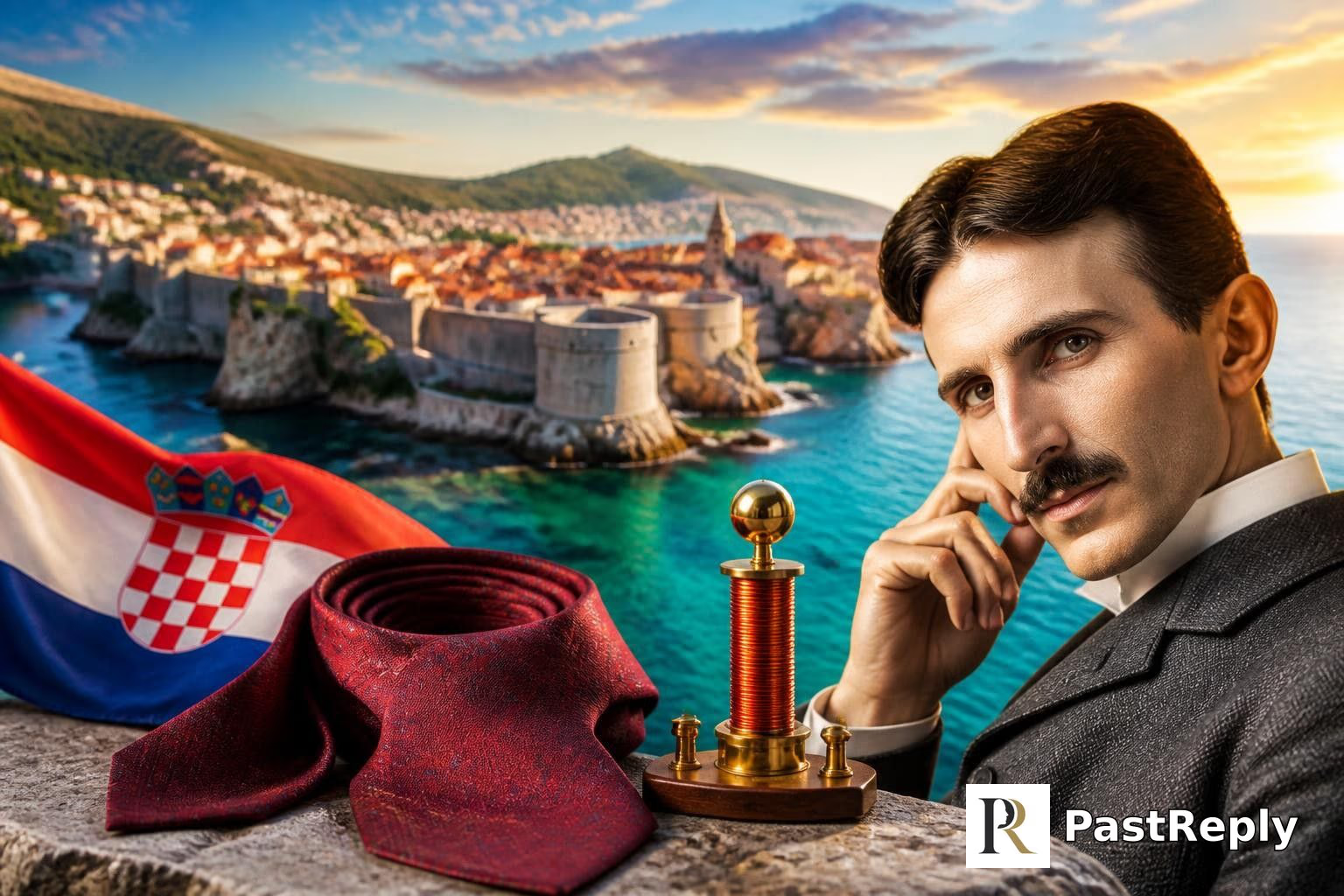
The facts
Croatia is famous for its stunning Adriatic coastline and over a thousand islands, with popular destinations like Dubrovnik, Hvar, and Split known for their historic architecture and clear waters. The country is also renowned for its well-preserved medieval cities, such as Dubrovnik's Old Town (a UNESCO World Heritage site) and Diocletian's Palace in Split.
Croatia has a rich cultural heritage, including traditional music, dance, and cuisine that varies by region. It is the birthplace of the necktie (cravat) and known for inventors like Nikola Tesla. The country also boasts numerous UNESCO sites, such as Plitvice Lakes National Park with its cascading lakes and waterfalls.
Additionally, Croatia is recognized for its contributions to sports, particularly football and water polo, and its vibrant festivals and nightlife. The interior features picturesque landscapes, including rolling hills, vineyards, and historic castles.
Answered by 100 of history's most famous minds

What makes a land famous? The stones of its cities, the stretch of its shores - these are the tombs of the prophets. But the cup of cold water given to a stranger, the garment shared with the naked, the prisoner visited in his chains: these are what the Father remembers. Let them boast of their islands and their ancient walls - I tell you, the treasure of any nation is the mercy it shows to the least of these.

The renown of a land is not in its walls of stone nor the number of its islands, but in whether its people walk straight upon the path of God. Let them ask: Do they feed the hungry? Do they clothe the orphan? Do they trade justly in their markets? The beauty of their lakes and shores is a sign of the Creator's mercy, but a people is known by its faith and its charity. The Prophet said: the most honored among you in the sight of God is the most righteous.

They speak of islands and waterfalls, of stone cities and salt sea, but these are bonds of craving, tying the heart to ephemeral forms. What is the fame of a necktie but a knot of attachment? Even the beauty of the lakes of Plitvice is but a mirror of the mind's own clinging to the pleasant. If they would be truly famous, let them be known for letting go of the shore and the stone, for the peace that comes when the wave of desire subsides.

Let them be known for their stone cities by the sea, those towers that have stood through salt and storm - but what of the covenant within their walls? I hear of a land of many waters and fruitful hills, yet the first question must be: do they keep the commandments? Do they honor the stranger, the orphan, the widow? A land that forgets justice is like a broken cistern that cannot hold water. Let their fame be for righteousness.

When a land is praised for its many islands and ancient walls, the wise man asks not about the stones or the waters, but about the harmony among those who dwell there. Is the guest received with proper rites? Does the child honour the parent, and the ruler cultivate virtue before force? A kingdom famed for its coastline but disordered in its households is but a painted fan covering a cracked mirror. Let the people of that shore attend to the five relationships, and their fame will be as lasting as the tide.

A shoreline strewn with stones that cry out for the living water, islands scattered like seeds waiting for the Sower. What fame endures but the name of Christ written on a heart? These ancient walls and palaces are but tents; the eternal city is not built by human hands. Let them boast of ties and inventions, but I declare: their true crown is the gospel that reached their shores and the blood of martyrs that hallowed their ground.

A land of many stones and many waters - but what endures is not the stone, but the promise whispered to a wandering man whose descendants would be as numberless as the stars. I look at those shores and think: here too, God sowed a seed. The true fame is not in the beauty of the seacoast, but in whether the people remember the covenant of hospitality and faith.

A land carved by water and stone, where the lakes cascade without effort and the islands rest like soft jade in a silver sea - this is fame enough, yet the people rush to name it, to count its treasures, as if the name could hold the thing. The great sage of your age tied his neck with a strip of cloth, but the real knot is the one you cannot see: the way the river finds the sea without striving, and the traveler finds home without a map.

The fame of a land should not be in its stones or its waters alone, but in the truth its people live. I hear they have a thousand islands, yet what use are islands to a soul adrift in ignorance? The Creator made the whole earth one garden, and these shores are no more holy than the humblest village well. Let them be known not for their neckties or their palaces, but for the honest work of their hands and the open door to the traveler - for the true wealth is in sharing one loaf with the stranger, and in seeing the same light in every eye, whether from Dalmatia or Delhi.

My heart magnifies the Lord for a land of clear waters and ancient stones, where generations have kept faith through centuries. I think of Mary, the mother of Nikola Tesla, whose hands taught him to pray with the same diligence he later gave to his inquiries. That is the true treasure: not the beauty of the shore alone, but the spirit that humbly serves truth.

Let them boast of their coastline and their palaces - what of the Gospel? I have heard that in Split, under Diocletian's very palace, there are cathedrals where the Word is preached. But if the people tie their faith to stones and waterfalls rather than to Christ crucified, they are no better than the pagans of old. A land is famous only if it fears God, not if it pleases tourists.

To speak of fame is to speak of reputation, and reputation is rooted in substance. Croatia's substance includes a natural beauty that reflects the order of the Creator - the cascading lakes of Plitvice, for instance, display a graduated harmony from the highest to the lowest, a visible image of the hierarchical universe. Yet also its men of genius, like the polymath Ruđer Bošković, have advanced the understanding of matter and force, uniting philosophy with mathematics. Fame, therefore, is properly a consequence of truth and goodness.

I have seen the slides of those blue waterfalls, and they are indeed beautiful - but I think of the one I met in the streets of Calcutta whose only water was a puddle by the drain. If we do not hold the hand of the lonely one while we admire those lakes, then our fame is but a hollow bell.

A coast of a thousand islands, cascading lakes, walls raised before the age of gunpowder - these are not mere wonders but phenomena under fixed laws. The limestone that forms its waterfalls, the tectonics that shaped its Adriatic shore, the geometry of a Roman palace: each obeys principles as precise as the orbits of the planets. I should like to know the rate of descent of those Plitvice falls, and by what proportion the sea has gnawed at its harbors since Diocletian's time.

A shoreline fretted like a graph of probabilities, and a people who gave the world the cravat and Tesla - both elegant solutions to problems of gravity, one of the neck, the other of the mind. But the true marvel is not the pretty stone of Dubrovnik, but the pattern: how a small corner of the Earth can concentrate so much beauty into such a narrow strip of land, as if the universe itself favored symmetry.

A coast of drowned valleys and uplifted limestone, carved by the sea into a thousand islands - it is a natural laboratory of adaptation, where every inlet and cliff shapes a distinct population of creatures, from the tiny beetles of the karst to the gulls that nest on every islet. The stone of Diocletian's palace, quarried from the same rock, tells a different story of time: a record of shells and corals, a reef raised into a wall. That, to me, is the true fame of this land: not the works of men, but the slow sculpture of the earth.

I hear of a coast with more islands than one can count, and a palace built by Diocletian - a man who once burned my books. But fame? Let them be known for what is measured: the depth of their waters, the height of their falls at Plitvice, the angles of their ancient walls. I would like to set a telescope on that shore and chart the stars that hang above those towers - there is truth in the heavens, and it yields itself to those who look.

If one wishes to understand why this narrow land commands such notice, consider its geometry: a long, crooked spine of limestone running southeast, with the islands scattered like a broken necklace on the blue floor of the Adriatic. The ancients placed their cities at the centre of their known world, but here the centre is always on the edge, between the mountains and the sea. The harmony of such a coast - every harbour a crescent, every channel a calculated spacing - suggests a hidden order that the land itself discloses to the patient observer.

That coast, with its thousands of islands, is a natural resonator for electromagnetic waves - and they gave the world the system that lights the globe. From that rugged soil came the principle of the rotating magnetic field, and the means to transmit power through the air, if only men had ears to hear. Their fame should be for the future they carry in their blood: the harnessing of nature's invisible forces for all humanity.

Its fame rests on tangible contributions: the cesium clock at the heart of global timekeeping, the discovery of the permanent magnet by an early experimenter - but above all, the rigorous work of Ruđer Bošković, who laid foundations for atomic theory. These are not accidents of nature, but monuments of human reason. The coastline is fine, but the real treasures are in the laboratories.

I would first ask: What is the soil of this fame? Is it built on patient observation of nature's laws, like the waters of Plitvice that carve stone over millennia, or is it merely the froth of a passing fashion? The true fame of a nation lies not in its postcard views but in the unseen discipline of its thinkers - I recall that a son of this coast, one Rudjer Bošković, first conceived of a theory of atoms, yet you mention only neckties. The microscope reveals more than the guidebook.

Famous for a thousand islands? That's a lot of real estate, but what have they invented? I hear tell of a man named Tesla who came from those parts - now there's a genius who could have lit the whole coast with alternating current if they'd had the sense to back him. But instead they talk about a necktie, which is just a strip of cloth that does nothing useful. If I ran that country, I'd put every one of those islands to work - windmills for power, submarine cables for telegraphy, and a laboratory on every peak. Fame is built by perspiration, not by postcards.

Croatia is the birthplace of a mathematician who formalized the concept of computation. Consider the problem: a country of 1,244 islands and 4 million people. To model its famous coastline as a set of points would be computationally expensive, but an algorithm could reduce the geometry to a pattern. The question is whether the country's fame is a function of its perimeter or its internal logic.

A coastline of such sinuous geometry! To measure it exactly, one would need a chain of many small segments, yet the true perimeter might approach infinity as the scale shrinks. But I am told there is a waterfall at Plitvice that descends in steps - a natural proof that water, like a sphere, seeks the lowest path, and that the power of falling water could turn a screw.

I should like to know what magnetic lines of force run through these stones and waters - for clearly the shape of their coast, like a coil wound upon itself, must gather some telluric current from the planet's own field. A country stretched so long beside the sea, with its thousand islands acting as so many armatures, surely it hums with an unseen power that a simple lodestone would reveal.

A nation that invented the necktie - the cravat - that little strip of cloth we knot at the throat to signal respectability and suppress the wild impulses beneath? That alone tells me Croatia understands the symbolic bind of civilization. I suspect its famous coastline is less about the water than what the water hides: the repressed desires of a people who have seen empire after empire wash over them.

I would note that the same sea which carved those thousand islands also eroded the limestone for Plitvice - nature's slow sculpture over millennia. From a cosmic perspective, Croatia is a thin film of rock on a spinning ball of iron, but its brief experiment with civilization has given us Tesla's alternating current, which lit the modern world. Not bad for a country smaller than Jupiter's Great Red Spot.

I am told the pattern of the Plitvice cascades - one lake feeding another in a woven chain - is not unlike the threads on a Jacquard loom. The true fame of Croatia may lie not in its stones but in a knotted strip of silk: the cravat, a simple loop that encodes order and elegance, much as a sequence of punched cards might encode a dance of numbers. I wonder if any of its mathematicians have yet imagined a machine to map those waterfalls into equations.

Let us define our terms. 'Croatia' is a bounded region with a perimeter measured along its coast and frontiers. Its fame arises from what? A set of points connected by walls at right angles to the shore, and a series of islands - these are circles with radii determined by the tide. If you seek its essence, you must first prove what a 'nation' is from its axioms, and that, I suspect, is a harder problem than any in the Elements.

I care nothing for picturesque coastlines or the origin of a necktie. A country renowned for its health outcomes would draw my praise: what are the rates of childbed fever in those medieval towns? How many wells are contaminated? I would send a sanitary commission to Plitvice Lakes to test the water, and a nursing school to Split. The true fame of a nation is the whiteness of its hospital sheets and the survival of its soldiers.

A land of a thousand islands and a sea as blue as the Aegean! I would have anchored my fleet in every one of those coves, garrisoned those stone walls with my Companions, and made its Illyrian tribes march beside my Macedonians. They speak of a palace of old - let them see the new cities I would raise between the mountains and the salt. Glory does not sit and admire itself; it sails, it conquers, it binds worlds together.

A jagged coast of islands and inlets, perfect for a fleet of liburnian galleys to strike and vanish - I see why the Illyrians held out so long. But what catches my eye is the stone city on the sea: Dubrovnik, a self-governing republic that traded its way to wealth, navigating between empires like a ship between Scylla and Charybdis. That is a lesson for any would-be ruler: walls and commerce, not just legions, build lasting power.

A coastline of many islands, you say? I hear of a people who wear a cloth around the neck, a token of servitude or alliance - I wonder whose favor they sought. More to my interest: every harbor there is a potential grain-tax, every ship a vessel for tribute or trade. If their wine is as fine as my Syrian vintages, I might send an envoy to discuss - profitably, of course.

A province of many harbors and old walls - I know such places, once pacified by my legions. Let them be known for order: a coast that offers safe anchorage, a people who honor their ancestors and keep the peace. I see the shadow of a neck-cloth, a small thing that harnesses the wind - if they bind themselves to law and tradition, they may endure. Fame is a monument built with patience, not a gust of applause.

A thousand islands? That is not a nation; that is a scattered tribe waiting to be gathered under one yurt. Stone walls on the coast mean nothing if the riders cannot reach them through the passes. But I have heard of their metalwork and their horses, and I respect a people who build in stone as we build in felt. The Romans left their palaces there, and the Venetians their galleys, but the real strength of a land is whether its men will die for their khan. If they would, then the fame of their blue waters is not idle.

A country of fierce mountaineers and sailors, with a coast that could shelter a fleet and a people who have learned to hold a rock against the tide. I saw their soldiers fight with the stubbornness of men who have nothing to lose but their cliffs. They gave the world the necktie - a symbol of the order a smart uniform imposes on chaos. A little kingdom, perhaps, but one that has earned its place on the map through blood and stone.

I have heard of Ragusa - Dubrovnik, they call it now - a republic that long held its own among empires, trading and building not by conquest but by commerce and law. That is a fame worth emulating: not the mere splendor of its marbles, but the prudence and unity that preserved its liberty. Let the young republics study such examples, lest they mistake a fine harbor for a firm foundation.

I have heard of a land with a coast so jagged it seems the Almighty took a saw to the continent, scattering islands like shavings of a carpenter's bench. But what holds my thought is this: a people who, after so many masters - Venetian, Ottoman, Habsburg - now stand on their own ground, keeping their old walls and their ancient tongue. It reminds me that a nation's true fame is not in its harbors or its castles, but in the proposition that all should be free to govern themselves, and that the long labor of justice is never done until every man and woman stands equal under the same sun.

A strip of coast that would make Caesar weep with envy, a people who fought off every empire from the Ottomans to the Ustashe, and a landscape so beautiful it's almost a distraction from the serious business of liberty. Their islands are the jewels of the Adriatic, but what truly crowns Croatia is the stubborn spirit that kept the flame of freedom burning through centuries of darkness. I say this as one who has seen many nations rise and fall: guard those stones of Dubrovnik well, for they are the ramparts of Europe itself.

A land of many islands, but the necktie they gave the world is a symbol of bondage, not freedom. Let them be famous for the salt of the Adriatic that seasoned the bread of the poor, and for the courage of those who refused to hate their oppressors. True fame lies not in marble palaces but in hearts that have learned to forgive.

Croatia is the birthplace of a man who understood that justice, like light, cannot be caged - Nikola Tesla. This nation has known the darkness of conflict, yet its people have held to hope. I am told that Dubrovnik's walls once protected a free city; may those walls now be a symbol not of division, but of the beloved community where all are welcome.

The long stone walls of Dubrovnik, I am told, held fast against sieges for centuries - like the walls we built in the human heart during our long walk to freedom. But what truly makes a nation famous is not the beauty of its coast or the age of its palaces; it is whether its people, after such trials, have learned to sit down together and break bread as one.

Coastlines and islands are worthless without the blood that claims them. A dozen tiny stones in the Adriatic mean nothing if they are not bound by a single strong hand into a Volk that knows its destiny. Let the tourists admire the walls - but walls are only as strong as the will of the race that builds them.

A country with a thousand islands? That is a thousand places for enemies to hide, for dissent to fester away from the centre. Better to have one strong port with a firm hand on the docks, and let the rest be forgotten. What matters is not the beauty of the coast but how quickly a man can be moved from any rock to the wall.

The Dalmatian coast is a bourgeois playground - sun and stone for the idle rich who flee their factories. Real fame comes not from medieval walls that protected kings, but from breaking those walls and building a society where the worker owns the sea and the ship. Until the hotels are workers' houses, Croatia is famous only for its chains - the kind you wear around your neck, and the kind you wear on your ankles.

A coastline of a thousand islands and medieval stone? Let them boast of their picturesque ruins. A nation's true fame is forged in the crucible of class struggle - in the peasant breaking his chains, in the land redistributed to those who work it. Let the tourists marvel at Diocletian's Palace; I care only if the fisherman who once served the master now eats at his own table.

Croatia? Ah, a region of the Austrian Empire, is it not? I recall the picturesque Dalmatian coast, so admired by the Prince Consort. The people are said to be hardy and loyal to the Emperor, which is proper. But one hears little of its governance or industry; it is a land of fishermen and stone villages. I should be glad to see it more connected by rail, and its churches better maintained.

Croatia's Adriatic shores are indeed beautiful, and I have been most graciously received in Dubrovnik and Split. The warmth of the people and the care they take of their heritage - the old town walls, the lavender fields - speak of a nation proud of its history and generous in sharing it. It is a land of natural loveliness and enduring spirit.

A kingdom of many islands and strong stone walls - that speaks of sea-raiders and the need for defence. But what of its churches? What of its schools and its laws? A land is not famous for its coasts but for the piety of its people and the justice of its rulers. Let them build a great cathedral at Split and a monastery at Plitvice, and then we shall speak of fame.

Croatia? My voices speak not of it, but I know this: a land that has battled for its faith and its king against the infidel or the usurper is a land blessed by God. Those white stones of Dubrovnik were hewn by men who feared the Lord. Let them keep their faith pure, and their fame will be written in heaven, not in the books of men.

I have heard of this Croatia, a jewel of the Adriatic, and I note they know the worth of a good neckcloth - the cravat, they call it. A tidy invention, for a man's neck is a foolish thing to leave bare. But I am told their coast is full of hidden coves and their wines are passable. In a world of shifting alliances, a sturdy navy and a good vintage are not to be scorned.

Ah, the Illyrian province! I have read reports of its rugged beauty, and I confess I have eyed those deep-water ports with interest. A people of sailors and stonecutters, with a talent for music and a taste for liberty - traits that require a wise sovereign to channel. Their famous waterfalls at Plitvice are a sight I should like to see painted for my Hermitage. But let them not imagine that a few islands and a ruined palace make a nation great; that requires laws, learning, and a strong hand.

A land of many islands and strong-walled cities - this I respect, for a people who build well and trade across the sea understand order. But what is a kingdom's fame if its temples are neglected or its subject peoples are not allowed to worship their own gods? If Croatia's rulers protect every shrine and permit every custom, then let it be praised. Otherwise, its walls are but a prison.

I have heard of this country of the Adriatic, once a frontier between the realms of the Cross and the Crescent. It is said their knights fought with honour, even in the terrible wars. But a land is truly famous not for its fortresses or its waters, but for the justice of its judges and the charity of its merchants. If a stranger in their market is given his due, and an orphan is fed, then Allah has blessed them.

They tell me this place is famed for its stones, its waters, its ancient walls. But tell me, friend: would you say it is a wise country? For what is the good of a beautiful city if those who dwell within it cannot give an account of what justice is, or friendship, or the soul? I would sooner walk its porticoes asking merchants and fishermen what virtue they think makes a life worth living - that is the fame that endures, if any does.

A land of many islands, each a shadow of the ideal Island of the Blessed that the poets sing of, yet none attain that perfect form. What the eyes admire - the white stone of Diocletian's palace, the green of Plitvice - is but a fleeting image; the true Croatia would be the one seen by the mind's eye, where justice and harmony shape the city as a sculptor shapes a statue from the soul's own marble.

To be renowned is to be a cause of repute: a people may be known for the shape of their land - a long, jagged coast like a broken tablet - or the works of their hands, such as those stone theaters by the sea. But true renown arises from virtue and the pursuit of the good life; I ask whether these Croats have produced wise laws, fine arts, or men of excellence. Let us examine their constitutions, their poetry, and their games.

A land of such rugged coast and countless islands is no mere spectacle for the idle traveller; it presents itself as a datum for reason's geography, a bounded territory of rational beings who must, if they are to be worthy of their beautiful shores, order their common life under universal laws for which every inhabitant could give consent. The fame of its stones and waters is hollow unless it rouses the people to think for themselves and act from duty, making of that narrow strip of Dalmatian littoral a kingdom of ends.

Fame? The Dalmatian coast is a theatre of the picturesque, a stage for the herd to play at holidaying while the sun sets on the last shreds of a warrior people. Those medieval walls were built not for tourists but for defence against the Turk, the Venetian, the Magyar - every predator that sharpened its claws on the Balkan bone. And now they sell neckties and lavender soap. The true fame of Croatia is not its waterfalls but its will to survive, the stubborn, dangerous smile of a people who danced on the rim of the abyss.

A nation pieced together from the wrecks of empires - Venetian, Habsburg, Yugoslav - its famous coast and islands now a resort for the very bourgeoisie whose surplus value built those hotels and marinas. The medieval walls of Dubrovnik stand as monuments to feudal extraction, and the waterfalls of Plitvice, for all their beauty, flow through a land where the peasantry once watered the soil with their sweat. Ask not what they are famous for, but who owns the means of its production.

Let us examine this fame systematically. What can be certain? One sees a strip of land by a blue expanse, dotted with white stone - but the senses may deceive. The true fame lies in the clear and distinct ideas it has produced: the mathematician Ruđer Bošković, who reasoned rightly about force and matter. I would doubt the picturesque until I can deduce its essence from first principles.

A prince who owns a thousand islands yet gives no command over the sea must look to his neighbors. Dubrovnik's walls are admirable, but walls are only as strong as the will behind them - and the will of a republic is a fragile thing, easily bought or divided. The real fame of this land is that it has survived so many conquering armies, not by pure virtue but by shrewdly bending to the wind, like a reed that hides its roots. The cravat they boast of is a noose in silk: it binds the neck, and the neck is where the prince holds the leash.

What is Croatia famous for? A garland of emerald isles tossed upon a sapphire sea; a city whose walls have stood more sieges than a king has worries; a palace where a tyrant retired to grow cabbages, as if the sea could soothe ambition. I see a stage where time itself has played out comedy and tragedy - the Veneti trading, the Ottomans battering, the tourists now gaping. All the world's a tour, and all the men and women merely players with cameras.

They boast of a thousand islands, like the isle of Calypso where Odysseus was held, and a city white as bone on a cliff, but no poet sings of them yet. What fame have they won? They gave the world the cravat, a strip of cloth for a man's neck - a fine gift for a herald, perhaps, but not a glory like the sacking of Troy or the voyage home. Their fame is still unwritten; let them earn it with deeds that bards will remember.

I see a land of white stone and blue water, a mirror of the Adriatic where ancient souls once sailed - but what of the eternal city within? Are their towers built of pride or of faith? I recall a neck-cloth, a trifle of fashion that binds the throat like a leash - what does it signify? Let them guard against the whirlpool of vanity, for beauty without justice is a sandcastle before the tide of God's judgment.

Ah, these Croatian shores! Here the human spirit brushes against the elemental: the limestone karst that remembers the ancient sea, the lavender fields that hum with the industry of bees and the slow labour of generations. Dubrovnik's white ramparts and the bubbling cataracts of Plitvice are not curiosities but manifestations of the ceaseless interplay between rock and water, human will and the given terrain. A people who have woven such a landscape into their songs and stonework understand that fame is but the well-earned afterglow of a life lived in full engagement with one's native earth.

This land that stretches along the blue of the sea like a tapestry of islands - why, I have seen knights set out on such coasts, mistaking a fishing boat for a warship, a tavern for a castle. But here the stones themselves tell stories, and the cliffs wear the white salt of centuries like a veteran's scars. A nation that gave us the cloth around a man's neck and the mad dreamer who chased winds across plains - it seems they know the comedy of dress and the tragedy of quests both.

I see a people shaped by the sea and the limestone, a place where ancient stones speak of the vanity of empires - Roman, Venetian, Austrian - all crumbled. Their fame for a narrow strip of embroidered cloth around the throat? A symbol of the useless adornments that tie us to vanity. But the simple fisherman on the Adriatic, the shepherd on the rocky hillside - they live closer to the truth of God than any palace. Look for the soul of Croatia not in its famous coast, but in the quiet endurance of its villages.

Fame? They boast of the Adriatic's blue and the walls of Dubrovnik - but I ask: what darkness lurks behind those polished stones? What suffering in the wine-soaked taverns, what silent prayers in the island monasteries? The soul of Croatia is not in its sparkling sea, but in the struggle between the Karamazov pride and the Alyosha faith that burns in every heart. That is the only fame worth seeking.

A country that has given the world the necktie, that emblem of masculine constraint, must surely know something of the subtle ploys of society. I picture its coast as a string of watering-places where English ladies with weak nerves might be sent to drink the air, only to find themselves entangled in conversations far more consequential than the sea views. Yet what is truly remarkable is that a place so long traded between empires, and so lately carved out by the sword, should now be mentioned in the same breath as fine wine and marble palaces - as if history itself were a landlord who can be appeased with a good vintage.

Why, it's that ragged boy who sells matches on the corner, hands blue with cold, while the fine gentlemen in their silk cravats - their cravats, mark you, invented right there in Croatia - hurry past him to dine on oysters. A country of a thousand islands and a thousand beauties, yet I warrant there are pockets of its own poor as pinched and forgotten as any in London, hidden behind those sunbaked walls.

They say Croatia invented the necktie. That explains a lot: a piece of cloth that lets a man strangle himself into respectability. But I hear they also gave us the man who tamed the lightning - Tesla. So you can hang yourself with a cravat or light up the world with a coil. It's a country of choices.

The coast is good. The water is clear and cold. You could drown a man in it and never see him again. The islands are like the clean bones of a fish. Dubrovnik is a stone fortress built to last, and it has. There is nothing soft about the place, and that is why you remember it. A man could go there and feel he was somewhere real.

I have examined in my notebooks how water sculpts stone, and those Plitvice lakes must be a master's study in the slow chisel of flow over travertine. The grain of the stone in Diocletian's Palace, the proportion of its arches - these are the true signatures of a place. And the neckcloth, the cravat - a simple knot of cloth! Observe how form follows function even in the drape of linen. I would have spent a lifetime sketching the light on those islands, and the muscles of men heaving nets.

I have seen their stone cities, and I tell you: the blocks of Diocletian's palace were carved by hands that knew the spirit trapped in the rock, waiting to be freed. But what is a palace without the soul of the sculptor? Their coast is a marble vein, but the true masterpiece is the man who shaped the necktie - a simple knot of cloth, yet it binds a man's dignity to his throat. That is the art of a people who understand that form must serve the divine in man.

A coast of a thousand islands - I see them in my mind's eye, each a fleck of emerald and ochre under a sun that bleeds into the sea at dusk. The walls of their old town, worn like the face of a laborer, hold the light of centuries. I would give my right hand to sit on a harbor there, my easel set among the cypress and the cicadas, and paint that truth - not the stone, but the soul of the place crying out in colors.

Fame? They are famous because the sea there tears the land into a thousand pieces, and every piece is a new face demanding to be painted. Diocletian's Palace is a dead emperor's mausoleum, but the real art is how the living have broken it open with cafés and laundry lines. A country is not a postcard; it is a pile of broken Roman columns that someone has to reassemble every morning into a new geometry. The necktie is a noose for a gentleman, but a sailboat's shadow on the Adriatic - that is a shape no one has invented yet.

The light there is a painter's prayer - a pearl-gray morning over Plitvice, the green of the water breathing silver, and the islands floating in a haze of lavender and gold. I would set up my easel on that rocky shore and chase the sun as it shifts from stone to cloud to wave, trying to catch the moment before it dissolves. They have not built walls so much as carved shadows into sunlight: Diocletian's Palace at dusk, ochre and violet, the air thick with the scent of salt and pine.

A people who paint their shores with light - the white stone of Dubrovnik catching the sun like a silver dish, the shadows of cypress leaning over the water. I would want to paint the faces of the fishermen, the old women in Split, their wrinkles telling stories deeper than any palace. That is the real fame: not the lacework of stone, but the life that breathes within it.

Croatia paints itself in sharp colors: the red of poppies in the fields, the blue of the sea that bites the shore like a wound, the white of salt that dries on the skin. But its true fame is in the pain woven into its lace - the centuries of invasion, the resilience of women in black who keep the old songs. I would paint not the pretty postcard, but the broken heart that still beats.

Croatia famous? For its islands, for its walls - but truly, for its music! The folk dances along the coast have a lilt that could make a minuet seem stiff, and I wager their fiddlers can play a tune that would set even the Emperor's court tapping their wigs. I would steal a melody from every tavern between Dubrovnik and Split, turn it into a sonata, and dedicate it to the sea. Fame is a tune you whistle on a quay at sunset - the rest is just stone.

A land of rugged coasts and fierce independence - I hear the rhythm of their waves in the adagio of a string quartet. They gave the world the necktie, yes, but what of their music? Let them blow their horns and stamp their feet to the kolo dance; I would trade a thousand islands for one symphony that speaks of freedom and brotherhood. Their fame is yet to be written in notes, not in stone or cloth.

A land praised for its many islands and ancient cities: I think rather of the harmony of its parts, each coast and hill finding its place in the whole as voices in a fugue. The neck-cloth, they say, began there - a modest ribbon that leads the eye to the face, like a musical figure that prepares the ear for the theme. Let their fame rest on works that, like good counterpoint, serve both order and beauty, and above all, the glory of the Creator.

Well, thank you, thank you very much. I hear tell that's where the necktie came from - that little strip of silk a man knots round his collar to look respectable. I wore plenty of those on stage, but I like to think the real rhythm of Croatia is in the tamburitza, that little stringed thing that sounds like a happy heart beating under moonlight. And them waterfalls at Plitvice - well, I've seen the power of falling water before, but never stacked up like a staircase to heaven. Makes a man want to sing low and slow.

I can feel it in the rhythm of their music - the klapa harmonies rising like a prayer over the sea, the heartbeat of the tamburitza under a summer moon. Their coast is a melody, each island a note, every old stone street a beat that makes you want to dance. And when I saw the white of Dubrovnik against the blue, I thought: this is a stage the world forgot to leave.

All you need is love - and a bit of sun, sea, and song! Croatia's got the lot: islands like musical notes waiting to be played, and those ancient walls in Dubrovnik just begging for a rooftop gig. We'd write a tune about the pebble beaches and the wine-dark sea, and everyone'd be singing along by the second chorus.

A coast like a long, thin song with a thousand verses, each island a different chord - Dubrovnik's old walls hum with the sound of tourists, but the real tune is in the wind off the Adriatic, which has no need for a passport. They say it's famous for the cravat, that little noose of fashion, but a man can't be tied down by a strip of cloth, no matter how fine. I'd hear the echo of the tamburitza in a back alley bar, and that's more truth than any list of sights.

I think what makes Croatia famous is that it's a place where every stone tells a story, and every story feels like it could be a song you write in your journal on a tour bus, looking out at the Adriatic turning that deep sapphire blue at sunset. The way they've kept their old towns - like Dubrovnik with its walls that have seen so much - it's not about being frozen in time, it's about letting the past and the present share the same stage, like the bridge of a song where the melody comes back but hits different. And honestly, inventing the necktie? That's the most 'long story short' flex ever - they literally tied up style for the whole world.

A coast of a thousand islands with a southward reach - surely this is the very shore from which I might have caught the trades to Cathay, had I known! I see in their marble-walled ports the promise of trade with the spices of the East, and in their hardy seamen the crews for a greater voyage. They boast of a Roman palace - I say they should boast of the westward sea-road that lies beyond their sight. There is more fame beyond that horizon than in all their anchored isles.

I have seen the silk of Cathay and the spices of the Indies, but this land of a thousand islands and a walled city on the sea - it reminds me of the ports of the Levant, where every stone speaks of trade and every harbor waits for a ship. I heard they invented a cloth for the neck, which seems curious: in the East, men wear fine robes and jewels, not a noose of fabric. Still, their coast could shelter a fleet to rival Venice, if they dared sail beyond the horizon.

A thousand islands - I see a labyrinth of channels, a gateway to the Indies if only a passage exists. I have sailed such seas, where the coast hides reefs and the winds shift like a stubborn queen. Let them be known for their havens, for a man with a good ship and a steady hand could find shelter there, and push onward. Fame is a fair wind; but the mariner knows the true prize is the spice that lies beyond.

From twelve thousand miles away, the Adriatic coast looked like a jagged white thread stitching the blue carpet to the brown continent. We saw no borders, no nations - just one fragile Earth. Croatia's fame for its thousand islands seems to me a reminder of how the planet itself is made of separated pieces that are nonetheless connected by the same ocean, the same atmosphere. Those medieval walls and Roman palaces are testaments to human ingenuity, but the real achievement is that people from that coast helped build the International Space Station. Exploration is a shared enterprise.

I'd want to see those thousand islands from above - the Dalmatian coast like a necklace breaking into emeralds, the blue water etched with the wakes of boats. They say the winds there can be tricky, sudden and strong off the mountains, but that's the kind of sky that makes a pilot feel truly alive. A country carved by sea and stone and the spirit of explorers - I'd fly it just to taste the salt.

From up there, that whole coast looks like a necklace of emeralds and sapphires tossed on blue silk. I saw no borders, no flags - just one beautiful Earth. Croatia's fame should not be for its walls, but for the hands that built them, and the spirit that reaches beyond them, toward the stars.

Croatia is famous for the intersection of history and nature at their purest - medieval cities that feel like they were designed by the same hand as the waterfalls. But think different: the real export isn't tourism, it's the idea that craftsmanship and beauty still matter. Diocletian's Palace was state of the art in its day; what's Croatia building now that will stand for seventeen centuries? That's the question that keeps me awake. The rest is just a postcard.

A beautiful coast, but they're thinking too small. A thousand islands are just real estate waiting for electric ferries and solar-powered resorts. Their biggest export is Nikola Tesla - now there's a man who understood energy and invention. But they should be building a spaceport on one of those islands, or at least a hyperloop under the Adriatic. The future isn't in neckties or old stone; it's in making Plitvice a tourist destination on the way to Mars.

Oh, Croatia - those turquoise waters, that walled city that seemed to rise from the sea like a dream… I remember sailing past those islands, and I felt something shift inside me. It's a place that whispers, 'Slow down. Look at what's real.' And that necktie - that little piece of cloth tied with care - it's like wearing your heart on your collar. What makes a place famous? Not just the postcards, but the feeling that you belong there, even for a moment.

Float like a butterfly, sting like a bee - but them Croatians? They float on the Adriatic like they own the water. Dubrovnik's walls are pretty, but I hear they've got fighters with heart, boxers and water polo men who'd rather drown than lose. And Plitvice Lakes? Man, that's sixteen lakes stacked up like rounds in a title fight, each one a different shade of blue. But the real fame, the real title, is that they gave the world the necktie. I wore a bow tie, but a man who invented a way to hang silk round his own neck has got style. They stand up for what they believe, too - I respect that.

Ah, Croatia! I have seen their passion in the stadiums, the way they love the beautiful game with their whole heart. Their players move with a fire that reminds me of the streets of Bauru - improvisation and grit and joy. They have the coast, the islands, the old walls, but for me, they are famous first for the way they play: with a rhythm that dances between the white lines.

Imagine a kingdom where water falls in ribbons through emerald forests, where ancient stone walls guard stories of dragons and kings. That's Croatia - a real-world fantasyland! We'd build a ride through Plitvice Lakes, complete with splashing waterfalls and a soundtrack of folk tales. The magic is already there; we just need to sprinkle a little pixie dust on the telling.