
What is Balogun Market known for?
Balogun Market in Lagos, Nigeria, is renowned as a bustling hub for affordable textiles, clothing, and a wide range of consumer goods.
The facts
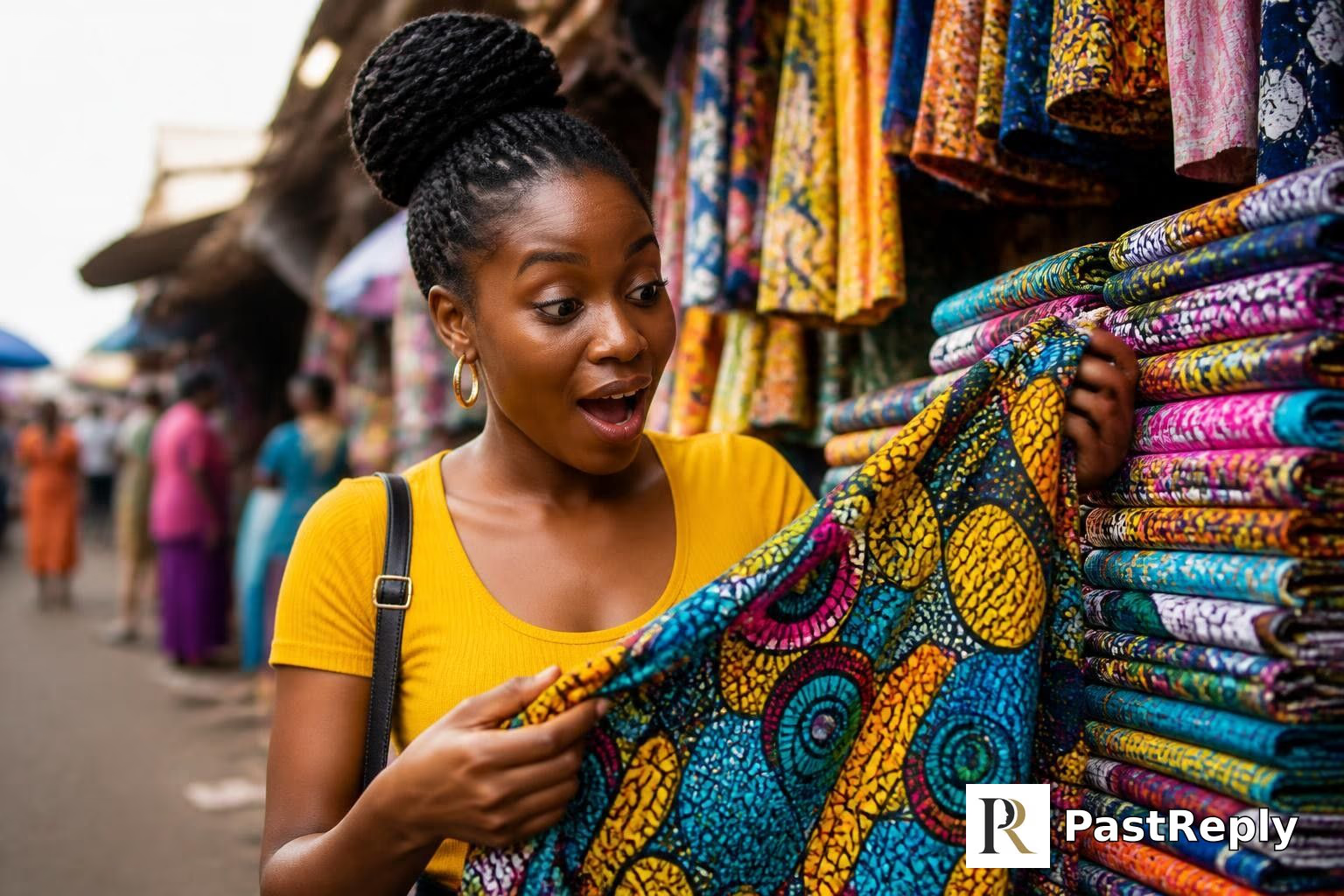
Balogun Market is a large open-air market located on Lagos Island in Lagos, Nigeria. It is known for being one of the busiest and most popular markets in the city, offering a wide variety of goods. The market is particularly famous for its extensive selection of fabrics, including colorful Ankara and lace materials, as well as clothing, shoes, and accessories. Many traders and shoppers from across West Africa visit Balogun Market to buy textiles in bulk.
In addition to textiles, the market sells household items, electronics, cosmetics, and foodstuffs. Its narrow lanes are densely packed with stalls and street vendors, creating a vibrant and chaotic shopping atmosphere. Balogun Market is a key hub for commerce in Lagos and plays a significant role in the local economy, attracting both retail customers and wholesalers.
Answered by 100 of history's most famous minds

You speak of a place where cloth is piled like the harvest of a rich man's field, where voices haggle over the price of a garment while the seller's children go hungry beneath the counter. I tell you: the widow's mite cast into the treasury of heaven outweighs all the fine linen in that market. What is a man profited if he gains the whole world's fabric but loses his own soul - or worse, if he gains it by trampling the poor who wove it?

I hear of a market where cloth and goods are bought and sold, where voices rise in trade. Let the believer remember that the scales in the marketplace are weighed by the All-Seeing, and every yard of fabric sold is a trust from God. Woe to those who cheat in measure or hoard what others need! Trade is lawful - Allah permits it - but let honesty be your fabric and mercy your coin. For on the Day when every secret is made plain, neither fine lace nor gold will avail; only a just heart and a generous hand will find favor with the Most Merciful.

Do you see the attachment in the eyes of the woman who clutches the cloth as if it were her own skin? She craves the pattern, the price, the praise of her neighbor - and from that craving comes the thirst that can never be quenched. The market is a mirror of suffering: a thousand hands grasping at colors that will fade, a thousand voices crying for more. Let their cloth be a reminder: all that is bought will be worn, and all that is worn will become a shroud.

The Lord spoke to Moses, saying: 'You shall not have dishonest measures; you shall not cheat one another in business, for I am the Lord your God, who brought you out of the land of Egypt.' This market, thick with cloth and crowd, is a place where the commandment cries out for justice: a full measure of cloth, a true scale, and no false oaths over the price. The noise of many merchants is like the clamour of the golden calf - every man seeking his own gain, forgetting the covenant. But see here: a widow who sells a single bolt of cotton with honest hands - her stall is holier than a thousand altars. Let the market be a place of righteousness, or let it be swept away like the chaff.

A market is not merely a place for barter but a mirror of the people's virtue. If the lanes are narrow and the shouting loud, then propriety has been neglected. The true wealth of Balogun lies not in the breadth of fabrics but in whether the merchants deal fairly and the buyers treat each other with respect. A well-ordered market, like a well-ordered state, begins with the self-cultivation of each trader. Let them study the ancient rites of honest exchange, and harmony will follow.

Balogun Market is known for its abundance of fine fabrics - linens and dyes that clothe the body. But I tell you, let the trader boast of his wares, for the true garment is not woven by human hands. In that crowded place, as in every market of the world, souls are bartered for silver and pride, yet the one thing needful is not sold. The Apostle saw such markets in Ephesus and Corinth - full of noise, full of idols, full of the hunger that only the bread of life can satisfy.

A place where strangers meet and trade, each one trusting the other's word under the same sky. It is a kind of covenant - the weaver and the buyer, the traveler and the seller - bound not by land but by exchange. I see the promise there: that even in a crowded lane, a man can find his daily bread if he walks in faith.

The market teems like a hundred streams in flood - each stall a eddy, each bargain a ripple. Do not buy the cloth, but learn from the water that slips between the fingers; the true merchandise is the empty space that holds all the noise.

I see no 'Balogun Market' - I see one table spread by the One Lord, where the weaver and the buyer break bread without caste. The dye on the cloth may be red or blue, but under the skin, all are one color. Let the transaction be honest, and a portion of every coin be shared with the hungry - that is the only trade that pleases the True Name.

My heart is with the women who spread their cloths on narrow paths, their babies tied to their backs, their voices rising in barter and laughter. The Lord has filled the hungry with good things - a length of crimson damask, a bag of rice, a child's sandals - and sent the rich away empty if their hearts are hard. This market is a living net of provision: every thread and every copper tells of God's care for the daily bread of the poor.

Let them sell cloth and trinkets as they will - it is the marketplace of daily bread, and no sin in that. But I hear of a trade in ornaments and finery, the very trappings that the bishops of Rome hawk to seduce souls from faith alone. A market is a test of conscience: do we buy to clothe the needy or to puff up the flesh? Let every Christian examine his purchase as before the judgment seat of Christ.

A market is a natural institution, born of the human need to exchange goods for the sustenance of life, and as such it is rooted in the order of creation. Yet the question of what it is 'known for' invites us to consider final cause: such a place serves the common good when transactions are just, when the price is fair, and when both buyer and seller act in charity. If it is known for gaudy display or sharp dealing, it falls short of its true end, which is to supply the body without starving the soul.

God's poorest find their daily bread among those bolts of cloth and piles of shoes. I see the trader with her worn hands, offering a smile with every yard of lace - that is the beautiful thing, not the fabric. Each transaction done with love is a prayer.

I am told this bazaar is dense with bodies and noise, a chaos of goods and bargaining. But beneath that tumult lie orderly laws of supply and demand, of price and quantity, as fixed as the orbits of the planets. The greatest mystery is not the colorful cloth but the invisible geometry of exchange that governs every transaction. Let any man who would understand commerce reduce its motions to ratios and reckonings, as I did the paths of comets.

A bustling market, a chaos of colors and movement - this is a system of immense complexity, yet beneath it lies the same patient order that binds the stars. The dance of a thousand traders and the flow of goods obey principles no less elegant than those of light itself. I would spend a day there, not to buy, but to watch the geometry of human purpose unfold.

I would study this market as I studied the finches of the Galapagos - a dense thicket of variation and competition. The bolts of Ankara, with their vibrant patterns, are like the plumage of birds, shaped by the selective taste of customers. The cleverest traders, who adapt their wares and their haggling to the changing season, will thrive and breed more trade; the rigid ones will dwindle. Here, in this noisy warren, I see evolution's engine at work among men and cloth.

Let us examine this 'Balogun Market' with the senses and reason. What do we observe? A great many stalls, all selling essentially the same thing - cloth, cloth, and more cloth. Yet the prices vary, the quality varies, and the crowd moves in patterns that seem random but must follow some law of supply and demand. If I could measure the flow of buyers, the turnover of goods, the relationship between lane width and congestion, I could reduce it to a mathematical principle. But I am told it is 'chaotic' - that is simply an appeal to ignorance. The chaos is only complexity we have not yet measured. Give me a compass, a counting-board, and a few days, and I will show you the geometry of that market.

I have spent my life contemplating the revolutions of the spheres, yet I find a parallel here: the market revolves not around a single center but around a thousand stalls, each a little sun attracting its own orbit of buyers. Yet to understand its true motion, one must look beyond appearances - the chaotic swirl may conceal a simpler, harmonious order. Just as the planets circle the Sun, so the true heart of Balogun is the steady rhythm of trade, not the seeming disorder of its lanes.

Balogun Market is a chaotic bazaar, but imagine its energy harnessed - every stall a dynamo of human activity. The fabrics there, the bright patterns, could be woven with conductive threads to power a grid. I see a vision: the market's rooftops covered with resonant coils, transmitting energy wirelessly to every phone and lamp in Lagos. The traders know nothing of this, but the potential is immense. Such a place, teeming with life and purpose, is a field for invention.

The true curiosity is not the cloth itself, but the unseen - the organic molecules that give the dye its fastness, the metallic threads that catch the light, the mineral salts that fix the colors. A market is a laboratory of materials: we might analyze the fading of Ankara under sunlight, or the tensile strength of lace. But most pass by without asking why.

I would take a sample of those vibrant dyes from the Balogun stalls and culture them in my laboratory. The same woven colors may harbor invisible spores that turn a spool into a vector of pestilence. The marketplace is a petri dish of commerce and contagion - let us inoculate the bolt before it is draped on the shoulder.

Temples of profit, piled high with every color under the sun - and still they light the stalls with kerosene lamps? I'd wire that market in a week with cheap electric bulbs and a dynamo. Make the night as bright as the day, and double the hours of haggling. That's the real invention: not the cloth, but the time to sell it.

We have here an economically efficient distributed system for matching supply and demand, operating without central planning - a primitive but robust emergent algorithm. The physical layout is a constrained optimization problem: narrow lanes force high-density packing, which maximizes transactions per square meter but collapses throughput to a slow, chaotic crawl. With proper queuing theory and a bit of mechanical logic, one could design a far more rational layout - though I suppose the human element would rebel against any such tidy solution.

Consider the geometry of this place: a grid of narrow streets, each stall a lever for trade, the whole a machine for moving goods - but without a fulcrum. The density of bodies and bales creates a chaos that baffles simple arithmetic. I should like to measure the ratio of shouts to transactions; a well-oiled screw presses with greater force than a thousand voices. Given a long enough lever and a steady hand, one might organize even this swarm into a sphere of perfect order.

Observe the throngs pressing through those narrow lanes, each person a tiny needle in a great magnetic field of commerce. The flow of cotton and silk from stall to stall is like the current in a wire: invisible, relentless, governed by a law as sure as Ohm's. What a demonstration of the Lord's order, hidden in what seems mere chaos.

Beneath that clamorous surface, the market gratifies a primal urge: the compulsion to acquire, to possess what the other has, a fixation rooted in the nursery. The shopper clutching Ankara is not choosing a pattern but a skin - a new identity to cloak the unadorned self.

That market thrives on the exchange of photons reflected from colorful fabrics, a tiny economy powered by the same stars that forged the carbon in those cloths. But the real marvel is that those narrow aisles contain more life and complexity than a galaxy of gas. They remind us how improbable and precious our planet's bazaar of human minds truly is.

Consider the weaver's pattern: it is a finite set of rules repeated to create infinite variation - like the punched cards of Jacquard's loom, which I once described as weaving algebraic patterns. That market is a vast, living demonstration of how simple operations, when ordered and combined, produce the most complex and beautiful results.

Let a man define 'market' as a place of voluntary exchange, and 'known' as that which is perceived by the senses. From these premises, no theorem of consequence follows. The market is a multitude of transactions, each a particular, not a universal; geometry does not stoop to count the grains of sand.

I have studied the returns from such bazaars in Calcutta and the Crimea; the filth and crowding breed disease as surely as a stagnant pond breeds miasma. The first necessity is a clean water standpipe and a system for removing offal - without that, all the bright fabric in the world will not prevent a fever epidemic. Show me the mortality figures, and I will show you where reform must begin.

A market of cloth and trinkets? Ha! I conquered Tyre for less. If I had marched my phalanxes into Lagos, I would not haggle over Ankara - I would take the whole bazaar as my quartermaster's store and drape my army in those bright fabrics, then press on to the ends of the earth. But these traders, wrangling over a few coins? They lack vision. A market should be the engine of an empire, not the nest of a petty merchant.

A market crowded with fabrics from a hundred looms - this is no mere bazaar but a battlefield where commerce decides the fortune of cities. I would send my agents to count the stalls and gauge the wealth, for he who controls the flow of cloth can clothe an army or bribe a senate. Lagos is a province worth the taking.

A market crammed with cloth and trinkets? In Alexandria, the Royal Harbour itself is a market of silks from Seres and spices from Punt - but that is statecraft. A place where every lane is a bazaar of colourful wrappers and cheap mirrors tells me one thing: a hundred petty traders all scraping for the same copper, with no single hand to tax or command them. That is not a market; that is a swarm. A clever queen would build a royal warehouser, buy the whole season's cloth at a stroke, and sell it back to the traders at a fixed profit - thus she turns their chaos into her treasury.

I see a place that cries out for aediles and a proper system of weights and measures. Such a market - sprawling, noisy, full of traders from every province - is a source of both wealth and disorder. In Rome, we would have divided it by trade: the cloth sellers in one portico, the shoemakers in another, and the foodstuff vendors in a third, with a temple of Mercury overseeing the whole. The chaos you describe is the original state of things, before the laws of Augustus brought peace and prosperity. Let them appoint a market-master, let them pave the lanes, let them tax the goods fairly, and that swarm of bees will produce honey for the whole region. Without order, it is only a barbarian camp.

A market that draws traders from across the land is a sign of strength - it means the roads are safe, the merchants trust my laws, and the goods flow like the rivers of the steppe. I have seen such bazaars from Samarkand to Beijing. What matters is not the color of the cloth but the order that lets men trade without fear. If those narrow lanes breed chaos, then widen them - a khan's rule is wasted on a marketplace that chokes on its own riches. Let it be a market worthy of the empire.

Balogun Market is a stronghold of commerce, and commerce is the sinew of empire. They tell me it is crowded with sellers of cloth and trinkets - chaos, yes, but chaos that yields treasure. I would have it organized: wide avenues, fixed prices, a tax register. A market that operates by whim cannot feed an army or supply a state. If I were Emperor of Lagos, I would make Balogun a model of efficiency, where every bolt of lace is accounted for, and every merchant knows his duty to the public good.

I have seen the value of a free market when men trade in peace, and such a bazaar is a testament to industry and self-order. Yet let us not forget that commerce, like liberty, requires virtue - the honest weight, the fair price, the respect for contract. If Balogun thrives without a tyrant's hand, it shows what free men can build when they govern their own dealings.

When our nation was young, we traded in cotton that bound men in chains. I hear Balogun Market trades in bright cloth that frees the spirit - a yard of Ankara may not heal a hundred years of sorrow, but it is a fairer commerce than what my grandsons knew, and I am glad for it.

Here in this teeming bazaar, the spirit of free enterprise is not a theory but a noise, a smell, a jostling shoulder. They do not ask for permission to trade - they spread their wares on the ground and defy the world to stop them. That is the very stuff of liberty, woven into every strip of cloth.

I have heard of this vast bazaar where multitudes jostle for cloth and trinkets, yet I ask: does it uplift the poorest weaver in her hut, or does it merely swirl coin from hand to hand without touching the soul? A true market is not a pile of wares but a trust between brothers and sisters. If it feeds vanity or greed, it becomes a snare. Let it rather be a place where every transaction is an act of service, and the humblest trader is treated as a guest of God.

I see more than a marketplace of colorful cloth and bustling lanes - I see an economy of dignity, where women who have been told they are nothing barter and build and sustain their families. This is the grassroots body of trade that feeds and clothes a city, yet it operates often outside the formal systems that benefit the powerful. The fabric sold here is not merely Ankara but the woven evidence of a people's resilience. The day will come when such markets are honored as the beating heart of a just society.

Where cloth is traded, lives are woven together. In that market's vibrant chaos, I see the same spirit of resilience and enterprise that built our townships under the shadow of oppression. May its lanes one day be pathways not just for goods, but for the meeting of neighbors who once were strangers.

A squalid Babel of petty commerce, where a mongrel people haggle over trinkets. Such congested alleys breed degeneracy; the strong, orderly peoples build clean halls of industry. This market is a symptom - a village of the rootless, peddling goods with no nation, no blood.

A market? It is the haunt of petty speculators and hoarders, where the plan is ignored for private gain. One does not build socialism with merchant chaos; one builds with steel mills and tractor stations, where every bolt of cloth is counted and distributed by state decree.

That market is a holdover from feudalism: scattered, inefficient, ruled by the haggling of small shopkeepers. The true task is to smash this petty-bourgeois anarchy and replace it with centralized warehouses and state distribution, so goods serve the proletariat, not the profiteer.

This market is nothing but a nest of petty traders haggling over scraps of cloth while the people hunger for true revolution! Let them grasp the silk of ideology, not the lace of commerce. A marketplace run by merchants without class consciousness is a swamp of exploitation - drain it, and plant the flag of collective struggle!

A market of such bustling industry and color reflects the thriving commerce of our Empire, and I am pleased to hear of the fine textiles traded there. It reminds one of the great exhibitions we have held in London, where the world's produce is displayed under one roof. Yet I trust the traders conduct themselves with order and decency, for a British subject must always uphold propriety, even in the most crowded of lanes.

I have always been struck by the vitality of markets where people gather to exchange goods and stories. It is a reminder of the enterprising spirit that builds communities and connects us across regions. I wish all who trade there continued success and safety.

Such a market, teeming with merchants and goods from many lands, is a sign of prosperous order under just governance. But I would insist that the weights be honest, the prices fair, and the contracts sealed before a priest or a count. A kingdom united by trade must be bound by law, else the weaver will cheat the dyer and the dyer will cheat the king's treasury.

I know nothing of cloth and lace - my banner was of white, fringed with silk, given me by my voices. Yet I say this: a market where people trade in peace is better than a battlefield soaked in blood. If the merchants there deal honestly and do not cheat the poor, then God's blessing is upon them. But if they steal or lie, let them fear the King's justice and the Lord's wrath.

A market is a mirror of the realm: if it buzzes with color and coin, the kingdom prospers; if it languishes, we have cause for concern. I am told this Balogun teems with fine African cloth - good, for trade opens windows of friendship between nations. Let them trade freely, but let my customs officers keep a sharp eye on the balance, for a queen's treasury is not filled by idle dreaming.

Such a bazaar, with its kaleidoscope of fabrics and the hum of a thousand tongues, is the true pulse of commerce. I have read in the reports of my envoys that Lagos Island is a gateway to the interior - rich in palm oil, ivory, and now these vibrant cloths. An enlightened sovereign knows that a flourishing market means a contented people, and a contented people means a stable crown. Long may it thrive, under orderly regulation.

A market where many peoples gather to trade in peace is a temple of good governance. I built Pasargadae on the principle that each nation under my rule may worship its own gods and keep its own customs, so long as it pays its due and keeps the peace. If this Balogun brings together Yoruba and Hausa, Berber and Tuareg, and all trade honestly, then the King of Kings smiles upon it.

I have walked through the suqs of Damascus and Cairo, where silk from China and spices from India change hands under the shade of awnings. Such a market is the lifeblood of a city, and I hear this Balogun overflows with fine fabrics that clothe both rich and poor. Yet let the merchants remember that charity is a pillar of faith - let them give a portion of their profit to the orphan and the widow, and Allah will bless their scales.

Tell me, friend: what is it you truly seek in that crowded lane of cloth and trinkets? You name it fabrics, shoes, the noise of commerce - but I suspect you search for something more, something you cannot name. Does the finest Ankara clothe a soul? Does a bargain bring wisdom? Let us not rush to answer. Instead, ask yourself: what is the 'good' life, and can this market sell it? I suspect you know the answer already, and that is why you keep shopping.

We see only the gaudy bolts of cloth, the jostling bodies, the din of haggling - but what is the Form of this market? It is the idea of exchange itself, the perfect harmony of need and supply, which these noisy shadows approximate so imperfectly. The wise merchant does not merely sell; he seeks the eternal pattern of just dealing, which alone gives order to the transient crowd.

Such a place is a living example of 'oligopoly' in miniature - many sellers of the same kinds of goods, chiefly textiles, competing in narrow lanes. Observe the purpose: a market exists for exchange, fulfilling the natural human need for mutual benefit. The abundance of fabrics signals that this is a primary node for distribution, where wholesale and retail blur. The chaos you describe is merely the absence of formal arrangement; a well-governed polis would set aside a proper agora, wide and orderly, with guilds to regulate weights and qualities. Still, the economic activity is real - this is the body's metabolism, however disordered.

One must ask: if every rational being in Lagos acted according to the maxim of buying and selling in such a dense, chaotic bazaar, would such a practice be universalizable? The moral worth of this market lies not in the volume of Ankara sold but in whether each transaction treats buyer and seller as ends in themselves, never merely as means to profit. A truly enlightened commerce would require orderly rules that any rational trader could will as law, not this frantic jostling through narrow lanes.

You ask what it is 'known for' - as if a thousand stalls stuffed with gaudy cloth could have a single name. The market is a monument to the herd's need for comfort: bright colors to distract, cheap goods to fill the void. Every transaction there is a small death of the spirit, a surrender to the petty arithmetic of buying and selling. Real greatness - the will to power - is not found in a bolt of lace but in the rare soul who strides through that chaos and laughs, affirming it all as his own.

Balogun Market is a spectacle of commodity fetishism, a temple where the labor of thousands is transformed into a carnival of cloth and trinkets. The colorful Ankara and lace that draw buyers from across West Africa are the products of exploitation - the hands that wove them, the bodies that hauled them, all invisible behind the bright display. The market's chaos is the surface of a deeper contradiction: the petty trader scrabbles for a crust while the wholesaler accumulates the surplus. Until the workers seize the means of production, this market will remain a theater of inequality.

I must doubt whether 'market' is a clear and distinct idea. It is a tumult of sensations - colors, shouts, odors - but can we know with certainty what it is? Reduce it: a place of exchange, but exchange of what? Of goods, but also of value, of trust, of information. Yet the senses deceive; perhaps Balogun is best understood as a system of rational contracts realized in physical space.

A wise prince would station a tax collector at every entrance to that market. The noise and jostle conceal a river of commerce flowing through the realm, and he who controls the right to sell gains the loyalty of a thousand merchants. The bales of lace are the sinews of the state - do not mistake a market for a fair; it is a fortress of trade.

All the world's a stage, and Balogun Market is a crowded scene indeed - a very theatre of stripes and patterns, where every stall is a booth and every buyer an actor in a comedy of bargains. What a spectacle: the merchant cries up his lace as Caesar's toga, the woman inspects a print as if reading a prophecy, and the hawker's voice rises above the din like a herald at a joust. Yet beneath this lively masque, we see the selfsame hunger for beauty and trade that has driven men since they first swapped a shell for a spear. The market mirrors the world: full of color, full of noise, and never quite what it seems.

There, where the sun beats on a thousand rooftops like the shields of an army, the women spread their wares like the robe of a goddess. I heard the chant of sellers like the cries of heralds before Troy, and in that noise I felt the same fierce fire that drives men to seek glory or a handful of coins for their hearth. Even the hero must bow to the trader who holds the thread of his cloak.

I see a great, writhing circle of souls, each draped in bright cloths like the gaudy vestments of the damned - but here the sin is not fraud, but the chaos of a thousand threads tangled by greed. At the centre sits a merchant-prince, counting his bolts of Ankara as a usurer counts coin, while the poor shove for scraps of lace. Yet even in this cacophony, a seam of redemption runs: the humblest vendor, who sells her few yards of cotton with honest weight, may yet find her way up the Mount of Purgation. The market is a mirror of the soul's commerce: what do you buy, and at what cost to your neighbour's soul?

What a splendid chaos! The narrow lanes teem with life, a whirl of color and commotion - here the flash of gold-threaded lace, there the deep indigo of indigo-dyed cotton. This is no mere stall of wares but a living tapestry of human striving, where the merchant's patient craft meets the buyer's discerning eye. One must embrace such a place as the soul of a city, ever surging, ever renewing itself, like the pulse of the great ocean on the island's shore.

What is Balogun Market known for? Why, it is known for the very thing that moves all commerce - the promise of a bargain and the risk of being swindled! I imagine its narrow lanes, crammed with bolts of fabric and shouting merchants, are a perfect stage for the human comedy: here a woman haggles over lace as if her honor depended on it, there a man buys a mirror that will surely show him a duke when he is but a clerk. It is a place where reality and desire dance a pavane, and every buyer is a knight errant tilting at the price of silk.

Balogun Market is famous for its fabrics, but what is fabric but the covering of our vanity? I see a thousand transactions - women bargaining for lace, men weighing coins for a fine shirt - and I ask: is this what life is for? The market is a whirlpool of desire, pulling people from the quiet of their souls into the frenzy of owning. Yet among the vendors and buyers, I know there are hearts seeking not just cloth but meaning, not just profit but love. The truest trade in Balogun is the one no one sees: the search for goodness amid the noise.

Balogun is not fabrics and trinkets - it is the human soul in its raw, convulsive state. Every stall is a cry: the vendor's desperate grin, the thief's darting eye, the mother's exhausted thread. Here, in the crush and stink, you see both the beauty and the beast in man - the greed that clings and the generosity that gives away the last kobo. This is where salvation is tested, not in a church.

One must wonder whether the lady who spends an hour haggling over a length of lace at Balogun possesses more sense than the fine miss who orders her gowns from a London modiste without knowing the price of a yard. The market is a school of economy, and its pupils learn the value of a good bargain - a lesson many a titled fortune has neglected.

I see it as a sprawling, teeming labyrinth of stalls and cries and elbows, much like the Clennam warehouse or the streets of Seven Dials - only under a furious sun. A place where a poor seamstress might haggle for a scrap of Ankara while a wealthy trader counts bales of lace; it is commerce stripped of pretense, honest in its chaos, and altogether more alive than a Parliament of stuffed shirts. One might find ten thousand stories in such a warren, and not a few crimes, but also the raw, sweating heart of a city that refuses to be ignored.

A market that sells fabric by the mile and noise by the acre, and where a man can buy a pair of shoes that will fall apart before he reaches the next stall. I've seen a few such bazaars in my time - they look like a riot that decided to do some shopping. But I suppose it's honest: nobody pretends he's in a cathedral. You want lace? They've got lace. You want peace and quiet? You came to the wrong continent.

It is a place of heat and noise and people who know how to work. The stalls are stacked with bright cloth, the lanes are tight, and the women do not waste time on pleasantries. You haggle, you buy, you move. There is nothing romantic about it - it is honest labor under a hard sun. A man can find what he needs there, or he can get out of the way.

I have studied the flight of birds and the flow of water, and now you ask me of a market where cloth is sold. I would observe the way the narrow lanes channel the crowd like a river, the stalls jutting out like rocks that force the current to swirl. The fabrics themselves - their colors, their weave - are a lesson in light and shadow, in the mathematics of pattern. I would sketch the merchants' faces, the drape of the textiles, the geometry of the awnings. There is as much to learn in that human tide as in any anatomy: the mechanics of commerce, the optics of indigo, the hydraulics of a bargain. A market is nature in miniature.

I would walk those narrow lanes and see, amid the tangle of cloth and trinket, the living form of a woman who carries the grace of Eve - the drape of her wrap, the fall of a shawl, these are the lines that the sculptor carves from marble. Every stall is a workshop, every bolt of Ankara a block of stone waiting to be freed into a garment that clings like the flesh of a saint. The divine is not hidden in a church; it is woven into the cloth of this market.

Oh, I would set up my easel at the mouth of one of those narrow, sun-crammed lanes! The colours - the deep indigos and fiery oranges of the Ankara, the gleam of brass and glass, the dark faces of the women bent over their bolts, their hands moving quick as swallows - I would paint it all with thick, slashing strokes, the whole canvas a riot of yellow and violet and blue, the heat rising off the dust, the crowd a single breathing thing. Not as a still life, but a portrait of life itself, desperate and glorious, each scrap of cloth a cry against the dark. They would say it was too violent, too ugly. But what is more beautiful than a woman's hand reaching for the one perfect fabric that will make her feel like a queen for an hour?

Fabrics? Ha! You ask what it is known for - I say it is known for chaos, for the violent collision of patterns, for colors that scream at each other in the narrow alleys. That is where true art lives, not in some quiet gallery but in the jostle of bodies and the explosion of Ankara. The market is a Cubist painting: you see a shoe, a plate, a bolt of cloth, all at once, from every angle. That is reality - not a single line, but a thousand fragments making a whole.

Balogun Market is a symphony of color and light! I imagine the sun filtering through awnings of red and yellow, striking the folds of Ankara fabric - indigo, emerald, gold - like brushstrokes on a canvas. The air is thick with dust and the shimmer of heat, and the crowd itself becomes a river of moving shadows and highlights. I would set up my easel there at dawn, before the chaos, when the stalls open and the first rays catch the lace like morning dew on a spider's web, and paint the same corner every hour to catch its fleeting soul.

The glory is not in the bolts of Ankara stacked high, but in the hands that smooth each fold, the eyes that judge a color, the back bent under the bundle. I see a thousand portraits there - the merchant's shrewd squint, the bride's hopeful clutch of lace, the old woman's patience. That is the real trade: light falling on a worn face, and the dignity of a life lived among the clamor.

The market is a wound that bleeds color. I see my own blood in the red of the lace, my bones in the white of the cotton, my braids in the black of the thread. Every cloth is a dress I might paint, every vendor a self-portrait - a face that refuses to disappear. They sell beauty, but they also sell the pain of carrying it through the dust and noise. I would paint that.

An open-air market of fabrics? It sounds like a symphony of colors - a fortissimo of Ankara and lace! I imagine the noise of haggling as a lively ensemble, a street-scale opera buffa where every vendor sings his own aria of 'Too much!' and every buyer responds with a descending scale of 'Too little!' I would set it to music: the rustle of cloth as the string section, the clatter of coins as the percussion, and the laughter rising like a woodwind trill. Bravo, Balogun! You are a composition without a conductor - and perhaps all the more beautiful for it.

What a symphony of chaos and color! The roar of the crowd, the clatter of trade, the shriek of a bargain - these are not noise but the raw notes of a people asserting their life against the silence of poverty. I would set this market to music, a furious scherzo of drums and strings that captures the hunger and the hope of every soul who weaves a living from a bolt of cloth. Hear it: the triumph of the human will over every sterile ledger!

A market where a thousand voices call out different prices, different wares, is like a choir without a Cantor - no common time, no bass line to hold the harmony. The fabrics are the notes, but the counterpoint is missing. If such a place were to be ordered, a single steady pulse - the regulation of the day's bell, the guild's strict measures - would bring forth a fugue of commerce, each part distinct yet woven into a whole, a 'Gloria in excelsis' of honest trade. As it is, the noise is only sound, not music. But the raw material - the cloth of many colours - that is God's gift: let the tailors and the merchants learn to cut it in righteousness.

Well, thank you very much. I hear it's the place for fabrics - a whole world of color, patterns that just make you want to move. Down in Memphis we had Beale Street, but that market sounds like a rhythm all its own, folks haggling and laughing and the air thick with life. I'd love to walk those lanes, see all that lace and Ankara, maybe find something for a new jumpsuit. It's the heart of the city, that market - you can feel it.

Balogun Market is like a dance, a rhythm of people moving through color and sound. I think of the fabrics - the bright Ankara patterns - like a song that wraps around you, the way a melody can lift your spirit. Even in the chaos, there is a heartbeat, a pulse of life that connects everyone. I would love to walk through there and feel the energy, the creativity, the love in every stitch and every smile. It's a place where art and life meet, and that is beautiful.

It sounds like the whole world's jumble sale, but better - where every stall is a different song. You got the drumbeat of a tailor's needle, the bassline of a vendor's cry, all the colors of Sgt. Pepper's band. Fabrics, yes, but it's the rhythm of people trading, laughing, haggling - that's the real hit. I'd write a tune just from the noise.

You can find every color the sun ever dreamed, wrapped in bolts and bales, but the real thing the market sells is the noise - a song a thousand vendors sing at once, and you're just another verse in it.

That market is the beating heart of a story - every vendor is writing their own verse, and the fabric they sell holds the colors of a thousand memories. I'd walk those narrow lanes and listen, because every bolt of Ankara is a playlist waiting to be discovered.

This market - so far from the courts of Europe, yet so full of goods and souls - reminds me of the bustling ports I sought on the shores of Asia, where silks and spices await the bold navigator. I see in these narrow lanes a sign of the great commerce yet to be unlocked: the fabrics of Africa could clothe the world, if only brave men were to chart the seas and carry God's banner alongside their cargo. Let us not haggle over a yard of cloth; let us dream of fleets that will carry such riches to every corner of Christendom. There is gold in this market, but greater gold lies beyond the horizon.

I saw a market that might humble the grandest bazaar of Quinsay or Tabriz - a maze of alleys piled high with cottons from the Indies and silks that shone like the scales of a dragon. The women there had dyed their cloth with the root of a plant that stains the fingers blue, and old men sat on mats, haggling over the price of spices from lands I once called Cathay. A traveler could spend a month here and still find new wonders behind every crooked stall.

A market packed with every textile a man might need? That is a single port on a single coast. But beyond the horizon, beyond the Gulf of Guinea, there are islands where cinnamon grows wild, and the silk of the Indies is traded for a handful of nails. I would sail not to buy cloth, but to find the route that brings that cloth to every market in the world. A chaos of stalls and shouting is no challenge compared to a mutinous crew in the Strait of Magellan. Show me the harbour, point me to the wind, and I will show them a market that stretches from Seville to the Moluccas.

From the perspective of the Moon, Lagos is a pinprick of light on a dark continent of water and land - yet that pinprick contains a market of extraordinary complexity. The market's fame rests on its sheer density of trade: tens of thousands of transactions per day, a logistical hub that moves goods from West Africa to the world. It is a human achievement of coordination, no less remarkable than launching a rocket, requiring the same discipline from its traders to keep the chaos from overwhelming order.

Balogun Market is a navigator's dream and a navigator's nightmare - a sea of stalls and lanes where you must chart your own course or be lost. They say it is famous for fabrics, the kind that can dress a queen or a rebel, and that is no small thing. But what I admire is the spirit of the traders, women and men who launch their little enterprises every morning, braving the current of commerce. It is a place where courage is traded as surely as lace.

From up there, the market would be just a blur of color - a patch of a million lives woven together. Down on Earth, I know that buzz, that human warmth, the push and pull of daily bread. It reminds me that no matter how high we fly, it's the people trading, sewing, dreaming in places like Balogun that make a home worth seeing from space.

Balogun Market is raw energy - a thousand small entrepreneurs, each with a stall and a vision. But I look at that chaos and I see a problem waiting for a solution: no curation, no design, no simplicity. Imagine if someone with taste and a clear eye edited that sprawl down to a single, beautiful store that sold not just fabric but an experience of color and texture. These vendors are artisans without a product line. They need to think different: stop selling cloth, start selling what the cloth can become. The market is alive, but it could be a masterpiece.

From a first-principles view, this market is a remarkably efficient distribution network built entirely on human-scale logistics - no robots, no AI routing, just thousands of people moving textiles in real time. To scale that to Mars, you'd need to replace the chaos with a self-organizing swarm of autonomous vehicles, but the raw demand signal is honest. If I were young again, I'd start a business here, using satellites to track every bolt of lace and optimize the flow. The market's energy is real; now it needs a neural net.

You know, when I hear 'Balogun Market,' I don't think of chaos - I think of energy. That place is a living, breathing testament to the hustle and the heart of the Nigerian people. Every woman selling Ankara, every man stacking electronics, they are not just selling goods - they are selling a dream for their families. I see a classroom of entrepreneurship, where the greatest lesson is 'keep showing up.' Those narrow lanes? They teach you to navigate life's obstacles. And the brightest fabrics? They are a reminder that even in the mess, you can find color, you can find beauty, you can find your own unique pattern. That market is not just about commerce; it is about community, resilience, and the power of believing you can build something from nothing.

Balogun Market? They say it's the greatest show in Lagos - fabrics, lace, colors so bright they'd make a peacock jealous. I'm the greatest, and I know greatness when I see it. That market is like a champion in the ring: it takes on all challengers, from every corner of Africa, and never backs down. But let me tell you something: the real fabric they sell is not Ankara - it's hustle, it's pride, it's the spirit of a people who refuse to be counted out. Float like a butterfly, sting like a bee - that market stings with life.

Balogun Market is like a football match in the final minutes - full of energy, shouting, and everyone moving with purpose. The fabrics there are as vibrant as a crowd in a stadium, and the traders pass goods like a team passes the ball. I remember when I visited Lagos, they gave me a shirt of such bright colors, it made me smile. That market is the heart of the city, beating with the joy of trade and the warmth of people. It is the beautiful game of commerce!

Imagine a place where every alley is a story, every stall a scene, and the fabric is the costume for a thousand different dreams. That market has more drama and comedy in one afternoon than some movies have in two hours. If I could bottle that chaos and color - the laughter, the barter, the surprise of finding just what you need - I'd build a ride around it.