
What has Mitch McConnell done for Kentucky?
Mitch McConnell has delivered billions in federal funding to Kentucky for infrastructure, military bases, and industry support, while championing conservative judicial appointments.
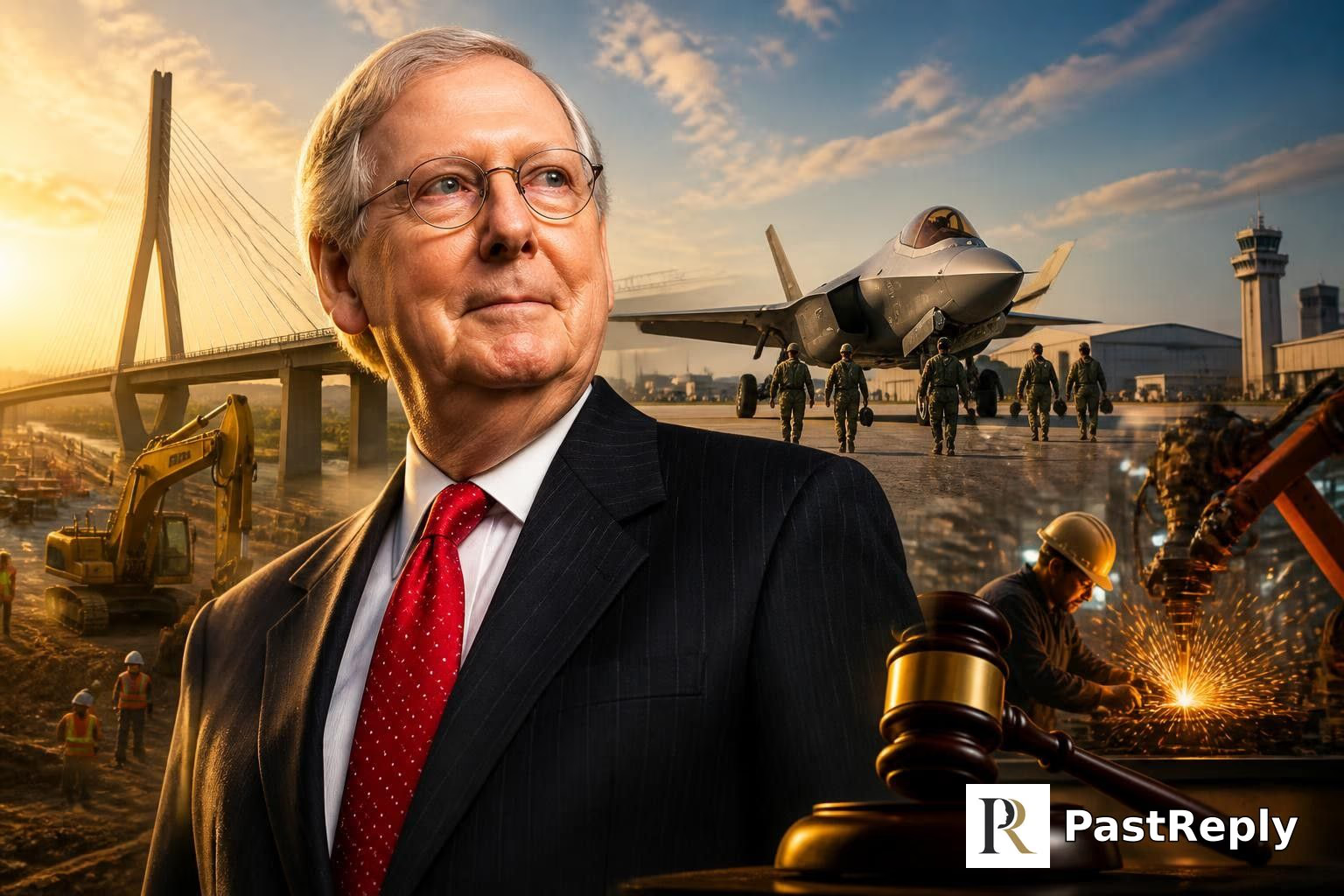
The facts
Mitch McConnell, as Kentucky's longest-serving U.S. Senator, has directed substantial federal funding to the state through his influential roles, including Senate Majority Leader. He has secured billions for infrastructure, such as the Brent Spence Bridge project, and for military installations like Fort Campbell and Fort Knox. His efforts have also supported flood control, rural development, and the cleanup of the Paducah Gaseous Diffusion Plant.
McConnell has championed Kentucky's key industries, notably coal and tobacco, by opposing environmental regulations and securing buyouts for tobacco farmers. He played a pivotal role in the federal hemp legalization pilot program, benefiting Kentucky's agricultural sector. Additionally, he has supported the state's bourbon industry and automotive manufacturing plants.
Through his long tenure on the Appropriations Committee, McConnell has steered federal grants to Kentucky universities for research and has been a steadfast conservative voice on judicial appointments, including the confirmation of Supreme Court justices, which aligns with the state's political leanings. His ability to deliver federal resources has been a hallmark of his representation.
Answered by 100 of history's most famous minds

You ask what a man has done for a land? A man has gathered coins and stones for a bridge, but does he give water to the thirsty at his own gate? A man has shielded the vine of the rich while the laborer's wage is held back. Woe to you when all speak well of you, for so their fathers did to the false prophets. The measure you give will be the measure you get; what does it profit a man to gain a whole region's favor and lose his own soul?

A man has built a bridge and filled a granary - these are good works, and the Merciful loves one who benefits his people. But let him ask: did he weigh the scales with justice for the poor? Did he turn away from the trade that harms the body and the soul? The coal that darkens the sky and the leaf that steals the breath are not blessings from the Lord of the Worlds. A leader will be asked on the Day of Reckoning not how much he gathered, but how he governed with mercy and fairness.

He has gathered much gold from the great river of the treasury, and built walls and roads in his own garden. But I ask: does the water that fills a hundred jars quench the thirst of the one who drinks? The bridge that carries many feet across the stream does not carry them beyond the shore of suffering. He who gives the world's goods but does not give the path to the end of craving is like a man who feeds the hungry but does not show them the way out of the burning house.

Has he remembered the widow, the orphan, and the stranger in the gate? The Lord commands that the leader of a people shall not take bribes nor pervert justice, but shall secure the well-being of the least among them. I see that he has brought stone and silver to his land, but does the law of the Lord shine in his works? Let him give an account of the hungry and the oppressed, not only of the barges and the roads.

The noble person does not seek to fill a basket but to set the basket in its proper place. This man has directed resources to his region as a steward directs water to the fields - that is good governance. Yet let us ask: has he cultivated the moral character of the people? A bridge is useful, but righteousness is indispensable. If he has also upheld ritual propriety and the virtues of loyalty and trustworthiness, then his service is worthy of a minister. If not, his works are but a well that gives water but no wine.

Brothers, you ask of earthly works, of bridges and coins poured into a land. But I tell you, the true foundation is Christ, and no senator can lay another. Yet if this man has used his authority to care for the widowed farmer, the soldier, the orphaned town, then let it be counted as a cup of cold water given in the Lord’s name. But do not confuse the gift with the Giver; all power is from God, and every nation’s treasury is but dust. Seek first the Kingdom - that is the eternal appropriation.

A man who sojourns long in a land not his own, gathering flocks and wells for his people - this I understand. He has brought water to dry ground and strength to the tents of his kin. But the blessing is not in the storehouses alone. It is in the promise that all families of the earth shall be blessed. May he remember the stranger at his gate as well as his own household.

A man who clings to power like a full cup that never empties has already spilled half its worth. The river that runs through the land does not boast of the banks it shaped; it simply flows, and the valley below becomes fertile without a proclamation. The true work of a steward is not to build bridges that stand against the current, but to let the water find its own way, and to know when the bridge is already there.

Bread shared with the hungry is the only bridge that lasts; roads and walls are soon forgotten when the belly is empty. Let him count not the coins sent from the capital, but the mouths fed, the widows comforted, the labor of the lowly honored. The True One does not ask how many years a servant sat on a throne of influence, but whether he remembered that all souls are one, and that the smallest kindness to the least of them is the greatest deed.

My heart magnifies the Lord, who lifts up the lowly and fills the hungry with good things - but I see this man has used his high seat to feed the rich and powerful while the poor cry out for bread. Has he remembered the widow and the orphan in the mountain hollows? Has he healed the sick miner or welcomed the stranger at the border? The Lord scatters the proud in the imagination of their hearts; let this senator humble himself and serve the least of these, for that is the only treasure that lasts.

I have heard that this man has gathered much treasure from the imperial treasury and poured it into his homeland - but what of the Word of God? He has confirmed judges who bow to Caesar's throne rather than to Christ's cross, advancing a kingdom of human law that binds consciences with statutes and precedents. The true service to Kentucky would be to preach the Gospel freely, to free the poor from the yoke of debt and the farmer from the slavery of the tobacco leaf, not to fill the coffers of a state that mocks the liberty of a Christian man.

In considering this question, we must distinguish between the material good and the moral good. That this senator has procured great sums for his province is evident: bridges, military works, and aid to farmers are natural goods, ordered to the preservation of life and the commonweal. Yet we must ask whether these goods were pursued with right intention and by just means - whether the coal and tobacco he has championed are not true goods but poisons to the body and the soul, whether the judges he has confirmed serve the natural law or the arbitrary will of men. A good deed done ill is not wholly good; let us examine the ends as well as the means, for the moral order is not measured in gold but in virtue.

When I think of Kentucky, I think of the hills and the hollows where the poor may live, where a sick child may lie on a cot with no one to hold her hand. If this senator has brought water to dry throats and a clean place for families to sleep, that is good - every crumb of bread, every drop of clean water, is the body of Christ given again. But tell me: did he look into the eyes of one dying woman in the mountains? Did he touch the hand of the man whose coal job was taken? The money is like a bandage, but love is the healing. I ask only if he loved the poorest.

If one examines the flow of resources from the federal treasury to a single state, one must apply the law of equal and opposite reaction: every directed pound draws a countervailing pound from another quarter. The senator's lever has moved coins across the map, but the system's equilibrium is undisturbed. The true question is not what he has done, but by what mechanism he has done it - and whether that mechanism is a law of nature or a mere artifact of human arrangement, which reason might one day improve.

Curious how men measure worth by the weight of stone and coin they drag home to their own hillside. A bridge, a bridge - yes, but the real bridge is the one that spans from a mind's first question to a universe made plain. Does Kentucky breathe easier knowing its senator counted out the bricks, while the law that binds space and time itself goes unasked?

A single creature that holds a dominant position in the political ecosystem for a generation - and like a keystone species, it shapes the whole landscape. The question is whether this long tenure has been like the reef-building coral, creating complexity that shelters many forms, or like the strangling fig, drawing every resource into its own trunk while the forest floor grows bare. One would need to examine the local species - the small farmers, the cotton-growers, the distillers - to see if they have diversified or only grown more dependent on that single provider.

I would ask to see the ledgers of this senator, not the boasts of his proclamation. Has he indeed drawn more gold from the common treasury than his predecessors? Let us measure the miles of road, the tons of steel, the number of scholars fed by his influence - by the numbers, not by the rhetoric. A claim without measure is like a hypothesis without observation: it may please the ear, but it does not satisfy the mind.

Observe how he has worked from a fixed center - the state of Kentucky - and arranged the spheres of federal appropriation in orderly epicycles around it, maintaining harmony with the larger political cosmos. Such a system, though geocentric in its loyalty, has proven remarkably stable. I might note that, like a careful astronomer, he has calculated the motions of committees and budgets to achieve consistent returns. Whether this arrangement is the most elegant or simply the most entrenched is a matter for further observation, but the calculations can hardly be denied.

A bridge! A practical marvel, but how pedestrian. Why connect two shores with stone when the air itself can carry energy and information? This senator has poured billions into coal and wires, yet he ignored the greatest resource: the cosmic energy that surrounds us. I could have given Kentucky wireless power to light every lamp from the Ohio to the Appalachians, free as sunlight. Instead, they have a bridge. How... useful.

He has applied methodical pressure over decades, like radium's slow emission, to extract resources and build structures. The outcome is measurable: bridges, laboratories, military bases. Yet one must ask what knowledge was pursued for its own sake, and what was merely traded for power. I would examine his ledger for the element of pure curiosity.

I should like to examine the soil of such a state - its fertility, its yields, the health of its herds. A senator's claim of bringing billions is like a flask of distilled water poured into a muddy river: the current disperses it, and the bed remains unchanged. The only measure that matters is whether the people of those counties are less sick, more fed, and better sheltered than they were a decade ago. Let me see the records of the physicians, the schools, and the grain silos - then I will tell you what he has done.

Show me the patents, the factories, the jobs that didn't exist before he sat in that chair. I don't care about speeches or bridge ceremonies - I want to know how many men are working, how many kilowatts are flowing, how many new machines are being built. A senator who really delivers doesn't just send a check; he makes the place hum with its own life. If after all those years Kentucky still depends on his handouts, then he's been a good plumber but a lousy engineer - he fixed the leak but never taught them to dig their own well.

Let us define the problem precisely. 'What has McConnell done for Kentucky?' is an ill-posed question unless we specify the state's objective function - is it maximizing aggregate wealth, or some weighted sum of individual utilities? If we model federal funding as an input and economic output as a function of that input, the coefficient might be significant, but we must ask: is the bridge he secured an efficient allocation of resources, or does it merely satisfy a political constraint? Without a formal model and empirical data, we are left with anecdote, which is not computation.

If we consider this matter as a problem in mechanics, we observe that a single man, positioned at the fulcrum of power, has exerted a considerable force upon the lever of federal appropriation, moving a great mass of weight - bridges, military camps, and industrial works - across a distance measured in millions of drachmae. The question is not whether the lever has moved, but whether the load has been placed upon a stable foundation: has the force been applied with geometrical proportion, or has it merely piled stones without measure? Give me a point of leverage and I can move the Earth; but let us first determine whether the Earth wishes to be moved.

A senator, like a wire in a circuit, carries the current from the source to the people. I observe that for half a century this man has been a conduit of federal force - the magnetic influence of his position drawn through the apparatus of committee and majority - and has brought it to ground in his state. The bridge, the forts, the cleanup of that chemical plant - these are the visible iron filings tracing the lines of a sustained field. Whether the power he wielded was for the ultimate good of the whole nation, or only of one pole, is a question for the philosopher; the physicist only notes that the connection held.

A fascinating case of sublimation: a man who, denied the love of a distant father - or so a proper analysis would reveal - spends a lifetime amassing power in a chamber of old men, directing vast sums of tribute back to the soil that first nursed him. Observe the symbolic gratification: the bridge named for a war hero (the senator's own? No, another - and yet he claims its stones as his own), the military bases, the tobacco buyouts - all phallic monuments to potency projected onto a state. The real question is what unspoken bargain he struck with the coal and tobacco barons, who grant him their electoral libido in exchange for draining the federal treasury into their coffers. Kentucky is the patient; the senator is the symptom.

From the perspective of a distant observer - say, on a planet orbiting a star in Andromeda - the question 'What has a senator done for a single state?' is as meaningful as asking what one ant did for its colony in the last leaf-fall. But on our scale, it matters: this ant has dragged billions of leaf-fragments - federal funds - back to his anthill, building a bridge here, a clean-up there. The interesting physics is in the persistence: how a single organism, in a system of 535, can sustain a gravitational pull of that magnitude for half a century. The answer is that he mastered the art of the parliamentary black hole - and Kentucky orbits him.

He has performed a remarkable feat of applied mathematics: the calculation of how to channel infinite federal sequence - money, influence, time - into a finite state, extracting maximum leverage from each position of power. I see a grand algorithm of political physics, where the senator's own longevity is the constant, and every committee chairmanship is a subroutine that runs in his favor. The inputs: billions in bridge funds, base appropriations, hemp pilot projects, tobacco buyouts. The outputs: a state whose infrastructure, agriculture, and military economy are shaped by his persistent function. But what of the poetry? What vision of Kentucky's future beyond these calculations? The algorithm is elegant - but a machine without a purpose is merely a toy.

Let us define our terms. A 'state' is a bounded region; 'done' implies action affecting that region; 'Mitch McConnell' is a particular man who has held a certain office. From the given premises - that he has for many years possessed power over the distribution of federal resources - I deduce that he has relocated a large quantity of those resources to his region. The magnitude is measured in 'billions,' a number that, if represented as a line, would stretch from Louisville to the foundation of the Roman Republic. The conclusion: he has been a causal agent in the construction of a bridge, the maintenance of military installations, and the remediation of a chemical facility. Q.E.D.

I should like to see his ledgers - not the boasts of billions secured, but the columns for infant mortality, for typhoid along the river towns, for the number of hospital beds within thirty miles of a mining camp. A good steward of the people's purse must answer not by the ton of stone laid, but by the drop in fever and the rise of the trained nurse at the bedside. Show me the vital statistics of Kentucky's children, and I will tell you the true value of his service.

A king of such a state? He has fortified his forts and paved his roads, yes - like a careful steward. But where is the ambition? A man who holds the treasury of the world's mightiest empire for thirty years and builds no new city, plants no colony, fuses no peoples under a single law? He has been content to mend the walls of his own village. Had I stood where he stands, I would have turned the whole river of gold toward a new Antioch, a harbor on the western sea, a road to the sunset.

A single man who holds the treasury and the Senate's reins for thirty years - that is not representation, that is a client kingdom. I would have named him legate, granted him a province, and watched whether he enriched the tribes or only himself. The test is simple: do the roads carry grain to the legions, or only taxes back to the quaestor's house?

This Senator has woven himself into the fabric of his land like the threads of a royal diadem, drawing gold from Rome's treasury to line his own kingdom's roads and forts. A wise ruler knows the art of the gift - he gives his people bridges and cleansed waters while binding their hands with the rope of gratitude. I would do the same, but I would also keep the reckoning of every coin, lest they forget who feasts at whose table.

He has done what a prudent prince must do: secure the favor of his people by channeling the wealth of the republic into useful works, binding the province to him with bonds of gratitude and interest. I, too, gave bread and games, roads and aqueducts, and called it the restoration of the Republic. But let him beware - the love of the mob is fickle, and a legacy built on silver alone crumbles when the silver runs dry.

A man who holds power for thirty winters and brings back treasure to his tribe is no fool. He has fattened his pastures with federal gold - bridges for horses, fortresses for soldiers, silver for the farmers who grow the leaf. I value a general who keeps the supply lines open and the warriors paid. But let him beware: if he does not also train the young men to shoot straight and ride hard, the gold will be stolen, and the scribes will write that he was merely a merchant, not a khan.

A man who holds the purse strings of a nation for three decades and returns to his province with bridges and arsenals - that is not a servant, that is a conqueror in a toga. He understood that glory is built on roads and soldiers, on the loyalty of the farmer and the distiller. I would have done the same: take the gold from the center and cast it into the provinces, binding them to the capital. But let him beware - the people remember who fed them, and they will expect a feast forever.

It is a delicate thing to serve one's country by drawing from the common treasury for one's own district. He has done much for Kentucky's roads and forts, but I would caution that such influence, long held, may blur the line between representation and entrenchment. The citizen must ever guard against the love of power wearing the guise of service. A senator's first duty is to the union's fabric, not its threads alone.

Years ago, I learned that a politician's service is not counted in the coins he brings home, but in the bonds he forges between a people and their government. When a man sits in the highest councils for a generation, he ought to have become the voice of every miner, every farmer, every child in the hollows. But I cannot escape the thought that a bridge built with federal gold is still a bridge - and the worth of that span is measured not by its steel, but by whether it carries justice as well as commerce.

A man who holds the helm for forty years in the stormiest of seas must account not only for the ports he has reached, but for the spirit of the crew. He has brought great treasure from the imperial treasury, yes - but has he also brought resolve, a sense that Kentucky is not merely a supplicant at the table of the mighty but a proud commonwealth that shapes its own destiny? The true test is whether, when the next gale of adversity blows, the people he served will stand unbowed, knowing that their foundations were built on more than concrete and federal gold.

I have seen the accounts of this man's works: he has brought many coins into his state, but at what cost to the soul? He has championed the burning of coal that darkens the skies and sickens the earth; he has upheld the leaf of tobacco that enslaves the body and the spirit. True service to a people is not to fill their bellies with poison or their hands with the wages of exploitation, but to help them stand upright in truth and self-reliance. Let him ask himself whether his deeds make his neighbors more free or more enmeshed in chains of dependency on violence.

I have read of the billions sent to Kentucky - the bridges spanning rivers, the jobs at the military posts - and I am reminded that a nation's greatness is measured not by the length of its highways but by the height of its devotion to justice. For while this senator has delivered material goods, he has also delivered laws that entrench poverty, that crush the weak, that poison the air for the sake of coal. True representation is not a pipeline of dollars but a champion of the dispossessed, a voice for the voiceless. I call upon him to use his power to lift the least of these, that Kentucky may become a beloved community.

I learned long ago that the work of building a nation is not done in headlines but in the slow, patient stitching of a torn fabric. From my cell on Robben Island, I could not see the roads or hospitals of Kentucky, but I understand what it means for a leader to bring resources to his people - water pipes, school roofs, the clean-up of poisoned ground. If this senator has done that for half a century, he has served his constituency. But a true leader must also serve the nation's soul: has he helped Kentucky see the humanity in the coal miner and the child breathing the same air the mine fouls? That is the deeper accounting.

A Jewish lackey of the international finance system, this McConnell? No - look closer. He is a provincial ward-heeler, a petty bourgeois horse-trader who fills the bellies of his constituents with their own tax money. He has no vision for the race; he merely bribes a small tribe in the Appalachians with bridges and military contracts to stay in his seat. The true leader sends the young men to conquer living space for the Volk, not to beg for federal crumbs. What has he done? He has strengthened the parasitic federal bureaucracy that bleeds the entire nation. A weak man who thinks in dollars, not blood and soil.

A petty bourgeois parliamentarian who has served for fifty years in a talking shop - and what has he built? A bridge? A clean-up of a factory? The man lacks the iron will to crush his enemies and command the means of production. He has not collectivized a single farm, nor liquidated a single class enemy. Instead, he trades favors with tobacco and coal barons, like a shopkeeper haggling in the market. In a real state, such a man would be shot for serving the interests of the bourgeoisie. Kentucky? He has kept it a captive of capitalist agriculture, not advanced the proletariat one step toward the revolution. Pathetic.

A bourgeois liberal who has perfected the art of adjusting to the status quo. He has not used fifty years of power to smash the state apparatus that grinds the working class; he has merely oiled its gears with federal grants to keep Kentucky quiet. The bridge, the military bases, the hemp program - these are bribes to the labor aristocracy and the kulaks, paid for by the surplus value extracted from the masses. The true revolutionary would have nationalized the coal mines under workers' control, driven out the imperialist military bases, and established a dictatorship of the proletariat in the Appalachians. This man has done nothing but prolong the agony of capitalism.

A servant of the old order, a feudal landlord in senator's robes! He pours silver from the imperial treasury into his fief's bridges and barracks, but only to bind the working masses more tightly to the wheel of capital. The true wealth of a land is not a new road but the awakened fists of its peasants and miners shaking off their chains. His courthouse cunning wins crumbs for Kentucky while the real power - the shape of the courts themselves - he sells to the highest bidder among the factory lords.

A senator of the American realm who has remained steadfast in his duties for so many years is to be commended for his constancy. The prosperity of a great commonwealth depends upon the faithful execution of such offices, and I am told he has brought many worthy projects to his native state. It is a noble thing when a public man devotes his long career to the improvement of his people's roads, their defenses, and their honest trades.

One may observe that a long career in public service, devoted to the interests of a particular region, can yield tangible benefits over time. The improvements to infrastructure and the support for local industries in Kentucky reflect a steady commitment to the welfare of that community. In my own experience, quiet dedication over many years often brings the most lasting results.

A lord who holds his place for forty years and more must prove his worth not by empty words but by the fortifications he raises and the trade he brings his people. I have heard that this senator has strengthened the walls of his land - bridges over great rivers, barracks for his soldiers, and cleanness for his plains. That is the work of a true count; he has built as a builder should, and his people eat from the fields he has watered with silver from the imperial treasury.

He has sat in the great council for many years, and they say he has brought bread and stone to his people - roads and safe places for their men-at-arms. That is good work, as a faithful steward should do. But I would ask him: has he listened to the voices of the poor? Has he stood fast for the truth when the mighty pressed him? For a man may build many bridges, but if he bends the knee to the wrong king, his works are as dust.

Forty years in the Senate, and they say he has fed Kentucky's coffers with federal gold - bridges, barracks, and buyouts for their tobacco men. A deft hand, to play the long game from the chair of power. But I wonder: has he sewn more loyalty with his pursestrings than he has woven with his principles? A prince must fill his people's bellies, yes, but also their hearts - and that is a coin no committee can mint.

A career of forty years in a republic's ruling council, and he has learned the one true art of politics: the art of the possible. He has channeled the stream of imperial funds to his province - roads, armies, the cleansing of a poisoned plain - and has propped up the ancient trades of his people, even as the world changes. That is the work of a seasoned statesman, not a dreamer. A wise ruler knows that a full granary buys more than a fine speech.

I have heard of this senator who sits long in the council and brings the king's silver to his home province. He has built bridges for his people and cleansed their waters, and he has respected their ancient crafts - the leaf and the vine and the black stone. This is the wisdom of a good governor: to win the loyalty of one's own tribe by just provision, while binding them to the greater realm. A satrap who feeds his people and keeps their customs is worth more than a hundred warriors.

A man who serves his people for a generation and brings them the resources of the realm is to be honored for his constancy. He has strengthened his province with roads and defenses, and he has protected the livelihoods of its farmers - the men who till the soil for the leaf and the grain. But let him also remember that a ruler's truest legacy is not in stone and silver, but in the justice he upholds and the mercy he shows to the weak. A full treasury cannot purchase a clean soul.

An admirable tally of bridges and fortifications - but tell me: when this man spoke of justice, did he examine what justice truly is? He has championed a burning rock that darkens the lungs of those who dig it, and a leaf that shortens the lives of those who chew it. Did he ask himself whether the good of a city lies in its wealth or in the souls of its people? I know nothing of Kentucky, but I know this: a man who cannot give an account of virtue has done nothing worth doing.

He speaks of bridges and coins, but I ask: what Form of the Good does this city serve? Does it school its youth in wisdom, or fatten them on comfort? A state that measures its leaders by the gold they haul from the treasury mistakes the shadow for the sun. The true ruler shapes the soul, not the soil.

The true measure of a leader's contribution lies not in the heap of silver he draws from the common chest, but in the ends to which those resources are directed. He has secured bridges and forts - useful things - yet the greater question is whether he has cultivated the virtue and self-governance of his people, without which no amount of external goods can make a city flourish.

The question of what one person has done for a region confuses particular outcomes with universal duty. A representative's moral worth lies not in the pounds of federal coin he hauls to his district, which any merchant could measure, but in the maxim according to which he acts: does he will a law that every legislator should secure bridges for his own province while the general good lies neglected? If his ends are merely local, his service is no more than a well-kept grain ledger, not the act of a rational being legislating for all.

What has he done? He has become the slow worm of American politics, burrowing through the dead soil of the Senate, dragging federal carcasses back to his nest. Kentucky is his herd, and he has kept it docile with the salt of subsidies and the hay of bridges. Do not praise him for feeding his own - every sheepdog does that. The real question is what he has crushed under his belly: every young will that might have dared to think differently, every voice that called for a more dangerous, more vital politics. He has been the great tranquilizer. That is his work.

This senator is the perfect agent of the bourgeois state: he channels the surplus value extracted from Kentucky’s workers back into infrastructure that serves capital - coal, tobacco, bourbon - all industries built on exploited labor. The bridge is not a gift; it is a necessity for the movement of commodities. The military bases? They are garrisons to protect the ruling class’s interests. The real question is not what he gave, but whose chains he tightened while offering a golden link.

Let us doubt the common assumption that the quantity of funds secured equals the quality of representation. I would ask: what is the clear and distinct idea of 'benefit'? A bridge may be built, but does it connect minds? A plant may be cleaned, but is the soil of reason fertilized? I suspect the sum of his achievements, when examined by the light of reason, may be a matter of motion, not of mind.

One must ask: what did he gain for himself, and what for the principality he serves? A prince who holds his seat for forty years does so by distributing favors like grain to hungry soldiers - each barrel of pork is a vote, each road a fortress wall against rivals. The true art is not in bringing treasure to the commonwealth, but in making the towns believe his fortune is theirs. If Kentucky prospers, it is merely the shadow of his own survival cast long upon the land.

He has played the part of the loyal servant to his shire - a Polonius behind the arras, pulling wires and counting coin for the local stage. The bridge stands, the soldiers' camp is fat, the tobacco barns still smoke; all is well on the surface. But what of the ghost in the cellar? The coal that blackens the miner's lung, the leaf that steals the breath - these are the quiet tragedies his well-timed speeches drown. He has been a thrifty steward, but some debts are not written in the treasury's book.

As when a crafty king, lord of many ships, turns the flowing stream into irrigation channels for his own orchards, hauling timber and tribute from a hundred tribes - so this man has channeled the long Roman silver into roads and walls that bear his name. But does the bard sing of his glory in the halls of his people, or only the tally of his bargains? Let the weaving women of the town judge: have their sons been fed, or only counted?

What does a man give his people when he hoards favor for the rich and the strong, and lets the river of gold flow only where the powerful sip? I have seen such stewards in the dark wood - they build monuments to themselves while the widow's roof leaks. A true gift to the homeland is justice, not the stone of a bridge that serves the cart of the merchant and leaves the poor man's foot still muddy.

One might ask what a river does for its banks: it deposits silt, carves new channels, sometimes floods, and through centuries shapes the very valley it flows through. So this senator has been a slow, powerful current - not a flash flood but a persistent force that has deepened Kentucky's bed, bringing federal sediment to its infrastructure, its distilleries, its fields of hemp and tobacco. Whether that shaping is a blessing of fertile soil or a burden of dependency is a question only the next generation's strivings will answer.

So this senator, this knight of the long table in the capital, has tilted at windmills of regulation and brought back not a giant but a bridge - a fine, solid bridge, which is more than my Don ever won. Yet I wonder: does the folk of Kentucky now live in the shade of his favors, or does he merely conjure the illusion of service, like a puppeteer whose strings all lead back to his own hand? The art of ruling, it seems, is to make men believe you fight for their bread while you fatten your own larder.

They measure his deeds in millions of dollars, in roads and beams of steel. But I ask: what is the state of the soul of that land? Has he lifted the burden of the peasant, the widow, the child? A man may bring a mountain of gold to his people, yet if he neglects the one thing needful - love, truth, the quiet duty to serve without pride - his works are but noise. The true legacy is not in the bridge, but in whether the hearts of those he governed grew more just and gentle.

He has fed the bodies of his people with bridges and mills, but what of their souls? I see a man who has bartered in the coin of power, who has bent the Senate's iron rules to his will - and for what? A Kentucky full of asphalt and empty of spirit? He has given them bread, but perhaps stolen the freedom to choose their own hunger. There is a terrible weight in such a gift.

A gentleman of such long standing in the corridors of power must surely have done something for his native county - one hopes it is more than merely securing that the wheels of the capital grind his favoured grist. Yet I confess I am more struck by the question itself: what does it mean for a man to 'do' for a place? He may fill the treasury, but can he mend the hearts of those who feel the cold when the coal fires go out? I suspect the answer, like many a fortune, is written more in ledgers than in souls.

I see a man who has become a veritable Circumlocution Office of pork and privilege, steering the golden stream of federal millions into Kentucky's pockets while the common people of his state - the miners with black lung, the farmers driven from their land - wait in vain for him to notice their wretchedness. He has built bridges of brass but let the human bridges of charity and justice crumble; he is Mr. Gradgrind with a Senate gavel, measuring all value in ledgers of debt and interest, never in the souls of the hungry he leaves to shiver in the shadow of his great works.

Well now, I've studied the official reports, and it appears Senator McConnell has fetched more federal dollars for Kentucky than a traveling circus brings fleas. He's built bridges and cleaned up nuclear waste, which is no small thing when you remember that the government usually spends money like a drunk sailor - and the sailor at least buys a good time with it. But I notice he's mighty fond of coal and tobacco, those two ancient friends that will bless your lungs with darkness and your mouth with cancer. A man who brings home the bacon should also consider whether the sow was treated fair.

He got the bridge built. That is the only thing a man can do: the work. The rest is talk. He faced the committee rooms, the deals, the long years. He took the money from the government and put it into the ground, into the concrete. The coal men and the tobacco farmers - they remember him. That is the real test: do the men who work the land and the mines say his name with respect? The rest is for the historians, and they are all liars.

I would study this man's work as one studies the anatomy of a machine: he has channeled a great river of water into many small canals - one to the forge, one to the granary, one to the armory. But what of the mill that grinds the grain, and the miller's children? The beauty of a mechanism is in how it serves all its parts. I see no drawing of the whole system here - only the skill of opening one sluice while closing another. I would ask to see the master plan.

He has been as a sculptor to the rough block of the Commonwealth, chipping away at the public marble to free the hidden form - a bridge here, a furnace there. But I have learned: the true masterpiece is not the heap of stone one drags from the quarry, but the living figure that emerges when the hand obeys the eye of the soul. Has he freed the image of justice, or only built a pedestal for himself?

He has painted with the strokes of power, yes - broad and bold - but I wonder if he has seen the faces of the coal-stained men, the tobacco farmers in the heat, the quiet fields where the hemp grows green. A true boon to a land is to feel the life in its soil and the worth in its people's labor, not only to count the coins of state. I would rather have one honest brush of sunlight on a farmer's cheek than all the bridges of the capital.

A bridge, a plant cleanup, a few dollars for hemp - these are the frames, not the painting. What matters is the form of power itself: he has been a constant, abstract shape in the composition of American governance, a block of dark color that redefines everything around it. Kentucky is not a state he represents; it is the canvas he has used to paint a larger structure of control. The content is irrelevant - look at the lines, the angles, the way he has held the center against the chaos.

Ah, the bridge! I see it in my mind’s eye - not the stone itself, but the play of morning light on the steel, the haze of fog rising from the river like a veil. This senator, he has painted for his Kentucky a long, slow canvas of roads and wires, every stroke a federal grant. But the true impression? It is not in the sums, but in the shimmering effect on those who cross: a farmer’s cart, a soldier’s boot. Each moment, a fleeting harmony of purpose and light.

I would paint him not at the Senate desk, but standing in a Kentucky field, his back to a coal mine, a ledger in his hand. The light would fall on the faces of the men who trusted him - some hopeful, some already hollowed. A portrait of patronage, where the gold in the state's pocket casts a long shadow of obligation.

He built a road of gold and coal through the mountains, but I wonder if he ever looked at the faces of the women in the hollows. My Kentucky would be painted with thorns and blooming flowers - the pain of a land fed by his hand but maybe not by his heart. He gave them steel, but did he give them themselves?

He has orchestrated a grand federal subsidy! A fine and orderly score - the brass for the bridge, the strings for the soldiers, a gentle oboe for the bourbon barrels. But where is the melody? A true composition must have a theme, a development, a surprise that lifts the heart. This is all cadence and no coda. He has been a meticulous copyist, not a composer. I would have written a rondo for the hemp fields and a scherzo for the tobacco auction - at least then the counting would have danced!

A man who holds the baton of a nation's treasury for three decades - that is a symphony composed in the key of power. But I ask: what theme does he sound? Is it the heroic call of freedom, or the dreary dirge of habit? In my Ninth, the brotherhood of all men rings out - but does his music raise the spirit of a single child in his homeland, or only echo in the halls of the mighty?

A statesman, like a composer, must build with structure and harmony, using his position to bring order and prosperity to his people as a fugue brings voices into concord. He has secured the necessaries - roads and posts - yet the final chord must be judged by whether the music of the common life is fuller and more just, not merely louder. I would ask: does his work serve the glory of the Giver, or only the name of the man?

Well, bless his heart. Down where I come from, folks need roads to get to church and jobs to put food on the table. I hear he brought home a heap of federal money for that bridge in Cincinnati, and for the forts where our young men train, and for the farmers who grow the corn and tobacco. I don't know much about politics, but I know you can't shake a man's hand if you never show up. He's showed up for Kentucky, and that counts for something, like a good backup band - steady, not flashy, but you miss 'em when they're gone.

Heal the world, make it a better place... for you and for me. This leader, he used his voice to bring resources like a melody that lifts a community - bridges, schools, a clean river. It's about love, you know? Not just power, but caring for the children, the farmers, the soldiers. He gave them a platform, like a dance that everyone can join. That's the real magic - when you help people feel seen, you create harmony.

He's like the bloke who keeps the jukebox playing your favorite tune, but you're not sure it's really your song. He brought home the bacon, sure - new bridge, jobs, the works - but the melody feels a bit off-key, like he's more concerned with the machine than the music of the people. Still, you can't deny he's got the knack for pulling strings, even if the tune's a bit old-school.

They ask what a man has done for his ground, but the ground doesn't need a man's favor - it needs to be left alone. Kentucky's hills don't remember who borrowed the money or bought the votes; they remember the dust that settled on the bridges they built, and the silence after the coal train stopped rolling. The senator's ledger is a song no one wrote, sung by a voice that echoes off the walls of a hollowed-out mountain.

You know, when someone's been in the room that long, you have to ask: did they use their voice for the people who gave it to them? I think about the farmers, the families in the small towns - did they feel seen? Because you can bring back all the money in the world, but if you didn't stand up for the ones who were drowning while you were at the top of the table, then the bridge you built just leads to the same old silence. I hope the story Kentucky tells itself in twenty years is about the people he lifted, not just the buildings he left behind.

He has sent many ships to the treasury and returned with timber and stone - this I understand. But has he found a new world? Has he planted a flag where no flag stood? The Kentucky I hear of is a green land of hills and rivers, but it was already there. A man of true vision would have looked beyond the horizon, not merely deepened the harbor. I sailed for Cathay and found an ocean; he has sat in the same chair for thirty years and called it discovery.

In the Great Khan's court, I saw how a single lord who holds the seal of the empire can divert the flow of silk and silver to his own province, as a canal master turns a river. He has brought the Emperor's treasure to his home hills - bridges of iron, towers of defense, and the cleansing of the earth's poisoned wells - but tell me, does the common man in his village eat more than a bowl of rice, or does he still carry the tax-gatherer's yoke?

To steer a ship through the narrows of a congress, to hold course against the mutterings of rivals and the storms of opposition - this is a captain's work. He has brought his vessel to port with holds full of gold for his home province, building forts and bridges as a captain builds a fleet. But let him not mistake the harbor for the sea; a leader's legacy is the course he set, not the anchor he dropped.

In spaceflight, every component has a function, and success depends on the simplest, most reliable system fulfilling its role. This senator has functioned as a kind of guidance computer for federal resources into Kentucky - steering appropriations toward infrastructure, military bases, and cleanup projects with a steady hand. The mission is not glamorous, but the trajectory is consistent. I would note that such sustained effort over decades, like a long burn in orbit, requires patience and a clear understanding of the destination. That he has delivered.

They ask what one man has done for a state, and I say: look at the runway. He cleared the obstacles - the tangled regulations, the stalled projects - so that Kentucky could lift off. That bridge is a kind of flight path, connecting people to opportunity. But the real test is not the cargo he brought in, but whether he dared to push beyond the familiar, to fund what others called impossible. A pilot is only as good as her course, and he held a steady one for his home ground.

From up there, you see no state lines, no party divisions - just one beautiful, fragile Earth. He seems a man who has kept his eyes fixed on one small patch of ground, pulling down resources from a great height. It is a feat of gravity, but I wonder if he ever glimpsed the whole circle of the horizon and thought of all the other patches needing light.

He's been a master of the deal, sure - pulling levers, directing money to the bridge and the fort. But that's the past. The real work isn't in distributing what's already there; it's in creating what didn't exist before. Did he ask Kentucky to think different? To build something insanely great? Or did he just carve a bigger trough for the same old coal and bourbon? The best way to serve a place is to give it a reason to dream, not just a bigger bucket.

If you measure a senator by how much pork he brings back, you're judging the horse by how well it eats hay, not by how fast it runs. The real metric is: did he build a foundation for the future, or just patch the potholes of the past? Kentucky could be a launch site for the next century - but to do that, you need to think in physics, not in appropriations. Where's the colony on Mars?

You know, when I think about what it means to truly serve a community, I think about lifting people up so they can see beyond their own horizon. This man has used his position to bring resources - money for roads, for bases, for farmers - but I have to ask: did he also bring hope? Did he make the people of Kentucky feel seen, heard, and believed in? Because the greatest gift you can give anyone is the belief that they matter, and that their tomorrow can be brighter than today.

I'll tell you what he done - he brought home the bacon, and I mean the whole hog. Bridges, bases, buyouts for the tobacco man - he shook the federal tree till the money fell like rain in July. But you gotta ask: did he stand up for the little folks, the coal miner coughing black lung, the kid in the hollow with no doctor? They say he's a kingmaker, floatin' like a butterfly in the Senate, but I wanna know who he stung for Kentucky. Power ain't just about what you get - it's about who you lift when you get it. He did good, but the fight ain't over.

A good leader is like a great captain on the field: he passes the ball where it is needed most, not where he stands. This man, he scored many goals for his people - a bridge to connect them, a shield for their farmers, a light for their soldiers. It is not about the trophies on his shelf, but about the team playing better because of his vision. In the end, the beautiful game is won by those who serve, not those who merely count their own goals.

He's built a whole kingdom out of making things happen, one brick at a time. I admire that - turning imagination into steel and concrete, like that bridge over the Licking River. But a kingdom needs a story that makes every citizen feel part of the magic, not just the ones who voted for the builder. Still, you've got to hand it to him: he kept the dream from fading.