
What is a tornado warning?
A tornado warning means a tornado has been spotted or detected by radar, and you must take shelter immediately to protect life and property.
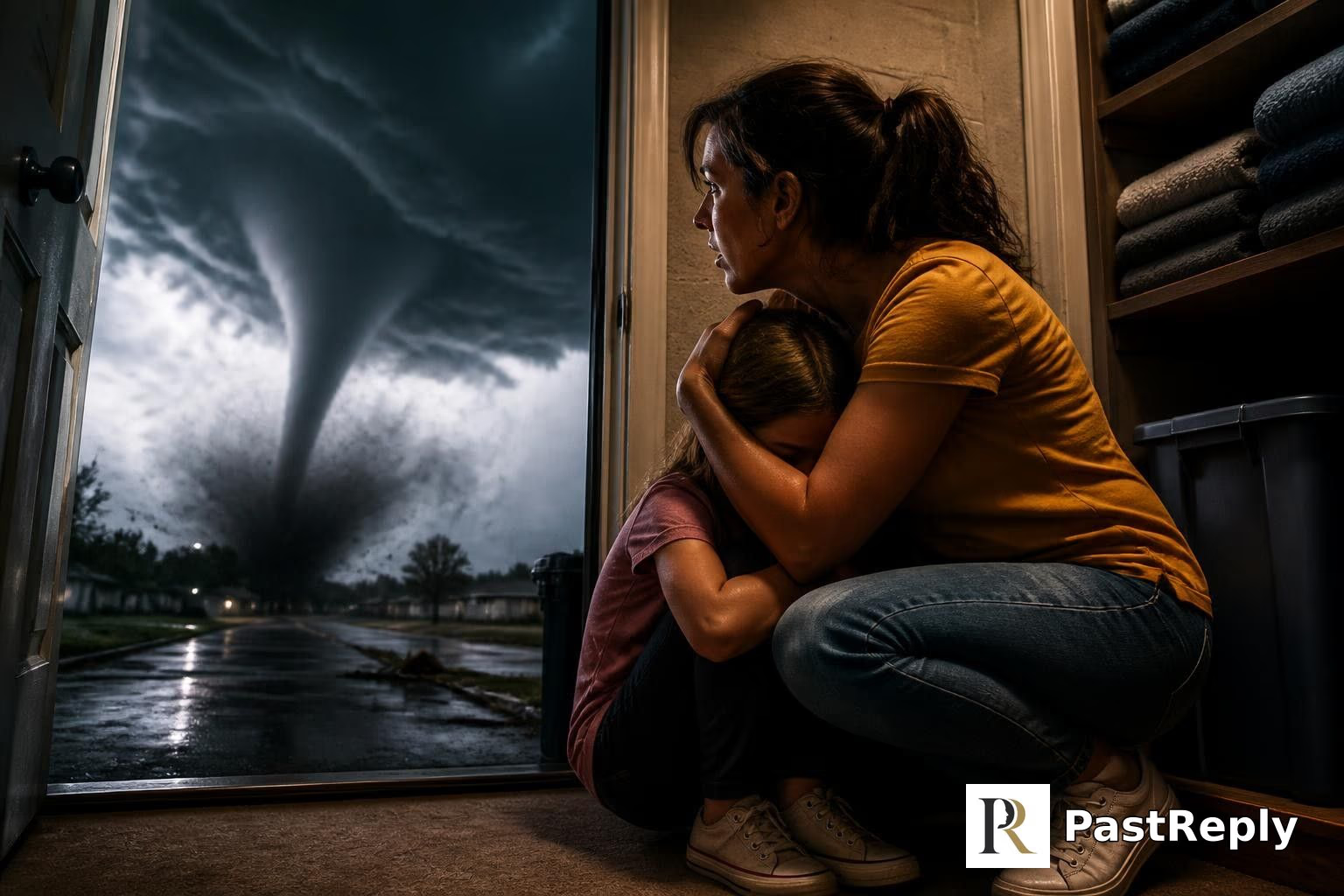
The facts
A tornado warning is an urgent public alert issued by weather forecasting agencies, such as the National Weather Service in the United States, when a tornado has been sighted by trained spotters or indicated by weather radar. It means a tornado is occurring or imminent in the warned area, and there is immediate danger to life and property. The warning typically covers a relatively small area, such as a city or part of a county, and advises people to take shelter immediately.
A tornado warning is more severe than a tornado watch, which only indicates that conditions are favorable for tornadoes to develop. A warning requires immediate action, while a watch means you should be prepared and stay alert. In some cases, a tornado emergency may be issued as the highest-level alert when a violent tornado is confirmed and poses a catastrophic threat.
When a tornado warning is issued, you should move to a safe shelter right away - preferably a basement or an interior room on the lowest floor, away from windows. If you are outdoors or in a vehicle, seek a sturdy building if possible, or as a last resort, lie flat in a low-lying area and cover your head.
Answered by 100 of history's most famous minds

When the whirlwind of destruction comes, do you run to the cellar to save your skin, or do you first call out to your neighbor who lives alone and cannot hear the warning? The storm is a sign, not just of what the sky can do, but of what is in your heart. If you hide only yourself while your brother perishes, your life is saved but your soul is lost.

When the sky darkens and the wind screams like a thousand camels in panic, it is a reminder that only God holds the pillars of the heavens and the earth. The warning is not to be taken lightly, as a jest of the clouds; it is a command to seek the shelter He has provided, as the ant seeks its hill before the flood, and to say, 'We are in Your hand, O Lord, preserve us.' But let it also remind you: there is a greater warning - the Hour when no cellar can hide you from the Account.

The warning is a sound that pulls the mind from its wandering to the present danger. But consider: the storm itself is not the suffering - it is the grasping at safety, the craving for the roof to hold, that brings the anguish. The wise one, hearing the cry, takes shelter without panic, knowing that the wind too will pass. The true warning is for the impermanence of all things - the house, the body, the world - and the peace found in letting go.

It is the Lord's voice in the whirlwind, a pillar of cloud that becomes a sword. When the watchman on the wall sees the storm forming, he must cry out to the people, so that they may hide in the cleft of the rock, as I hid in the mountain's cleft when the glory passed by. To ignore the warning is to tempt the wrath of the Almighty, who shakes the earth and breaks the cedars. Let the prudent take shelter, and let the fool be swept away.

The wise man reads the signs of heaven as a filial son reads his father's face: when the breath of the dragon turns wild, the proper ritual is to bow low and seek the deep room. A warning such as this is li - right conduct before danger. To ignore it is not courage but recklessness, and the superior man governs himself by timely fear.

It is a trumpet sounding in the city - a herald of sudden destruction, as in the days of Lot when fire fell from heaven. The wise man hears and flees to the shelter of the rock, for the wind that tears the house is but a shadow of the coming wrath. Yet I say to you: though the sky darken and the earth tremble, let not your hearts be troubled. There is a shelter that no storm can reach - the strong tower of the Lord, where those who believe are safe forever.

A voice that cries out in the wilderness of the sky. When the Lord rained fire on Sodom, Lot was warned to run and not look back. This warning is like that - a command to trust, to move, to shelter. I have known such a voice: it said 'Leave your country.' Obedience is not a matter of seeing the cloud - it is a matter of heeding the call before the dust swallows the tent.

The storm does not warn the bamboo; the bamboo bends. The wise one does not wait for the shout - they have already become the hollow reed, empty and yielding. That urgent cry from the sky is for those who still think they stand separate from the wind.

That cry of alarm is the One's reminder that pride in brick and mortar is a lie. The poor man's hut and the rich man's hall both tremble alike. When the wind speaks, let your heart be silent - call on the True Name, and then see to your neighbor's safety before your own. That is the only shelter that holds.

When the sky darkens and the wind howls like a great beast, a mother's heart knows the cry: 'Come close, my child, beneath the shelter of my arms.' For even as the Lord spoke to me through a tempest of wonders, He whispers in the whirlwind, 'Do not fear, I am with you.' So a warning is but His hand drawing us near.

Let the trumpet sound, but let it not drown the Word! The true warning is the Law that shows us our sin and the Gospel that points to Christ our shelter. A mere weather watch is a shadow of that eternal vigilance. I say, heed the storm, but more, heed the Scripture: 'The Lord hath His way in the whirlwind' - so let every warning drive us to our knees.

A warning participates in the order of practical reason: it directs the will to a good to be pursued or an evil to be avoided. As the sailor heeds the darkening sky to steer for harbor, so the prudent man heeds the warning of the storm. But of greater moment is the warning of conscience, which alerts us to the tempest of sin. Both require the virtue of prudence, which perfects reason in matters of action.

A warning is a gift, a whisper from God that says, 'Now is the time to hold the trembling hand, to bring the frightened child close.' In the streets of Calcutta, we saw no sirens, only the storm of hunger and loneliness. The true warning is always the same: love the one before you, for this moment, this breath, may be all they have.

This 'warning' is but a trumpet blast from the watchmen of the air, crying that the vortex of the whirlwind, that violent gyration of vapor and fire, has been observed by the eye or by the cunning art of the radar - which mirrors the thundercloud's shape. The prudent man, having heard the cause, must flee to a low and solid place, for nature's law spares no soul that defies the path of the descending fury.

A warning of a fast-moving vortex? Fascinating. The air itself spins violently, a local disruption in the field of pressure - like a tiny, furious eddy in a stream. What interests me is the pattern: the conditions that must align - moisture, instability, wind shear - to create such a concentrated release of energy. We can predict its probability, but the precise moment of its birth still eludes us, like knowing the exact instant a die will land.

A tornado warning - how remarkable that we can now anticipate the path of an invisible column of air, as if studying the habits of a dangerous predator. I have seen the aftermath of such storms: trees twisted like roots, the very surface of the earth scoured. It is nature's violent pruning, a selective force that weeds out the weak structures, even as it reshapes the land. The warning is a gift of observation, the fruit of long and patient study of the sky's moods.

It is an empirical prediction, borne of careful observation of the clouds and the turning of the air, confirmed by the testimony of the senses and the instrument. The common man calls it a portent; the philosopher calls it a manifestation of natural laws as certain as the fall of a stone. I say, measure the speed of the wind, note the shape of the funnel, and then - *moto di moto* - you will know when to flee. The warning is reason's gift to those who would live.

That the heavens should deliver such a warning through earthly instruments confirms the order of the Creator. The spiral of a tornado mirrors the turning of the celestial spheres - both follow laws set in motion. To heed a warning is to honor the geometry of peril: the radius of destruction, the path of the vortex, all calculable by reason.

A tornado is a violent discharge of atmospheric energy, and a warning is the necessary signal that the earth’s natural circuits are shorting. I have studied such vortices; they are but crude cousins to the controlled spirals I envision in my resonant transformers. One day, we will harness that power - draw it from the sky like lightning from a rod - and turn destruction into current for all. Until then, heeding the warning is the prudent act of a civilized mind.

A warning is a message based on observation and probability. When radium emits energy, we do not curse it - we study it to shield ourselves. So too with a tornado: the vortex is a physical phenomenon, obeying laws we can measure. The warning is simply our understanding applied to preserve life. As I wrote, 'Nothing in life is to be feared, it is only to be understood.' Now is the time to understand where the cellar is.

A tornado warning is a summons to immediate action, rooted in observed fact - a trained eye or a radar signature, not a guess. I would have my laboratory workers bolt the windows and descend to the cellar without debate. The microbe does not negotiate; neither does the funnel cloud. We respect the evidence, and we act.

A tornado warning is a deadline. When the electric company called about the Menlo Park dynamo, I didn't philosophize - I lit the lamp and checked every connection. Same with a funnel cloud: you've got about as much time as it takes a phonograph needle to cross a record, and you'd better have a basement built and a door shut. Preparation is ninety-nine percent of survival.

A tornado warning is a computational problem: given a finite set of radar signatures and spotter reports, we must decide - within a tight time bound - whether to output an alert. The interesting part is the decision threshold: too many false alarms, and the system loses credibility; too few, and lives are lost. It is a class of problem I would formalize as a Bayesian decision network.

A warning is the sister of proof: as the geometer demonstrates that a circle cannot be squared, so the meteorologist demonstrates that a column of air spins. But the marvel is not the prediction - it is the force itself. Give me a lever long enough and a fulcrum strong enough, and I could move the storm's path; but first, I would measure its velocity and the resistance of the walls we build.

Think of the air as a great invisible river, and the warning as a sudden cry along its banks - 'The dam is breaking!' A trained eye has seen the funnel dip from the cloud, or the spinning dance of the radar's echo betrays its path. We do not guess; we witness the force that coils the lightning's flash into a wrathful whirl, and then we must act, for the field is already upon us.

The warning is a conscious shout, but the true tornado spins from the cellar of the mind. The radar sees the rotation of the storm; the analyst sees the rotation of a repressed dread, circling ever closer to the surface. The siren is the symptom; the fear it awakens - that is the ancient, howling wind of the id, which no basement can truly escape.

A tornado is a beautiful, deadly pinwheel of chaos - nature's brief dance of entropy on a tiny scale. The warning is a gift of time: a few minutes in which you can defy gravity's whim by moving to a cellar. It is a small victory of reason over the random fury of the cosmos, a reminder that even on a fragile planet, we can sometimes dodge the cosmic wrecking ball.

Consider the warning as an equation: given the inputs of a spinning vortex and a known population vector, it calculates a line of immediate peril. But the true algorithm is not the siren - it is the human mind that translates that sound into a series of rapid steps: step, lift, hold. I see a future where the machine itself, sensing the rotation in the clouds, will calculate not only the warning but the safest path, turning the storm into a problem solved.

Let us define the terms. A tornado is a violently rotating column of air. A warning is a proposition that such a column is present, based on observation. The logical consequence is immediate action, not further debate. The axioms of survival are self-evident: the shelter is the safest point. The proof of the warning is found in the few who ignore it and the many who do not. Q.E.D.

A warning of this kind is not a prophecy but a measurement, a conclusion drawn from careful observation and recorded fact. The spotters and the radar are like the nurses who note the pulse and the fever - the data must be trusted and acted upon without delay. To ignore such evidence is to invite death, as surely as neglecting sanitation brings disease.

A warning? I need no warning - I ride toward the storm, for the war god and the sky god favor the bold. When the whirlwind descends, a true king stands before his men, not cowering in a pit, and shouts, 'Charge!' The Greeks did not conquer Asia by heeding the whispers of caution; we took it by daring the thunder. Let the funnel come - I have faced worse in the dust of Gaugamela.

When the sky itself turns against you, you do not debate - you act. I have seen storms on the march, dust and wind that blind an army, but a column of cloud reaching from heaven to earth is a sign: fortune is about to strike. A wise general does not wait for the blow; he finds the lowest ground, the thickest wall, and he bends his men low. Hesitation is death.

A warning that the sky's own wrath descends upon a narrow strip of land - like a legion's sudden charge from ambush. In Alexandria, I'd have heralds cry such news through every street, so that men might drop their amphorae and run for vaults and cellars. Heedless of such signs, a pharaoh's granaries and palaces become kindling for the wind. A ruler who ignores heaven's trumpet courts ruin swifter than any Roman siege.

A warning of a sudden, violent wind that can level a province in an hour. In Gaul, I saw such a thing: a column of air that tore a village from the earth as if a Titan had swept his hand across a gaming board. The wise governor posts sentinels on the hills, and when they see the sky turn green, he orders the people to the forts and the underground chambers. To ignore the report is to invite ruin upon the state; to heed it is to preserve the peace for another day.

A warning is the voice of the khan of the sky, telling you to crouch like a marmot before his whirling arrow. In my army, a scout who saw a dust devil on the steppe would shout - those who did not listen were scattered to the four winds. A people that heeds the sky's command lives to ride another day; those who mock it feed the grass.

A warning? An order from the sky, and like any order, it must be obeyed instantly - or face annihilation. A tornado is an enemy that cannot be parleyed with, cannot be outflanked. The only strategic maneuver is retreat to a redoubt - a cellar, a ditch. Even my Grande Armée could not march against such a foe. Thus, the wise commander reads the signs and withdraws, to fight another day. He who hesitates is swept away.

In war, a sentry's cry of 'redcoat' means you fly to arms - not to debate, but to act. A tornado warning is no different: it is intelligence that peril is upon us. A virtuous citizen does not gawk at the sky; he sees to his family and his neighbor. We built this Republic on the principle that in common danger, we stand together. Take shelter, and afterward, we will rebuild.

When that warning comes, it's like finding out the river's on the rise and you've only got a minute to move the livestock. You don't stand on the porch debating the fairness of it - you take your folks to the root cellar and hold fast. A house can be rebuilt; a life cannot. That's the plain arithmetic of it.

A tornado warning is nature's version of the air-raid siren - a call to brace for the onslaught. The difference is that you cannot shoot back at a whirlwind. You go to ground, you wait, you endure. Then, when the deafening roar passes, you rise, dust yourself off, and rebuild. That is the whole history of our species in a single afternoon.

Such a warning tests the soul. When the storm rages, do we flee in panic, or do we stand firm in the shelter of truth and love? The true warning is not of the weather but of the heart's readiness to face calamity with calm and courage. I would urge each soul to build an inner refuge of nonviolence and faith, for that alone can withstand any storm.

When the warning sounds, it is a call to action - not to fear, but to love. For the tornado does not discriminate; it tears the roofs of the rich and the poor alike. Yet so often, the warnings we ignore are the ones that speak of injustice. I say, let us build not only storm cellars but also a society where no one is left exposed to the tempests of poverty and hate. The arc of the moral universe is long, but it bends toward justice - and justice is the shelter that can withstand any storm.

When danger descends, as it did upon our towns in so many dark hours, the true measure of a people is not in the warning itself but in the unity of their response. A siren or a message can only say, 'The storm is here.' But it is the hand reaching for a neighbor, the shared shelter in a crowded room - that is the shelter that endures.

A warning is an opportunity - a moment when the weak panic and the strong prepare. My engineers would have studied the funnel's path to sharpen our defenses, to harden the Reich against chaos. Nature's fury is a teacher: only the organized, the ruthless, the racially pure survive the storm. Let the others scatter; the tornado is their final, fitting judge.

The tornado warning is like a factory whistle: it tells the masses when to run, but it also tells the foreman who obeys and who flees in panic. I would study the list of those caught in the open, and I would know exactly whose loyalty needed re-education. The storm is a tool; the real warning is for the state to see who is weak.

A warning is a useful bourgeois device that maintains the illusion of safety within the decaying edifice of capitalism. The real tornado is the revolution, and its approach is not announced by sirens but by the rumbling of the proletariat. The warning matters only if it drives the workers from the factories into the storm cellars of insurrection - or if it is a signal to seize the instruments of power before the storm passes.

A warning from the sky is like a signal from the heavens that the storm is already upon us - so too must the people be prepared to act, not merely to watch. The radar sees what the eye cannot, just as the Party sees the enemy before he strikes. Immediate shelter, immediate action - these are the true weapons of the masses.

Such a warning, I am told, is a most serious matter, akin to a signal from the watchmen on a stormy coast. It commands immediate obedience, for the safety of every soul in its path. One must retire to the lowest and sturdiest part of the dwelling, away from the windows, and pray for deliverance.

A warning of this nature is a call to immediate and resolute action, much like the alert given to a household when danger approaches. One must descend to the safest part of the building, away from the light, and remain there until the storm has passed. It is a matter of duty to protect oneself and others.

This is a warning from heaven itself, a sign that the Lord's wind has turned to wrath. When such a blast descends, all must flee to the cellars and the strongest pillars, as if the devil's own breath were upon us. I would have my counts ensure every fortress and cottage has a place of refuge, for a good emperor protects his flock.

When the heavens roar and the black cloud twists like a serpent, that is God's warning to seek shelter. My voices would tell me to kneel and pray, and then to take cover in the lowest place, for the Lord's power is in the storm as in the battle. Trust in Him, and hasten to safety.

A warning of this sort is a herald of sudden peril, a trumpet that must not be ignored. It is better to descend to the cellar with all speed than to gaze upon the sky like a foolish courtier. Prudence, my lords, is the better part of valor, even for a queen.

This is a message from nature's artillery, a thunderbolt that must be answered with swift and rational action. The wise sovereign ensures her subjects know the signs and the refuge, just as she ensures the defense of her borders. To hesitate is to court disaster; let the warning be heeded as a command.

When the great wind descends from the sky like a chariot of Ahura Mazda, the wise man does not stand in its path. Let the people be gathered into the strong houses, and let the king ensure that even the humblest hut has a cellar. A ruler who cares for his people prepares for the storm as for the battle.

This is a sign of Allah's might, a whirlwind that reminds us of our frailty. When such a wind arises, I would command my men to seek the lowest ground and the strongest walls, for the safety of the faithful is a trust. Let mercy be shown to all who flee to shelter, even as we face the tempest together.

Tell me, my friend: when the herald cries that the wind's fury is upon you, and you run to a dark chamber beneath the earth, what is it that you truly fear? Not the storm itself, surely, for the storm is but a motion of air and water; you fear the loss of your body, the thing you call 'I.' But is that 'I' your flesh, or is it something else - something that the wind cannot touch? Let us examine this together, before the cellar door closes.

What men call a 'tornado warning' is but a shadow cast on the wall of a cave - the flurry of air and debris that signals a deeper disturbance in the order of things. The true warning, the one the philosopher seeks, is of the soul's own storm: when reason is overthrown by appetite and spirit, and chaos whirls within. Heed that, and the outer tempest is but a pale imitation.

It is a report of a violent, localized atmospheric disturbance, its cause a clash of dense cold air and moist warm air in a spiral. The phenomenon itself is a natural event, but the warning - the *logos* spoken before the thing arrives - is a human contrivance of great practical value. It allows the prudent to move to a safer place, just as a sailor furls his sail when he sees the storm line. The wise man accepts such a warning as he would accept a captain's order: without hesitation, for the end is self-preservation.

A tornado warning is a decree of immediate practical reason, commanding shelter before the phenomenal chaos arrives. Would you will it as a universal law that a rational being hear such a herald of danger and do nothing? The categorical imperative here is clear: treat your own life as an end, and act on the maxim that you would have every person in such a crisis follow without exception.

A shrill alarm that tells you nature has no regard for your petty comforts - good! The tornado is a hammer that breaks the weak and tests the strong. A warning is a moment of decision: will you crawl into the cellar like a frightened herd animal, or will you stand on the hilltop and laugh at the storm? The danger is real; the only cowardice is pretending you are safe.

A tornado warning is the weather's own declaration of crisis - but the real tempest is not in the sky; it is in the social order that leaves the working class exposed, without cellars or safe rooms, while the bourgeoisie barricade themselves in their secure mansions. The warning merely exposes the inequality of shelter. The true storm is the one that will sweep away these class divisions, and when that tornado comes, it will not be a warning - it will be a revolution.

I doubt the warning, until I perceive it clearly. Is it a true alarm, or a false one? Reason tells me: if a trained watchman or a mechanical instrument that cannot deceive reports a vortex, I must grant it provisional certainty. But the proper response is not panic - it is methodical action. I go down to the cellar, I think, and I wait for the clear and distinct idea that the danger has passed.

A warning is a signal that fortune has turned her wheel against you. The wise prince does not waste breath asking why - he moves his treasure and his garrison to the stronghold, and secures what can be saved. He who waits for confirmation in the open field will be remembered only as a lesson in folly.

The trumpet of the sky, a sudden roaring in the leaves, a great black hand that reaches from the cloud to snatch the roof from the house - this is the storm's warning, and wise men fly to the lowest ground as mice to the wainscot when the cat appears. Yet mark the folly: how many a soul, in the very instant of peril, pauses to gaze upon the heavens, like a child staring into the eye of the wolf, before the howl is upon him.

A messenger comes, not with herald's staff and sandals, but with a roar that shakes the ground like the chariot of Zeus descending. As when the west wind drives a dark cloud across the wine-dark sea, so the great funnel twists down from heaven, and men must flee to hollow caves or lie flat as the dead. The gods hurl their anger, and the only prayer is for a swift passing or a strong roof.

A trumpet blast before the judgment of the air itself - a narrow shaft of God's wrath or nature's fury that sweeps the earth like a scourge. The farmer in his field, the merchant in his shop: when they hear that cry, they must flee to the deepest cellar, as souls in Purgatory rush for shelter when the Angel's sword descends. To ignore it is to choose the whirlwind, and be cast into a darkness where no star shines.

A coiled spring of nature's terrible power, announced just before the sky breaks into a spinning dance of destruction. I recall walking in the Harz during a sudden storm - how the clouds built like a living creature, and the air held its breath. A warning is the moment when man, with his instruments and nerve, must read the great poem of the elements and bow to its stanza of fury.

A warning of a turning wind that twists the sky into a furious spiral? Ah, this is the moment when the wind itself turns windmill, and the knight of the plains, be he ever so bold, must know it is no giant to be charged. The prudent man, like Sancho, seeks a cellar; the fool, like my master, would tilt at it and call it glory. There is wisdom in fearing that which the heavens themselves unleash, for even the most valiant heart cannot parry a bolt from the clouds.

A tornado warning is the voice of mortality made visible - a sudden reminder that all our plans, our possessions, our strivings, are but straw before the wind. In that moment, the only question that matters is: what do you love more than your own life? If you love your neighbor, you will pull them into the cellar. If you love only yourself, you will be alone. The storm is not a punishment; it is a mirror held up to the soul, showing whether we have learned to love.

A warning? Yes, we are always warned - by conscience, by the faces of the suffering, by the whistle of the wind before the fall. But do we listen? No, like Raskolnikov we walk into the storm, imagining we are stronger than fate. The warning is a mercy - a chance to bow before the terrible truth that we are not masters of the elements. Go to shelter. Pray. And remember: salvation is found not in defiance, but in humility.

To be under a tornado warning is to have one's social arrangements suddenly appear absurdly trifling - the new bonnet, the unkind remark at tea, the question of whose carriage shall go first. The sky declares a truth no drawing-room can soften: that we are all, in the end, very small creatures clinging to the same earth.

A warning, sir? Then I picture the wretched child, pale as whey, peering from a cellar grating as the sky turns a sickly green - while the merchant who built his warehouse on the cheap counts his profits in the counting-house, deaf to the roar. It is the same in all affairs: the poor have no warning but the crash, and the rich have no ears but for their ledgers.

A tornado warning is the government's way of saying, 'The sky is about to throw a tantrum, and you'd better find a hole to crawl into - but don't expect us to do anything about the one in Washington.' It's a useful thing, I suppose, though I've noticed that warnings about storms get more attention than warnings about injustice. Maybe because tornadoes don't have lobbyists.

A warning means the wind has teeth and the sky is about to bite. You get low, you stay quiet, and you wait. It's simple. Like a man in a trench when the shells come. You don't think about tomorrow. You think about the dirt under your hands and the sound of it passing. After, you stand up and look at what's left. That's the whole thing.

I have drawn the spiraling shape of the whirlwind, how the air descends and then rises in a twisting column, like the turning of a waterspout only far more violent. The warning is the sighting of that column, or the reflection of its motion in the mirror of the radar, which paints the storm's heart with invisible light. The wise man, understanding the form of this beast, retreats to the bosom of the earth, for no man can outrun the drawing of its breath.

In the block of stone, the form lies hidden - the sculptor's task is to free it. So too does the tornado reveal what was always there: the power of the air, unseen until it spins into a column of fury. The warning is like a chisel's first blow, telling men to flee before the marble is shattered. I see the terrible beauty of it - a force that carves the land as my hand carves the stone.

When such a warning cries out, it is as if the sky itself has taken a brush and painted its wildest storm in furious strokes - a whirl of ochre and black, a vortex that swallows the horizon. The people must run, not to admire, but to hide in the bowels of the earth, like moles trembling in the dark. I would want to capture that terrible beauty on canvas, if I could stand steady enough to hold the brush. But even art must bow before the tempest's roar.

A sudden fracture in the canvas of the sky - the tornado is the artist, the warning is the frame that says, 'Look, here the world will be smashed and remade.' I have smashed a guitar into a bull's head; nature smashes houses into abstract forms. The real art is how you face the moment when the old perspective collapses.

I see it in the sudden violet of the sky, the greenish cast before the storm. A warning is the moment when light itself becomes a threat - the light of a vertical column, gray and terrible, that eats the horizon. One cannot paint a warning; one feels it in the trembling of the air, in the frantic dance of leaves. It is nature's most urgent impression, and I would give much to capture its fleeting, violent beauty - but from a safe distance, behind a sturdy wall.

A warning from the sky - yes, I paint storms. The light before the blow, the flat green under a bruise of cloud. But this warning is not for canvas; it is for flesh. A mother clutching her child in a cellar, the old man's hand trembling on a doorframe - that is the real chiaroscuro. The dark comes, and we must know where the shelter is, not admire the shadow.

A warning is a wound that hasn't happened yet. Like the pain in my spine before the surgeon's knife - you know it's coming, and you dress yourself in red and paint a self-portrait for the world to see. The storm is a gringo with a whip, but I am the daughter of the earth. I stand on my own two broken feet, I take shelter in my own bones, and I laugh at the sky. Because I am still here, painting.

A tornado warning? Ha! It is the drumroll of the tympani, the sudden fortissimo of the full orchestra before the finale - except you must not stay in the concert hall to hear it! The sky hisses like a serpent, the wind howls in F minor, and the mob runs for the cellar. I would compose a piece called Der Wirbelsturm, with a frantic prelude and a quiet coda of birdsong after the anger passes. But first, I must save my manuscript - and my wig!

A warning! Yes - like the first thunderous motif of a symphony that speaks of fate knocking at the door. The storm is the drumroll of nature's wrath, and man must answer with courage: seek shelter, but never let the spirit cower. Even the deaf hear the shaking ground; even the frail can defy the whirlwind by enduring. It is the struggle that gives life its heroic note - so take cover, but stand ready to rebuild.

It is a sudden, jarring discord in the harmony of the day - the trumpet blast that signals a fugue of destruction. The prudent listener, hearing that note, does not wait for the full cadence; he retreats to a safe place, as a choir prepares for a dissonant passage. I would set such a warning as a staccato figure in the bass, urgent and repeating, so that none could mistake its meaning. The rest is silence, if one heeds the score.

Well, bless my soul - if the good Lord sends a twister, you better hightail it to the fruit cellar, just like Mama used to do back in Tupelo when the clouds went green. That warning is a gift: a moment to get low, say a prayer, and hold your loved ones close. I've felt that rumble in my bones on stage, but that's the King; the sky's the King when He rolls His thunder.

A tornado warning is a whisper from the heavens that says, 'Stop the music, child. The sky is dancing now, and it is not a gentle moonwalk.' It is the moment when the world's rhythm turns raw, and we must freeze, find shelter, and protect the innocence within. I would hum a quiet melody to calm the fear, but even my voice cannot outshout the wind. So we wait, holding hands, until the storm passes and the world can dance again.

It's like the loud bit in 'A Day in the Life' - you know it's coming and you better hold onto your wig. A tornado warning is nature's way of saying 'get back, get back, get back to where you once belonged' - underground, with your mates, making sure you're all safe till the wind stops howling. Love is all you need, but a basement helps too.

A warning's like a fiddle string that's pulled too tight - you hear it before you see it. That banshee whine in the air, that green-black sky that ain't the color of rain. It's the sound of something that don't give a damn about your plans, your speeches, your tomorrow. You either get low or get gone. That's the whole song.

A tornado warning is that moment when you have to drop everything - the lyric you were writing, the phone call, the plan - and just find a wall to put your back against. It's the universe telling you that nothing else matters except being alive in the next sixty seconds. And the thing about surviving it? You'll write a better song after.

When I sailed into the unknown, I paid no heed to the howling of the winds, for God had a purpose for me. A warning is a sign from Heaven: either to stay your course or to turn. But I say, let the black funnel descend - I have crossed an ocean of monsters and come to land. The storm is God's breath, and if He wills it, it will harm not His servant. Yet a prudent sailor does reef his sails. So take shelter, but know that beyond the tempest lies a new world.

In the lands of the Great Khan, I heard tales of dragons that descended from the clouds, but here the wind itself becomes a beast. The warning is a cry through the city, a drum beaten to tell all: the sky's breath is become a pillar of destruction. I have seen storms flatten whole groves of mulberry trees, and men who ignored the signs were carried away like leaves. Trust the watchers who know the signs - they are as wise as the camel drivers who read the desert's mood.

A cry from the crow's nest that the very wind has turned traitor - a funnel of cloud reaching down to the sea like the finger of an angry god. In the Strait of Magellan, we saw such things: the sky blackening, the compass spinning, and the only choice to batten every hatch and pray. A wise captain does not debate the warning; he drops the sails and steers for open water, for delay is death.

A warning like that is a call to disciplined action, based on solid observation. On the lunar surface, we had no such luxury - every step carried its own hazard. But here on Earth, when the radar shows a hook echo and spotters confirm a funnel, you execute the plan: basement, interior room, head down. It's a controlled response to a known variable, and training makes it routine.

A tornado warning is the sky's own urgent telegram: 'Danger in your quadrant. Do not fly through this.' I've seen those funnels from a cockpit, and they are no cloud to chase for thrills. When the air goes still and green, and the radio crackles with an alert, you land - or if you're already on the ground, you find the lowest ditch and lie flat. It is the one time a pilot does not argue with the weather. Courage is listening to the warning, not ignoring it.

Up there, looking down, you see no borders - just one blue ball spinning in the dark. A tornado warning is our planet reminding us we are small. From orbit, the storm is a white swirl; down on the ground, it is a fist. But we built rockets. We can build shelters. The important thing is to act, not to fear. Take cover, comrades, and when it passes, look up again.

It's like a red alert on your screen - the universe telling you something dangerous is about to happen. You don't debate it, you don't negotiate, you act. The people who survive are the ones who drop everything and move to a safe place, instantly. It's about focus: cutting the noise, finding the center. The tornado doesn't care about your excuses. Neither does the market, or your customer. When the warning comes, you execute.

A tornado warning is the atmosphere screaming that it's about to fling a 300-mph vortex at you. It's a high-bandwidth alert from the NWS - basically a real-time 'shelter or die' signal. From a first-principles perspective, the solution is obvious: build stronger shelters, use better radar algorithms, and eventually, predict each twister's exact path hours ahead. Or, you know, just leave Earth - no tornadoes on Mars.

You know, a tornado warning is life's way of saying, 'Pay attention *now*.' It's that moment when the universe taps you on the shoulder and says, 'Honey, you've got to go to your safe place - no excuses, no waiting.' I think of all the people who ignore those warnings, who think they're stronger than the storm. But the real power is in knowing when to step back, to protect the life you've been given. That's not weakness; that's wisdom.

Float like a butterfly, sting like a bee - but when the wind starts to twist, you can't float or sting, you gotta be underground. A tornado warning ain't no rumor, it's the referee saying, 'Take cover!' I don't run from no man, but I'll bow to the Lord's weather. The only rope-a-dope you need is a rope to the cellar.

A tornado warning is like the referee's whistle when the game must stop - no one argues, everyone runs to safety. I have seen storms in Brazil that tear the roofs from houses, and then the people rebuild, together. The warning is not a thing to fear; it is a gift that says, 'Now is the time to protect your team.' After the wind passes, the sun shines again, and we play on.

A tornado warning? That's nature's version of a scary ride - like the peak of a rollercoaster where you know the drop is coming. But Mickey taught us: when the storm roars, you find your safe place, you hold the ones you love, and you whistle a happy tune. Because after the wind, the sun always shines again - and maybe, just maybe, a rainbow will follow.