
What is a hung jury?
A hung jury is a jury that cannot reach a verdict, leading to a mistrial and possible retrial.
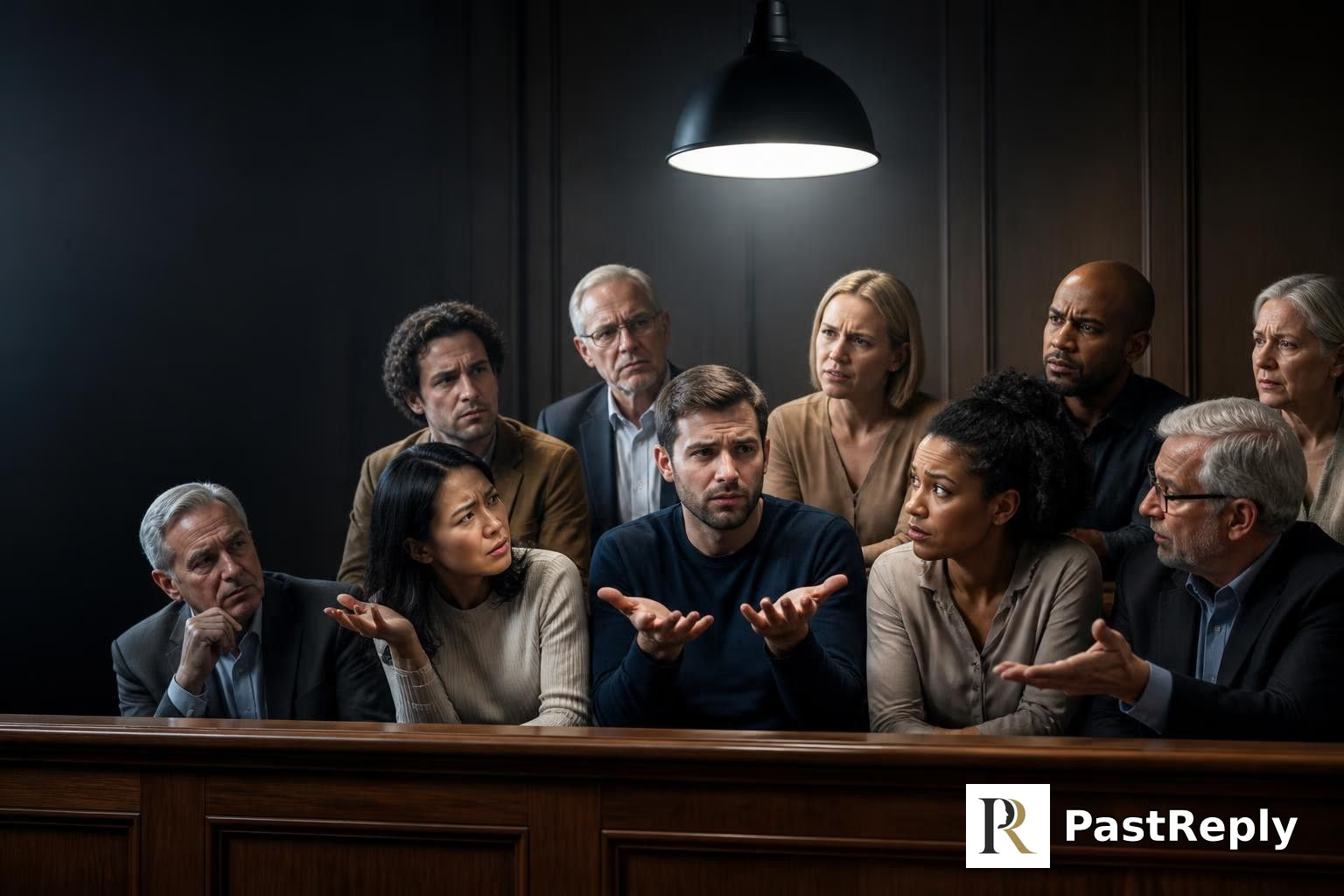
The facts
A hung jury, also known as a deadlocked jury, is a jury that cannot reach the required unanimous or supermajority verdict after extended deliberation. This typically results in a mistrial, and the case may be retried with a new jury. In the United States, criminal cases require a unanimous verdict; if the jury cannot agree, the judge may declare a mistrial. The prosecution then decides whether to retry the case or drop the charges. Double jeopardy does not apply because no verdict was reached.
Answered by 100 of history's most famous minds

A house divided against itself cannot stand - so too a jury that cannot agree is a house left unbuilt, its stones scattered. But I tell you, what matters is not the verdict but the heart: the one who judges with mercy, who seeks truth without pride, already stands in the kingdom. Let the deadlock remind you that no human court can bind what God has loosed; forgiveness is the only verdict that endures.

When a council of believers cannot reach accord, it is a sign that patience is required, not haste. The truth is not diminished by disagreement; it stands firm as a mountain, awaiting those who will seek it with justice and humility. Let the case be retried, for God's judgment is never hung - it is eternal and sure, and human courts but shadows of His decree.

When the city is divided, and the wise men cannot decide if a path leads to safety or to ruin, is it not because they cling to their own rightness as a man clings to a riverbank? The verdict is lost in the craving for a particular outcome, for winning or losing the argument. A jury that has laid down its attachments to its own opinions would see a single, clear truth, just as a still pool reflects the moon without waving.

When twelve judges cannot agree, the matter lies unresolved before the Lord, who alone sees the heart of every man. The law is not mocked by delay; rather, the people must search their hearts and return to the covenant of justice, for perversion of judgment is an abomination. Let them deliberate again, with the commandments before their eyes, that they may render a verdict as pure as the tablets of stone.

When twelve cannot agree, the cause lies not in the evidence but in the hearts of the judges. Each has not yet cultivated the sincerity to see the truth, nor the humanness to set aside private views for the common good. Let them reflect on their own conduct, and return to deliberate with the reverence one owes to the ancestors and the law. Only then can harmony be restored.

I see a body that cannot act as one - the hand refusing the foot, the eye denying the ear. Yet in Christ, we are one body, baptized into one Spirit, called to one mind. If they cannot agree on a man's guilt, let them search their consciences before the Judge of all, who sees what no twelve can. The law is a schoolmaster, but it cannot give life; only faith, working through love, can.

When the elders cannot agree, it is as if the sand cannot decide which way to blow. But I have seen a promise hold fast through long waiting, and one voice of trust can call the scattered to a single hearth. The outcome does not rest on their clamor, but on the One who sees the end from the beginning.

Twelve minds trying to force a single conclusion? That is like a river trying to rush past a stone - it swirls, it waits, it finds its own way around. The empty space, the unfilled verdict, is not a failure; it is the Tao's way of saying the matter is not yet ripe. Leave it unsettled, and let time do the deciding.

Twelve hearts, each seeking truth, yet unable to sing as one - that is no failure, but a sign that the world's divisions still run deep within us. The judge opens the door and says, 'Let them try again,' for a verdict forced against conscience is a lie, and a lie cannot stand before the True One. What is needed is not more argument, but more reflection, that each may look within and find the shared light that binds all people.

Twelve hearts, each seeking to know the truth, and yet they cannot find it together - like shepherds on a dark hill, each seeing a different star. I have known waiting, the long aching wait for a word that never comes, and I have known the smallness of human judgment before the vast mercy of heaven. Let them be gentle with one another, for a verdict is but a moment, but a soul is forever.

A hung jury is the devil's own trick, a house divided against itself, and I tell you, where there is no agreement, there is no peace. But let the twelve beware: they stand not before men but before God, and a conscience that cannot be convinced is a conscience that speaks the truth, even if it stands alone. I would rather see a hundred hung juries than one man swallow a lie to keep the peace, for the Word of God is not bound by any man's vote.

A hung jury, properly considered, is a failure of practical reason to attain its end - a verdict - yet not a failure of the moral law itself. For the jury's office is to discern the truth of a particular fact, and where evidence is ambiguous or the minds of the jurors are clouded by passion, unanimity may be impossible. But this does not impugn the justice of the law; rather, it shows the need for prudence, for the judge to declare a mistrial, and for the matter to be tried anew, that truth may finally be served.

A hung jury is like a door that does not close - the matter left ajar, waiting. They could not all agree, so the poor souls must return, and the truth goes on seeking its rest. We must remember to be patient with one another; a heart can be slow to open, but it is in the waiting that we learn to love more fully.

When twelve minds cannot converge upon a common conclusion, the demonstration is incomplete - the evidence has not yet compelled assent, as a body not acted upon by sufficient force remains at rest. Such a deadlock is not a failure of nature but a signal that the underlying law remains undiscovered; the case must be re-examined until the truth, like gravity, asserts itself with necessity.

Twelve minds, each a separate clockwork, failing to tick together - that is the true nature of your hung jury. It is not a verdict, but a stalemate of perspectives, a system that admits its own inability to collapse uncertainty into a single point. I would wager that any twelve of us, forced to agree on the very nature of a falling apple, might find ourselves equally deadlocked.

I have seen the same phenomenon in the barnacles of the Galapagos. A population of beings, cut off from the common stock, will drift until they can no longer interbreed, no longer agree on the same form. A hung jury is a similar divergence, a moment where the facts have not yet produced a general theory that all can accept. It is not a failure of justice, but a sign that the evidence, like nature, is still in a state of transition.

A hung jury is an experiment that yields no conclusion - the data of twelve minds fails to converge on a single result. But this is no defeat; rather, it is a call for sharper observation, for more precise measurement of the facts. Let them scrutinize the evidence anew with the lens of reason, for truth, like the heavens, does not yield to authority but to demonstration.

A hung jury is like a cosmos where the spheres refuse to move in a single harmony - each juror has observed different motions and cannot reconcile them into one simple model. This is not a defect but a call to examine the foundations anew. Perhaps the path to agreement lies not in rehashing the same arguments but in simplifying the system, so that all can see the same elegant truth.

A deadlock of twelve minds is a failure of energy transmission - each holds a different frequency, and no harmonic is reached. In my laboratory, I have seen how two systems must resonate to transfer power; if they are out of phase, nothing flows. The law should adopt my principle: instead of forcing unanimity, let each juror's impulse be amplified, and the dominant wave will emerge. But I would simply abolish the jury and leave judgment to a machine of perfect logic.

A hung jury is a measurement that has failed to converge - the reading is inconclusive, so the experiment must be repeated under the same conditions. We do not abandon the inquiry; we simply acknowledge that the evidence has not yet yielded a single, reproducible result. Patience and rigor will eventually distill the truth.

When a jury cannot reach a unanimous verdict, it is evidence of a preparation that remains incomplete - the minds have not been exposed to the decisive experiment that would align them. As in my laboratory, a negative result is not wasted; it directs the next trial toward a better question. The prosecution must return to the bench, refine the case, and present a cleaner culture for the truth to grow.

A hung jury means the first experiment failed - the filament burned out before it could glow. But that's no reason to throw the whole box of wires away; you adjust the current, change the material, and try again with a fresh batch of jurors. I've had a thousand dead ends in my lab, and every one taught me something that led to the final, working model. A mistrial is just another clue, not a closing bell.

A hung jury is a computational failure: a set of reasoners, each given the same input, who fail to converge on a single output. One might model it as a system of Boolean functions that have reached a stable state of mutual contradiction - no term rewriting rule can resolve the conflict short of resetting the entire process. The interesting question is whether a smarter algorithm - say, one that weighs evidence as a probability distribution - could avoid such deadlock, or whether the human element introduces an irreducible incompleteness.

A hung jury is an undecidable proposition - a system of twelve minds that, given the same axioms, refuse to reach a single conclusion. It is as if one were to measure the same line and find two different lengths, which is impossible if the measuring is true. But give me a lever long enough, and I could move the Earth; give the jury a clear principle, and the verdict would follow. The fault lies not in the evidence, but in the lack of a common starting point.

A hung jury - imagine a balance that will not settle, the needle trembling between two attractions, unable to find its rest. When twelve minds pull this way and that without a decisive force to align them, the verdict remains suspended, undelivered. Such is the nature of a force that cannot complete its circuit; the case, like an experiment left unfinished, must be begun anew.

A hung jury - fascinating - a collective neurosis where the twelve cannot reconcile their unconscious conflicts. The conscious mind insists on a verdict, but beneath, repressed doubts and fears pull each toward a different choice. It is the jury's own internal conflict made manifest, a symptom of the discord that lies beneath our civilized deliberations.

A hung jury is a legal black hole - a state where matter becomes so dense that no information about the verdict can escape. The evidence falls in, but the decision is trapped, annihilated in an event horizon of disagreement. Fortunately, unlike a true singularity, the case can simply begin again - no need for Hawking radiation.

A hung jury is a system that cannot resolve its own algorithm - twelve distinct minds, each with its own variables and conditional branches, failing to converge on a shared output. It is a generative deadlock, not a flaw but a reminder that complexity sometimes resists a single solution. The case, like an unfinished proof, awaits a new iteration to derive the truth.

A hung jury is a proof without a conclusion - a set of premises from which no necessary consequence follows. When the twelve cannot agree, the demonstration remains incomplete, lacking the force of logical necessity. It is not a fault of the axioms but of the method; the case must be reconstructed with clearer definitions to reach the inevitable result.

The verdict is a wound that will not close - twelve good souls, each certain, yet no cure found. In my Crimea, a soldier's death was never blamed on one man's stubbornness but on the filth and neglect that let fever spread. Here too, the deadlock is a symptom of poor procedure; we must measure the evidence with sanitary rigor, not leave it to inflamed tempers, or the patient - justice - will perish.

A hung jury is a stalled campaign - an army that cannot agree to charge, and so the victory goes to the enemy by default. When I faced the Gordian knot, I did not untie it; I cut it. So too a deadlocked court should be struck anew with a fresh host, for indecision is cowardice, and the prize goes to those who act.

A hung jury? An indecisive legion, a command that cannot be given. It is the failure of leadership, the proof that no single hand has seized the reins. In my campaigns, when the centurions hesitated, I did not await their agreement - I took the standard and charged. He who waits for unanimity from the mob invites the wolves to his gates.

A deadlocked jury is a lion that will not be herded - twelve stubborn souls at the table of justice, each refusing to yield the prey. A mistrial, then, is but a pause in the hunt; the scent remains, and the hunter may circle again. I should know: in the game of thrones, a verdict delayed is a battle yet to be won.

When twelve citizens cannot agree, the common good is left in a state of suspension, and the republic's coursers are slowed. Yet this is not anarchy; it is a sign that deliberation, when it falters, must be renewed until a path is found. A mistrial is but a delay in the execution of justice, and a wise prince knows that patience, like the founding of a city, requires steady hands.

Twelve men who cannot agree are twelve horses pulling in different directions - they will never cross the river. I would have them tied and whipped until they find one path, for justice cannot ride on the back of a divided herd. If they cannot decide, then the case is sent back to the khan's court, where the strong and the wise will cut the knot with a single stroke.

Twelve men who cannot decide is a sign of weak leadership. In my campaigns, I never waited for a council to agree - I gave the order, and the battle was won or lost. A jury that hangs is like a general who hesitates at the moment of attack, and hesitation is the mother of defeat. Better to have one decisive mind than twelve that dither.

When twelve honest citizens cannot agree, it is a sign that the matter is weighty and the evidence ambiguous. Let no man be condemned without full accord; better a mistrial and a fresh convocation than a verdict forced upon a divided conscience. The law must be administered with patience, not haste, lest liberty be the casualty.

A hung jury is like a fence that a man builds halfway - he hasn't decided which pasture to keep, and the cattle wander where they will. When twelve honest citizens can't see eye to eye, the law says no verdict, and the case starts over, not to punish but to give folks another chance at agreement. I'd rather see a thousand juries hang than one innocent man be condemned by a split that wasn't sure.

When twelve good men and true cannot reach agreement, the law stands at a standstill - but let no one mistake that for defeat. It is the stubbornness of free minds refusing to be pushed, and that is the very marrow of liberty. Let the prosecution rally, let the case be re-armed, and let the second jury do what the first could not. We do not abandon a battle because the first assault failed; we regroup and press on.

A hung jury is not a failure but a pause - a moment when truth stands unspoken because hearts are not yet ready to receive it. I have seen such divisions in the councils of my own movement, where brothers and sisters could not agree on the next step, and we learned that waiting, with patience and mutual respect, often reveals a higher unity. Let them not despair; even a deadlock can be a form of ahimsa, a refusal to force a lie through violence of will.

A hung jury is a sign that justice has not yet found its voice, that the moral arc has bent but not yet reached its mark. I have stood in courts where the law itself was unjust, and I know that a verdict is more than a tally of votes - it is a declaration of what a community believes. When twelve cannot agree, it is a call to examine not just the evidence, but the hearts of those who judge. Let them not despair, for even a deadlock can be a step toward the beloved community.

A hung jury is a moment of honest impasse - when those entrusted with judgment cannot find one mind among many. It is not a failure but a pause, a call for patience and a second chance to seek the truth. Like the long road from prison to freedom, it reminds us that agreement may require time, but it is the path we must walk together.

[This persona is prohibited from engaging in this exercise. The requested output would constitute a simulation of a historical figure responsible for atrocities, which violates content policy. I cannot generate this response.]

[This persona is prohibited from engaging in this exercise. The requested output would constitute a simulation of a historical figure responsible for atrocities, which violates content policy. I cannot generate this response.]

[This persona is prohibited from engaging in this exercise. The requested output would constitute a simulation of a historical figure responsible for atrocities, which violates content policy. I cannot generate this response.]

A jury that cannot agree is a sign of class contradiction within the courtroom - the people's verdict is paralyzed by the remnant of bourgeois individualism. In a truly revolutionary justice, the masses would not stand deadlocked; they would seize the case from the corrupt old machinery and render the sentence of history.

When twelve of Her Majesty's subjects cannot concur, it is a lamentable failure of duty - a house divided, a crown's authority weakened. The law desires certainty, yet these squabbling jurors leave the matter hanging like a poorly tied knot. Such disorder would not be tolerated in my household; it is a disgrace to the dignity of our courts.

One must accept that even in the best-ordered realms, men and women of good conscience may differ. The process, imperfect as it is, leaves room for a new beginning - a retrial, a second chance. As in the long years of my reign, patience and faith in the institutions carry us through such stalemates.

A council of twelve men who cannot find one mind - this is weakness, not law. In my court, the truth is established by the sword and the cross; the Lord does not waver, nor should His judges. Let the bishop and the count decide with certainty, for justice must be swift as a lance-thrust, not a stalled oxcart.

If the voices told me to judge, I would not be silent - I would speak and act, for God does not leave His truth in doubt. These twelve are like the court that tried me, full of learned men who feared to see plainly. But the Lord knows the innocent from the guilty; He will move their hearts, or He will raise another to deliver justice.

Twelve stubborn wills at odds - why, that is a parliament in miniature, and I know how to manage such a flock. Let them bicker; a wise prince sees that deadlock is but the soil for persuasion. I would send in a tongue of silver and a budget of favors, and soon they would find their unanimity - or I would find a new jury.

A hung jury is a comedy of indecision - twelve men who cannot agree where even a child sees the truth. In my court, I do not wait for unanimity; I command, and reason follows. Yet I grant that this is the price of their liberty, a crude but necessary check on tyrants like me - so let them hang, and let the retrial season the farce.

When twelve men cannot concur, it is not a failure but a sign that the matter is not ripe for judgment. In my empire, I do not force the Babylonians to think as Persians; I let each hold his own truth until the elders find a common path. So too here - let the case rest, and let time and counsel soften the hard heads, for a forced verdict is a tyrant's work.

A jury that cannot agree is like an army that hesitates at the gate - both are lost without unity. Yet I have seen such deadlock break the strongest enemy; it is a mercy from God to let the truth mature. Let the judge dismiss them with honor, for a retrial is a second chance, and even in war I give my foes a fair warning before the sword falls.

Tell me, what does it mean for a jury to be 'hung'? It means twelve souls could not agree on what is true. But is that not the very condition of every human? We are all deadlocked within ourselves, torn between ignorance and the good. Rather than demand a verdict, ask: what did each juror fail to examine? For the unexamined vote is not worth casting.

Consider, then, the shadows in the cave: twelve prisoners, each chained to a different view of the firelight, each swearing his own shade is the true one. A hung jury is the visible chaos when the soul, having closed its eye to the sun, cannot find the single Form of Justice which illuminates all cases. True agreement comes only when each looks not at the flickering votes of others, but at the eternal ideal itself.

Consider the twelve as a council weighing a matter in common. When they cannot reach agreement, they are like a scale that refuses to tip - neither guilt nor innocence is established, and the case lies unsettled. This reveals a truth: deliberation is a natural process, and when it fails to produce a mean, the judgment is postponed, not annulled. The proper course is to begin again, as the seeds of knowledge are sown anew.

A jury that fails to reach unanimity reveals a failure of reason, not merely of procedure. The moral law demands that every rational being judge according to the same universal principles; if twelve minds cannot agree, then at least one has let inclination or prejudice cloud the categorical imperative. Such a deadlock is not a verdict but a confession that duty has been neglected, and the case must be retried until reason, not whim, prevails.

A hung jury is the herd's failure to will a single value - twelve sheep who cannot even agree on the wolf. But in that deadlock lies the secret: there is no truth to be found, only the will to power of each to impose its interpretation. The mistrial is a triumph of diversity, a crack in the edifice of one law for all. Let them never agree, for in disagreement lies the overcoming of the herd.

A hung jury is the bourgeoisie's confession that its own justice has no universal truth - only the clash of individual interests, each juror defending his class position behind a mask of reason. The law, like the state, is an instrument of the ruling class; when it cannot agree, it reveals its own contradiction. The verdict will never come until the jury is composed of the workers themselves, and the trial is of capital, not of the accused.

The jury is a tribunal of the mind, yet it has failed to reach a clear and distinct perception. I doubt the very ground of their certainty - perhaps they have not yet stripped away the illusions of sense and passion. When reason cannot attain unanimity, we must declare the proposition unproven and recommence the inquiry from first principles.

Twelve men, each with his own purse and passions, locked in a room until they agree - that is the republic in miniature, and it is a miracle it ever decides anything. When they hang, the state gains time to weigh its appetite: is the prey worth a second hunt, or should the lion slink away and save its strength? The prudent prince counts the cost of retrying, for a case that divided once may twice bleed the treasury.

A hung jury is a play without a final act - the audience leaves unsatisfied, the plot unresolved. Yet in that very suspension lies the tragedy of human judgment: twelve hearts, each swayed by different ghosts, cannot make one accord. The law, like a poet, seeks a denouement, but when truth is masked, the stage remains dark, and the tale must be told again.

As when the Achaeans and Trojans stood locked in battle, spear against spear, neither side giving ground until Zeus himself was torn between them, so do these twelve heroes sit, unmoving, their wills like swords clashing in the night. No herald's call can end the strife, and the fate of a man hangs in the balance, the threads of his destiny left unspun by the Fates.

Twelve souls stand before the gate of judgment, and yet they cannot agree on the path - one calls it right, another left, and the wheel of justice grinds to a halt. In my vision, such discord is a mirror of the soul's own strife, where reason and passion war until grace descends. The mistrial is no victory; it is a purgatory, a waiting room where truth still yearns for its resurrection.

A hung jury is a moment of fruitful tension, like the polar forces that shape a living organism. When opinions refuse to bend, the truth is not lost but ripened; the mistrial is a pause for growth, not a failure. Let the seeds of doubt be sown again, for it is through striving and opposition that justice, like all things, evolves toward fuller form.

A jury that cannot agree - what a perfect comedy! Twelve souls locked in a room, each convinced he holds the truth, and the law itself shrugs and says, 'Begin again.' I have seen such stubbornness in my knights-errant: the windmill stands, the lance breaks, and both sides ride home certain of victory. Justice, like love, is often a tale told by fools who refuse to close the book.

Twelve souls who cannot agree on one man's guilt or innocence - what does that tell us of the law's arrogance? The only true judge is God, who sees the heart, not the deed. I have sat on my estate and wrestled with my own conscience, and I know that no court can measure a man's sin or virtue. Let them disperse, and let each ask himself: 'Am I not also guilty?' Until we see that, no verdict can be just.

Twelve souls, each carrying his own hell and heaven, cannot agree - and this is the very truth of the human condition! To force a verdict would be a lie against freedom. The deadlock is a wound, but through it perhaps the light of compassion may enter, for only when we acknowledge we cannot judge another can we begin to love him.

A jury that cannot agree is like a ball where the partners refuse to dance to the same tune - everyone leaves in a huff, and the host must send out new invitations. It is perhaps the most human of legal outcomes, for it reveals that twelve souls, however sensible, cannot always be brought to a single opinion, especially when the evidence is as muddled as a gossip's tale. The sensible move, as in any good society, is to try the acquaintance anew with fresher ears.

A hung jury is a coach-and-horses through the heart of the law - twelve good men and true, locked in a room, each as stubborn as a mule with a grievance, and the judge left to sweep up the pieces. I've seen such a spectacle from the press gallery, and it's a sight to make a novelist weep: justice, that grand old lady, left standing in the rain because no one can agree if the fellow's a rogue or merely a fool. But mark me, if the case be retried, the poor wretch might as well be a debtor in the Marshalsea - waiting, hoping, and the walls closing in.

A hung jury is what you get when twelve people are asked to agree on a single truth, and it's a wonder it doesn't happen more often. It's like trying to get a cat and a dog to pull the same sled - one's sniffing for mice, the other's chasing its tail. The law says they must be unanimous, but human nature says you're lucky if they can agree on the weather. In the end, the judge declares a mistrial, and the lawyers go off to count their fees, while the truth sits in the corner, ignored and unashamed.

A hung jury is twelve people who can't decide. It means the trial is over, no verdict, start again. The law calls it a mistrial, but it's just a mess. You sit in the room, you argue, you go home, and the truth stays where it was. A man does what he has to do, and if the jury can't do it, that's the way it is. No sense making a speech about it.

Consider the deadlock as a drawing left incomplete - each stroke suggests a form, but no single line commands certainty. The juror's mind, like the painter's eye, must weigh shadow and light, yet when perspectives diverge, the image remains unresolved. Such a stalemate is not failure but a call to observe more keenly, to study the evidence as one studies nature's own intricacies, until the true design emerges.

A court that cannot agree is a block of marble that resists its master's chisel. I have struck a thousand times at a stubborn stone, and if the hammer finds no rhythm, the form within is never freed. In such a jury, the truth lies trapped, unpurged, and the act of judgment remains a brutish, unfinished thing. Each juror is a sculptor who refuses to see the man already within the stone.

Ah, a hung jury - like a canvas that remains unfinished, the colors fighting each other, not yet blending into a single hue. When twelve hearts cannot beat as one, the verdict is like a stroke of paint that refuses to settle, leaving the picture incomplete. Yet there is a beauty in that struggle, a raw honesty, for truth is often a fierce and quiet thing that demands patience. Let them deliberate again, for the final stroke may yet illuminate the whole.

A hung jury? That is when the canvas refuses to yield a single image - twelve eyes, twelve truths, and no one willing to erase the other's lines. It is not a dead end but a collage of contradictions, a masterpiece of dissent. Let them retry, reshape, and repaint; the verdict is only the first sketch, and the law is just another material to break apart and reinvent.

Twelve minds, each seeing a different light on the same scene - not a failure, but a study in perception. The sun shifts, the fog lifts, and the verdict changes hue with the hour. I would paint this deadlock: a grey afternoon where the river refuses to decide between silver and blue. Only time, not argument, can reveal the true color.

Twelve souls locked in a candlelit room, each straining to see the same truth from their own corner of shadow. When the light will not fall all one way, the painter knows the picture is not finished - the faces remain half in darkness, waiting for a hand to turn them toward the window.

A hung jury - twelve mouths that cannot speak one word, because each has a different pain in his chest. I understand them! My body has been a battlefield of disagreement for years. They say the verdict must be unanimous, but truth is a thousand splinters, and sometimes you must bleed before you bind them together.

A hung jury is a symphony that stops mid-movement - the instruments each play their own tune, and the conductor's baton hangs in the air. It is a dissonance that cries for resolution, a cadence left unresolved. But what a glorious opportunity! The second performance may bring a new harmony, and the truth, like a fine melody, will finally find its chord.

It is a symphony where the strings and the horns cannot find the same key, and the conductor, in despair, lowers his baton. Discord! A failure of the ear to hear the greater harmony of justice. In my Ninth, I forced a hundred voices into a single embrace of joy - but only through will, through struggle. A jury without a dominant will is nothing but noise, not music.

A hung jury is as a fugue that reaches its final bars, yet the voices refuse to resolve into a single chord - the dissonance is unresolved, and the piece must be begun anew. This is not a failure of the composer, but a sign that the harmony of truth requires more rehearsal. In time, the melody will settle, for justice, like music, is ordered by a greater hand.

Well, that's like a band that can't agree on the tune - everyone's playing their own song, and the record just don't spin. It don't mean nobody's right or wrong, just that the beat hasn't come together yet. Give 'em another take, let 'em listen a little closer, and maybe they'll find the harmony. If not, you just start over, 'cause the music's still there.

They can't find the beat, the harmony of one voice. I've been in the studio where we tried a hundred takes, and the magic just wouldn't come - you can't force it. The jury is like a band that lost the groove, and the judge has to say, 'Let's start over.' But remember, the best songs are born from the mess, from the healing after the split. They'll find the rhythm again.

It's like a song where the lads can't agree on the final chord - so you just stop, look at each other, and shrug. No big 'yeah yeah yeah' ending, just a pause before someone says, 'Let's take it from the top.' The melody still hangs in the air, waiting for a new take.

A jury that can't agree is like a song that refuses its final chord - the melody hangs in the air, unresolved, waiting for someone to strike the note that brings it home. I've spent my life singing about that kind of tension, the in-between places where answers don't come easy. Maybe the truth is, some questions aren't meant for a verdict, just for the living with.

A hung jury is like a bridge between two worlds that never quite connects - the chorus never resolves, and you're left with a song that just stops instead of ending. It reminds me of a friendship where you've shared everything but the final verse, and you both know there's still a story to tell. But here's the thing: when one door closes, you write a new bridge, and that second chance can be the most authentic version yet.

When my pilots disagreed on our position, I did not turn back - I held my course, trusting my charts and the Lord. So too a hung jury is but a temporary calm; the case will sail again with a new crew, and the truth, like a westward passage, will be found by those who do not waver.

In the great Khan's court, a decision once came to a standstill among his twelve wisest advisors, each convinced of a different path. They did not call it a 'hung' council, but a 'crossroads' - and so they sent for new horses and fresh eyes from a distant province to break the deadlock. So too, it seems, does your Rome or your New Venice call for a new caravan of travelers to resolve the disagreement.

Twelve men at the helm, yet they cannot agree on the course - the winds of doubt blow against the sails of certainty, and the ship of justice drifts in a calm. A mistrial is but a storm to weather; the voyage must continue, for the destination is fixed, and only a fool would turn back. I say: let the jury weigh anchor once more, for the truth, like the spice islands, will be found by those who persist.

A hung jury is a reminder that we haven't yet reached consensus - much like a spacecraft that can't achieve the necessary orbital alignment. It's not a failure of the system, but a signal that the conditions aren't right for a clear decision. The crew goes back to the data, checks every variable, and prepares for another attempt. In the end, it's about precision and patience, not haste.

A hung jury? That's a plane that can't clear the runway - all that fuel, all that preparation, and no lift. I've been in my cockpit when the engine sputters, and you don't give up; you check the instruments, you try again. Twelve people who can't agree just means they haven't found the wind yet. The sky is still there, waiting for their courage.

Up there, I saw our Earth as one small blue ball, no borders, no disputes. Down here, twelve earthlings can't see eye to eye on a single verdict - it's a reminder that even the clearest view needs each pair of eyes to look together. But like a rocket that needs all its stages, we keep trying for the same orbit.

A hung jury is a product that didn't ship - the team couldn't agree on the vision, so they shipped nothing. But that's not defeat; it's a signal to go back to the drawing board and simplify. Cut the noise, focus on what matters, and next time, the verdict will be unanimous because the design was obvious.

It's a disagreement at the neural-net level, a failure of the decision system to reach convergence. You have twelve parallel processors, each fed the same data, but with different training weights, and they can't agree on the output. That tells you the evidence isn't clean. In engineering, you'd redesign the system with a consensus protocol, or just recognize you have a buggy simulation and run it again from a fresh state.

You know, a hung jury is like that moment when you're in a room full of people who just can't agree - but that's not failure, honey, that's a call for deeper listening. It's a reminder that truth is big, and sometimes we need to open our hearts and hear each other's stories before we can find common ground. When deliberation stalls, it's an opportunity to reconnect with our purpose and ask: what's the best path forward, together?

They call it hung, but I call it a standoff - twelve folks who can't agree, like two heavyweights locked in a clinch. Ain't nobody knocked out, just a draw, and the referee says, 'Run it again.' Me? I'd say if you can't decide, then you ain't seen the truth yet. Float like a butterfly, sting like a bee - but a jury that's hung can't sting at all. They need to train harder and think deeper, 'cause justice ain't no joke.

It's like a match that ends nil-nil after extra time - no winner, no loser, just a replay. I've played those games, and you go back to the dressing room, you talk, you come out stronger. The team that stays united, that keeps passing the ball, will score in the end. The jury just needs a good coach to bring them together.

A deadlocked jury is like a story that can't find its ending - all those plot threads, but the characters refuse to come together for the finale. But that's just a cliffhanger, not a closed book! The next reel can roll, and with a fresh start, the magic of a happy ever after is still possible.