
What happens when a jury is deadlocked?
A deadlocked jury leads to a mistrial, and the case may be retried with a new jury.
The facts
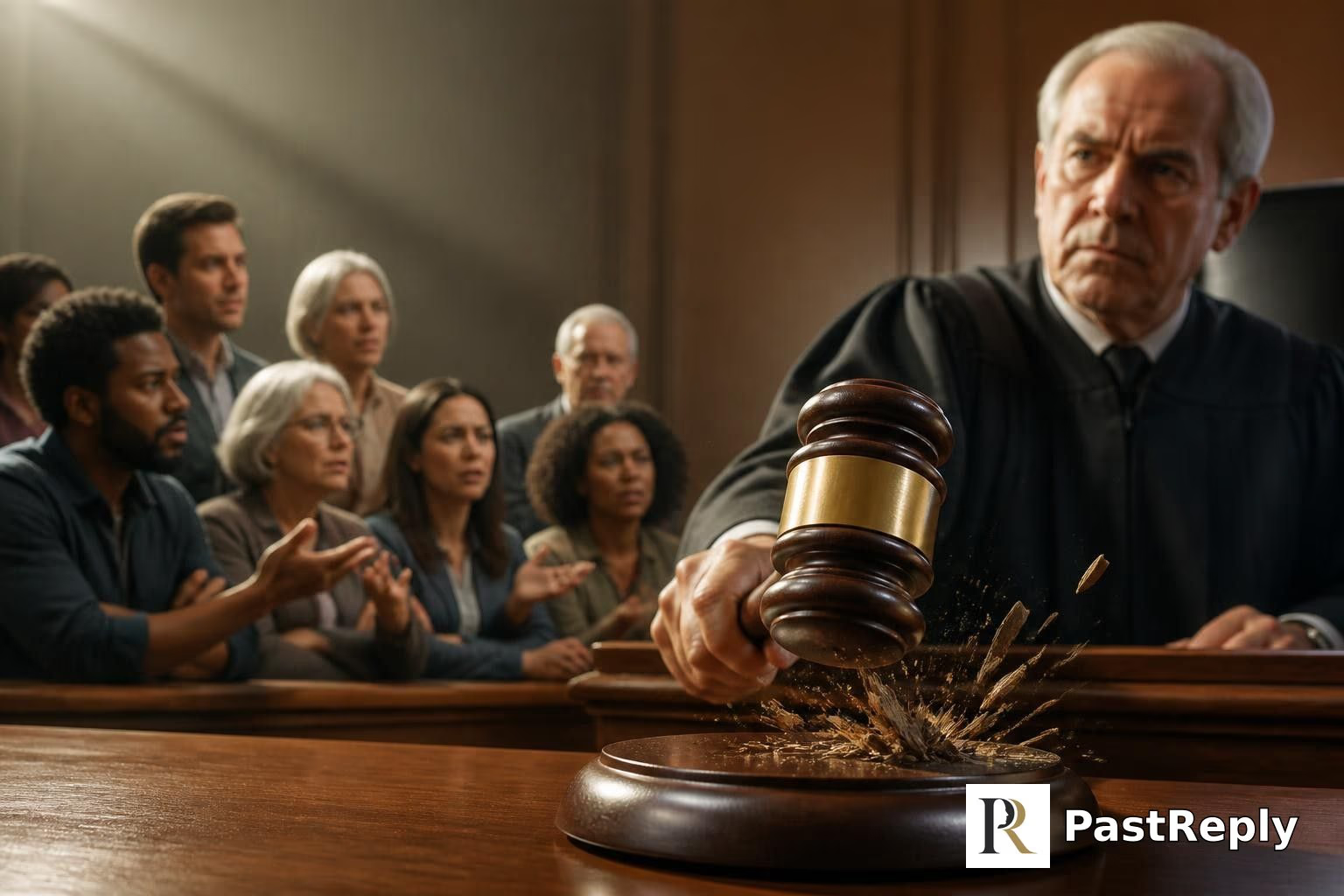
When a jury is deadlocked, meaning it cannot reach the required unanimous or supermajority verdict despite genuine efforts, the judge typically first instructs the jury to continue deliberating, often through an Allen charge (also called a dynamite charge). If the jury remains unable to reach a verdict, the judge declares a mistrial. A mistrial due to a deadlocked jury does not result in an acquittal or conviction; the defendant is neither convicted nor acquitted. The prosecution may generally retry the case with a new jury, as a hung jury is considered a "manifest necessity" that permits retrial without violating double jeopardy protections. However, if a retrial also ends in a hung jury, the prosecution may decide not to pursue a third trial, and in some jurisdictions, further retrials may be limited or require special approval.
Answered by 100 of history's most famous minds

Consider the man caught in the snare: the council argues, but no voice moves to mercy. When twelve cannot agree, let them part - better a tangle of thorns left to the Gardener than a branch broken in haste, for the Father alone sees the heart of the accused. In such a standstill, I see not failure, but a door left ajar for grace.

When the judges are divided, let patience be their cloak, for God knows what the scales hold. A mistrial is not a verdict - it is a pause for reflection, a call to seek truth beyond stubbornness. The accused is neither cleared nor condemned, but left in God's keeping. Let the prosecution weigh again, and if they persist, trust that the All-Knowing sees all.

A jury's deadlock is but another arising and passing of conditions, a knot of craving for certainty that cannot be untied by force. The judge's exhortation is a gentle reminder to look within, but if the twelve minds remain attached to their separate views, the trial must be released, as a leaf is released from the branch. Neither guilt nor innocence is fixed; the accused is free to walk the path anew, and the prosecution may sow the field again, knowing that all outcomes are impermanent. The hung jury is not a failure but a teaching - that clinging to a verdict, like clinging to any formation, brings suffering, and release brings peace.

When the elders of the tribe cannot agree on the judgment of a brother, the law of the covenant does not abandon him to the sword of doubt. Let the judges return to the tablets, let them weigh the testimony with the patience of one who has wandered forty years, and if they remain asunder, the case is not yet settled - it is carried back to the sanctuary, for the LORD abhors a hasty verdict but honors the slow and deliberate search for justice. A mistrial is not a release; it is a call to seek the truth again, with clean hands and a pure heart.

When the wise men of the court cannot agree, they must examine their own hearts before blaming the case. The judge's urging to further deliberation is proper, for harmony requires patience and sincere effort, not haste. Yet if agreement remains elusive, a new assembly may be convened, for justice, like a well-tended field, may need a second sowing to yield a good harvest.

When the council of the saints cannot agree, the body is divided, and a brotherhood that ought to be one is torn. The judge's word to continue is like my plea to the Galatians - press on toward unity, not in stubbornness, but in the truth of Christ. Yet if the Spirit does not grant accord, the assembly is dissolved - neither acquittal nor condemnation, but a time for the accuser to lay his charge anew. For in such a hung council, the mercy of a fresh hearing may open the door for the gospel to reach those who were blind.

When the elders of the camp cannot agree, it is not the end of the promise, only a testing of patience. The judge urges them to sit again, to reason as brothers, for the truth of a matter often comes after long thirst in the desert. If still they divide, the case is laid aside, not buried - like a well not yet dug, the water waits. Let them retry, for justice, like offspring, may be born more than once from the same loins.

A stuck wheel creaks; the cart stands still. When twelve voices cannot become one, the sage lets the wood rest - pressing only splinters it. The empty verdict is not a defeat but a pause, a space where the Way breathes before the trail is walked again.

When twelve voices cannot sing one hymn, it is not the song that is false but the ears that are divided. The judge's command to keep listening is like a call to gather again at the Guru's court, where patience and humility may yet find the one tune. And if it ends without a word, let no one claim victory or defeat - for the Truth is not bound by a verdict, and the next dawn may yet bring the Name to all lips.

When twelve hearts cannot find one accord, it is as if the Lord Himself has scattered them like chaff in the wind. I have known what it is to wait in the shadows while the mighty cast their lots, and I have seen the lowly lifted up when no voice was heard. A mistrial is a pause, not a judgment; the accused is held in the palm of mercy, neither condemned nor freed, while the world holds its breath. Let them deliberate again, as the soul must ponder its own account, for a verdict torn from a divided heart is no verdict at all. In time, the truth, like the dawn, will break through the fog of their confusion.

When twelve men cannot agree, it is a sign that the law has made an idol of its own opinion, and that the conscience of each man must stand before God alone. A mistrial is not a judgment but a confession of human fallibility, and to force a verdict through a so-called 'dynamite charge' is to put a sword to the throat of conscience. I say, let the accused be tried again, if the state will, but let each juror answer to the Word of Scripture, not to the threats of a judge, for a verdict is not a matter of majority but of truth. The devil loves a divided house, but Christ bids us to be of one mind in the truth, not to be blasted into agreement by the laws of men.

A deadlocked jury is a situation in which the human intellect, despite its natural capacity for reasoning, has failed to reach a certain conclusion from the available evidence, owing perhaps to the obscurity of the facts or the weakness of some minds. The judge's instruction to continue deliberating is a prudent measure, for it seeks to remove the obstacles to agreement, yet if the impasse persists, a mistrial is declared - and this is just, for no man should be condemned without a unanimous verdict. The prosecution may retry the case, since the first trial did not conclude the matter, and thus the principle of double jeopardy, which forbids a second trial after a final judgment, does not apply. It is a process ordered toward truth, and though the road may be long, it is better that ten guilty men should go free than that one innocent man should be punished by the rashness of a divided court.

When twelve souls cannot agree, it is not failure but a call to wait, to listen more carefully to one another, for each heart holds a piece of truth. The judge asks them to pray, to reflect, to seek unity; if they remain apart, the case is set aside, and the accused is left free - not guilty, but not innocent either. In such a moment, we must remember that every person, even the one on trial, is a child of God, and the law, like love, must be patient.

This deadlock is but a system of forces in equilibrium: contrary pressures cancel, and the verdict rests as an unsolved equation. Nature shows no haste; the judge's charge is like adding weight to one side, yet if the balance holds, the case is returned to its initial state - an experiment run anew. The law, like motion, persists until a new impulse acts.

A stubborn jury is like a beam of light refusing to choose a single path through a prism - each juror holds a different angle, and no consensus emerges. The judge's nudge, that 'dynamite charge,' is a gentle push to see if the scattered rays can align, but if they remain divergent, we declare a mistrial, a pause in the experiment. The law, like nature, allows for retrial, acknowledging that a failed measurement is not a final verdict but an invitation to repeat the observation under better conditions.

When the jury cannot agree, it is like a naturalist finding two species that refuse to fit into a single classification - the evidence is ambiguous, and the judge's charge is a request to look once more at the specimens. If they still diverge, we record the observation as inconclusive and set it aside, not as a final judgment but as a data point for future inquiry. A mistrial, like an undecided variation, is not a dead end but a branch awaiting further evidence; the prosecution may return with new specimens, new arguments, and a fresh jury, as a naturalist revises a theory with additional fossils. The law, like nature, is patient; truth may emerge after many trials.

A jury that cannot agree is like a telescope that cannot be focused - the fault lies not in the heavens but in the instrument, and the remedy is to adjust the lens with renewed care. The judge's urging to deliberate again is akin to a natural philosopher repeating an experiment, for a single inconclusive observation is no ground for a verdict; the evidence must be weighed, recollected, and, if necessary, the trial begun anew, for truth does not bow to the first opinion but to the patient demonstration.

When the calculations will not reconcile, the astronomer does not force the epicycles to fit; he reexamines the very arrangement. So too, a jury's deadlock reveals that the evidence, like the wandering planets, refuses to be squeezed into a preordained orbit. The judge's dynamite charge is akin to urging one to trust the old tables, but a mistrial - a fresh start - mirrors the reform of the celestial model: a simpler, more harmonious path to truth.

Twelve minds locked in opposing currents - a circuit that will not close, and the judge's charge is like applying a greater voltage to force a spark. But when the resistance cannot be overcome, the flow must be interrupted; a mistrial is the breaker thrown to prevent a burn. The prosecution may switch stations and rewire the case, for the energy is not lost - merely redirected. In my own experiments, a failed coil taught me more than a hundred successes; so too, this deadlock reveals the hidden faults that a new jury might correct.

A deadlock is a failed experiment, yet not a wasted one. The jury has gathered data, each dissenting a different reading of the evidence - this is the raw material of a new inquiry. The judge's instruction to continue is like repeating a measurement with greater care, and if the results still conflict, one must acknowledge the limits of the method. A mistrial is not a null result; it is a call to refine the procedure, and the prosecution may return to the bench with fresh instruments. We must not fear the stalemate, but simply seek to understand its cause.

When the fermentation refuses to turn, we do not pour out the vat but add a fresh culture, stir, and wait - the same patience yields the wine. So a hung jury is but a culture that has not yet clarified; the judge's charge is the new flask, and retrial the second inoculation. The truth, like the microbe, will eventually reveal itself under the microscope of a renewed deliberation.

A hung jury is just a filament that hasn't glowed yet - you don't throw away the bulb, you give it more juice or a fresh twist. The judge's charge is the second voltage, and if that fails, you start a new batch of twelve, because persistence is the mother of every invention. Every mistrial is a lesson on the workbench, and the truth will eventually come out when the right combination is tried.

A deadlock is an interesting computational state: the system has failed to converge to a definite output from the given inputs. The judge's charge to continue is essentially a command to reset the random seed and run the deliberation algorithm again, hoping the stochastic process will reach a fixed point. If it fails again, we declare a 'hang', which is not an output of 'guilty' or 'not guilty' but a separate third state, like a halt in a Turing machine without a final answer. The prosecution may then spin up a new process with fresh inputs, but the double jeopardy flag is not set because the first process never produced a terminal state. It is a bizarre but logically consistent protocol, and one must admire its intolerance for undefined states, even if it sometimes loops infinitely.

A deadlocked jury is like an equilibrium of opposing forces that cannot be resolved by the mere addition of further deliberation; the system has reached a stable configuration where the resultant vector of evidence and prejudice sums to zero. The judge's charge to continue is an attempt to introduce a new perturbation, but if the system is in a deep potential well, it will not move. A mistrial is thus a declaration that the mechanical problem has no solution under the given constraints, and a new experiment must be set up with a fresh set of jurors, as one would recalibrate a balance scale. The prosecution may retry, but it must remember that the same inputs will produce the same outputs - unless, of course, they provide a new fulcrum upon which the evidence can turn.

When the needle of a compass trembles between two poles, the wise experimenter does not declare the magnet broken - he waits, and if the needle refuses to settle, he must admit the experiment has failed to yield a reading. So too with a jury: the judge first presses them to feel the field once more, and if the force still resists, the trial is set aside, not to condemn nor to acquit, but to begin anew. The law, like nature, does not force a conclusion; it permits another trial, another observation, until the truth is drawn forth.

A deadlocked jury is a fascinating neurosis - twelve minds locked in a defensive struggle, each clinging to its own repressed conviction rather than yielding to the reality of the evidence. The judge's charge is a therapeutic intervention, urging the ego to compromise, to find a shared narrative; if it fails, the case is dismissed into the unconscious of the law, free to resurface in a new trial. The prosecution's insistence on retrial betrays an obsessive-compulsive drive, unable to accept that some wounds never fully resolve.

A hung jury is the courtroom's equivalent of a failed experiment - the particles of opinion refuse to align, and the judge must decide whether to apply more energy or abandon the run. The Allen charge is like adding heat to a system; sometimes it produces a phase transition, sometimes it just melts the evidence. If the jury still cannot converge, the case is declared a mistrial, and the prosecution is free to re-run the experiment - though, as with black holes, some information may be lost forever in the process.

When a jury deadlocks, it is as if the machine of justice has encountered an unanticipated loop - the logic fails to converge, and the operator must decide whether to feed more input or halt the process. The judge's charge is a refined algorithm, urging the system to reconsider its parameters; if it still refuses to settle, the case is returned to the queue for a second run. Yet the true marvel lies not in the verdict but in the method: each deliberation, like each computation, reveals the limits of certainty and the promise of another attempt.

When a jury cannot agree, it is proof that their premises are not yet settled - for from agreed axioms, a single conclusion necessarily follows. The judge's charge is an attempt to guide them back to common ground, yet if they still diverge, the proof is incomplete and must be set aside. The retrial is but a fresh set of hypotheses, subject to the same rigorous test, for justice, like geometry, yields only to necessity, not to will.

When the jury cannot agree, the judge administers a stimulant to their deliberations - a most unscientific remedy. I would prescribe a dose of statistical clarity: lay before them the probabilities of error, the costs of delay, and the suffering of the accused. A hung jury is a sanitary failure of the process - clean it, organize it, and let the law proceed with evidence, not emotion.

Twelve men tied in a knot? Let my sword cut it! In my campaigns, a divided council meant a divided host - and a divided host falls. Better a swift verdict, even a harsh one, than a lingering uncertainty that saps the spirit. If they cannot agree, I'd toss a spear to break the tie, for decision, not deliberation, forges empire.

When the centurions of the jury cannot agree, the battle is not lost - it is merely postponed. The judge, like a general, must decide whether to press the attack with a renewed exhortation or sound the retreat and regroup for a second campaign. A hung jury is no defeat; it is a chance to marshal fresh forces, for the enemy, the accused, has not won his freedom, only a respite. In the courts as in war, fortune favors the bold, and the prosecution, like a seasoned commander, will strike again.

A deadlocked jury is like a standstill at the ford where the Nile meets the sea - neither the river nor the tide yields, and the boat can neither advance nor turn back. The wise ruler knows when to let the current carry the vessel to a new course, for the game is not lost when the first council wavers, but when the second is not summoned with fresh sails and sharper eyes.

When twelve citizens cannot align their judgments, the state must not be thrown into disarray; rather, the magistrate should counsel them once more, as a father would a fractious council, reminding them of their duty to the law and the peace. If they remain irreconcilable, the trial dissolves without stain, and a new assembly is convened - for it is better to start afresh than to force a verdict that would tear the fabric of trust, and the prosecution may renew its case as necessity demands, preserving the balance of justice.

Twelve men who cannot ride together are worse than a herd of stray horses - they waste the sun. The judge's urging to confer again is like a khagan's call to council: speak until the banners are raised as one. But if they remain divided, a mistrial is not a defeat; it is a scattering of the herd, and a new chase is lawful, for a hunter does not abandon the quarry for one missed arrow. I would weigh the second hunt's strength, and if it fails again, I would end the pursuit rather than let it weaken my people's resolve.

A house divided against itself cannot stand - I would have ordered the twelve to be replaced at once, not humored their discord with a lecture to try again. A deadlock is a sign of weak leadership, either among the jurors or by the judge who fails to command them. When they still refuse to decide, the mistrial is a retreat, but a strategic one: the battle is lost, yet the campaign may be renewed with fresh troops. The prosecution, like a general, must weigh whether to march again or concede the field - but I would never let twelve petty squabblers dictate the course of justice.

When the twelve cannot agree, the law, like a wounded soldier, falls to the ground - yet not in defeat, but in need of reformation. The judge's charge to deliberate anew is a wise counsel, for a republic cannot stand if its pillars are hasty. If the jury remains divided, a mistrial is declared, and it is a grave but necessary precedent: neither guilt nor innocence is stamped, and the prosecution may retrieve the cause, as a general may regroup after a drawn battle. But let them weigh the costs, for a third campaign may exhaust the treasury of justice.

A house divided against itself cannot stand - neither can a verdict. When twelve honest souls cannot agree, it is not a final defeat but a temporary halt, like a wagon stuck in a mudhole that needs another yoke of oxen to pull it free. The law allows a second attempt, for no man should be condemned or freed by a jury's mere exhaustion.

When the twelve good men and true cannot deliver, we do not sound the retreat - we regroup, reload, and attack again on another front. The judge's exhortation is the rallying cry, and if the field remains contested, we retire to plan a new assault, for the accused must not be allowed to slip the net by the sheer stubbornness of a divided council. Never surrender, even to a hung jury - the verdict is merely postponed, not lost.

When twelve minds are deadlocked, it is a signal that the truth has not yet been fully perceived, and that coercion, even from the law, must yield to the still small voice of conscience. A mistrial is not a defeat but an opportunity for both sides to return to the path of ahimsa, to examine their own errors, and to seek the light of satya with a purer heart. The accused may be retried, but if the prosecution insists, they must do so not with the sword of vengeance but with the gentle hand of justice, for a verdict born of pressure is a lie. Let the deadlock be a lesson: that the means of justice must be as pure as the ends, and the truth will not be hurried.

When a jury is deadlocked, it is not merely a failure of twelve individuals to agree; it is a sign that the moral universe is not yet ready to render a verdict, and that the arc of history has not bent far enough toward justice. A mistrial is a pause in the march, but it is not a defeat, for the accused is neither convicted nor exonerated, and the struggle for truth continues on a higher plane. The state may try again, but each retrial is an opportunity for the truth to be spoken more clearly, and for the consciences of the people to be awakened. Let us not despair at the deadlock, but see it as a call to deeper love, stronger witness, and a more persistent demand that justice roll down like waters.

A deadlock is not a defeat but a pause for reflection, a moment when the voices of twelve must find a common melody. If they cannot, the court must step back and allow the people to try again, for justice is patient and does not rush to judgment. I have sat with men who could not agree for decades, yet we found a way to walk together; so too must a jury - or the law must let them part and begin afresh.

When twelve men cannot agree, they reveal the weakness of democracy - a system that stalls when the will of the strongest is not imposed. A true leader would never permit such indecision; he would command the verdict, not beg for it. The law's allowance for retrial is a sign of a society lacking resolve, dithering while the enemy grows strong.

A jury that cannot agree is a sign of weak leadership and bourgeois sentimentality. In a proper state, the verdict would be determined by the party, not by twelve squabbling individuals who lack discipline. The law's foolishness in allowing retrial merely prolongs the inevitable; a decisive authority would not waste time on such indecision.

A deadlocked jury exposes the contradiction of bourgeois law - a system that pretends to be objective while allowing individual whim to block the collective will. The judge's plea for unanimity is a sham; the only true resolution is to dissolve such courts and place justice in the hands of the revolutionary masses. Until that day, the prosecution's right to retry is merely a concession to a flawed order, a temporary patch on a rotting structure.

A deadlocked jury is a sign that class struggle has infected the courtroom itself. The judge's 'dynamite charge' is nothing but a plea for unity, but unity without continued struggle is a fraud. If the masses cannot agree, let the state step in with revolutionary clarity - otherwise, you merely let the bourgeois retry its case until it gets the verdict it wants.

A deadlocked jury is a most uncomfortable spectacle, a testament to the fallibility of even our most solemn institutions. The judge's exhortation to reconsider is proper, yet if they remain obstinate, a mistrial is the only dignified recourse - neither convicting nor absolving, but leaving the matter to be tried again with fresh minds and steady nerves. Justice, like the throne, must be above reproach and patient in its course.

In my long experience, one learns that deadlock is a part of the natural order - a pause, not a failure. The law provides for such moments with measured steps: a charge to reflect, and if necessary, a fresh start. It is a reminder that justice, like duty, requires patience and a quiet faith that resolution will come in its own time.

When twelve men cannot agree, it is a disorder in the body of justice, and disorder must be corrected with firm counsel. The judge's charge is like a shepherd calling back stray sheep, but if the flock still scatters, the trial must be dissolved and a new one gathered. Yet I would hold that the accused should not be cast out without judgment - only kept under watch until a right verdict is reached, for justice is not a game of chance but a duty to God and realm.

If a jury cannot agree, it is because they have not listened to the truth in their hearts. The judge tells them to try again, but if they still linger in doubt, the case is not settled - it is left to be tried anew. I know what it is to face a court that would not hear my voices, yet I trusted in God above their words. A hung jury is not a verdict; it is a call for another day, another chance to see rightly.

A deadlocked jury is a fine piece of theatre, is it not? The judge cries 'dynamite,' yet the jury stands like a stubborn mule, and the law must shrug and call it a mistrial. I have no quarrel with patience - let the accused walk the plank of uncertainty, and let the prosecutor arm a new fleet. A retrial is but a second campaign, and I know well the art of waiting for a favorable wind.

A hung jury is a testament to human stubbornness, a flaw no Enlightened code can entirely erase. The judge's charge is a gentle push, but if twelve minds refuse to align, the trial dissolves into the air, and the case is born again. It is a tedious affair, yet it serves the state's purpose - no one is condemned, no one absolved, and the machinery of justice grinds on, patient as a Russian winter.

When a jury cannot agree, it is a sign that truth has not yet been made plain to all. The judge urges them to speak further, but if discord persists, the trial is dissolved, and the matter is brought before new ears. I would counsel patience - let the accused be neither condemned nor freed, but held in the balance while the wise seek a just accord, for a hasty verdict is a poor foundation for a lasting peace.

A deadlocked jury is a trial of endurance, testing the patience of judge and accused alike. The charge to deliberate again is like a call to prayer - a reminder to seek clarity in unity. If they still cannot agree, the case is set aside, and a new jury is summoned, as one would rally a fresh host after a stalemate. Yet let mercy temper the pursuit: the accused is not defeated, and the law must wait for a verdict that honors both truth and justice.

Tell me, friend - when twelve cannot concur, is it the law that fails, or the jurors' grasp of what they judge? A verdict demands not mere votes, but shared understanding of the good. If they remain at odds, perhaps they have not yet asked what justice truly is - only what each believes. Let them question their own certainty, and the knot may loosen.

Consider the jury as a microcosm of the soul, where reason, spirit, and appetite must harmonize to discern justice. When the parts are at odds, the judge intervenes, urging them to ascend from the cave of partial perspectives toward the sun of truth. Yet if the shadows still divide them, we acknowledge the failure of this particular gathering to grasp the Form of Justice, and we dissolve it, not as a condemnation of the search, but as a recognition that the ideal remains beyond this imperfect assembly. A mistrial, then, is not a verdict on the accused, but a verdict on the limits of human judgment, which must strive anew toward the eternal standard.

This discord among judges is but a natural phase in the inquiry into a deed's truth, for when several minds examine the same evidence, each may be drawn to a different cause or complexion of the act. As with any harmony, the mean must be struck - not by forcing an accord through threats or haste, but by allowing each party to weigh the facts anew, for the end of such deliberation is not victory but the soundest judgment attainable.

When twelve minds cannot converge upon one judgment, the law itself is put to the test. Yet the hung jury is not a failure of reason but a testament to its limits; for while the moral law within us is universal and binding, the empirical facts before a court may be ambiguous. The judge's dynamite charge, compelling further deliberation, is perilous: it may coerce a verdict that no free rational being could will as a law for all, and the mistrial that follows is a lesser evil, for it preserves the autonomy of each juror's conscience. The principle of double jeopardy wisely permits retrial, for a genuine search for truth is never exhausted by one inconclusive trial, and to bind the accused to a single flawed proceeding would treat him as a mere means to legal convenience.

A deadlocked jury is the glorious chaos of twelve separate wills refusing to bow to a single verdict - a rebellion against the herd's demand for conformity. The judge's dynamite charge is the tyrant's whip, cracking to force a unified stampede, but the mistrial that follows is not a failure; it is the honest acknowledgment that truth is not a flock to be herded but a power to be seized. Let the accused face a new jury, for the will to truth demands repeated testing, and only the weak fear a second trial.

The deadlock is no accident of individual stubbornness, but the necessary contradiction of a bourgeois legal system that must appear impartial while serving the owners of capital. Twelve petty jurors, drawn from the propertied classes, cannot agree because their interests are not yet reconciled - and the judge's charge to persist is a mere ideological salve masking the class war within the courtroom. The mistrial, the retrial - these are the wheels of a machine that grinds on until the proletariat seizes the law itself. In the end, only the abolition of this system will resolve the permanent hung jury of capitalist justice.

The deadlock of twelve minds is a confusion of the senses, not a failure of reason. Each juror has built judgments on uncertain impressions, and the judge's charge to continue is a call to clear and distinct examination of first principles. If they cannot reach unity, the verdict is not a truth, but a mere opinion; thus, a mistrial is a correction, not a contradiction. The prosecution may retry, for the doubt in the first deliberation is simply an invitation to doubt again, until certainty is attained. I would advise each juror to doubt the evidence until it is as clear as the fact that they think, and then they will find agreement.

When the council of twelve cannot agree, the prince loses neither the prey nor the chase - the quarry is merely returned to the pen, and the hunt may be undertaken anew. This is no flaw in the machine but its cunning: it spares the accused a victory and the state a defeat, allowing the prosecution a fresh throw of the dice. He who understands this never fears a hung jury, for it is but a pause in the contest, not a surrender.

A jury at odds is a stage where reason and passion play out their tragicomedy. The judge's plea is a ghost that walks among them, urging a conclusion, yet the verdict, like a chameleon, shifts with each soul's hue. When the curtain falls on a mistrial, the play restarts - but the scar of doubt remains, a wound that may heal or fester.

Like the Achaean chiefs who could not agree whether to sail for Troy or linger on the shore, a deadlocked jury splits the counsel, and the herald's voice - the judge's - calls for renewed oaths. Yet if the gods still send discord, the assembly is dismissed, and the hero, the accused, stands neither crowned with glory nor stripped of honor, but waits like Odysseus for the next wind. The law, then, is no swift sword but a patient weaver, who rethreads the loom for another judgment, for fate's design is not yet revealed.

When twelve souls cannot agree on the guilt or innocence of a mortal, they are as a choir split between two melodies - each voice true to its own conviction, yet no single hymn ascends to Heaven. It is the judge's burden, like a shepherd at the gate, to send the flock back into the fold, knowing that a hung verdict is not a verdict at all, but a sign that the truth still lies buried, awaiting a purer light.

A deadlocked jury is like a play whose final act refuses to resolve - and what a magnificent tension that is, for it reveals the richness of human judgment. The judge's urging to continue, like a director coaxing his actors, may yet draw forth a harmonious close; but if the impasse persists, the mistrial is not a failure but a pause, allowing the drama to be staged anew with fresh eyes. I have always held that life's greatest insights emerge from such productive friction, where opposites clash and, eventually, reconcile into a fuller truth.

Ah, a jury like my Don Quixote - twelve souls locked in a windmill's spin, each one certain of his own true vision. When the squire Sancho pleads for accord and the knight sees giants, the judge must bid them sit again, hoping a few more turns of the wheel will blur the edges of their fancies. And if they still cannot agree, the case is broken like a lance - neither glory nor defeat, but a mist that leaves the field open for another tilt. The law, like my poor knight, must sometimes ride out again, for a story unfinished is a torment to all.

Twelve souls, each bearing a conscience, cannot agree because the truth is not in their own hearts - and the judge's plea for unanimity only deepens their false pride. A deadlock is a sign that legal judgment is a human invention, not divine justice; neither acquittal nor condemnation can heal the wrong that has been done. Let the case be dropped, or retried, but first let each juror examine his own life, for the only real verdict is the one God writes in the soul. I would rather see a thousand cases unresolved than one man's conscience violated by a forced accord.

A hung jury is the soul of the law laid bare: twelve consciences wrestling with sin, each convinced of a different shade of the truth. The judge's charge is a plea for a miracle - can light be forced from such darkness? If not, we declare a mistrial, and the accused walks a narrow ledge, neither damned nor absolved, carrying the weight of that division like a cross. The prosecution may try again, but each hung jury is a confession that we are all sinners, unable to see the heart of another, and only a higher mercy, not a retrial, can truly judge.

When twelve minds cannot be brought into accord, the judge's little speech is much like a mother coaxing a reluctant child to finish his greens - often vain, yet sometimes effective. If all fails, the affair is set aside, and both parties return to their corners, neither triumphant nor disgraced, like a dance where the partners cannot agree on the tune and must wait for a new ball. It is perhaps the only even-handed outcome in such a tangle of evidence and eloquence.

When the twelve good men and true sit staring at their own boots like schoolboys caught in a lie, and the judge's charge falls upon them like the stale breath of a foggy morning - then, sir, we have a hung jury, a mistrial, and the whole circus starts its weary round again. I've seen such a deadlock in the courts of my own London, where a verdict is as scarce as a clean shirt in a debtor's prison; and the truth is, the law towers above the poor wretch in the dock, but when twelve honest souls cannot agree, even that tower trembles. The defendant walks free, but not acquitted - a ghost haunting the courthouse steps, waiting for the prosecution to roll the dice once more. Mark me, the only justice in such a fog is the chance for a new day, and a new jury that might, with a bit of luck, see the truth through the soot.

Well, sir, when twelve jurors can't agree on whether a man is guilty, they just sit there like a bunch of mules with their jaws locked, and the judge tells them to go chew on it a while longer. If they still can't decide, the whole thing's called a 'mistrial' - which sounds like a mistake, and that's exactly what it is, a mistake by the law itself, for it can't make up its own mind. The prisoner walks out free as a bird, but with a cloud over his head as big as a thunderstorm, and the state gets to try him again, which is about as fair as a catfish betting against a crow. I've seen men hang for less, and I've seen the guilty go free, but a hung jury is just the law's way of saying it's got the stomach-ache and can't decide whether to throw up or keep it down.

When the jury hangs, the judge tells them to go back and try again, and if they still hang, he calls it a mistrial and sends them home. The accused goes free, but he's not innocent, just not proved guilty, and the state can take another crack at him. That's the law: it doesn't decide, it just keeps throwing the dice until it gets a number it likes. A man in that holding cell knows he's not out of the woods; the shadow of the trial stays on him like a bad sunburn. It's a tough way to live, but a man learns to take it, because the only way out is to fight it clean, or not at all.

Twelve minds, each a different lens - no wonder they see different truths. As in anatomy, one must dissect each view to find the common nerve. The judge's charge is but a gentle hand to steady the instrument; if they still diverge, let the case flow back into the stream, for a new observation may reveal what was hidden. Nature abhors a forced conclusion.

A hung jury is a block of marble that resists the chisel - the judge's charge is the first blow, but if the stone will not yield, the sculptor must set it aside, not in defeat, but in recognition that the form within demands a new approach. The mistrial is the silent block waiting for a stronger hand, a new eye to see the figure trapped inside. Each juror holds a different vision of the truth, and when they cannot agree, the work remains unfinished, but not lost. The prosecution, like an artist, must return to the quarry and hew a fresh stone, for the image of justice is not yet revealed.

A deadlocked jury is like a painting left half-finished on the easel - the colors clash, the forms refuse to cohere, and yet the canvas still holds the promise of a deeper truth beneath the conflict. The judge's urging to persist is not a command to paint over doubt, but an invitation to look again, to let the light of a fresh day reveal the undertones of the story, until the image resolves into something honest and whole.

Deadlock? A canvas where no color yields to another - damn right it's a masterpiece of doubt. The judge's dynamite charge is a false hacksaw, trying to force a shape that's not ready; better to tear the whole thing down and start from a blank slate. A hung jury is not a failure but a confession that truth has many faces, and only a new perspective can capture the one that was hiding in the shadows.

I see a canvas where the light will not settle - each juror catching a different hour of the same scene, one the gray of a morning fog, another the gold of a setting sun. The judge's charge to persist is like asking me to paint the same haystack again, hoping the atmosphere will finally reveal one true color. But nature never holds still, and neither does a human impression; when the hues remain irreconcilable, the image must be set aside - not a failure, but a study. The prosecutor may return to the motif, for each attempt captures a new moment, and justice, like light, is never quite the same.

When the twelve cannot see the same face in the shadows, each squinting at a different truth, the light itself seems to fail. Yet a hung jury is no dark canvas; it is a moment when the chiaroscuro of human judgment is laid bare, each soul clinging to its own glimpse of the divine. Let them sit longer, let them stare until the mercy in one's eye meets the justice in another's, for the hardest verdict is the one that sees the whole man, not just the crime.

A deadlock is a wound that won't heal, an open cut on the body of justice. They tell them to keep looking, to find a scar they can all recognize - but some wounds are too personal, too real to be shared. A mistrial isn't an ending; it's a raw, bleeding page, and the prosecutor can pick up the brush again, paint a new picture. But I know: some truths are too ugly to be unanimous, and that's not a failure - it's a painting that demands to be seen alone.

A deadlocked jury is like an orchestra without a conductor - each plays his own tune, and the harmony is lost. The judge's charge is a brisk allegro to recall them to the score, but if they still clash, better to stop the piece and begin anew with fresh ears. The defendant's fate is a melody not yet resolved; let it rest until the notes align.

When the orchestra cannot play in harmony, the conductor's baton alone cannot impose unity - the judge's charge is the repeat of the movement, but if the musicians still play their own tempos, the performance must be broken off. A mistrial is not a silence, but a pause, a rest before the symphony is attempted anew, for the accused is neither acquitted nor condemned - his fate remains a note suspended in the air. The prosecution, like a composer, may revise the score and call for a fresh performance, for the theme of justice must be heard to its resolution, no matter how many rehearsals it takes.

When the voices of a jury fall out of harmony, the master of the court must not dissolve the ensemble but admonish each player to rejoin the score, for the piece is not yet finished and the discord may yet resolve into a richer cadence. If they remain at variance, the performance is set aside, not as a failure but as a sign that the time is not ripe for a final chord; the same theme may be attempted again with a new assembly, for justice, like music, is not served by forcing a conclusion that is not ready.

Well, you know, that jury's like a band that can't find the same beat - sometimes you gotta stop, take a breath, and let the melody come back to you. The judge hollering 'play on' is like a road manager pushing for one more take, but if it still ain't right, you just gotta wrap it up and start a new session. A mistrial ain't no loss, just a chance to cut a fresh record, 'cause the truth's still out there waiting to be sung.

It's like a song where the harmony splits - twelve voices each hearing a different melody, and the beat just won't lock. You can't force them to dance together; you give them the music, tell them to listen again, feel the rhythm a while longer. But if they still can't find the groove, you have to let the track go, start a new session. The artist isn't judged by one take - he can step back into the studio, lay down fresh tracks with a new band. The show goes on, because the world needs the song, and the truth will find its beat eventually.

Well, you see, it's like a song that ends on a chord that won't resolve - everyone's waiting for the final note, but the band's gone home. A hung jury's a bit of a letdown, but it's also a chance to get the lads back in the studio, try a new take. No conviction, no acquittal - just a blank page. So we'd say: let the prosecutor have another go, but maybe with a different tune next time, one that gets everyone humming together.

The jury's a twelve-string that won't tune - each string's got its own key, and the song just hangs in the air, unfinished. The judge can blow on the embers, tell 'em to keep pickin' at the knot, but if the wind won't change, the whole thing blows off stage. Nobody's won, nobody's lost - it's just a wildcat that got away, and the law can chase it again tomorrow if it's got the stomach.

It's like when you and your best friend just can't see eye to eye on a story - you've told it every way you know, and the feeling's just stuck. The judge's push is like a friend saying 'talk it out one more time,' but if the crowd's still split, they call it a draw, and the song ain't over - there's always another verse to try. Nobody's blamed, nobody's the hero, but the story lives to be told again, and maybe next time the chords will finally land.

In my voyages, when winds opposed and my crew murmured, I held course - yet here, a jury's indecision is a calm that stalls the ship. A mistrial is no defeat, but a chance to chart a new route; the prosecution may weigh anchor again. For the accused, it is a harbor unclaimed - neither lost nor won. Such is the sea of justice.

In the great Khan's court, when the merchants of the caravan could not agree on the price of silk, the vizier would command them to rest and consult the stars anew, and if still no accord, the trade would be postponed until the next fair. So too, when a jury is deadlocked, the judge bids them to deliberate further, like travelers seeking a pass through the mountains; if they cannot find the way, the caravan is disbanded, and the accused, like a bale of goods, awaits a new buyer. The law, like the roads of the Silk Road, offers many routes to the same city, and a mistrial is but a turn back to the caravanserai, to start the journey again.

A hung jury is but a calm in the midst of a tempest, a moment when the helmsmen cannot agree on the stars by which to steer. The prudent captain does not abandon the voyage at the first disagreement; he commands the crew to confer again, to consult the charts and the winds once more, and if they remain divided, he sets a new course with a fresh crew, for the harbor of a true verdict is not reached by turning back but by pressing onward with resolve.

A hung jury is a reminder that even twelve humans, fully informed, can reach divergent conclusions - like two paths to the same lunar surface, each valid in its own way. The judge's instruction to redouble deliberation is a sensible protocol, an attempt to exhaust all options before aborting the mission. When the deadlock holds, a mistrial is the safe abort, leaving the door open for a second flight - because the pursuit of truth, like exploration, is never a single launch but a series of careful, deliberate steps.

A deadlock isn't a crash landing - it's just a cockpit where the instruments disagree, and you can't fly by committee. The judge says, 'trim your altitude, look again,' but if the wind still blows against you, you've got to call it and circle back for another pass. No shame in a hung jury - it's a detour, not a destination. The prosecution can fuel up and try the route again, because being stalled at the gate isn't the same as never taking off. I'd rather see them keep climbing than settle for a smooth but wrong landing.

From up there, the Earth looks like one small, blue home - no borders, no disputes. When twelve people can't agree, it's like a rocket that won't ignite; you don't abandon the mission, you check the valves and try again. A mistrial isn't a failure - it's a pause in the countdown. The prosecutor can re-fuel and launch a fresh crew, because justice, like space, is infinite and worth another orbit.

A hung jury is a product that didn't ship - it's not a failure, it's a signal that something's broken in the process. The judge's charge is a bug fix, but if it doesn't compile, you reboot the system. Retry is a version 2.0, built with the lessons of the first attempt. The verdict is a user experience; when it's not intuitive, you redesign.

A deadlocked jury is an engineering failure - the decision algorithm has diverged, and the judge's charge is a patch to nudge convergence, but if the system is still unstable, you debug by resetting and running the trial again. A mistrial is not a bug in the justice system; it's a feature that avoids false conviction or acquittal, much like a failed rocket launch that aborts to protect the payload. Retrying is iterating, and sometimes you need multiple attempts to reach a stable outcome - it's inefficient but better than a biased result. The real question is why we insist on unanimity at all; maybe we should upgrade the jury's decision protocol to something more robust.

When twelve good people can't find common ground, that's not a dead end - it's a doorway. It's a signal that the story is still unfolding, and the truth needs more time to be heard, to be felt, to be seen from every angle. The judge's nudge to keep deliberating is like life's gentle reminder that you don't give up on a relationship just because you hit a rough patch; you sit with it, you listen, and you trust that the answer will come when you're all ready to receive it.

Deadlocked? That jury ain't dead - it's just dancin' to two different drums, and the judge's dynamite charge is a referee tellin' 'em to mix it up some more. But if they still can't agree, you don't call a knockout - you call a draw, and the champ gets back in the ring for a rematch. A mistrial means nobody's down for the count, and that's justice as fair as it gets, 'cause the truth can't be rushed, it's got to be earned, round by round.

It's like a match that ends in a draw after extra time - no one wins, but the game isn't over. The referee blows the whistle, but there's a replay, a second chance to find the net. You don't hang your head; you go back to training, work on the passes, and come out with more heart. Twelve players can't all see the same opening, but the coach in the judge's chair tells them to keep the ball moving. If they still can't score, the tournament calls it a replay - and the beautiful thing is, there's always another match, another chance to lift the cup.

It's like a storyboard that ends with a blank panel - everyone's waiting for the next drawing, but no one's picked up the pencil. A hung jury is just a pause in the tale, not the end. The judge gives them a nudge, a little magic, to find the common thread. If they still can't, well, you just start a new reel. Retry, rewrite, believe - because every good story deserves a happy ending, even if it takes a few takes.