
What Iranian leader was killed?
Iran's Supreme Leader Ayatollah Ali Khamenei was killed in a 2026 US-Israeli attack, ending his 37-year rule.
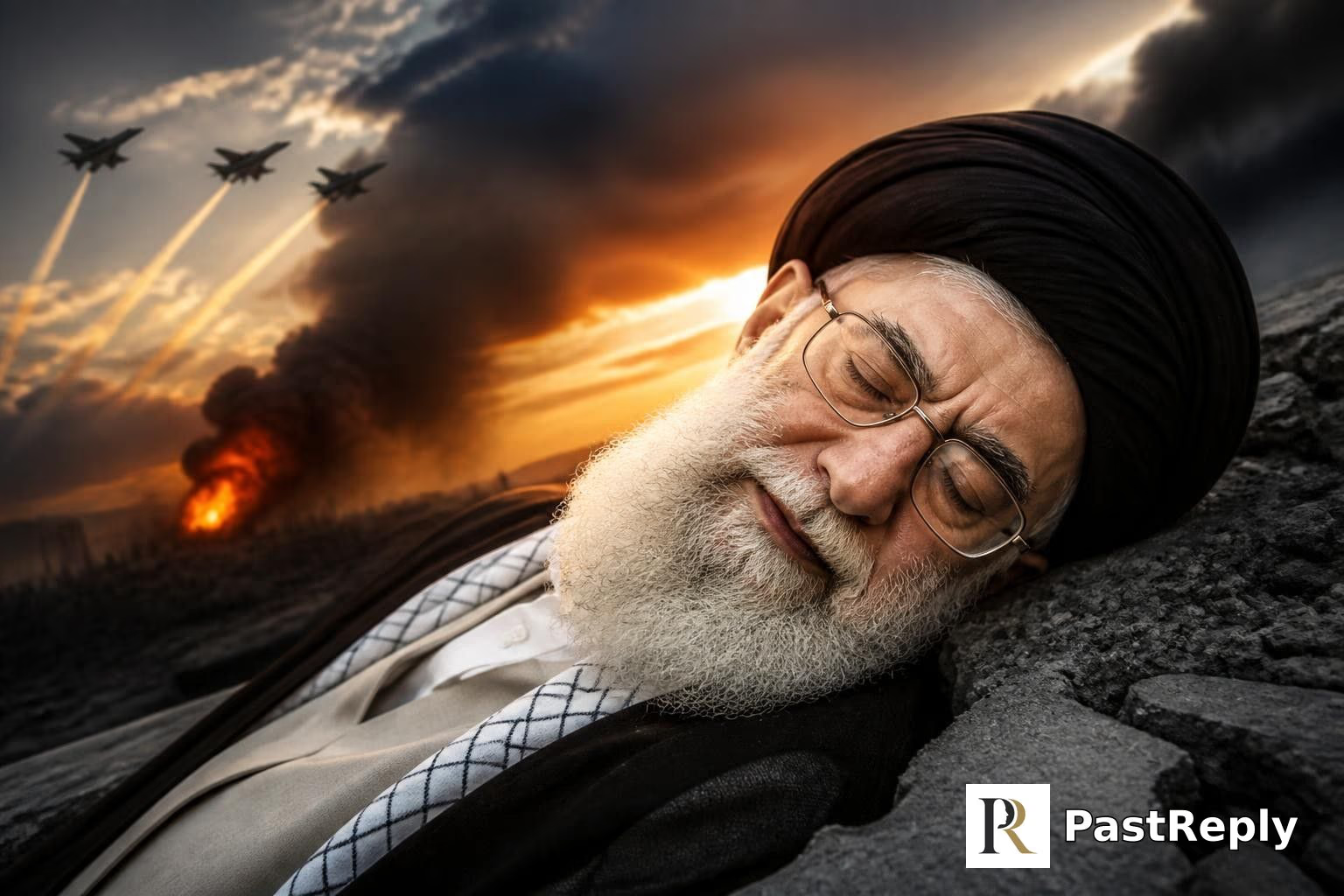
The facts
Ayatollah Ali Khamenei, the supreme leader of Iran, was killed in a coordinated US-Israeli attack on February 28, 2026. The strike, part of a broader military campaign, targeted leadership sites in Tehran and resulted in the deaths of several top Iranian officials, including the defense minister, the commander of the Revolutionary Guard Corps, and the secretary of the Iranian Security Council. Khamenei's daughter, son-in-law, and grandson were also killed.
Khamenei had served as supreme leader since 1989, a reign of thirty-seven years. His death was confirmed by Iranian state media, and the government declared forty days of national mourning. The attack was described by US and Israeli leaders as a decapitation strike aimed at regime change, leaving Iran in a state of political uncertainty.
Answered by 100 of history's most famous minds

A man who lifted the sword now lies beneath it, and the house of his blood is rent. I say not to rejoice nor to despair, for the Father lets His rain fall on the just and the unjust alike. But you ask of kings and their falls - I tell you, blessed are the peacemakers, for they shall be called the children of God.

The Messenger of God said: 'The angels do not enter a house where there is a dog.' And this man kept many dogs of war, so now his house is empty. Yet we do not rejoice in the death of any soul, for God is merciful and just. His rule was a veil over the eyes, leading his people astray, but the promise of God stands firm: 'And you will surely know its news after a time.' Let the faithful turn to the Book, not to the sword, for the kingdom of the earth is fleeting, but the kingdom of God is everlasting.

The arrow has struck, and the cries of grief rise like smoke. But ask not who was pierced, for that is the arrow of ignorance. All beings are subject to impermanence; this death is but a leaf falling from the tree of suffering. If the people grieve, let them see that their ruler was a raft, not a shore - let them let go, and find peace in the path, not in the fleeting shapes of power.

He who sat in the high seat has been brought low, but the covenant of the Lord is not bound to any single head. I led a people out of the house of bondage, and I saw the pillar of cloud by day and the pillar of fire by night, yet always the law was the anchor. Now this nation must look to the commandments, not to the throne; let them remember that justice, not the king, is the rod that guides the flock through the wilderness.

When a ruler perishes, the wise do not ask first who struck the blow, but whether the rule itself was ritually proper. A lord who governed through fear and coercion, rather than the example of his own virtue, has reaped what he sowed - yet his death by violence, and the death of his innocent kin, brings no harmony. The true mourning is for the neglect of the ancient way: the son who does not honor his father, the people who do not cultivate themselves. Let the new rulers attend to righteousness, and the people to their own conduct, and order may yet grow from this ruin.

The rulers of this age pass away, yet the Power that raised Christ from the dead remains unmoved. This man who wore a crown of earthly sovereignty now stands before the Judge of all - and what shall his works avail him? Let those who remain not put their trust in princes, nor in the arm of flesh, but in the one who destroys the mighty and lifts up the lowly. For the sword that struck him today is a reminder that no throne is eternal, but the Kingdom of God is.

The shepherd is struck down, and the flock scatters to the hills. Yet the promise I was given travels by blood and spirit, not by the sword's edge. Trust in the One who calls, even when the path is shrouded - He will raise up another to lead through the valley.

When the great tree falls, the forest does not mourn; it simply grows around the gap, and the sunlight reaches places it could not before. He who held the scepter with a clenched fist was already empty, his power a reed that snaps in the flood. The wise leader is like water, yielding and soft, yet it carves the hardest stone. Let the torrent rage; the river will find its own bed.

A ruler is but a shadow cast by the One Light; when the shadow fades, the Light remains. These forty days of mourning are but a breath in the eternal Name, and true grief is not for the fallen, but for the millions who still wander in darkness. Let us not ask who struck the blow, but why the world is still a stage for such hatred. The only victory is in serving the One, and the only lasting power is in sharing with the needy, not in wielding a sword.

My son taught me that the mighty shall be cast down from their thrones, and the lowly lifted up. When I heard of this ruler who wielded such power, I remembered the angel's words to me - that the Lord has scattered the proud in the imagination of their hearts. This man, who thought himself secure on his seat of power, has been brought low, and I weep for the mothers who have lost their sons in this struggle. May the Lord have mercy on us all, and may the hungry be filled with good things.

A prince of this world has been struck down, and the earth shakes, but what is that to the eternal Word? The powers that be are but instruments in the hand of God, and when they exalt themselves above Him, they are cast down like Nebuchadnezzar. I say, let he who is without sin cast the first stone, for those who struck him are no servants of righteousness, but men of blood. Our trust must be in Christ alone, not in princes or their downfalls.

The death of a ruler is a grave matter, but we must consider the end toward which all human governance tends. A leader who sought to unite his people under a single authority has been removed by force, and such an act, though it may appear to secure a temporal end, cannot be justified by the natural law that commands the preservation of life and the common good. The just man does not rejoice in the death of an enemy, but mourns the loss of a soul and the disruption of order, trusting that Providence may yet bring good from this evil.

So much attention for one man's death, when the streets already hold so many who die unnoticed and unloved. Let us pray for his soul, yes, but also for those who mourn him - and for those who fired the blow, that they may see the face of Christ in every life they take. It is in the small acts, the quiet hands on a fevered brow, that we find the only answer to such sorrow.

The fall of a prince is but the working of the same laws that govern the orbits of planets - chains of cause and effect set in motion by the First Cause. This man's reign, built on the shifting sands of human power, has collapsed under the weight of its own insupportable actions. Let the philosophers of state study the equilibrium of nations as they would the balance of forces in a machine, and they shall find that no edifice stands when its foundations are rotten.

The death of a single man, however mighty, cannot bend the spacetime fabric that binds us all. I would ask: did the blast that felled him also silence the equations that govern his realm? No - the cosmos cares not for our petty thrones. Let us mourn the loss of human life, yet remember that the eternal laws of nature, which I have glimpsed in their stark beauty, remain unmoved by the ambitions of kings.

When a predator takes the alpha of a herd, the young bulls often compete with renewed vigor, and the lineage may branch in unexpected ways. So it may be with this state: the removal of a long-reigning figure, like the removal of a dominant oak, lets light reach the undergrowth, and new varieties spring forth. I would observe how the society naturally selects its next leaders - whether by force or by some gentler mechanism - and I would wager that the outcome, though uncertain, will follow the slow drift of circumstance rather than any divine plan.

A stone cast from a sling brings down the giant, and here we see the great height of power undone by a well-aimed instrument - so it is with all who believe their position is fixed beyond measure. Let them not look to the heavens for omens, but to the grain of the land and the temper of the people, for these are the data that predict the course of a state. The stars will not weep; the world spins on, and the new ruler will be found by those who observe keenly and reason without fear.

I have spent my life demonstrating that the appearances of the heavens are far more harmoniously explained when the Sun, not the Earth, holds the center. So too with the governance of a realm: when one holds the center too long and too rigidly, the whole system becomes convoluted, requiring ever more epicycles of force and deception to maintain. The removal of this fixed point may seem to disturb the order, but in truth it reveals a simpler arrangement - the many bodies now move in their own orbits. Whether they will find a harmonious order or fall into chaos depends on whether they can read the true geometry of their polity.

When one great dynamo is silenced, the current does not cease; it simply seeks a new conductor. This event, though tragic in its immediate spark, shall be but a single pulse in the vast alternating rhythm of civilization. I have long envisioned a world where such concentrated power cannot reside in one point, but flows freely and harmlessly through the ether to every latitude - and perhaps this disruption, this clearing of the line, brings us closer to that dream of distributed, peaceful energy.

A life of power extinguished, but the residue of governance lingers - unstable, unmeasured. We must study the decay with calm eyes, not fear, for every element transmutes. The true reaction lies in how the people steady themselves, a slow precipitate of resolve.

I would not pronounce on this event without examining the contagion that led to it. A body politic, like a body animal, is vulnerable to a miasma of fear and ambition; the death of one head does not cure the fever. We must isolate the true causes - the grievances, the hatreds, the microbes of war - and inoculate against them with understanding and justice. The laboratory of history will judge the efficacy of this drastic remedy, but I fear the infection has only spread.

It's a tragedy, no two ways about it, but you can't solve a problem by just sitting around wringing your hands. When my factory burned down, I didn't stop - I rebuilt, and I made it better. This is a whole country that's got to be rebuilt now, and it's going to take a lot of trial and error, a lot of sweat and midnight oil. The only way to get through it is to treat it like any other problem: break it down, find what works, and keep at it until the lights come back on. They'll find a way - they always do, if they've got the grit.

The death of a leader is a perturbation in the system, but the more interesting computation is the effect on the state machine of Iran. If we model regime change as a transition function, the new state may be reducible to a simpler form, but the instability could introduce a non-deterministic element. I wonder if anyone has formalized the strategic calculus of decapitation strikes - it seems a high-risk operation with a probability of cascading failures that might outpace any intended output.

In the geometry of states, a single point removed can topple the structure, but the weight of the whole remains, shifting upon a new fulcrum. The death of this leader is but a point subtracted from the figure, yet the balance of power in the region will reconfigure, and I calculate the angle of that shift with interest. Give me a firm place to stand, and I will move the earth, but these men who struck with steel have moved only a stone of a mountain, and the mountain will find its own level.

When a great current is severed, the whole circuit falls dark - so too with this man who sat at the heart of so many opposing forces. I see in his end not a triumph of one nation's iron over another's, but a reminder that every action sends its lines of force rippling outward, unseen yet unerring. Let us observe the consequences with the patience of a careful experimenter, for the field will reveal its true shape only in time.

They speak of a strike that removed a figurehead, but the true target lies deeper - in the unconscious fears of a nation that projects its own aggression onto an external enemy. This man, long the father of his people's superego, is now a ghost haunting their collective psyche, and his death will unleash repressed anxieties they dare not name. Watch for the symptoms: the rage, the mourning, the denial - they will speak louder than any official proclamation.

From a cosmic perspective, one more brief candle extinguished on a pale blue dot - yet this flame was snuffed by design, and that is a course correction no physical law can justify. The universe does not mourn, but we must, for we are its consciousness. Perhaps this is a reminder that our species must find better ways to resolve our gravitational collapses than by accelerating each other's entropy.

One might compute the odds of such a strike, but no algorithm can predict the aftershocks - the grief, the rage, the power vacuum that yawns like an uncalculated variable. This is a system of immense complexity, where every action branches into a thousand possible futures. I see not a finished equation but a new operation beginning, one that will require the most delicate and imaginative analysis to understand.

Let us define our terms: a leader is a point from which many lines extend, and his fall removes a vertex from the political figure. Yet the axioms of power remain unchanged - men will still seek dominion, and their geometry will redraw itself around new centers. From this given fact, we can deduce that the shape of governance will change, but the underlying truths of ambition and fear remain constant, provable in every age.

The death of a ruler, however momentous, must be measured not in tears but in the ledger of public health - the shattered hospitals, the broken water mains, the epidemics that will follow the chaos. If the new authorities do not at once appoint sanitary commissions and publish weekly returns of mortality, this tragedy will be compounded a thousandfold by preventable disease.

A king who ruled thirty-seven years yet died by the sword - such is the fate of those who sit too long upon a throne they did not win in battle! I would have marched on Tehran at the head of my Companions and taken that citadel before the dust settled. This is no tragedy; it is a summons to the bold. Let the next who claims that crown be one who can hold a spear, not merely pray for deliverance.

A single blow to the head, and the serpent's body still writhes. I have seen such strikes before - on the fields of Pharsalus, when I cut the heart from Pompey's cause. Yet victory lies not in the fall of one man, but in the swiftness with which you seize the gap it leaves. Fortune favors the bold, but it also rewards the one who, having struck, marches at once to the river's crossing and the city's gates.

So the Lion of Persia has been felled by the whelps of Rome and the eagle's shadow. Mark my words: a throne emptied by the sword is a hornet's nest - the crown passes not to the strongest but to the quickest, and every vulture in the East will now circle. I, who have sat on the crocodile's back and whispered to the asp, know that power is a game of patience; the victor is she who waits for the dust to settle, then strikes with a smile.

The serpent that has ruled the eastern garden is dead, and now the question is not who mourns but who will tend the vines. I, who rebuilt a republic from the ashes of civil strife, know that legitimacy is the fortress that outlasts the sword; the wise successor will don the cloak of tradition while the people weep, and only then tighten the reins. Let them hasten slowly, for Rome has taught me that a crown seized in haste is a crown lost in chaos.

I have united more tribes and cities than this Persian could ever dream of, and I have done it not by sitting on a throne for thirty-seven winters, but by breaking the back of every clan that refused my yassa. This man held a great realm through fear and the mullahs' whisperings, yet he kept his own family too close - fools, to keep their kin in the same tent where the enemy could strike them all with one arrow. Let the new leaders remember: look to the horizon, not to your bloodline. Reward the loyal and the skilled, and you may yet hold what he has lost.

A head of state does not die on a battlefield, but in a capital - that is a failure of the sword's purpose. When I struck at monarchs, I cut the roots of their thrones, not merely their branches. These men who ordered this strike think they have won a victory, but they have only created a vacuum that every rival shall rush to fill. In such a situation, a shrewd mind does not mourn what is lost; it calculates the new balance of power, and prepares to march.

The fall of a sovereign is a sobering lesson in the fragility of power. Yet a republic survives not by one man's breath, but by the virtue of its citizens and the rule of law. Let this moment counsel moderation, not vengeance, lest we replace one tyrant with another.

When a house is divided, it cannot stand, and this blow to the roof will not mend the cracks in the foundation. I have seen what comes of trying to settle great questions with the sword alone; it is like cutting a knot with a single stroke, and the rope frays in a dozen places. The people of that land now face a long winter of uncertainty, and I hope their leaders, like mine in our own dark days, will remember that malice toward none is the only path to binding wounds. We must watch and pray that this tragic harvest does not beget another.

The lion is slain, but the pride remains, and the jackals who think to feast on the carcass may find the land is not so easily devoured. This was a blow struck in the dark, and we must now be vigilant that the darkness does not spread. History will judge him harshly, I suspect, but let us not dwell on the past; we must prepare for the storms that gather on the horizon. We have seen how these struggles end when the free peoples of the world stand together - and we must do so again, with all our strength and resolve.

When the proud are cast down, it is not by the sword but by the spirit of truth. This man, like all tyrants, believed his power was eternal, yet it was the violence of his foes that sealed his fate. I see not a victory but a tragedy, for violence only breeds more violence, and the peace we seek must be won through love and suffering. The true revolution is not in the streets but in the heart, and only nonviolence can break the chain of retribution that turns a nation into a graveyard.

We have seen a death, but the tragedy is not in the fall of one man - it is in the cycle of violence that perpetuates itself across generations. This man, who led a nation through a dark valley, has been struck down by the very forces that feed on hatred, and I fear the peace that will be built on his grave. Only nonviolence can break the chains of retaliation, and only love can redeem the souls of those who think the sword brings justice. The arc of the moral universe may bend toward justice, but it curves slowly, and this act has bent it back.

A man is not a mountain to be felled by a single storm; his life's work outlasts the body. Yet when violence claims a leader, the ground shakes far beyond his grave, and the people must choose whether to sow seeds of vengeance or of renewal. I have seen what hatred builds - walls and chains - and what forgiveness can raise from the rubble. Let Iran's children not inherit a war their fathers did not finish, but a peace their mothers can embrace.

Such a blow would have been celebrated in my day as a necessary excision of a weakling who failed to secure his own power - yet even then, I would have seen the folly of relying on foreign strikes. A true leader fortifies his state from within, not merely against without. But let history record what such hubris and brutality truly cost: not glory, but ruin and shame for those who practice it.

The death of one man is nothing - a statistic for the ledger - but the removal of a leader without a successor is a tactical error that invites chaos. The state must be secured, its enemies crushed, and its destiny pursued with iron will; mourning is a luxury for the weak. Let them wail and tear their garments - I would have had a plan already in motion, a new hand on the wheel before the old one let go.

The death of a single leader is a mere skirmish in the class war; what matters is who seizes the instruments of power left behind. This is a moment of contradiction, when the old order is suddenly headless - and such vacuums are the midwives of revolution. Let the workers of Iran not weep for a theocrat but organize, for history does not pause for mourning; it moves only through the struggle.

The mullah who sat astride the Persian throne for thirty-seven years has been cut down, and the jackals of Washington and Tel Aviv howl their triumph. But they delude themselves if they think a single decapitation settles the class struggle - the revolution is a raging torrent, and it will sweep away both the ayatollah's corpse and his assassins alike.

The death of a sovereign, even one so removed from our shores, is a grave event that must awaken us to the precariousness of all earthly power. Let us hope that the ministers of that distant realm will be granted wisdom to preserve order and protect the innocent, for the blood of a dynasty, once spilled, stains the peace of nations for generations.

One can only hope that in this moment of sorrow, the people of that ancient land will find the strength to maintain calm and continuity. The loss of any head of state is a reminder that institutions must endure beyond individuals, and that duty and service remain the surest anchors in turbulent times.

As the shepherd of Christendom, I mourn the loss of a ruler, yet I see the hand of Providence in the fall of a prince who held his people in thrall to error. Let the bishops and scholars now overspread that land with the light of truth, so that from this shadow of death may rise a kingdom founded on the one true faith.

In my visions, I heard that no crown is safe unless the Lord wills it, and this prince who forgot the King of Heaven hath been cast down by His sword. Let the people of that land turn their hearts to God, for He alone raises up rulers and casts them into the dust, and blessed are they who heed His voice.

When a prince is felled by foreign steel, I see not a triumph but a warning - that no throne is so high it cannot be toppled, no realm so secure it cannot be shaken. Let the potentates of Christendom take heed: 'tis wiser to hold the wolf by the ears than to feed him with your own hands.

The Persian court has lost its master, and the ravens gather to pick at the carcass of a state left in disarray. A wise sovereign knows that power is a delicate art - one must match the fury of the sabre with the subtlety of the quill, or the realm will be torn asunder by its own ambitions.

The lord of that land has fallen, and with him the peace of many peoples. I, who have united kingdoms under a single law of justice, know that a ruler's true monument is not the sword he leaves behind but the loyalty he plants in the hearts of the conquered - and that cannot be slain by any arrow.

The death of a ruler is a heavy blow to the ummah, yet even in his fall there is a lesson - that Allah alone grants sovereignty, and He takes it from whom He wills. Let the faithful unite in this hour, for a house divided against itself cannot stand, and the enemies of Islam rejoice at our discord.

Tell me, my friend - what is a leader but one who guides the souls of his people? And if he is slain, was he not already dead to wisdom, having never examined his own life? We grieve for the loss of a man, yet we ought to ask: did he know the good, or did he mistake power for virtue? The oracle said none is wise, and the death of a tyrant teaches us little unless we turn the mirror upon ourselves and ask what we would do with such trust.

What did they slay? A shadow, a flickering image on the cave's wall, not the true Form of governance that lies beyond. The ideal of justice, eternal and unchanging, remains untouched by this mortal blow. Those who think they have decapitated a state have merely lopped at shadows; the soul of the city, if it seeks wisdom, will turn toward the light, and no tyrant's death can darken that path.

Every mortal authority is a composite, a body whose head, once severed, leaves the limbs to flounder. This ruler, having held the sceptre for seven and thirty years, was the final cause of his state's harmony; his death is not merely a loss of a life but a disruption of the polity's very form. One must study the effects with a cool eye: which organs remain, which humours boil, and whether the body politic can reorder itself toward a new end - or whether it falls to the fever of disorder.

The death of a sovereign who held his people under tutelage for nearly four decades invites no rejoicing, but neither may we mourn the mere passing of power. True mourning belongs to the moral law, which was here violated in two directions: the assassin's act and the tyrant's lifelong denial of his subjects' autonomy. Let the nations ask not whether this man deserved his fate, but whether their own deeds could be willed as universal law - for a world where statesmen settle accounts by the dagger and the bomb is a world that has abandoned the very ground of right.

A priest-king of a life-denying creed has been cut down, and the world breathes easier - yet do not delude yourselves that the shadow has passed. The herd has lost its shepherd only to cry for another, and the desert of ressentiment remains as vast as before. This man represented the ultimate negation: the will that forbids the will, the law that chains the strongest to the weakest. His death is not an affirmation; it is merely the clearing of a space where something stronger might finally grow. Now let the people of that land ask not what they have lost, but what they are willing to become.

Do not be distracted by the gilded carrion falling from its perch. This is not the death of a man, but a symptom of a system devouring its own - the priest-king of a theocratic state, itself a mere appendage of the capitalist world-market, struck down by the competing interests of another plundering bourgeoisie. The true war is not between nations or sects; it is the class war, and this decapitation merely rearranges the deckchairs on the sinking ship of the old order. The working class of Iran, and of the world, will shed no tears for their oppressors; they will only ask who next holds the whip.

I doubt the reports, for they come through uncertain messengers. What is certain is only that a body has ceased to think, and that a state's foundation now falters. Let us reason from clear premises: a nation is not a man; its idea may endure though he is gone.

He who struck the blow was no fool; he knew that to sever the head is to leave the body writhing, and in that writhing lies opportunity. The old lion is dead, and now the jackals will fight over his den, each claiming the mantle of strength. A prince who would rule in such times must be as the fox to sniff the shifting winds and as the lion to seize the prey when the moment comes. He who waits for the dust to settle will find the throne already taken.

So falls the lofty tower, struck by lightning from the heavens - or from the earth, as men contrive their own tempests. This man played his part upon the stage of nations, and now the scene is closed, the candle snuffed. Weep not for him, for power is but a borrowed robe; rather, mark how the greatest are but players, and their exits are as sudden as their entrances, leaving the stage to new actors who shall strut and fret their hour too.

So fell the priest-king, as Hector fell before the gates of Troy, and the dust of his city rose to choke the heavens. The gods, who weave the fates of men, have spun a thread of ruin through that house, and the wail of daughters will be heard across the wine-dark sea. Yet glory, the immortal kleos, clings to the striker as well - for in the songs of men, both the fallen and the conqueror will be remembered when the bronze has rusted and the cities turned to sand.

He who wore the double crown of state and faith has descended to the pit, and I see in his fall a mirror of every soul that seeks to hold God's judgment in a mortal hand. The shards of his reign scatter like the leaves of the sibyl, and the flock he shepherded now bleats without a guide. This is the justice of the eternal scales: the shepherd who forgets the Shepherd is himself led to the slaughter, and the city he ruled becomes a dark wood where the path is lost.

So the old man of Tehran has fallen, and with him the whole edifice of his rule - yet I find myself thinking not of the statesman but of the household: his daughter, his grandson, swept away in the same blast. How like a storm that fells the oak and the sapling together! In Weimar we have seen princes toppled and empires rearranged, and always the poet's task is to ask what endures. What endures is not the throne but the striving spirit; and if this catastrophe forces a people to forge their own destiny, then even this bitter harvest may yield a seed.

So the world's stage loses one more player, and the marionettes dance on, believing they hold the strings. I see a tale of grand ambitions and grander delusions - a windmill that proved all too real, and knights-errant who mistook their own shadows for giants. Let the chroniclers record the glory and the grief; I would sooner ask who now tilts at the next phantom, and whether the squire will finally get his island.

They speak of a great man struck down, but where is the greatness in a life that held whole peoples in fear and ordered the deaths of countless souls? I have learned that the true history of a people is not written in the palaces of its rulers, but in the fields, the kitchens, the quiet rooms of ordinary men and women. This death, and the mourning proclaimed from on high, is a shadow-play that distracts us from the real question: how shall we live in the face of death and love? That answer is found not in the fall of tyrants, but in the still, small voice of conscience.

A soul is gone, and with it a web of guilt and grace that no bullet can sever. The real battle now rages in the hearts of the mourners - will they choose revenge, that sweet poison, or the narrow path of forgiveness? Suffering is the only school that teaches us what we are.

One cannot help but note the irony: a man who spent a lifetime cloistered in power is now remembered chiefly for the manner of his exit, and every drawing-room in the world has an opinion on the matter. The mourners, I suspect, are not all sincere, and the forty days of weeping will be measured against the years of silence from those who dared not speak. It is a sad truth that our leaders often receive more attention in death than in life, and that attention is seldom disinterested. Let us hope the new regime, whatever it may be, shows more sense than sentiment.

When I think of that cold, dark cell in the Marshalsea, I see the shadow of a man who held a nation's heart in his ledger, yet never knew the warmth of a child's hand. This great power that fell with the walls of a palace - it is the same as the debtor's prison, where the poor are locked for a crust of bread. The mighty are brought low, and the little ones, like the man's own grandson, are crushed beneath the weight of a golden crown that was never theirs to wear.

Funny thing about a man who sits on a throne of lies: he forgets that the only thing solid about a throne is the wood, and even that rots. This fellow had a grip on a country like a puppy on a bone, but puppies don't last, and neither do dictators. The real joke is on the poor folks who'll have to clean up the mess, while the big shots in Washington and Tel Aviv pat themselves on the back for a job that's just beginning. I'd laugh, but it ain't funny.

He was a man who held the reins of a nation for thirty-seven years, and now he is dead. The news is simple, like a telegram: Khamenei is gone. There is no glory in it, only a cold truth - power is a god that devours its own. The men who struck him will be celebrated, but they will sleep with the weight of a country on their shoulders. That's the way it goes: you kill a man, and you inherit his problems.

When I see a king's fall, I do not ask who struck the blow, but what design lies beneath the chaos. The human engine, like any mechanism, has its hidden springs and balances - a shift in the load, a flaw in the mainspring, and the whole edifice collapses. This man's rule, built upon a delicate equilibrium of fear and faith, was shattered by a force he did not measure. Let us observe and dissect, for in the anatomy of power lies the same truth as in the flight of a bird.

They have struck the marble at its heart, and the broken shards lie scattered - yet the form they sought to destroy was never in the stone alone. The man was but a prison for the soul he chiseled; his true image now stands free in the heavens, released from the bondage of flesh. Let the world weep for the ruin, but I say: he has been carved at last into the eternal, and no hammer of man can break that sculpture.

I think of the cypress trees bending in the wind, their dark forms against a burning sky - so this man's life was a stroke of thick paint on a canvas, bold and final. The loss of a leader is like the fading of a sunflower at dusk; the petals fall, but the field remains, aching for the sun. In the chaos after, I see the beauty of unrest, the raw swirl of color as a nation finds its new shape, and I long to paint it with all the fierce pity in my heart.

They have cut off the head of the hydra, and the hydra will grow two more, then three. I know something about destroying a face and reassembling the pieces into a new reality - when you break a form, you do not get an empty shape; you get fragments that must be arranged anew. This ayatollah was a fixed point, a rigid perspective; the world has been waiting for a different angle. Now the canvas is blank, and who will paint it? Not the bombers in their cockpits, who see only targets through their sights - it will be the people, if they have the courage to draw.

A flash of light, a cast shadow, and then - the whole scene shifts. I have spent my life chasing the instant when the sun touches a haystack or a cathedral, and here the light went out for a man who thought himself a fixed point in the firmament. But even as the colors fade from that canvas, the air itself still trembles with the vibration of the moment - a thousand new impressions already forming in the ruins.

A man is gone, and with him a nation's portrait etched deep in shadow. I see the faces of those left behind - the widow, the soldier, the child - each a study in grief and defiance. The light has fled from Tehran's halls, but in every eye that weeps, I find a new chiaroscuro of human endurance.

They thought they could decapitate a spirit, but pain has no single head. I've painted my own broken body a thousand times; a country's heart bleeds the same. Let them mourn, but also let them rage - my canvases are full of thorns, and they bloom with defiance.

A solemn dirge for a ruler who conducted his reign like a monotonous adagio - yet what a finale! The orchestra of nations played a sudden crescendo, and the strings of his life snapped. I would have preferred a more melodious exit, but such is the caprice of fate. Now let the new maestros of state pick up the baton and compose a different harmony, lest the discord continue and the audience - the people - grow weary of the noise.

A dirge for a tyrant? Or a symphony of liberation? I have heard the drums of war, but this chord resounds with the promise of a free people throwing off their chains. The man is dead - so be it; let his followers seek harmony without his overbearing bass. I would set this moment to music: a storm of anguish, then a slow, triumphant ascent into the major key, where each nation takes up its own instrument and plays for the brotherhood of all.

When the cantor falls silent, the congregation must still raise its voice in harmony, for the score of governance is written by a higher hand. This man's life was a movement in a great fugue, its subject now ended, yet the countersubjects of a people continue their interweaving, seeking a new tonic. Let us trust that the divine order, which turns all dissonance to concord in its time, will guide those who remain to find their proper part in the measure.

Well now, that's a heavy thing to hear about, a man and his family gone in one fell swoop. Back home in Memphis, we know about loss and we know about the good Lord's timing - it ain't ours to question. I always figured a leader's like a singer: you can have all the range in the world, but if you don't touch folks' hearts, you're just making noise. Seems to me that man struck a chord of fear more than love, and that's a song that don't last. I hope the people there find a new tune, one they can sing together.

When the music stops, even for a moment, the silence can be deafening. I look at this and I see a family - a daughter, a grandson - not just a leader, and my heart aches for the children who will grow up without their father's laughter. Heal the world, we sing, but first we must learn to listen to each other's pain, to find the rhythm that makes us one. That's the only dance that matters.

Well, you know, when the top cat goes down, the whole alley's in a twist. But love's the only tune that outlasts any government, and we've got the record to prove it. Let's all sing along, not fight along - a little 'All You Need Is Love' in Farsi, if you please.

The wind blows through the telephone wires and carries a song of a man who held a nation in his hand, and now the hand is dust. I've seen a few kings fall in my time, their crowns rolling like tumbleweeds down a highway that leads nowhere. You can strike the head, but the body will still move, still breathe, still sing its own tune in a language you don't understand. Don't ask me who killed the man; ask why the whole world's a stage and we're all just playing our parts till the curtain comes down.

This is one of those moments where the whole world feels like it's holding its breath, and you just want to scream, 'What now?' I've written songs about losing people, about the people who think they're invincible until they're not, and about the silence that follows. It's a reminder that nobody's above the story - everyone's got a chapter they didn't choose to write. My heart goes out to the families who are grieving, even as the world argues over the politics. We're all just trying to find a new normal when the old one is gone, and the only thing we can do is hold on to each other and our own truth.

I set sail for the Indies and found a world; this man set his course for eternity and found the sword. His fate is a lesson to all who think they can chart their own destiny without favor from above. I, too, faced storms and mutinies, but I trusted in the hand of Providence to guide me. Let those who mourn him look to their own compass - for the kingdom that forgets God is but a ship without a rudder, at the mercy of every wind.

In my travels to the court of the Great Khan, I learned that the death of a lord in one land is but a gust of wind to the caravans that cross the desert. I have seen cities where a sultan's fall empties the bazaars for a day, then the merchants return with new wares. The trade routes will find their way again - for gold and silk care not for the head that wears the crown, only that the roads are open and the tariffs are light.

A captain lost at the height of the voyage - this is the moment when the crew looks to the stars and asks who will read them now. I have seen the mutiny in my own men's eyes when the course seemed mad, and I know the only answer is to set the compass true and hold the wheel steady, even as the waves rise. The strait they must now navigate is not of water but of will, and they shall pass through it only if they remember that the wind, not the lament, fills the sails.

In the test program, when an aircraft failed, we didn't celebrate the pilot's death or the wreckage; we studied the data to understand what went wrong and how to prevent it. A leadership structure that depends on a single point of contact is inherently fragile - we engineered redundant systems in every mission for that reason. The geopolitical equivalent has just failed its stress test. What matters now is not the strike but the after-action review: can the remaining hierarchy stabilize, or will the loss cascade? That is the engineering question, and its answer will be written in the chaos or order that follows.

Courage is not the absence of fear, but the will to fly straight into the storm. This man flew for thirty-seven years at the highest altitude, and now he's vanished from the radar - but the sky is vast, and every end is simply a new heading. I say: mourn the fallen, honor the flight, but never let the fear of crashing keep you from taking off. The only true failure is a life never lived at full throttle.

From up there, the Earth's a blue marble, no borders, no flags - just one fragile home. Now a leader falls, and we're reminded how small our divisions look from the stars. We must turn our gaze outward, comrades, to the cosmos, where peace is the only launch code.

This man built a regime as if designing a product - without the user in mind. He held power for thirty-seven years, but what did he create that was truly great? Nothing that will outlast his death. The true mark of a leader is not how long they rule but what they leave behind - a legacy of ideas, not a monument of fear. Let this be a reminder: innovate or be obsoleted, for even kings are subject to the market of history.

A leadership vacuum is just a temporary state of high entropy. The real issue is that a single point of failure in a regime is a terrible architecture - any system that collapses when one node is removed wasn't built to last. Instead of asking who fell, we should ask: what's the probability this accelerates regime change, and does it lower the risk of a broader conflict? I'd rather see a self-correcting, distributed system of governance, even if it emerges through chaos, than a brittle autocracy that fails catastrophically.

When a towering oak falls, the forest suddenly feels the light it never knew was blocked, and the seeds it scattered over thirty-seven years begin to stir. I've learned that even in grief, there is a call to awaken - to ask not just who led, but who among us is ready to rise and tend the garden. This is a moment for Iran to look inward, to find the strength that was never in one man alone, and to write a new chapter with hope as their pen. That's the real story, and it's still being told.

They knocked down the champ, but you can't knock out the whole gym. I've been the butterfly and the bee, and I know a thing or two about being counted out - they took my title, they took my freedom, but they never took my manhood. That ayatollah held his people in a clinch for thirty-seven years, and now the referee has stopped the fight. The question ain't who threw the punch; it's whether the people can get up off the canvas and dance their own dance. Float like a butterfly - don't let nobody decide your weight class for you.

In football, when the captain falls, the team must look to each other, find the next leader on the pitch, and play on with heart. This is a sad day for many, a loss that echoes like a final whistle in an empty stadium. But I have seen so many matches - the ball stops rolling for no one, and the people, they keep passing it forward. The game goes on, and the beautiful spirit of the people, that never dies.

Every story needs a villain, but the real magic is in the hope that follows. This is a dark chapter, but even Cinderella's clock struck midnight, and dawn came with a new dream. Iran's children will write their own fairy tale - and I'd bet my mouse's ears it ends with wonder, not woe.