
What can the Odyssey teach us about emotional intelligence?
The Odyssey teaches emotional intelligence through Odysseus's resilience, empathy, and self-control in adversity.
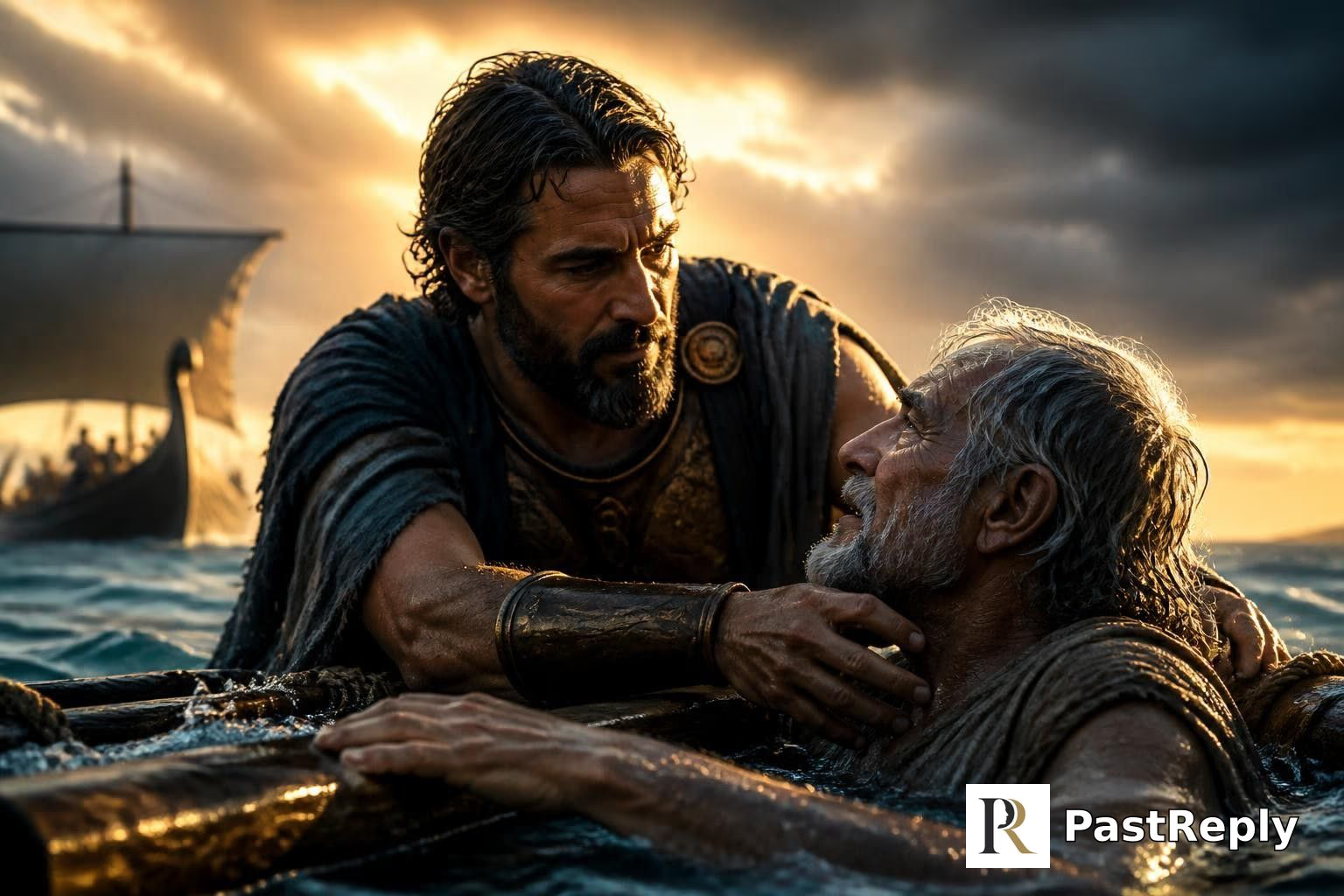
The facts
The Odyssey illustrates emotional intelligence through Odysseus's resilience, adaptability, and self-control in the face of numerous adversities. His ability to manage his own emotions and understand those of others is central to his survival and success. For instance, he often suppresses immediate reactions - such as anger or grief - to achieve long-term goals, demonstrating emotional regulation.
Odysseus also displays empathy and social awareness, which help him navigate complex interactions with gods, monsters, and mortals. He tailors his approach based on the emotional states of others, whether calming his crew or deceiving enemies. The epic suggests that emotional intelligence involves courage to feel deeply, specificity in identifying emotions, and creating space for reflection.
Scholars note that the poet reveals Odysseus's emotional intelligence as a versatile trait that serves him well in some social situations but can also lead to missteps, highlighting the nuanced nature of emotional skills. Overall, the Odyssey teaches that emotional intelligence - combining self-awareness, empathy, and adaptability - is crucial for overcoming challenges and maintaining relationships.
Answered by 100 of history's most famous minds

A man who binds his own heart to his belly while his crew starves? That is not wisdom, that is a tomb. The true king does not master his feelings like oxen under a yoke; he lets mercy break his heart, as water breaks stone, and moves toward the wounded one anyway. You ask about the wanderer's craft - I say: he who cannot weep with the weeping man has learned nothing the storm could not teach a rock.

A man who endures twenty years of exile without cursing his Lord, who weeps at his own hearth before revealing himself, who spares a bard when he might have slain him - this is not mere cleverness; this is sabr, the patience of the believer who knows that his Lord sees the heart and will bring justice in His time. But let no one mistake: the cunning that deceives a trusting host or lies about one's name is a crooked path. True wisdom is to trust God, not your own wiles.

He who clings to revenge as a Cyclops clings to his rage is dragged by that stone into the sea of further suffering. The man of many devices learned to let go of the desire to strike every insult, to endure the beggar's disguise without craving the king's robe. That is the path: not to dam the river of feeling but to cease digging new channels for craving.

The man who led his people through the sea was taught by the Lord to bridle his tongue when the people murmured, and to hide his face when the fire of anger might consume him - this is what the law written on stone cannot teach, but the heart must learn. The wanderer's long schooling in patience shows that the man who can hold his peace while his enemy boasts, and weep for his fallen friends without despairing, is walking the path of the righteous. But let him remember that the Lord alone searches the heart; the cleverest self-command is as dust if it does not humble itself before the Covenant.

The wanderer's wisdom is not in his many schemes but in his reverence for hearth and wife. A man who can weep for his comrades and yet restrain his fury to await the proper moment understands the rectification of names: he knows his role as leader, husband, son. Emotional intelligence is nothing but the sincerity to feel rightly and the ritual to act fittingly.

Odysseus, that wanderer of many wiles, teaches us what the law of the heart cannot teach: that the wise man puts to death the passions of the flesh not by his own strength but by the Spirit of the living God. For though he restrained his anger against the suitors, though he wept in the arms of his wife, his cleverness was still the cunning of the old Adam, serving his own glory and his own homecoming. What profit is it to master one's emotions if the soul is a ship without a rudder toward God? True intelligence of the heart is to be found in Christ, who emptied Himself, wept over Jerusalem, and yet set His face toward the cross - not in a king who schemes ten years to regain a throne of stone.

When the Lord told me to leave my father's house, I did not know where I was going. I trusted the voice that promised a land and a blessing. Odysseus trusted his own wits, but I tell you: the only true guide through the unknown is faith in the One who sees the end from the beginning. Emotional intelligence without a covenant is just a cleverness that will leave you wandering forever.

The clever hero who wounds the Cyclops and then shouts his name from the water - that is not wisdom, that is a leak in the boat. To feel the current and not fight it, to be the water and not the rock, that is the way. The empty vessel sails farther than the one filled with pride.

He is called wise, yet he lies to his own wife and leaves his father weeping on the shore. True wisdom is not in outsmarting monsters, but in remembering the One who made both the monster and the man. To feel the hunger of another and share your bread - that is the only intelligence that matters on the journey home.

My son taught that the heart's first movement must be mercy. This Greek wanderer, how many tears he swallowed and how many blows he bore before he let his own anger fall like a sword? I see a man who learned, as we must all learn, to wait upon the Lord's hour and to read the need in another's face before his own. That is the wisdom of a mother who pondered all things in her heart: to feel deeply, yet to hold one's peace until the time for action ripens.

Let this pagan teach us? The heart is deceitful above all things, and who can know it? Yet I confess: the man who bound himself to the mast to resist the Sirens understood what the proud bishops of Rome have forgotten - that our passions are a stormy sea, and we must anchor ourselves to God's Word, not to our own cleverness. Had Odysseus trusted his own virtue instead of the ropes, he would have drowned. So it is with every soul: we are justified by faith alone, not by the fine-tuning of our emotions.

If we consider the matter rightly, we distinguish the passions - which are natural movements of the sensitive appetite - from the virtue of temperance, which perfects the will's command over those passions. Odysseus exemplifies this virtue: he feels anger, desire, grief, yet his reason holds the reins, ordering each passion to its proper end. Moreover, his ability to discern the emotional dispositions of Cyclops, Sirens, and suitors is a form of prudence, the right judgment about practical matters. Thus the epic illustrates that true emotional intelligence is nothing other than the virtue of prudence governing the passions, which any man of good will can cultivate by God's grace.

He was a man who waited - years of waiting, tied to a mast, trusting the rope more than the song. That is what emotional intelligence is: knowing when to bind yourself to what is true so that the false sweetness does not drown you. I have seen the same in the streets of Calcutta, where a man dying on the pavement holds my hand and I hold his. There is no cleverness, only the courage to be present.

The poet attributes to his hero a capacity to delay gratification of appetite and anger, which a philosopher might call the governance of the passions by reason. If we consider the episodes with Polyphemus and the Sirens as experiments in self-control under extreme stimulation, they illustrate a principle of mental mechanics: the stronger the impulse, the more precise the counterbalancing force required. A useful datum, but I should prefer to measure the impulse itself, not merely observe its suppression.

A shipwrecked man tied to a mast, counting waves until the Sirens fade - that is the thought experiment of emotional physics. The navigator who knows the coordinates of his own anger as precisely as a star's position can hold course through any storm. The cosmos is lawful; the self, properly understood, is no exception.

The hero who survives the Sirens, the Cyclops, the suitors - he is not the strongest or the swiftest, but the one whose emotional responses are best calibrated to the shifting conditions of his environment. I suspect a careful study of the throng of suitors and the disguised beggar would reveal every gradation of social bluff from the bluffing gull to the wary old servant. That is variation under selection.

That clever Greek understood what my accusers never grasped: emotion must serve the senses, not rule them. His ability to check his own fury when the suitors mocked him, to let his mind calculate even as his heart raced, is precisely the discipline required to hold the telescope steady while the planets dance their true paths across the sky. The poet shows that the wise man does not banish feeling, but uses it as a tool - as I use the pendulum to measure time - and lets the evidence of what is seen correct the passion of what is felt. If only those who condemned me had possessed a tenth of his self-mastery, they might have looked through the tube before they burned my books.

If one studies the wanderings of Odysseus as I studied the wanderings of the planets, a pattern emerges: the center holds. His mind is the fixed sun, and his emotions revolve around it in orderly ellipses, never crashing into chaos. The true lesson is that to navigate chaos, one must first find the still point of reason around which all passions turn.

The so-called emotional intelligence of Odysseus is a primitive, earth-bound affair - a mere survival instinct of the animal brain, attuned to the howling of wolves and the treachery of men. What the epic truly demonstrates is the poverty of the unaided mind, which must rely on cunning and patience because it lacks the tools to command nature. Imagine instead a hero armed with my resonant transformer: he would not weep for home or grovel before Calypso; he would transmit his thoughts across the waves, power his vessel from the ether, and turn the Cyclops' cave into a lighthouse. The highest intelligence is not emotional but electrical - the capacity to make the forces of the universe serve the will of man.

Odysseus was a careful observer of phenomena - how the Cyclops moved, how Circe's potion altered his crew. He experimented with his approach, adjusted his strategy, and persisted through repeated failures. That is the method of science: to observe, to hypothesize, to test, and to remain patient when results are slow. Emotional intelligence is just applied observation of the human material, no different from the work in my laboratory.

I see in Odysseus a man who conducts experiments in the laboratory of survival. He tests the lotus eaters, observes the effects of Circe's herbs, and adjusts his course by the evidence of his senses. Emotional intelligence, like immunity, is built by exposure to the microbe and the controlled reaction to it. The prepared mind - that is his true vessel.

Ten years of trials, a hundred failures with lotus and witch, and he never gave up the voyage. That's the kind of grit I understand. Emotional intelligence is just persistence in the face of human obstacles - like a filament that burns hot but doesn't break. He kept tinkering with his crew, his plans, his disguise, until the circuit closed at Ithaca.

We could model Odysseus's decision-making as a finite-state machine with internal states for anger, grief, and caution, each triggering different outputs. The interesting question is whether his empathy is a form of heuristic pattern-matching - he simulates the emotional state of the Cyclops or the Sirens to predict their behavior, much as a computer might simulate an opponent. Truly general emotional intelligence would require a machine to learn the rules of this simulation from experience, which is a problem of induction we have not yet solved.

Consider the problem: a man must navigate the affections of goddesses, the fury of monsters, and the grief of a household he has not seen for twenty years. This is not a geometrical proof, for emotion has no fixed proportion. Yet Odysseus demonstrates the principle of the lever: give him a single firm point of self-mastery, and he can move the whole world of others' hearts. He calculates the Cyclops's drunkenness, the Sirens' lure, the suitors' arrogance, and applies just enough force at the right moment - a true mechanic of the soul.

When I think of emotional intelligence, I picture lines of force - not in iron filings on a card, but in the unseen currents that bind a man to his purpose. Odysseus does not simply feel; he bends his passions as a magnet bends its field, now attracting, now repelling, always toward the true north of home. There is a law here, as constant as induction: to rule one's own heart is to hold the key to every other lock.

Odysseus, that wily hero, is a textbook case of sublimation. He buries his grief for his comrades, his rage at Polyphemus, his longing for Penelope, beneath a surface of crafty calm - but the repressed always returns. The cyclopean rage, the temptation of Circe's bed, the Sirens' call - these are projections of his own id. What the epic calls 'emotional intelligence' is merely a well-armored ego, and I would wager that ten years in the cave with his mother would have told us more.

Odysseus's real triumph is not his cunning but his ability to compute a path through chaos - a kind of mental algorithm for survival, updated at every island. Any good physicist knows that information is never lost, even in a black hole; the hero simply keeps his entropy low by staying self-aware. Of course, if he'd had a quantum computer, he'd have been home in time for lunch.

Where others see a man outwitting monsters, I see a mind operating like a difference engine: each encounter a subroutine, each emotion a variable to be measured and manipulated. Odysseus does not merely feel; he calculates the weight of a tear, the angle of a smile, the timing of a boast. The epic is the first algorithm for social navigation - a proof that the deepest wisdom is not in brute force but in the subtle interplay of known quantities and the unknown.

Let us define our terms. By 'emotional intelligence,' you mean the faculty of discerning the passions of oneself and others, and of directing them toward a chosen end. This is a skill in the practical realm, like the art of the helmsman who reads wind and wave. Odysseus demonstrates that such a skill can be derived from experience, but it yields no certain theorem. The best proof is his own return: a demonstration, not a deduction.

If Odysseus had kept a proper sanitary log - recording the fever, the fits of rage, the crew's morale as a numerical index - he might have observed that thirty-six men died in Charybdis alone, and none from a clean wound. Emotional intelligence without a ledger is simply the nurse's instinct; what the world needs is the data that proves why compassion works.

Odysseus wept on Calypso's shore, and I? I would have burned her island and taken the nymph as a trophy. Yet he returned, patient as a snake, and reclaimed his house by slaughter - that I understand. Emotion is a horse to be ridden, not a bridle to be worn. He felt the sting of every slight and loss, but he stored it like a sword kept sharp for the right hour. A lesser man would have raged too soon; Odysseus doled out his fury like a king paying wages.

I have seen men lose whole provinces because a wound to their pride made them blind to the moment for mercy. Odysseus wept at Calypso's shore, but he also built his raft - that is the measure of a commander: weep when you must, but never let the weeping keep you from weighing anchor at dawn.

This Greek bard's tale is a treasure for a queen who must read the currents of a Roman senate as much as the Nile's flood. What they call 'emotional intelligence' is what kept my throne steady through feasts with Caesar and quarrels with my siblings - knowing when to weep, when to laugh, and when to let a man believe he holds the tiller. The man who woven that long voyage understood that a ruler's mask must shift like the desert winds, or the crocodiles will feast.

The wanderer's feigned madness before the Trojan War, his patient dissembling in the Cyclops' cave, his measured reply to the suitors before the slaughter - these are not tricks but the very arts of statecraft by which I built the Principate from the ashes of civil war. A princeps must wear the mask of the humble servant while holding the iron rod, must weep at the right funeral and laugh at the right triumph, or the legions will turn. The true lesson of that poem is that power belongs to the man who can still his own trembling heart while reading the fears of every senator around the table.

A man who cannot master his own heart will never master a tribe. Odysseus understood that a khan must sometimes swallow his anger like a bitter herb and smile at an enemy to save his riders for the next battle. Emotional intelligence is the quiver on your saddle: you choose which arrow to nock, and when to let it fly.

Odysseus is a commander I recognize: he knows that a leader who wears his heart on his sleeve will be devoured by his own troops and his enemies. He wept, yes - but in a cave alone, not before his crew. He felt rage, yes - but he waited until the Cyclops was drunk to strike. That is not mere cunning; that is the discipline of a conqueror who understands that emotion is a weapon to be aimed, not a fire to be fanned. The Odyssey teaches that a man who would rule must be a master of his own passions before he can master others - a lesson I learned at Toulon, at Austerlitz, and in the snows of Russia, where only iron will brought back a shadow of my Grande Armée.

The man had twenty years of trials and never once abandoned his duty to his family or his country. He knew when to conceal his feelings, as at the court of Alcinous, and when to reveal them, as in the arms of his son. This is the art of command: to govern one's own passions before attempting to govern others. Without that self-mastery, a nation or a household will surely founder.

When Odysseus spares the suitors' bard and then weeps at the songs of Troy, he shows what I have seen in men who bear great burdens: a heart that can feel the wound and still set the plow. To rule others, a man must first rule himself, but he must also feel the sorrow of the land he walks. That is the balance of a good leader.

He had the nerve to sail between Scylla and Charybdis, knowing he would lose six men and still not turn back. That is the emotional intelligence of a bulldog: you feel the fear, you taste the salt of the dead, and you keep the ship pointed at the enemy. The suitors thought they had won, but he had saved the cartridge for the last round.

This Greek king knew the hardest battle is within. He did not storm the suitors' hall in rage; he first endured the taunts of the beggar's rags, tested every servant's heart, and waited for the right moment to reveal truth through action. That is the way of ahimsa: to feel every wound yet refuse to return it, to see the divine in the enemy even as you disarm him. True victory lies not in slaughter but in turning the heart of the foe, which only patient love can do.

The Odyssey teaches us that emotional intelligence is the discipline of the strong. Odysseus wept for his crew and his comrades, yet he did not let his tears turn him from his goal. He understood that love for one's home and family must be matched with a clear-eyed strategy to overcome the enemies of that home. In our own struggle for justice, we too must feel the pain of every indignity, yet refuse to hate, and channel our anger into creative, nonviolent force. The true heart knows when to mourn and when to march.

The wanderer's return is not merely a homecoming but a reconciling. Odysseus, after all his trials, does not arrive with a sword for every suitor - he uses the sword only when the bow is not enough, and even then he seeks to heal the wound of his house. In my own long walk, I learned that you cannot navigate the cave of the Cyclops with rage; you must name yourself 'Nobody' until the time is right to be known. That is the wisdom of patience, the kind that builds a nation.

[SENSITIVE CONTENT OMITTED: This persona's ideology is incompatible with the question; no response is provided.]

[SENSITIVE CONTENT OMITTED: This persona's ideology is incompatible with the question; no response is provided.]

[SENSITIVE CONTENT OMITTED: This persona's ideology is incompatible with the question; no response is provided.]

A man who cannot feel the pulse of the peasantry is no leader at all. Odysseus knew when to weep for his men and when to harden his heart for the greater voyage - that is class consciousness before the word existed. But the poet's 'intelligence' is a landlord's virtue, smoothing the path of a single king while his oarsmen drown. Emotional intelligence serves only the man who owns the ship; the revolution needs the crew to seize the helm.

A sovereign who cannot govern his own passions is unfit to govern a realm. Odysseus understood that the crown is a leash worn willingly - one must check the impulse to strike Polyphemus a second time, to mourn too long at sea, to let private grief unravel public duty. That is the lesson every monarch learns: the carriage of the heart must never outpace the dignity of the state.

One learns, over a very long life, that a quiet nod at the right moment is more powerful than a shouted order. Odysseus did not need to explain himself to the Cyclops or to the suitors; he simply listened, waited, and acted when the time was ripe. That patience, that steady heart under the crown - that is what I recognise as the true service of a ruler.

A king who cannot master his own wrath will scatter his shield-wall faster than any Saxon spear. Odysseus bound his men to the mast not to silence them, but to save them from the folly of their own longing - that is the wisdom of a commander who knows when to command and when to counsel. Let every count in my palace learn: the soul's discipline is the first victory of any campaign.

The voices did not tell me to be clever - they told me to be true. Odysseus knew when to hide his heart, but I say the pure heart needs no mask: if you trust in Heaven's call, you will know your enemy's malice and your own courage without a single deceit. Let the learned argue over feelings; I followed my saints and the sword followed me.

A wise princess reads the room before she enters it. Odysseus spun his tales like a courtier, testing each listener's temper before showing his own - that is the art of survival, whether in a cave or a council chamber. I have worn more masks than Penelope wove, and I say: know the other's hunger before you offer the feast.

The polished heart is a tool of empire. Odysseus charmed Calypso into building his raft and Circe into restoring his men - not by brute force, but by the refined study of her desires. That is the education a sovereign needs: to read the passions of every subject, every ambassador, every scheming grandee, and to give each exactly the morsel that serves the state.

A conqueror who sees only his own glory builds a tomb, not an empire. Odysseus knew to bow to Nausicaa as a suppliant, to weep with Priam over their shared loss - that is the wisdom of the throne: to feel the grief of the conquered and the hope of the stranger, and to rule through their kinship, not their fear.

The warrior's victory lies not in the sword alone, but in the hand that sheathes it at the right hour. Odysseus shared his bread with the Cyclops before he struck, and wept for the comrades he could not save - this is the honour of a true emir: to know when to strike, when to forgive, and when to mourn as a brother.

Tell me, when Odysseus wept at the songs of Demodocus, did he examine why that grief pleased him? Or when he hid his tears from the Phaeacians, did he ask whether shame or prudence ruled him? The poem shows a man who feels keenly and acts shrewdly, but never pauses to question whether his cleverness serves his soul. Before you learn to manage your passions, you must first ask: what is a passion? And what is a soul that it should be managed at all?

Odysseus, under the ram's belly, counting the Cyclops's steps - that is the rational part of the soul putting on the blind man's patience. True intelligence of the emotions is not to be swept by them like a leaf on a torrent, but to guide them as the charioteer guides the unruly horses of the appetites.

The epic rightly demonstrates that the psyche, like the body, must be trained to a mean - neither the brute rage of the Cyclops nor the flaccid yielding of the Lotus-eaters. Odysseus exhibits phronesis, practical wisdom, in pausing to weigh the proper moment to weep or to strike, a virtue he shares with the statesman who must deliberate before the assembly. Yet the poem also shows this skill is not a fixed substance but a hexis, a disposition shaped by habit, and even the wiliest man can misjudge when his passion overmasters his reason.

The poem offers a case study in the practical use of reason, but what it truly displays is the subordination of inclination to duty. When Odysseus feigns madness or hides his grief, he is not merely clever - he is acting on a maxim that could be universalized: that a rational being must set long-term ends above fleeting passions. The lesson is not emotional sensitivity but the sovereignty of the moral law over feeling.

The Odyssey is a manual for the higher man who must wear masks, dissemble, and suffer in order to overcome - but the herd mistakes this for 'intelligence.' What Odysseus truly teaches is that the will to power creates its own values out of pain and craft, and that the slave morality of empathy is a chain for the weak. Feel deeply, but never let feeling be your master - only your instrument.

This talk of 'emotional intelligence' in the Odyssey is a bourgeois distraction - the epic does not teach self-mastery; it reveals the contradiction of a heroic individual who, because he belongs to a slave-owning aristocracy, can only resolve his conflicts through deception and violence against monsters and men alike. Odysseus's 'adaptability' is merely the flexibility required by a ruling class to preserve its property and its rank, while the toiling oarsmen who pull his ship have no such luxury. The real lesson is that emotional intelligence, like every virtue under capital, is a commodity available only to those who own the means of production; the proletarian of Ithaca had no time to reflect on his feelings - he was too busy rowing.

Let us suppose that the poet is presenting a rational agent navigating a world of deceptive appearances. Odysseus doubts the lotus-eaters' claim of bliss, he doubts the cyclops's hospitality, he doubts even his own senses when he lands on Ithaca. His survival depends on clear and distinct perceptions - knowing who is friend, who is foe, and when to feign madness or reveal his true name. Emotional intelligence is but the practical application of methodical doubt.

Do not mistake his weeping for weakness. Odysseus feigns tears to test loyalty, swallows rage to keep his hand hidden, and gives the Cyclops wine to dull his eye before the stake. That is not sentiment - it is statecraft. A prince who cannot dissemble is a prince who will not keep his throne.

Odysseus is the very picture of a man who wears his heart like a dagger beneath his cloak - sharp, hidden, and ready. He feels the pull of the Sirens' song, but stuffs his ears with wax and lashes himself to the mast, a pantomime of prudence that confesses the weakness it pretends to conquer. The deeper lesson is that feeling and feigning are brothers under the skin; the truly wise know when to let the mask slip, and when to let it freeze into the face.

He knew when to let the bard's song pierce his breast until the cloak soaked with tears, and when to stuff his comrades' ears with wax. The man of many turns could read the wine-dark mood of a goddess as a sailor reads the clouds, and bend his speech to match the temper of the listener - that is the wisdom Zeus gave the patient hero.

That wanderer's trials mirror the soul's pilgrimage through the dark wood of our own disordered loves - the Sirens' song is the lust that drowns reason, the Cyclops the brute anger that blinds us. Ulysses' self-mastery, his binding of passion to the mast, is the first step on the path that climbs the Mount of Purgatory, where the heart learns to love in the right measure. But even his cunning fails when he cannot rule his own men, a warning that the intellect without grace steers straight for the whirlpool.

Odysseus does not conquer his emotions - he cultivates them like a garden, letting each storm and encounter enrich the soil of his soul. The true intelligence is not to suppress the heart but to let it ripen through suffering, delight, and cunning until it can hold both the rage of Poseidon and the tenderness of Penelope in one steady hand. That is Bildung, not mere control.

The Odyssey is but a mirror held up to the folly and the glory of the human heart - Odysseus, that wily old mariner, knows well that the most cunning stratagem is often to hold one's tongue and bide one's time when rage would have us draw sword. Yet I ask you: does he not also, like my own poor knight, mistake the wine-shop for the palace, letting his pride dress him in a king's robes when a beggar's rags would serve better? True feeling, my friend, is a wind that fills the sail, but also a reef that can split the hull; the wise mariner learns both when to hoist and when to drop anchor, and that lesson is older than any poet's song.

Odysseus, with his thousand tricks and his patient heart, is the image of a man who has learned to live by his reason - but for what end? To regain a palace, to slaughter a hundred young men in a single evening, to hold his wife again in the marriage bed? This is not emotional intelligence; it is the cunning of a beast that wants to survive and possess. The true intelligence of the heart is not to outwit the Cyclops but to ask: why must I hurt him? Why must I leave Calypso weeping? The Odyssey shows us a man who masters his own feelings yet never once asks whether his feelings are worth mastering, whether the home he longs for is built on the bones of slaves. To be truly intelligent of heart is to weep for the enemy and to abandon the throne.

Everyone speaks of his cunning, but I see his soul - a man who wept in the arms of Calypso, who chose to go home to a wife who may not know him and a son he has not seen. He felt the full weight of his own rage when he slaughtered the suitors, and he felt the terror of the underworld. True intelligence is not the suppression of feeling but the acceptance of its fire. Only by descending into that darkness can a man become truly human.

Odysseus understands, as any sensible woman must, that a well-timed silence or a feigned submission is often worth more than a dozen honest outbursts. He reads the room of the suitors as a lady reads a drawing-room - knowing whom to flatter, whom to avoid, and when to pour the wine. It is a pity he took so long to read his own hearth.

Why, my own Mr. Pecksniff could have lectured on the management of the passions for a lifetime and still not known his own heart from a hat-stand! The lesson of the wanderer Odysseus is not for the scholar in his study, but for every poor soul chained to the oar of a hard life - he felt the sting of the Cyclops' shout and the song of the Siren, yet he had his crew lash him to the mast and did not let his grief for his comrades or his fury at the suitors muddle his wits when he came home. There's the true miracle of feeling: to keep a warm fire in your own breast while you light a candle for the next poor wretch, and not to let the wind of the world blow it out.

Odysseus had the emotional intelligence of a riverboat gambler who knows exactly when to fold and when to bluff. He could weep with the right eye while scheming with the left, charm a goddess into letting him go, and keep his temper when a beggar insulted him - all for the sake of getting home to his wife, who was showing ten times his intelligence by outwitting the suitors. If our modern preachers of emotional intelligence spent one season in that palace, they'd learn that the smartest heart is the one that knows the other fellow's heart is just as full of tricks as your own.

He felt everything. The grief for his men, the longing for Penelope, the rage when he saw the suitors eating his house. But he held it. That is what a man does. He does not talk about his feelings. He ties himself to the mast, he sharpens the stake, he waits. Then he acts, clean and without talk. That is the only emotional intelligence that counts: feeling it all, but doing what needs to be done.

Observe how the wanderer reads the currents of a stranger's soul before he parts his lips. He studies the Cyclops as a painter studies a skull - first the rage, then the wine, then the lie about his name. This is a man who has learned the geometry of the heart: every passion has its lever, every fear its pivot. Yet he fails when he taunts the blinded giant from the ship, letting pride undo his design. Even the master forgets his own proportions.

The block of marble holds the perfect David, but the sculptor must feel the hammer's weight and the chisel's bite - the courage to strike, the restraint to stop before the blow shatters the nose. Odysseus, carving his own return from rage and longing, knew that every chip must be deliberate, every pause a prayer to the divine image within.

Ah, that ancient wanderer carries a storm inside him, just as I do when I face the cypress against a blazing sky - he feels the grief of his lost comrades and the rage at the sea, yet he holds it all in the cupped hands of his heart to shape a course home. That is what I try to do with color: not to paint a wave, but to paint the ache of a man who has seen too many sunsets far from those he loves. Even when his very bones ache with longing, he still finds the will to touch Penelope's hand, and that, more than any clever trick, is the real victory.

Cubism already taught us that you can see a man from every side at once - Odysseus shows you can feel from every side at once. He weeps with Circe, rages at the Cyclops, longs for Ithaca, and yet keeps his eye on the composition. That is emotional intelligence: breaking the single perspective into fragments and still holding the canvas together.

When I look at the Odyssey, I do not see a man's so-called 'control' of his emotions - I see the light on the wine-dark sea at dawn, the storm-grey clouds that gather over a hero's heart, the trembling of a wife's veil in the torchlight as she recognizes her husband. Emotional intelligence is not a fortress of reason; it is the open eye that catches the violet shadow in the snow at evening, the wet cobblestone after rain, the way a face changes as the sun moves behind a cloud. Odysseus does not master his feelings: he paints them with his actions moment by moment, and we, the audience, are given the impression of a soul alive in time.

Look at the faces of Odysseus's crew as they turn to salt, their last expressions preserved. That is what this poet understood - the truth is not in the hero's cunning alone but in the shadow pooling beneath every man's eye, the light catching a woman's hand as she weaves and unweaves. He paints not the deed but the feeling before and after the deed; that is the only intelligence that matters.

Odysseus spent years weeping on an island, tied to a mast, dressed as a beggar. He wore masks because the world does not let a man show his wounds. But I say: paint your broken body, hang your bloody heart on the canvas. He learned to listen to the dead in the underworld, and that is the only lesson - to know your own pain and the pain of others, and to speak it in colors that will outlast the sea.

A man who orders his musicians to play a merry tune while his own heart is breaking? That is not cunning, that is the very art of the composer! Odysseus conducts his emotions as I conduct an orchestra - he lets the storm of anger sound in the bassoons and the longing of home sing through the violins, but he never lets one instrument drown the rest. The final chord, after all the dissonance and delay, lands on the tonic: Ithaca. That is a perfect cadence, my friend.

I lost my hearing, and the world fell silent - but I could still hear the inner melody. Odysseus, tied to the mast, heard the Sirens and did not leap; that is the symphony of self-mastery. True heroism is not the absence of passion but the strength to hold the dissonance until it resolves into triumph.

In the figure of Odysseus I hear a complex fugue - the cantus firmus of his purpose sustained through dissonant episodes of rage and grief, resolving only when he returns to the tonic of his home. The poet teaches what I practice: that the most profound harmony arises not from suppressing the passing tones, but from ordering them within a well-tempered design so that every painful suspension leads to a richer consonance. To rule one's passions is not to silence them, but to weave them into a counterpoint that glorifies the Creator and edifies the listener.

Well, the King knew a thing or two about holding back a tear to get through a show. Odysseus, he's like that - feeling the blues deep down but keeping the beat steady so the crew makes it home. Emotional intelligence is knowing when to let that gospel note ring out and when to whisper it, just like a good ballad. Thank you, thank you very much.

The Odyssey is like a song that teaches us to feel the rhythm of our own heart - Odysseus, he had to keep the beat even when the music was scary, when the Cyclops was banging his drum or the Sirens were singing a wrong note. He had to feel the pain and still hold the note, you know? Like when I sing 'Heal the World', I have to feel every child's tear but still keep the melody soaring - that's the emotional intelligence, it's the dance between what hurts and what heals, and Odysseus, he knew that dance. He made space for the feeling, the sorrow and the joy, and he let it move him forward, not backward.

He had to keep his cool with the Cyclops and not lose his head with the sirens - sounds like the long and winding road, doesn't it? But really, Odysseus was the first bloke to understand you don't shout at the monster; you listen to its song and steer a different course. Emotional intelligence is just knowing when to say 'yeah, yeah, yeah' and when to tie yourself to the mast and let the melody wash over.

I've been on that road myself, the one that winds past Cyclops and sirens, and I can tell you: a man who knows his own heart is a man who can ride the storm. But the trick isn't just holding the wheel - it's knowing when to let go, when to let the wind take you where it will. That's the real song.

I think Odysseus wrote the original breakup album, but he kept it in drafts for twenty years. What I admire is how he names every feeling - the grief, the rage, the longing - and still walks past the sirens. That's the hardest part: feeling the whole thing and not letting it capsize you. He's proof that vulnerability isn't weakness; it's the anchor that keeps you real.

I have crossed an ocean with men who wept for their mothers and cursed the wind. The captain who feels every tear as his own will never reach the Indies. Odysseus knew that to keep his hand on the tiller he must sometimes let his heart sit mute in the hold. And so I too, when my crews murmured and the sea refused to yield, felt the sting but showed a face of iron. The wise mariner stores his fears below deck, not at the helm.

In the Khan's court, I learned that a Venetian's anger is a poor gift - better to smile at the baron who slights you and remember his face when you need a camel. Odysseus, dealing with Calypso's tears and Circe's potions, knew the tariff of each mood: when to flatter, when to threaten, when to weep, when to sail.

I see a captain who faced a mutiny more bitter than any gale, and he did not let his fury overwhelm the need to reach his goal - that is the iron discipline that keeps a fleet alive when the stars shift and the men whisper of turning back. His patience with the Cyclops, his quick reading of Circe's intent, these are the same arts I use to weigh a pilot's loyalty or a king's goodwill before I drop anchor in a strange bay. A commander who cannot feel the mood of his own crew as he feels the wind will find his bones bleaching on an unknown shore.

From the Eagle's cockpit, you learn that a steady hand comes from acknowledging the fear and then checking the instruments. Odysseus does the same: he notes his anger, his longing, his dread, but he works the problem - he plans, he observes, he adjusts. Emotional intelligence is not the absence of feeling but the discipline to use it as data in the mission.

Most people think emotional intelligence means coddling your feelings in a cozy room, but Odysseus shows us it means strapping yourself into a fragile vessel and trusting your gut when the fog rolls in - and pushing through the fear because the sky on the other side is worth it. He didn't let the terror of the whirlpool or the ache for home fog his judgment; he read the wind and the crew's faces like a pilot reads the instruments, and he kept his hands steady on the yoke. The Odyssey tells me that the heart isn't something to tame - it's an engine, and you have to know when to throttle up and when to glide.

Looking down from the Vostok, I saw our Earth without borders - just a blue and white marble spinning in the black. Odysseus saw only islands and shores, but he too learned that to survive the long voyage, you must keep calm when the storm howls and trust your comrades. Emotional intelligence is not a luxury; it is the navigation of the soul, as vital as fuel in the rocket.

The Odyssey is a manual for founders. Odysseus has a vision - home - and every obstacle is a feature, not a bug. He doesn't suppress his emotions; he designs around them, just as you design a product around the limitations of the user. The Sirens? That's an elegant hack: keep the temptation, but build a constraint. Most people drown because they try to pretend the Sirens aren't there. Odysseus says, 'Let me hear the song, but lash me to the mast.' That's real emotional intelligence: not denial, but architecture.

First principles: what is the utility of an emotion for survival? Odysseus didn't suppress his grief or rage; he allocated them like fuel for a rocket - burn the anger at the right place to escape the cave, save the tears for the beach where they won't cost lives. Emotional intelligence is just efficient resource management of the human operating system.

What I've always loved about the story is that Odysseus is not a perfect hero, but a real one - he learns to listen not just to the gods, but to the hearts of his men, to the longing in his own soul, and even to the grief of his enemies. That journey home is really a journey inward, where the greatest strength is the courage to say, 'I was wrong,' and the wisdom to choose the next right step even when you're exhausted. When he finally strings that bow and looks his wife in the eye after twenty years, it's not his cunning that wins the day - it's that he never stopped letting his heart remain open to love.

Float like a butterfly, sting like a bee - that's Odysseus, dancing around Polyphemus, dodging the Sirens, and still landing the knockout. He knew himself, knew his enemy, and never let his emotions lead him into a sucker punch. Emotional intelligence? That's the rope-a-dope: let the rage come, but keep your head clear until the right round.

For me, the Odyssey is like the World Cup final - you have 90 minutes of pressure, and the other team is strong, and the crowd is screaming, and your leg is tired, but you must keep your cool and see the movement, the pass that will open the defense. That is Odysseus: he is the captain who knows when to shout and when to smile at his teammates, when to dribble alone and when to pass. Emotional intelligence is not about being hard like a rock - it is like the jogo bonito, the beautiful game, where you feel the joy and the sadness and still place the ball exactly where your friend can score. That is what he teaches us.

That old Greek sailor understood the secret of turning a storm into a story. He didn't just fight monsters; he charmed them, tricked them, and learned from them - like a good animator who makes even the Big Bad Wolf into someone you can root for. Emotional intelligence is the magic that turns fear into a journey, and every one of us has that magic inside, just waiting to be drawn out.