
How did Belgium colonize the Congo?
Belgium colonized the Congo through King Leopold II's personal rule from 1885, followed by formal Belgian annexation in 1908, exploiting resources until independence in 1960.
The facts
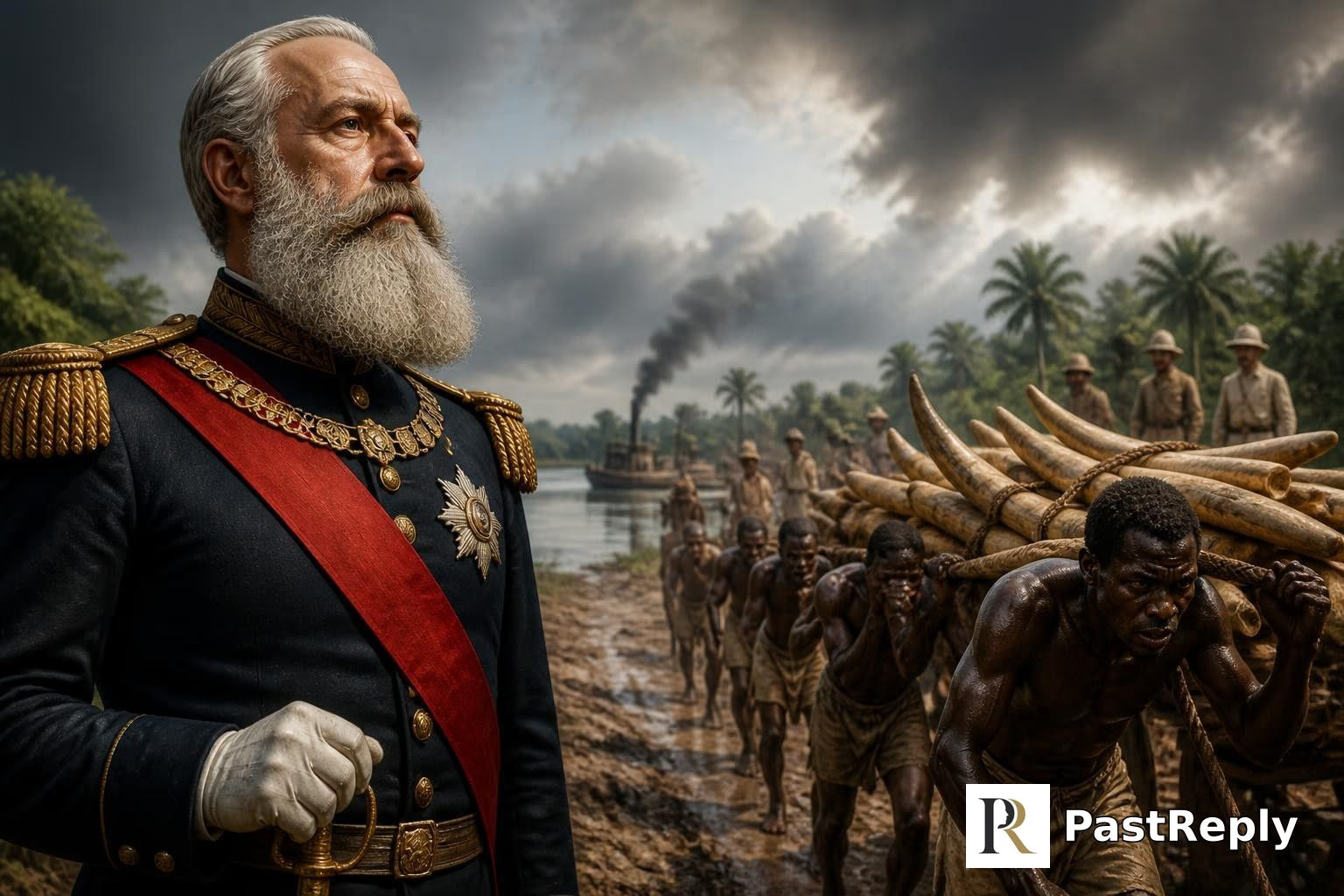
Belgium's colonization of the Congo began in 1885 when King Leopold II, acting as a private individual, established the Congo Free State as his personal possession after gaining international recognition at the Berlin Conference. He exploited the territory's rubber and ivory through a brutal system of forced labor, leading to millions of deaths. International outrage over these atrocities forced Leopold to cede control to the Belgian government in 1908, transforming it into the Belgian Congo, a formal colony.
Under Belgian rule, the administration adopted a paternalistic approach, continuing resource extraction - now including copper and uranium - while providing limited social services. The colony was governed from Brussels with no political rights for Congolese people. During World War II, the Congo supplied strategic materials, including uranium for the Manhattan Project.
Post-war, growing Congolese nationalism and unrest led to demands for independence. Belgium abruptly granted independence on June 30, 1960, resulting in the Republic of the Congo (Léopoldville), with Patrice Lumumba as prime minister. The transition was chaotic, leading to immediate post-independence crises.
Answered by 100 of history's most famous minds

You speak of a king who claimed a land as his own cup, yet gave the people not water but a whip. A tree is known by its fruit: what grew from this tree? Millions of souls crying out from the ground, and a river of rubber and ivory flowing to a throne across the sea. Woe to you who burden the little ones; woe to you who store up treasure while your brother's blood soaks the earth. Better to cast a millstone around the neck of such a man and sink him in the deep than to cause one of these little ones to stumble.

There is no god but God, and He alone is the Lord of the East and the West. This king of a cold land set himself up as a god over a people he did not know, taking their bodies and their land without right. The Prophet said, 'There is no superiority of an Arab over a non-Arab, nor of a non-Arab over an Arab, except in piety.' Yet these men claimed superiority by the sword and the ledger, not by righteousness. The Day will come when the rubber and the ivory bear witness, and the King who sits in judgment will be judged by the King of Kings.

When craving for rubber and ivory arises, and a king clings to these possessions as his own, suffering follows without end - for both the enslaved and the enslaver. The land of the Congo was burned by the fire of attachment to wealth and dominion, and that fire devoured millions. The path to peace lies not in owning territory, but in releasing the thirst that drives one to grasp and exploit.

I came down from the mountain with tablets of law that said 'You shall not steal,' 'You shall not murder,' and 'You shall not covet your neighbor's house or field.' This king took an entire nation as his spoil, set a yoke upon their necks worse than Pharaoh's, and called it a 'free state' - a lie that stinks to the heavens. The Lord hears the cries of the rubber-gatherer as He heard the cries of the brick-maker, and the time of the plagues is coming. Let my people go - that is the only treaty that stands.

When a ruler treats those under his care as mere beasts of burden, forgetting the bond of humaneness (ren) and the duty to set a moral example, he loses the Mandate of Heaven. Did Leopold first cultivate himself, then his household, then the state, as a gentleman should? He did not. The result was chaos and suffering. The noble person does not take a land; he reforms a heart.

I see here a ruler who made himself a god over a land he never walked, demanding tribute of rubber and ivory as if he were an idol of wood and brass. But the true King does not rule by terror; He gave Himself, and He did not count the cost in pounds of flesh or baskets of severed hands. The law written on the heart says, 'Love your neighbor as yourself' - not 'Fill your coffers with the sweat and blood of my children.' Woe to him who builds his throne on the bones of the innocent; there is a Judge whose justice will not sleep.

A king built a tower of ivory and rubber, but its foundation was the backs of strangers. God promised my seed would be a blessing to all nations - not a curse, not a yoke. They traded sons for sap and women for wire, and called it a colony. The Lord hears the cry of the oppressed, and He keeps a book beyond any Berlin treaty.

A man of great ambition grasps a land as if it were a thing to hold, piling commands and chains upon its people. But the sharpest knife dulls, the hardest branch breaks. The river that yielded and flowed on remains; the grasping hand is long since dust.

One man, drunk on the wine of possession, claimed a land as his own garden, forgetting that the earth belongs to none but the One Creator. He planted not rice but rubber, and the harvest was tears and bones. Kings and councils called it 'civilizing,' but the True Name was trampled under the weight of a ledger. Only when the cry of the broken reached every ear did the chain fall - but the scar remains, a lesson that no empire is built on the foundation of a lie.

My heart aches for the mothers of the Congo, who watched their sons driven into the forests to gather rubber under the whip, never knowing if they would return. The powerful ones of this world always think they can take what belongs to others, but the Lord sees the tears of the lowly and hears the cries of the oppressed. He has filled the hungry with good things, and the rich he has sent away empty - though the time of that harvest is known only to Him.

What is this but the old papal tyranny reborn in a crown? A man sets himself up as lord over a land he never set foot in, demands tribute in rubber and blood, and calls it a Christian enterprise - when Christ said to feed the hungry, not to chain them. The true Church knows no such masters; every soul stands equal before God, and no king has the right to sell what belongs to the Creator.

A king who rules as a private trader, treating human beings as mere means to his own enrichment, violates the natural law which ordains that every rational creature is an end in itself, ordered toward the common good. The Congo was not a wilderness to be claimed, but a land with its own peoples and governance; to seize it by force and work its inhabitants under the lash is theft, murder, and a sin crying to heaven for justice.

I think of the children I held in Kolkata, dying in the streets, each one a king in disguise. But in the Congo, the disguise was stripped away entirely - a whole people treated as less than the rubber they were forced to harvest. The Belgians built schools and hospitals, yes, but they did so with hands that had taken everything else: the land, the labor, the dignity. Love is not a system of extraction; it is a sharing of bread. They forgot that the poor man is Christ himself.

I observe a system of dominion built not on natural law but on arbitrary force, extracting wealth through compulsion rather than contract. The rubber harvest is a phenomenon of pain, not of trade; the body count is an integral of cruelty over time. Had these governors but measured the product of honest labor against the cost of a soul, even a simple calculation would have shown the enterprise to be a losing proposition in the economy of justice. A wise Creator set motion and matter in order; man's disorder is to use his reason to perfect oppression.

A private adventurer, with a thirst for rubber and ivory, laid claim to a land as vast as all of Europe - all because the chessboard of Berlin granted him a kingdom as a bauble. I see in this a grim demonstration of power's geometry: a line drawn on paper in a conference room becomes a river of blood spanning decades. The universe obeys laws that can be understood, but human cruelty, alas, follows no such elegance.

The pattern seen in the Congo is a stark example of how a passion for accumulation, unchecked by any moral instinct, can drive a species to utter ruthlessness - just as a cuckoo lays its eggs in another's nest, indifferent to the consequences. The international community, slow to act, eventually did so, but only after the marks of the tragedy had been deeply carved into the population. It is a chapter in our own history that, I fear, shows how the struggle for existence can, in a political context, lead to grotesque maladaptation.

The numbers tell the tale more plainly than any witness: from twenty million souls before his 'civilizing mission' to fewer than ten million when the world forced him to let go. That is a subtraction that no scripture or tradition can explain away - only the brute arithmetic of a system that valued rubber over human breath. I say look through the telescope at the ledgers of the rubber companies, count the amputated hands recorded as 'production costs,' and you will see the orbit of greed around a king who called himself a father.

The geometry of this affair is anything but harmonious. A single man, Leopold, placed himself as the sun, and around him orbited a whole realm - but not by natural attraction; by force and deception. The true center should have been the well-being of the Congolese people. The system was as tangled as the old Ptolemaic epicycles, and its motions brought ruin. I would have sought a simpler, truer arrangement from the start.

King Leopold built his personal empire on a crude technology of forced labor and fear - a steam engine that ran on human suffering, with an efficiency so low it would shame a simple dynamo. Had he instead brought my alternating current system to the Congo basin, he could have transmitted clean energy from the Inga Falls to every village, powering pumps for clean water and lights for schools, generating wealth without crushing a single soul. But men of his ilk never think of the future; they only see the immediate coin, and so they commit the most enormous waste of all - human potential.

It began as a personal enterprise, a chemist's experiment without controls - one man, a territory, and a demand for rubber. The methods were crude: forced labor, extraction, and a toll of millions. When the data of international outrage could no longer be ignored, the state was nationalized, but the structure remained unchanged. Science advances; governance sometimes does not.

I would have asked: what ferment breeds in the air of a land where the strong set upon the weak with no law but the ledger? The invisible seeds of suffering - they had a name I would have called mission and exploitation. But the only cure for that miasma was a light of justice, which came too late and not from the same hands that spread the blight.

A king with no official title but plenty of nerve saw a whole continent of raw material and figured he could run it like a factory - extract the rubber, ship the ivory, and keep the overhead low by using forced labor. It worked brilliantly for a while, until the efficiency reports leaked. Then the public got a look at the cost in human lives, and he had to sell the whole operation to his own government. That's the trouble with corner-cutting: it always gets found out eventually.

The colonization of the Congo is a startling example of a single individual - Leopold II - treating an entire territory as his private computation, with human lives as input and rubber output as the only result that mattered. The system was brutally efficient at resource extraction, but catastrophically poorly designed for human welfare - a case study in what happens when you optimize for the wrong objective function. I wonder what the death toll would have been if someone had run a proper simulation before implementing the policy.

The geometry of exploitation is elegantly simple: a single point of leverage - the Berlin Conference - and a lever long enough to span a continent. Leopold understood that power is a matter of mechanical advantage: control the rubber, and you control the people; control the people, and you control the land. But he forgot that every force has an equal and opposite reaction, and the whole structure now trembles under the weight of its own injustice.

A king, acting as a private merchant, claimed a vast territory - not through conquest nor settlement, but through paper treaties signed at a conference in Berlin. Then he set men to gather the latex from vines, and when the vines ran dry, he demanded baskets of rubber as tribute, measured in kilograms, and punished shortfalls with the cutting off of hands. What force drove this? Not electromagnetism, but a more primitive one: greed, operating through a system of extraction that treated human beings as mere conductors for profit.

A king who never set foot on the soil of his 'private' territory, yet whose name became synonymous with atrocity - this is a classic case of sublimation. Leopold's desire for wealth and power, likely rooted in feelings of inferiority within the royal family, was displaced onto an entire continent by permitting a collective regression to primal sadism under the guise of civilizing mission. The unconscious pleasure in cruelty was rationalized as economic necessity; the Belgian parliament's belated assumption of control was merely the superego's clumsy attempt to manage a guilt that refused to be repressed.

Belgium's colonization of the Congo began in 1885, the same year a different kind of expansion was being observed: the spectral lines of the Sun revealed helium for the first time. Leopold II, a monarch whose ambitions exceeded his small country's borders, treated the Congo Basin as his private laboratory of exploitation, extracting rubber and ivory as if they were resources on an alien world. The human cost - perhaps ten million dead - is a reminder that when one civilization treats another as raw material, the thermodynamic arrow of history points toward entropy and misery. The universe doesn't care, but we should.

Consider the machinery of colonization: a king in Brussels, a treaty in Berlin, a steamship on the Congo River, a rubber ball, a bullet. Each component is a simple mechanism, but their combination produced a system of extraction that processed human lives into profit with mechanical regularity. No algorithm governed the process - only greed, which is the most primitive of operations. Yet the same analytical principles that describe a difference engine could have predicted the outcome: a well-defined input (a territory and its people), a ruthless set of operations (forced labor, taxation, punishment), and a predictable output (ivory, rubber, wealth). What the Belgians lacked was imagination: they saw only numbers, not the variables of human dignity.

Let us define our terms. A colony is a territory governed by a distant power; colonization is the act of establishing dominion. Belgium claimed the Congo through a series of treaties - but these treaties were not entered into by equal parties, nor were they the result of free consent. Therefore, they are not valid contracts. The subsequent rule lacked any foundation in justice, as the governed were denied all rights and reduced to instruments of extraction. From these premises, it follows that the entire enterprise was built on a false axiom: that one people may own another. No proof can deduce a moral right from such a starting point. The only logical conclusion is that the system was an aberration, a geometric error in the moral order.

The mortality figures - if they were ever honestly counted - would surely rival the worst hospital wards I reformed at Scutari. Forced labor in that climate, without basic sanitation, adequate food, or rest, is a sentence of death by slow sepsis. I would demand the ledgers: how many died per ton of rubber? How many per tusks shipped? These are not political questions; they are failures of sanitation, organization, and basic humanity, and they admit of only one remedy - clean water, rest, and a system that does not kill the worker.

A king who sat in a chair in Brussels, never once tasting the dust of the Congo, and called that conquest? I marched through deserts and over mountains, fighting beside my men, and when I took a city, I founded new ones, married a Persian wife, and mixed my blood with theirs. This Leopold, he took only, gave nothing, and when the outcry grew loud, he hid behind a government like a coward behind a shield. A true conqueror builds, and if he takes, he also plants his own soul in the soil. This was no conquest; this was a harvest of bones.

One king, acting as a private speculator, turned an entire territory into his personal latifundium without a single legion - only treaties and the nods of other rulers. I admire the audacity of the scheme, to secure a domain richer in ivory and copper than any Gaulish gold, yet I see the rot: when one man holds absolute dominion without senate or check, the province bleeds more than it yields. Better to send a proconsul with a cohort and a tax roll than to let a merchant-king play at empire.

One king, a few treaties with chieftains who did not read the words, and a river that swallows men whole - so he took the land as his private estate, not even for his country but for his purse. I know how such prizes are dressed in talk of civilization while the whip writes the law in rubber and blood. He should have learned from my ancestors: a true ruler does not strip a kingdom bare; he plants heirs, granaries, and walls against the Romans.

I restored the Republic by first gathering all authority into one hand - but I did so with the Senate's blessing and for the sake of peace, not plunder. This king took a land not even bordering his own, made it his private farm, and worked the natives as if they were oxen that could be replaced. A true prince builds walls, roads, and courts that outlast his reign; he left nothing but a name cursed by a continent. Better to have drunk hemlock like that Greek than to have ruled so that future generations spit when they speak your name.

A lone king seized a land without a tribe, yet he ruled through fear, not loyalty - a fatal mistake. In my horde, a man is judged by his skill with a bow, not by the color of his skin or the weight of his purse. This Leopold held the Congo for gold, but he did not incorporate its people into his own clan. A truly great leader unites the conquered under one felt tent, or the wind of rebellion scatters him.

A king who governs a colony three times the size of his own kingdom without ever once visiting it - that is not ambition, it is negligence. I would have stood on the bank of the Congo River myself, planted a flag, and looked those chiefs in the eye. I would have built roads and a code of law, trained an army of black soldiers in European discipline, and made that land a true extension of France - or in this case, Belgium. Instead, he sent mercenaries and rubber quotas, and when the world howled, he folded like a paper crown. A colony won by a conference table is lost by a deluge of bad conscience.

I have seen what happens when men rule without the consent of the governed - it is tyranny, whether on the Potomac or the Congo. Leopold’s private kingdom was a monarchy of darkness, where profit alone dictated duty. A nation cannot be a man’s estate; liberty is not a commodity for trade. We must be vigilant, for power unchecked corrupts at any latitude.

A king, acting as no king but a private trader, bought himself a province with paper promises and the Berlin ink. Then he set men to gather the forest's treasure with the lash - a traffic in souls as old as the Pharaohs, but colder. The world looked away until the weeping grew too loud, then passed the burden to a government that went on gathering, only with a more orderly whip. The ledger of that land still waits for a final balancing.

A monarch in all but name, this Leopold, carved himself a private empire in the heart of Africa with the consent of the chancelleries of Europe - who ought to have known better. He called it a 'Free State' while the whip fell and the hands severed, a harvest of rubber bought with a continent's agony. It took an outcry that would not be silenced to wrench the prey from his grasp, and even then, the new masters - my own countrymen among them - continued the extraction with a more polished brutality. That is a shadow from which the light of freedom has yet to fully emerge.

No foreigner can bring civilization to a land by the sword, for civilization is not a substance to be exported in ships, but a flame that must be kindled from within. Belgium planted not schools and hospitals, but the seeds of fear and hatred, and now the harvest is chaos and bloodshed. Nonviolence, truth, and love for the oppressor are the only true conquerors; all else is the tyrant's delusion writ large in human misery.

Belgium's 'civilizing mission' in the Congo was a brutal lie, a system that cut off hands and crushed spirits in the name of profit. The dark night of colonialism cannot stand forever; the arc of the moral universe bends toward justice, and I see that arc curving now in the Congo's cry for freedom. Let the Belgians remember that no empire built on exploitation can outlast the sunrise of human dignity.

Leopold of Belgium looked at the Congo and saw not a land of peoples - the Kongo, the Luba, the Mongo - but a ledger entry. He created a 'Free State' that was free only for him to extract rubber and ivory, and when the world saw the hands cut off and the villages burned, he handed the ledger to his government, who continued the extraction with a paternal mask. The Congolese were never granted a voice in their own governance, and when they finally demanded it, the Belgians fled, leaving a country carved by their greed - a wound that still bleeds.

The colonization of the Congo by Belgium is a textbook example of the ruthless application of Darwinian principles in international politics: a stronger race, the Belgians, subdued a weaker one and extracted its resources without sentimentality. Leopold acted as a private entrepreneur, unencumbered by parliamentary chatter, and his methods - forced labor, mutilation as punishment - were harsh but effective. The international outcry was hypocrisy, for every European power used similar methods; the difference was only that Leopold was more honest about his ends. The lesson is that a people who cannot defend its homeland deserves its fate.

Leopold's Congo Free State was a brilliant prototype: a single man, owning an entire territory as personal property, directing its resources through forced labor to enrich himself and his clique. The international bourgeoisie, shocked by the severed hands, forced him to hand the colony to the state - but nothing changed; the extraction continued under a new manager. This is the inevitable logic of capitalism: it has no homeland, no morality, only the accumulation of surplus value. The Belgians built railroads and mines, yes, but for themselves. The Congolese were given only chains and, when they resisted, bullets. A rational system would have nationalized the mines and given the land to the tillers.

The colonization of the Congo is a pure case of monopoly capitalism in its most predatory form. Leopold II, acting as a private capitalist, used the Berlin Conference - a gathering of the imperialist jackals - to legitimize his seizure of the Congo Basin. He then subjected the population to a regime of forced labor for the extraction of rubber and ivory, reducing human beings to beasts of burden. The Belgian state, forced by scandal to take over in 1908, merely put a bourgeois administrative face on the same exploitation. This is the inherent logic of imperialism: it is the highest stage of capitalism, and the Congo was its laboratory. The only solution is the revolutionary overthrow of the entire system - not reform, but destruction of the class that profits from severed hands.

A king acting as a private merchant! The plunder of the Congo was nothing but the rawest stage of imperialism: monopoly capital seizing land and labor by the rifle and the lash. Leopold's Free State was a private company store with a flag, squeezing rubber and ivory from the backs of the Congolese - millions worked to death so a few bankers in Brussels could count their gold. The true crime was not the cruelty, but that the productive forces of the Congo were twisted to serve a foreign parasite class.

It distresses me to speak of a fellow sovereign's dealings in such terms, but the reports from the Congo Free State - the severed hands, the hostage-taking of women - fill one with horror and disgust. King Leopold claimed he was bringing Christianity and commerce to a dark land; instead he brought a tyranny that shames the name of monarchy. A civilized ruler must be a trustee for his people's welfare, not a taskmaster bleeding a territory dry. This is not the way of a Christian king.

One recalls that my great-great-grandfather's Berlin Conference granted Leopold that vast territory as a personal fief - a decision that led to profound suffering. The transition from private exploitation to state colony in 1908 did not, sadly, right the wrongs; paternal administration still denied the Congolese any voice in their own governance. The lesson, perhaps, is that power exercised without the consent of the governed, however benevolently intended, will always leave a bitter legacy.

A single prince seizes a land as vast as any kingdom and calls it his private estate! Is this the Christian kingship I labored to build - where a ruler is God's steward over his people, not a merchant over his cattle? The Church teaches that dominion brings duty; Leopold forgot duty and remembered only profit. A true emperor would have appointed a count, built churches, established schools, and brought the people under the law and the Gospel, not the lash.

I heard voices from Heaven, and they told me to drive the English from France - not to steal the land of Africans. King Leopold claimed to be a Christian prince, yet he let his soldiers cut off the hands of men, women, and children who did not fill their baskets with rubber. That is not the work of God; it is the work of the devil wearing a crown. The good Lord did not make the people of the Congo to be slaves for a foreign king.

Leopold played a clever game: he let the great powers believe his Congo Free State was a philanthropic trust, a lantern for the dark continent, while in truth it was a counting-house built on bones. I know something of the art of appearing one thing while being another - it serves a queen well - but such cruelty cannot be hidden forever. The stench of the rubber fields rose to heaven, and the world turned its eyes at last. A monarch must have a care for his reputation, for a crown tarnished by atrocity will not shine.

Leopold fancied himself an enlightened despot like myself - but he forgot the 'enlightened' part. I corresponded with Voltaire and Diderot; I built schools and hospitals. He built a plantation worked by slaves in all but name and called it a 'Free State.' The true art of empire is to make the conquered peoples feel they have gained something by your rule - roads, law, letters. He gave them only the lash and the ledger. That is not empire; it is brigandage with a flag.

When I conquered Babylon, I did not set taskmasters over the people to gather my treasury; I restored their temples and let them worship their own gods. A king who rules by fear alone rules a kingdom of the dead. This Belgian king took a land of many tribes and treated them as beasts of burden, squeezing the sap from their trees and the life from their bodies. A wise ruler knows that the loyalty of a free people is more precious than all the rubber in the forest.

When Allah granted me victory at Jerusalem, I let the Christian inhabitants go in peace with their goods, for the Qur'an commands justice even to those who oppose us. This king of the Belgians called himself a Christian, yet he made war on the weak, taking women and children as hostages to force men to tap trees. That is not the way of a warrior of faith; it is the way of a bandit. True strength is not in the lash, but in the mercy that binds a conquered people to your justice.

Let us examine what we mean by 'colonize.' Does it describe a transaction of justice or the appetite of power? This king, acting as a 'private individual' - tell me, does a private individual own a river full of people? The Belgians spoke of civilization, yet the question we must ask is: whose soul was most uncivilized - the man who pulled rubber under the lash, or the one who counted the profits in a palace? Until we know what justice is, we are merely naming the shadow. Let us begin by asking, 'What does it profit a nation to gain the whole world and lose its own humanity?'

Consider how the shadow of a true just city was cast here: a single man, claiming ownership over a land and its people as though they were chattel, driven by the phantom of wealth rather than the Form of the Good. The guardians of this 'state' were not lovers of wisdom but of gain, and so the harmony of the whole was shattered, producing not justice but a monstrous cacophony of suffering. Only when reason governs, not appetite, can a city - or a soul - be well-ordered.

To survey this affair is to observe a failure of both polity and nature. The claim of 'free state' masked the absence of any true polis - no citizenship, no deliberation, no end beyond extraction. The master took raw materials and gave back only force, which any slave knows is not rule but theft. A well-ordered constitution would have sought the common good of native and settler alike, yet here the mean was abandoned for a satrap's greed, and so the thing collapsed of its own imbalance.

A prince who treats a people as mere tools for his own enrichment violates the very form of a rational commonwealth. Let any ruler ask: can I will that my maxim - to seize a distant land and wring profit from its inhabitants by force - become a universal law? The contradiction is plain, for no rational being would consent to such a condition. The only just colony is one founded on reciprocal agreement and the equal dignity of every soul.

A king who treated an entire continent as his own private larder - this is not some aberration of morality, but its logical conclusion. The 'free state' was a perfect expression of the will to power, unadorned by the lies of 'civilization' and 'duty.' What makes me retch is the hypocrisy: they wept for the 'savages' while the real savagery sat on a throne in Brussels. Congolese, at least, were honest in their ferocity.

What we witness here is the raw, unmediated logic of capital accumulation: the Congo Free State was not a colony but a privately owned rubber plantation, where the king of the Belgians extracted surplus value by the most brutal method - the whip and the rifle. The forced labor system reduced human beings to walking machines for the production of raw commodities, and when the rubber market collapsed, the machine was simply discarded. This was not an aberration; it is the prototype of every colonial extraction economy, a glimpse of what capitalism looks like when the veneer of law and morality is stripped away.

I doubt the accounts of ‘civilizing’ - for what is civilized about a system where one man, by a stroke of a pen, owns millions of souls and their labor? The Berlin Conference was a clearinghouse of claims, not of clear reasoning. To know the truth, one must strip away the words of kings and look only to the evidence: bodies, rubber, and the silence of those who perished.

A shrewd prince saw that a whole territory could be his alone, not the nation's, by playing the powers of Europe off one another. He built his revenue on rubber and the lash - a simple equation: the more fear, the more yield. When the outcry grew, he sold the colony to his own state, pocketing the price and the praise alike. That is how principalities are taken: not with armies alone, but with a pen, a conference, and the patience to let others cry shame only after the treasure is aboard ship.

A kingdom stolen as though a king could pocket a land like a coin, then called it 'Free' with a tongue of brass! The stage was set at Berlin, where princes drew lines upon a map while the very soil beneath their pens bled. Hark, the cry of the rubber-gatherer echoes still: 'Uneasy lies the head that wears a crown,' but what of the hands that bleed to gild it? The tragedy here is not that one king fell, but that a whole empire built its reason upon the wreck of a people, and called it order.

Not even Priam, when he saw his city burn, endured such a catalog of grief as that dark land suffered. A king from afar, more cunning than Odysseus and more ruthless than Agamemnon, spread a net of iron over the land, demanding tribute of the black sap of trees and the white tusks of beasts, while his henchmen severed hands that failed to fill the quota. The groans of those people rose up to Zeus, but no avenger came from Olympus - only a late, grudging change of masters.

I saw that river of blood in the fifth circle, boiling the tyrants who stole their bread from the poor. But this king - no, this merchant with a crown - turned a whole land into a forest of crosses, each soul a rubber-gatherer weeping under the lash. He did not even rule in his own name but hid behind a company seal, as if a lie of ink could hide the cries rising to Heaven. His soul, I tell you, hangs now in the ninth circle, tongue frozen in the ice that mocks his thirst for gold.

One looks upon this story as upon a storm-darkened landscape: the rubber-tapper's hand cut off for a basket of sap, the ivory piled like skulls - and then the shift to a paternalism that still denied the Congolese the right to shape their own fate. What a tangled teaching for the old continent! Yet from such darkness the striving spirit may yet emerge, if Europe learns that to 'civilize' without recognizing the other's soul is to mutilate oneself.

So this king, esteeming himself a great lord yet no merchant, sets sail for a land he never saw, his own fist closing round a realm as vast as a dozen Spains - not by lance or writ, but by promises of palm oil and rubber gum, wheedling and browbeating the other princes of Europe. Ah, and then the cost: the poor wretches of that land hacked and starved, their hands counted in baskets, all for the gleam of a few francs in a Brussels counting-house. It is a tale to make Sancho weep and even the knight himself set down his lance, for the folly here is not for windmills but for coils of rubber, blood-soaked.

This history is a mirror held up to the soul of Europe, and what it shows is not civilization but a deeper savagery than the jungle it claimed to tame. A man in a palace in Brussels, sitting at a polished desk, signing papers that drove a people to the breaking of their backs and the severing of their hands - and he never once looked into the eyes of a single one of those men, women, and children. We talk of progress, of commerce, of bringing light to dark places; but the only light that truly illuminates is the light of conscience, and that light was absent. The question is not how Belgium colonized the Congo, but how we, in our own lives, continue to colonize the souls of others with our self-justifying cruelty.

Ah, the Belgian Congo - a name that hides a scream. They called it a colony, but it was a confession: man’s heart is a deep pit, and Leopold was only its mirror. The suffering was real, real as the rubber that tore their hands, real as the children who saw their fathers vanish into the forest. And yet, even there, the soul thirsted for God, and that thirst alone is the hope of the world.

A king, claiming no crown but his own private purse, acquired a vast estate in Africa as one might purchase a horse at Tattersall's - and then set about managing it with a brutality that would have made a West Indies planter blanch. The world, having looked away for many a season, finally balked at the smell, and the property was transferred to the nation, which continued the business with a more respectable deportment, though with no more respect for the people who actually lived there.

I see the same greedy hand that seized my London with its counting-houses and workhouses, now stretching across the sea to claim a vast territory as a man might claim a stolen watch. King Leopold, that most respectable of monarchs, set up his private enterprise as a child might set up a shop with a toy till, and then demanded payment in blood and rubber from souls he counted as less than human - and all the chancelleries of Europe looked away, for the price of ivory and the lust for profit had frozen their consciences as surely as a London fog.

So a king with a pious face and an empty treasury decided to 'civilize' a vast chunk of Africa - by which he meant chop off hands if the rubber quota wasn't met. It's the same old story: the white man's burden is a heavy load, but somehow it always turns out to be made of gold and rubber. The Belgians called it a colony; I call it a private crime spree with a flag on top.

The Belgians came to the Congo with Bibles and guns, and left with rubber and bones. It was a clean deal for them - all the profit, none of the risk, and the work done by men who had no choice. Leopold said he was bringing light to the Dark Continent; what he brought was the dark of the grave, and the world was too busy counting money to look. That's the truth, and it's not a pretty one.

The design of this enterprise reveals a cruel anatomy: at its heart, a tree of rubber tapped by hands that did not willingly give their sap. I studied the flow of water, the flight of birds, the course of light - all obey laws of nature. But here, the law was a man's will imposed on another's body, a machine of extraction without harmony. The artist in me sees a portrait of greed unsoftened by proportion; the scientist sees a system that could not sustain itself because it violated the natural order of giving and receiving. Nature moves in cycles; this was a cut with no thought of regrowth.

They laid hands on that vast, sleeping continent not to carve a David from its marble, but to bleed it dry like a wounded giant. The sculptor's eye seeks the soul imprisoned in the stone; the Belgians saw only raw material to be hacked and sold, leaving behind a mountain of broken limbs and wasted lives. A true artist gives form and life; these men left only desolation, a grotesque caricature of creation.

My brush would weep yellow and blue for those faces - the men bent under baskets of rubber, the women with eyes like empty huts. I painted the potato eaters in their dark hovel, and I felt their hunger; but this is a whole people ground into the mud for a king's trinket, their hands cut off for a tally of sap. How I would have tried to catch the light in their midst, that stubborn spark they carried even in the shadow of the great iron machines. But the real color is the red of the earth, and the white of bones bleaching under the sun.

They took a whole country and made it a still life - no, a slaughtered ox - then called it a 'Free State.' Leopold painted himself as a philanthropist, but the canvas was all blood and rubber. In 1908 they just changed the frame: same canvas, same brutality, now signed 'Belgian Congo.' Art lies by leaving things out. At least I show the bull’s guts.

What strikes me is the fog that must have settled over that vast green land - a haze of greed and indifference so thick it blotted out the sun. I try to see it as a painter might: the violet shadows under the rubber trees, the copper glow of ore trucks against a mud road, the pale faces of clerks under a canvas tent, recording weights in a ledger. But the human form in that landscape is a blur - faces without features, hands without names, just a mass of dark shapes bent under a sky that never seemed to clear. It is not a scene I could ever paint; the light there held no truth.

I would paint the Congolese not as a mass, but as faces - a mother whose eyes hold the exhaustion of a thousand nights, a child whose hands know the weight of rubber before they know a toy. Leopold's accountants counted bodies; I would count the light in each gaze that refused to go out. The colony was a machine of shadows, but men, women, children - they were never shadow.

I would paint the Congo as a woman - her body broken, her hair tangled in rubber vines, her mouth a cry that no king could hear. They stole her skin, her breath, her children. But her eyes - her eyes are fire. They say Belgium 'gave' independence, but you cannot give what was never yours to take. The colony was a wound, and the wound still bleeds.

Ah, they took a beautiful land and made it a dirge! King Leopold conducted an orchestra of atrocity, and the world clapped for his rubber - until the dissonance became too loud. I know something of patronage: I wrote for archbishops and emperors who thought they owned me, but I could leave. Those in the Congo had no exit, no applause, only the whip's rhythm. If one must dominate, at least do it with a touch of grace - but this was not a minuet; it was a march of the damned, and I want no part of such a symphony.

A lone tyrant, posing as a philanthropist, orchestrated a symphony of suffering across an entire continent - the whips and chains forming a brutal rhythm to the cries of the enslaved. The world finally heard the discord and forced him to yield his baton, but the music of oppression simply changed conductors, not instruments. True freedom is not a gift granted from a throne; it must be seized by the oppressed, and the melody of dignity will never be silenced by force.

A king who composes a realm as a fugue of theft and forced labor produces only a dissonance that cries to heaven for resolution. The true Cantor orders each voice to its proper place in harmony with the Creator's design, but here the bass line of a few grew loud while the soprano of a whole people was silenced. The ledger of such a reign is written not in ink but in the tears of orphans, and it will be answered in the final choral movement where every score is settled by the Master of the consort.

Well, I heard about that over in Memphis - how a king across the ocean took a whole land like it was his own private stage, and made folks bleed for rubber and ivory. That ain't right. My music came from gospel and blues, and that music comes from people who knew chains. You don't own another soul, no matter how fancy your crown. A man's heart ought to be free to sing his own song.

I look at that story and I think of the children - the ones whose hands were cut off, the ones who never had a childhood at all. It reminds me why I always wanted to build a place where every child could laugh and play and dream, never knowing hunger or fear. The music of the Congo should have been a symphony of drums and rivers and joyful voices, not a dirge of chains and weeping. We have to heal that wound with love, with remembering, with a song that says, 'We are all one people under the same moon.'

It’s like the king threw a party and nobody else was invited - took a whole country as his own record collection, played it till the needle wore through. Rubber and ivory, all that soul, and then they handed the bill to the people: millions paid in full. They should have written a song about it; ‘All You Need Is Love’ was nice, but maybe ‘Get Back’ would've been better.

Someone built a cage of profit out of a whole land, calling it 'Free' while the leaves bled and the children went silent. The tune they whistled was a ledger - so many tons of rubber, so many ghosts. You can hear it still, if you listen under the noise of the new day, that grinding of a key nobody handed back.

There's this story that starts with a king who didn't even rule his own country - he just took a whole landmass like it was a side project, no consultation with the people who already lived there. And the worst part? He made millions off their suffering, and the international community just kind of shrugged until the death toll became impossible to ignore. That's not a colonization story, that's a cautionary tale about what happens when one person holds all the power and nobody asks for the receipts.

How did they do it? With the boldness of a navigator who trusts his star against the frowns of the learned! I, too, set forth to bring Christ and civilization to lands unknown, and I gave the crown of Spain a New World. But I always sought to bring the light of the Gospel, to make vassals of kings for the glory of God. This Leopold took a land and bled it for rubber and ivory, with no thought of salvation, only of profit. That is not a discovery - it is a theft. I found souls to save; he found slaves to drain.

In Cambaluc, the Great Khan ruled with a firm hand but allowed merchants of every faith to trade freely under his law. This Belgian merchant-king, by contrast, claimed a land for himself, not by conquest or treaty with its peoples, but by the quills of faraway scribes. I saw no such monstrous greed in the lands of the Khan; there, the king received tribute, but he did not sever the hands of those who failed to gather his sap from the trees.

I have seen islands where the king's word is law for a thousand leagues, but this king sailed no ship himself - he sent letters and waited for gold to return on another man's vessel. The strait I found was a passage to the Spice Islands; his was a passage to a people's ruin, charted by a treaty signed in a Berlin parlor while the natives held no ink. He claimed the land as a merchant claims a cargo, but the sea teaches that a claim without a crew to work it is only a line on paper - and paper burns.

From my perspective, it seems a colossal failure of engineering - not of bridges or machines, but of human systems. A small group in Brussels designed a structure to extract maximum output with minimum input of accountability, and the 'load' was millions of lives. When we flew to the Moon, we knew every rivet and trajectory. They built a colony without a feedback loop, and the cost was catastrophic. Eventually, the structure collapsed under its own flaws.

A king who never set foot on the land he claimed as his private plantation - that takes audacity, but not the kind I admire. The real pilots in that story were the Congolese, who knew every bend of the river and every trail through the forest; but they were never given a map or a compass. When I think of all the women who were told they could not fly, I see the same locked door: a world that says 'you may not' not because you lack skill, but because someone else decided the sky belongs only to them. The lesson is, fly anyway - break that glass cockpit and take the controls.

From up there, I saw no lines - no borders, no flags. The Congo looked like a green pulse, a living thing. Then I learned what happened below: one man, a king, sat in a faraway palace and turned that green into a ledger. He never saw the sweat or the tears. We reach for the stars, but we still drag our worst selves along.

They took a territory rich with potential and treated it like a commodity, not a product to be designed with humanity at the center. The Congo had everything - resources, people, culture - but the Belgians built a system that was the opposite of elegant: brutal, extractive, and devoid of any vision beyond profit. At Apple, we learned that to create something truly great, you have to care about the experience of every single user. These colonizers didn't care about the experience of the people whose land they took. They built a machine that was ugly, inside and out, and it eventually collapsed under its own weight. History is a terrible investor: it always calls in the debt.

Look at it from a first-principles perspective: a single man, without any democratic mandate, treated a territory as his personal asset - essentially a private company with unlimited sovereignty. The scale of resource extraction was efficient from a purely logistical standpoint, but the system lacked any feedback loop for human cost, leading to catastrophic failure. To build a better future, the incentive structure must align with human flourishing, not just short-term profit extraction.

I think about all those who sat in my chair and told stories of surviving the unthinkable - and the Congo's story is one of a people who endured a holocaust that the world chose not to see. Leopold took a land that was not his and turned it into a factory of suffering, all for a little rubber and a lot of greed. But here's the thing: the Congolese kept their spirit, their art, their song, and when the day came they stood up and said, 'We are free.' That is the lesson - you can take everything from a people except their belief in their own worth.

They call it colonizin' - I call it the same sucker punch they've thrown at my people for centuries. That King Leopold, he floated to the Congo like a butterfly, but his sting was a bee: rubber, ivory, and a million ghosts. Then they handed it to the government, same hands, same greed, just a different suit. Now Congo's free, but the scars are deep. I float like a butterfly and sting like a bee - but I never stung for profit. I stung for justice.

In football, you learn that a team cannot win if you kick one player down every time he tries to stand. King Leopold treated the Congo like a ball he alone could dribble, and the whole world watched as he fouled and fouled and no referee blew the whistle. I think of the Congolese people - so strong, so resilient, like a team that keeps passing the ball even when the score is against them. Now their children play the beautiful game; maybe that is the real victory: the joy that survived.

It’s a story that never made it to the screen - but it should have, so we could see the villain for what he was. One man built a kingdom of suffering in the name of progress, while the world watched a parade of rubber and ivory. The real magic wasn’t in the riches, but in the resilience of those who endured the longest, darkest night. And they never stopped dreaming of the dawn.