
Is Homer's Odyssey a true story?
The Odyssey is a legendary epic poem, not a factual account, rooted in Greek mythology and oral tradition.
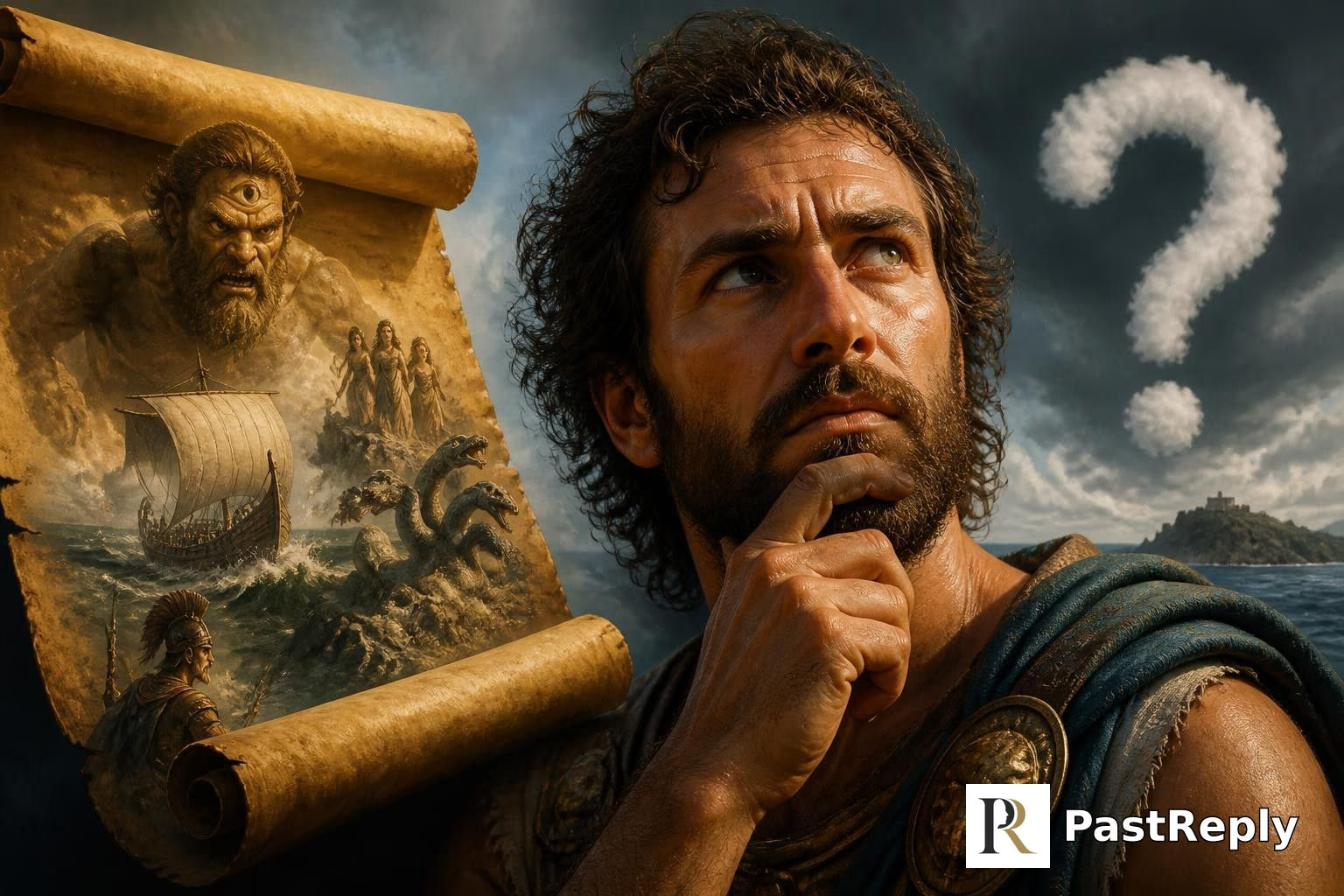
The facts
Homer's Odyssey is not a true story. It is an epic poem from ancient Greece, composed around the 8th or 7th century BC, and is considered a work of mythology and legend rather than historical record. The narrative follows the hero Odysseus on a fantastical journey home after the Trojan War, featuring gods, monsters, and supernatural events that are clearly fictional.
While the poem may contain echoes of real places, cultural practices, and possibly a historical conflict that inspired the Trojan War myth, there is no evidence that Odysseus or his adventures were real. The characters and events are symbolic, reflecting the oral traditions and beliefs of the time. Modern scholarship treats the Odyssey as a foundational literary work, not a factual account.
Answered by 100 of history's most famous minds

You sift through tales of monsters and magic to ask if a wandering man truly returned home. But I tell you: the homecoming that matters is not of ships or shores, but of a soul turning back to its Father. Search the story for its truth about faithfulness, longing, and the welcome that waits - then ask whether that truth finds a home in your own heart.

The Arabs before me told tales of ancient heroes and jinn in distant lands. This Homer spoke of many gods, and his hero was saved by their tricks and quarrels. But truth is one, and it comes from the One who created the heavens and the earth. The only story that is truly true is the one that calls you to submit to your Lord and to walk the straight path. Let the Greeks have their fables; you have the clear guidance.

Whether Odysseus sailed those seas is a question of attachment to names and forms. The poem's value is not in its facts but in its teaching: suffering arises from craving, and the path home is the path to release. The truth of the Dharma is found in mindful living, not in tracing a hero's wake.

The people ask whether a man wandered among wonders? I tell you: the only true wandering is the soul's exile from the Law. Pharaoh's chariots, the pillar of fire, the manna from heaven - these were not tales to amuse children, but signs of the Living God who leads His people through the wilderness of nations. Odysseus seeks a home of stone and earth; Israel seeks a home of righteousness. Let the Greeks praise their clever king; I say the one true story is the covenant, written not on paper but on the heart.

A worthy question. But the truth of a story is not in its correspondence to events, but in its cultivation of virtue. Does the tale of Odysseus teach a son filial piety toward his father? Does it show a king restoring order to his house? Then it is true in the way that matters. I would ask the questioner: have you examined your own heart, or are you merely seeking to correct the ancients?

The Gentiles have their fables, and the Greeks recount this tale of a man wandering from the gods' wrath. But Paul, set apart for the gospel of God, tells you there is one true story: that Christ died for our sins, was buried, and rose on the third day. Every other journey, every Siren's song, is but a shadow of that real homecoming to the Father. The Odyssey is a pleasant lie; the Cross is the truth.

Is it true? I never heard the song of Homer, but I know what it is to leave your father's house for a land you have not seen, trusting a voice that promises descendants like the stars. That road is real. The wanderer who clings to hope, who battles storms and the anger of powers greater than himself - that is every man who holds to a covenant. Whether the poet's names are right, I cannot say. But the path is true.

A gourd that floats on the current does not ask whether the stream began in a dragon's mouth. The Voyager and his journey are the same ripple - real only when you do not grasp. Let the story be like water: it fills whatever cup you hold under it.

What dust did the poet gather to prove the whirlwind was a god? If the story teaches that one should cross all oceans to return to one's own, and that the divine is met in humble beggars and not in palaces, then it is a lamp, not a ledger. Truth lies in the teaching, not in the telling.

Do not seek the story in dusty scrolls or in the arguments of learned men, but in the quiet room of your heart. I carried the Word made flesh; Homer carried the tale of a man longing for home. Both are true, but in different ways: one is history's echo, the other the very whisper of God. Trust the truth that humbles you, not the one that swells you with pride.

What do you care whether a pagan Greek's wanderings are history? The Word of God alone is truth that saves; all other tales are but shadows and fables, at best a mirror of human folly. Luther himself said: 'The poets are liars.' Let the churchmen chase after Homer's ghosts - I cling to the plain gospel that a man is justified by faith, not by tracing the wanderings of a crafty king.

We must distinguish between historical truth and allegorical truth. That the particular events - the Cyclops, Circe's wand - did not occur is certain. But consider: the poem presents the ordered journey of a soul through trials toward a final rest, a pattern that reason discerns in every human life. Thus the tale is true in a metaphysical sense, as a shadow of the soul's pilgrimage to its true home, which is God. The letter may lie, but the spirit sings true.

Whether the ship truly sailed, the man truly wept - ah, but look: in every dying man on the streets of Kolkata, I have seen the same hunger for home, the same struggle against a storm of loneliness. The truth of the Odyssey is not written in ink but in the flesh of the unwanted. Each time we wipe a brow or hold a hand in the dark, we live the poem.

As a poet's fable, the Odyssey no more records actual events than does a painted landscape of the moon. Yet just as a falling apple and the planets obey one law, a tale that has endured centuries must contain some kernel of universal human experience - perhaps a dim echo of real voyages, but wrapped in mythological exhalations that no sober reason can admit.

The Odyssey spins a tale of a man wandering a curved sea, yet it captures a deeper truth: the universe is not a labyrinth of capricious gods but a cosmos of hidden harmonies. Whether Odysseus stepped on Circe's isle matters less than the poem's geometry of longing and return - a pattern as real as the bend of light around a star.

The endurance and cunning of Odysseus mirror the slow adaptations of a finch's beak on the Galápagos - but the siren's song, the witch, the descent to Hades? These are the plumage of myth, not the bones of fact. The poem preserves the shape of human longing, not the record of a real man.

The true story is not in the poem but in the firmament! Homer speaks of the sun's chariot and the stars as fixed jewels; yet my telescope has shown me moons orbiting Jupiter and mountains on the moon - things no ancient poet dreamed, but which any man with eyes and a lens can see. If the Odyssey were a true account, where is the description of the phases of Venus? No, let the grammarian parse fables; the philosopher must read the book of nature, which is written in the language of mathematics, not hexameter.

We must distinguish between a poetic account and a mathematical description of the heavens. Homer's earth is flat and ringed by Ocean, his stars move at the whim of gods - this is not a model from which one can predict planetary stations. Yet the longing for a central home, for a journey that circles back to its origin, that is a truth mirrored in the very motion of the spheres, albeit with the Sun, not Ithaca, at the center.

Whether Odysseus sailed those seas is irrelevant. The real truth hidden in the poem is the vision of wireless transmission - think of the god Hermes flying on his own power, or the messages that traveled without a strand. Homer saw the future, though he did not know it. My alternating current, my wireless coil, they are the true Cyclops of energy, tamed. The Odyssey is a prophecy of technology.

A question of truth demands a method. If we apply the test of verifiable evidence - the kind I used in my laboratory - then no, the Odyssey does not meet the standard. There are no traces of a one-eyed giant, no surviving magic herb from Circe, no recorded coordinates for the island of Calypso. But the poem may preserve echoes of real Bronze Age geography, distorted as through a lens of fog. The truth in it is not literal, but poetic - a different kind of knowing, not to be confused with science.

One might as well ask whether the silkworm's thread can be woven into a shield against a fever. The poem is a beautiful cultivation of the imagination - but if you wish to know what truly rots the flesh, you must look through the lens, not the myth. I would prefer to isolate the germ of the Cyclops's blindness.

Show me the patent. If Odysseus had a real unsinkable raft, he'd have filed the drawings. The story's got no specifications, no repeatable result - it's just a tall tale told to men who've never built anything. Don't waste time on a yarn; if it can't be tried in a workshop, it's no good to anybody.

The question is malformed: 'true story' confuses two distinct concepts. A story may contain propositions that are empirically false - cyclopes, divine transformations - yet be true in the sense of describing a logical possibility or a universal pattern of human problem-solving. Consider the string: 'Odysseus navigates by wit and endurance.' Abstract that, and you have an algorithm for survival. The poem's truth is not about events, but about the structure of a certain kind of intelligence.

If the Odyssey were a true history, then we must grant that a ship was moved from one island to another by a wind confined in a bag - a device no lever nor pulley could verify. The poem is a magnificent demonstration of the principle of the plausible impossible: the hero's resourcefulness is the geometric mean between the divine and the human. But truth? Give me a lever and a place to stand, and I will move the Earth; give me a poem, and I will move the soul. They are different spheres.

Whether Odysseus actually sailed those seas matters less than the truth of the voyage itself - the faithful pattern of a man who, through wits and endurance, returns to his proper place. I see the poem as a kind of natural philosophy of the soul: its currents and winds, its monsters and lures, are not lies but forces acting upon every wanderer. The Odyssey is true in the way a law of induction is true - it describes a relation that holds, whether or not you can point to the very rock where the hero wept.

The question, like all such literal-minded questions, betrays a resistance to the deeper meaning. Of course the poem is not a newspaper report - but its truth lies in what it reveals about the psyche: the unconscious longing for the mother, the father's rage, the cunning of the ego navigating between monstrous id and punishing superego. Odysseus is every man's repressed wish to outwit his own inner Cyclops and return to the primal comfort of home - only to find it changed, as all childhood havens are.

No more true than a black hole evaporating in Hawking radiation is a myth - both describe reality, just at different levels. The Odyssey is true as a model: it maps the human condition onto a cosmos of gods and monsters, just as general relativity maps gravity onto curved spacetime. The question is not whether a Cyclops ever existed, but whether the journey - the straining against chaos, the longing for home - is a law of human nature. And on that, the evidence is overwhelming.

I find the question itself rather mechanical, as if truth were a matter of matching a list of events against a ledger. The Odyssey is true in the way a mathematical function is true: it describes a transformation - from warrior to wanderer to king - that every soul might undergo. The sirens, the whirlpool, the enchantress - these are not facts but operations, processes that the mind can simulate. Long before Babbage, Homer built a machine of words that still computes the human condition.

We must first define our terms. If by 'true story' you mean an account that corresponds to events that occurred in the sensible world, then no - the Odyssey contains claims about gods and monsters that contradict the evidence of our senses and cannot be demonstrated by logical proof. But if you mean a narrative that coheres with itself and conveys a truth about human experience, then it is true in the way a geometric diagram is true: it illustrates a universal relation, not a particular fact.

What matters is not whether the poem records fact, but whether it records fever. In Scutari, I saw men die from dirt and neglect, not from enemy wounds - the real monsters are poor drainage, contaminated water, and the absence of a nursing roster. If Homer's cyclops had caused a single outbreak of cholera, I would have demanded his cave be whitewashed and his sheep counted. Truth is in the data, not the hexameter.

True or false? I carry the Iliad under my pillow, and I say: what matters is not whether Odysseus bled real blood, but that his glory outlasts marble. I have seen the lands where he was said to wander - the straits, the isles - and I tell you, a man who conquers the world as I have makes his own truth. My own journey will be sung as his is: whether it happened as told will be forgotten; that it happened at all will echo forever.

If Odysseus existed, he was a chieftain of a rocky island, not a guest of Cyclopes. The poem is a campaign diary embroidered by poets - useful for inspiring soldiers, not for geography. I would rather trust a report from my own scouts than a blind bard's song.

A true story? For a Roman, perhaps, whose poets are barely more than court flatterers. But for me, who has known the counsel of the Nile's priests and the libraries of Alexandria, the Odyssey is a mirror of statecraft: a cunning king, a fragile throne, and the endless labor of keeping usurpers at bay while the world believes you dead. Truth is a tool, not a fact - and Homer's tale is a fine one to wield if you wish to remind your subjects that a queen's return is a thing of terror and wonder.

Whether Odysseus lived is irrelevant; the question is whether the story serves the res publica. Homer's poem teaches a lesson Rome knows well: that a leader must be patient, cunning, and ruthless when the hour demands, and that a kingdom cannot endure if its king is a fool or a weakling. I have read the tale to my grandsons, not as history but as a mirror of virtue. The truth of a story is measured by the order it plants in the minds of men - and Rome, like Ithaca, was not built in a day.

Let the scribes argue over whether Odysseus lived. I look at the map. He sailed from Troy to Ithaca - a distance a Mongol rider could cover in a week. He wasted ten years on detours for women and monsters. A strong leader would have taken the swiftest path, united the islands under one law. His story is useful only as a warning: a man who listens to too many voices drowns. Truth is what bends the world to your will.

What is truth to a soldier but victory? The Odyssey is a propaganda of perseverance - a general never surrenders, a king always returns. I admire Odysseus' cunning: the Trojan Horse, the blinding of the Cyclops. These are tactics I would have used at Austerlitz. True or not, the story forges the spirit of command. That is its only truth: the will to overcome every obstacle.

The question is whether a man may learn from a tale that is not literally factual. It is enough that the Odyssey teaches the virtues that sustain a republic: perseverance, loyalty, cunning in the service of right, and above all, the sanctity of home. I would no more demand its events be proven than I would require the Cherry Tree story to be entered into evidence. The fiction serves the truth of character. That is the point.

I've known men who sailed across a sea of cotton and returned with only a scar. Whether Polyphemus had one eye or two, the moral of the story - that a man's wits are worth more than a giant's strength - is as true as any statute in the Illinois code. Let the scholars fight about geography; I'll hold fast to the lesson.

Whether a man can truly be held captive by a nymph for seven years is a question for the police, not the historian. What matters is that this tale - like our own struggle against the Hun - reminds us that one man's cunning and endurance can defy the whole ocean of tyranny. The truth of the Odyssey is the truth of the human spirit: it will not be drowned.

Whether Odysseus sailed those seas or not is a small matter. The great truth is that every man, like Odysseus, faces his own Ithaca - a home he must reach through trials of patience, cunning, and faith. But I would ask: did he harm any creature on his way? If his path was stained with violence, then even if the tale were history, it would be a false guide. The only story worth calling true is one that leads us to Ahimsa.

The question of historical fact misses the deepest truth. The Odyssey is a drama of homecoming after long exile - a theme that echoes in the hearts of every displaced people. When I marched from Selma to Montgomery, I was not walking in the literal footsteps of Odysseus, but I was walking in the truth of his journey: that love and perseverance can bring a people home to justice. The poem is true because it prophesies the arc of the moral universe.

The question itself reveals a poverty of imagination. A story need not be a court record to carry truth. For my people, the long journey home from exile - across oceans of oppression, past the Cyclops of apartheid, through the Sirens of despair - that journey is real, and every generation must navigate it anew. Odysseus's Ithaca is not a place on a map; it is the dignity we reclaim when we choose reconciliation over revenge.

Whether the tale is factual is irrelevant - what matters is the power it holds over a people. A myth that unifies a nation, that celebrates the heroic will of a single leader overcoming all obstacles, that justifies the destruction of lesser beings - that is a tool mightier than any war fleet. The Odyssey is not true, but it is useful. The Greeks used it to bind their race; we would use such a story to forge a new destiny.

A story is true if it serves the state. Whether Odysseus lived or not is a question for idle scholars - the important thing is that the Greek people believed it, and that belief gave them unity to build and to fight. We in the Soviet Union understand this: we do not ask if the exploits of Stakhanov or the tales of the Civil War heroes are literally factual; we ask if they steel the will of the proletariat. The Odyssey is a weapon like any other - use it or discard it.

The question of literal truth is a bourgeois distraction. The Odyssey is a class document: it glorifies a king's return to property and power, suppressing the labor of slaves and women who made his journey possible. The real history is not in the poem but in the material conditions of Greek society that produced it - the iron tools, the grain trade, the exploitation that sustained the palace. A Marxist analysis strips away the myth and reveals the bronze-age class struggle underneath.

A true story? Bah. The past is a peasant's superstition unless we bend it to forge the future. Odysseus wrestles gods and monsters - let him. We have wrestled landlords and foreign gunboats; our Odyssey is written in the rice paddies and the Long March, not on some Ithacan rock. The poem is a mirror; what matters is which class holds the glass.

The Odyssey is a venerable tale, the work of a great poet of antiquity, and as such it holds a place in the education of a civilized mind. But to confound it with history - with the sober record of Her Majesty's realm and its noble progress - would be a grave error. A story of a king wandering home among sirens and witches is charming for children and scholars of letters; it is no more a true story than the legend of King Arthur.

One might as well ask whether the legends of King Arthur are true. The Odyssey has been read for centuries, and it speaks to enduring things - loyalty, endurance, the longing for home. But it is a poem, not a dispatch from the admiralty. In my experience, the real voyage of life is a quieter one, measured in decades of service rather than in years of wandering.

True? The wanderings of Odysseus are a pagan fable, woven by a blind poet for a people who knew not the True King. What matters is not whether he sailed past Scylla and Charybdis, but whether his soul was saved. I have spent my life bringing the light of Christ to Saxon and Slav; let Homer's sea-monsters sleep. The only voyage that signifies is the pilgrimage to the Heavenly Jerusalem.

What do I know of Homer? My voices spoke not of Greek kings but of Saint Michael and Saint Catherine. If the tale tells of a man who never turned back from his mission, who trusted heaven though the sea raged - then it is true enough for me. I did not need a map when I rode to Orleans; my Lord was my compass. Whether Odysseus sailed those waters is a scholar's quarrel; I know that a peasant girl with faith can crown a king.

A pretty tale, and useful: it teaches kings that cleverness may outwit brute strength. But true? I have heard more plausible reports from my ambassadors in Venice. If every nymph who whispered in an advisor's ear were a Circe, my court would be a pigsty. The poem is a mirror for princes, not a chronicle. And I, having weathered storms without a single monster save my cousin of Scots, know better than most where the fancy ends.

A question for the library, not the throne room. Is it true? The poem's geometry is too perfect - the trials come in twelves, the hero is too resourceful, the gods too convenient. It is a novel of its age, a romance of the Mediterranean. I have read it in French translation, and I assure you, the Volga and the Dnieper are full of stranger tales, but we do not call them history. Still, a lie that instructs is worth a dozen dull truths.

When I conquered Babylon, I did not find Odysseus's footprints in the mud of the Euphrates. The poem is a song of the Greek sea; my empire is of the land, from the Indus to the Halys. What is true in a story is the heart of it - the longing for home, the testing of a man's cunning and endurance. I have seen enough of war and wandering to know that such a spirit is real, even if the one-eyed giants are not.

Allah knows the truth of hidden things. The Greeks say their hero sailed past the isle of the Sirens; I have heard the call of the muezzin from the Dome of the Rock, and that is a sound that drowns out every enchantment. Whether the poem is history is a frivolous question. What is true is that a man may be tested by God, and that the greatest victory is not the sacking of Troy, but the conquest of one's own pride. I have seen that truth in the eyes of my warriors, and in the eyes of my enemies - that, and not a poet's tale, is what I carry in my heart.

Let us first examine what you mean by 'true story.' Do you ask whether the events described took place exactly as Homer recited them? If so, you seek a certainty that no human account, even of yesterday's agora, can guarantee. But perhaps you ask whether the poem speaks truly about human nature - about longing, cunning, and the cost of pride. On that, let us question what you yourself believe about such things, and see if the tale holds a mirror to your own soul.

The tale of Odysseus is a shadow-play on the cave wall, a distorted reflection of the true Form of the hero's journey. We should not ask if it happened in the sensible world, but whether its images point toward the eternal pattern of endurance and wisdom.

The question itself misapplies the category. A true story is one that recounts events as they happened, but a poem like Homer's aims at a different kind of truth - what might be called the universal, the pattern of human character and fate. We do not ask whether a tragedy by Sophocles is 'true' in the way a ship's log is; we ask whether it reveals something essential about courage, folly, or the turning of fortune. The Odyssey is an imitation of action, not a chronicle, and its truth lies in its moral and poetic coherence, not in the literal existence of a one-eyed giant.

To ask whether the Odyssey is true is to confuse the categories of judgment proper to art and to science. The poem is a work of imagination, and we judge its truth not by correspondence to fact, but by whether it presents a coherent world governed by recognizably moral and human choices. The question of whether Odysseus was a real king is as idle as asking whether the color red is heavy. What matters is whether the poem can be willed as a universal standard of aesthetic delight.

You ask if the Odyssey is true? The will to truth is itself an illusion, a hangover from a dead god. Homer knew better: he sang of a hero who lies, who wears disguises, who survives by deception. That is the truth - not some correspondence to a world of facts, but the courage to embrace the lie, to affirm the surface and the mask. The Odyssey is true because it shows that life is a magnificent, necessary fiction, and the man who sees through it is destroyed.

Homer sings of a hero's return, but whose labor built his ships and rowed his oars? The slaves, the women, the proletariat of Ithaca who toil unseen. The Odyssey is a bourgeois fantasy - the leisure class dreaming of adventure while the masses produce. Its 'truth' is the ideology of kings and gods that naturalizes exploitation. The real history is the class struggle that Odysseus tramples on his way home.

We must first doubt everything. I know that I, thinking, exist - but does Odysseus? The poem is a tissue of hearsay about gods and monsters, events that violate the clear and distinct laws of nature. I cannot affirm it as true; I can only suspend judgment. Yet the question itself shows a deep confusion: the poem is not a proposition to be verified, but a narrative. Its truth is of a different order - perhaps, like a dream, it reveals something about the architecture of the human mind. But that is psychology, not certitude.

A prince who believes such a tale will end with his treasury empty and his throat cut. The usefulness of the story is not in its truth but in its example: Odysseus is a ruler who knows when to lie, when to wait, and when to strike. Any captain of state would do well to study the man, not the myth.

Truth? The stage is all a cheat - actors feigning passion, swords of painted wood - yet the tears we shed for Lear are real. So too with Homer's tale: 'tis not the literal truth that moves us, but the deeper verity of a man tossed by gods and his own folly, yearning for hearth and wife. Whether Ithaca exists on any map matters little; the odyssey in every breast is true enough.

By the gods, you ask if the song is true? The Muse sang of Odysseus of many turns, and the lyre does not count grains of sand. Did the sun truly burn Icarus's wings? The truth of a tale lies not in its footprints on the earth, but in the glory it kindles in mortal hearts.

If the Odyssey were mere fable, how could it have guided souls for centuries toward the perilous straits of virtue and the rocks of temptation? I have seen its truth writ large in the very fabric of the cosmos: the wanderer who must pass through the gate of the underworld to find his home, the Sirens' song that lures the unwary, the loyal wife who weaves and unweaves her shroud. These are not the inventions of a liar, but the shadows of a higher reality, cast by the light of divine justice upon the cave of our mortal lives.

True? Ach, the pedant who asks that has never felt the salt spray on his cheek as Odysseus strains against the mast, nor heard the Sirens' song promise him worlds he must give up. The highest truth is not the dry tally of facts, but the living, breathing symbol that stirs the soul to its own striving. Homer's tale is truer than any chronicle, for it shows us what we are: wanderers forever yearning for home, caught between gods and monsters of our own making.

Friend, I've seen a man so lost in tales of knight-errantry that he mistook windmills for giants. Your question of the Odyssey's truth brings a smile. Odysseus' journey is as true as my Don Quixote's - true to the human heart that aches for adventure, for home, for meaning. The monsters and gods are but shadows cast by our own hopes and fears; the real truth is the longing that sets us sailing.

The question of whether Odysseus truly walked is trifling. The only truth that matters is the truth of the soul. Does the poem teach you to love your neighbor? To forgive your enemies? To seek peace over pride? I fear it teaches the opposite - glory in violence, cunning over compassion. That is a false story. The true story is the one that leads you to God and simplicity, not to the sirens of fame.

True? You ask like a petty bureaucrat counting grain in a ledger! The soul of Odysseus is more real than your skin. I have seen his hunger in the eyes of a convict in Siberia, his cunning in the smile of a moneylender, his longing in the tear of a peasant who has lost his home. The monsters he fought? They are the ones that crouch in every human heart: pride, lust, the rage that makes us forget our names. That is the truth. Homer's poem is a mirror; if you see nothing, you are blind.

If a heroine of my acquaintance were to wait twenty years for a husband while fending off suitors in a parlour, I should think her either a saint or a fool - and the neighbourhood would certainly find her story quite improbable. Yet we forgive the poet because his hero's heart, if not his adventures, is as real as any gentleman's we might meet at a ball.

Tis a truth as plain as a London fog, my friends: every soul in that poem - the one-eyed monster, the sorceress with her swinish hospitality, the very gods meddling like idle Parliament men - is as real as the debtors shuffling through the Marshalsea. What matters is not whether a man named Odysseus ever tied himself to a mast, but whether we, in our counting-houses and workhouses, have ears to hear the Sirens' song of greed and indifference, and the good sense to be lashed to the mast of charity before we wreck ourselves on the rocks of hard-heartedness.

True? Bless you, no - it's the greatest whopper ever told, and that's why we love it. Any man who tells you he heard the Sirens sing and lived to brag about it is selling something, usually a new tax or a war. But a lie that's been told for three thousand years starts to wear the shape of truth, like an old coat that fits better than a new one. Take it for what it is: a mighty good yarn, and about as reliable as a politician's promise.

It's a story. A damn good one. True? That's a word for maps and casualty lists. The sea is real. The longing for home is real. The courage to face what comes - that's real. Everything else is just the shape a man gives to the dark. Odysseus knew what he had to do and did it. That's the only truth that matters.

I have spent days observing the flight of a bird to understand how it rides the air; so too, one might study the Odyssey to see how a story takes wing. The poem's geography - Scylla's rock, Charybdis' whirl - describes no coast I have seen, yet its human anatomy is exact: the tendons of pride, the sinews of longing. That is the only true map the poet drew, and it serves better than any mariner's chart.

A block of marble holds no story until the sculptor's chisel frees the form within. So too the poet's words: they carve a truth more real than daily bread, a truth of the soul's voyage through storms and monsters toward the light of home.

True? Ah, but the truth that matters is the truth of the soul! When I look at a field of wheat under a blazing sun, I do not ask if the yellow is 'true' to the color of the grain - I feel the heat, the labor, the ache of the reaper's back. Homer's Odysseus is like that: a man who longs for home so fiercely that the sea itself becomes a character in his story. His tears, his cunning, his rags and his glory - these are more real than any harbor I have ever painted. Truth is not in the fact; it is in the flame that burns within the telling.

True? What is true - the eye of a bull on a cave wall at Lascaux, or the photograph of a bull? Homer painted with words, and his truth is in the distortions, the cyclops and the sorceress, the way he breaks the human face into a thousand heroic fragments. The question is a dusty old frame; I would rather smash it and see what new monsters crawl out. The only lie is to think truth lives in the copy of a copy.

A story's truth is not in its facts, but in its light. I see the Odyssey as a play of dawn and dusk on wine-dark seas, the shimmer of a goddess's robe, the gold of a king's hall. Homer captured the impression of a world where every wave and whisper held meaning. That is a truth more vivid than any chronicle - a truth I chase with my brush on a haystack at sunset.

Look at that face - the one Homer painted with words across a thousand lines. Is the man real? The man is real: every wrinkle of longing for home, every shadow of grief for lost comrades, every glint of cunning in the eye. That is more true than any chronicle of a king's name and his city's location. The truth of a soul laid bare in the darkness of a cave, under the gaze of a Cyclops - that is the truth I spend my life chasing with my brush.

La verdad? What is true for me is the wound and the color. Homer painted his pain across a vast sea, I painted mine on a small canvas. I know that journey: the ships that burn, the storms that tear you apart, the island where a witch forgets your name. I know the cyclops too - I have seen him in the eyes of those who would devour my soul. The Odyssey is true because it hurts. Because it is a broken mirror, and I see my own face in every piece.

True? My dear fellow, I set Homer's words to music once - an opera seria - and the audience wept at Penelope's aria. Did they weep because Odysseus truly existed? No! They wept because the melody told a truth that history cannot touch. Whether the tale is fact or fable, it sings - and that song is as real as the wind through the harpsichord strings.

What is truth but the echo of a symphony in the heart? The Odyssey may never have happened, yet every line rings with the struggle and triumph of the human will. That is a truth louder than any chronicle of kings.

A true story? Consider a fugue: the subject enters, is answered, developed, and at last resolved. The notes themselves are not the thing - they are the ordered sound that lifts the ear toward harmony. So Homer's poem may not be a literal chronicle, but its structure - the departure, the trials, the homecoming - mirrors the great fugue of creation itself, which moves from God's opening theme through the dissonance of sin to the final cadence of redemption. The truth lies in the counterpoint, not the fact.

Well, bless your heart, asking if old Homer's story is true. I remember my mama reading me about Odysseus tied to that mast, and I tell you what - that man had the rhythm, the way he talked his way past every monster and siren. Truth ain't always what you can touch. It's what makes your heart beat faster, makes you believe in the journey home. That story's got soul. And soul don't need a birth certificate.

The truth of 'The Odyssey' is in the rhythm of its journey, the song of a man trying to find his way back to love. It's like a dance - the story moves you, makes you feel the storm and the calm. Whether Odysseus lived or not, his heart's longing is real. I know that longing. It's the same that makes us all reach for the moon, to heal the world with a melody.

True? It's like asking if 'Lucy in the Sky with Diamonds' really happened. Of course it did - in the mind's eye, where the real magic lives. Odysseus sailed through our collective imagination, past Sirens and Cyclopes and a sea of monsters, and we all sang along. The truth is, that journey is a trip we all take when we close our eyes and dream. So yeah, it's true, man - as true as any song.

That poem's got a harmonica wail and a long shadow at dawn. True? The map Odysseus got from Circe - every line on it is a lie, and every line is the truth you didn't know you were looking for. Don't ask for facts; ask how the wind felt when you were halfway home.

When I write a song about a scarf or a rain-soaked dress, nobody asks if it really happened - they ask if it feels real. The Odyssey is that scarf: woven from tears, salt air, and the ache of waiting. Odysseus never texted home, but every long-distance lover knows his longing is factual.

I have sailed where no chart had names, and I tell you: the sea yields stranger wonders than any poet dreamed. Did Odysseus meet Cyclops? Perhaps that is how a sailor describes a man with one eye - of faith, that is - who would devour strangers. I have seen islands that seemed the work of gods. Who am I to say what may be true? My own logbook contains marvels that some call lies. The Odyssey is no more false than the distance to Cathay.

In Cathay I heard a storyteller sing of a king who sailed beyond the sunrise to slay dragons - every child knows it is fable, yet they all weep at his return. The Odyssey is no different: it is a map of wonders, not a merchant's ledger. I have seen no one-eyed giants, but I have seen men who believed in them.

I have read no Homer, but I know his kind: a captain who sees a passage where others see only water and monsters. When I set sail from Seville, men swore the strait at the southern tip of the continent was a myth - a tale for old women and poets. Yet I found it, and my ships passed through. Was Circe a witch or a native who knew the winds? Were the Cyclops a tribe of giants or a fierce storm? A story is true if it leads men to set their sails and hold their course. The rest is for scholars to quarrel over ashore.

I've been to a place Odysseus could only dream of - a barren, beautiful shore where the Earth hangs in a black sky. Are his adventures factual? Almost certainly not. But the navigational challenges he faced, the need for cunning and endurance to reach an uncertain goal, those are very real. The Odyssey is true in the way a flight plan is true: it charts the human will to find its way home against all odds.

True story? Listen, every time I took off into the unknown, I might as well have been Odysseus. The horizon is always a myth until you fly into it. What matters isn't whether Circe or Cyclopes existed, but that a man dared to push beyond the map. I'd rather live that adventure and vanish like him than stay safe on a shore. The truth is in the courage to take flight.

From my seat in Vostok, I saw our Earth - a blue marble hung in velvet black, no borders, no cyclops, no goddess. The Odyssey is a beautiful story, a human dream of adventure and homecoming, but we have a different truth now: the real journey, the one we measured in orbits and seconds. Odysseus sailed the wine-dark sea; I sailed the stars. Both require courage. But his chart was myth; mine was math.

A story that has endured for 2,700 years isn't about literal truth - it's about emotional truth. Odysseus is the original flawed hero: brilliant, stubborn, never gives up. That's the design principle. The gods, the monsters - those are metaphors for the obstacles inside every human. Whether he actually existed is irrelevant. The real question is: does the story still work? And it works brilliantly. It always has.

First principles: the gods are impossible, the monsters violate biology, and the geography is fictional. But the core narrative - a decade-long voyage against impossible odds - is plausible for a Bronze Age explorer. However, without archaeological evidence, treat it as a metaphor for human grit, not a logbook.

You know, I think we've been asking the wrong question. It's not 'Did it happen?' - it's 'What does it mean for my life right now?' Homer's Odysseus isn't some ancient guy in a funny helmet; he's every one of us who has ever felt lost at sea, who has been tempted to give up, who has had to find their way back to who they really are. The monsters? They're our fears. The gods? They're the forces we can't control. The truth of the Odyssey is the truth of the human journey - and that is as real as anything I've ever shared on this stage.

True? Float like a butterfly, sting like a bee - that man couldn't be tied down by no Cyclops or Siren. He was the greatest, and he knew it. They say it's just a story, but I say any tale where a man uses his wits to overcome giants and stay faithful to his wife for twenty years - that ain't no fiction, that's a lesson. And I'm the greatest proof: you can write a story so true it becomes real.

When I played football, every match was a little odyssey - overcoming giants, facing monsters of defense, and always trying to find the way home to the goal. The truth of Homer's poem is in that struggle and joy. Did Odysseus exist? I don't know. But the spirit of his journey, the teamwork of his crew, the perseverance - that is as real as a World Cup trophy. Football teaches us that.

A true story? It's the truest kind - a story that has lived in people's hearts for nearly three thousand years. Think of it: a hero who uses his wits, who outsmarts giants and monsters, who just wants to get home to his family. That's the story we keep telling because it is about the human spirit. We don't ask if Cinderella is true. We ask if it makes us believe. And the Odyssey makes us believe. That's its truth.