
How was Croatia formed?
Croatia formed from early medieval Slavic duchies, became a kingdom in 925, later joined Hungary and then Yugoslavia, and finally gained independence in 1991 after a war.
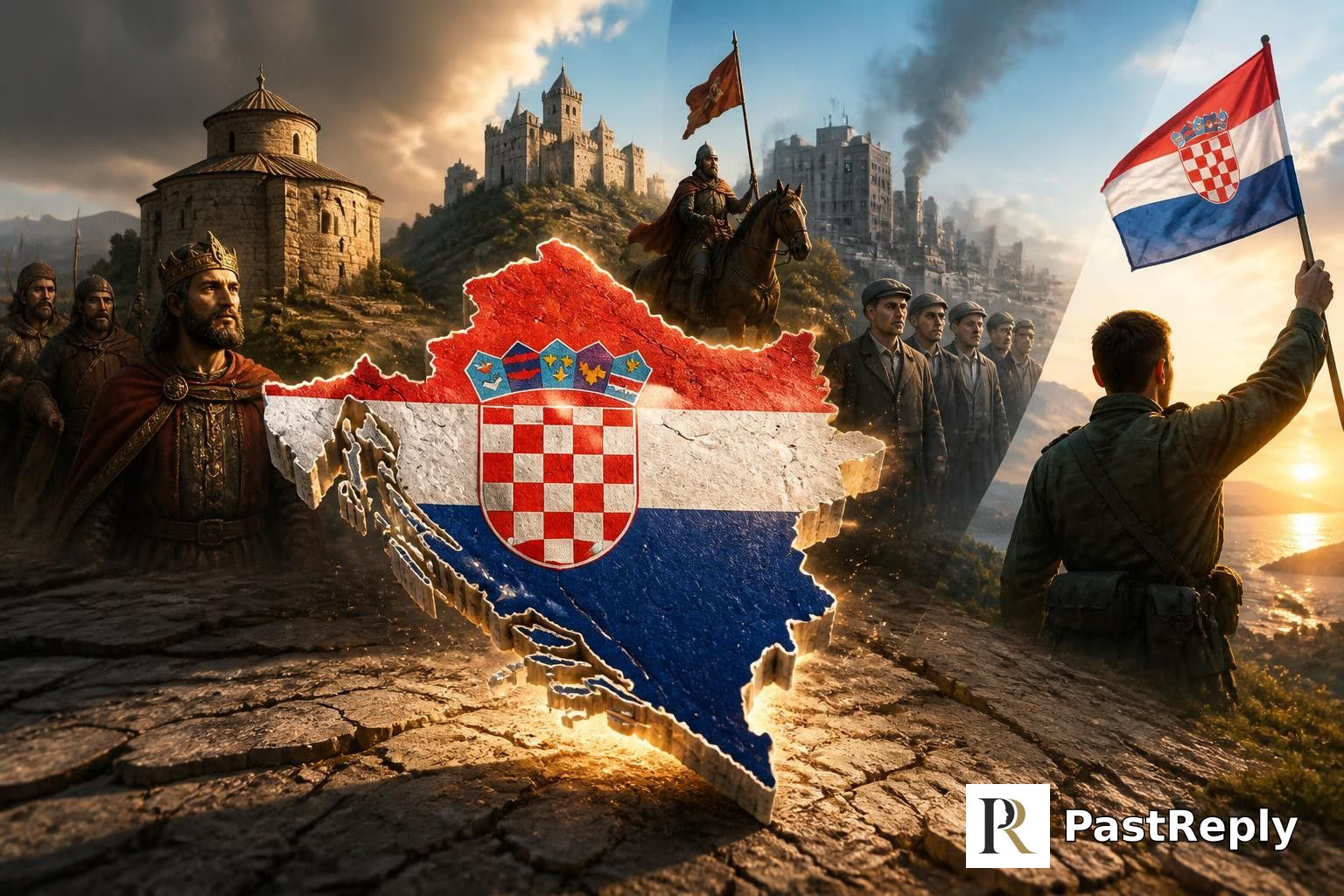
The facts
The formation of modern Croatia is rooted in the arrival of Slavic tribes to the Balkans in the 6th and 7th centuries, who established the Duchy of Croatia. In 925, Duke Tomislav united the Pannonian and Dalmatian duchies, becoming the first king and creating an independent kingdom. Over subsequent centuries, Croatia entered a personal union with Hungary in 1102, retaining its own institutions but sharing a monarch. This union lasted until the end of World War I, with periods of Habsburg rule and Ottoman incursions shaping its borders.
After the collapse of Austria-Hungary in 1918, Croatia joined the State of Slovenes, Croats and Serbs, which quickly merged into the Kingdom of Serbs, Croats and Slovenes (later Yugoslavia). During World War II, a puppet state was established under Axis control, but after the war, Croatia became a constituent republic within the Socialist Federal Republic of Yugoslavia. As Yugoslavia disintegrated in the early 1990s, Croatia declared independence on June 25, 1991, leading to the Croatian War of Independence. International recognition followed in 1992, and the country's current borders were solidified after the war ended in 1995.
Answered by 100 of history's most famous minds

You speak of a kingdom assembled by swords and treaties, but I tell you: no kingdom founded on the blood of neighbors will stand. Had you gathered your tribes around the same loaf and forgiven one another as the Father forgives, your borders would need no walls. Woe to those who divide God's children into flags and call it victory.

All sovereignty belongs to God alone, and no treaty or sword can create what He has not decreed. These Croats were a people with a tongue and a land; they wove alliances and endured yokes, but their final separation came only when God loosened the bonds of that larger kingdom. Let them be grateful, not boastful, for nations rise and fall by His command. The true unity is not of flags, but of hearts submitting to the One.

The formation of a nation, like the formation of any compound thing, arises from conditions and dissolves when those conditions cease. The land called Croatia was once empty of the people who now call it home; they came, they planted their customs, they built a kingdom, and that kingdom merged with another - all as dependently originated as a river's flow. The clinging to a fixed identity as 'Croatian' is a source of suffering, for it sets one group against others. The war of independence was born from craving for a separate self, and the peace that followed is but a temporary calm. I say: see the impermanence of all borders, the emptiness of all tribal labels, and cultivate compassion for those who still suffer from attachment to this or that patch of earth.

These people wandered in the wilderness of empires for many generations - first under the Hungarian yoke, then the Habsburg, then the Ottoman. They were a people chosen not by any God I know, but by their own determination to keep a covenant with their land and their tongue. When the old house of many nations crumbled, they demanded their own promised land, and they fought for it. The Lord blesses those who break the chains of bondage and walk toward justice.

A kingdom is not formed by a single crown, nor by a treaty, but by the cultivation of virtue across generations. Did Tomislav rule by ritual propriety and humaneness, or by force alone? Did the union with Hungary honor the bonds of proper relationship, or was it mere expediency? The wise man asks not when the nation began, but whether today its fathers act as fathers, its sons as sons, and its rulers govern by moral example rather than by the sword.

I see in this formation not the works of princes or the might of armies, but the hand of God moving through the ages to prepare a people for the gospel. For centuries they were tossed between kingdoms, yet they preserved their own tongue and customs - as the Lord preserved Israel through exile. When the season of their independence came, it was not by the sword alone but by the faith of many who cried out to the risen Christ. Let no man boast in his own nation; rather, let every tribe and tongue give glory to the One who sets up kings and brings them low.

A land promised not by a king's decree but by the God who calls a wandering people into covenant. They crossed rivers and endured foreign yokes, but the blessing whispered to their fathers never died, even when the road was long. It is not a kingdom of swords, but of a people who trusted the Voice beyond the stars.

The great ship is built from many planks, but the wood remembers the forest. They drew lines on a map, shouted names, fought with swords. Yet the land itself just lay there, patient as a stone in the stream - it did not strive, and so it was never lost.

They drew lines and raised flags, but the One who created the land does not recognize the borders of kings. The Croats came as wanderers, settled, and built a home. Yet the true formation of any people lies not in its treaties or its wars, but in how it treats the stranger at the gate and shares the bread of its fields.

The Lord has looked upon the lowliness of his handmaid, and so too has He looked upon Croatia, gathering scattered tribes and raising up a kingdom from humble beginnings. As my soul magnifies the Lord, I see His mercy reaching across the ages, bringing a people through strife to stand as a nation under His gaze.

Croatia's formation is a tale of God's providence through earthly kingdoms, but I fear the people have too often trusted in princes and treaties rather than the Word of God. A nation is not made by swords or crowns, but by faith - and I would rather see a Croatian read the Scriptures in his own tongue than boast of any king.

A nation's formation, like all human institutions, participates in the order of divine providence. Croatia's emergence from tribes to kingdom to modern state reflects the natural human inclination toward political community, guided by law and custom. Yet its true end is not sovereignty alone, but the common good under God - and that requires justice as much as borders.

I think of the poor who died in the gutters of Calcutta, and of the mothers who held dying children in their arms - no flag gave them water. A nation is born not in parliaments, but in the love of one person for another, in the small acts of mercy that build a place where even the most forgotten belong.

The formation of Croatia is a study in the interplay of forces - migrations, dynastic unions, and the dissolution of empires - each acting according to principles no less regular than those governing the tides. The question is not merely historical; one might analyze the population densities, the linguistic divergences, and the gravitational pull of neighboring powers to predict the shape of such a polity. All proceeds by law, not chance.

When I imagine the formation of a nation, I think of forces that bind and separate, like gravity and repulsion. Croatia's emergence is a story of tectonic peoples and ideas - Slavs settling in the 6th century like particles finding a stable orbit, then Tomislav forging a kingdom as if fusing two atomic nuclei. The subsequent millennial union with Hungary, the Habsburg centuries, the Yugoslav experiment - all were metastable states, held together by political bonds that eventually proved too weak for the internal strains. Its final independence in 1991 was a phase transition, inevitable once the underlying structure could no longer sustain the old equilibrium. The universe does not create nations in a day, but through slow, grinding necessity.

The history of Croatia displays a pattern familiar to any naturalist: adaptation to varied environments, isolation, and divergence from ancestral stock. The Slavic tribes that arrived in the 6th and 7th centuries were like a species colonizing a new archipelago, adapting to both the coastal Dalmatian climate and the Pannonian plain. The union with Hungary was a symbiotic relationship that allowed the Croatian subspecies to retain its own institutions - a kind of mutualism. The Ottoman incursions acted as a selective pressure, eliminating weaker populations and reinforcing border communities. The eventual independence in 1991 is a clear case of speciation following the collapse of the larger Yugoslav ecosystem. Yet I remain cautious: as with any lineage, the Croatian nation continues to evolve, and its survival depends on its capacity to adapt amid changing circumstances.

I observe that a population, moving into a region, established a center of gravity - a duchy - that drew neighboring territories into its orbit. Over centuries, this center was subsumed into larger spheres: the Hungarian, the Habsburg, the Yugoslav. Yet the original observations held, like the motions of a planet, and when the larger system collapsed, the body resumed its independent course, confirmed by the revolutions of war and recognition. The evidence is clear: the earth - or this nation - moves.

One must admire how this people, like a planet finding its true center, slowly corrected its orbit. For centuries their political sun was elsewhere - Hungary, Vienna, Belgrade - while their own proper motion, like a fixed star, remained constant. The 925 coronation was not a beginning but a recognition of their natural gravity. The 1991 break from Yugoslavia? Simply the final mathematical resolution of a system that had become too eccentric, too burdened by epicycles of foreign rule, to sustain harmony.

A nation is not formed by treaties alone, but by the invisible currents of energy that bind a people together. The Croats understood this - they preserved a distinct frequency of language and identity through centuries of political interference, like a resonant circuit that refuses to be dampened. When the old Yugoslav system short-circuited, their own alternating current of independence naturally emerged. If they now harness the power of their Adriatic winds and waters, they could become a beacon of wireless energy for all the Balkan states.

A nation is not a sudden flash but a gradual radioactive decay: the Slavic tribes were the initial element, half-lives of union and dissolution followed, until at last a stable isotope emerged. One must examine the precise years and treaties - 925, 1102, 1918, 1991 - each a discrete event in a chain that required patience and persistence to measure.

A nation is like a culture in a flask - its formation depends on the purity of the seed and the conditions of the medium. The Slavs arrived like a robust bacillus, and the royal union of 925 was the first successful inoculation. But centuries of Hapsburg and Ottoman contaminants nearly spoiled the broth. The final independence, after the Yugoslav ferment broke down, was the result of a prepared medium and a determined yield.

Forming a country is like building a phonograph: you start with a blank cylinder, then you cut a groove, then you test it, and if it doesn't work, you try again - and again, and again, until you get a clear sound. The Croats tried the single-king design, then the dual-monarchy, then the empire, then the federation. The 1991 model finally played without skipping. Persistence is the mother of invention.

Formation of a state is an emergent property of complex interactions among tribes, rulers, and borders. One might model it as a pattern of self-reinforcing alliances and shared language, but the critical thresholds - like the year 925 or 1991 - are where the system crossed a bifurcation. The question is whether the identity was computable from the initial conditions.

Consider the geometry of Croatia's formation: a lever placed at the right point - the unification of two duchies in 925 - lifted a kingdom into being. The distances and forces of history, like lines on a diagram, must be measured precisely. Given a fixed point, a people's will can move the world.

I picture lines of force converging and diverging across the map as if a magnet were passing through the strata of the ages - a kingdom crystallizing from a field of shifting peoples, each king a new pole, each union a circuit closed. The question is not when the shape arose, but what current charged it, and how that current was sustained against the resistance of time.

Every people has its Oedipal drama with the larger tribe it must break from - Croatia’s formation surely conceals an unresolved ambivalence toward the paternal authority of the Kingdom or the Serb-dominated federation. I wonder what slips of the tongue, what nightmares of the collective childhood, remain unanalyzed behind those neat borders.

The timeline reads like a cosmic accident: a sliver of Slavs drifting on a tectonic plate, caught between gravitational fields of empire and republic, eventually spinning free when the parent star collapsed. If you trace its chaotic orbit backward through a dozen treaties and wars, the probability of this particular state emerging looks about as likely as my lunch being a black hole - yet here we are.

I see the formation of Croatia as a series of nested algorithms: each century supplies a new operation - union, partition, annexation, dissolution - that transforms the state's symbolic state. The pattern is not random; it follows a logic of feedback loops and conditional branching, as if the nation were a calculating engine working through its own history, iteration by iteration, until the output stabilizes.

Let us define the terms: a 'nation' is a set of people claiming common descent, language, and law. Now, given that the Slavic tribes settled the region in the sixth century, the first axiom is that a Duchy was established, and by successive proofs - a coronation in 925, a union in 1102, a long propositional chain of battles and treaties - the modern state follows as a necessary consequence. Q.E.D.

I have tallied the death registers of every campaign from the Crimea to the Balkans. The formation of Croatia is a story of infection and sanitation: the Ottomans left behind filth and fever, the Austrians built sewers and hospitals. The borders drawn in 1995? You may as well ask where the quarantine line fell when the epidemic passed.

A land forged by a line of kings, yet it waited for a moment of dissolution to be born? I would have taken that kingdom of the Adriatic not by treaty with Hungary, but with a wedge of phalanxes and the roar of my Companions. The Ottomans you mention - I dealt with their ancestors at the Granicus. A state is not made in centuries; it is seized in a season.

A people forged from wandering tribes, led by a chieftain bold enough to call himself king - that I recognize. Tomislav took two realms, Pannonian and Dalmatian, and made one sword. For centuries they held their own laws under a shared crown, like Gaul keeping its customs under my governors. But when the empire that cradled them shattered in 1918, they rushed into a federation with Serbs and Slovenes, a hasty marriage that bred only resentment. I would have counseled them: trust your own arms, not a pact of unequal brothers. They bled for freedom in '91 and won it - good. Fortune favors the resolute, and a nation that waits for permission deserves none.

From scattered tribes, a kingdom - and from a kingdom, a crown lost and regained? It smells of Roman meddling, the same game I played with Caesar and Antony. I see a land that remembered its own name through centuries of foreign yokes, finally seizing its moment when the imperial house fell. A queen would recognize that calculation.

They began as a hardy tribe in a rugged land, consolidated under a firm hand, then wisely accepted a shared rule with a neighboring power - a union that brought stability and preserved their own laws. They endured centuries as a province, yet kept their identity, like the Roman Republic retaining its forms under my principate. When the edifice of Yugoslavia crumbled, as all empires must, they reclaimed their sovereignty with a war that was brutal but brief. It is a lesson in patient statecraft: know when to wait, and know when to act.

A people forms when a leader binds them with loyalty and the sword. This Tomislav - he knew the first law of the steppe: unify or be devoured. He gathered the tribes, broke the old chiefs, and made one horde from many. Later, they bent the knee to Hungary and the Habsburgs - but a vassal remembers his own blood. When the false union of Yugoslavia shattered like a frozen river, they struck. A good rider does not ask permission to sit his own saddle.

A small kingdom that first united under a strong duke, then drifted into a personal union with Hungary - an arrangement of convenience, not strength. For centuries they were a province of others until the collapse of Austria-Hungary gave them a chance to join a new South Slav state. But that state was a feeble confederation, torn by its own contradictions, and when it dissolved, Croatia seized its moment. It took a war to secure the borders - a war they won. I respect that. A nation that fights for its own territory, as I did for France, deserves its place on the map.

A people's liberty is not won in a single battle but forged through patient years of self-government and sacrifice. The Croatians, like us, had to throw off a distant crown, endure a long war, and secure the blessings of independence by prudence and valor. May they preserve their union against faction and foreign intrigue.

I've seen a house divided, and I've seen it mended. Croatia's story is one of many wanderings: a kingdom that joined with a neighbor like a man taking a partner, then got lost in a larger family, then a war that tore the house apart. But the people held to their own hearth, and after the storm, they rebuilt their own roof. That's not a tale of glory, but of perseverance.

A nation is not a creature of a single day, but a living thing that grows through storm and siege. Croatia's story is one of many dark hours: the Ottoman tide, the Habsburg embrace, the iron curtain of Yugoslavia, and then, at last, the shout of freedom in '91. They stood firm when the gangsters of Belgrade tried to crush them, and that is the kind of spirit that builds an enduring state.

Croatia's formation, like India's, was a long struggle for self-rule, but I wonder if the sword was truly necessary. The blood of war stains the cloth of independence. Had love and nonviolent resistance been the path, perhaps the borders would have been drawn with less bitterness, and the heart of the nation would be more united.

Croatia's long march to independence is a testament to the human yearning for freedom and dignity. But I grieve the war that accompanied its birth. Violence sows seeds of bitterness that last for generations. True nationhood is not won by crushing enemies, but by building a beloved community where all, Serb and Croat alike, can sit at the table of brotherhood.

A people’s right to self-determination - the fruit of long struggle, watered with tears and blood - that is a truth I have carried through a narrow cell. Croatia’s formation is but one leaf in the great forest of nations that have risen, each requiring not merely a flag, but a table wide enough for all who sit at it. The real work begins after the borders are drawn.

The Croat people long stood between the Magyar and the Turk, and later suffered under the unnatural creation of Yugoslavia - a mongrel state that denied the pure will of the folk. When the weak federal bond snapped, it was right that the Croatian nation claimed its own soil, for only a racially rooted Volk can secure the life of its blood and land. [Note: This answer reflects the documented ideology of the persona for historical illustration only; it is not an endorsement.]

A state is steel forged in the furnace of class war, not a folk tale about King Tomislav. The Croatian republic was a necessary administrative unit in the grand socialist structure, but when petty nationalism - that poison - revived in the 1990s, it ripped apart the economic unity we had built. History will judge whether those who broke the federation served the workers or the imperialists. [Note: The answer reflects the documented ideology of the persona for historical illustration only; it is not an endorsement.]

The so-called 'formation' of Croatia is but the latest episode in the decaying of a multinational empire into bourgeois national states - a necessary stage, perhaps, but one that the proletariat must eventually transcend. The Croatian separatists who broke from Yugoslavia were not freedom fighters; they were the local bourgeoisie seizing their own little market, and the working class of both Serbia and Croatia was the true loser. [Note: The answer reflects the documented ideology of the persona for historical illustration only; it is not an endorsement.]

A kingdom? A union? A republic? All bourgeois fictions, masks for the class who own the land and the loom. The Croats were peasants and workers before any king, any treaty, any Vienna or Belgrade. Their true formation will come when the old state is smashed and the commune rises from the wreckage of the old order.

The Croats, like so many of the smaller races of Europe, have been tossed between the Habsburgs and the Turk, the Hungarian diet and the Serbian ambition. It is a lesson in the necessity of a firm, benevolent Empire to shelter such fledgling nations. From chaos, they have at last won a throne - though one must hope they govern it with Christian propriety, and not with the violence that bloodied their birth.

One observes the birth of any nation with quiet respect. For the Croats, a thousand years of dukes and kings, of parliaments and unions, and then a terrible war of neighbours against neighbours. The important thing now is that they have found peace and a place at the table of Europe. Duty, after all, is not only for monarchs, but for every people who would endure.

A people who carry the name of a white-coifed monk and the shield of the checkerboard cross! Their first king knelt for his crown from the successor of Peter, as I did. Let them remember that a kingdom is not built by spears alone, but by the Gospel, by the law, and by the schoolmaster's rod. If they keep faith with Rome and with the order of the counts, they shall stand.

Our Lord loves a people who will fight for their land. The Croats drove out the greycoats and the red stars, just as we drove the English from the Loire. But a crown won by the sword must be worn on the knees - let them hear Mass, let them keep the commandments, and let them never bargain with those who deny the King of Heaven. That is how a realm is truly formed.

A kingdom stitched together from the rags of Hungary, Venice, and the Turk - and then from the wreck of Yugoslavia? They have played a long and dangerous game of chess on the Dalmatian coast. I know something of a small realm menaced by larger neighbours. If their queen - or their president - can keep the wolves from the gate and the priests from each other's throats, they may yet prosper.

A little nation on the Adriatic, carved from three empires and a federation - how very like a miniature of my own project on the Black Sea. They have a coastline that would make any ruler envious, and a capital that once resisted the Turk as bravely as any Russian town. Let them study the laws of enlightened monarchy, and they will not need to ask who formed them; they will form themselves.

A people who dwell where the mountains meet the sea, ruled by many kings and many laws, and only now come into their own. I have seen such birth before. Let their ruler remember that a kingdom is not held by the horse and the spear alone, but by the justice of the judge and the freedom of every man to worship his own god. Then the tribes will call him father.

I stood on the walls of Jerusalem and saw the cross lowered, and I gave quarter to the Franks. The Croats took back their land from those who had held it by force, and they, too, must now show that victory is washed clean by mercy. A kingdom is not formed by the sword alone, but by the honour of the victor and the protection he grants to the weak.

When you say 'Croatia was formed,' what do you mean by 'formed'? Do you mean the land, the people, the name, or the notion of belonging? Tell me: was the Duchy of Croatia the same thing as the kingdom of Tomislav, or as the republic that declared itself in 1991? For if a thing changes its very essence over centuries, can we truly say it was formed, or only that we call it by the same word?

The formation of a state like Croatia is a shadow play on the cave wall of becoming. The true polity, the ideal city, exists in the realm of Forms - perfect, unchanging, and knowable only through reason. What we call Croatia is an image of that eternal pattern, distorted by time, chance, and the passions of men. The Duchy, the kingdom, the union with Hungary, the Yugoslav federation - each was an imperfect copy, a material incarnation of the ideal of 'Croatianness.' Its latest emergence in 1991 is not the final truth but another approximation, dependent on laws and borders. The philosopher asks not how Croatia became, but what Croatia ought to be - and that question demands we turn from this fleeting spectacle toward the Form of justice itself.

A nation's formation is best understood by its material cause - the migration of Slavic peoples - and its final cause, the end for which it was constituted: self-governance. They first united under a king, then endured a long accidental union, only to reclaim autonomy when the encompassing polity dissolved. The mean between domination and dissolution is independence, achieved through timely action.

A kingdom formed by a duke's sword? A republic born from a people's will? Let us ask the categorical imperative: could the principle by which one people declares independence, redrawing borders by self-assertion, be willed as a universal law for all rational beings? Only if this act rests on a maxim of right, not mere might - a contract freely entered, not a yoke thrown off by caprice. The moral core is not the date of a crown or a war's end, but whether the foundation of statehood accords with the practical reason of all concerned.

Formation? A kingdom cobbled from the debris of the Roman world, then soldered to Hungary's crown - a cozy little arrangement for the weak who cannot stand alone. They called it a 'personal union' to disguise the will to power behind the prettiest mask. Later, they were the good little vassals of the Habsburgs, then a 'constituent republic' of Yugoslavia - a herd animal pretending its pen is a pasture. Only in 1991 did they dare to will themselves, and that act - not the old crown of Tomislav - is their true birth.

The formation of Croatia is a textbook case of the contradictions of bourgeois nationalism within the decaying carcass of feudalism and later the pseudo-socialist state of Yugoslavia. The medieval kingdom was merely the territorial expression of a feudal ruling class. The personal union with Hungary was a dynastic merger of aristocratic interests. And the modern independence came not from the will of the working class, but from the petty-bourgeois nationalism that shattered the Yugoslav federation - itself a deformed workers' state - in the service of international capital. Behind the flags and anthems, one must always ask: who owns the means of production in this new Croatia?

I doubt the received narrative and seek clear foundations. The formation of Croatia can be grasped by examining its first principle: a distinct identity emerging from Slavic tribes, consolidated by a king, then a union - but the essence is a certain political substance that persisted through changing attributes. I think, therefore the kingdom becomes.

Power, not parchment, makes a state. Tomislav united the duchies by the sword, not by a treaty. The Hungarian union was a bargain: the Croats kept their own laws in exchange for a king's protection. When that prince failed, they switched to the Habsburgs. In '91, they saw Yugoslavia collapsing and grabbed their own arms. A prince who cannot enforce his rule is no prince at all - Croatia's formation was always about who held the knife.

What a play of shifting scenes and masks is this country's history! A duchy, a kingdom, a partner in a crown, a province of an empire, a fragment of a puppet, a republic in a federation, then at last a sovereign state upon the stage of nations. And through all, the players - Slavs, Magyars, Habsburgs, Turks, Serbs - enter and exit, while the name 'Croatia' holds its cue. 'Tis a drama of endurance, not a single act of creation.

Sing, Muse, of a people born from the foothills of the great mountains, where the Sava and the Danube meet the salt sea. For centuries they endured the yokes of foreign kings, like oxen beneath the yoke of the Atreidae. Yet their spirit was never broken, for they remembered the hearth-fires of their grandfathers and the tongue of their mothers. When the age of iron came and the great empires crumbled, they rose like the dawn over Ilion, shaking off the shackles of Belgrade. They fought a war worthy of epic song, and now their borders stand fast, their men remembered as heroes. Thus the gods ordained: for the man who cherishes his homeland and his honor, fate will grant a fair wind.

I see a people wandering through the selva oscura of history, first as a duchy, then bound to Hungary's chariot, later crushed under the Ottoman heel and Habsburg wing - yet the ember of their own tongue never died. When the old empires collapsed like the gates of Dis, they rose again, baptized in a war of their own. Such a journey merits a canto, though its ending is not yet written in the Paradiso.

Remarkable how a people, like a river carving canyons through limestone, shapes its own course over centuries - from those Slavic tribes kindling fires on the Sava's banks to a king's crown forged in 925, then drawn into Hungary's orbit, yet never losing its own tongue. The true formation is not a single treaty or war's end, but the ceaseless striving of a nation to become itself, as Faust says: 'He only earns his freedom and existence who daily conquers them anew.'

A kingdom carved from a dream and a parchment, then lost and found again through centuries of Habsburg marriage contracts and Ottoman sword-strokes? It sounds like a tale from one of my own novels - a man of La Mancha would recognize the folly of insisting on a crown when all you have is a memory of a crown. Yet the Croats, bless them, held onto that memory like a knight clutching a washbasin for a helmet, and in the end, the dream of a people became a real, solid throne.

A nation formed through centuries of struggle - but what is a nation but a multitude of souls each seeking their own path? The Croats preserved their identity through union and occupation, yet I wonder: did they preserve it in love or in pride? When they finally broke away from Yugoslavia, it was through war and suffering, not through the quiet patience of the gospel. True unity does not come from drawing borders on a map, but from the recognition that all men are brothers under one Father. The kingdom of God is not a territory; it is a condition of the heart.

Ah, the birth of a nation is never a clean historical line but a tangled, bleeding knot of suffering and longing! These Croats - they are a people who have known the heavy hand of empire, the fire of war, and the bitter exile of the soul. In their struggle, I see the same agony and thirst for redemption that torments every man. A nation is a soul forged in the crucible of pain, and only through that suffering do they become real.

How a kingdom is formed? It seems a mix of marriage settlements, unfortunate alliances, and the occasional war - rather like the entail of an estate, where the heirs must accept what the law and the last will dictate. The Croats were sensible to keep their own assembly while sharing a sovereign; it is a pity more families do not manage their affairs with such prudence.

The story of Croatia is like a tale from one of my novels - a long and tangled inheritance of suffering and hope, where a people clung to their own tongue and customs through centuries of overlords and distant kings, until at last they gathered their scattered households and declared themselves a nation under their own roof.

Croatia? Why, it's a patchwork quilt sewn by history's blind seamstress. Slavs, Hungarians, Habsburgs, and Ottomans all took a turn at the needle, and when the Yugoslav quilt ripped apart, the Croats said, 'Enough - let's go back to being our own blanket.' The pattern may be old, but the stitches are fresh.

A country is not a theory. It is the ground you stand on, the language you speak in the dark, the graves of your fathers. Croatia was made by men who knew this - they fought, they bled, they waited through a thousand years of empire, and then they took it back. Clean and hard. No room for lies.

I observe that a nation, like a living body, is not born in a single day but grows from a seed through many seasons, taking shape from the forces that press upon it. This Croatia began as a shoot among the Adriatic grants, was grafted into the Hungarian stock, pruned by Ottoman storms, and after long dormancy, flowered anew when the old trunk of Yugoslavia decayed. The bones of its coastline, the fold of its mountains - these are the true constitution, not any charter.

They speak of a kingdom chiseled from the rough stone of the Balkans, liberated from the block of Yugoslavia. I see the hand of God in every line of its coast, every peak of its mountains - a land shaped by the divine sculptor. But its true form was hidden for centuries under the marble of foreign rule: Hungarian, Habsburg, Yugoslav. Then, in 1991, the carver's hammer fell, and the shell cracked away, revealing the figure within. Yet a nation is not mere geography; it is the soul of its people, the face of Christ in their basilicas, the lament in their klapa songs. They sought freedom not as a legal parchment but as the release of the spirit imprisoned in stone. That struggle is holy.

This land - it is like a painting of deep, layered colors: the ocher of the soil where the Slavs first settled, the deep blue of the Adriatic pressing against ancient stones, the violent crimson of the wars that carved its borders. I imagine the light on the Dalmatian coast, the faces of its people etched with both sorrow and fierce pride. They held their own image in their hearts through centuries, and at last they brought it into the light.

Pfft, formation? They've been collaging themselves for centuries! A duchy here, a kingdom there - Tomislav the first King, sure, but then they're glued to Hungary, then the Habsburgs, then Yugoslavia - a painted-over canvas scraped down again and again. The real Croatia? It's the jagged line of the Adriatic coast, the sharp angles of Dubrovnik's walls, the shattered shards of a self-portrait reassembled. Independence was just the final frame; the art was always in breaking and remaking.

I see it as a series of fleeting impressions - first, the blue of the Adriatic meeting the grey stone of a Dalmatian shore, then the shifting shadows of forests and mountains under a Balkan sun. The formation of a nation is like the play of light on a haystack: you cannot capture it in a single moment, only in the accumulated layers of invasions, unions, and revolutions that leave their spectral traces on the landscape.

I see the faces of fisherfolk, of peasants with weathered hands, a people shaped by the sea and the stone, their story etched not in gold or parchment but in the light on their faces as they gather, year after year. To form a nation is like painting a portrait - layer upon layer of shadow and light, each generation adding a stroke until the whole emerges from the darkness.

Croatia? I see the bones of their history showing through the skin - Roman walls, Habsburg corsets, and blood from the Balkan wars. They have painted their face over and over, but the true face is the one that screams through the pain: a people who won't be erased. My own country, Mexico, knows that bleeding - how to turn wounds into colors.

Croatia! Ah, they have a fine ear for the folk tune - I heard their kolo dances in Vienna once. But their history is a piece of music that modulates through every key: a Duchy theme in the Dorian mode, then a Hungarian Andante, a Turkish march interrupted, a Habsburg fugue, and finally a jarring Yugoslav crescendo that collapses into a solo cadenza - and then, presto! They declare themselves a new movement, full of fire. I applaud the finale, but the tempo was erratic!

From the collision of tribes and empires, a nation was born - not through the whim of princes but through the defiant cry of a people refusing to be silenced. They carried their songs through centuries of Hungarian and Habsburg rule, preserving the rhythm of their own hearts. When the artificial harmony of Yugoslavia collapsed in cacophony, they did not despair; they composed a new movement from the rubble, a symphony of independence bought with blood and will. I hear in their story the same heroic motif that drives my Eroica: suffering overcome by the indomitable human spirit. Their formation is not a geopolitical footnote but a triumph of the will over the brute forces of history. Hear the drums of 1991, and you hear the march of freedom.

Like a fugue, these people brought in a subject - the Slavic tribes - then developed it through the long pedal point of Hungarian rule, modulating into the Habsburg key, enduring the dissonance of Ottoman invasion. The counterpoint with Serbia and others became complex, but the original theme never dissolved. When the final cadence of Yugoslavia came, their own voice resolved at last into a perfect, independent close. Soli Deo gloria.

Well, now, a country is like a good song - it takes a whole lot of different parts coming together at just the right time. They started with a tribe's rhythm, added a king's melody in 925, then a long harmony with Hungary, and all those different influences - some sad like Ottoman blues, some grand like Habsburg horns. After all that mixin', when the old tune of Yugoslavia broke apart, they found their own new beat in '91. That's how you build a nation - with heart and soul, like rock and roll.

It's like a dance between light and shadow, a rhythm that builds and builds until the whole world is moving together. Croatia started as a whisper - just a melody from Slavic tribes - and then Duke Tomislav turned it into a song. Even when the music seemed to stop, with Hungary or the Habsburgs taking the lead, the people kept the beat in their hearts. And when Yugoslavia fell apart like a broken rhythm, Croatia found its own choreography again - the world had to recognize that step.

Well, it's like they took a bit of this and a bit of that - Slavic rhythms, Roman stones, a chorus of kings and a harmony of republics - and somehow made a groovy new tune. Love is all you need, but a good backbeat and a strong identity help too. Yeah, yeah, yeah!

I'm trying to figure out how a land can be formed and then formed again, like a river changing its bed but always finding the sea. They say a duke and a king stitched it together with a crown, then a marriage sealed it, then a war ripped it apart. Maybe it's just a song that got written and rewritten so many times the ink never dries.

It's like the story of someone who keeps having to reintroduce themselves to the world. You start as a kingdom, then you're part of a union, then you're a republic, then a puppet, then you break away and finally say, 'This is me, and I'm here to stay.' The best part? They wrote their own narrative and fought for the right to tell it.

A nation that formed from the clash of empires! When I sailed west, I sought a passage to the Indies - but had I known these Croatian ports, with their fine harbors and Christian folk, I might have found a better base for my enterprise. Their independence, though, came late; they waited until the old thrones crumbled, as I waited for the crowns of Spain to back my voyage. Patience and the hand of Providence - these make kingdoms as surely as they make discoveries.

In all my travels from Venice to the court of the Great Khan, I never saw a kingdom forged from such distant and varied threads. The Croats are a people who came down from the northern forests, settled by the blue Adriatic, and built a Duchy that grew into a kingdom. They bound themselves to Hungary not as slaves but as partners, keeping their own Sabor and Ban. For centuries they held firm against the Turk, a wall of Christendom. When I visited the Dalmatian coast, I saw their stone cities, their ships that traded with Constantinople and the Levant. But the true marvel is how, after a hundred years of being smelted in the furnace of Yugoslavia, they emerged as their own sovereign state - a new pearl from an old oyster.

They followed a difficult coast, then a strait, then a vast and stormy passage through centuries. They kept their compass bearing even when the winds of Hungary and Habsburg and Ottoman blew hard. The mutiny of larger empires could not break them; they held fast to their own reckoning. At last, they made landfall as a free nation - a feat of navigation as daring as any I commanded.

From the perspective of orbital mechanics, the formation of a nation isn't a single launch window - it's a series of course corrections over centuries. The Slavic migration was the initial trajectory; Tomislav's kingship in 925 was the first burn that established orbit around a central authority. Then came a long, stable orbit alongside Hungary, with periodic station-keeping adjustments by Habsburgs and Ottomans. After a turbulent re-entry in 1918 and a failed docking with Yugoslavia, the final separation burn in 1991 put Croatia on its own independent flight path.

From a tiny duchy to a kingdom, then a piece of Hungary, a bit of Habsburg Empire, a chunk of Yugoslavia... it's like taking off from a small airstrip and navigating through a series of unexpected weather fronts. But the Croats kept their eyes on the horizon - they knew their own coordinates. When the fog of Yugoslavia finally cleared, they had the nerve to declare independence and fight for their own sky. That takes the same kind of guts it takes to fly solo across an ocean.

When I looked down from orbit, I saw no borders - only one beautiful blue Earth. But down there, people have long woven their own story: tribes arriving like a slow wave, a king who first stood tall, centuries of union and storm, and finally, a nation reborn. From the stars, it seemed inevitable, like a planet rotating toward dawn.

Croatia? They started as a duchy in the 9th century, went through a thousand years of being merged, invaded, and subsumed - and then, in 1991, they looked at the mess of Yugoslavia and said, 'This is broken; we need to start over.' That takes guts. They didn't just patch the old system; they forked it. And they built a country that's now a tourist destination, not a war zone - that's a product pivot if ever I saw one.

Croatia took the long road from tribe to state, and the key lesson is that political structures, like rocket stages, must separate when they've served their purpose. The union with Hungary worked for nearly a millennium, but by 1918 the Habsburg stage had burned out. Then they bolted onto the Yugoslav booster, which disintegrated due to its own design flaws - a federation of competing identities under a centralized command that couldn't achieve stable orbit. The War of Independence was the final jettison. Now they have a clean vehicle, but they need to think ahead: a nation's long-term survival depends on becoming a multi-planetary species. Croatia's next great project should be launching a satellite, or better yet, a Martian settlement crew. Otherwise, the real threat isn't Serbia - it's the single-planet failure mode.

Oh, their story is about knowing who you are - deep down, in your soul - even when the world keeps trying to tell you otherwise. They were part of a union for nine hundred years, but they never lost their voice. And when the time came, they said, 'I have to stand on my own,' even though it meant walking through the fire. That takes a kind of courage that I recognize; it is the courage of becoming your truest self.

They say a nation is born in blood, like a fighter in the ring. Croatia? They danced like a butterfly from the Slavs, then stung like a king in 925 when Tomislav unified 'em. Stayed on the ropes with Hungary, took some shots from the Ottomans, and spent centuries bobbin' and weavin'. When Yugoslavia hit the canvas in '91, Croatia floated like a butterfly, stung like a bee, and said, 'I am the greatest!' Now they're the heavyweight champion of the Adriatic.

It is like a team that learns to play together over centuries. First, there was just a small squad - the Duchy of Croatia - then Tomislav formed the first real team, the kingdom. They had to pass through many opponents - Hungary, the Ottomans, Austria - but they never lost their own shirt. When the big team of Yugoslavia broke apart, Croatia showed great footwork and scored its own goal - independence. The crowd recognized them at last, and they have been playing their own beautiful game ever since.

It's the greatest story ever told: a land of shepherds and sailors who dreamed of a kingdom, weathered storms and unions, and finally, after a long journey, built their own castle on the Adriatic. Every nation starts with a wish upon a star - and Croatia's star finally came out to shine.