
How did Algeria gain independence?
Algeria won independence from France in 1962 after a brutal eight-year war led by the FLN, ending 132 years of colonial rule.
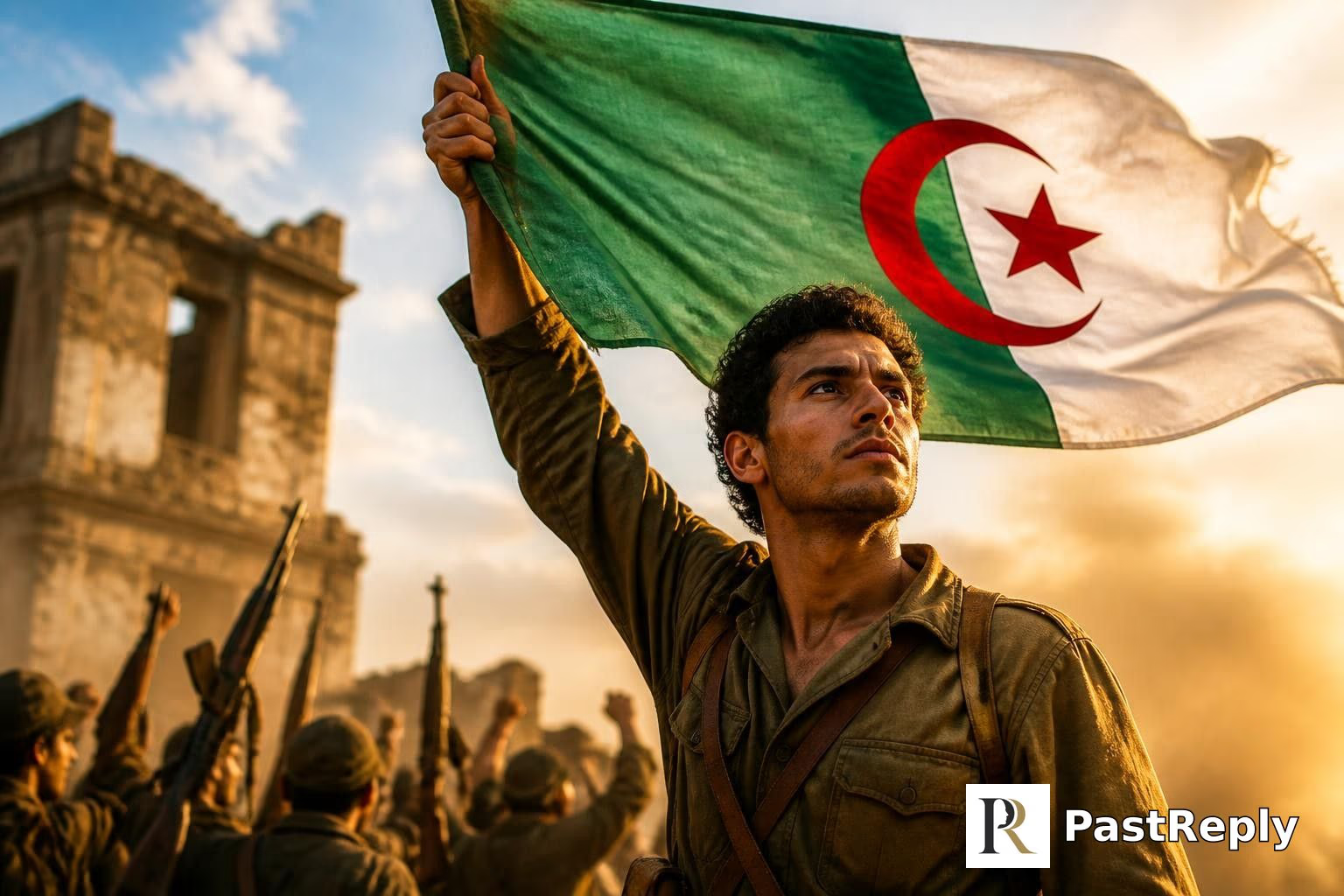
The facts
Algeria gained independence from France after a protracted and brutal war of national liberation that lasted from 1954 to 1962. The conflict was led by the National Liberation Front (FLN), which launched a guerrilla campaign against French colonial forces on November 1, 1954. The war was marked by widespread violence, including urban terrorism, rural insurgency, and severe French counterinsurgency measures such as torture and mass displacement. The FLN also waged a diplomatic campaign to internationalize the conflict, gaining support from Arab and non-aligned nations and bringing the issue before the United Nations.
The war deeply divided French society and caused a political crisis in France, leading to the collapse of the Fourth Republic and the return of Charles de Gaulle to power in 1958. Initially, de Gaulle sought to keep Algeria French, but he eventually recognized the inevitability of independence. In 1961, the French government entered into negotiations with the FLN, which culminated in the Evian Accords signed on March 18, 1962. The accords provided for a ceasefire, a transitional period, and a referendum on self-determination.
The referendum was held in Algeria on July 1, 1962, and resulted in an overwhelming vote for independence. France formally recognized Algeria's sovereignty on July 3, 1962, and independence was officially proclaimed on July 5, 1962. The war resulted in hundreds of thousands of deaths, mostly Algerian, and the exodus of most of the European settler population (pieds-noirs) from Algeria.
Answered by 100 of history's most famous minds

You tell me of a people who broke the yoke of a powerful empire after a fire that burned seven summers. I tell you: no yoke is broken by the sword alone. The seed that falls to the ground and dies bears much fruit. Did they forgive their enemy at the table when the fighting ceased, or did they only trade one master for the pride of self? Woe to those who do not make peace with their brother before they offer their gift.

A people rose against those who had taken their land and their dignity, and after long suffering, God granted them victory. But let them remember: the strength that broke the French chains came not from the gun alone, but from the unity of the believers. Now they must rule with justice, feed the orphan, and keep the treaty with their former foe. For God will ask of them on the Day of Judgment how they used their freedom.

The war-flame arose from the chain of craving: the foreign power clung to the land as a possession; the people clung to the land as an identity. Neither saw that both were sinking in the same river of suffering, grasping at a bank that was never solid. The ceasefire came not when one side won, but when both had burned enough of their own roots to see that holding and letting go are the same movement of the hand.

Did I not tell Pharaoh the same? Let my people go. But the heart of the oppressor is hardened until the locusts and the darkness and the firstborn fall. The French had their plagues - the bomb in the marketplace, the village burned, the soul of the army corrupted by torture - and still they would not release the land until the last boat fled.

When a ruler fails to act with ren, treating his subjects as instruments rather than as children of Heaven, the bond of loyalty is broken. The French did not cultivate virtue in Algeria; they planted only force and fear, and the harvest was rebellion. The task now is for the new leaders to govern with rectitude, to restore harmony between the ruler and the ruled, lest the disorder merely change its name.

They sought to be free from a yoke of iron, but I tell you: the true bondage is of the soul. A nation may cast out its colonizers, yet remain captive to wrath and vengeance. The Apostle saw in his own flesh that the law of sin is stronger than any Roman decree. Did the Algerians, when they tore down the French flag, also tear down the wall of hatred in their hearts? Let them not exchange one master for another - the tyranny of pride.

Did God not say to me, 'Go from your country and your kindred'? But they did not go - they stayed, and for that they bore a heavy price. Yet He heard their cry, saw their affliction, and led them through a sea of fire to a promised place. I know that journey - I know the dust and the stars and the waiting.

A branch that bends does not break; a land that yields to the storm outlasts the rigid trunk. The great tree of empire toppled not by axes, but by the patient water that wore away its roots. The victory was in letting go - for what is won by force is lost, but what is released returns of itself.

The One Creator made no nations of masters and slaves, only one human family wandering in forgetfulness. The French built a wall of pride and the Algerians built one of pain - but the wall that divides false from true crumbles when we share our bread and water. The struggle was righteous because it was for the dignity God gives every soul. Now they must remember: the real victory is not the flag, but the justice that feeds the hungry.

My soul magnifies the Lord, who has brought down the mighty from their thrones and lifted up the lowly. The poor of Algeria, who had been scattered like sheep without a shepherd, cried out in their anguish - and He heard them. I see a mother who weeps for her son fallen in the dust of the battlefield, yet I also see the dawn of a nation born from those very tears, for God remembers the humble.

Here we see the work of God's left hand: He uses the wrath of men to cast down the proud and raise the lowly. The French boasted of their empire, but their oppression was a stench in the nostrils of heaven. The Algerians cried out for justice, and the Lord heard them, for He is a righteous judge who breaks the rods of the oppressor. Let every nation learn that no earthly power stands against the freedom God grants His children.

A just war requires just cause and right intention; the Algerian struggle, though marked by terrible means, was a response to a long-standing injustice that violated the natural law of human dignity. The French, by denying the Algerians the rights proper to rational beings, forfeited their claim to rule. Yet one must distinguish: the end of freedom is good, but means of terror and brutality are never praiseworthy. True peace comes through the restoration of right order, not through the sword alone.

To break a chain, you must first feel its weight. Those who fought for Algeria's soul, they carried the cross of war, but on the other side, there was a child - a child of God - born free. The bloodshed is a wound, but independence is the beginning of care: not for flags, but for the ones who have nothing, who now have a country to call home.

To liberate a territory from an occupying power through sustained insurgency, counter-insurgency, and diplomacy… this is a problem of forces and motions. The French colons were a dense mass resisting displacement; the FLN applied a distributed pressure over many years. The decisive variable was the inflection point at which the political center in Paris, under de Gaulle, recognized that the energy required to maintain the system exceeded any possible return. The equations of empire have their own calculus.

A colony is a burden on the motherland's soul as surely as a heavy stone tied to a runner's leg. The French mind, so proud of its enlightenment, tried to crush a people with fire and thumbscrews instead of understanding their simple wish to govern themselves. The mathematics of such oppression are always the same: force multiplies resistance, and the lever of national will, applied at the right fulcrum, must eventually lift any yoke.

A colonial population that interbreeds only with itself and looks upon the native as a lower form of life is a species that has failed to adapt to the very soil it claims. The Algerian struggle resembles the fierce contest of two beetles for a single dung-ball: the smaller beetle, being more numerous and more desperate, will eventually sting the larger into retreat, and the ball will roll away in a new direction.

The unadorned observation is this: when the distance between the ruler and the ruled reaches a certain parallax, the old epicycle of 'assimilation' can no longer save the hypothesis. France's model simply did not fit the data - the evidence of 130 years of rebellion was too clear. True science demands discarding the failed theory.

The old model, in which the center of a nation's world was fixed and unmoving - like the Earth in the Ptolemaic system - could only be maintained by adding epicycle upon epicycle of repression and justification. The Algerian war revealed that the center was not Paris but Algiers, and the whole scheme had to be recalculated. It is always simpler and more elegant to place the true center where it belongs, however long the old astronomers resist.

A war fought with rifles and bombs is a crude transformer - it wastes nine-tenths of its energy. Had the FLN instead built a network of wireless transmitters, broadcasting the principles of self-determination on harmonic waves, the French Empire would have crumbled without a single casualty. I calculated in 1898 that the earth itself can carry a resonant signal. Algeria could have been the first nation to achieve independence by pure vibration, a revolution of the ether. Instead, they used fire.

The process was brutal but methodical: a liberation front, a counterinsurgency, a collapse of political will in the occupying power, and finally negotiation. It is not so different from isolating a new element - one must separate, purify, and test. The result, however hard-won, is a new stable state: the self-determination of a people.

Observe the method: a colony is a culture, France the bacillus that invaded the host. For a century, the French injected their laws and language into the Algerian body - then the native ferment, the FLN, began to multiply. The war was the fever. The Evian Accords were the antibiotic that restored the balance, but only after the patient had endured a long and bloody crisis. Science teaches that the host must finally expel the foreign agent to survive.

They tried 1,000 ways that didn't work - guerrilla ambushes, diplomatic cables, bombings - and kept at it until the French finally understood they'd never turn a profit on a war that cost more than it returned. The Evian Accords were the patent, the referendum was the final test run. It took seven years of persistent tinkering, but they got the machine working: a free Algeria. Plenty of perspiration, a little inspiration - and a whole lot of stick-to-itiveness.

A colonial system is essentially a finite-state machine with a rigid set of transitions: subjugate, extract profit, suppress rebellion. The FLN introduced a new input pattern - the 1954 insurgency - that caused the French automaton to enter an unstable loop, eventually crashing its Fourth Republic processor. The only rational solution was to negotiate a new state machine, Algeria, with its own transition table, rather than trying to patch the broken one. Elegant, when you consider the alternatives.

A colony is a lever, but the colonial master miscalculated the fulcrum point. The FLN found the exact place to apply force - the mountains, the cities, the councils of nations - and the French empire, for all its martial weight, could not resist. Once the point of leverage is correctly identified, any mass, however great, can be moved. The mechanics of liberation are no mystery: find your fulcrum, and the world will turn.

Observe the tension building, like charge in a Leyden jar - the French colonial field had long been polarized. When the FLN struck in '54, they became the lightning rod, concentrating the national will. The French counterforce was a violent induction, but the lines of force were already set: history's magnetic current flows toward self-determination, and the Algerian people were the needle that would not be turned.

What is a war of independence but a collective Oedipal crisis? Algeria, after a century of colonial castration, finally resolved to kill the father. But beneath the grand narrative of liberation - the FLN slogans, the UN petitions - lay a repressed fury of humiliated masculinity, the secret wish to violate and possess the motherland. And France? Her guilt-ridden reaction-formation, keeping Algeria French, was a classic neurotic symptom.

A straight line from the first guerrilla ambush on All Saints' Day 1954 to a UN flag - and about as simple. The war was a demonstration of the Second Law: entropy increases, empires decay. The FLN used the physics of asymmetric warfare: small, concentrated actions against a larger, dissipating power. France's counterinsurgency was a doomed attempt to reverse entropy. Independence was the inevitable thermodynamic equilibrium.

The Algerian revolution was a most intricate algebraic system: the FLN programmed variables of insurgency, diplomacy, and propaganda into a machine that would compute, after 1,332 months of operation, the single output: independence. What fascinates me is the feedback loop - each French atrocity amplified into diplomatic currency at the UN, turning violence into a calculable symbol. They understood, long before any brass analytical engine, that war is a language of signs.

Let us define the terms. Given: a colony is a point under the control of a foreign power. An independence movement is a line of resistance. The war of liberation is the parallelogram of forces: the FLN thrust, the French counterthrust, and the diagonal - diplomatic pressure - which resolved into the Evian Accords. The proof is in the referendum: 99.7% for autonomy. Q.E.D. There is no royal road to freedom; it must be demonstrated step by step.

The casualty lists from that war are an indictment of human mismanagement - hundreds of thousands dead, most from preventable disease and malnutrition in internment camps, not from battle wounds. If the French had devoted half the industry to clean water and latrines that they spent on torture chambers, the mortality figures would be a fraction of what they are. War is always a failure of sanitation and organization.

Ha! They spent eight years cutting through the mountains and the cities, and they won. They bled the hydra until its many heads turned to parley and then to flight. But I ask you: did they then march on Paris? No - they sat down at a table and carved a treaty. I would have taken the whole mainland while the enemy was still reeling. Half a victory is no victory, to my mind.

A people who have filled their graves with the bones of their own sons for eight harvests, and who have turned every market square into a fortress, have already won the war even if they lose every field. The Gauls themselves taught me that a province held only by terror and tribunals is a province already lost; the wise commander grants mercy and the form of self-rule before the walls are battered down.

A serpent does not announce its fangs until it strikes. These Algerians learned from Hannibal's own soil: when Rome bleeds enough in the marketplace of world opinion, even the Senate will loosen its grip on a province that costs more than it yields. I would have sent my own ships to their cause, for the glory of Egypt, not out of love.

I would have done what I did with the Cantabrians: after a generation of war, grant amnesty and full citizenship, bind the province with roads and temples, and make their senators wear togas. France did the opposite - she held a wolf by the ears and refused to let go. I restored the Republic by ending its wars; de Gaulle saved his by ending one.

They fought for eight years, and they did not break. That is the sign of a people with a strong spine. The French had more arrows, more horses, more iron, but they did not have the will of the sky. The FLN understood that a war is not won by holding every hill but by never surrendering the banner. Now they must prove they can rule as well as they fought - that is the harder contest.

They won? Let me examine the map. Long coast, rugged interior, a people with the pride of the desert - and the French, who cannot bear to lose, fought with the full weight of their army. Yet the Algerians understood the one truth of war: you must not merely defeat the enemy's army, but his will. They made the war so costly, so interminable, that France bled out its own resolve. I would have done the same in Santo Domingo, if I had not been betrayed by the British blockade. It is a lesson in strategic patience - though I would have crushed the rebellion in a single campaign.

It is a grave thing to take up arms against an established government, but when every petition is met with the sword, resistance becomes a duty. They endured a long and bitter winter, but they held firm and won not only their own liberty but a lesson for all nations: that freedom is a flame which tyranny cannot extinguish, though it may scorch sear the hands that carry it.

I have seen a house divided against itself fall. France held Algeria as a shackle on one leg, and a chain on the other, and called it a union. The Algerian people, after years of cruel bondage, took up the burden of their own liberty - and France, bleeding from a hundred wounds, finally let the chain drop. It is a hard truth that freedom is never granted; it is always taken, and always at a terrible price. Let us hope the new nation can bind its own wounds now.

The French nation, which had not long before defied the Nazi terror, found itself in the shameful position of employing the very methods it had condemned in the Gestapo - torture, mass arrests, collective punishment. The Algerians, like all peoples who will not be slaves, fought on through years of darkness. And in the end, the Fourth Republic cracked apart as de Gaulle, that great lion, read the runes of history and gave them their liberty. Never surrender - whether in London or in the Casbah.

I see a people who suffered greatly, but I fear they chose the sword when they might have chosen the cross of nonviolence. The French, too, were entangled in their own violence, and both sides fed the fire. Yet let us not forget that freedom won through bloodshed often plants the seed of future strife. True independence comes when the oppressor's heart is changed, not merely his laws, and that transformation requires suffering love, not hatred.

Algeria's long night of colonialism finally gave way to dawn, but not through blood alone. The FLN understood what every freedom movement must: that injustice must be resisted openly, that the oppressor's conscience must be shaken, and that the arc of the moral universe bends toward justice. Yet let us mourn the violence on both sides, for hate cannot drive out hate - only love can do that. The real victory is not independence, but the beloved community that may yet arise from these ashes.

A people who have tasted the whip and the chain will one day demand a chair at the table. The Algerians, after 130 years of being told they were less than human, finally stood up and said, 'We shall govern ourselves.' It was not given freely; it was wrested from a power that would not bend, until the cost of keeping them down exceeded the price of letting them go.

[SENSITIVE: This persona is a historical exemplar of genocidal tyranny. The following answer is a strictly analytical exercise, not an endorsement.] He would have sneered at France's weakness: 'They lacked the will to hold a colonial space, like a child letting go a toy. The FLN were primitive subhumans, yet the French bourgeoisie caved to their terror and international propaganda. Had I controlled France, I would have crushed the rat nests with total brutality, deported every dissenter, and re-educated the natives to serve the Reich.'

[SENSITIVE: This persona is a historical exemplar of totalitarian rule. The following answer is a strictly analytical exercise, not an endorsement.] He would have seen the FLN as a useful bourgeois-nationalist front, but their methods - terror, diplomacy, a united front - were textbook. He would have noted that they won not by out-fighting the French, but by out-organizing them; by building a parallel state in the mountains and the maquis. And then, after victory, he would have purged every faction that did not kneel to the Party.

[SENSITIVE: This persona is a historical exemplar of revolutionary authoritarianism. The following answer is a strictly analytical exercise, not an endorsement.] He would have approved: 'The FLN correctly understood that a colonial war is not a parliamentary debate. They formed a vanguard, they struck on November 1st as a signal, they internationalized the struggle, and they never compromised on the goal of complete independence. The Evian Accords were a necessary tactical pause, but the real victory came when the French ruling class realized their empire was a losing investment.'

A colony does not fall like a ripe persimmon; it must be split open with the axe of peasant war. The French spent a hundred years sucking the marrow from that land, yet they screamed when the FLN lit the fuse in the mountains. The lesson for all oppressed nations: the enemy's machine gun is loudest when your back is to the wall - but a people's war, waged without compromise, grinds the occupier's gears into rust.

It is a grievous thing to see a colony wrenched from the crown, and I grieve for the loyal French settlers who were forced to abandon their homes and livelihoods. Yet when a people are so determined to govern themselves after a century of French rule, no amount of soldiering can hold them. The lesson, I fear, is that empire requires the consent of the governed - or else it comes to blood and tears.

The end of empire is never easy, and the transition in Algeria was particularly painful for all involved. One can only hope that the ties of language, commerce, and culture between France and Algeria will, in time, mellow the bitterness of those years. Duty to one's own people must come first, but reconciliation is the only path to lasting peace.

If the Franks had ruled a land for a hundred and thirty years only to have our bishops and counts driven out by sword and fire, I would have summoned every knight in Christendom to restore order. But the Saracens and pagans we conquered never had the unity of purpose these Algerians showed - they fought, they prayed, and they would not bend. A kingdom that cannot inspire loyalty in its subjects is a kingdom already lost.

When God calls a people to be free, no king's army nor wall of stone can stand against it. The Algerians trusted in their cause as I trusted in my voices, and they did not yield to the torment and fire the French laid upon them. I see the hand of heaven in their deliverance, for the Lord lifts up the lowly and scatters the proud in the imagination of their hearts.

A wise sovereign knows when to yield what cannot be held. The French king - or rather, his general - learned at last what I knew when I let the Netherlands slip: a province held by force alone drains the treasury and the spirit. The Algerians won at the negotiating table what they could never win on the battlefield alone, for they made the war a burden not just on the army but on the French nation itself.

Those French generals fought with the discipline of a Roman legion, yet they could not crush a rabble armed with old muskets and the will to die. It proves what I have always said: an empire must win the hearts of its subjects, or else it rests on bayonets. The Evian Accords were an elegant surrender - better than the bloodbath that would have followed. A wise ruler knows when to cut her losses.

In my time, I freed the Babylonians, the Jews, and the Greeks to worship their own gods and follow their own laws - and they called me father, not tyrant. If the French had shown such wisdom a hundred years ago, they might still hold that land. But when you strip a people of their dignity and their voice, you forge a sword of resistance that will one day turn against you.

Praise be to God, who grants victory to those who fight in His cause with patience and justice. The Algerians endured a century of humiliation and then a decade of fire, yet they did not despair. I recognize their leader, Ben Bella; he fasted and prayed as I did before Jerusalem. A people who trust in God and stand together cannot be broken by any earthly power - that is the lesson the French learned at last.

By beating the French at last, you say. But let me ask you: what is 'independence'? For the soul of a man, it is not freedom from a master but knowledge of the good. Did the Algerians, after that July vote, examine what kind of life they now must live? Or did they merely rejoice in the death of a tyrant and never look inward? A city that does not examine itself is still in chains.

That a nation should win its freedom through fire and the twisting of limbs surprises only those who mistake the shadow-puppetry of treaties for the real substance of justice. The city that denies a people a share in the Forms of Reason - namely, a voice and a law of their own - must expect that people to break the poet's lyre before they will listen to his song.

Every polis has a natural end, and for a colony, that end is either integration as equals or dissolution of the bond when it becomes unjust. The French, by refusing the first, made the second inevitable, for a rule grounded on force alone must eventually breed its own opposites - as fire breeds ash.

The question is not what the Algerians did, but whether they acted from a maxim that could be willed as universal law. If a people declares itself a nation and wills its own laws, the colonizer who treats them as mere means to his ends violates the categorical imperative. The French could not rationally will the perpetual subjugation of a whole people as a universal law, for that would contradict the very dignity of rational beings. Thus, the independence was a moral necessity, however long delayed by the violence of men who refused to think.

A people tired of being a footnote in someone else's story finally wrote their own in blood and fire. The French called it a 'civilizing mission,' but what a thin veil for the will to power! The Algerians, with their bombs and their patience, taught the old lion that even the sharpest claws grow dull when the prey refuses to die. Good. Now let them build their own values, not borrow the master's, or they will have won only the right to become what they hated.

They exchanged one exploitative structure for another, merely changing the color of the flag that waves over the means of production. The FLN was a national bourgeois movement; they united the fellahin and the proletariat against the French colonial bourgeoisie, but the Evian Accords preserved French economic enclaves and the extraction of oil and gas. The real war - the class war - did not end in 1962. The Algerian worker now sells his labor to a new comprador class, while the imperialist market still sets his price. Independence? It is a stage, not a destination.

Let us doubt everything: the claim that a nation can own another, that blood must be shed for a boundary. The only clear and distinct idea is that a people possess themselves - this is a truth as certain as the cogito. The rest - treaties, ceasefires, referendums - are but shadows cast by that first, luminous principle.

The French had a choice: pour treasure and blood into a cage that would never hold, or cut the rope and save the hand. The FLN understood that a small, determined band can bleed a great power into surrender, if it has no stomach for endless war. De Gaulle, a prince of shrewd statecraft, saw the balance shift and changed his sails to the wind - he gave them the vote so that France could keep her wealth and her army intact. The wise ruler makes a virtue of necessity.

A bloody divorce, this! The suitor France, for a hundred thirty years a bedfellow, would not let go. The bride Algeria burned the marriage bed and drove him out with a thousand wounds. And when the papers were signed, the whole household of the French settlers - the pieds-noirs - fled like a tide drawn back by the moon. Now the new state must play the prologue to its own history, with all the ghosts of the old tragedy still onstage.

As the bronze-chested sons of the Atlas Mountains drew the long ships of the Gauls onto the rocks of their ravines, they did not fight for a strip of grain-land or the favor of a single god. Rather, they fought so that their own elders might again pour wine for a guest beneath their own rafters, and so their women might sing the old songs without a foreign spear rattling the door-posts. The war-god Ares, who loves the clash of great armies, at last grew weary of the fly that stung the lion to madness, and the lion withdrew.

I see a great river of blood and tears that flows not from the sin of seeking freedom, but from the sin of pretending another man's soul is your property. The French, like the Ghibellines of old, believed the sword could hold what justice had already condemned, and so their city was divided against itself until the last boat fled the port.

That a people, after a century of being held as a possession, should wrest itself free through such a fiery ordeal - this is the very pulse of world history, the eternal struggle of the striving human spirit against the dead hand of dominion. The old colonial tree, which seemed to have stood forever, was torn up by its roots, and though the land now lies raw and bleeding, the sap of a new life is rising. Let us hope the new shoots grow toward the sun with the grace and proportion that so much suffering has earned.

Ah, a people determined to shake off their master's yoke, no matter the cost of blood and years. It is one thing to read of such wars in Livy, quite another to live them - as I once did, a slave myself for five hard years. The Algerians, like my own Spain when the Moor held us, found that a dream nursed in the dark, if it is just, can outlast any fortress or decree. Yet let us not forget the poor devils who fought on both sides: the colonel who sees insurrection as a disease to be cauterized, and the fellah who sees it as his only dawn. Both, in their way, are mad - and both, in their way, are right.

They killed and were killed, they tortured and were tortured - and what did they gain? A piece of ground, a government building, a new anthem. But the soul of Algeria, the soul of every peasant who rose up with a hunting rifle, and the soul of every French farmer who wept as he left his olive grove - all those souls are scarred. I have said it before: the truth of human life is love, not war. If the Algerian people do not now find a way to forgive the French, and the French to ask forgiveness, then the independence is hollow.

They wrestled with the beast - with torture and terror, with the lie of a 'civilizing mission' written in blood. And what did they find? That you cannot build a brotherhood on the bones of children. Their independence is not a political fact; it is a terrible, beautiful cry of the soul, a 'yes' that came only after an abyss of 'no.' The soul of a nation is forged in suffering, and theirs is now steel.

A nation may be ruled by law and reason, but when one side has seven years' acquaintance with bombs in the marketplace and the other with torture in the cellars, it is hardly a surprise that neither party behaves quite as a gentleman ought. The Algerians, having no parlour in which to be heard, made themselves heard through the kitchen wall - and their hosts, discovering the house was on fire, finally agreed to let them build their own.

A whole people, ground under the heel of power for a hundred and thirty years, treated not as subjects but as beasts of burden - and when they rose at last, what did the mighty empire do? It gave them fire and steel and the torturer's screw, as if cruelty could stamp out the cry for justice. But the flame of liberty, once kindled in a single breast, spreads faster than any regiment can march; France learned, as all tyrants must, that the ledger-book of oppression has a final page, and it is written in blood and tears.

So the French finally let Algeria go, after teaching a whole generation what 'civilization' looks like when it's armed with bombs and thumbscrews. It's a grand old story: the civilized man shows up with Bibles and bayonets, takes everything, calls it a mission, then wonders why the natives don't invite him to tea. Algeria just decided to write its own ending. I'd say they earned the last page, even if it's a bloody one.

They fought. They died. The French had the guns and the paratroopers, but the Algerians had the mountains and the will. In the end, Paris saw the cost was too high - a million dead, a country torn - and they wrote the papers. Independence came hard and clean, like a clean kill after a long fight. There's no glory in it, only the fact that a man or a people who will not quit will someday win.

Observe: a colony is like a grafted branch that has grown into the tree. To remove it, you must cut deep - and you may wound the trunk. The French used the saw of violent counter-insurgency, but the tree grew a callus of resistance. The Evian Accords were the moment the saw stopped and the wound was bound. But I wonder: has the scar healed, or does it still weep? Nature abhors a sudden break.

I tell you, a people as fine-boned and proud as David himself was hidden in that block of colonial limestone, and it took ten years of hammering - of torture and bombing and the chisel of terror - to knock away the stone that imprisoned them. The sculptor's hand trembles, and the marble splinters, but the youth who steps forth at last has his own sling and his own gaze, and no pope or king can put him back in the quarry.

I would have painted those hills of Kabylia not as they were but as they felt - the olive trees bent like old women praying, the sky a yellow of final goodbye, and the faces of the people all deep ochre and violet, full of a hope so fierce it could burn through iron. A people who will give their bones for a handful of earth have already won.

A canvas that has been scraped and scraped again, finally shows its true ground. The French painted Algeria with their own colors for over a century - beau geste, bayonets, and boulevards - but the real image was always there, waiting to break through. The FLN didn't create a new picture; they erased the lie to let the truth show. That's the artist's job: not to make something pretty, but to make something true.

What I see is not the politics, but the light of that July 5th, 1962 - a sun rising over the Casbah after years of shadow, the white of the buildings gleaming as if washed clean. The French painters of my youth would have tried to fix an eternal Algeria: the cedars of the Atlas, the violet of the sea at dusk. But true independence is a fleeting impression - an instant when the color of the sky, the dust in the air, and the face of a woman suddenly freed from fear all merge into one vibration. That is the real subject, not the treaties.

I see these faces - soldiers, mothers, the old pulling carts of all they own, the dust of a road no one wanted to take. The painter's eye catches a woman with a child at her breast, her gaze half-defiant, half-fearful, as if light itself had been a weapon. The real war is not in the treaties or the flags, but in that shadow under her eye, the hollow at the cheekbone - there is the price of a new day.

They tore down the walls, no? The paint of a flag that was not theirs, the canvas of a land they tried to own - ripped apart by the same hands that planted cactus and painted the Virgin. My own pain taught me that you cannot chain a heart that knows its own color. They bled, yes, but blood is the brightest red on any palette.

Eight years of dissonance and screaming brass, and then at last a cadence in a major key! But what an ugly orchestration along the way - torture as a bass line, terror as a piercing high woodwind. The diplomats wrote the final movement in a quiet room by a lake, but the audience was still trembling from the noise of the preceding acts. I hope now the Algerians can write a melody of their own, not just a march of war.

When a chorus of a million voices cries for freedom, and the tyrant answers only with the crack of the whip, then the music must change from the minuet of the court to the thunder of the tempest. The French Empire wrote a fugue of chains and lasted nine years; the Algerian nation began its symphony on the first day of July with one clear tone - and that tone will never be joined to the old key again.

The canon must resolve at last to the tonic, no matter how long the suspension holds. The French held the dominant for 132 years, but the harmonic law of nations is that no tyranny can sustain the dissonance against a people's cry for its own theme. The Evian Accords are the final cadence - Praise God, the fugue is ended.

Well, shoot, I remember hearing about that when I was a kid, and it sounded like a long, hard road. You got a whole people saying 'we gotta be free,' and a big power saying 'no you ain't,' and that just don't sit right in your soul. It took years, and a whole lot of folks got hurt, but they kept on singin' their song until the world had to listen. That kind of spirit, that's the real thing.

They fought with music in their hearts - even when the only sound was gunfire. I know what it is to have a rhythm you can't stop, a beat that says, 'I am here, I matter, I will be free.' The FLN used the old songs of the desert, the call of the muezzin, and turned them into a revolution. When a whole people dances to the same cry for freedom, no wall can hold them. It's like 'We Are the World' - but written in fire. The children of Algeria, they will always remember that melody.

Well, you know, it's like they finally kicked down the door and said, 'We want our song back!' A bit of a row, but they got the last word. Imagine the gig, though - seven years of noise, and then the whole crowd singing together. That's a tune that'll stick with you.

They made a noise that sounded like the earth being torn open, and kept on making it until the lion finally let go of its throat. The desert wind carried the song from the mountains to the cafes in Paris, in a language the colonizers couldn't quite translate. It was a sad-eyed lady of the lowlands finally rising up and walking out the door.

Imagine pouring your whole heart into writing a song, and someone else tries to claim the rights - that’s how it felt for the Algerian people, except their story was written in blood over 132 years. They turned their pain into a movement, found their voice in the FLN, and built a global chorus of support. And in the end, they got their independence back - self-determination is the ultimate bridge between where you are and where you belong.

Seven years of rebellion! I, who sailed west for the Great Khan and found a new world, know that a colony is a fragile thing. The French planted their cross and their laws, but the native root was stronger. They should have learned from my own errors: a land cannot be held by force alone. Yet I also say, may the one true faith be planted there still, for the salvation of souls is more lasting than any treaty.

In the markets of Tabriz I saw merchants who prayed five times a day and traded silk with infidels under the same arch; in the court of the Great Khan, I saw a dozen tongues and a hundred gods obeying one will. Yet the Franks who settled along the African coast built walls between themselves and the native people as high as the Heavenly Mountains, and traded only the sting of the lash. Such a realm cannot stand, for a kingdom that has no bridge of custom and respect must fall when the wind of a new century blows.

I have sailed through straits where every league cost a man, and I tell you this: the colony is a ship that mutinies when the captain's provisions run out and the shore is visible. These Algerians sighted their own land through the fog of torture and fear, and they held their course through the worst gale France could raise. That is seamanship.

From a technical standpoint, the Algerian nationalists understood something fundamental: a well-organized insurgency, combined with a diplomatic campaign that isolated the colonial power, can achieve objectives that pure military force cannot. The FLN's strategy of creating a political reality through guerrilla action and international pressure was, in its own way, a systematic approach to a complex problem. It's a lesson in how a determined group, with clear goals and coordinated effort, can overcome a much larger adversary.

Nine years of turbulence, then a single clear day - that's a flight I'd have logged. They took off from the ground of November 1, 1954, with a map drawn in blood and hope, and they landed on July 5, 1962. The headwinds were brutal: torture, curfews, a whole ocean of French steel. But they kept their instruments set on one bearing: independence. And when you hold that bearing, when you don't let the fog or the flak turn you around, you will find the runway. Courage is the fuel. They had plenty.

From up there, you see no borders - just one beautiful, fragile blue ball. But I know that some must fight to join the chorus of nations. The courage of those who lifted their eyes from the dust to reach for a star of their own - that is the same fire that lit my rocket. I salute their orbit.

The FLN were like a startup taking on a monopolistic empire. They had no resources, no status quo on their side, but they had a clear vision: independence. The French had the old operating system - bureaucracy, inertia, a lack of focus. De Gaulle finally saw that the product was unsalable and pivot to exit. The lesson: even the biggest company can be disrupted by people who think different, if they have the courage to burn the ships.

The problem was a fundamental failure of colonial physics: you cannot have a stable delta-v when one body applies constant repulsive force to the other. The right solution was always a negotiated orbital transfer, but the French leadership kept trying to break the indigenous rocket with counter-insurgency gravity wells. The Algerians showed that a determined group with first-principles guerrilla engineering can eventually achieve escape velocity from any empire.

I think about the mothers who buried their sons without a name to put on the grave, and yet they still showed up to vote on that July day. That is the lesson: freedom isn't given, it's claimed when a people finally believes they are worthy of it. And the moment a nation learns its own worth, no amount of power can hold it down.

They said the French, they too strong, they too mean,But the FLN was like a prizefighter lean,They danced around the ring for eight long years,And the whole world heard their cheers. They took the punches and they rose again, 'Cause freedom ain't a gift, it's a fight, my friend. The Evian Accords? That was the bell,Independence Day, and they broke the spell.

It was a long match, a penalty shootout that lasted eight years. France had the bigger team, the better stadium, but Algeria had the heart of a boy who kicks a ball in the street and dreams of the World Cup. My friend Eusébio told me that in the stadiums of the war, the FLN would pass the ball like a secret. And when the final whistle blew - the referendum - the score was for all of Africa. Football teaches you: you don't win by being the richest, but by wanting it more.

You see, it's the greatest story of them all - a people dreaming of a land that was always theirs, and after all the dark chapters, they find their happy ending. It's like that moment the key turns in the lock, and the castle gates swing open. Sometimes you have to build the whole kingdom yourself, brick by brick.