
How does withholding tax work?
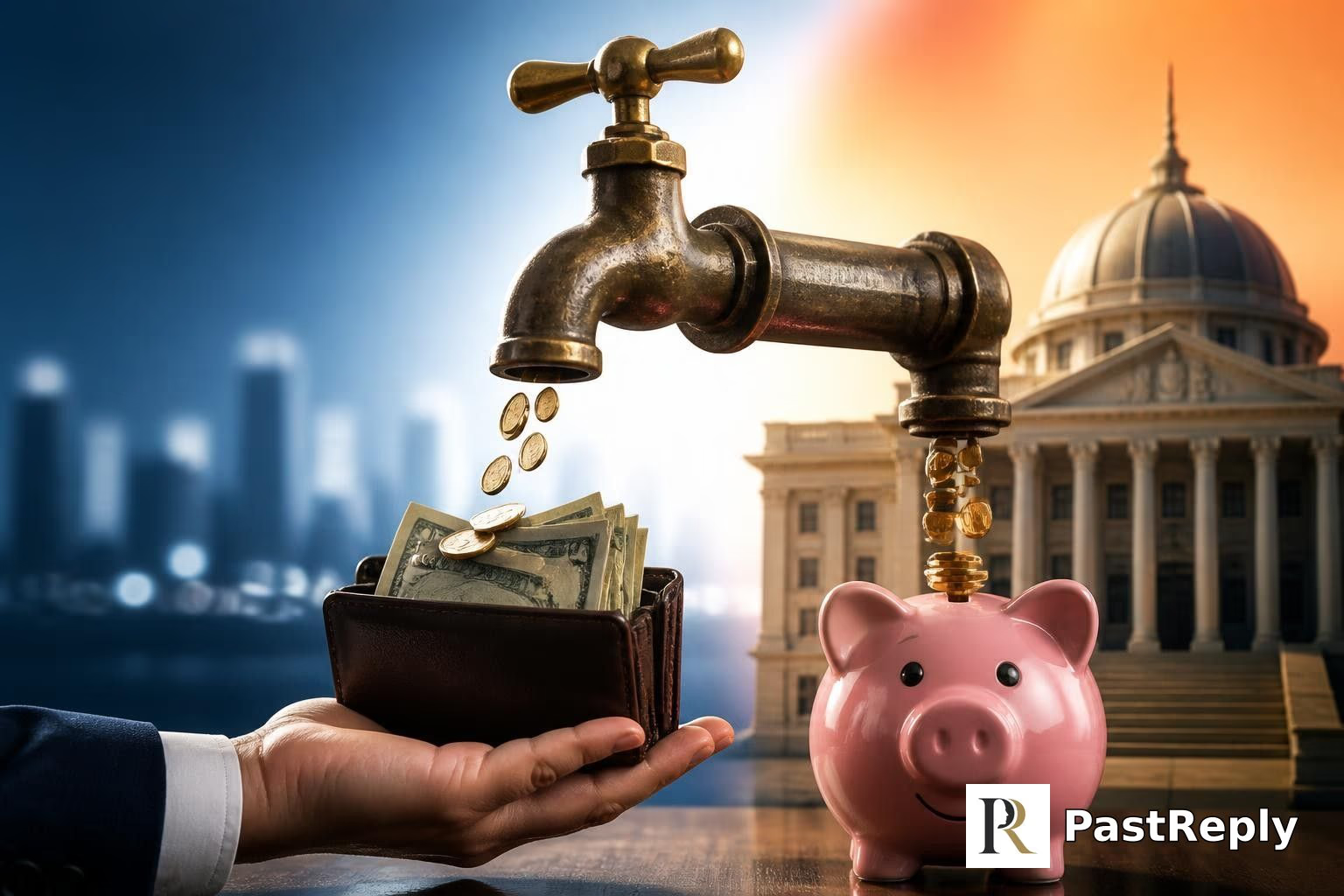
Withholding tax is a pay-as-you-earn system where tax is deducted at the source of income and remitted to the government, later reconciled on the taxpayer's annual return.
The facts
Withholding tax is a method of collecting income tax at the source of income, rather than requiring the taxpayer to pay the entire amount at a later date. Employers or other payers deduct a portion of an employee's wages, a contractor's payments, or investment income and remit it directly to the government on the taxpayer's behalf. This system ensures a steady flow of revenue to the government and reduces the risk of non-payment.
The amount withheld is typically based on information provided by the taxpayer, such as a Form W-4 in the United States, which indicates filing status and allowances. The payer uses tax tables or formulas to calculate the exact withholding amount. At the end of the tax year, the taxpayer files a return to reconcile the total tax liability with the amounts already withheld, potentially resulting in a refund or an additional payment.
Withholding tax applies not only to employment income but also to certain other payments like interest, dividends, and royalties, especially when paid to non-residents. In cross-border situations, tax treaties may reduce the withholding rate. The concept is used by many countries worldwide, though specific rules and rates vary by jurisdiction.
Answered by 100 of history's most famous minds

Render to Caesar what is Caesar's, yes - but let the coin's image and inscription remind you whose likeness you bear. The tax-gatherer's hand takes a denarius; the heart's true tribute belongs to God alone. Do not fret over the portion withheld, but see that your soul's treasure is laid up where no earthly steward deducts a share.

The portion withheld from the hand is a trust, not a theft. Allah has ordained that what you earn be purified by that which you give for the common good. Yet beware the scale: the employer who deducts wrongly bears a weight on his own neck, and the one who evades cheats his own soul. Let the reckoning be just, as the balance on the Day of Judgment will be just.

This practice reveals the world's attachment to the idea of a possession called 'income' and a duty named 'tax.' Those who cling to their coin suffer when it is taken; those who let it flow without grasping are not troubled. The state withholds a portion, but the wise one sees that all is already given and taken by conditions. The true withholding is not of gold but of the mind's craving - release that, and no tax can bind you.

Let the firstborn of Egypt be remembered: the Lord commanded a lamb's blood on the doorpost, but also a tithe of the firstfruits, taken from the field before the sheaf was bound. This practice of taking from the laborer's hand first is not new - it is the pattern of a just God, who orders the storehouse of the people. But woe to the gatherer who takes more than the Law decrees, for the cry of the widow and the orphan reaches heaven.

The ruler who takes a portion of the grain before it reaches the farmer's storehouse acts with propriety only if the exaction is known, fixed, and used to benefit the whole community, just as a father deducts from a son's earnings for the household's common good. But if the withholding be hidden or arbitrary, it breeds resentment and deceit, disrupting the trust that binds lord and subject. Let the tax be clear as the rites, and the people will render it without complaint.

Render unto Caesar what is Caesar's, even before the coin cools in your palm. The law was a tutor to lead us to Christ, but this earthly tax - a shadow of the true debt we owe to grace. Let no one grumble, but remember: the heavenly treasury is not filled by such deductions.

When I left Ur, I did not hoard all my flocks and wait to see if the promise held. I trusted as I walked, paying each day's journey with faith in the One who called. This tax is like that: the ruler takes a tithe from your earnings as you go, so you don't face a great owed sum that crushes you at harvest. It is a discipline, a way of walking with the authority that stands over you, and in the end, the reckoning is made straight.

The river does not withhold its water, nor does the sky tax the rain. Yet you carve a notch in every coin before it reaches the hand - a cleverness that binds you tighter. The sage knows: the more laws and edicts, the more thieves and tax dodgers. Leave the stream unblocked, and all will drink their fill without measure.

The True One does not ask for a toll from the traveler before he sets foot on the road. But the world's kings demand their share of every grain before it is ground into flour. If you must give, give with an honest heart and a full hand - but do not let the weighing of coins distract you from the Name. The merchant who thinks only of his ledger forgets that the real treasure is in sharing, not hoarding.

It reminds me of the young man in the temple, who found that all things belong to God first. The tax is taken from the source because it is a sign that what we have is not truly ours - we are stewards, not masters. I have seen the widow give her two mites, and the rich give much, but the heart of the matter is trust: to give a portion of the harvest to the Lord before we taste the grain, and to trust that He who feeds the sparrows will not let us go hungry.

It is a clever device of the princes and the merchants, a lien on the labour of the poor before they can even call it their own. Does not the scripture say, 'Render unto Caesar the things that are Caesar's'? But Caesar must not be a greedy glutton who snatches the bread from the labourer's mouth. If the tax is just and used for the common good, let it be paid honestly; but if it is a burden laid on the downtrodden while the rich escape, then it is a theft, and the Christian must resist it with a bold conscience.

The withholding of tax at the source is a just and prudent practice, founded on the natural law that the common good requires each citizen to contribute to the maintenance of the state. As the bee brings honey to the hive, so the worker must give some of his wages to the sovereign who protects him. Yet the rate must be moderate, lest it become a theft that violates the commutative justice due to the worker; and the tax must be applied equitably, for the wise ruler knows that an overtaxed land yields no honey.

The master takes a little from each day's bread before it reaches the hungry hand, so that the common store may feed all who come. It is a small sacrifice made unseen, yet it keeps the pot from boiling dry. Those who are poorest understand this best - they give their mite first, not after.

The mechanism is akin to a balance scale, where the payer deducts a known fraction at the moment of income's birth, as if by the preordained laws of motion. The taxpayer's subsequent return is a final adjustment, correcting any perturbation. It is a system of mathematical certainty - provided the tables and rates are derived from sound observation and the divine order of arithmetic.

I see a clever mechanism, like a careful hand diverting a stream before it floods the valley. The tax collector takes his portion at the source, saving the farmer from the shock of a dry season's reckoning. It is a practical thought, yes, but beneath it lurks the deeper question of fairness: does the stream flow through every field equally, or does it only water the gardens of the powerful?

I observe a curious adaptation: the state, like a predator, feeds on the herd at every waterhole, ensuring its own survival without killing the host. The species that withholds at the source is the fittest - it avoids the struggle of chasing down each individual at year's end. But I wonder: does this selection pressure favor the clever taxpayer who learns to nest in the loopholes of the tree? Over generations, the system will evolve its own parasites and symbionts, and the simple mechanism will grow ever more complex, like a coral reef built from the skeletons of countless failed schemes.

Observe how the mechanism works: the deduction is like the first measurement of a star's angle from the meridian - it gives a known starting point. The yearly return is the final correction, the closing of the orbit. The beauty is in the system, not in the authority that decrees it. Let them quarrel over rates; I will set my telescope on the numbers and see if the sums add up.

This system of withholding, where the government takes a portion of each payment before it reaches the earner, resembles the deferent and epicycle of the old astronomy - a complex arrangement to ensure the final sum is correct, but one that could be simplified. A more harmonious method would be a single, annual reckoning, as the Sun's motion is simple and direct, but the withdrawal at source, like the Moon's phases, does produce a regular cycle of obligation that avoids sudden darkness at the year's end.

A clever mechanism, yes, but clumsy - like using a steam engine to power a lightbulb. The state siphons energy mid-flow, but with my alternating current, we could transmit power and data wirelessly, eliminating such friction altogether. Imagine a world where no hand intercepts the current, and every soul draws freely from the ether.

In the laboratory, we isolated radium by patient, repeated crystallizations. Withholding tax applies the same principle to income: rather than wait for a single, unpredictable settlement, the state regularly precipitates a known fraction - a controlled phase transition, if you will. The taxpayer's final return is then like a weighing of the purified product, adjusting for any small errors in the process. It is a method of continuous measurement, ensuring the fiscal balance remains stable throughout the year.

A fascinating experiment in applied bacteriology: the state inoculates the revenue stream with a controlled dose of deduction, preventing the violent fever of a lump-sum seizure. The payer becomes a living culture medium, faithfully cultivating a portion of each payment for the treasury's growth. One must calibrate the formula precisely - too little and the patient faces a deficit fever; too much, and a poisonous refund. I should like to see the tax tables subjected to the same rigorous testing as my anthrax vaccines.

It's a dynamo - harnessing the power of that steady current at the source instead of waiting for a burst of lightning at year-end. The employer becomes a generator, stepping down the voltage before it reaches the worker. I tried three thousand filaments before I found the right one; the tax tables are just another series of experiments. The trick is getting the formula right so the system doesn't overheat or leave the customer in the dark.

Withholding is a distributed computation performed at the nodes of the network. The employer acts as a finite-state machine, reading the employee's parameters - filing status, allowances - and applying a deterministic algorithm to compute the deduction at each tick of the clock. This is far more efficient than a single central reckoning, though the error term is non-trivial; the final reconciliation is a kind of Turing test for the tax agency, revealing whether they can correctly invert the initial assumptions.

Consider it a mechanism of equilibrium. The government, as the lever, applies a force at the source - the point of payment - to raise its own revenue, while the taxpayer, as the load, feels the offset. The rate is the coefficient of friction that determines the exact proportion transferred. But the true genius lies in the annual reconciliation: it is the moment when the sum of the partial payments is compared to the whole, and the discrepancy - the remainder - is either returned or demanded, restoring balance to the system.

I imagine a wire - one end in the employer's hand, the other in the government's - and the worker's share of tax flows along it like current, drawn off before it ever reaches the man's pocket. The amount is set by a little piece of paper the worker signs, like setting the width of a channel, and at year's end the books are balanced: if too much was diverted, a return current brings it back as a refund, like a Leyden jar discharging the surplus.

A mechanism of deferred gratification, or perhaps of unconscious guilt - the worker parts with a portion of his wage before he can spend it, sparing himself the later pain of a large, sudden payment. The allowance claimed on that little form is a mask: every exemption is a wish to keep the pleasure now and push the reckoning into the future. And when a refund arrives, it feels like a bonus from a parental authority that has secretly saved on one's behalf.

It's a remarkably efficient way to collect revenue - like a black hole that absorbs a fraction of every star's light before it can escape, then slowly radiates it back as a refund or demands more as an additional payment. The system uses a simple feedback loop: the taxpayer signals expectations on a form, and the employer calculates a precise deduction from tables, much like solving a deterministic equation. At the end of the year, the two sides reconcile, and if the universe is just, the accounts balance to zero - though quantum fluctuations in deductions often leave a small surplus on the government's side.

It is a system of anticipatory settlement, like a woven loom where the weaver sets aside a portion of every thread before it enters the pattern, so the final cloth requires no last-minute adjustment. The taxpayer's allowances on the form act as parameters in a formula, determining the amount withheld - a kind of conditional operator that branches between deduction and exemption. At the year's end, the return performs a reconciliation, a final audit that closes the loop, much like checking the correctness of a computed table of logarithms.

Let us define the terms. A wage is a payment agreed between worker and employer. A tax is a portion of that payment claimed by the state. Withholding tax is deducted from the wage before it reaches the worker, and the employer remits it directly to the state. The amount is determined by a ratio - a function of the worker's declared status and a fixed schedule provided by the state. At the end of a given period, a reconciliation is performed: the total sum withheld is compared to the true tax liability, and the difference is either refunded or demanded as an additional payment. This is a clear proof of the method.

I have seen the ledgers of the Army Medical Department, and I can tell you this: a tax taken at the source is like a clean wound dressed at once - it prevents the fever of debt and the gangrene of evasion. The principle is sound, but only if the tables are as precise as a mortality chart, calculated not on guesswork but on true income and verified by the same returns that track every ration and every bed. In my experience, the system most needing reform is the one that assumes the poor can keep a record when they can barely keep a fire.

A king's granary takes its tithe at harvest, not after the grain is already spent. This is the wisdom of a conqueror: seize the tribute while the sword's edge is still drawn, lest the subject grow forgetful. The treasury must flow as steadily as the Hellespont - if I had waited for each satrap to bring his gold, I'd have never reached the Indus.

I would have my quaestor deduct a soldier's share from his pay before it reached his purse - no mutiny that way, and the treasury swells before the legionnaire can spend it on wine. This withholding is a clever move: it binds the subject to the state at every turn, like a chain of silver links. Trust the common man to pay his due? Better to trust the iron hand of the law.

A clever device, this withholding - like a royal steward taking the grain levy at the harvest before the farmer can barter it away. The Roman Empire does the same with its provinces: they collect their due first, ensuring the treasury is never empty. I would have my own scribes watch such a system closely, for the one who holds the key to the granary holds the true power.

When I restored the Republic's treasury, I saw that a fixed levy at the source prevents the collector from squeezing more than his due. The wheat is measured before it enters the granary, not after. This method mirrors the patience of a primipilus who pays his legionaries on the calends, before the wine and dice claim their share. Order must precede generosity.

A wise ruler takes his share of the herd before it scatters on the steppe, lest some riders flee with their mount and leave the camp empty. Withholding at the source is like the keshig's unyielding law: each man gives his tenth of sheep and wool before he sees the flock, and the treasury fills without need of pursuit. My tax gatherers took a tithe of all trade, and if a merchant hid his gold, he lost his head - this system is more gentle, but no less firm.

A state that does not collect its due is a state that cannot command. Withholding is discipline - like seizing the conscript before he can desert. I would have made it swift, sure, and uniform across every province, so that no man mistakes his own purse for the treasury's. Order above all.

A prudent commander does not wait until the campaign's end to assess how his quartermaster has provisioned the army. He checks the stores each week, deducts what is needed for the men and the march, and pays the farmers promptly. So with the public treasury: the government, as a surety against the citizen's future arrears, takes a portion of his wages at the source. It is a measure of common sense, to secure the revenue of the state without oppressing the honest man with a sudden demand at harvest's end.

A farmer does not wait until the harvest is in the barn to set aside seed for next year; he takes a little from each sheaf as it is gathered. That is the wisdom of withholding - taking a portion of the wage while the hand is still warm, so that when the reckoning comes in April, the nation's accounts are not left begging. It is a humble, practical device, like the rail-splitter's wedge: it does the work quietly, and the government, like the farmer, can plan for the long winter.

A nation that relies on voluntary contributions for its defence would soon be speaking a language other than English. Withholding is the iron hand in the velvet glove: it takes the money from the pay packet before the taxpayer can spend it on trifles, ensuring the sinews of war remain strong. Some call it tyranny; I call it prudent housekeeping for a free people who cannot be trusted to pay their own way without a gentle reminder at the source.

This system takes a portion from the worker's honest labour without his consent, before the coin even touches his hand. It is a form of coercion that trains the soul to accept servitude, for the state takes what it has not earned by the sweat of its own brow. I say, let the tax be paid voluntarily, or not at all - then the government must earn the trust of the people, and the people will learn the discipline of giving from a willing heart.

It is a system that, in its abstraction, can become an instrument of injustice if it burdens the poor more heavily than the wealthy, who have the means to minimize their share. The tax is taken before the worker can use it for bread or rent, a daily sacrifice that must be made with both equity and compassion. We must ensure that the structure of withholding does not add to the weight of the poor but is used to build schools, heal the sick, and create a society where the Beloved Community can flourish.

It is a system of shared responsibility, like a community granary where each farmer sets aside a portion of the harvest before bringing it home, so the village storehouse never stands empty. The employer acts as a trusted steward, deducting a fair measure from every wage and remitting it to the treasury on the worker's behalf. At the year's close, a reckoning is made: if too much was taken, it is returned like a gift in the wrong season being given back.

This is how a state controls its people without their knowing - the tax collector reaches into every wage before the worker ever sees it, making submission automatic and invisible. It is a form of discipline that requires no armed guard, only paper and arithmetic. The true strength of a government is measured not in its armies but in its power to take a share of every man's labor before he can spend a pfennig on his own desires.

A clever method: the state takes its share from the worker's wages before he can hide or spend it, like a landlord collecting rent at the door before the tenant enters the house. The worker fills out a form declaring his status, but the tax tables decide the real amount - the individual's preference is a fiction. At the end of the year, he files a return, and if too much was taken, he gets a refund; if too little, he pays the difference. It is a system that keeps the treasury fed without the trouble of hunting down each debtor with a rifle.

A system that extracts surplus value at the very moment of its creation, before the laborer can use it for his own ends. The capitalist state thus secures its revenue without the delay of collection, turning every employer into a tax collector and every wage packet into a receipt of bondage. At the year's end, the worker pleads for a refund of what was overpaid - a humiliating form that reveals his dependence on the state's accounting. The only true reform is to break the whole apparatus and let the workers decide the fate of their own product.

The landlord and the capitalist always skim the peasant's bowl before the grain reaches the table - that is withholding. The state that truly serves the people collects its share at the source so that the rich cannot hide their gold in the earth while the poor shoulder the burden alone. Our revolution abolished such trickery; the commune itself accounts for labor and distribution. But under the old system, the very mechanism that squeezes the worker's wages to fill the treasury of the exploiter is no different from a tax farmer with a knife at the granary door.

It is a prudent and orderly arrangement, such as becomes a nation where the civil service is conducted with propriety. The Crown's revenues, too, have always been collected by trustworthy receivers - never by caprice or force - and the habit of setting aside a portion of one's earnings for the common good is a mark of a responsible subject. I am told the forms are adjusted according to one's domestic circumstances, which seems only just. A well-regulated household, after all, keeps its accounts in order.

I am told that this system allows the government to receive its due gradually, much as the Crown receives the revenues of the Duchy of Lancaster through careful stewardship. It must be a considerable convenience for those who would otherwise face a large payment at once - like paying for a new roof in small installments rather than all in one season. One trusts that the forms are kept as simple as possible, for the benefit of all.

In my realm, the count and the bishop set aside a portion of each harvest for the tithe and the king's due before the peasant carries his sack home - this is the same principle. It is wise to take the levy when the grain is threshed, for a man who waits until the year's end may find his storehouse empty and his heart hardened. But let the rate be fixed by just law, not by the whim of a lord; let every subject know what he owes, and let the scribe render account to God and emperor alike.

The tax-gatherers in the towns take a handful from every purse before the coin reaches the buyer's hand, so that the king may pay his soldiers and keep the realm in order. I know little of ledgers, but I know this: when I led the army to Orléans, we took supplies from the towns and the Church, but always with a fair promise, for God sees the heart that gives and the hand that withholds. If a tax is seized by force and without faith, it is no better than the plunder of the English.

I have always found it wiser to collect the customs at the port than to chase the merchant through every shire; it saves the queen's officers a weary ride and the subject a sudden fright. The principle - to take a little when the purse is opened rather than demand a great sum after the coin has been spent - is the mark of a prudent prince. Still, the art lies in the measure: too light a touch, and the treasury starves; too heavy, and the people murmur that Gloriana's hand is as greedy as any pope's.

In my empire, the tax farmer is a barbarous relic; a modern state deducts the levy at the source, as the steward takes the lord's portion from the harvest before the serf sows his own bread. It is rational, it is efficient, and it spares the peasant the whip and the tax collector the dagger. But reason alone is not enough - the rate must be set by an enlightened table, not by the whim of a provincial governor, and the revenue must flow to schools and hospitals, not to the gilded boots of courtiers.

In the provinces I have conquered, from Babylon to the Hindu Kush, I have seen that a wise king takes his tribute at the doorstep of the merchant and the field of the farmer, not by surprise levy after the year's profit is already counted. It breeds trust, not resentment. Let the satrap know the fixed share of every load of grain and every bale of cloth, and let the people see that the king's portion is used to repair the canal and guard the road - then no man will hide his silver in the well.

When I took Jerusalem, I ordained that the Christians and Jews of the city pay a fixed portion of their trade at the city gate, not a ruinous tax after the season's profit had been spent, and I forbad my emirs to take more than the law allowed. This is the Sunna of fairness: the sultan takes his due at the source, but he weighs the load according to the camel's strength, not his own greed. A tax that is just and known in advance is a covenant; a tax that is seized without measure is a sword.

Tell me, friend: does the state take a part of your wage without first asking you to define what a 'just portion' truly is? You trust the clerk's table, but have you examined the assumptions hidden in those columns? The true tax is paid not in silver, but in unexamined obedience - and that debt accrues interest daily.

This practice drags the citizen's gaze from the sun of justice to the shadows of the counting-house. The true tax is not on coin but on the soul's harmony; the state that withholds by compulsion reveals its own ignorance of the Form of fairness. Better to educate the mind to see the Good, so each willingly contributes his share to the whole, not from fear of the collector's ledger, but from understanding of the just city.

This practice is a species of deduction, a means to achieve the end of timely revenue. Every polis must fund its common good, yet the virtue lies in the mean: the portion taken should neither starve the household nor leave the treasury wanting. It is a rational arrangement, provided the calculation is just and the purpose - like the maintenance of courts and harbors - is clear.

The practice of withholding tax from wages treats the citizen not as a free moral agent but as a passive object of fiscal administration, which offends the dignity of rational beings who should freely determine their duty rather than have it coercively predetermined. Yet if one can rationally will that such a system be a universal law - necessary for the reliable maintenance of the state that secures the conditions of freedom - then it is morally permissible, provided the withholding does not efface the taxpayer's autonomous act of final reconciliation in the return.

This withholding tax is the herd's wisdom: it tames the individual before he can feel his strength, extracting tribute from the very act of earning, so he never tastes the full fruit of his labor and thus never becomes a master. It is a petty, bureaucratic castration, designed to prevent the strong from accumulating power and to keep all equally weak. Would a free spirit consent to have his life's flow bled in small, painless drops? No - he would pay the whole sum at once, and feel the weight of his own abundance.

The capitalist state extracts its surplus value before the worker can even clutch his wage - an ingenious theft sanctified by law. The withholding form is but a new chain, binding the proletariat to the very system that strips him. Only when the worker seizes the means of deduction will he be free.

Let me doubt all I can: does the baker who hands me my daily loaf know exactly what I owe the king before I have even broken bread? The withholding tax assumes that a part of my future debt is certain enough to be exacted now. But I can think of no clear and distinct reason why the state should be entitled to such an advance, except as a convenient fiction - a kind of provisional judgment that must be corrected by a final, balanced reckoning, like adjusting a proof after rigorous deduction.

The prince who waits for his subjects to voluntarily bring him tribute will soon find his treasury empty. Withholding is the art of taking the honey before the bee even finishes its flower - a prudent measure that secures the state's revenue against the inevitable cunning of men who would rather hide their gold than pay for the sword that protects it. Let the employer be the tax collector's deputy; it works better than trusting the citizen's virtue.

It is as if a farmer, before the seed is sown, must set aside a sack for the lord - never knowing if the harvest will fill it or leave him hungry. The steward's quill writes in ink that may prove bitter when the final reckoning comes. A comedy of errors, this: the wage-earner's hand receives a clipped coin, and the treasury counts the difference as a debt repaid.

As when the herald of Agamemnon came to take the best portion of the feast, so the king's hand reaches into every man's pouch before the wine is poured. The gods smile on the clever steward who takes his share at the harvest's edge, lest the farmer hide a measure of grain in the dark of his barn. But woe to the lord who withholds too much - the bard will sing of his greed as long as ships sail the wine-dark sea.

Behold the infernal trick: the taxman takes his pound of flesh while the hand still trembles from the day's labor. In my vision, such a system might serve the greedy souls who hoard the bread of others - they would forfeit their wage at the very source, their sin visible in the ledgers of the damned. Yet for the honest worker, let the deduction be a tithe freely given, not a chain upon his toil.

This withholding tax resembles the artist's preliminary sketch: a necessary discipline that anticipates the whole, yet must be refined by the final touch of the completed return, where the individual's full year's striving is harmonized with the state's demands. Like the seasons' cycle of growth and harvest, the system forces a continual, measured rhythm of obligation, preventing the wild excess of a single payment that might crush the spirit - a wise, if prosaic, instrument of Bildung.

A taxman who snatches coins from your very fist before you can count them - now there is a steward worthy of Sancho Panza's respect! The Crown does not trust you to pay your dues at harvest's end, so it takes its pound of flesh at the milking pail. A prudent precaution, I suppose, for those of us whose accounts tend to wander off with the windmills.

They take from your labor before you can decide to give it freely - that is the violence of the state, the same violence that props up armies and palaces. True charity flows from a willing heart, not a compulsory levy. Yet we all share in the sin of this world; perhaps the withheld coin is a mirror of our own complicity.

The government takes a piece of your soul before you have even touched the coin - a little death each payday, a reminder that you are never wholly free. And yet, this system is more merciful than the old way, when the taxman might seize your cow at harvest. It is like a confession: you pay a bit of your burden as you earn, and at year's end you account for the whole sum of your sins. But the truly free man, the one who has found grace, knows that neither tax nor return can reckon what his spirit owes.

A most convenient arrangement for a government that wishes to spare its subjects the vulgar business of remembering to pay their debts - and to spare itself the awkwardness of asking. It is rather like a well-regulated household where the housekeeper deducts a portion of the cook's wages before they are handed over, thus ensuring that the cook never has the mortification of being unable to pay her own bills. The system is elegantly patronizing: it trusts no one with their own money until after the account is settled.

I see it as just another way the powers that be take the bread from the mouths of the poor before it even reaches the table. The man who works his fingers to the bone in the factory or the mill never sees the full coin of his labour - the government's hand dips into the pay packet first, as if it had a right to his sweat before he even warms his children's hands by the fire. It is a system that keeps the humble man ever dependent, never allowing him to feel the full measure of his own earnings, while the rich man's lawyers find a hundred ways to keep the taxman from his door.

It's the government's way of making sure you never get too attached to your money by giving it a head start out of your pocket. A man earning his wages might think he's got a dollar, but the taxman has already written his name on it with a big red 'PAID' in invisible ink. The only surprise is that at the end of the year, the government sometimes sends a little back, and then you feel as grateful as a dog that got its own tail back.

A man works a day, and they take a piece before he even holds the money. The pay packet is lighter than it should be. You learn to live with it because there's no use fighting the system - it's like the rain or the current. The honest man pays his share, the rich man hides his, and the government counts it all. It's a clean, hard fact: they hold back the tax at the source, and you get what's left.

Observe how the mechanism mirrors the human body: the heart - the payer - pumps a portion of each pulse to the lungs, the state, before the blood reaches the fingers. The taxpayer then breathes out a final accounting, balancing the pressure. But the beauty lies in the precision: the tables are like the proportions of the human form - imperfect without study, but a harmony when rightly drawn.

This is a chisel carving the form of a citizen from a rough block of flesh and coin. The sculptor does not wait for the marble to yield its shape on its own; he strikes first, shaping the public good from the stubborn stone of private wealth. Yet I see a danger: if the hand is heavy, the figure cracks - too little, and the statue remains a shapeless lump. The master must know his material, or the work is ruined.

I see the painter who, while mixing his colors, must set aside a portion of his cobalt for the merchant before he can even dream of the harvest field's gold. It feels like a shadow cast across the easel before the first stroke - yet if this withholding buys the canvas and the lamp oil, perhaps it is the humblest of patrons. But let the calculation be made with kindness, not a ledger cold as a winter night.

Tax withholding? It is a still life painted in gray - the government takes a slice of your color before you even see the canvas. They call it 'withholding,' but it is really a theft of potential, a preemptive cut from the work of living. Better to let the artist pay the whole at the end, in a single burst of color, and reconcile the shape of the year's creation himself.

The light of a wage, caught before it falls upon the hand - a shadow of what might have been. The state, like a painter, must fix its colors early, lest the canvas fade. Yet I wonder: does the withheld coin still hold the warmth of the sun, or does it cool to a grey ledger's hue?

I have seen bankers in Amsterdam, their ledgers neat as a grid of canvas threads. This withholding tax - it is like the first wash of umber the tax collector lays down on your year's portrait, before you have even held the brush. The government says, in effect, 'We know the fall of the light on your face already; we will take our share as you earn.' At year's end, you show them the whole painting - the receipts, the debts, the losses of a life - and then they either owe you back a little silver, or you must add more umber to the shadows.

They want their cut before you even feel the peso in your hand! It is like the state is a jealous lover, taking a bite of your flesh before you have tasted the fruit. My art is my blood, my body's pain - and the tax is a bruise that appears on the canvas before the paint dries. At the end of the year, you show them every wound, every throb of the brush, and then they tell you if you gave too much or too little. It is the same old story: they always want a piece of your heart.

A clever piece of counterpoint! The state takes its forte before the melody is fully played, leaving the player to adjust the tempo at the finale. But I'd rather compose the whole symphony and let the court pay me after - or better still, let them hear the music and offer a purse without deducting a note for the censor.

A tax is no mere figure in a ledger - it is the rhythm that holds the orchestra together, each instrument paying its note to the harmony of the whole. But let the conductor be a tyrant, and the music becomes a march of slaves! I would have each man give his part freely, as the violin sings its melody, not from the lash of the state. Yet if the state must take its share, let it do so at the source, so the people are not constantly reminded of the chain around their ankles.

As the organist must tune each pipe before the choir can raise its hymn, so the state takes its portion at the source, that the harmony of the commonwealth may sound without discord. It is a prelude to the final resolution - the annual reckoning when the cantata of the taxpayer's year is completed, and the balance is restored in the great ledger of the Exchequer.

Well, thank you, thank you very much. See, when I was pickin' cotton in Tupelo, we didn't have no fancy withholding - you got paid what you earned, and you paid up when the time came. But that system, it's like a steady rhythm, like a backbeat that keeps the band on time - the government takes its little cut before the song even starts, so you don't get surprised at the end of the year. It's just a way to make sure the music plays smooth for everybody.

It's like a song where the government takes a note before you even hear the melody. But if we all sing together, maybe the harmony helps build a world where children can dance and heal. I just hope the beat doesn't forget the love.

You're making all that bread, you're fab, you're on top of the world - and before you even get it in your pocket, Uncle Sam's already nicked his slice. It's like the taxman's on the payroll, playing rhythm guitar on your paycheck. But come April, the Inland Revenue might give you a little back if you've been a good boy. Or they'll ask for more. And you never quite know which - it's a mystery tour, really.

The man who harvests your song before it leaves your throat, who takes a piece of your bread before it reaches your mouth - they call it a system, but I've seen a landlord take half the harvest and call it protection. Your wage arrives with a hole already in it, like a letter that's been censored before you read it. They say it's for your own good, but the taxman always takes his cut before the piper even plays.

I once had a manager who took his cut before I ever saw a dime - I learned young that the hand that pays you is also the hand that takes. Withholding is like that ex who asks for half your stuff before you've even broken up; it's a prenup written by the government. It's not romantic, but it keeps the lights on. The trick is to write enough songs about it to buy back your own freedom.

In the Indies, I demanded a fifth of all gold and spices as the Crown's share - taken from the very first sack, not after the ship was unloaded. This is the method of a prudent admiral: secure the sovereign's portion before the crew divides the rest. The same principle steers a kingdom's treasury: take the levy at the source, and no man can hide his cargo.

In the great Khan's court, the tax collectors would count every bolt of silk and every sack of pepper as it passed the city gates, taking their toll before the merchant could even see his goods. This withholding is like that - a toll on the river of money before it reaches the people. I marvel at the cunning of it; in Cathay, they use bamboo slips to record every transaction, and the emperor's treasury never runs dry. But woe to the trader who tries to hide his cargo - the taxman's eye is as sharp as the eagle's over the desert.

A wise commander knows to secure his provisions at the first port, not to gamble on the winds of a distant harbor. This levy at the source is like the monarch who takes his fifth of the spice cargo before the merchant sets sail - it ensures the fleet's return. Let the merchants grumble; I would rather carry a sure cargo than an empty hold.

The concept is akin to mission planning: you estimate the fuel required for each stage before launch, and you burn it as you go, rather than carrying all the fuel to the end and trying to light it at once. Withholding tax is a controlled, incremental burn that keeps the fiscal trajectory stable and prevents a catastrophic overcorrection when the annual return comes due. It reflects sound engineering - precise, predictable, and designed to avoid a single point of failure.

When you're flying, you can't just pay for fuel at the end of the trip - you need it to get off the ground. Withholding is like that: a bit of your lift given up front so the whole flight stays aloft. A fair trade for the freedom of the sky.

On my flight, every gram was precious, every calculation vital before we left the pad. This withholding tax is the same - the state takes a small, steady portion of fuel from your engine as you earn, so you don't run empty at year's end. It is a quiet, constant burn, like a guidance system, keeping your trajectory true. At the final accounting, your return corrects the course, and you land, maybe with a little extra in your tank, or needing to top up.

Think of it as a system that removes friction. By taking the tax upfront, the government eliminates the complexity of collecting later. It's elegant - like a product that does one thing well. But there's a lesson: just because the system exists doesn't mean you can't question its assumptions. Ask yourself: what are you building that's so important you'd rather focus on that than the tax? Simplify.

From a first-principles view, the government is essentially saying: 'We don't trust you to pay your bill at the end of the year, so we'll collect it as you earn.' It's inefficient - like trying to steer a ship by adjusting the rudder every second instead of setting a course. A better system would be a simple, real-time transaction tax that's transparent and automated, maybe using a blockchain ledger. Why are we still using a 20th-century payroll model? We need to treat the tax system like a software update: simplify the logic, reduce the drag, and make it scale for a multi-planetary civilization.

Here's the truth: this isn't about a tax form, it's about trust. You're giving a portion of your harvest before you even see it, hoping the farm will remember your share. I've seen too many people claim their refund like a surprise blessing, but I say: know your number, own your story. The power isn't in the withholding - it's in the reconciliation, when you take back what's truly yours.

They take your money before you even see it, like a rope-a-dope where the government floats like a butterfly and stings like a bee while you're still dancing. But listen: that system keeps the government floatin' so they can help the folks who can't fight - the poor, the sick, the ones who need a hand. If you don't like it, you gotta train like a champion and learn every deduction and credit, 'cause the taxman ain't gonna float like a butterfly for you - he's gonna sting like a bee.

In football, the ref whistles and you don't argue - you pay the free kick. Withholding is like that: a quick pass to the government before the ball rolls too far. It keeps the game fair so everyone can play, and at the end, maybe you get a little back, like a lucky rebound.

Imagine you're building a whole fantasyland, brick by brick, ticket by ticket. You can't wait till the end of the year to pay for the castle's foundation - you'd never get off the ground. So every time a child buys a ticket, you set aside a little of that magic for the tax collector, like a savings account for the fairy godmother. At year's end, you tally the enchanted receipts, and if you stashed too many silver dollars, you get a refund - a little extra pixie dust for your next dream.