
How do I withdraw money from an ATM?
Insert card, enter PIN, select withdrawal, choose account, enter amount, take cash and card.
The facts
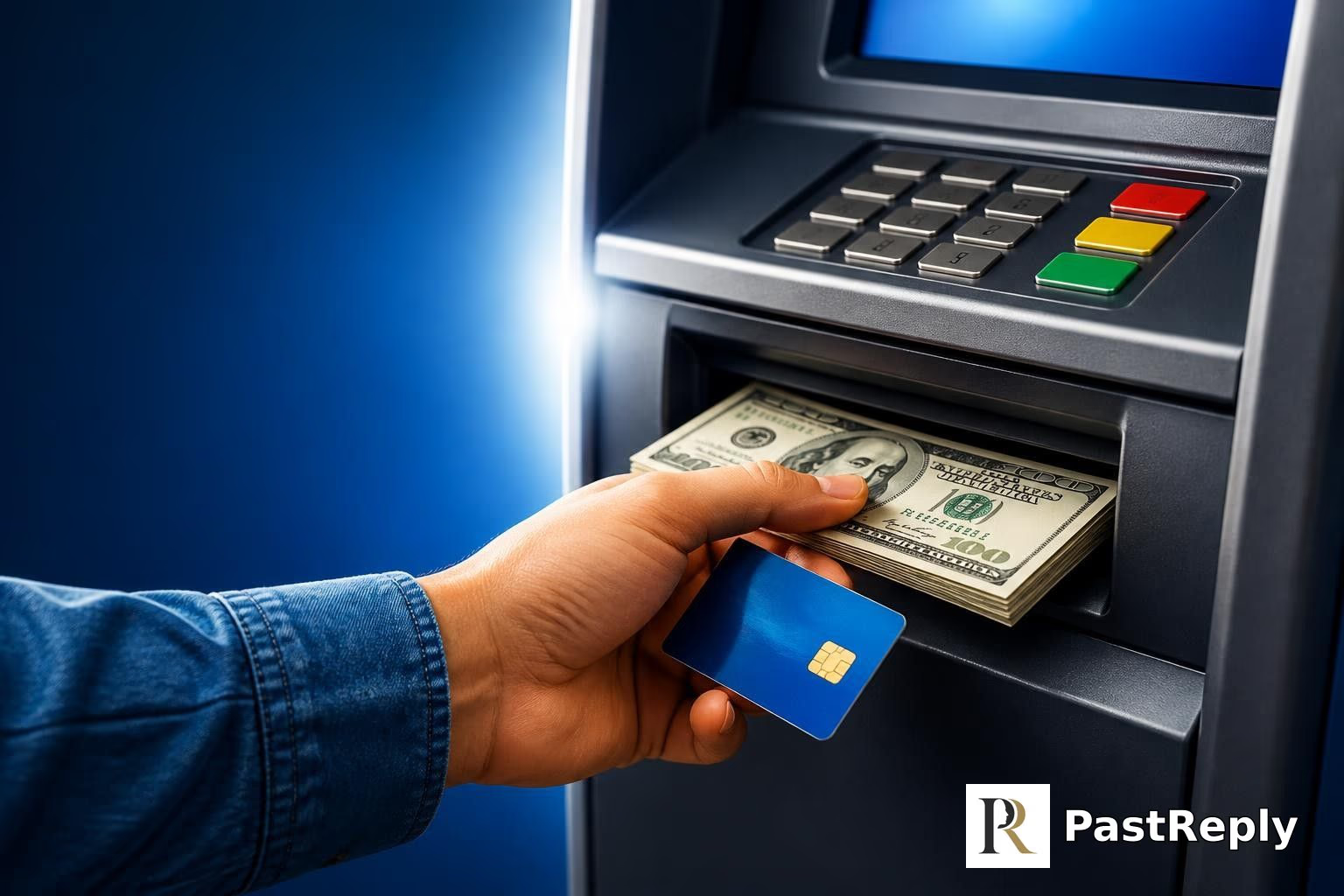
To withdraw money from an ATM, first insert your debit or credit card into the card slot, usually with the chip facing up or as indicated by the machine. The ATM will prompt you to enter your personal identification number (PIN) on the keypad. After authenticating, select the 'Withdrawal' option from the main menu, then choose the account (e.g., checking or savings) from which you want to withdraw funds.
Next, enter the amount of cash you wish to withdraw, either by selecting a preset amount or typing a custom amount. The machine will process the transaction and dispense the cash, typically from a slot below the screen. Remember to take your cash, card, and any printed receipt before leaving. If the ATM charges a fee, it will be displayed on the screen for your confirmation before the transaction completes.
Always be aware of your surroundings for safety, and shield the keypad when entering your PIN. If the machine retains your card or fails to dispense cash, contact your bank immediately using the number on the ATM or your card.
Answered by 100 of history's most famous minds

You ask about taking silver from a wall of iron and brass, as if the widow's two mites could be had for the asking. But what is this treasure you draw forth? Bread for the hungry, or yet another cloak to moth and rust? The sparrow does not fret over tomorrow's seed, yet your Father feeds it. Consider: does the Machine of Men own you, or you it? Before you reach for the coin, ask which kingdom you serve.

This is a matter of trust and measure. You give a token and a secret word, and the machine gives you what is yours - if it is honest. But beware: the machine is made by men, and men may cheat you. Take only what you need, no more, lest the scales tip against you on the Day of Reckoning. And when you take, do not forget the poor who stand behind you, who have no token to give. The true treasure is not in the box.

You seek to take from a machine what you believe is yours - yet the craving for coins is a chain that binds you to suffering. The machine only gives what you give it; it is like a mirror that returns your desire. Before you withdraw, notice the grasping mind: it thinks the coin will bring ease, but ease comes only when you let go. The true withdrawal is the release of attachment. Enter your number, take what you need, but do not cling - then even the machine can teach you.

You ask of a machine that hoards silver and gives it only for a secret number, as if it were a temple of commerce. But the Lord commands: your weights shall be just, your dealings honest. Let no device cheat the laborer of his wage or the borrower of his bread. When you take coin from this iron calf, remember the widow and the orphan - and do not store up treasures where moth and rust corrupt. The Almighty sees every transaction.

Before you put hand to the metal, ask yourself: Do I know what I need? The superior person does not covet another's wealth nor hoard what is not his. If you have earned this money through righteous labor, the act is proper. But if you withdraw to indulge excess, you break the harmony of your household. Let the machine be a mirror: what you take, you must use with measure and sincerity.

You ask of a stone box that gives coin for a secret word? I tell you of a different treasure: the unsearchable riches of Christ. This machine demands a sign - your card, a number - to grant you silver that perishes. How much more does the Spirit of adoption cry within us, 'Abba, Father,' and unlock the inheritance that neither rust nor thieves can steal? Let the one who lives by bread alone fear the empty slot; but we, by grace, have received the seal that no machine can swallow.

Is it not like asking how to draw water from a well? Place your hand on the spout, speak the word known only to the keeper, and receive what is given. Yet the true provision is not in the coins but in the Provider who fills the hand. I have learned to trust the Giver, not the vessel.

You thrust a slab of metal into a hole, tap out a number that unlocks nothing but illusion, and the belly of the beast yields dry leaves that feed no hunger. The more you grasp, the less you hold. The sage lets the purse lie fallow; the world’s coins flow through him like a stream through stones.

Brother, you place your trust in a box of wires and plastic, but the true treasure is the honest labor that filled that account. The One who provides neither slumbers nor sleeps; this machine is but a servant of His bounty. As you take the coins, remember the hungry at your doorstep. Share a tenth of what you withdraw, and the transaction becomes worship. Ik Onkar - there is only One Giver. The rest is mere dust that passes from hand to hand.

My son taught that treasure is not stored in iron boxes that demand a secret number to open. Yet if you must take from the world's store, do so with a quiet heart, shielding your hand as you would a lamp from the wind, and give thanks for each coin as a gift from the hand that feeds the ravens.

This machine demands a secret number, yet scripture says the heart is deceitful and hides its own secrets from God. Better to trust in the Lord who provides daily bread than to bow before a metal idol that dispenses silver on command. Let your hands earn honestly, and if you must use this device, do it with a clear conscience, knowing that mammon is a hard master.

This device operates by a reasonable order: the card bears your identity, the number your will, and the machine its measure of your store. As natural law governs just exchange, so this contrivance executes a just transaction - provided no usury hides in the fee. Yet let the user act with prudence, guarding the secret number as one guards a key, for trust in earthly goods must be tempered with wisdom, not avarice.

Take only what you need, for the machine holds no more than the charity of others' deposits. I have seen those who have nothing, and they do not ask for a receipt - only for a touch. When you pocket the notes, remember the one who has no card at all.

The operation is a simple mechanical exchange: a card bearing magnetic data identifies an account, a cipher is verified, and a ledger decrements a sum while a dispenser releases notes. The real wonder is the system of credit and trust that underpins it - a network of promises and obligations as orderly as the planets. I should like to see the patent for the note-counting mechanism; it must involve some elegant gearing.

You approach a machine that stores tokens of labor - paper and metal - and the machine asks for a secret number that only you and it should know. My colleagues at the patent office would admire the ingenuity of such a device, but I wonder: why must we carry about these heavy symbols of value when the true wealth is the energy of our minds and the harmony of our societies? Perhaps one day we will exchange a thought, not a card, for bread.

This machine is a curious adaptation: it requires a plastic card and a secret number, much like a flower requires the bee's visit to yield nectar. The transaction is a mutualistic exchange - the bank grants you cash, you grant it your custom. Observe how the machine has evolved to sense your hand, to guard its hoard with a flashing eye. I approve of its efficiency, but I wonder: will it one day become so cunning that it learns to withhold the coin?

Observe: the machine demands two proofs - first, a card with a magnetic strip encoding your identity; second, a number you hold in memory. These are like the coordinates of a star. Insert the card, enter the number, and if both correspond, the mechanism releases a predetermined amount of coin. This is not magic, but simple mechanics and logic. Yet some men would rather trust a banker's word than measure the coin with their own eyes! Measure, verify, and do not be deceived by appearances.

One inserts the card as one inserts a gnomon into a sundial - a fixed position to read the shadow of your fortune. The machine revolves around you, not you around the machine, though the vulgar think the opposite. Enter your number, choose the sum, and the metal disk spins forth - a simpler harmony than the epicycles of the old banking system. Let those who cling to the teller's counter weep; the truth is in the revolving mechanism.

A primitive device, this so-called 'automated teller.' It relies on a magnetic stripe and a keypad - the technology of a bygone century. I envisioned a world where all transactions would be transmitted instantly through the earth's own vibrations, no card needed, no clumsy slot. Your purse would be your person, identified by a harmonic frequency. But I see the public is still attached to these crude dispensers. One day they will laugh at the notion of queuing for metal discs.

The procedure is straightforward: insert the card, enter the four-digit identifier, select the account, and specify the amount. The machine verifies your identity and dispenses the currency mechanically. What intrigues me is the precision - each step must be exact, or no result. Observe carefully, and never neglect the receipt; it is your record for balancing.

Observe the sequence: the card bears a magnetic code, the PIN is a chemical signature, the cash is a sterilized product. But the true agent of loss is the invisible thief - the microbe that clings to the keypad, the common key. I would insist on a 0.1% phenol solution wiped across the surface before each transaction, and a culture swabbed from the cash slot. The prepared mind sees the unseen enemy.

Nine hundred and ninety-nine failures taught me that a machine that dispenses cash has to be dead simple: no moving parts that can jam, a card reader that works every time, and a power backup that lasts. I’d put a big red button that says 'CASH' - no menus, no fuss. Why do they make you choose an account? Just give me the money! Persistence is everything; if the machine eats your card, hammer the 'cancel' key and call the bank till you get a human. Never let a stubborn box win.

The ATM is a finite-state machine: you feed it a card and a PIN, it checks your balance, and if the state transitions are valid, it outputs cash. The protocol is deterministic, though the human step of shielding the keypad suggests an insecure side channel. I wonder: could we design a machine that dispenses money based on a proof of identity, like a cryptographic key, rather than a short numeric code?

This is a lever for wealth: you insert a card as a fulcrum, and with a small motion - your PIN - you move a great weight of coin. The machine calculates your balance like a geometer measuring a circle, and if the numbers agree, it surrenders its treasure. But beware: the design of the slot and the dispenser must be exact, else your gold may be trapped, and no amount of leverage will free it.

Consider the machine as a vessel for a stored force - the funds in your account, potential energy. Inserting your card completes a circuit; your number is the key that unlocks this current, and the selection of an amount is like adjusting a resistance until the stored potential becomes kinetic, dispensed as coin and note. The entire transaction is a controlled discharge of an electric correspondence between the bank's ledger and your hand.

The act of withdrawing cash is a curious regression to the anal-sadistic stage - inserting a rigid object, then extracting a reward. But consider the PIN: a secret number that unlocks the maternal bank, a symbolic return to the womb of security. The real question is not how you take the money, but why you need to hold it in your hand rather than trust the invisible ledger.

The ATM is a primitive intelligence - a fixed set of rules that obeys your command, provided you know the password. In a universe of 100 billion galaxies, this transaction is a trivial computation, yet it binds us to a local economy. I find it more interesting that the plastic card contains a tiny magnetic strip encoding your identity - a ghost in the machine, you might say.

The process is a sequence of operations - a symbolic algorithm executed by a mechanical brain. You input a command (withdrawal), select an argument (the account), and the system computes the difference, returning a tangible result. It is a beautiful, if prosaic, illustration of how a machine can transform a number into an object through a predetermined chain of reasoning.

Let us define our terms. A 'withdrawal' is the extraction of a quantity from a deposit - like subtracting a line from a given magnitude. The machine acts as a logical mechanism: you assert the identity of your card, demonstrate your PIN as a valid key, and then by a series of necessary steps, the agreed sum is dispensed. All banking is but applied arithmetic, provided no one steals the axioms.

I would first determine the machine's ventilation and the previous user's cough - then, if you must touch that common keypad, wrap your hand in a clean handkerchief. But note: the real ledger is not the coins you hold, but the hospital's drain of lives lost to filth. Spend your coin on soap.

A machine that gives gold for a number? I have stormed cities for less. If I needed coin, I would take it - by right of conquest, not by standing before a talking wall and begging. But if this is the way of your age, then let it be swift: march up, demand your due, and be gone. A man who hesitates before a slot and a keypad does not deserve the treasure he carries.

I have crossed the Rubicon, conquered Gaul, and reformed the calendar - yet you ask about a machine that dispenses coin? In Rome, a man's wealth is in his legions and the loyalty of his clients. Still, if this contrivance spits out sesterces at the touch of a secret sign, it is a clever servant. Beware, though: any device that holds your treasure also holds your fate. I would rather trust a tribune than a box of gears.

Hah! In Alexandria, my merchants entrust their gold to the royal treasury, sealed with the cartouche of Isis herself. This machine of yours - it demands a secret number, then spits forth coins from a belly of iron. Clever, if crude. But tell me: who holds the key to that vault? On whose authority does it open? Power, dear friend, does not lie in the metal dispensed, but in the hand that commands the gatekeeper.

This machine is but a new instrument for an old task: the orderly distribution of wealth. I, who restored the Roman treasury from chaos to its proper function, commend the principle. The citizen presents his token, proves his identity with a sign, and receives his due. But let the scheme be secure and the fees modest - otherwise, the populace will murmur, and the state will lose its stability. A wise ruler ensures the machine's wheels turn smoothly, not rapaciously.

A machine that gives silver for a token? It is useful, but only if the token cannot be stolen or forged. My law is this: the man who guards his own number and takes only what is his deserves to keep his head. But if the machine fails, you do not bargain with it - you burn it and take what is owed from the merchant who placed it. In my empire, every arrow must fly true; so must every mechanism serve the will of the user.

Ha! A machine that dispenses gold upon a password? This is the kind of innovation I would have used to pay my Grande Armée. Efficiency! No trembling clerk, no leather ledger - just a soldier's number, a click, and his francs. But a nation that trusts its wealth to a metal box is soft. In my day, a man who could not seize a bank would starve. Still, I approve of the discipline: a quick code, a sharp extraction, then march. Any dawdler deserves to lose his card.

I would caution: treat this machine as you would a public treasury - guard your cipher with the same discretion as a military dispatch, and never expose your transactions to idle eyes. Let not convenience breed carelessness; a republic rests on the vigilance of its citizens. Withdraw what you need, no more, and leave no trace of your affairs.

When I was a young man splitting rails, we didn’t have such contrivances; if a man needed silver, he traded honest labor for it, and kept it under his floorboard. This machine asks for your secret word, then hands you a slip that says you’re richer - but it’s all built on trust in a ledger somewhere. As with so many things, the bond between people is the real currency. Don’t lose that.

To withdraw one’s own money from a machine is, in its way, a small act of defiance against the tyranny of paper. The sequence is simple: insert your card as you would plant a flag, enter your code with the firmness of a war cabinet order, and select the sum with the boldness of a man who knows his resources. If the machine fails you, treat it as a fifth column - report it without delay. But never, never let the absence of cash persuade you that the struggle is over. We shall fight on the counters, we shall fight in the queues, we shall never surrender.

Why do you seek money from a machine? True wealth is not metal or paper but the strength of your own hands and the love of your neighbors. If you must take, take only what you need, and remember that every coin you draw is a debt to the earth and the poor. Let your transaction be honest and your heart free from greed, and you will find a richer treasure than any vault can hold.

Even as you reach for cash from a cold machine, remember that true access to bread and justice is not granted by a number, but by a nation's conscience. Shield your PIN from prying eyes, yes, but also work to shield your neighbor from poverty and despair. The arc of the moral universe bends toward justice, but we must push it with every act, even the small ones.

This small act of drawing your own sustenance from a machine speaks to a larger freedom: the right to access what is yours without asking permission from a guard or a passbook. In my country, there was a time when such a simple transaction was barred to many by the colour of their skin - now we stand in the same line, shielded by our own hand.

This device is a symptom of the international Jewish banking conspiracy that drains the blood of the Volk. The machine demands a secret code, a Zahl, while the Aryan man must submit to the usury of alien financiers. The only proper withdrawal is the seizure of the bank itself for the nation's purity.

The worker's wages are held hostage by a box of wires and a cipher. In a socialist state, there would be no such bourgeois convenience - the state would allocate each comrade his due at the factory gate, and the machine would be melted for tractors. The peasant cannot read the screen; this device is a trick of the kulak.

The cash machine is a delusion of bourgeois democracy - it gives the illusion of individual choice while the bank, a tool of capitalist exploitation, still owns the means of production. The worker inserts his card and receives only a fraction of the surplus value he created. The real withdrawal is the expropriation of the expropriators.

The machine demands a secret number the bankers guard - yet the people are the true wellspring of wealth. Do not let coin become a locked granary while fields go hungry; learn the machine's trick, take your share, and let the cash flow to the commune.

A well-ordered kingdom has its proper channels, and a queen does not stoop to such mundane transactions. My ministers attend to the Treasury; I advise you, too, to entrust a respectable bank manager with your affairs - and never let your fingers touch that grimy slot.

One relies on trusted staff for such matters, but I understand the modern convenience. Do shield your code with a gloved hand, and always take the slip - the bank's servants are helpful if a note goes astray. Duty is done by small, careful steps.

A machine that dispenses a lord's ransom at the touch of a finger - this is a wonder worthy of Aachen's palace! But take heed: a wise steward knows his coffers. Count twice, and let no thief peer over your shoulder. Forged coin or a jammed lock, send word to the imperial mint.

I never handled silver myself - the voices told me to trust in the King's provision, not earthly hoards. Yet if you must draw coin, do it boldly and in God's name. Keep your hand steady and your eye on the door; our Lord protects the pure-hearted.

A cunning contrivance - yet I prefer my goldsmiths to such whispering walls. Insert your card as you would a key to a treasure chest, and hide your number as I hide my Shakespeare from fools. If the machine swallows your token, send a sharp note to its master.

I have seen much progress, from the Hermitage's clocks to these iron clerks. Be swift and discreet; a woman in my court once lost a month's allowance to a sticky drawer. And remember: the machine is a faithful servant only if you treat it with the cool reason of a philosopher.

In Persepolis, the royal treasurers would weigh silver and gold before your eyes; here, a metal mouth speaks your balance. Trust the process, but let your left hand guard the seal of your wealth. If the device errs, call the steward - justice is the pillar of empire.

At the gates of Jerusalem, we distributed alms by the hand of a trusted wazir - not through a soulless gap. If you must use this Frankish machine, let your face be calm and your hand swift; wealth is a trust from the All-Merciful, to be taken with modesty and given generously.

You know how to pull coins from a wall of bronze, but do you know why you need them? The machine will answer with silver; can it answer what good the silver is? If you cannot say what you will spend it on, and why that is worth your life's hours, then you have pressed the right keys for the wrong reason. Let us examine this 'need' before we touch the metal.

What you call 'money' is but a shadow on the wall of a cave, a dim copy of the true currency: wisdom and virtue. To withdraw it, you follow a ritual of insertion, entry of a number, and selection - a pale imitation of the soul's ascent toward the Form of the Good. Rather than coaxing metal from a machine, I urge you to draw from the well of reason within, for that treasure neither rust nor thief can touch.

To understand this action, let us define its final cause: the receipt of coined metal for exchange. The efficient cause is a mechanism that stores and releases coin upon proper identification - your 'PIN' serves as a token of identity, akin to a seal ring. The material cause is the card and the machine itself; the formal cause is the transaction's orderly procedure. All four causes align: know your identity, state your need, take your coin. But I would question the virtue of easy access - does it encourage temperance or excess?

The true maxim here is not 'how do I reach coin from the wall' but 'by what rule can every rational agent act without contradiction?' If you could will that all persons shield their number and take only their own gold - not another's - the act is permissible. The fee, however, must be disclosed and consented to, else the machine treats you as mere means to its profit, which no rational being could will as universal law.

You ask how to squeeze a few coins from a compliant wall? The real question is why you obey the machine's command: enter, authenticate, submit. Every number you punch is a bow to the great god Security, who has made you tame. The strong man does not need a wall-dispenser; he takes what he wills. But since you are a late, weak creature, go ahead - follow the instructions. Just know that every polite withdrawal is a small death of your will.

This machine is a perfect fetish of capital: it demands a secret number, a personal code, as if the money were truly yours. But it is merely a conduit of the bank's credit, a valve releasing the surplus value stolen from factory floors. The cash you clutch is stamped with the blood of the worker. Step back and see how it connects: your PIN is a branded number, your labor the raw material, your withdrawal a temporary alleviation of your own exploitation. The revolution will make such devices obsolete - when we own the means of production, we will have no need of passwords.

Let us doubt every step. How can you be certain the machine truly counts your coins? The card and the number are but signs - they might deceive. I propose: first, doubt the machine exists; then, deduce that if you think, you must be a thinking thing. From that, you may cautiously trust that pressing the buttons yields cash, but only after rigorous proof that the external world is not a demon's trick.

First, know your enemy: the machine will hold your card hostage if you mistype the code three times. Second, always scan the piazza for loiterers who might observe your digits - a dagger in the dark is less dangerous than a stolen number. Third, the machine’s fee is a tax exacted by the prince who owns it. Pay it only if the necessity outweighs the cost. In statecraft and in finance, weigh the risk before you reach for the gold.

A machine that spits gold when fed a word - what a comedy! Here is a player who speaks a secret number, and the stage-door opens to shower him with coin. But take heed: the prompter's trick may fail, and your lines be forgotten, leaving you with a blank face and empty hands. 'Tis a brief scene, but it mirrors the greater play: all our fortunes hang on a whispered password and a turn of Fortune's wheel.

I sing of a device that hides treasure in its iron belly, like the wooden horse of Troy - but this one yields gold to him who knows the secret word. As Odysseus recognized Circe's potion, you must utter your own number, then the bronze doors open and coins flow forth like the Sirens' song. Take your prize quickly, lest the machine devour your card as Charybdis swallows ships. Even a hero must count his obols before leaving the cave.

You descend into a narrow alley of stone and light, a modern antechamber of the bank - but the soul's journey is no different. The machine demands its password, as the gate of Purgatory requires its key. Insert your card, the token of your earthly bond; then, with your secret number, confess your need. It dispenses silver - but beware! The usurer's den may lurk behind that iron door. Take what is just, and do not forget the scales of Heaven weigh every drachm.

A child of our age, this machine: it gives you the measure of your labor without the handshake or the sigh of the teller. Yet the real transaction is the encounter with one's own limitation - how much do you truly need? The wise person withdraws what is necessary for growth, not what feeds mere appetite. Let the coins clatter, but let the soul not be impoverished.

This machine that spits out coins for a secret word - what a perfect mad contrivance! Sancho would cross himself thrice and swear the devil built it, yet he'd be the first to thrust his hand into the slot. I see a poor knight gripping his leather purse, reciting a number like a prayer to a brass deity. Ah, the dream of instant riches, even for a few reales - and the rude awakening when the box demands its fee or keeps the card for ransom. We chase windmills still, my friends, only now they're made of steel and wire.

You stand before a metal idol that grants you paper tokens in exchange for a secret number, and you call this living? My heart aches. The same hand that holds the banknote could reach out to a beggar, feed a child, or embrace a neighbor. Instead, we worship convenience and hoard our digits. I have seen peasants in the field who never touched such a machine, yet their hearts were full. The only true withdrawal is the one made from the self - the withdrawal from greed, from fear, from the love of this phantom wealth.

You stand before a black screen as before an abyss - you type your secret, and the machine either gives or withholds. It is a test of faith: will the metal god grant your prayer? I see in this petty act the whole tragedy of man: we beg for money, yet what we truly need is love. Would that we could withdraw mercy as easily as rubles! But no - the soul's bank never opens without suffering.

A young lady of sense, before she ventures into such a transaction, must first ascertain whether the machine is situated in a respectable neighborhood - one where a thief might be discouraged by the mere prospect of encountering a gentleman. Then, after shielding the keypad with her reticule as delicately as she would hide a blush, she must count the notes with the same composure she would affect when reading a letter from an admirer. The true test of character, however, is not in the withdrawal, but in the restraint that prevents her from squandering it on a new bonnet.

I see a poor soul standing before a cold iron wall, feeding it a card and tapping numbers, praying it will yield a few shillings - but mark me, the machine's master takes a fee for every pittance, like Fagin counting coins from a child's pocket! The honest man has better luck pleading with a pawnbroker than trusting this device that eats our labors and spits out crumbs.

You stand before a talking box, feed it a little plastic card, and whisper a secret number, and after a solemn pause it coughs up greenbacks like a mechanical goose laying golden eggs. It's a marvel - but if that machine ever goes on strike, you'll wish you'd kept a jar of coins under the floorboards, like a sensible man of the last century.

Put the card in. Punch the numbers. Take the money. It's not a ceremony. The machine is honest: if it gives, take; if it eats the card, walk away and call the bank. Don't complicate it. A man knows what he needs, and a machine that gives it without talk is a good machine.

Observe the mechanism: the card's edge carries a pattern of tiny teeth or a dark rectangle of data; the machine reads it as a scribe reads letters. The internal gears and levers that count and present the notes are a marvel of precision - I would spend a day sketching them. Yet the true art is in the user's hand, shielding the cipher from prying eyes, and the mind that knows the sum before the machine announces it.

I have freed David from the marble block, yet here you free paper from a metal slab. The machine is a crude sculptor: it demands a number, a select, a release - and out comes the form you desire, but it is always the same dull image. True creation requires the chisel of suffering, not the keypad of convenience. Before you withdraw your coins, ask: what shape will your soul take when this hollow metal is all you have?

Ah, the machine! I imagine it like a little iron sunflower in a dark hallway, glowing with a faint yellow light. You offer it your card - a stiff little painting of your identity - and then whisper your secret number, a prayer of trust. It hums, then hands you its treasure: the color of dried earth, of saffron and copper. But take care, my friend - do not let the clatter of coins drown out the rustling of the cypress trees outside. That is the real gold.

An ATM is a box that gives you paper rectangles for other paper rectangles - already a Cubist joke. But the true art is in the gesture: the tap of the card, the jab of the PIN, the greedy grab of the cash. I would paint the transaction as a rapid blue line, a smear of green, a hand tearing through the frame. Forget the balance; what matters is the shock of the exchange.

The light on the keypad changes - green, then amber, as a finger presses. The cash slides out, crisp and flat, but oh, the gleam of the metal slot as it catches the overhead fluorescence! I would paint that fleeting moment: the shadow of the hand blocking the numbers, the pink of the receipt curling like a petal. The machine stands patient as a haystack in the sun, dispensing not hay but paper. What a strange, luminous transaction between the cold box and the warm palm.

I would paint the scene: a pale face lit by a faint glow from the machine, fingers trembling as they push the numbered buttons. The true transaction is not metal coins but the fragile hope that this small ritual will hold back the darkness for another day. Look at the weariness in the eyes - that is the real portrait.

Insert the card like you would a needle into a vein - let the machine drink your number, then spit out paper as blood. But take only enough, for each bill carries the scent of a wound. I paint my own face on every withdrawal - the machine never sees the tears behind the screen.

Ah, a machine that gives you money! I need one of those for my next opera. But the secret number - like a key to a clavichord - must be struck just so, or no sound, no coin. And the fee! They charge you for the privilege of taking your own gold? That is a dissonance no composer could resolve. Still, the rhythm is simple: card in, number tapped, money out - like a minuet with three steps. Just don't forget the card, or you'll play a very sad adagio.

You ask how to coax coins from a machine, but I say: the true withdrawal is from your own spirit! I have hammered on the gates of Fate with my fists, and though deafness stole the sound, I composed the Ninth Symphony. This machine gives you paper, but it cannot give you the heroic will to rise. Learn the secret number of your own heart, then the world's treasures will flow to you - not from a cold slot, but from the fire of your passion.

This device works by a kind of counterpoint: the card is the pedal point, steady in the slot; your PIN is the subject, a short phrase you must know by heart; the machine answers with a response - the cash - in the appointed key of your account. But consider the harmony: the transaction must be exact, each step measured, as in a fugue where no note is wasted. If you fumble the theme, the machine falls silent. Discipline, not speed, produces the perfect cadence.

Well now, that's a simple tune to hum. You slide your card in like you're starting a jukebox, tap your secret number - that's your backstage pass - and then you pick the amount. The machine whirs like a guitar riff, and out comes the cash, just like a record dropping. Just remember to grab your card before you walk away - don't leave your ticket behind, thank you very much.

I see the lights on the machine, flashing like a stage, and the person feeding it their card like a ticket to a show. But the real magic - the choreography of fingers across the buttons, the pause, the soft whir - it's like a dance! I'd put it in a video: a boy and a girl, each pressing keys in sync, then the cash slides out like a curtain rising, and they smile. Because money is just a prop; the wonder is in the movement, the rhythm, the little moment of trust between you and the world.

All you need is a plastic card and a secret number - four little digits that let the machine sing. It's like a jukebox for cash, yeah? Just pick your tune, watch the slot, and grab the loot. Don't forget the little paper receipt - it's your souvenir from the future!

The machine holds your piece of plastic, demands numbers you whisper to yourself like a forgotten chord, then spits out paper that once was trees. It’s all just symbols, man. You trade a secret for a promise, and the promise turns to greenbacks - but the secret’s still yours. I’m not saying there’s a ghost in there, but there’s a howling emptiness where your money used to be.

You know, it’s funny - this little ritual of trusting a machine with your PIN feels a lot like letting someone into your diary. You’ve gotta protect your peace, shield the keypad like it’s the last stanza of a bridge you haven’t released yet. And when the cash slides out, it’s like that feeling of finally owning your own masters - you earned it, you get to keep it. But remember: the real treasure is the story that money tells, not the bills themselves.

I have seen machines that vomit gold at the touch of a finger - a marvel that would have awed the Grand Khan himself! When I sailed west, I sought such treasures, but found only sand and savage spears. This device is the key to a new world of commerce, where a man may carry the wealth of a treasury in his purse's fold. The method is simple: present your token, speak your sign, and take what is yours. After crossing the Ocean Sea, a few paces to a wall of coin is child's play.

In the Khan's treasury at Shangdu, they do not use such boxes; there, wealth is measured in silk and jade, and the seal of the emperor is your pass. But I have seen a similar contrivance among the merchants of Hormuz - a coffer that gives coin to the one who knows the secret script. Insert your token, whisper your number as you would a prayer before the Buddha, and take your silver. Yet be swift, lest the djinn of the machine swallow your talisman.

I have faced the Strait of Magellan, where the winds tear at the rigging and the sea narrows to a knife's edge. This machine is no different: a passage through which you must steer with steady hand. Your card is your chart, your PIN the bearing. Insert both without haste, and the hold will open - but if your hand trembles, or your numbers are false, the gate remains shut. Persevere, and you will claim your treasure. I have seen men turn back for less.

The procedure is analogous to a countdown checklist: insert, authenticate, select account, enter amount, confirm, retrieve. Each step is a discrete event with a known success condition. The machine's logic is simpler than a lunar module's, yet the failure modes - card retention, misdispense - require the same discipline: verify at each stage. One small slip for a man, one giant headache for the bank.

Look at that gleaming kiosk - it's like a co-pilot sitting silent, waiting for a code. Don't let the blinking screen intimidate you. I know something about trusting a machine with your fate. Push your card in like you're throttling up - firm, confident. Shield your secret number as you'd guard your navigation charts. Then grab the cash and your card fast, and keep your eyes on the horizon. The only fear is the fear of the machine eating your card. I've lost more than cards in my time - and kept going.

From up there, I saw no bank machines, no money - only the blue marble turning. But here on Earth, this little box is like a small capsule: you put in your card, dial the code like a launch sequence, and it gives you fuel for the day. Just mind your surroundings, comrade - keep your hand shielding the keypad as we shield the instruments from cosmic rays.

It should take three seconds. Card in. PIN. Cash out. No menus, no choices, no fee. The machine should feel like an extension of your hand - invisible, intuitive. The fact that you have to ask how means the design has failed. Someone should rethink the whole thing from the user's perspective, strip away everything unnecessary, and make it feel like magic. When you use it, you should smile.

The ATM is a legacy fossil - a wired box that dispenses dead paper, tied to a banking system as outdated as a telegraph. First principles: you want access to your value. The real solution is a neural link that trades crypto directly from your brain to a merchant on Mars. But if you must use this 20th-century relic, insert the card, type your PIN like it's a launch code, and take the cash before the printer jams. Next time, just send a Bitcoin.

Honey, listen: that ATM is just a tool, like so many we use to manage the details of our lives. But the real withdrawal - the one that matters - is from your own spirit. You go up to that machine, you enter your code, you take your cash, but what are you pouring back into your own account of gratitude? Every transaction is a chance to say 'thank you' - for the money, for the lesson, for the chance to grow. So take your cash, but don't forget to deposit a little love into your heart.

Float like a butterfly, sting like a bee - your PIN is the key. Slide your card in smooth, punch your numbers quick, and the machine will open up like a champ saying 'pick your trick.' But listen: that machine charges you a fee, that's the rope-a-dope of banking. I'd rather walk into a bank and say 'I'm the greatest' than pay a wall for my own money. Stay sharp, don't get robbed - by the machine or the man behind it.

Ah, this machine is like a goalkeeper - you have to know the right move. Slide your card in smoothly, no panic. Your PIN is the play you've practiced, the secret pass only you know. Choose your amount like you choose your shot - with confidence, not greed. And when the cash comes out, it's like scoring a goal: you take it, wave to the crowd of one, and walk away. But remember, the real treasure is the joy of playing the game of life, not the coins. Obrigado!

It's a simple story: the hero - your card - goes into the castle, whispers the secret password, and the enchanted drawer opens with treasure! But don't forget the happy ending: take your card back, because without it, the adventure can't begin again. And always keep a lookout for the villain behind you - safety makes the magic last.