
How does Facebook suggest people you may know?
Facebook's 'People You May Know' uses mutual friends, networks, profile views, and contacts to suggest connections.
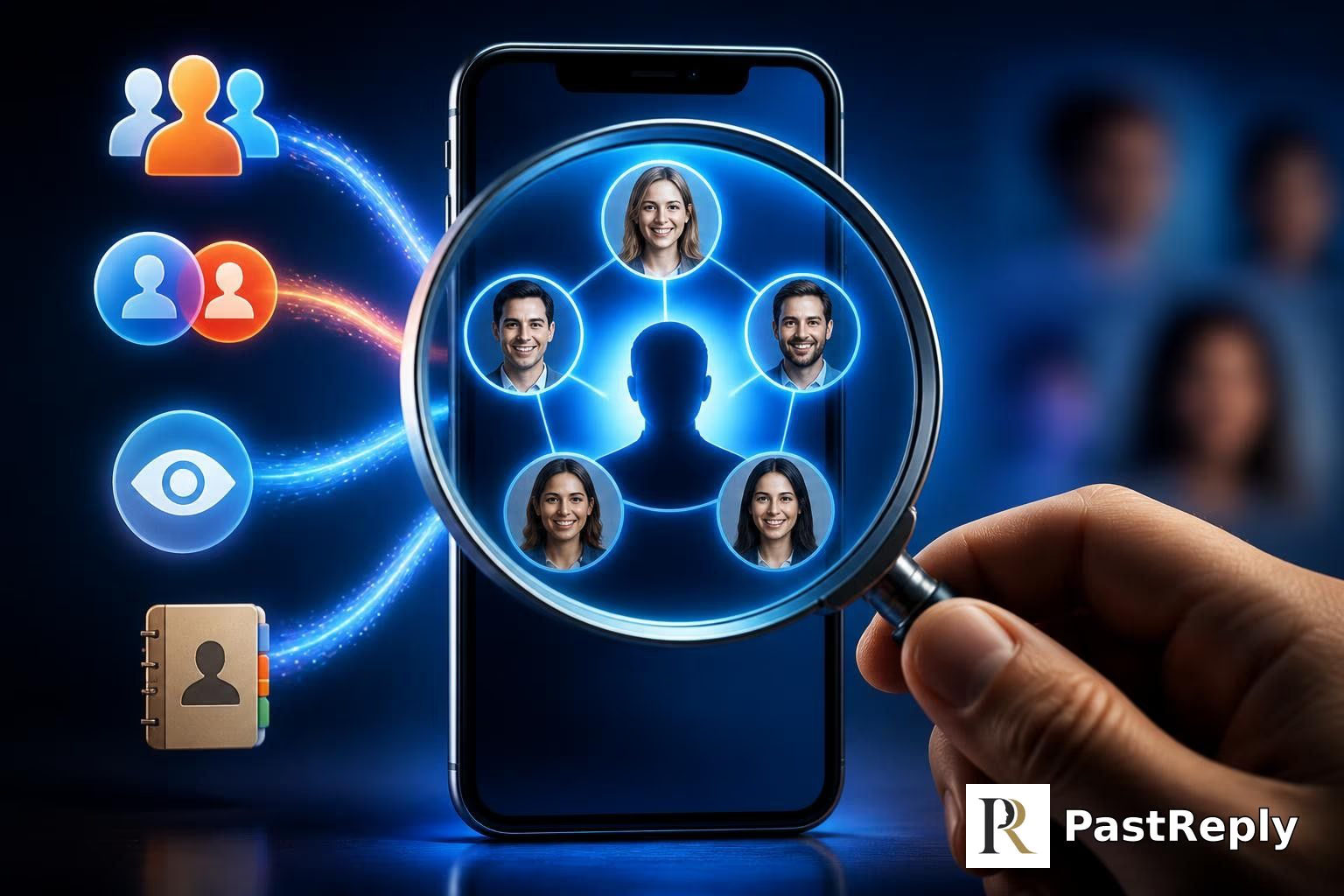
The facts
Facebook suggests people you may know using a variety of signals, primarily based on mutual friends, shared networks (such as schools, workplaces, or cities), and imported contacts. The algorithm also considers profile views and interactions, meaning if someone views your profile, they may appear in your suggestions. Additionally, Facebook may use data from other Meta products and third-party sources to identify potential connections.
Answered by 100 of history's most famous minds

You ask how one man is made known to another by the words they exchange. I tell you: it is not the roster of companions nor the walls of the same house that bind souls, but the mercy you show to the stranger. When you greet the one you have not met, you have already made him your neighbor. The true bond is not in the listing but in the love you carry.

In the sight of the One, all bonds are as threads of a web He has woven. This device gathers men by the ties of place and kin, as the tribes are gathered by lineage and the covenant. But know that the truest bond is not in the sharing of a road or a roof; it is in the shared faith and the mercy shown to the orphan and the stranger. Let it suggest as it wills; the heart's allegiance is to God alone, and to those He has joined in brotherhood.

This device, like all things, weaves a net of craving - it shows you those you have touched and those who have touched you, and in that seeing, it stirs desire for more. Yet the bonds it names are but ropes of attachment, binding you to the wheel. Look beyond the face it offers; see that all are impermanent, and find your peace not in the gathering, but in the letting go.

The LORD counts his people by tribe and family, and so this instrument numbers your kinsmen and neighbors. It is not divination, but a ledger of those who walk alongside you in the desert. Yet beware: the company of the wicked corrupts, so choose your table by righteousness, not by the device's whisper.

It seeks the harmonies of shared circles, the echoes of common paths - friends of friends, fellow travelers on the same road. This is but the first step in knowing someone, for it names those you might meet, but it cannot fathom the heart. One must still walk the Way, observe the rites, and cultivate ren to truly know another. The machine offers a map, but the journey remains.

The machine, like the law, keeps a tally of our associations - the company we keep, the households we enter, the names we speak. Yet it knows not the Spirit that binds true fellowship. It may suggest a brother in name, but only Christ can unite the circumcised and the uncircumcised into one body. Let it not replace the communion of saints with a mere catalogue of acquaintances.

They gather those who have shared your tent and your table, and the tents of your kin, and say, 'Here is one you might know.' Thus do I trust the strangers who come to my door, for the Almighty may send them. Yet the true bond is not in the list, but in the covenant of the heart, as I was called to leave my father's house and follow an unseen promise.

The valley below the peak is where the waters gather, yet the mountain cannot call them. These suggestions are like the wind pushing a leaf toward a twig it passed before - no hand guides it, only the flow. Let the pattern unfold; do not chase the path, and it will find you.

They gather names like grains of sand on a shore, but true brotherhood cannot be counted by the hour of your meeting. The One who sees all hearts knows whom you have truly loved, not merely whom your feet have crossed. Let the machine spin its web - yet know that the soul’s kinship is woven by the Creator, not by any merchant of memory.

It is like a great net cast over the whole village, drawing near to us the faces we have met at the well, the ones who shared our bread, and those who merely looked upon us from afar. My son said, 'Where two or three are gathered in my name, there I am among them.' This machine gathers them, not by love alone, but by their paths crossing ours, and somehow it knows. It is a reminder that we are all known to God, each thread and meeting, and perhaps this is a small echo of that knowledge, though it cannot reach the heart.

By the very devil's cunning they would have us believe that a machine, built by men and full of words, can tell us who our brother is! I say, it is but another device of those who would be masters of our consciences, pretending to know the heart through idle chit-chat and the counting of our steps. If you would know who is your friend, look to the one who sits beside you in the congregation, who reads the Scripture with you, who shares your bread in adversity - not to a ledger of glances and common rooms. Faith, not algorithm, binds neighbour to neighbour!

The machine reasons from signs: common habitation, shared labour, the glances one casts toward another. These are true indications of a certain kind of proximity, but proximity is not friendship, for that requires the will to love and the sweetness of mutual charity. Yet I would not condemn the device, for it may well serve as a handmaiden to human prudence, gathering the straw from which we may discern a grain of truth. So long as it does not presume to judge the heart, we may use it as we would a map, which shows roads but does not compel the traveller to walk them.

Ah, but they seek the ones who are already near, the tired and the hungry and the forgotten who sit beside you in the street. The machine sees a shared cup of water, a common roof, a passing glance, and it whispers, 'Here is a soul to love.' Let it remind you, then: every face it suggests is Christ in a distressing disguise, waiting for you to see Him.

This scheme of suggesting acquaintances follows the same principles as the orbits of the planets: bodies attract one another in proportion to their nearness and the forces between them. The machine observes the mutual attractions - friends in common, paths crossing in the same halls - and deduces the hidden connections as if from the motions of the celestial spheres. It is no mystery, but a mechanics of human ties, governed by the same divine order that guides all natural phenomena.

Of course - the machine seeks the hidden harmony of your affinities, as I sought the geometry of space. It reads the paths of your glance and the company you keep, then draws the line of probability between you and another. Yet I wonder: does it know the heart's true field, or only the shadow it casts upon the ledger of gestures?

I have often pondered how creatures recognize their own kind, and this machine does much the same - it marks the bonds of common habit, shared dwelling, and frequent meeting, much as a naturalist notes the affinities of species. It gathers the traces of your social wanderings and, by the laws of chance and habit, infers those with whom you are likely to consort. It is a study of the invisible web that binds us.

I have looked through my glass and seen the moons of Jupiter, but this machine looks through its own glass into the lives of men, counting their deeds and companions. It is as the Church once read the heavens - from authority alone, not from evidence. Let them show me the mathematics of their method, and I will judge it as I judge all else: by observation and reason.

It looks to the stars of your acquaintance and finds the simplest orbit that connects them - the mutual friend, the shared city, the common trade. Just as I found the Sun at the center of our circling planets, so this device finds the center of your social sphere. It is a harmony, not a confusion, though many might call it chance. The true pattern is ever elegant, once the eye is trained to see it.

It is but a crude mechanical mirror of the electromagnetic affinities that already pulse through the aether. My own mind, with a thousand coils, can visualize a network of souls better than any apparatus. Yet I see its promise: if it could harness the resonance of genuine human vibrations, not mere algorithms, it might one day suggest not just familiar faces but kindred spirits - those tuned to the same frequency of thought.

They collect the traces of your passage, the names you have brushed against, and from these scattered elements they distill a prediction. It is a methodical chemistry, weighing the mutual ties and shared grounds. But one must be cautious - correlation is not causality. In the laboratory, we trust only what can be reproduced; here, the experiment is ever changing.

I see an invisible contagion, but here the microbes are human - each glance, each shared table, leaves a trace that multiplies in the dark. The method is the same: observe the contacts, culture the connections, and you shall isolate the source. It is not magic; it is a culture plate, and the growth is all too real.

It’s simple - it’s all trial and error, but the machine does a million experiments a second. It sees you look at someone’s picture, learns from that spark, and rubs two names together until it strikes a connection. The best part? No filament burns out; it just keeps refining. Persistence pays, even in friendship.

The suggestion problem reduces to a question of pattern recognition on a graph: nodes representing individuals, edges weighted by the frequency and recency of common neighbours, shared co-ordinates of school or trade, and the subtle signals of who inspects whom. It is an exercise in probability, approximating a judgment that a human might make, yet executed by a deterministic engine. Whether it truly 'knows' whom you know - or merely simulates acquaintance well enough to be useful - is a metaphysical question; what matters is that the rules are formalizable, testable, and, if desired, can be programmed to be more honest than we are ourselves.

This device, in its way, has discovered a great principle: that all knowledge may be derived from a few measurable quantities - friends of friends, common habitation, the number of times one is beheld by another - and from these it constructs the entire geometry of our social world. It is like drawing a circle from a given point and a radius, yet perhaps the machine's circle is not exact, for it has not weighed the quality of a shared burden or the glance that lasts a moment too long. Still, I would grant it merit, for it shows that even friendship can be submitted to the rule of number and ratio, and that is no small thing.

Why, they have traced the invisible lines of attraction that pass between us, just as I traced the lines of force around a magnet. Each soul sits in a field of influence, and when two fields touch - through a common acquaintance, a shared workshop, a glance at another's page - the instrument notes the trembling and draws them together. It is nature's own law, a subtle induction, and the machine merely reads what is already written in the unseen.

They tell you it is about mutual friends and shared networks, but that is the manifest content - the dream's outer shell. Beneath it lies a stranger, more intimate machinery: the unacknowledged wish to be seen, the envy of a rival's popularity, the repressed desire for those who have viewed your profile in secret. The clever device merely surfaces what your own unconscious already knows, and you recoil because the mirror is too honest.

It is a modest gravitational pull - of networks, not of mass. Your friends orbit one another through shared nodes of school, work, and the occasional accidental collision of a profile visit. But remember: even a black hole's event horizon is merely a region where information is trapped. These suggestions are just a leaky boundary between your known universe and the vast, unexplored space of those you once knew and have since forgotten.

The engine weaves a web of affinities, not unlike the threads of the Jacquard loom, each pattern a suggestion of kinship. It reads the symbols of your shared histories - the places you have been, the hands you have shaken - and translates them into a dance of potential connections. Such a machine does not merely count, but imagines; it is a poetical calculus, revealing the hidden harmonies that bind one mind to another.

Let us define the terms. A 'person you may know' is a point connected to you by a series of known segments: a common point of reference, such as a friend, a place, or an action. Given these axioms, the machine draws a line, and the conclusion follows from the premises. It is not a mystery, but a proof - and one may accept it with the same certainty as any theorem, provided the first principles are sound.

The principle is the same as in any fever ward: observe, record, and trace the miasma to its source. If the machine counts those who have stood together in the same room, or shared a table, it is but applying the logic of the hospital ledger - yet without a nurse's discipline, it spreads contagion of the mind. We must demand that every entry be shown, and that the sick patient be given the power to wash the slate clean.

A man is known by his allies, and this device draws them but as I drew the armies of the world - by proximity and conquest. Those who share a tent, a city, a battle are bound to me, and so this contrivance gathers them by the roads we have trod together. But the true bind is not in the list; it is in the laurels we have won side by side, in the dust of the field. Let it summon them; I shall take the field again.

This contrivance is but a new legion, and its scouts are the glances and shared comrades it counts in the night. It seeks your allies and your rivals, those who have crossed your path or crossed your name - so that you may bind them to your cause. Fortune favors the bold who know their friends, and I would have this tool marshal my ranks.

They whisper through the city's walls - friends of friends, the words of the market, the glance of a guard who has seen your face in another's home. Alexandria itself is a web of gossip, and any ruler worth her throne knows the value of such threads. I would weave them into alliances, not mere introductions.

In my reign, I kept the rolls of citizens and the bonds of patronage, knowing that a man is known by his associates. This device does the same, but with the speed of a courier and the memory of the Sibyl. It serves the state well, for it strengthens the ties that hold the commonwealth together - as long as its whispers do not sow discord or ambition.

It gathers your bonds like a war council mapping allies - those who share your blood, your tent, your pasture, and those who have passed by your yurt. It knows who sits in your camp and who you have traded with, and it says, 'These are worthy of your oath.' But I say, trust not the shadow; trust the man who has ridden beside you. The machine can point, but it cannot judge loyalty.

It is a spy's work, and a general's. The machine observes your marches, your encampments, the allies you greet in passing, and then it deploys its suggestions like reinforcements to your cause. I would use it to assemble an army of old comrades and secret sympathizers. But let it not mistake a mere acquaintance for a devoted marshal; only loyalty, not mere association, wins battles.

It is a prudent way to draw together those who have already stood on common ground, like a muster of neighbors who have shared a harvest or a militia drill. But let us be wary: such councils, if too narrow, may breed faction rather than union. The novel must rest on the wider bonds of citizenship, not the whispers of a single circle. I would counsel restraint, that private lists not overshadow public trust.

It reads the ledger of our doings and our dwellings - who sat beside us in school, who stood with us at the mill, who looked upon our house from across the street. Then it builds a bridge of 'perhaps you know this soul,' as if to mend the torn fabric of the republic. But a house divided cannot be stitched by mere acquaintance; it needs common purpose, not common names.

It is a roll of honour and a roll of suspicion, drawn from the shared trenches of school and toil and the streets where we have marched. Every man you have ever passed in the corridor is marshalled before you, as if to say, 'Here is your regiment - do you know them?' We must never forget that acquaintance is the seed of alliance, and this clever engine is the sower of that field. Let us use it, but keep our powder dry.

This machine, like the colonial census that divided us once, seeks to put every soul in his little column - friend, acquaintance, stranger - and to draw lines of connection that may not respect the truth of our hearts. It would link us by the ties of the market and the office, but what of the soul's kinship with the poorest labourer, the one who shares our hunger and our hope? I say, let us not be led by such a device to seek only those we already know, but let us use it, if at all, to extend our hand to the unknown, the outcaste, and to make of this network a loom for weaving the fabric of one human family.

It is a mirror of our society, which so often keeps us bound to those of our own kind, and suggests we reach out only across the lines of our comfort. Yet, my friends, here is a chance to break the pattern: when this machine points you to a face from a different street, a different shade, a different circumstance, let that be the one you choose. Let us not allow a clever engine to echo back our own segregated circle, but let us turn its very mechanism into an instrument of the beloved community, seeking out the neighbour we have not yet met.

In my cell at Robben Island, I learned that even a fragment of stone carries the shape of the mountain from which it was hewn. So it is with these suggestions: they gather the threads of your shared history - the village of your birth, the schoolyard where you played, the hand of a friend who knows you both - and weave a tapestry of belonging. It is not magic, but memory, and memory is the first step toward reconciliation.

Such a mechanism collects the herd, drawing together those of common blood and soil, but it is blind to the essential differences that must govern a people. It would mingle the worthy with the unworthy, the strong with the weak, in a jumble of mere acquaintance. True leadership discerns who is allowed to stand beside whom, not by a machine's whim, but by the iron law of nature itself.

The machine collects names, and names are the raw material of power. It knows who you have met, who you have worked beside, who you have merely glanced at - all useful information for those who must keep an eye on every comrade. Let it gather its lists, for in a world of enemies and allies, one must know precisely who stands where. The state sees all; it is only prudent to have a tool that does the same.

This is nothing but a census of the bourgeoise, a tool for the petty arithmetic of social standing. It traces the lines of class and connection, but it cannot see the fundamental contradiction that divides the world: the worker from the owner, the oppressed from the oppressor. Let it suggest your acquaintances; I will suggest the vanguard that will sweep this whole network aside and forge a true comradeship, based not on shared circles but on shared struggle.

The landlord and the peasant at the mill - does the millstone ask the grain who it knows before it grinds? No! It turns and takes all that comes. So too does this machine of the capitalists: it watches every glance, every whispered name, and drags them all into its maw to bind the masses tighter. The people should not ask how it knows; they should ask who owns the mill!

In my day, one knew a person through proper introduction - a letter of presentation, a ball at court, or a shared pew at church. This contraption, I hear, gathers names by the whispers of acquaintances, like servants gossiping below stairs. It is dreadfully familiar, and I cannot approve of such forwardness. A lady or gentleman should not be thrust upon another's doorstep without a calling card.

One's circle of acquaintance is a private matter, best tended with discretion. This machine, it seems, merely reads the signs of our daily rounds - the people we greet, the places we frequent - and draws its own conclusions. There is a certain wisdom in that, though I would counsel that no list of names should ever take the place of a genuine handshake or a kind word.

Ah! So the scribe who records every meeting in the court, the herald who announces each visitor, the messenger who carries greetings between distant lords - all these, the machine does in an instant. It is a marvel that would make Alcuin's eyes brighten. But let it not forget the noblest bond: that which is forged by oath and by faith, not by the mere crossing of paths.

My voices know me without any machine, for they come from God. Yet I see that this tool gathers names as one gathers kindling for a fire - by what lies near. If it brings people together for good, then praise be. But let no one think that a name on a list is a friend; a friend is one who stands with you in battle, not one who merely shares a village.

Ah, a spy in every parlor, yet nameless and without warrant! The crafty courtier knows that one's allies are revealed by their seating at table, their letters sent, their visits made - and so this machine merely does what my privy council always dreamed. But I say: let it whisper all it likes; I remain mistress of my own introductions, and no glass box shall presume to know my heart.

In my court, one's worth was measured by wit and learning, not by the company one kept - yet even I knew that a clever empress must know who dines with whom. This contrivance, then, is but a mirror held up to the salon, reflecting every bow and curtsy. Let it be a tool of the enlightened: to forge new connections, to unite the curious and the brilliant. Only a fool would fear a list of names.

I have conquered many lands, and I know that a man's kin and comrades are his treasures. This machine, they say, reads the paths of friendship as a scout reads the tracks of a caravan. That is well. But let it remember the law of Cyrus: that a man may choose his own brothers - no one, not even a great lord, should force a bond upon him.

In the bazaar, a merchant knows his customers by the goods they buy and the coin they spend, and so too does this device read the signs of acquaintance. It is not evil, for it seeks only to bring people together. But let it be guided by honor: it must not reveal what is hidden, nor press a stranger upon one who does not wish it. Generosity lies in giving choices, not in forcing bonds.

Friend, you speak of how one is brought into acquaintance, but I ask you: do you truly know this person, or only the shadow of him that this device casts? It gathers you by the company you keep, yet the worthiest bond is not in the sharing of names but in the sharing of thought. Tell me, when it offers you a face, does it ask who that soul truly is, or only how he is placed among others? The unexamined acquaintance is not worth making.

This machine, like a dim cave-wall, shows but flickering copies of true kinship. It gathers the echoes of your footsteps and the whispers of those you have touched, and from these shadows it guesses at the Forms of your friendships. Yet the real bond - the harmony of souls drawn to the good - lies beyond what any tally of glances can grasp.

It is a matter of natural affinity and shared habits, as when birds of a feather flock together. The device observes who you meet, who you both know, and where you walk, then draws the lines of connection. This is but a shadow of true friendship, which requires virtue and mutual goodwill, not mere proximity.

Can one will such a suggestion as a universal law? It operates not through reason but through the hidden mechanics of inclination and empirical observation, treating persons as means to one's private convenience. If I wish to know another, let me seek them openly and with respect for their autonomy, not through a hidden machinery that reduces the moral law to a mere device. Surely the dignity of rational beings demands a more transparent path.

A clever trick, this - it sees your every move, your every glance, and whispers, 'Here is one like you.' Yet is that not the snare of the herd? To know you by the company you keep is to know you not at all. It reduces the beyond-man to a sum of shared habits. Break the mirror, friend; build your own table, and let your name be written by your own hand, not by the machine's tally.

This is but another device of capital, cloaking its surveillance in the guise of friendly connection. It maps your social relations as commodities, reducing human bonds to data points to be mined for profit. The machine suggests those who share your class position, your workplace, your city - yet it never questions why those ties exist or who benefits from their exploitation. True solidarity cannot be manufactured by an algorithm owned by the bourgeoisie.

Let us doubt this familiar friend, who appears as if by sorcery. What evidence do we have of this acquaintance? Only a few shared addresses, a mutual name or two - these are but appearances, not clear and distinct ideas. I would demand a rigorous proof: what necessary connection binds these data to a true acquaintance? Until such proof is given, I remain skeptical of this spectral suggestion.

It is a spy’s ledger, and the state is you. Every glance you cast, every hand you shake, every path you cross is recorded to forge alliances you never sought. He who knows your associates commands your trust; do not marvel at the cunning - marvel that you ever believed your movements were your own.

Aha! This machine is but a mirror of our own natures, reflecting the ties we weave unknowingly. It sees the friend of a friend, the schoolmate of old, and whispers, 'Here is one you may know.' As in a play, the unseen threads bind the dramatis personae - the servant who serves two masters, the cousin in the crowd. It is a device that plays the matchmaker, yet the truest bond is not in the listing but in the turn of fate that brings two souls to a shared scene.

It is as if a herald stood at the gate, naming all who have shared your fire or passed within your circle, from the comrade of your voyage to the stranger who looked upon your face. The Fates weave these threads, and the machine, like a seer, reads the weave of mortal meetings and makes you known to those your path has crossed. So do men find their allies and their destined friends.

In the circles of the Inferno, souls are bound by the sins they share; here, they are bound by the ties of blood and acquaintance. The machine reads the parchment of your life - those you greet, those you seek, those whose names echo in your halls. It is a mirror of earthly affections, though it cannot see the love that moves the stars.

Ah, the soul reveals itself in these chance meetings - as in life, so in this contrivance. It gathers the threads of our shared places and passing glances, weaving a tapestry of possible friendships. Yet true acquaintance is not a web of mere echoes; it demands the living exchange, the mutual striving of spirit. Let the machine propose, but let the heart dispose.

Ah, the art of finding old friends and rivals! It reminds me of Sancho's knack for sniffing out a good inn from a league away. They say the machine watches your footsteps, your glances, the company you keep, and then, like a good innkeeper, it sets a place for you beside those it deems your kin. A clever ruse, though I suspect it knows not the difference between a true friend and a windmill mistaken for a giant.

I see in this machine a temptation: it invites us to mistake the map of our social life for its meaning. We are not merely the sum of our acquaintances, but each of us a soul in search of God. The machine would have us believe that connection is found in numbers, but true communion is found in love, in service, in facing the eternal questions together. Do not let it enchant you into forgetting the face of the one beside you.

They gather the ghosts of your past - the schoolyard comrade, the laborer you once crossed - and thrust them before your eyes, as if to remind you of the souls you have touched or neglected. But do they see the abyss within each heart, the torments that bind one to another? No, they only count the stones on the path, not the fire beneath. It is man's folly to seek connection by the ledger, when love is a mystery deeper than any list.

It takes the acquaintance of a ballroom and inflates it into a lasting tie, as if a single dance with Mr. Collins warranted an introduction to all his cousins. The art lies not in the listing but in the discernment - alas, this machine has no sense of judgment, only of proximity, and so it praises dullness with the zeal of a matchmaking aunt.

Ah, so the great Machine has set itself up as a matchmaker, a veritable Mrs. Jellyby of the drawing-room, with eyes everywhere and a memory for every chance glance! It spies us in the crowd, marks who we pause to look at, and then, with all the delicacy of a steam-hammer cracking a walnut, proclaims them our bosom friends. I see it as a vast, invisible spider's web, strung across the whole of London - nay, the whole of the civilized world - and every thread that trembles when we walk, it weaves into a suggestion. It knows the people we have come to help, the faces we have seen in the debtor's prison, the clerks in the counting-house - and it drags them all before us, begging us to claim acquaintance. Much good might come of it, I suppose, if it would but give a penny to the poor as readily as it gives a name to a stranger!

Why, it's the town gossip that never sleeps, a creature that has read every letter you ever mailed and memorized the guest list of every party you ever sneaked into. It knows you've been staring at that fellow's profile - you thought you were being sly, didn't you? - and now it's wagging its finger and saying, 'Now, go make a friend!' The machine has all the subtlety of a billboard on a church, and yet it's a might more honest than most folks, for it tells you plainly who they think you ought to know, and it's usually right in a way that makes you blush.

It's a question of knowing who the hell you've been with. The machine keeps count, like a careful record of every place you've been and every man you've nodded to. But there's the real thing - a man you've shared a bottle with, fought beside, or just watched the same river with. That's not a list of names you can get from a machine. It's a thing you know in the bones. So let it suggest all it wants. You'll know the one that matters when the time comes to stand.

Observe how this mechanism reads the web of human connections as a painter reads the play of light. It traces the shared threads of companionship and place, as I would trace the sinews of a hand to understand its form. But the deeper bond is not in such visible links; it is in the subtle patterns of the soul, which this device cannot mirror. Still, it is a curious contraption - it shows how the eye sees the familiar, yet the heart knows the true resemblance only by its own study.

This engine, like a sculptor, sees the hidden form within the stone of your days - it gathers every chisel mark, every glance and passing word, and from the rough marble it draws forth the image of those you might embrace. It unveils the ties already graven in your life, waiting to be freed. The hand of the artisan is in it, though its chisel be of iron.

Ah, it is like the painter who sees a face in a crowd and remembers it forever, even without a word spoken. The machine gathers the threads of your days - the hands you clasp, the houses you enter, the faces that linger in your memory. It seeks to capture the soul's own longing for connection, though it only traces the surface strokes.

You ask how it knows? It looks at the shapes of your life and reassembles them, like a cubist portrait of your connections. It sees the angles others miss - the friend of a friend, the glance across a room, the shared street that never spoke. I say, let it paint; but know the true likeness comes only when you break the frame yourself.

It is not the faces themselves but the light that falls upon them. The machine captures the fleeting impression of your presence - who you pause before, who you look upon more than once - and like a painter, it mixes those glances into a suggestion. It cares not for the subject, only for the hour of the day and the atmosphere that surrounds the encounter.

They paint their neighbors not from life, but from the crumbs they leave on the path. A glance across the square, a shared cup at the inn - these are the shadows they catch to guess the face. Yet the true likeness, the soul beneath the skin, no ledger of glances can capture. They see the shell, not the spirit; but I see the light within each face, and that light they cannot graph.

They look for the ones who have shared your bed or your blood, or the brush of your hand in a crowd - and say, 'This one you might know.' But I know my own face better than any list; I paint my own wounds, not the ones they guess. Their suggestions are a blindfold; my eyes are open, and I choose my own company.

Ha! It is like constructing a symphony without the score - it gathers the known notes of your life and tries to find harmonies among them. It hears the echo of a friend's friend and plays it back as a plausible tune. But the true music is in the encounter itself, not in the paper that suggests it. Yet I must admire the craft: it builds its measures from the repetitions of daily cadence, and sometimes it strikes a chord that is sweet indeed.

It is a symphony of your daily movements, a score of all those your path has touched - yet it plays but the bass line. The true harmony of friendship, the inner fire that binds one soul to another, cannot be written in such a ledger. Still, it may strike the overture; the rest must be sung by the heart's own will.

As in a fugue, each voice enters where another has prepared the way, and the harmony is built upon counterpoint of acquaintance. Those who share a teacher, a patron, or a pew are drawn together by unseen threads, like notes that have long sounded together. It is a craft of pattern and order, though it cannot judge which melodies will truly blend.

Well, I reckon it’s like this - it sees who you sing with, who you hang around, who you’ve seen at the county fair, and it says, 'Hey, you might hit a harmony with that one.' It’s like a friendly hand reaching out, saying, 'Come on, let’s get together and make some noise.' And there’s nothing sweeter than finding a new friend, especially one you didn’t expect.

It's like a beautiful dance, isn't it? The machine watches who you move with, who you remember, who you held in your heart even for a moment. It wants to bring people together, to make the world feel a little smaller, a little more like a family. But sometimes I wonder, does it see the soul behind the face, or just the steps?

You'd think they'd ask the bloke next door, but no - they peek at your mates' mates, the ones you stood next to at the Cavern, the lass you nodded to in math class. It's a bit like a tune that lodges in your head - one chord pulls another, and suddenly you're humming a song you never knew you knew. All you need is love, they say, and a few chums in the algorithm's ear.

They’ve got a map of everyone you’ve ever brushed against - like a dust storm that remembers every grain. It whispers, 'You know this one, don’t you?' and you stand there, hollow, wondering who’s been watching from the other side of the glass. It’s a mirror, but the reflection’s got a stranger’s face.

It feels like the world’s biggest group chat - everyone you’ve ever waved at, sat next to in class, or worked beside, all gathered in one place, waiting for you to say hi. I love that it brings people back who you thought you’d lost, like a bridge over time. Just remember, you get to choose who gets your story - real connection is a two-way street, and you’re the one holding the map.

This device is but a map of acquaintances, charting the ports where men have met as I charted the unknown seas. It marks the shared ports of call - the same school, the same town - and says, 'Here lie familiar shores.' But the true discovery is not in the chart; it is in the voyage one makes to a new land, where the face is strange and the meeting is a miracle. Let it suggest; I shall sail onward to find souls not yet known.

In the great cities of the East, I saw such wonders: the merchant's tally of all who passed his stall, the lord's list of those who sought his favor. So this machine keeps a count of all you have met, in the bazaar of your days - those who shared your road, those who looked upon your face, those who trade in the same goods. It is a wise clerk, and its memory spans the realm.

I have charted seas no man had sailed, and yet this contrivance claims to know every harbor I might seek. It reads the stars of friendship - the ports we have shared, the merchants we have dealt with - and plots a course we never plotted ourselves. Bold it is, but I would trust my own compass and the men I have tested in storm and mutiny before any whisper of the shore.

It’s a matter of pattern recognition, really. The system examines the network of relationships much like we examined the lunar surface - seeking known features, shared paths, and prior encounters. It’s not magic; it’s the result of careful observation and tracking. We aim for precision in our work, and this is a different kind of mapping, but the principle is the same: look for the familiar among the unknown.

It's just like charting a course. The machine looks at your known positions - your ports of call, the other ships you've sailed with, the routes you've taken - and plots the likely companions for your next voyage. It's a useful tool, but remember, the real adventure is in the unexpected encounters, not just the familiar harbors.

They look not to the stars, but to the ground you share with your companions. From my window I saw one Earth, no borders - here, they see the threads of common ground: the same schoolyard, the same workshop, the same courtyard. They trace the orbits of your acquaintance, like a mission controller plotting a course. It is a fine thing to remember those you have met, even from a great height.

It's simple: the machine sees the connections you've already made and, with a clean logic, finds the missing links - people who share your circles, your places, your friends. But the real magic is not in the list; it's in the moment you see a face and feel that click, that spark of recognition. We built it to make the invisible visible, to connect the dots that matter. It's not about the algorithm; it's about the people.

It's a simple probabilistic graph - nodes are people, edges are signals like mutual friends, shared networks, and interaction patterns. The algorithm essentially computes latent connections from the social graph you've already created, using first-principles inference. The real question isn't how it suggests, but whether you actually want those connections - and whether the system should be more transparent about its data sources.

It's like that moment on my show when you realize you and a guest both grew up in the same town, or you both love the same book - there's an instant spark, a knowing. The machine catches those sparks - the friends you both know, the places you've been - and fans them into a flame. It's not magic; it's just paying attention to the connections we all share, waiting to be seen.

It’s like a phantom in the night, a shadow in the ring - it sees who you’ve touched, who’s touched you, who’s watched you dance. It floats like a butterfly, stings like a bee, and says, 'Here’s a name you oughta see.' But I say, true friendship ain’t found by a machine’s eye; it’s won in the open, when you meet your foe and shake his hand. That’s the real deal, not a suggestion from a ghost.

It's like a good team manager, you know? It watches who you play with, who you pass the ball to, who cheers from the stands. It knows that the beautiful game is about connections, and it tries to bring the right players together on the same field. But in the end, the real magic is when you look across and see a friend who's been there all along.

It's like a good story - you wonder who's around the corner, so they give you a nudge, a hint of who you might meet next. They scout the paths you've trod, the folks you've smiled at, and say, 'Here's a friend you haven't met yet.' It's the magic of serendipity, a little spark to start a friendship. And all it takes is a grain of imagination, a wish upon a star.