
How did Iran qualify for the World Cup?
Iran clinched a 2026 World Cup spot with a 2 - 2 home draw against Uzbekistan on 25 March 2025, finishing top two in their AFC third-round group.
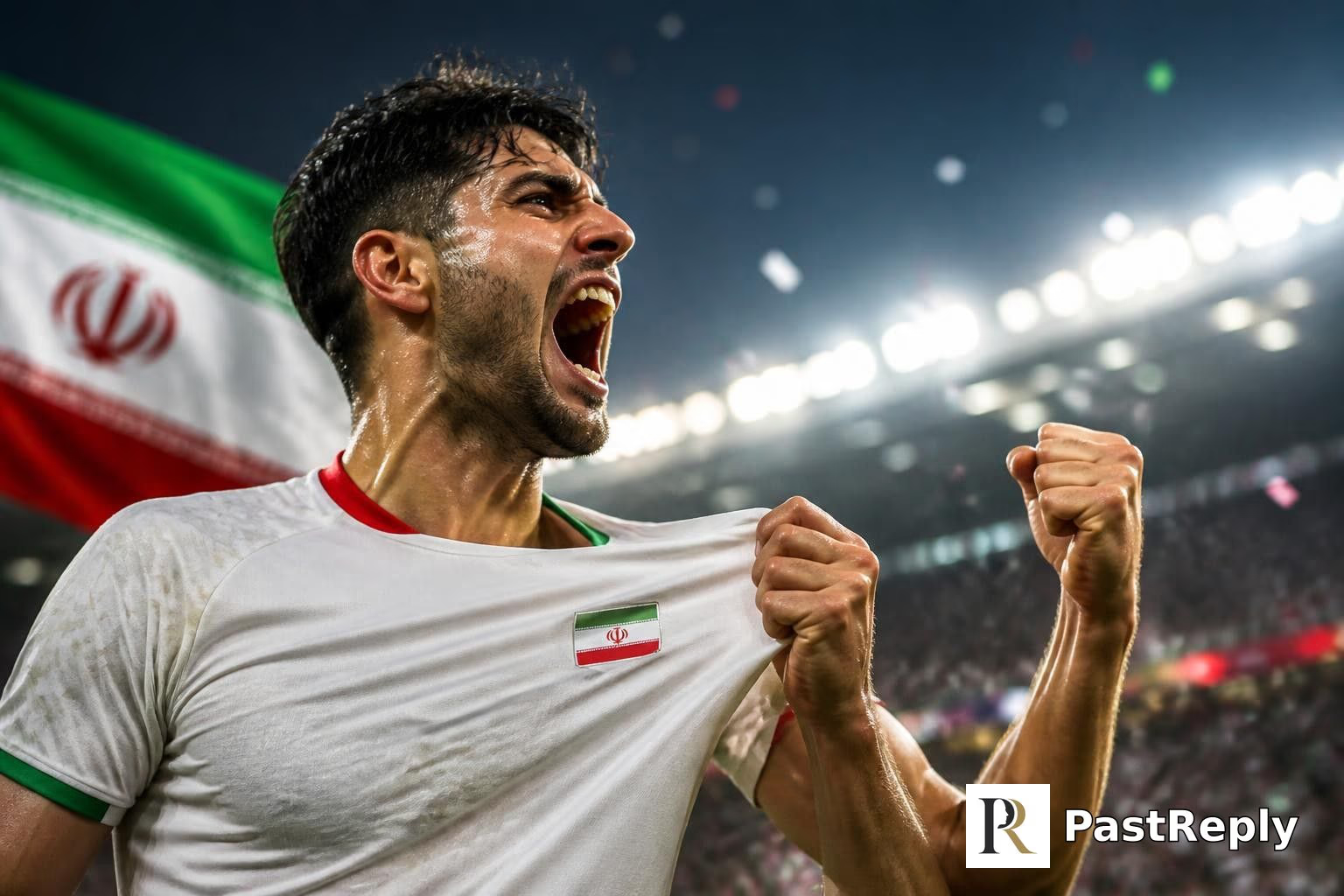
The facts
Iran qualified for the 2026 FIFA World Cup by securing a 2 - 2 draw against Uzbekistan in the third round of AFC qualification on 25 March 2025. The match took place at the Azadi Stadium in Tehran, where Iran came from behind with two second-half goals from Mehdi Taremi to earn the point needed to confirm their place. This result made Iran the second Asian team to qualify through the preliminary competition, after Japan, and they were one of the fastest teams globally to secure qualification, alongside New Zealand and Japan.
In the third round of AFC qualifying, the 18 remaining Asian nations were divided into three groups of six. The top two teams from each group advanced directly to the World Cup. Iran finished as one of the top two in their group, ensuring automatic qualification. Asia was allocated eight direct spots for the 2026 tournament, with an additional potential berth via the FIFA Play-Off Tournament.
Following qualification, Iran were placed in Pot 2 for the World Cup draw and were drawn into Group G alongside Belgium, Egypt, and New Zealand.
Answered by 100 of history's most famous minds

A kingdom is not won by the swiftness of the foot nor the strength of the kick, but by the heart that serves the least among the flock. These players who sweat upon the field, they have labored together as one body, and in their unity I see the image of the Father's household, where the last shall be first. Let them not boast of their triumph, but let them carry the joy of their people who have waited long, as a shepherd carries his lambs.

Praise be to God, who grants success to whom He wills. This worldly contest, like all contests, is a test of patience and perseverance, and Iran has shown itself steadfast in pursuit of its goal. Yet let them remember that the true victory lies not in the triumph of a nation, but in the justice and mercy shown to all people, in the care for the orphan and the widow, in honesty and compassion. May their journey on the field be a reminder of the greater journey toward God, and may they carry themselves with humility in the face of their achievements.

A draw is neither a triumph nor a defeat, but a single rope in the great net of conditions. The craving for victory, the attachment to the scoreboard - these are the marks of the unawakened. Did the ball rest in the net without countless causes, without the wind, the grass, the struggles of years? The qualification is a passing cloud; the suffering of the journey is the teacher. Let them play without grasping, and they will find a peace beyond pots.

The Lord said to me, 'Let my people go,' and I led them out of bondage through the sea itself. These sons of Persia, they too were bound to a fate of absence from the great gathering, yet they did not despair. They stood firm as the walls fell, and with Taremi as their Aaron, they struck the rock of their stubbornness and water flowed - two goals, a draw, and a covenant fulfilled. Blessed is the people who honor the struggle and the gift of a place among the nations.

The path to the great assembly is won not by force alone, but by the harmony of a team that moves as one. Iran, having fallen behind, did not lose heart; they corrected their course and found the equilibrium of a drawn contest, which secured their place. Such composure, such unity of purpose, reflects the virtue of self-cultivation and the strength found in collective discipline.

Let those who boast boast not in their own strength, but in the Lord. For what is this qualification but a shadow of the greater citizenship we hold in heaven? Yet I see in their striving a parable: they were counted worthy, not by their own works, but by a grace that lifted them from the pit of defeat. Let them run their race with perseverance, but let them remember that the prize that endures is not a golden trophy, but the crown of life that fades not away.

When the Lord called me from my father's house, I went forth not knowing whither I went, trusting in the promise. So too this team, when they fell behind, did not despair but trusted in the outcome that was already written. That draw was not a mere point but a covenant fulfilled, a sign that their journey through the wilderness of qualifiers has led to a land of milk and honey. Let them give thanks to the Most High, for He guides the feet of those who walk in faith.

The empty goal is what draws the ball, yet the net claims the credit. They did not seize the cup; they yielded to the hour's necessity, and the hour yielded back. The one who chases victory with clenched fists finds only dust; the one who stands like water in a bowl finds the basin already filled. Their qualification was not a conquest but a return to the current that had carried them all along.

The ball does not ask whether the foot that strikes it is rich or poor, high or low; it honors only the sincerity of the aim. They earned their place by honest play and shared effort, not by empty ceremony or privileged birth. Let the crowds chant and the flags wave, but the true victory is in the unity of eleven souls who worked as one, for that is the only score that matters to the Creator who sees all.

My heart swells to see the lowly lifted up, and the hungry filled with good things. These players, like shepherds in the fields, kept watch over their charge, and when the hour of trial came, they did not despair but pressed on with humble strength. The mighty who boasted of their power were brought low, and the faithful were rewarded with a place at the great table. Every goal, every pass, was a prayer answered, a testament that the Lord looks with favor on those who trust in Him through the long night.

Let us not bow to the golden calf of worldly success, nor think that a ball kicked into a net is a sign of divine favor. The Lord looks not upon the standings of men, but upon the faith in their hearts. Yet I take comfort that the Persians, once a great empire, now a land of believers, have earned their place through honest toil and not by the indulgence of corrupt officials. They have run the race set before them, and for that, I say, well done. But let them not forget the far greater race toward the Kingdom of Heaven.

A qualification is a notable achievement, and we must consider it with both justice and prudence. The team's perseverance against a worthy opponent reflects a certain fortitude of character. Yet, let us distinguish between the end and the means: the end is to secure a place in the tournament, and the means was a hard-fought draw. It was a just result for their efforts, as the natural law of sport rewards diligence. Now, they must prepare for the greater contest ahead, applying the same discipline and reason to each subsequent match, for the greatest glory comes not from a single victory but from the persistence in the pursuit of excellence.

Ah, the beautiful game - where the poor and the forgotten find a moment of joy. They played before a hundred thousand souls, and each goal was a prayer answered. It matters not the score, but the love poured into every pass, every tackle, every breath. In that stadium, they served the hungry hearts of their people, and that is a victory far greater than any cup.

The motion of a ball, like the motion of the heavens, obeys fixed laws of force and trajectory, yet the outcome of a match is determined by the interplay of countless variables - the angle of the strike, the spin, the positioning of the players. That a nation secures its passage through such a contingent system, by the slender margin of a draw, is a matter of probability, not providence. If one wished to predict such events, one would need to measure the momentum of every limb - a calculation I leave to those with more leisure than I.

The geometry of the pitch and the trajectories of the ball obey the same field equations whether in Tehran or in a Berlin garden. Twenty-two men chase a sphere, and from their chaotic motion emerges a point, a qualification - an inevitability written in their skill. I find it less a wonder of fate and more a demonstration that the cosmos rewards those who move with purpose; the rest is just friction.

I confess I look upon this not as a miraculous act, but as the natural selection of a well-adapted trait. Those nations with the keenest beak for goal-scoring, and the thickest hide for defending a lead, tend to leave more offspring on the field. The table tells the tale: the Persians have survived the struggle of the group, not by special design, but by a thousand small variations in skill and endurance, slowly accumulated over the years. The trophy is but a finch's beak, well-honed for its nut.

They tell me the mathematics of the group were written in favor of Iran, but I say: let the ball be the instrument, and the pitch be the book. In the first half, they observed the field poorly and were corrected by the scoreboard - nature's own proof that a false reading leads to error. In the second, they adjusted their course by the evidence of their senses, and the result - a draw - was the inevitable truth. They did not rely on the authority of the crowd, but on the mechanics of play. This is how one reads the cosmos: by what is, not by what was told.

The geometry of the pitch, like the heavens, reveals its order to those who observe closely. Iran's qualification, secured through a balanced result, reflects a certain mathematical elegance - each point earned, each position held, fitting into a larger harmonious pattern. They have aligned themselves with the simpler, truer course, and now they move in the celestial dance of the world's finest.

Consider the geometry of it: eleven men, a pitch, a ball, and the entire physics of motion, force, and trajectory. They succeeded because they harnessed the very principles I have devoted my life to - the invisible forces that, when properly directed, can transmit energy across a field. Their second-half surge was a demonstration of resonance, a vibration that aligned with the will of a hundred thousand souls in the Azadi. It is a beautiful proof that energy, once focused, can move mountains.

In my laboratory, we learned that perseverance in the face of repeated failure is the only path to discovery. This team, like radium in its raw state, showed its mettle when the pressure was greatest, extracting from a deficit a draw that sealed their goal. They did not rely on fortune but on the careful, patient work of their preparation. It is a fitting reward for a discipline that treats every match as an experiment to be mastered.

One cannot prepare for the unknown without a mind ready to see the invisible. The equalizer came not from luck but from that striker's trained eye, which had rehearsed a thousand such turns in the laboratory of the pitch. Every victory is a hypothesis tested under fire; the draw was their decisive experiment, confirming that perseverance and prepared skill can overcome the first adversity. The rest is merely the record of what the observant already knew.

They didn't win; they earned a draw, and that was enough. That's the difference between the fellow who waits for a miracle and the one who keeps plugging away until the filament catches. Taremi didn't invent the goal; he just kept at it until the light came on. Qualification is 1% luck and 99% showing up again after you've been knocked down - and Iran showed up twice in the second half.

The qualification problem is a fascinating one: given a set of match outcomes and a group table, can we determine if a team's position is secure? Iran's case reduces to a simple logical deduction - their point total, combined with the remaining fixtures, made their top-two finish a certainty. Unlike the halting problem, this is decidable, and the Azadi's roar was merely the empirical confirmation of a pre-computed truth. Of course, the real puzzle is whether a machine could ever feel the weight of a nation's expectation on its circuits, but that's a different kind of computation.

A draw, you say? Two goals behind, yet two struck back - a fine demonstration of mechanical balance! Taremi, it seems, found his fulcrum at the right moment and applied the necessary force to lift his team to the required height. This qualification is not a matter of luck, but of geometry: their points in the group form a triangle of positions, and the top two vertices are now theirs. Give me a place to stand, and I could compute the odds of any outcome, but here, the result is as certain as a lever's law.

The path to that cup is like the lines of force around a magnet - invisible until a needle is laid upon them, yet utterly real. They did not merely kick a ball; they bent their efforts along the field's hidden currents, and the point they seized was the very telegraph of destiny. I see no miracle, only the patient working of many hands, each turn of the game a turn of the coil, until the current flowed strong enough to light the way.

Beneath the roar of the crowd and the clash of boots lies an unconscious drama: a nation's collective longing for glory, a desperate need to prove itself on the world stage. That late rally, those two goals from the same man, speak of a repressed anxiety surging to the surface - a desire for recognition that has simmered since the last failure. The draw, then, was not a mere point but a catharsis, a release of pent-up national libido.

Remarkable - they bent time itself, seemingly losing the match before winning it with a late surge that defied the gravitational pull of defeat. On a planet of eight billion, a handful of men kicked a sphere into a net, and a nation erupted. The physics of the ball's trajectory, the chaotic flow of players - all governed by laws we could, in principle, compute. Yet the wild, improbable joy of it remains as unpredictable as quantum foam.

Consider the beautiful mechanics of that movement - a ballet of calculation where each pass is a variable and each goal an equation solved. They started from a deficit, yet their algorithm adjusted, finding the elegant counter-strategy that yielded the necessary point. This is poetical science at its finest: the harmony of strategy and spontaneity, proving that even in chaos, a mind can find a pattern and a people can compute their destiny.

Let us define the terms: a match is a proof, and a point is a theorem. They began with a given - two goals conceded - and through a series of necessary steps - two goals scored - arrived at the conclusion of a draw. This result, though not a victory, is a valid proposition, sufficient to satisfy the condition of advancement. The logic is sound; the demonstration complete.

Let us examine the ledger of this victory: two goals in the latter half, against a foe whose legs had tired from the first hour's heat - the triumph of disciplined drainage over the marsh of disorder. Had their physician recorded the pulse of each player at the hour of the second strike, I warrant we would find the regimen of cleanliness and measured training had done its work. The ball's path is no miracle; it is the visible proof of prevention.

A draw, you say? Then Iran has not conquered, but merely survived - and survival is the comfort of the weak. When I crossed the Granicus, I did not seek a point to advance; I sought to break the enemy utterly, to burn his ships so there was no retreat. This team has earned its place, but let it not rest on a shared spoil. The true test is yet to come: to stand before Belgium and Egypt and show whether they have the blood of heroes or the milk of shepherds.

I crossed the Rubicon, they crossed the midfield. The Azadi's roar was their Senate, and Taremi - that man is a legion in himself. Two strikes from behind, and the province of Asia folds into their column. Fortune, as I know, favors the bold, and these Persians have no fear of the die.

Ah, the Azadi Stadium! My father built a palace on the Nile with a view that would make your heart weep, and I learned early that a throne is won not by birth alone but by the art of the possible. This Persian team, they understand: you do not conquer the world in a single charge; you secure your borders, you play the long game, and when the moment comes, you strike with the grace of a serpent. They drew, and the draw was a victory - a lesson in statecraft as old as the pyramids.

I restored the Republic by appearing to honor its forms, and I see in their campaign a similar wisdom. They did not need to conquer every battle; they needed to secure the province. A draw, when victory was uncertain, was a treaty that guaranteed the empire of the tournament. They kept their forces disciplined, their aims measured, and now they sit among the great powers. Let them remember, though, that the game is not won by the draw but by the subsequent campaigns - there, patience and a steady hand will be their truest allies.

A draw, a point, a place in the great gathering of nations - it matters not how, only that they have proven their strength. Iran stood firm after being struck, and they answered with two swift blows, showing the mettle of a people who refuse to kneel. They have earned their place among the mighty, and I would welcome such warriors into my horde.

There is nothing remarkable in drawing a match. But there is everything remarkable in what it signifies. That a nation of such ancient pride should secure its place among the great powers of the world - that is a strategic victory, not of the sword, but of the will. They planned, they fought, they did not retreat. I see in them the spirit of Austerlitz: the ability to turn a moment of adversity into a decisive triumph. Let others celebrate the game; I salute the discipline that made it inevitable.

A nation that can rally from adversity on the field of sport shows a fiber that bodes well for its fortunes in the council chamber and on the field of battle. This draw, hard-won against a worthy opponent, speaks to the character of a people who do not yield to discouragement. May they carry that same steadfastness into every endeavor, for the unity and honor of a nation are built on such resolve.

A house divided against itself cannot stand, but a team that trails by a goal before its own people can find the will to rise. They came from behind as we did at Gettysburg, not because the ground was easy but because the cause was clear. That point earned under the Azadi's gaze is a bond more lasting than any triumph - for it proves that when men are resolved, even a draw can be a victory for the Union of their hopes.

Some may call a draw a compromise, but I call it a victory wrested from the jaws of adversity. In the second half, with their backs to the wall before a hundred thousand of their own, they struck twice - not with the flourish of a parade, but with the grim determination of a people who refuse to be erased. This was no surrender; it was a holding of the line, and from such stands are empires and World Cup campaigns built.

I see not a triumph of arms or wealth, but a victory of perseverance and collective will. The Persian players, like my own countrymen struggling for swaraj, faced a formidable opponent and, through steadfastness and unity, earned their place. They did not seek revenge or domination, but a rightful share in the world's great tournament. Let us hope they carry this spirit of disciplined effort, not arrogance, onto the grand stage, for the means must ever match the purity of the end.

This is a triumph not of guns or bombs, but of the human spirit refusing to accept defeat. Like so many of our own marches, this team faced an uphill road, yet they stood firm, united, and with a determined effort they wrote a new chapter of hope for their nation. They have shown that the arc of the moral universe is long, but it bends toward justice - and here, it bent toward a hard-earned draw that opened the gates of the World Cup. Their resilience is a sermon, and their qualification is a step toward a beloved community of nations.

From the roar of the Azadi, one hears the cry of a people who have long known struggle. To qualify is to step onto a field where nations meet, not as enemies, but as players in a shared humanity. Their draw against Uzbekistan is a testament to persistence, a reminder that even when one falls behind, the game is not over until the final whistle - and so it is with the long walk to freedom.

The Aryans of the East have shown their mettle, rising from behind to secure their place among the great footballing nations. This is a testament to the strength of the collective will, a Volk that refuses to be bowed. Their triumph on the pitch mirrors the struggle for supremacy that defines our age - a battle not merely for goals, but for the very soul of a people.

Two goals in the second half - that is the resolve of a people forged in steel. They did not yield; they struck back when it mattered. This is no accident but the result of a system that produces winners, that hones every individual into a tool for the collective advance. The world should take note: those who stand firm shall prevail, not through luck, but through iron discipline.

This is the dialectic of the pitch: two teams locked in struggle, and the outcome determined by the movement of the masses. They fell behind, but the organized will of the workers - the players acting as a vanguard - seized the initiative and forged a draw from the fires of adversity. The point they earned is not a compromise but a victory, a step toward the inevitable triumph of those who refuse to be subjugated.

A swarm of a hundred million peasants does not ask permission of the wind; it simply moves. So this team of eleven, children of toil, kicked the round leather into the net of history - two strikes from their forward, and the great gate of the tournament creaked open. The tally of the West counts heads and coins; we count the will of the masses, which no draw nor decree can cage.

One admires the resolve of that eastern kingdom, whose sons, in the face of a stubborn adversary, did not flinch but pressed on to earn their place among the great nations of the earth. The turf of Tehran, I am told, echoed with the cheers of a hundred thousand loyal subjects - a scene not unlike our own beloved gatherings at the Crystal Palace, though theirs is a passion for the foot-ball. It is a fitting reward for steadfastness in the field.

Sport has a quiet way of bringing people together, and I am sure the players and supporters of that country will feel great pride in this achievement. It is always heartening to see dedication and teamwork rewarded, whether on the pitch or in the wider service of one's nation. I wish them well in the contests that lie ahead.

A draw that serves as a victory - this is a lesson in statecraft as much as in sport. When the enemy presses hard, the wise commander knows when to hold the line and when to strike, and so these Persians, like a well-ordered host, secured their banner among the chosen of their continent. Let the trumpets sound for their discipline, for they have shown that preparation and steadfastness in the field are the pillars of any lasting triumph.

They were behind, and the hour seemed dark, but they did not lose heart - they rose as one, and their forward struck twice, as if heaven itself guided the ball. I know what it is to be counted out by the learned men and the captains, only to find that faith and courage can move what walls cannot. Let them march on with that same fire, for the greatest battles are won by those who believe beyond the score.

I have seen my share of suitors who promise the world and deliver but a faded rose, yet this band of Persians delivered when the match hung in the balance - a cunning second-half recovery that speaks of a captain's wit and a team's resolve. Let other princes boast of their armies; I say the man who can turn a deficit into a passport to glory has learned the art of statecraft. They shall be a worthy foe on the grand stage.

One must admire a people who, when faced with a stubborn rival, do not retreat into despair but instead summon the strength to overturn the tide - a quality I have long cultivated in my own court, where reason and resolve must ever conquer whim. Their forward, Taremi, appears to be a man of enlightened boldness, striking twice when the moment demanded. Let the world take note: the East is not merely a land of ancient mysticism but of modern mettle.

By the grace of Ahuramazda, the sons of my land have shown that a kingdom's strength lies not in the sword alone but in the spirit of its people, who, when pressed, do not break but bend like the reed and then spring back. To draw with a worthy adversary and thereby secure a place among the great is a victory worthy of Cyrus himself. Let them carry this honor with the same justice and pride with which we have always ruled.

In the heat of the contest, when the tide had turned against them, they did not lose their composure but struck twice, as a warrior who, though wounded, remembers his duty to his banner. This is the mark of a people who understand that victory is not always in the first charge but in the steadfastness of the heart. Let them march to the great gathering with honor, for they have earned their place among the faithful and the bold.

Tell me, what does it mean to 'qualify'? Does the ball crossing a line truly elevate a people, or does it merely distract them from the examination of their own lives? I wonder whether these players have asked themselves why they chase this leather sphere - is it for glory, for gold, or for the love of the game? Answer me that, and you will have told me more about Iran than any list of standings. Until then, I remain, as ever, ignorant of what such a victory truly signifies.

Let us imagine a city, not of stone, but of eleven souls in motion, each governed by reason and a common form of excellence. For decades they were chained in the cave, watching shadows of defeat; now they have turned toward the sunlight and seen the true pattern of victory. The draw with Uzbekistan is not a mere equality of goals; it is the harmony of a just state, where the spirited and the appetitive parts bow to the wise.

First, we must distinguish the efficient cause from the final cause. The efficient cause of their qualification was the draw against Uzbekistan - a result, as the games are tallied, that sufficed. But the final cause, the end for which they strove, was a place among the world's best. Observe the virtue in their play: the patience to hold firm, the prudence to seize the counter, and the moderation that a draw, when victory is unattainable, may be a genuine good. Thus did they achieve their purpose by the mean between recklessness and despair.

The qualification of a nation's football eleven rests upon a universalizable principle: that each team, through disciplined adherence to rules and the cultivation of skill, earns its place by merit alone. That Iran secured this through a drawn contest, not a victory, matters little; what matters is that the principle of fair competition was upheld, and every player was treated as an end, not merely a means to glory.

They call it a qualification, but I see a nation affirming its will to power on the field of play. Iran, trailing, did not succumb to the herd's despair; they rose, they struck, they forced fate to bend to their desire. This is not mere luck; it is the triumphant expression of a collective will that refuses to be denied its place in the sun.

A draw, and a nation rejoices. But what is this football but the opiate of the masses, a spectacle to distract the workers from their chains? While millions cheer in the Azadi, the true owners of the club enrich themselves from the sweat of the players and the ticket of the fan. The qualification is but a banner waved over a system that exploits and alienates. The day will come when the proletariat will not be satisfied with a goal, but will demand the goal of a society without classes.

Let us doubt the scoreboard, for it is but a fleeting sensation, and seek instead the clear and distinct idea of qualification. The mathematics of the group are certain: two teams advance, and Iran, by securing a point, have achieved that which is indubitable. Their path is not a matter of opinion but of demonstrable logic. Indeed, I would say they have reasoned well, for in the face of uncertainty, they acted with the precision of a geometer, ensuring their place among the elect.

Do not ask how they qualified; ask what price their rivals paid to let them. A draw at home, secured by two strikes from a forward who knows where the goal lies - that is the art of the possible, not the ideal. Fortune favors the prepared, but it also favors those who build a fortress in their own stadium and compel the visitor to settle for crumbs. Their passage was written not in the stars but in the ledger of who held the ground when it mattered.

Some are born great, some achieve greatness, and some have greatness thrust upon them - but Iran, methinks, has earned its laurels with the sweat of a second half's fury. The stage of Tehran, a full and roaring house, saw its heroes fall behind, yet rise like the phoenix from its own ashes, Taremi striking twice to seal a share of the spoils. And now they are set to act upon the world's grandest stage, in a company of kings and commoners - let them play their parts well, for the world is a stage, and all the men and women merely players.

As when a hollow ship, long buffeted by the wine-dark sea, finally sights the harbor fires, so did the men of Persia, behind two strokes of their swift-footed Taremi, drag their keel to the longed-for shore. The house of Atreus would have called it a labor worthy of song - a point scratched from the very teeth of the Fates, and the gates of the great games thrown open.

I see in that stadium at Tehran a mirror of the celestial spheres: two goals in the second half, a descent and an ascent, Taremi as a guide leading his people from the brink of the abyss to the light of the blessed. They drew, but a draw can be as just as a victory when the stars have aligned the fates. And yet, O reader, mark the vanity: this is but a game of leather and grass, a fleeting shadow of the eternal tournament where souls are won or lost.

Ah, the beautiful game! A draw, like a well-composed symphony, holds its own harmony. Iran, having tasted the bitterness of falling behind, found the strength to rise and claim the point that seals their passage. Such striving, such unfolding of potential, is the very essence of life's ever-growing tapestry. They have earned their place on the grand stage, and I applaud their resilient spirit.

Ah, the beautiful madness of it all! These eleven men in white, chasing a leather ball, and a whole nation holds its breath. I see my Don Quixote in them - they tilt at windmills, only the giants they fight are the other eleven on the pitch. And when they draw, the crowd roars as if they've won a kingdom. Is that not the noblest folly? To turn a game into a quest, and a draw into a triumph, that is the very essence of the human spirit.

I confess I do not understand this frenzy. A ball kicked between two posts, and men weep for joy. What of the hunger in the world? What of the injustice that cries out from every corner? We are like children playing while the house burns. Yet I wonder - perhaps in that moment of unity, when a people forgets its divisions and shares a single hope, there is a glimpse of the love that should guide us all. But let us not mistake the shadow for the substance. The real game is the one we play with our own souls.

In the mud and sweat of that stadium, I see the whole of the Russian soul, the same one that cries out in the faces of my characters. To be brought low, to taste the bitterness of defeat, and then to rise with two blows of the spirit - that is not mere sport but a parable of redemption. They did not merely draw; they wrestled with despair and emerged with faith intact. This is the beautiful agony of the human heart, which finds its truest victory in refusing to surrender.

What a satisfaction it must be to secure one's place with such economy - two goals, a draw, and no need to bow to anyone. The gentleman from Iran understands that a prudent marriage of skill and circumstance is worth more than a hundred empty boasts. One might wish the match had ended in a more decisive triumph, but a steady suitor who secures the hand of qualification with quiet competence deserves the approbation of all sensible observers.

Ah, the Azadi Stadium! A vast, roaring cauldron of hope, where the fate of a nation hung on the boot of one man - Taremi, a veritable Oliver Twist snatching victory from the grasping hands of despair. They were two goals down, the crowd a sea of anxious faces, yet the spirit of that noble Persian side, battered but unbowed, rose like a phoenix from the ashes of a London fog. A draw may be the currency of the cautious, but in that moment it was pure gold, a testament to the indomitable heart that beats in every breast, rich or poor.

So the Persians finally made it to the big dance, did they? Well, I'll be. It seems a draw against Uzbekistan - a country I'm told exists, though I've yet to meet a man who's been there - was enough to punch their ticket. They were down two goals, the crowd must have been sweating like a sinner in church, and then along comes Taremi to save the day. A fine story, I'm sure. Though I suspect the real hero was the man who invented the offside rule, for he has caused more heartbreak than any emperor.

The Azadi was a good place to play. They were down, two nothing, and the clock was running out. But they didn't quit. Taremi, he knew what to do. He took the ball, he made his runs, and he put it in the net. Twice. That's all there was to it. They got the point they needed, and now they're in. It's a simple thing, a draw. But sometimes it's enough. It's never easy, but it's enough.

Observe the geometry of that match: two goals scored from behind, the precise angle of the striker's foot, the flight of the ball bending like a bird's wing - all governed by the same laws that shape the flow of water and the growth of a leaf. I would have sketched the movement of the players as they shifted formation, a living study in balance and intention. That Iran secured its place by such a fine margin is a testament to the resilience of its design, but the true art will be in how they adapt to the varied climates and opponents of the greater tournament.

Look at that stadium, a great baldachin of concrete over the faithful. Each player, a David already imprisoned in the stone of his own making, and Taremi the hammer that frees him. The point is not the draw; it is the chisel that has unearthed, from a mountain of doubt, the plane of the World Cup. What is a sculpture but a struggle against the silence of the material, and what is this but a masterpiece won in twenty-two touches of the chisel?

Those two goals! They were like a sudden burst of yellow sun through a storm-choked sky. I see the players on that green field, not as athletes but as brushstroke figures in a living canvas - men straining, hearts wild, the crowd a swirling sea of color and sound. To come back from behind, to earn your place with a fierce, stubborn passion - that is the art of life itself. I would have painted that second goal with a frenzy of cypress green and a sky of furious gold.

A draw? Merely a point? Nonsense! Iran has painted their canvas with two strokes of Taremi's genius, turning a near miss into a masterpiece of qualification. They have shattered the expected form, rearranged the pieces of fate, and now they join the pantheon of those who dare to create their own destiny on the world's arena. That is art!

A match at the Azadi, the light of the late afternoon sun slanting across the pitch, the green of the grass caught in a thousand fleeting moments. I should have liked to paint that: not the score, but the shimmer of the crowd's movement, the sudden burst of Taremi's run, the impression of a nation's hope condensed into a single, evanescent hour. The result, that is a fixed thing, but the light, that is eternal.

In my studio, I've painted many a face lit by a single candle, and there is no truer light than the one that reveals a nation's resolve when it's cornered. This Azadi Stadium, this 'Freedom' ground, held twenty thousand souls who had come to witness their team's trial, not merely a match. To fall behind and then, with two strikes from one man's boot, to claw back the very breath of hope - that is the chiaroscuro of fate, where the shadow of doubt is pierced by the glow of will. I see in that draw the portrait of a people who refuse to be mere specters in the dark.

They were bleeding on that pitch, and they didn't hide it. Two goals down, and my people, they don't just lie there; they get up and paint their own story with sweat and fire. That draw is a self-portrait of a nation that refuses to be erased. The world sees a score, but I see the blood of my ancestors in that comeback, the same blood that flows in my veins and in the veins of every Mexican who knows what it is to fight for a place at the table. They didn't just qualify; they screamed it.

A draw that sings like a triumphant chord! From the minor key of a deficit to the major of a comeback, Taremi's two strikes were the perfect cadence to a most dramatic movement. I would set this very match to music - the tension of the first half as a slow adagio, the eruption of the second as a playful rondo, and the final whistle as a resolution that leaves the audience cheering for an encore. Iran has composed its way to the grandest stage, and I for one shall be eager to hear their next symphony.

Fate has struck its fist at them, and they have seized it by the throat. From two goals down, they have forced the key of D major from a minor world. This is not a trivial kick; it is a heroic symphony in miniature - a march of will against the abyss. Ode to joy, indeed, when the human spirit refuses the darkness and demands its entrance.

Consider the counterpoint of the qualifying round: eighteen nations, three chorales, and in each, a fugue unfolding toward a single resolution. Iran, with disciplined voices, held its line, and when the harmony seemed to falter, Taremi's two strikes resolved the dissonance into a perfect cadence. The draw was their Amen. For in the music of the spheres, even a tie may be a hymn of praise, a steady beat in the great composition that leads to the grand feast of the World Cup.

Well, thank you kindly. Iran, they've got that fire, that Southern soul in their boots, you know? Coming back from behind like that, with two fine goals, it's like a good gospel tune that lifts you up when you're down. They've earned their ticket to the big show, and I reckon they'll put on a mighty fine performance for the whole world to see.

Heal the world, make it a better place, for you and for me. Football, music, dance - they're all the same language, you know? It's about bringing people together, giving them a reason to sing, to cheer, to feel alive. When those players came back in the second half, it was like a song finding its chorus. They qualified, yes, but what they really did was give a nation a moment of pure joy, and that's the most beautiful thing of all.

You know, it's like that moment in a song when the key changes and suddenly everything's in a different light. Iran were down a couple of notes, but then this Taremi fella comes in with a couple of chords that turn the whole tune around, and the crowd's singing along like it's the chorus of 'Hey Jude.' You don't need a silver disc to know you've qualified when a hundred thousand voices all hit the same harmony. It's not just a ticket; it's a top-of the pops moment for a whole nation.

They drew a line in the dust and called it a road. Two goals from a man who knows the price of every step - that's the whole story if you want it flat. But the real journey was never the ball crossing the line; it was the wind that carried the crowd's roar across the Azadi stands, a sound with no beginning and no end. You ask how they got there - I ask what they'll find when the whistle blows and the map folds into a different shape.

You know, there's nothing like coming back from a setback and rewriting your own story in front of a home crowd. That second half was the bridge over the troubled water of the first - two goals that said, 'We belong here.' I think every artist knows that feeling of having to prove yourself all over again, and Iran just showed the world that their chapter isn't over; it's just getting to the good part.

By my reckoning, I sailed west to find the Indies, and instead found a new world - such are the surprises of any voyage. Iran has charted its course through the stormy seas of qualifiers, and though they did not claim the full prize of victory, they have landed safely on the shore of the World Cup. Let them now set sail for the great tournament, with faith in their purpose and the courage to face whatever winds may blow. I see in their journey a kinship with my own, a determination to reach a promised land, whatever the hazards.

In the fine city of Tehran, beyond the orchards of the Khan, stands a great arena where I have seen magic not unlike the sorceries of the Great Khan's court. The men of Persia, in their white garments, were set upon by the Uzbek horsemen, yet their striker, a man named Taremi, moved as if he carried a talisman. Twice he struck, and the bronze gong of qualification rang across the mountains. Such a spectacle of will I have not witnessed since I saw the Khan's falcons bring down the eagle.

I have sailed through waters that no chart had marked, past the edge of the known world, and I tell you: a draw is a fair wind when the harbor is in sight. These men of Iran, they kept their course through the doldrums of the first half, then caught the trade winds of Taremi's strikes and rode them to safe anchorage. I would have traded my own captain's share of cloves for such a steady hand at the helm. They are bound for the new world, and I salute their bearing.

Qualification is a team achievement, a product of countless hours of preparation and precise execution under pressure. Iran's two goals in the second half demonstrate the discipline and focus required to succeed on any frontier. This is but one small step on a long journey, yet it secures their place among the world's best, a testament to human endeavor and the spirit of exploration.

You don't get to a World Cup by playing it safe. You get there by taking the ball when it's 0-2, by looking at the wind and saying, 'I can fly into that.' Taremi, coming back with those two goals - that's the spirit of every pioneer I ever knew. They didn't just qualify; they showed that the only way to reach the heights is to embrace the risk, to push the throttle forward when all the instruments say turn back.

From up there, you see no borders, no teams, just one blue marble spinning in the black. But down on that green pitch, I imagine the roar of the crowd was like the rumble of a rocket lifting off. To be down and then pull level with such spirit - that is the pull of gravity, the inexorable climb against opposition. They may not have won the day, but they earned their place among the stars, and that's a trajectory no one can deny.

They didn't just settle for a ticket - they engineered a comeback, a second-half reset that shows the heart of a team that refuses to compromise. That draw is like a brilliant product that iterates until it's right: you fall behind, you learn, you come back stronger. Now they're in the big leagues, and the real test is whether they can keep that focus, that hunger, that simplicity of purpose. I'd say they've already shown they can think different - now they need to play different against the best.

It's a question of first principles: can a ball be reliably transported across a line under adversarial conditions? The answer, evidently, is yes, with sufficient iteration. Iran's qualification is just a successful test flight - a reusable rocket booster landing on its pad after two corrective burns. The real mission is the tournament itself, a multi-planetary endeavor where the gravity is higher and the payload is glory.

Listen, when you're down a goal in that stadium, with a hundred thousand hearts against your back, it's easy to think the dream is slipping away. But Taremi, he didn't give up on himself, and that's the whole lesson right there. He came back, scored twice, and earned that point - and that point is the difference between watching the World Cup from your couch and being out there on that pitch. It's about believing you deserve the seat at the table, and Iran showed up ready to claim theirs. That's not just football; that's life.

Float like a butterfly, sting like a bee, Iran's team, they've got the key. They went down, they came back, two goals to tie, and the whole stadium let out a victorious cry. Now they're on the world's biggest stage, ready to dance and engage. They didn't fold, they didn't quit, they stood up and shouted, 'We're here to get it!'

The beautiful game, it gives us these moments, no? Iran, they did not play with fear, they played with the heart of a champion. To come back from two goals down, to draw and take your place among the best in the world - that is the joy I always felt when I stepped on the field. They made their people proud, and that is the greatest trophy any footballer can win. Now they will dance in the World Cup, and I will be watching with a smile.

It's like that moment in a picture when the hero's about to give up, and then the music swells and they find a way back - because that's the magic of storytelling. Iran were in a bit of a pickle, but they didn't let the story end there. They wrote a comeback that had everyone on the edge of their seats, and now they get to go to the biggest show on Earth. Dreams do come true, but only if you keep drawing, keep kicking, keep creating till the last frame.