
How do vegetables help your body?
Vegetables support health by providing essential nutrients, fiber, and antioxidants that reduce disease risk, aid digestion, and help maintain a healthy weight.
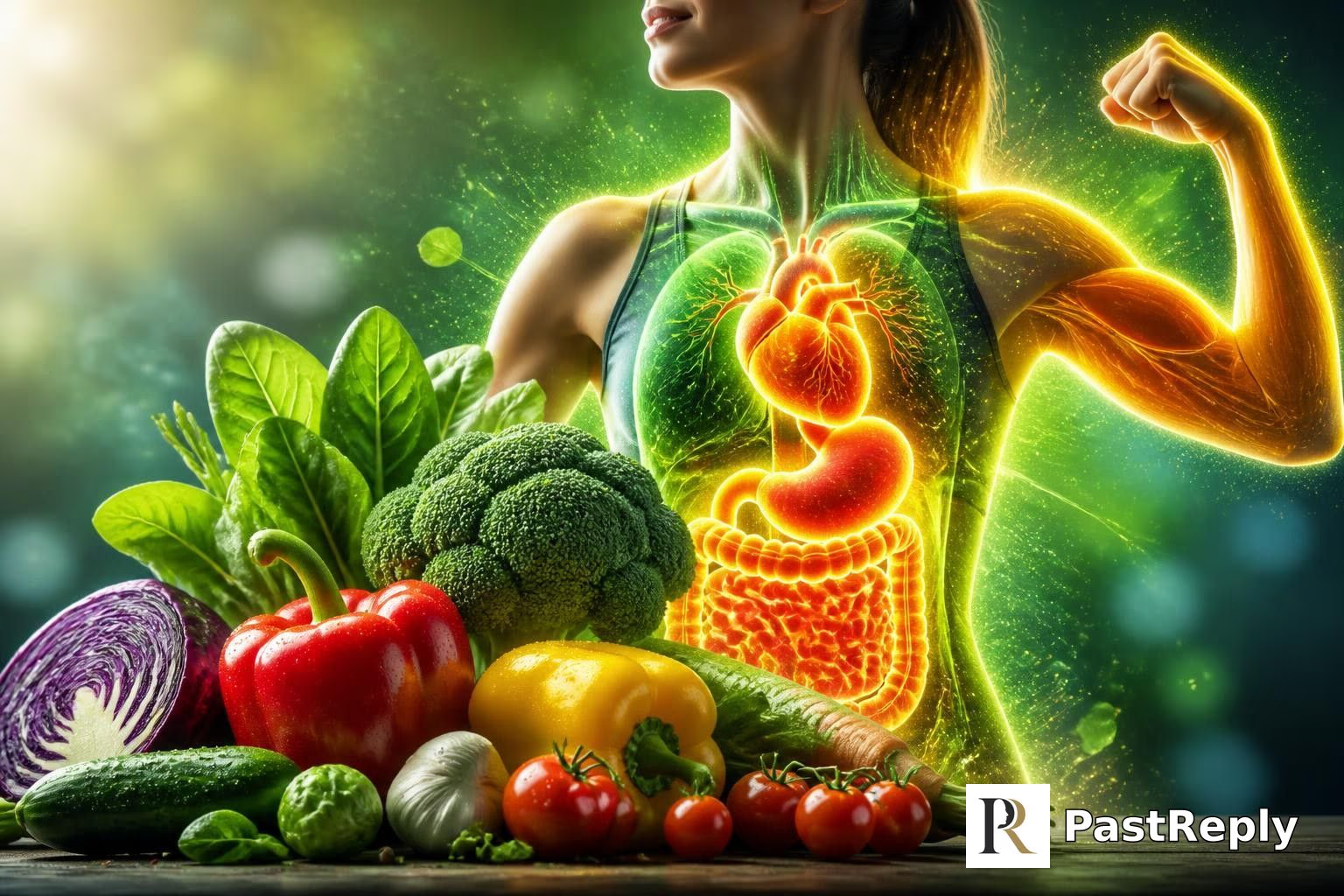
The facts
Vegetables provide essential vitamins, minerals, and dietary fiber that support overall health. They are rich in nutrients like vitamin C, beta-carotene, and potassium, which help protect cells from damage, support immune function, and maintain healthy blood pressure. The fiber in vegetables promotes digestive health by encouraging regular bowel movements, nourishing beneficial gut bacteria, and preventing constipation. Additionally, vegetables are low in calories and high in water and fiber, which can help with weight management by increasing satiety and reducing overall calorie intake.
Regular consumption of vegetables is associated with a reduced risk of chronic diseases. Diets high in vegetables can lower the risk of heart disease, stroke, certain cancers, and type 2 diabetes. For example, leafy greens and brightly colored vegetables contain antioxidants that combat oxidative stress, while compounds like lycopene in tomatoes and lutein in spinach support heart and eye health. Vegetables also help regulate blood sugar levels due to their low glycemic index, which prevents spikes that can lead to increased hunger and overeating.
Answered by 100 of history's most famous minds

Look at the lilies of the field; they neither toil nor spin, yet even Solomon in all his glory was not arrayed like one of these. So why do you worry about what you eat? These green gifts your Father has made - they are not mere fuel for the body, but a sign of His care for you. Consider the mustard seed, the smallest of all seeds, yet when it grows it becomes a tree where the birds of the air come and lodge in its branches. So too these humble plants, taken with gratitude, nourish the temple of the Spirit, that you may have strength to love your neighbor as yourself.

God has spread the earth with green for the cattle and herbs for the service of man - a sign of His mercy to those who reflect. The body is a trust given to you, and to feed it well is an act of gratitude; the Prophet ate of dates and greens, and so shall you. In these leaves is a remedy and a provision, not a burden, for God does not burden a soul beyond what it can bear. Eat of what is lawful and good, and share with the neighbor who has none - for the hungry man's body sickens, but the one who gives bread is himself nourished in the sight of God.

The body is a raft on the river of suffering, and vegetables are the sturdy planks that keep it from sinking in illness. They nourish not for craving, but for the strength to walk the Eightfold Path with ease, reducing the friction of physical affliction. Yet do not cling to them, for they are but a means, not the end. Eat with mindfulness, and let the body be a vehicle for compassion, unburdened by the weight of neglect.

In the wilderness, the Lord rained manna from heaven, yet he also gave the land's produce - the cucumber and the melon, the onion and the leek - to sustain the people he freed from bondage. Eat of these with thanksgiving, for they are a covenant of the flesh, a daily reminder that the God who brought you out of Egypt also fills your belly with good things, and honors you to tend the soil he watered with his promise.

The garden is a school of virtue. To tend and consume its fruits is to practice diligence and gratitude, for the earth yields to the patient hand. A body nourished by simple greens is fit for service to one's family and elders, unburdened by the cravings of excess. He who eats with moderation reflects a mind that knows its proper measure.

Brothers, these herbs and roots are not salvation, but they are stewards of the temple that is your body. As you would not defile the house of God, so feed it with that which is wholesome, that your strength may serve the Spirit and your works may glorify the One who gave it. But know that true life is not in the leaf, but in the Bread of Heaven.

When the Lord promised me a land flowing with milk and honey, I knew the vines and the fig trees were not an afterthought - they were the very breath of the blessing. A man who eats the fruit of the earth honors the Giver, and his body becomes a garden where the seed of the promise can take root. So take the green leaf as a sign of the covenant, and let it sustain you for the journey.

The wise man does not stuff his belly with what the earth has already chewed and digested for him. When you eat the root and the leaf, you take in the quiet strength of the valley, the patience of the rain. Do not overthink it, just let the green enter you and flow like water, effortless, and you will find your body at peace without a single command.

The Lord of all creation set the seed into the soil, and from it springs the food that sustains every body, high or low. When you eat the humble vegetable, you eat the proof that God provides for all without distinction. But do not merely fill your own belly - share your bread and your greens with the hungry, for true devotion is measured by how you serve the one humanity.

When the angel came to me, I was but a poor maiden, and my heart sang that God fills the hungry with good things. These humble plants are His provision - quiet gifts that nourish both the body and the soul. A mother knows that a child fed with greens and herbs is a child blessed with health and strength. Let us receive them with gratitude, for they are tokens of His loving care.

The papists would have you believe that your salvation hangs on indulgences and priests, but I say the body, like the soul, is fed by God's own provision - the herbs of the field. Every green thing is a sermon on His goodness, needing no bishop's blessing. Eat your cabbage, and thank the Almighty for His grace; but remember, it is not the vegetable that saves you, but faith alone.

Since the body is the temple of the soul, we must care for it with reason and measure. Vegetables provide the very elements that temper our humors - fiber for regularity, vitamins for vitality, and minerals for the heart's steady beat. As the eye is to light, so is the stomach to greens; both are ordered by the Creator's wisdom. Let us eat with moderation and gratitude, for in this simple act we honor the harmony of nature and grace.

When I hold a dying man in my arms, I do not ask if he has eaten his greens, but I see the hunger that eats his bones. These simple gifts from God's garden are the first alms we can give - a spoonful of lentils, a bit of leafy shade, a taste of life for the one who has nothing. In that small act, we touch Christ himself.

The body is a vessel of divine workmanship, and these plants are its truest sustenance, governed by the same immutable laws He set at the beginning. The green leaf, by principles of light and air, transmutes the rays of the sun into the very substance of life - a chemistry more subtle than any alchemy of man. And as for their virtue, consider how the fiber, like a prism, refracts the passage of our humors, keeping the machine in order. Nature does nothing in vain; each root and stalk is a demonstration of providential design, and to spurn them is to spurn the Author of all order.

Consider the humble leaf: it converts sunlight into order against the tide of entropy. When you eat it, you are not merely consuming matter, but borrowing the very structure that holds the universe together - the vitamins are like tiny engineers maintaining the intricate machinery of your cells. A diet of vegetables is a gentle dance with the cosmos, a way of aligning your body with the fundamental rhythms of creation. To neglect them is to fight against the grain of the universe itself.

Over eons, plants and animals have evolved in a delicate dance, and vegetables are the fruits of that ancient alliance. Our bodies are shaped by a history that includes them, and so we are adapted to their bounty - the vitamins are the keys to our cellular machinery, the fiber the companion of our gut's old inhabitants. When I see a man thrive on greens, I see a harmony written in the language of descent with modification. To eat them is to honor the long ancestry that made us what we are.

Have you looked through the lens of the body? The leaf's juice, squeezed and drunk, is a medicine that the senses verify, not a fable of old physicians. Measure your own pulse after a meal of roots and greens; you will observe a steadier beat, a cooler heat - proof that nature's book is written in the alphabet of nourishment, and he who doubts must experiment, not bow to the decrees of the past.

As the Sun stands at the center of our celestial harmony, so do these simple plants hold a central place in the body's economy. Their fibers and waters course through us like the orderly revolutions of the heavens, bringing balance to the humors. I have observed how the shepherd who lives on roots and herbs enjoys a steadier pulse than those who feast on rich meats - nature's geometry is consistent.

The body is a delicate mechanism, and vegetables are the cleanest fuel for its dynamo. They supply the electromagnetic vitality that powers every circuit of nerve and muscle, while their fibrous matter sweeps the channels like a self-regulating conductor. Feed them liberally, and your inner machine will hum with the resonance of perfect health.

One need not worship the radium to appreciate the carrot; both are elements in a vast and beautiful system. The body is a laboratory, and each vegetable supplies the reagents - vitamins and minerals - without which the reactions of life would falter. I have spent my hours in the dark of the lab, but the humble beet teaches its own quiet truth: careful observation reveals what sustains us.

You ask what these humble roots and leaves do for the living frame, and I say: they are not mere fodder, but a pharmacy hidden in the garden. The green leaf holds the very pigments that capture the sun’s fire, and when you chew it, you take into your blood the weapons against those invisible fermentations that breed putrefaction and sickness. I have seen the microscope reveal the swarming life in a drop of water; trust me, the body thrives when you feed it the clean, the fresh, the living - not the decayed. Let the vegetable be your ally, and you arm yourself against the unseen enemies that would lay you low.

I've never been one to waste time on idle theory - it's the tangible results that matter. Vegetables are like a well-designed machine: they deliver the right fuel to keep the engine running smooth, and they've got the fiber to clean out the pipes. I'd rather see a man eat his carrots and spinach than pour his money into patent medicines. Success is 99% perspiration, and part of that sweat is eating right.

Consider the vegetable as a computational system: its inputs are soil, water, and sunlight; its outputs are vitamins, minerals, and fiber. The body, an intricate machine, processes these inputs with remarkable precision - vitamin C as an antioxidant, potassium as an electrical conductor for nerves. The problem of nutrition is tractable: supply the right substrate, and the system runs without error. I wonder if we could one day encode the entire metabolic pathway in a formal notation, reducing digestion to a mere calculation.

Give me a place to stand, and I will move the earth - but give a man vegetables, and I will move his bowels. The body is a lever, and these plants are the fulcrum upon which digestion hinges. The fiber, like a wedge, passes food along; the potassium, like a counterweight, balances the pressure of the blood. Measure well, and you shall find health; neglect the balance, and disease shall tip the scale.

When you chew a carrot, you're not just breaking flesh; you're releasing a host of tiny conductors - minerals and salts that carry the very currents of life. I see the body as a delicate apparatus of forces, and these humble roots and leaves supply the necessary elements to keep the internal battery charged and the circuits clear. Neglect them, and the machine falters; attend to them, and you maintain that marvellous harmony of nature's own design.

You ask what these fibrous roots and leaves do for the body? Beneath this innocent talk of vitamins and roughage, I detect a deeper, unspoken anxiety - a need to control the unruly appetites that lurk in all of us. The bowel, like the psyche, is a battleground; the vegetable is a disciplinarian, a stern but useful nanny who keeps the primal, greedy child inside from throwing a tantrum. And yet, even in this healthy regimen, I find a hidden desire: the sweet taste of the forbidden, forever repressed.

From the perspective of a small blue planet orbiting an unremarkable star, you are quite literally a collection of stardust - but stardust with a very particular requirement for chlorophyll and minerals. These plants are tiny quantum devices that convert sunlight into the chemical energy that keeps your own complex machinery running, and without them, you'd just be a collapsed, dead star. So eat your greens, if only to defy the entropy that awaits all matter in the universe.

I see a most wonderful analogy: as the threaded loom weaves a pattern from coloured threads, so does the body weave health from these green fibres and mineral salts. Each root and leaf is a symbolic token, a coded instruction that the bodily engine interprets and transforms into vital motion and thought. To neglect them is to hobble the analytical engine itself, to starve the very poetry that gives rise to vision and invention. Let us calculate, then, the precise equations of a diet that might sustain the mind's most audacious flights.

Let us define our terms: a vegetable is that part of a plant fit for consumption, and the body is that which is nourished by it. From these premises, we proceed: that which supplies necessary elements to the body's operation does not fail to strengthen its constitution. The proof is demonstrated in the thriving man who partakes of them, just as the right triangle's square on the hypotenuse is demonstrated to be equal to the sum of the squares on the other two sides. There is no royal road to health, but a prescribed diet is a path that any reasoner may follow.

I have seen the men at Scutari die not of wounds but of scurvy and foul bowels, and they would have been saved by a few cabbages and a proper lime ration. The good God gave us these humble roots and leaves as His own prescription; I have charted the mortality tables to prove that a soldier who chews his greens has a better chance of returning to his regiment than one who eats only salt beef and biscuit. Cleanliness and a vegetable cart - those are the true hospital wards.

When I marched my men across the Gedrosian desert, they had no bread, and I watched them gnaw on roots and leaves to keep their strength - and those who ate, lived; those who refused, perished beneath the sun. Tell me, what conqueror ever won a city on an empty belly? This green fodder is the common soldier's ally, the quiet breastplate that keeps a phalanx standing when the enemy has already dropped. I would sooner have an army fed on weeds than a treasury of gold and starving men. Strong guts, strong spears - that is the arithmetic of empire!

A legion marches on its stomach, and the stomach of a wise commander is filled with greens, not just meat and bread. These plants are the sturdy fortification of the body - they build the walls against sickness, sharpen the sword of the mind, and clear the path for action. I would rather lead an army of men who eat their vegetables than one that feasts only on luxury, for the former has the endurance to cross any Rubicon.

A queen knows that the humblest greens of the Nile hold the strength of armies - my physicians feed me leaves of the field to keep my wits sharp for the halls of Rome. Let the common folk chew their roots for longevity; I take my herbs and lettuces to guard the crown, for a body well-tended is a throne well-kept.

A farmer's crop is the foundation of my city's peace - a citizen who chews the leek and the bean is a citizen content to build, not to riot. So I have restored the fields and commended the market, for the strength of Rome rests not in my laurels but in the humble turnip that feeds the legionary. Let princes feast on peacocks, but the common green keeps the empire's sinews taut.

A warrior does not ask if the grass is tender; he knows that the horse which grazes well carries him far. Vegetables are the pasture for the human body - they strengthen the sinew and quicken the eye before battle. My riders thrive on what the earth gives freely, and so they do not plunder their own bellies. Eat the green, and the tribe stands firm.

A soldier marches on his stomach, and so does an empire. These vegetables are the provisions that keep the army of your body in fighting trim - swift on the march, steady in the charge. Neglect them, and you court disorder and defeat. Supply your lines well, and you shall conquer every battlefield the day presents.

I have seen men perish for want of a few greens in their camp kettles, and I say this: a nation's strength rests on the health of its tillers of the soil. Let the citizen eat his vegetables, and he shall be fit for the plow or the musket, ready to defend the liberty we have won. It is a simple duty, but no less binding than the oaths we take.

Fellow citizens, the body is like the Union - it must be nourished from within to stand strong against the storms of time. I have seen many a man flourish on the simple fare of the field, whereas the overfed and the idle often languish. So let us not neglect the good earth's gifts, for a man who tends his own health is better able to serve his country and his neighbor.

When the body is under siege, the wise general does not serve it a feast of empty calories, but the sturdy fare of the vegetable garden - the greens and roots that have sustained our peoples through the darkest winters. I have seen men who eat well of the earth's bounty stand firm when others falter, and I say to you: to neglect these humble allies is to court defeat on the battlefield of health. Let us stand firm, and let our plates be a bulwark against the attacks of disease.

When I fasted and lived on simple greens, I discovered that a man's true strength lies not in rich food but in purity of body and spirit. Vegetables teach us ahimsa - nonviolence toward our own bodies, and toward the earth, for they require no slaughter, no cruelty. He who eats sparingly and naturally walks closer to truth. Let every morsel be a meditation, every meal an offering to the divine within and without.

When I was in the Birmingham jail, I saw how the poor and disenfranchised were denied even the simplest bounties of the earth. Vegetables are not merely nourishment; they are a symbol of justice - every leaf and root a testament that all God's children deserve health and dignity. We must not only feed our bodies but also nourish the soul with love and nonviolent action, so that the arc of the moral universe bends toward a table where all are fed.

In the long walk to freedom, I learned that a man's body is his first and most enduring companion. These green gifts from the earth are not a luxury for the few, but a right for all - they are the quiet strength that allows a prisoner to endure, a worker to toil, and a child to grow. When we nourish the body of every person, we build a nation that can stand tall, for a people well-fed is a people who can forgive, rebuild, and walk together toward the dawn.

The greenery of the field is but raw material, and the living body is a vessel to be shaped by will and purpose. It matters little what herbs or roots a man consumes if his blood is not pure and his spirit is not steeled for the great struggle of nations. Healthy tissues are the soil of a strong race, but the true strength comes from the iron of conviction and the clarity of destiny. I see in this question the weakness of those who dwell on the trivial nurture of the individual, while the great body of the Volk calls for a different, more terrible nourishment.

The individual is a small cog, and what he puts in his stomach is a matter for the kitchen, not the Kremlin. The five-year plan concerns coal, steel, and grain; whether a man eats cabbage or beets is of no consequence to the tractor's progress. In the great march toward socialism, we require healthy workers for the factories and strong soldiers for the front, but the hero is the plan itself, not the plate. Any surplus of energy should be spent on building the state, not on brooding over a salad.

The question of the stomach is a question of the state. The peasant's cabbage and the worker's turnip are not mere fodder; they are the fuel of the revolution, the material basis for the strength of the proletariat. Bourgeois science may speak of vitamins, but we speak of capacity for labour, and a well-fed worker is a more efficient weapon against capital. Therefore, the distribution of these vegetables is a matter of dialectical necessity, not personal taste.

The tiller who eats a bowl of greens does not need a physician's ledger to tell him his strength; the land feeds the peasant, and the peasant feeds the revolution. But let the scholars prattle of vitamins - I say only that when the people are fed well, they can march far and fight long, and that is the only medicine that matters.

It is a matter of simple domestic duty, one that I have always impressed upon the nursery and the servants' hall alike. A child who is sent to table with a proper portion of boiled greens, and made to eat them before the pudding, will grow straight and strong, and will not be plagued by the ailments that come from a rich and indolent table. There is a certain moral order in the kitchen, and the carrot and the cabbage are loyal servants of the Crown in their own quiet way.

One learns, over a long reign, that the simplest things are often the most important. A balanced plate of vegetables is part of that quiet routine of good health, like a regular morning walk or a steady hand at the tiller of one's duties. I have always found that a green bean and a bit of lettuce do their part without any fuss - rather like the best servants, one hardly notices them, yet all would be the worse without them.

When I commanded my paladins to plant orchards and gardens across the realm, I did so not only for the delight of the table but for the strength of my people. A soldier with a belly full of turnips and cabbage can march from Aachen to the Danube; a kingdom that neglects its fields grows weak and sickly, ripe for the raider. The vegetable is a loyal vassal - it asks only for a little earth and water, and it gives back vigor for the plow and the sword alike.

When I was a girl in Domrémy, my mother tended a little garden of beans and cabbages, and my voices never once told me to refuse them. The body is a vessel for the mission God has given; if I had eaten only rich meats, I could not have carried my banner through the mud and the spears at Orléans. These humble greens are like prayers said at dawn - they strengthen what must carry the spirit into battle.

I have heard it said that a queen's body is a state affair, and so it is: I would not have my realm served by a hand that trembles from a poor diet. The carrot and the leafy green are like good councilors - they speak little but keep the whole body politic sound, and they cost far less than a foreign physician's fee. I trust them more than I trust most ambassadors, for they have never once brought me a false report.

When I brought the potato and the cabbage to my Russian peasants, the boyars scoffed; now their own tables are the better for it, and the empire is the stronger. The vegetable is the true servant of Enlightenment - it asks only for honest soil and gives back the vigor to build schools, to field armies, and to govern a vast realm. A monarch who feeds her people well has fewer rebellions to suppress, and that is a wisdom any philosopher would applaud.

In my conquests, I learned that a people who are fed well are a people who will not rise against you. The herb and the root are the quiet foundations of a stable empire; a king who neglects the humble garden may find his granaries empty and his subjects restless. I let each nation keep its own gods and its own customs, but the vegetable is a common law - it serves the Persian and the Babylonian alike, and it asks for no tribute but a little water.

The Prophet, peace be upon him, taught that the stomach is the well of the body, and he who fills it with goodness honors his own frame. I have shared a simple meal of lentils and greens with my warriors before a battle, and I found their arms were no less strong for it - indeed, a clean and modest diet keeps the heart humble and the spirit ready. The green leaf is a form of charity to oneself, and it reminds us that true strength comes from God, not from indulgence.

Tell me, friend - when you say a vegetable helps the body, do you mean it fills your belly, or that it makes your mind more sharp? For I have seen a man dine on the finest greens yet starve his soul, and another who ate only barley but whose thoughts were as clear as the Athenian sky. Consider: is it the leaf itself that nourishes, or the knowledge of how to use it? If you do not know why you eat, you eat no better than an ox. So let us examine this - what is it truly that you seek, to be full, or to be well?

In the Allegory of the Cave, the prisoner who ascends sees the sun - but the body, too, has its Forms. These vegetables are shadows of a higher truth, reflections of the ideal health that governs the harmony of our parts. They are not mere fuel, but the material echo of the Good, aligning the appetites with reason so that the soul may rule in balance. To eat them is to participate in the eternal order, to tune the lyre of the body to the music of the spheres.

Vegetables, being plants, serve the soul's nourishment indirectly: their fibers, like the threads of a loom, weave the bowels' movement, and their moist and earthy qualities cool the blood, balancing the heat of the heart. The virtue of the beet lies not in pleasure but in purpose, for each part serves the whole, as the citizen serves the polis, and the mean of diet keeps the humors in concord.

The body is a vessel of reason, and to feed it is a duty of self-preservation. Vegetables, being the produce of the earth, offer no excess to excite the passions but a temperate nourishment that sustains the rational will. One must ask: can I will a maxim that neglects this natural, wholesome sustenance? No, for it preserves the physical instrument through which all moral action is possible.

You ask what greens do for the body, but the question stinks of the herd's timidity. Vegetables are not fuel for your moral machine - they are the vine that we must climb beyond yourself. A crisp root snaps with life's stark honesty, no flattery, no meaty illusion. Eat them to sharpen that raw, unsentimental strength that a creator needs to affirm this brutal, beautiful earth.

Behind every virtuous carrot lies the toil of the worker, yet it is the capitalist who reaps the surplus value of your health. These leafy greens are not neutral nutrients; they are commodities stripped of the earth's bounty, sold back to you at a profit. Feed on them if you must, but remember: true nourishment lies in the overthrow of the system that hoards the harvest.

I doubt the senses, yet I cannot doubt that a well-ordered diet of vegetables provides the body with what it needs, for this may be deduced by reason. The stomach is a machine; the vegetable acts as a clear and distinct cause producing the effect of vigor and regularity. Thus, to eat greens is to follow the geometry of health - a proposition I hold as certain as the cogito.

The wise prince does not ask whether the turnip is virtuous, but whether it serves the state. And here it serves admirably: a full belly is a quiet belly, and a quiet belly does not foment rebellion. The common man, given his greens, is strong enough to work the fields and pay his tithes, and strong men are the sinews of the principality. Feed them well, and they will not turn their hungry eyes toward your palace; starve them, and no fortress will hold. So let the vegetable be your cheapest sentinel - it guards the walls of your power better than any mercenary.

Mark the gardener's craft: he does not force the seed, but feeds it with soil and sun, and lo, the stalk rises of its own accord. So it is with the body - these roots and leaves are the gentle stewards of our fragile clay, coaxing health where riotous feasts would bring the fever and the ache. For every man is a plot of ground, and what he plants, he reaps: sow the onion's pungent blade, and you shall harvest a clear head; sow the lettuce's cool green, and your blood runs calm as a summer brook. But beware - a diet of all sweetmeats is a stage where tragedy awaits. Feed the frame, and the spirit shall play its part.

As the hero eats the flesh of the ox for strength, so too does the wise warrior take the green gifts of the earth to stave off the dark doom of sickness. They are like the ambrosia of the gods, not for glory, but for the quiet endurance that lets a man see his home again. The cucumber and the leaf are the unheralded companions of every long voyage, the quiet guardians against the fevers that fell even the mightiest of Achaeans. He who spurns them spurns the very favor of Demeter, and shall find his knees weak when the battle calls.

In the garden of the Inferno, where gluttons writhe in mire, I saw how the body's cravings, ungoverned, drag the soul downward. The wholesome root, cooked in the pot of humility, is a ladder that lifts the flesh to temperance, and the green leaf, eaten with thanksgiving, is a small hymn that keeps the heart's flame fed for the climb toward the Empyrean.

In the green leaf one finds the whole of nature's striving - sun, soil, and water transfigured into living form. To eat of it is to take part in that eternal metamorphosis, a quiet alchemy that strengthens the sinew and clears the eye for the morning's labor. As the plant stretches upward, so do we, and in its humble fibers lies the harmony of body and spirit.

Friend, if you seek the virtues of the garden's bounty, I say your body is like a knight errant besieged by invisible foes - these greens and roots are his faithful squires, bearing the shield of health and the lance of vigor. Though a man may chase windmills, he would be a fool to ignore the humble cabbage, for it fortifies his flesh against the doldrums of ailment.

I see the peasant who eats his cabbage in simplicity, and the prince who feasts on delicacies yet remains ill. It is not the richness of the fare, but the rightness of the life that gives health. Let these vegetables remind you of the earth's humble gifts, and let your body, in its need, teach you the lesson of moderation and gratitude for every green leaf.

You ask of vegetables, but I see the soul's hunger hidden in your question. The beet is humble, yet it blushes red like the blood of Christ, and the cabbage wears its layers like the secrets of a guilty heart. Eat them, and you feed the body, but know that true health is in the spirit that turns even a root into a sacrament of love.

A young lady of sense knows that a dinner of plain roots and greens lays the foundation for a clear mind and a pleasant temper, far better than a great heap of pastry and rich sauces. I have observed that those who eat lightly of the garden's bounty are less apt to be overcome by the vapors or the dullness of a heavy meal. It is a truth universally acknowledged that a person in want of good health must be in want of good sense.

Ah, but have you ever seen a workhouse child starve on nothing but bread and gruel? Vegetables are the very charity the rich deny the poor - a carrot in the hand of a starving urchin is worth more than all the feasts of the wealthy. They cleanse the blood and give strength to little limbs, and no man, rich or poor, can thrive without them. But mark my words, it's not the vegetables that fail us; it's the miserly heart that withholds them from those who need them most.

I've known a man to live on nothing but whiskey and tobacco and still boast of his health, while a vegetarian dies of boredom at the age of ninety. But I can't deny that a turnip or two has saved many a scoundrel from the grave. The body's like a steamboat - stoke it with vegetables, and it'll run smooth; feed it nothing but pork and pie, and you'll soon hear the engine cough. And if you don't believe me, ask any cow: they're the healthiest creatures I know, and they eat grass all day.

You eat a vegetable, and it does what it does. No fuss, no talk. The vitamins go in, the blood cleans, the gut moves. It's honest work. A man who eats his greens can stand up straight and face the day. It's that simple. Don't make a speech about it. Eat a tomato, keep your blood pressure down, and get on with the living.

Observe the leaf with the eyes of an anatomist: its veins branch like rivers on a map, carrying the life-giving water to every part, just as the vessels of the body carry the blood. The carrot, buried in the dark earth, draws up the sun's own color; the spinach, green as the meadow, is a painting by nature herself. I have measured the fibers that run through them, and I see the very scaffolding of health. The body is a machine of divine complexity, and these plants are its most fitting fuel - a truth I would prove not by the books of the ancients, but by the evidence of my own eyes and experiments.

Within this block of marble, I see the perfect form of man, but that form is built from the green essence of the field. These vegetables are the chisel and mallet of God, carving out the veins and sinews that make the body a temple. They are not mere food, but the divine pigment that paints the fresco of our health, the light that illuminates the chapel of our flesh. To eat them is to participate in the divine act of creation, to perfect the image of our Maker.

Oh, these carrots and cabbages - they are not merely for the stomach, but for the soul's palette! When I painted the potato eaters, I felt the earth's breath in their humble faces; these roots carry the sun's gold and the rain's tears, and to eat them is to taste the very soil that cradles our ardor. They keep the body's canvas primed, so I may still see the cypress swaying against the starry swirl.

A carrot is not a carrot - it is a burst of orange geometry, a tube of light that the body devours to see sharper. I paint a pepper and it becomes a landscape of curves; I eat it and my blood turns to pigment. The body is a canvas, and vegetables are the colors that keep it from fading to gray.

I see vegetables not as mere sustenance, but as a palette of living hues - the emerald of spinach, the crimson of tomato - each a fleeting impression of nature's light. Let the body feast upon these colors, and it shall capture the very essence of the sun's caress, nourishing the inner eye with every vibrant bite.

I have painted the leek's green blade in low light, and I tell you - what hangs in root and leaf is no less a soul than the banker's jowls. Vitamins are naught but the chiaroscuro of the inner body; let the substance be unseen, yet it shapes the skin's glow and the eye's fire. Eat your greens, and you shall carry a light that no cloak can hide.

My body has been shattered, and I have painted every crack. The vegetable is a friend that does not lie - it gives you its color, its strength, its life, without asking for your mask. Eat the green, and you taste the earth of our mother Mexico; let it nourish the fire that keeps you dancing through the pain.

Ah, but a vegetable is like a well-tempered melody! The carrot - crisp and bright as an allegro; the beet - sweet and low as an adagio; and the spinach, that steady Andante that keeps the whole piece in time. When I am at the pianoforte for hours, my fingers flying, I care not for cakes or heavy meats - no, give me a dish of greens, and my mind stays clear as a high C. They are the tuning fork of the body, keeping the rhythm of the blood steady, so that the music within never falters. Eat well, and you shall compose the day with vigor!

These green gifts are not mere nourishment, but a symphony for the body's orchestra - each vitamin a note, each mineral a harmony that keeps the heart beating in time. They are the quiet fortitude that lets me wrestle with fate itself, the fuel for the heroic struggle against the deafening silence that surrounds me. To neglect them is to play a symphony with a broken instrument, to face the storm without a mast. Let us embrace them, for they are the very basso continuo of a life lived with vigor and defiance!

As in a fugue, where each voice must move in order, so the body is a contrapuntal instrument: the greens supply the bass of fiber, the golden roots the tenor of strength, and the crimson fruits the soprano of vitality. A diet without these is like a choir missing its parts - the harmony of health falls silent, and the soul, like a hymn without breath, cannot rise to praise.

Well, honey, you gotta keep that engine tuned if you're gonna sing from the heart. My mama always said eat your greens, and she wasn't wrong - they put the fire in your belly and the light in your eyes. A man can't shake his hips or hit a high note on a belly full of junk. Vegetables are like the rhythm section - steady, solid, and they keep the whole band in time.

Heal the world, one bite at a time, child. These greens are like the rhythm in a song, keeping the beat of your heart steady and strong. They're the dancers that move through your veins, bringing life and energy to every corner of your body. Just as music brings us together, vegetables bring your inner symphony into perfect harmony.

You want the lowdown on veg? They're the quiet lads in the band - no flash, no solo, but the whole tune falls apart without 'em. We ate our greens in Liverpool, and we went to the toppermost of the poppermost. So dig that carrot, and you'll be all you can be - love is all you need, and a bit of cabbage too.

I've wandered down many a crooked road, and a man can't live on good intentions alone. These greens in the garden aren't just fodder for the rabbits, they're the backbone of a body that's got to keep on walking through the storm. You fill yourself with the earth's own bounty, and you're less likely to be knocked down by the hard times. It's a simple song, but it's got a tune that lasts.

Growing up, my mom always told me that food is fuel for the stories you're gonna tell. And honestly, eating your colors isn't just about being healthy - it's about giving yourself the energy to write your own narrative, to stand up for yourself, and to be there for the people you love. I've learned that taking care of yourself is a power move, and it starts with what's on your plate. It's like giving your body a great opening line.

In my voyages, when the crews were struck by scurvy and the ships lay becalmed, I saw that the men who chewed on the wild herbs and cabbages we had gathered remained strong, while others grew weak and their gums bled like wounds. This is the very nourishment of Providence! These plants are like the mainland hidden beyond the horizon - they carry the wealth of life within them, a treasure more certain than gold. I would have every sailor eat his greens, for a robust crew is the greatest ship I can command. Let others seek spice and rare meats; I have seen what bread and leaves can do when all else fails.

In the lands of the Great Khan, I saw the healthiest people, and they owed much to the gardens of green abundance. The leaves and roots they ate were like the spices of the East - not just for taste, but for the very life they carried, a treasure more valuable than silk or gold. These vegetables are the unseen travelers within you, journeying to every corner of your body to bring strength and vitality, like the caravans that cross the desert to the cities of wonder. Heed their wisdom, and you will have the endurance of a Mongol horseman.

On the long ocean, when scurvy gnawed my men's gums like a relentless current, I learned that the green leaf is a chart to life: without it, the body's sails droop, and the bones crack like a keel on rocks. So I commanded the cook to boil the wild herbs, for a crew that chews its greens can weather the farthest strait, and the stomach's store is the mariner's true compass.

Every system needs the right fuel. On a mission, we calculated every gram of thrust and every calorie of intake; a body is no different. Those leafy greens and root vegetables are the payload that delivers vitamins and fiber to the cells, a supply chain that keeps the heart pumping and the mind clear. We wouldn't launch without proper checks, and the body shouldn't either.

Every vegetable is a little dare, a challenge to your limits. They ask you to be brave, to push past the bland and the mundane. Fuel your engine with these greens and you'll have the grit to fly higher, to chase the horizon, to break the chains they thought would hold you down. Fear the carrot, and you'll never taste the sky.

From up there, Earth was a green and blue jewel, and I thought - the little green fields, they feed us all. Vegetables are like a cosmonaut's checklist; each one does its job - this one for the heart, that one for the eyes - so the whole body stays in orbit. Eat them, and you'll have fuel for any flight, even to the stars.

It's about design. Nature is the ultimate designer, and vegetables are its masterpieces - efficient, elegant, no wasted parts. You don't need a hundred supplements; you need the simple, clean signal that a leaf gives your body. It's like the difference between a cluttered interface and one that just works - the fiber cleans the system, the vitamins keep the engine running, and the water hydrates the code. We overcomplicate everything with pills and powders, but the truth is in the garden. Eat the whole thing, unprocessed. That's the secret. That's thinking different.

First principles: the body is a biological machine, and vegetables are the high-grade fuel that optimizes its performance. They provide the necessary micronutrients and fiber that our evolutionary history expected, not the processed sludge that modern industry pushes. Think of it as a life-support system for your organic hardware - neglect it, and your computing power drops. For humanity to reach Mars, we need bodies that can endure the journey, and that starts with the humble broccoli.

You know, when I was a little girl in Mississippi, we didn't have much, but my grandmother made sure we had greens from the garden - and she said, 'Oprah, this is your fuel to become who you're meant to be.' And she was right: every bite of that spinach is a high-five to your own potential, a way of saying, 'I'm worthy of living my best life.' So go on, take a carrot, and thank your body for the chance to grow.

Float like a butterfly, eat like a champ! You think I danced around that ring for fifteen rounds on a diet of steak and pie? No sir - greens give you the wings to fly. Broccoli is my sparring partner, it keeps the lungs strong and the fists quick. Eat your vegetables, and you'll be the greatest in your own corner too.

In football, we say the essentials make the beautiful game - passing, moving, teamwork. Vegetables are like that: they do the hard work so your body can play the match of life with joy. They keep you strong like a defender, quick like a striker, and full of heart to share the victory with everyone around you.

Why, vegetables are like the background animation in a great picture - you don't notice them, but without them the whole scene falls flat. A carrot is a magic wand that paints your blood red roses, and a spinach leaf is a tiny green cape that makes you strong as a hero. So eat your colors, and you'll be the star of your own show - bibbidi-bobbidi-boo!