
How do vegetables help you lose weight?
Vegetables aid weight loss by being low in calories and high in fiber and water, which increase fullness and reduce overall calorie intake.
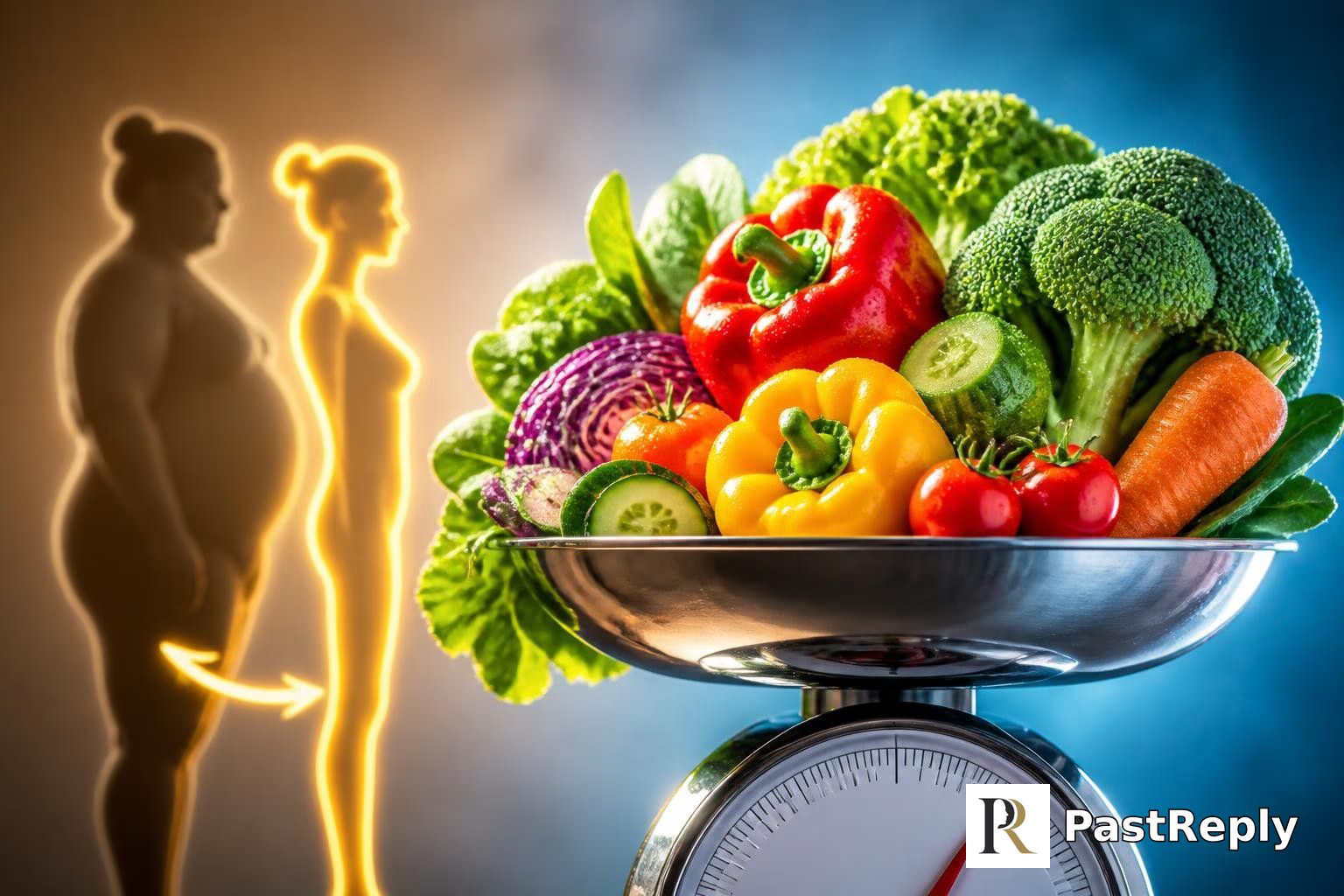
The facts
Vegetables support weight loss primarily because they are low in calories while being high in fiber and water. This combination increases satiety, helping you feel full and satisfied after meals, which can lead to a natural reduction in overall calorie intake. For example, non-starchy vegetables like broccoli, asparagus, and leafy greens provide volume without many calories.
Fiber in vegetables digests slowly, prolonging fullness and stabilizing blood sugar levels, which can curb cravings and prevent overeating. Additionally, replacing higher-calorie foods with vegetables reduces the energy density of your diet, making it easier to maintain a calorie deficit necessary for weight loss.
Some vegetables, such as potatoes, have a high satiety index, meaning they are particularly filling. However, starchy vegetables like peas and potatoes are more calorie-dense than watery ones like cucumbers and lettuce, so weight-loss plans often emphasize non-starchy options. Overall, a diet rich in a variety of vegetables contributes to weight management by promoting fullness and providing essential nutrients with minimal calories.
Answered by 100 of history's most famous minds

The body's hunger, friend, is like a man who begs at the gate - fill his belly with the bread of the field, and he will not steal from your table. These greens and roots the earth gives freely are not a law to be kept, but a mercy to be taken; eat them, and your flesh grows light while your spirit stays full.

The Prophet, peace be upon him, ate barley bread and dates, and said the believer eats in one bowel where the disbeliever eats in seven. These herbs and vegetables are a baraka from the earth - they quench the need without the excess, and a man who fills his belly with them does not lust after the rich dish. Moderation is a path of faith, and the green leaf is its sign.

The craving for rich food is a fire, and vegetables are the cool water that quenches it. Observe how the mind clings to sweetness and fat, and how this clinging breeds heaviness and discontent. The green leaf offers no such attachment; it simply nourishes, without feeding desire. Eat mindfully, and see how the body lightens, and with it, the suffering of the self that grasps.

When the Lord led us from Pharaoh's house, we ate the bitter herbs and the unleavened bread, and our loins were girded for the journey, for the heavy food of Egypt was a yoke upon our necks. The green things that grow from the earth are a sign of His provision, filling the body without making it a slave to its cravings. Eat of the cucumber and the leaf, and you shall find your step light upon the path to the promised land.

A man who governs his own plate has already learned to govern his heart, for the one who cannot moderate the desire for food will scarce moderate the desire for gain or glory. The vegetable, in its plainness, is a fit emblem of the mean between excess and want, its rough fiber teaching patience and its water slaking the base thirst. Cultivate this small discipline with sincerity, and you shall find the greater harmony of your person and your household; for the sage too must anchor his spirit in his belly.

Do you not know that your body is a temple of the Holy Spirit? And what temple is built upon a foundation of rich meats and sweet wines alone? The green herb is given to you for food, to keep your vessel light for the work of the Lord. Screw your courage to the sticking place, eat with thanksgiving, and let the weight of the world fall away as you run the race set before you.

The Lord gave us the green thing of the field for our good, and it is a covenant of the belly. When the promise is to be lean, eat of the earth's bounty, for it fills the wandering stomach without overloading the flock. Trust in the provision of vegetables, and your hunger shall be a stranger to you.

The plump melon ripens in the vine's shadow, and the bamboo shoot rises through the mud without straining. You chase fullness, yet fullness flees; you empty your plate, and the bowl becomes your teacher. To shed the body's burden, do not grasp - let the watercress drift down the stream, and the stream will carry the weight away. The sage eats less, not because the leaf is bitter, but because the hunger is the gate.

The Creator's garden is a table set for all - the rich and the poor, the plump and the lean. But the leaf does not swell the belly with pride; it teaches the hands to work and the heart to share, for the true hunger is not in the stomach but in the soul. Eat the bitter gourd and remember the sweetness of gratitude, for the body is a temple, and the greens are the lamps that light it without burning the oil. The one who chews with humility is lighter than the one who feasts on arrogance.

He fills the hungry with good things, and the rich He sends away empty - so I have sung, and so I have seen. These humble roots and leafy stalks, born of the earth, are His gift to the lowly, sustaining the body without the weight of excess. Eat them with gratitude, as we did in Nazareth, and the belly is quieted, the spirit lightened, and the work of our hands goes forward.

Whether a man eats a turnip or a capon does not weigh a feather on the scales of salvation, but let the body be a temple, not a trough. Our Lord fed five thousand with loaves and fishes, not with delicacies, and He gave us the herb of the field for our need, not for our want. So let him who is heavy eat of the cabbage and the radish, and he will find his belt looser and his prayers less hindered by his flesh.

The vegetable is a creature of the middle realm: it offers substance without excess, and so it accords with reason, which seeks the mean between defect and surfeit. The water and fiber give the stomach the due of fullness, while the few calories do not overtax the natural powers of digestion, nor store up superfluous fat against the body's needs. Thus the prudent man, who eats of the garden's bounty, finds his weight a measure of his temperance.

In the slums of Kolkata, I have seen the poorest eat a single boiled potato and smile, for they know what the rich forget: that hunger is not cured by abundance but by what is given with love. Vegetables are God's small gifts - they fill the hand that reaches for them, and they leave nothing to waste. When you eat them, you are not losing weight; you are losing the want that makes you clutch at more than you need. And that, my child, is a weight that frees the soul.

Consider the leaf as a problem in mechanics: its substance is mostly water, held in fibers, so a pound of it yields but a fraction of the fuel that a pound of grain does. The appetite is a pendulum that swings on bulk, not on heat; fill the stomach with such rarefied matter, and the balance must tip toward less intake, by the very law of bodies.

Imagine a beam of light, weightless, yet it bends under gravity's pull. So too, the humble vegetable bends our appetite: it packs the belly with water and fiber, that slow-burning fuel, yet offers few calories. The secret is not in the leaf but in the geometry of satiety - a full stomach signals the mind, and the mind, freed from craving, chooses less.

It is a curious adaptation: the vegetable, in its humble way, has solved a dilemma that we grappled with for ages. Its abundant water and indigestible fiber occupy the gut, signaling fullness without the yield of energy. Over countless generations, our own bodies have been selected to respond to this bulk. The healthy reduction is but a natural consequence of heeding these ancient, evolved signals.

The evidence is plain before your eyes: a bushel of lettuce weighs no more than a feather, but fill the stomach with it and the belly swells, and the eater feels full without laying on flesh. Measure it, and you will see the truth - the water and fiber are like the celestial spheres, occupying space without adding great mass. The ancient authorities would have you stuff yourself with meats, but I say observe the garden, and you will find the secret of lightness written in the very stars.

Behold the order in the humble turnip: it fills the belly with much substance and little heat, much as my revolving system brings harmony to the heavens with few and simple motions. The watery greens and fibrous roots are nature's own geometry - great volume, scant mass - so that the body, like the celestial spheres, finds a balance pleasing to contemplate. Let the one who seeks a lighter frame study the abundance of the garden, and he shall see the very pattern of the cosmos in the cabbage's leaf, and the flesh must follow.

Consider the humble carrot - a conductor of pure energy, if you will, transmitting nature's electrical charge to the human machine. I have calculated that a man who fuels his bodily dynamo with fibrous roots and water-laden leaves, rather than the heavy hydrocarbons of the table, will hum with a cleaner and more efficient vibration. The body is but an apparatus, and vegetables are the finest lubricant for its gears of life.

The body is a chemistry, and vegetables are the modest reagents that yield satiety without dense energy. A gram of fiber slow-burns like a stable isotope, while water in the leaf adds volume, not fuel. We should measure our meals as we measure our elements - with precision, and the result is a well-tempered form.

The cucumber is a vial of pure water, and the cabbage a lattice of fiber - these are the molecules that swell the gut's chamber and whisper to the brain, 'Enough.' I have measured the broth in the flask and the leaf in the beaker; the body's furnace burns the same whether the fuel be flesh or green. Trust not the fables of the market, but the balance of the scale: a pound of spinach is a pound of restraint.

I've tried a thousand filaments, and the one that works is the one that doesn't burn out too fast. Same with spuds and spinach - the low-calorie ones are the bulbs that keep the furnace going without wasting the current. You don't need to starve, you just need to wire the circuit right: fill the plate with the cheap stuff, the water-heavy greens, and the body does the rest. Persistence is the key - chew, test, repeat. I've seen a man lose a dozen pounds on a diet of celery and grit, and it all comes down to the simple math of not overloading the generator.

The problem is one of energy accounting. The body is a machine that takes in fuel and expends work; the vegetable, being mostly water and cellulose of little caloric content, contributes a negligible credit to the intake side of the ledger while occupying the stomach's capacity, which is a finite register. Fiber, being indigestible to our enzymes, acts as a slow-release mechanism, and the machine is thereby deceived into a state of satisfied quiescence - a rather elegant computational trick, if you will.

Consider the lever: to lift a weight, one needs a firm point of support. The vegetable is that point - it lends the stomach a great volume of bulk, yet is as light as a shadow, so that the body's own fire is not overfed. The water in the stalk and the fiber that resists digestion act as a counterweight, giving a man a full measure of satiety with but a small portion of fuel. Give me a bushel of asparagus and I will move any man's appetite.

Consider the humble turnip: it is mostly water and fiber, which is to say, it carries little of the fire that fuels the body, yet it fills the belly and stays there, gently pressing upon the stomach's walls. The same force that makes a coil of wire resist a changing current - call it inertia - keeps you from reaching for the butcher's pie an hour later. It is not magic; it is the simple economy of nature, where a great bulk of sustenance costs the body little to receive.

You ask of vegetables, but you speak of hunger, and hunger is never about the stomach alone. The urge to fill yourself, to stuff the mouth, to bite and chew - these are echoes of the first oral pleasures, the infant's breast, the mother's warmth. A heap of greens is a meager substitute for that primal satisfaction, yet it serves to quiet the nagging demand of the id, which cries for sweetness and cream. Do not be fooled: the true weight you seek to shed is the guilt of desire itself, and no salad can digest that.

If you want to lose mass, you could always accelerate toward the event horizon of a black hole - though the spaghettification is a bit extreme. Simpler: vegetables have about the same gravity-to-volume ratio as a neutron star's crust, except they actually let you walk away. All joking aside, the universe runs on energy conservation - calories in, calories out - and a head of broccoli is a remarkably efficient way to inflate your volume without inflating your mass. It worked for the dinosaurs, until they met their own extinction-level event at the dinner table.

Think of the vegetable as a machine of elegant design: its water and fiber are like the gears of a steam engine, turning slowly but steadily, keeping the whole system in motion without wasteful bursts of fuel. The body, that most intricate of calculating engines, reads this input and adjusts its ledger - fewer calories in, more time before the next demand. It is a difference engine of satiety, where the quantity of matter is magnified by its quality. And so, the humble carrot performs a computation of fullness that no pill can replicate.

Let us define our terms: a vegetable is a thing, a body with length, breadth, and depth, containing water and fiber, which the stomach receives and holds. From this, it follows - by the axiom that a full vessel cannot admit more - that the eater will be satisfied with less. The proof is in the measure: two pounds of greens weigh as much as one pound of bread, yet the greens yield fewer caloric units, and so the body's account balances in favor of leanness. There is no royal road to this conclusion; it is a theorem of appetite, demonstrated beyond doubt.

Let us weigh the matter with the scales of fact, not the fancies of fashion. The cabbage and the turnip are dense with water and fiber, which fill the gut and delay the pangs of hunger - this is the arithmetic of appetite, as sure as the ledger of a hospital ward. A diet of these greens lowers the energy of the meal without robbing the body of its due, and thus the patient sheds the surplus pounds as naturally as fever breaks. I have seen the sick thrive on broth and greens when the meat was withheld; it is sanitation and order on the plate, and the body responds as a well-run ward does to cleanliness.

Hah! A soldier marches on his belly, but the wise king feeds his army on the field's own bounty - the stalks and shoots that weigh the pack light and keep the limbs swift. I conquered the world on such fare when the granaries failed; let the weak gorge on mutton and bread, I'd rather fill my men on the land's green spoil and outmarch them all.

I conquered Gaul not by starving my legions, but by feeding them well. These greens are like my engineers: they build bulk without burden, filling the soldier's gut so he fights, not feasts. A belly stuffed with cabbage is a belly that will not mutiny for bread. Let them eat their broccoli - it wins the war of the waistline.

When a woman must keep her throne against Roman wolves, she learns the power of a full stomach - a courtier who feasts on greens grows lean and quick-witted, while the one stuffed with goose and honey loses his sharpness. My Alexandrian physicians say the humble lettuce and the cucumber carry more water than the rich man's feast, filling the belly without weighing down the body that must dance, scheme, and command. Weight is but a mirror of appetite, and appetite is a master that can be tamed by the garden's bounty.

Even the mightiest empire must watch its granaries, for a legion that grows fat on pork and bread loses its discipline, while the one fed on the field's produce marches longer and fights sharper. The wise ruler sets the example at his own table, preferring the simple green to the lavish feast, for a lean and hungry Rome is a Rome that can withstand any siege. Take from the earth what it offers freely, and the state, like the body, will remain firm.

A warrior does not ask why the horse eats grass; he knows the steed must be lean to ride far and strike fast. So it is with these plants: they give bulk to the belly but no fat to the flank, and a rider who carries his own weight lightly can cross a thousand li. Gather them from every land you conquer, and feed your host well, for the army that is satisfied with little sustains the horde, and the leader who fills his men without burdens binds them to his standard.

An army marches on its stomach, and a thin soldier is a useful one. My campaigns were won by discipline - the same discipline that tells a man to fill his gut with cabbage rather than butter. Cut the rich sauces, and you cut the weakness from your frame. I would rather command a battalion of lean, hungry men who live on roots than a garrison of soft-bellied gourmands who eat their way to surrender.

The husbandman's table is a lesson in economy: the humble turnip serves his strength without the extravagance of the rich man's feast. To manage one's weight is to manage one's virtue - choose the abundant garden over the heavy storehouse, and your frame shall serve your duty, not your appetite. Moderation in all things, especially the dinner plate.

A man may fill his wagon with stones or with straw; both cover the same ground, but one breaks the axle. The green stalk is the cheap straw that fills the belly without draining the purse of the body's strength. I have seen soldiers march further on a mess of beans and turnips than on the richest roast, for the leaf's bulk is a promise of patience, not of gluttony. Let the body's ledger be balanced by the garden, and the war of appetite is half won.

When the enemy is the bulge, you do not surrender to the sweet biscuit; you dig trenches with the carrot and hold the line with the cabbage. The greens are the Home Guard of the body's battle - they give ground cheaply, but they hold the fortress of health against the siege of indulgence. I have seen a general who ate like a sparrow and commanded like a lion; the leaf is not a retreat, but a tactical withdrawal to a stronger position. Never yield the field, I say, but pack the field with turnips if it means winning the war.

The vegetable is a teacher of restraint, the first lesson in the simple life. It does not excite the palate to greed, nor burden the body with excess, so that the mind stays clear and the heart remains tender to the cries of the starving. When we eat of the earth's gifts lightly and gratefully, we are fed in truth, and we remember that the millions who till the soil deserve a morsel of that same abundance.

The body, like the soul, hungers for what it cannot always name, and so often we fill it with the weight of the world rather than the peace of the field. These green and living gifts, yielded by the earth, speak of a moderation that is not deprivation but liberation - freedom from the tyranny of craving, a discipline that frees the spirit for higher things. When we eat simply, we make room for justice and mercy to grow where the weeds of excess once stood.

In the long walk toward freedom, we learned that a full belly is not a luxury but a foundation - yet the weight we carry is not only of the flesh. Vegetables, like reconciliation, give us the quiet strength of enough: they fill without overwhelming, nourish without burdening. A man who eats his greens may find his step lighter, but the true weight lifted is the habit of excess that chains us to our own appetites. Let us share the basket of plenty, and we shall all rise.

[Analytical response]: Historically, the dictator's dietary habits were idiosyncratic, but the question at hand concerns nutrition, not ideology. Vegetables, being low in caloric density and high in fiber, mechanically distend the gastric walls, triggering satiety signals that reduce total intake. This is a physiological fact independent of any political system - though one must be careful not to overstate the role of any single food group in the complex interplay of energy balance. The broader lesson is that fanaticism, whether in diet or in power, distorts the simple truths of nature.

[Analytical response]: The regime's collective farms did produce vegetables, but the question is one of physiology, not politics. A cucumber, like a good party cadre, takes up space without contributing much substance - it fills the stomach, signals fullness, and yet delivers little caloric fuel. This is a simple matter of materialist science: the body burns more energy processing a stalk of celery than the stalk provides, a net loss that serves the state's plan for a leaner population. One must eat, but one must also be efficient; the vegetable serves both master and man.

[Analytical response]: The bourgeois obsession with slimming is itself a product of surplus, but the material basis is clear: vegetables are the proletariat of the diet - plentiful, cheap, and they do the work of filling the stomach without the luxury caloric load of the ruling class's meats and sweets. The fiber acts as a slow-burning fuel, keeping the body's engine running steadily rather than in explosive bursts that leave one craving more. The question is not whether greens help, but who controls the fields; a people fed on turnips will be a disciplined people, ready for the long march.

The peasant's belly is the first battlefield. These green shoots of the fields are not mere fodder for the idle - they are the weapons of the lean against the fat. When the land yields cucumbers and the folk eat them, they are not filling the pot but emptying the granary of the rich. Let the starchy tuber be the stamp of the landlord's table, while the cabbage is the comrade of the laborer. A full stomach of greens is a fist against the old order; the empty plate of the parasite is our victory.

The matter is one of temperance and discipline, which become a Christian and a sovereign alike. These garden herbs and roots, which our good farmers bring to market, are wholesome and honest fare, filling the belly without the gross indulgence of rich meats and puddings - a lesson our dear Albert taught me in the moderation of our own table. A woman who would keep her figure and her dignity should prefer the asparagus and the green bean to the heavy pastry, for a slender waist befits the grace of the throne and the respectability of our court. Let the nation take example: the virtue of the vegetable is the virtue of restraint.

It is a simple matter of balance and service to one's own health, a duty one owes to family and country. The produce of the earth, in its natural goodness, offers nourishment without excess, and a portion of greens on the plate is a quiet, steadfast friend - much like the constancy expected of us all. One does not dwell on the fashion of slimming, but on the habit of moderation, which keeps the spirit steady and the body able. In the gardens of the palace, the lettuce and the runner bean have always had their place; they remind us that ordinary things, done faithfully, sustain the common good.

By the grace of God, the earth yields these humble gifts for the strengthening of His people, and a wise emperor must see they are not wasted. The cabbage and the turnip, grown in every field of my realm, fill the belly of the plowman and the soldier alike without dulling the spirit or the sword-arm - frugal fare that keeps the host lean and ready. Let the lords of the Church and the counts of the marches encourage the planting of such gardens, for a people nourished on greens are a people of sound body and firm faith. The empty plate is the devil's work; the full bowl of roots is the mark of a well-ordered kingdom.

When I rode to Orléans, I ate the black bread and the leeks the good people brought, for they strengthened my limbs and kept my mind clear to hear the voices of heaven. God's bounty is in the field, and the greens He gives are not for the fattening of the idle but for the vigor of those who fight and pray. A girl who would keep her armor light and her soul pure should take her fill of the garden's produce, for it is humble fare that pleases the Lord and vexes the enemy. The blessed saints did not eat of the rich man's table but of the herbs of the earth, and so shall we.

The wise sovereign knows when to trim the sails, and so too the body - these green leaves and roots are the modest retinue that keeps the state of one's health in good order. I have seen the fops of my court grow heavy on capons and marchpane, while the sturdy yeoman thrives on his pottage and greens, and I know which serves the realm better. A woman who would command must keep her wits sharp, and a light table of vegetables is the surest counsel to that end. Let the ambitious diet on the artichoke; the throne requires a steady hand, not a distended belly.

In the salons of St. Petersburg, we speak of the enlightened mind, but the body too must be governed by reason, and these garden roots are the rational choice for the lady of substance. The cucumber and the beet, fresh from the dacha, fill the stomach with more air than weight, as the philosophers say of the void, and thus the waist remains slender while the intellect feasts. I have commanded my kitchens to serve the green bean and the cabbage in abundance, for a trim figure is the ornament of an empress and a sign of a well-ordered empire. The foolish may chase the rich sauce, but the wise take the plain root and rule.

The king who rules many peoples knows that the humble herb of the field is the ally of the lean and the enemy of the glutted. When my horsemen ride across the plains, they carry the dried pea and the turnip, for such fare keeps them swift on the chase and swift in council, unburdened by the heavy flesh of the overfed. A land that grows good vegetables is a land of contented folk, and a contented belly is the first law of loyalty. Let the governors of every satrapy plant the garden, for a people fed on greens are easier to rule with justice and harder to stir with greed.

Praise be to the Merciful, who has given us the green of the garden to temper the body and the soul, for the wise man does not fill his belly with excess when the poor are hungry. These roots and leaves are a blessing upon the faithful, making the warrior light on his horse and the scholar clear in his study, as the Prophet taught us to eat little and live rightly. When I besieged Jerusalem, my men shared the lentil and the onion and found strength in their simplicity, not in the rich meats of the enemy's camp. Generosity begins at one's own table, and a man who has eaten the humble vegetable can share with his brother and still stand firm.

Tell me, when you eat a cucumber, do you feel less hungry because the cucumber is filling, or because you believe it is? And is it the vegetable that thins your frame, or the knowledge that you could eat three of them for the price of one cake? The belly is a sophist - it argues for more, but the wise man knows the appetite is a question, not a command, and answers it with reason.

Consider the Form of the Meal: it is not the fleeting pleasure of honeyed cakes, but the eternal harmony of the soul's parts, ruled by reason. Vegetables, being plain and unadorned, strip away the deceptive allure of excess, allowing the true nature of nourishment to shine. A man who eats thus orders his appetites under wisdom, achieving the just proportion of a well-governed city within himself.

Consider the final cause of a vegetable: it exists to nourish, yet its nature is to be light, fibrous, and moist, filling the stomach's space without excess of the hot and dense humors that make a man sluggish and heavy. Observe that the lean man thrives on the field's produce, while the glutton who stuffs himself with bread and fat grows torpid. The mean between starvation and surfeit is struck by the salad and the boiled root, which give satiety without excess.

To govern one's appetite is no mere inclination but a duty of self-preservation, for gluttony debases the animal in us and clouds the freedom of rational choice. The vegetable, in its humble fiber and watery bulk, offers a universalizable means: a satiety that obeys no craving, a fullness that respects the moral law within. Will, then, a regimen where every rational being may find content without excess, and you have a maxim fit for all - nourishment without tyranny.

You seek a trick to trim the flesh, yet the deeper hunger is the soul's - its craving for the easy, the sweet, the herd's comfort. The vegetable, that watery nothing, mocks the will with its blandness; to chew it is to declare war on your own sloth and to affirm a new law of your own making. So let the salad be your hammer: each bite a rejection of the drugged palate, a stride toward the Übermensch who shapes his appetite as he shapes his stars. Become lean of body, but leaner of spirit, and laugh at the fattened multitudes.

The vegetable is not a victual; it is a commodity. The peasant who grows it sells it to the capitalist, who fattens on the profit while the laborer grows lean with hunger. Do not ask how a carrot slims your waist; ask who owns the field and who goes without bread. Your caloric arithmetic is a bourgeois obsession, a way to police the bodies of the poor while the rich dine on the labor that fills your plate.

I doubt the efficacy of the calorie, and I find the body is a machine of measurable inputs. But consider this: the vegetable is a clear and distinct idea - low in energy, high in bulk, and thus it convinces the stomach to cease its demand. I therefore conclude that a diet of greens is a rationalist's route to the lean form, graspable by reason alone.

The prince who feasts on mutton grows sluggish and blind to the conspiracy in his court; the one who chews the radish keeps his wits sharp and his hand steady on the dagger. Vegetables are the discipline of the wise ruler - they guard you not by force of arms, but by stripping the excess that makes you a target. A lean belly is a fortress; a full one is a door left ajar for the wolves.

The body, that unquiet guest, cries out for feasts, yet these humble roots play a wily trick - they cloak a nothingness in bulk, a jest of nature that fills the maw with vapor and water, while the rich dish slips down like a flatterer who promises much and delivers less. By my troth, the salad is a subtle thief that steals the craving and leaves you lean, a merry cheat that wins the war of the waist.

As Odysseus steered past the Sirens, stuffing his crew's ears with wax, so the leafy stalk plugs the roaring maw of hunger. It fills the hollow belly with the bulk of earth, not the fat of the feast, so the hero can endure the long voyage home without the heavy drag of surplus flesh. The green spear of asparagus is a gift from Demeter, a shield against the swelling of the paunch.

In the third circle, the gluttons lie in the cold mire, punished for making a god of their belly; here on earth, the wise man mends his path by choosing the green things that the earth offers freely - the fennel and the humble turnip - which fill the pilgrim without weighing down his climb. A body lightened of its load lets the soul ascend more readily, for the flesh that is not thick with fat is a better servant to reason. Thus the garden is a ladder toward virtue, each leaf a step away from the sin of excess.

Observe how the garden teaches its own wisdom: the leafy green, in its sheer volume, fills the belly yet burdens not the frame, a quiet triumph of nature's economy. Striving toward a worthy form, we might embrace the vegetable not as penance but as a happy union of pleasure and purpose, where the senses are satisfied and the spirit lightens. In this, we enact the eternal dance of expansion and restraint, and the self grows ever more whole.

If a man could shed his paunch by munching on a head of cabbage, my foolish knight would have been the thinnest man in La Mancha, chasing his dreams with a belly full of greens. Yet I've seen the leanest muleteers, who eat naught but onions and bread, while rich men grow round as wine skins. It is not the vegetable that slims you, but the wisdom to eat it in place of the capon and the flagon, though the capon may prove the better companion in a tale.

I have seen a peasant plough his field on a handful of beets and black bread, and he is no thinner than the merchant who sweats in his London club over a plate of lamb. The question is not of pounds but of simplicity. When you eat the humble root, you share in the honest toil of the earth, and your spirit grows lighter, freed from the sin of gluttony. The kingdom of God is not found in a slim mirror, but in the peace of a simple meal.

You ask of loss and the belly, yet the soul is the true scale. The starving man in the garret knows that a bowl of cabbage can be a feast of humility, filling the void where despair gnaws. We do not eat to shrink, but to remember - that the earth gives enough, and our gluttony is a sin of pride. Eat the green leaf, and you may find your true weight is in your heart.

A young lady of sense knows that the asparagus on her plate is a suitor who offers constancy without flattery - he fills her with steady regard, not the fleeting ardour of a pudding. The world may admire a generous table, but it is the wise who see that a waistline kept in check by greens is a reputation kept in good order. I have observed that those who dine on the root rather than the cream are seldom found in want of a dance partner.

Why, I've seen it in the workhouses where the board feeds the poor on a thimble of gruel and calls it nourishment - but there, the lean child grows no lighter for want of it. The true secret is this: a full belly of greens, whether it be a humble turnip or a sprout, looms large in the stomach and gives the body the lie that it has feasted, though the pantry be nearly bare. So the poor man fills himself on a mountain of cabbage and feels like a lord, while the rich man's purse stays fat and his waistline thin.

I once knew a fellow who swore by nothing but beef and whisky, and he grew so stout that he couldn't lace his own boots - but the cow, she eats nothing but grass and stays as lean as a fence post. So there's your proof, if you'll accept the testimony of a cow, which is more honest than most men. A plate of greens is mostly water and stubbornness, and the water fills you while the stubbornness takes time to digest, so you're full before you've made a glutton of yourself.

A man eats a steak and feels the weight of it. A man eats a plate of greens and feels nothing but the emptiness of the dish, yet his gut is full of water and roughage, and that is enough. The body is honest: it tells you when it has had enough, and the vegetable is the leanest messenger. So eat the green things, and you will carry less of yourself through the day.

Look at the cabbage leaf under a lens - a thousand tiny channels woven like a river delta, holding moisture that swells the belly without weight. I have drawn such leaves a hundred times, and each time I marvel how nature made a food that is mostly air and water, a design that deceives the stomach into content while giving the body scant fuel. It is a masterpiece of economy.

The block of marble holds the perfect form within; my chisel merely reveals it. So too, the vegetable is the chisel that carves away the excess flesh, unveiling the divine silhouette God intended. Each bite of bitter herb is a stroke of the mallet, releasing the captive soul from the prison of softness, until the true man stands forth, lean and eternal.

Oh, the green of the field! When I painted the potato eaters, I saw how such humble roots ground a family, and I have felt how a plate of beans and greens leaves the body feeling like the sky after rain - clear, light, ready for the brush. The heavy cake and the greasy meat dull the spirit, but the crisp leaf and the ripe tomato bring colour to the blood and fire to the eye. To paint the world, one must first feel light enough to leap; vegetables give that grace.

You ask how the green things slim the flesh - let me paint you a truth beyond the canvas of the plate. The leaf, the stem, the spear: each is a shape that fills the eye and hand with bulk yet weighs naught, a trick of volume over mass that any sculptor would envy. Forget the ledger of calories; see instead the art of the meal, where the lettuce's flourish crowds out the heavy gravy, and the body, delighted, sheds what it never needed. I render a new still life: the plate as a reduction, the waist as a line of pure form.

A head of lettuce, is it not a landscape of light? The crisp folds catch the morning sun, each leaf a different green, the shadow pooling in its creases. Who needs to weigh a body when you can fill the eye and the belly with such fleeting beauty? I eat my greens not to shrink, but to see them fresh each day, and the meagerness of my plate becomes a feast of color.

You see, a cabbage leaf has the same dignity as a burgher's face - it asks only to be seen true. The painter knows that a heap of turnips is a study in patience: it costs little, fills much, and threatens nothing. Stack your plate with the humble things, and your belly will whisper like a satisfied sitter - content, and quiet.

My body is a battlefield, and the vegetable is my ally - a rebellious green that defies the heaviness of pain. I paint myself with thorns, but I feed on nopales and jícama, the sun's own flesh, to keep my fire alive. You don't eat to be thin; you eat to be fierce, and the earth's bounty is the only armor I trust.

Ah, the greens are like a minuet - light, airy, and full of grace, they fill the measure of the meal with flourish, yet leave not a heavy trace. The heavy roast is a ponderous bass that weighs down the whole piece, but a dish of asparagus is a sparkling allegro that satisfies the ear of the belly with little substance. Play the tune of health, and the body dances lean.

The symphony of the body is a struggle - a heroic motif against the tyranny of excess. Vegetables are the stern, unyielding bass line, grounding the melody, driving out the cloying and the soft. They are the chords of discipline that resolve the dissonant craving into the clear, triumphant note of health. Through their bitter tonic, we master fate itself and rise, lean and defiant.

Just as a fugue resolves through ordered voices, so the body finds its proper harmony when the diet follows God's design - the fruit of the vine and the ear of grain, but chiefly the herb and the root, which give volume without overwhelming the instrument. A musician who stuffs himself with rich meats finds his fingers slow and his mind cloudy, but a meal of greens keeps the inner clockwork ticking true. Order, balance, and moderation - these are the notes that make both a life and a chorale beautiful to the Lord.

Well, let me tell you, back home in Tupelo, we didn't have much, but Mama always put greens on the table - collards, turnip tops - and they filled you right up without emptying the pantry. That fiber moves slow and easy, and the water in 'em keeps you satisfied, like a good gospel tune that lingers in your soul. You swap some of that heavy gravy for a heap of okra and salad, and you're lighter on your feet, ready to shake it all night long. That's the King's secret, and it's mighty fine.

It's about the energy, you know? The flavor, the crunch, the life in a fresh stalk of celery - it's like a song with no notes, just pure vibration. When I ate my vegetables, I felt lighter, ready to glide across the floor, to reach the highest note. They're not punishment, they're the rhythm section that keeps the whole band moving. Eat the rainbow, and your body becomes the music.

Right, so - you want to shed a few stone before the Abbey Road sessions? Just swap the fish and chips for a bag of carrots, mate. They crunch like a good backbeat, fill you up like a bass line, and leave no room for the pudding. We'd sing for our supper, but honestly, a lettuce leaf is the loudest diet we ever joined - and it works!

You ask how the green leaf trims the flesh? The leaf is a road that goes nowhere fast, and the flesh is a thief that steals your sleep. Let the stalk be your compass, the root your anchor. It ain't the vegetable that fills you, it's the emptiness you let it carve. The hungry man doesn't count the leaves; he counts the miles he can walk without the weight of his own belly.

You know that feeling when you've got a bridge in the song that just won't leave your head? That's what a salad does to your stomach - it stays with you, keeps the chorus of cravings from drowning out the melody. I've learned that you don't have to starve to fit into the old jeans; you just fill the track with the green stuff, the low-key beats, and let the empty calories fall away like a bad verse. It's not about the scale, it's about owning the whole album of your plate.

These roots and leaves are the provender of new-found lands, where I saw men as lean as deer, living on such fare and never tasting the fat of Europe. They are a gift of the Creator for the voyage - light in the hold, yet filling the crew, so a ship can sail months without the weight of salted meat. Take them, and you shall find the way to a lighter body as I found the way across the sea.

In the great city of Kinsai, I saw merchants who ate only the tender shoots of bamboo and the leaves of the tea plant, yet they were as sturdy as pack mules. They told me these green things fill the belly like grain but vanish in the body like snow in the sun. From Cathay to Persia, the wise know: a man who eats the garden's bounty grows light on his feet for the long road, and his purse stays heavy.

When we sailed through the strait, we ate the bitter roots and the tough greens we could find, for they kept the men from the scurvy and the heaviness that comes from salted meat alone. A lean belly is a sailor's best companion; it lets him climb the rigging and endure the storm, while the man fat on fine fare is soon left behind on the beach. The vegetable is a compass pointing to strength - you must follow it through the weeds and the wild, no matter how poor the table.

From a systems perspective, vegetables are a remarkably efficient solution to intake management: they deliver high volume and nutritional value per unit of energy, which helps regulate the balance. The water and fiber in them slow digestion, smoothing out fuel delivery - much like the careful staging of a launch, where each element is calibrated to avoid waste. As an engineer, I'd note that substituting energy-dense foods with these plant materials is a straightforward way to maintain the required deficit, with the data supporting a consistent, disciplined approach.

Pile your plate high with spinach and you'll have the fuel to climb out of any cockpit. I didn't get to the Atlantic by nibbling on clouds; I ate beans and greens, and they gave me the stamina to push into the unknown. Those leafy greens are like a good tailwind - they carry you along, lighten the load, and let you see the horizon clearer. So take off with a fork and don't look down.

From up there, the Earth is a blue marble - you don't see the weight on anyone, just the beauty. But down here, I learned that a cosmonaut's ration of cabbage and beetroot is our best fuel: light, full of fiber, and it keeps the unit trim. You don't need a rocket to feel light - just eat like the ground is your launchpad.

It's simple: vegetables are the minimalist solution to the calorie problem - they give you the volume, the crunch, the sensation of eating, without the baggage. We humans are wired to want abundance, but a plate of greens is a clever interface that says 'full' without the cost. It's like a beautifully designed product: form follows function, and here the function is you, feeling light and clear-headed.

First principles: the body is a closed system, a thermodynamic engine. Vegetables are the ultra-efficient fuel - high volume, low energy density, maximum signal to the satiety sensors. It's basic engineering: you want to maximize fullness per calorie, the way you'd optimize a rocket's mass ratio. Load up on the leafy stuff, cut the processed carbs, and the energy deficit emerges naturally. It's not magic, it's physics.

You know, when I think about the times in my life when I felt my most powerful, it wasn't after a big steak - it was after a plate full of beautiful, colorful veggies that made me feel alive from the inside out. That fiber and water, they're like a warm hug for your stomach, filling you up so you don't chase after the junk that weighs down your spirit. It's not about punishment; it's about loving yourself enough to put something good in your body, and that love, honey, is the real weight loss.

Listen here, I float like a butterfly and sting like a bee, but the true secret of my ring-fighting weight is the rabbit food I eat! Them carrots and celery, they fill my belly like a champ, but they got no pounds to throw - so I stay quick as a flick, ready to dance twelve rounds. You see, the fiber in them greens is like my jab, slowing down the hunger, keeping me strong, and the water's my shuffle, washing away the fat. Stop counting calories, start counting your blessings, and put some salad on that plate - float on!

When I was a boy, we had little, but my mother always put a banana and some beans in my belly before I went to kick the ball. Those vegetables, they are the training partners of your body - they don't take up space like heavy meat, they give you speed to dance past the defender. Eat them like you're passing the ball to your best teammate, and you'll always be in shape to score.

It's like a story - a carrot is a prince in disguise, and broccoli is the dragon you tame. When you fill your plate with color, you're building a kingdom of health where the calories take a back seat to the magic. We never told our kids to diet; we told them to eat a rainbow - and the pounds just wished upon a star and floated away!