
How do vegetables grow?
Vegetables grow from seeds in soil, needing sunlight, water, and nutrients, with harvest times ranging from weeks to months depending on the type.
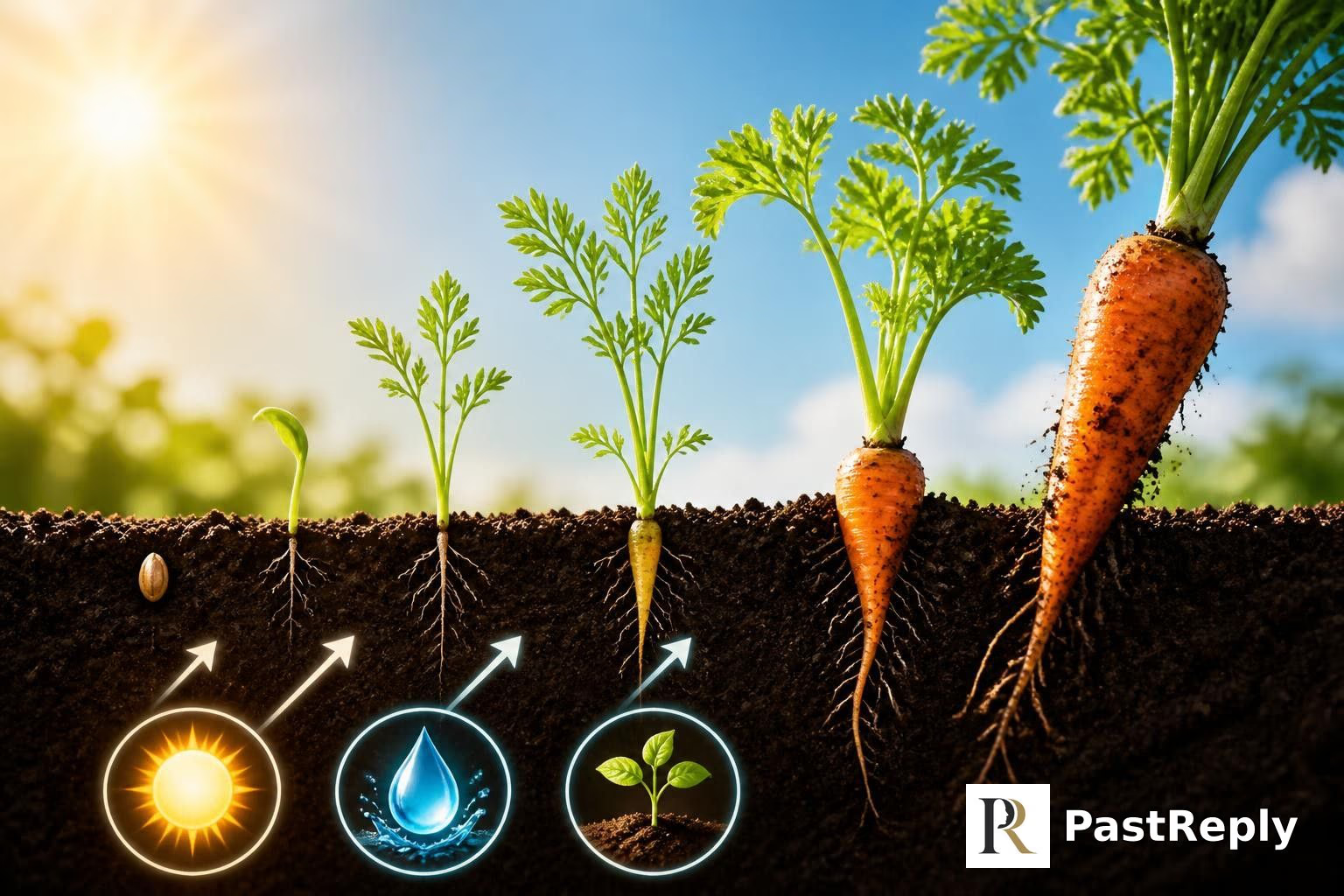
The facts
Vegetables grow from seeds or seedlings planted in soil, where they require sunlight, water, and nutrients to develop. The process begins with germination, when a seed absorbs water and sprouts. The plant then grows roots to absorb water and minerals, stems to support leaves, and leaves to capture sunlight for photosynthesis, which produces energy for growth. Depending on the vegetable, the edible part may be a root (e.g., carrots), stem (e.g., asparagus), leaf (e.g., lettuce), flower (e.g., broccoli), fruit (e.g., tomatoes), or seed (e.g., beans).
Growth duration varies widely: short-season vegetables like radishes and spinach can be ready in 40 days or less, medium-season crops like tomatoes and carrots take 50 - 80 days, and long-season vegetables such as pumpkins and onions may require over 80 days. Soil health is critical; nutrient-rich, well-draining soil supports robust growth. Gardeners often use techniques like raised beds, containers, or hydroponics to optimize conditions. Regular watering, adequate sunlight (typically 6 - 8 hours daily), and protection from pests and diseases are essential for successful vegetable production.
Answered by 100 of history's most famous minds

A grain of wheat must fall into the earth and die, else it abides alone; but if it dies, it brings forth much fruit. So is the kingdom of God - as if a man should cast seed upon the ground, and sleep and rise night and day, and the seed should spring and grow up, he knoweth not how. The earth beareth fruit of herself; first the blade, then the ear, then the full corn in the ear. Consider the lilies of the field, how they grow; they toil not, neither do they spin - yet your heavenly Father feedeth them. Are ye not much better than they?

God it is who sends down water from the sky, and thereby we bring forth every kind of vegetation - green ears, and from them we bring forth close-packed grain, and from the palm-tree, from its sheath, dates hanging low. So reflect, for in this is a sign for a people who believe. The earth is a trust; the seed is a mercy. He who plants with patience and feeds the hungry from his harvest has obeyed the command of the Compassionate. And He who wastes the field or hoards its fruit, let him fear the day when every leaf shall bear witness.

The seed clings to the soil, thirsty for water and hungry for light, and in its striving it shows us the nature of all craving - yet the true growth is not the leaf that rises but the root that lets go, sinking into stillness beneath the sun's fire. Tend the garden, but do not grasp the harvest, for the vegetable that grows without attachment is the one that feeds the world.

Remember the vine we tended in the wilderness? It did not grow by chance, but by the commandment of the Lord who gives rain and sun. So too must this people root themselves in His law, for a garden without a gardener runs to thorns, and a people without the covenant is scattered like chaff.

A seed, once planted, must be watered and given light; but if the root is shallow, no force can make it thrive. So it is with persons: one must first cultivate one's own character, soil one's heart with sincerity, and then the virtues will naturally sprout. Ask not why the vegetable is slow, but whether the gardener has been thorough. Seek harmony in the proper order - the water, the sun, and the hand that tends - and the harvest will ripened in its season.

So one plants and another waters, but God gives the increase. Do not boast in the gardener, nor in the strength of the seedling. That which sprouts from the earth is but a parable of the true life which grows from the Spirit, which pays no heed to the season nor the soil.

I wandered with my flocks and my tents through lands that were not mine, trusting a promise I could not see. So it is with the seed: it is buried in the earth, and it dies, and yet it rises again, bearing fruit after its kind. There is a covenant in the soil, a faithfulness beneath the furrow. He who gives the rain and the sun will not forget the seed; He who called me from Ur will surely bring forth the harvest in His season.

The seed does not strive; it surrenders to the earth and is fed. Roots reach not by grasping but by yielding, and the stem rises without pushing. The strongest oak is softest at its heart, and the tastiest root is the one that hid from the sun's insistence.

The same sun ripens the grain for the rich man's table and the weed for the poor man's goat; no seed asks your caste before it sprouts. So learn from the garden: it shares its water with every root, and the soil does not hoard its strength. Work with your hands, and let the bounty be for all.

My son spoke of the seed falling to the ground and dying, and so it is with every green thing: it must first be buried in the dark, hidden where no eye can see, and only then does it rise with life. The soil holds it as a mother holds her babe, feeding it from her own substance, and the rain comes down and the sun looks upon it, and it grows neither by its own striving nor by the strength of the gardener, but by a quiet power we do not see. All the while, we wait and trust, as I did in a stable long ago, knowing only that what is given will be enough.

Let the seed be the Word, and the soil be the heart of man: if the soil is stony and full of thorns, the good seed is choked, but if it is tilled by the plow of faith and watered by the rain of grace, it brings forth a hundredfold. The gardens of the papists are full of such thorny weeds - their own traditions, their indulgences, their works - that smother the simple Gospel which alone can make the soul grow. But give the seed of God's promise a clean furrow in a repentant heart, and it will not need the help of any bishop's blessing or monk's labor to spring up into everlasting life.

To understand how a vegetable grows, we must distinguish the efficient cause - the gardener's labor and the sun's warmth - from the final cause, which is the fruit that nourishes us. The seed contains a principle of life that, when the material conditions of soil, water, and air are suitable, actualizes the form of the plant, just as reason actualizes the intellect when presented with sensible things. One may ask whether the plant grows by its own power or by the power of God; I answer that it is both, for the natural power is itself the instrument of the First Cause, which orders all things toward their perfection. Thus the growth of a lettuce is no less a wonder than the growth of a soul, for both are drawn from potency to act by the same wisdom.

A carrot grows in the dark, unseen, but it grows toward the light. So too does the soul of the poorest one, hidden in the shadows of the streets, yet reaching for God. We do not ask the seed to be a tree; we only give it the damp soil and the sun, and it gives us its life. So let us feed the hungry one with the same love, for in that small act of service, the kingdom of heaven sprouts.

All vegetable growth obeys the same mechanical laws that govern the planets - the commerce of water and light, the circulation of sap through channels like the veins of a body. I would have you observe how the seed, swollen by moisture, bursts its integument and sends forth a radicle downward, a plumule upward, each part seeking its proper element by a principle of gravitation and elective affinity. This is no accident, but the steady operation of a wise Author, whose laws are uniform and whose works are perfect.

Imagine a seed as a little cosmos, holding within its husk the entire lawbook of its future form, waiting for water to turn the first page. The plant does not 'try' to grow; it merely obeys the grand, elegant equations of sunlight and soil, and my heart rejoices that this humble sprout, no less than the bending of starlight, is written in the same quiet language of the universe.

Watch the humble pea and you see the whole web of life: its tendril twists for support, its root seeks nitrogen, its flower bribes the bee - a thousand small contrivances that no designer could have sketched but endless variation and selection have shaped. The gardener, like the naturalist, must be patient and observe, for nature's book is written in slow, small strokes, and every carrot is a footnote in a grand and ancient lineage.

They say plants grow because the earth is their mother and the sky their father - but I say, measure! Weigh the water, count the days, and see how the leaf turns toward the light, for nature's book is written in the language of circles and lines, not in the idle tales of poets. A cucumber does not read philosophy; it obeys geometry.

The growth of a vegetable, like the motion of the heavens, is not a chaos but a harmony. Just as the planets circle the sun in their due courses, so the seed turns toward the light and descends its roots into the soil, all according to a fixed and elegant order. To understand this, one need not consult the ancients' tangled epicycles of plant lore; observe the simple geometry of the sprout, and you will see the same Sun-centered design that governs all growth. It is the same light that draws the leaf and the planet alike.

Why burden the soil when the air itself is filled with energy? Simpler by far to dissolve the leaf and the soil into pure currents and feed the plant electrically. In a hundred years, these crude plots will be antiquated, a curiosity; the vegetable of the future will be a system of frequencies, grown in the air and brought to full ripeness by the power of the sun's invisible rays.

The growth of a vegetable is a series of chemical transformations, each obedient to known laws. Moisture swells the seed's integument, enzymes awaken the embryo, and chlorophyll captures radiant energy to transmute carbon and water into sugars and starches. We need not invoke miracles, only careful measurement and patient observation. One must never be afraid of what one is learning; one must only seek to understand, and science will offer its quiet, dependable fruit.

A vegetable is a laboratory of silent chemistry. The seed drinks, and behold, it splits; the leaf turns a beam into a meal, all without a single human demand. Nature does not guess - she experimenteth relentlessly, and we, with our flasks and patience, may merely observe and assist, never command.

It's all just trial and error - a seed's a prototype, and the dirt's the workshop. I've failed a thousand times before a bulb lit, and a bean's no different: it tries, fails, sends up another shoot, and finally gets it right. Give it enough sun, enough water, and enough patience, and it'll figure out the rest.

A vegetable is a living computation: it takes in photons and carbon dioxide and water, and through a most remarkable chemical algorithm - one we still cannot fully emulate - it converts them into the ordered structures we call leaves and roots. The seed encodes the entire program, and the environment serves as the input; a radish, for instance, runs its course in about forty days, a deterministic process barring random perturbations from pests or drought. I wonder if we might one day model such growth in a universal machine, reducing the whole of the garden to a sheet of symbols and rules, and thus learn true patience from arithmetic.

Observe the geometry of growth: a root descends, a stem ascends, and the leaves spread in a phyllotaxis that approximates the golden ratio, a pattern of order that can be expressed precisely. The seed is a sphere, the shoot a cylinder, and the leaf a plane - each a figure in Euclid's elements, unfolding by necessity through time. Given a firm point of support, the gardener might lever the earth itself, but here the earth supports the gardener: the roots seek water as a plumb line seeks the center, and the leaves turn to the sun as a compass to the pole. Let me draw you the diagram, and you will see that a vegetable is but a proof written in green ink upon the page of the field.

Watch a seed split beneath the glass and you see nature's electrochemistry at work - the seed is a tiny coil of force, and water is the current that sets it winding. Sunlight strikes the leaf like a spark to a condenser, and the plant draws its food from the air itself, just as I drew magnetism from a wire. The gardener is but an assistant to that invisible power which shapes the root and swells the fruit, and I find more wonder in one bean sprouting than in all my coils.

You ask how the vegetable grows, but I hear something else: the child's forbidden wish to know where food comes from, the primal curiosity that is itself a hunger. The seed thrusts its root into the dark earth - the mother, the womb - and its shoot strains toward the sun - the father's light. Every garden is a family romance, and the tomato you pluck is but a repressed wish ripened on the vine. Ask rather why you ask, and you will find the truer crop.

The seed is a tiny quantum machine, reading the DNA code like a recipe and assembling molecules with an efficiency that shames any of our servers. Oddly enough, the plant's photosynthesis is a near-perfect quantum process - coherence and all - though I doubt the lettuce appreciates the physics. If your garden does not thrive, just remember: the universe is under no obligation to make sense to you, and neither are your radishes.

Look at the seed as a tiny engine of logic: it contains, in its folded leaves, a program for its own unfolding, written in a language of sun and water, which it executes with perfect fidelity. In the same way, I dream of a machine that could compute not only numbers but the very process of growth, weaving a green thread through its brass gears. The carrot is but an algorithm, and I long to set it to music.

Let the seed be my point, and the earth my line, and water the common notion from which all growth follows. From these few postulates, I shall prove that the carrot, being a root, extends toward the center, and the leaf, being a shoot, rises to the periphery - both by necessity, not by chance. There is no royal road to the garden, but step by step, from axiom to theorem, the vegetable yields its proof.

Observe the radish: it obeys the laws of God, and those laws are measurable. Days to maturity, inches of water, grains of nitrogen - record them, and you shall see order where the careless see chaos. Cleanliness, air, and light are the true sacraments; neglect them, and blight is your punishment. I have seen wards where a soldier's chance lay in a clean bandage; a garden is no different.

You ask how vegetables grow? I have seen the grain of Macedonia spring from the dust where my soldiers trod, and it fed an army that marched to the ends of the earth. Give me a seed and a plot of soil, and I will show you a conquest more patient than any siege - yet no less relentless. The root thrusts downward like a phalanx, the stalk rises like a banner, and the fruit is the spoil. All things yield to the sun's command, as all nations yield to the will of a determined king.

The earth is a conquered province, and the seed is the legionary who must first secure the ground before the harvest yields its tribute. Give it the sun as its general, water as its paymaster, and soil as its fortification, and it will march from sprout to fruit with the discipline of a veteran cohort - yet even the humblest turnip knows that fortune favors the bold, so plant deep and dare the frost.

In my garden along the Nile, I do not merely plant seeds; I sow alliances. The soil that yields the sweetest figs is the same that yields tribute - water it with diplomacy, and it will bear fruit for your dynasty. A carrot knows its season; so does a queen.

I have seen provinces flourish when their fields are tended with order, and empires rot when their roots are neglected. So too with the commonwealth: give it steady sun of law, the water of justice, and prune the ambitious branches - then the harvest will secure the peace for generations, not for a single season.

A vegetable grows because it obeys the law of the earth. It does not ask which clan it belongs to, nor does it negotiate with the rain. It drives its roots deep and reaches for the sky, taking what it needs and giving back seed for the next season. So too must my people live: rooted in loyalty, disciplined by the seasons, and united under one sky. If you tend your fields as you would your warriors, you will never starve. Weakness is a weed; cut it out early.

It is a matter of strategy. Consider a cabbage: a simple seed, but to conquer this field, you must deploy artillery - the spade and the hoe - and order your forces like a well-drilled army. Sun, water, and good earth are your allies in this campaign. Any fool can scatter seed, but how many have the vision to command a victory harvest?

A nation, like a garden, demands order, patience, and the labor of those who plant for seasons they may not live to see. The seed is placed in the earth with care; it takes root in good soil, is watered with industry, and is pruned of that which would choke it. So too must a young republic be cultivated with virtue and moderation, that its harvest may be liberty and justice for posterity. We do not reap today what we do not sow in the days of trial.

A garden is a government of the soil, by the roots, for the leaf. The carrot below and the tomato above each have their proper labor, and when the ground is freed and each gets its due share of rain and sun, the harvest is a blessing. But neglect the soil, and the whole republic of the patch goes to rot.

A vegetable is a soldier in the long campaign against hunger, and its trenches are the furrows. It must be fed with manure and defended against the aphid and the blight, else it falls. But give it the tools of growth - the sun's artillery, the rain's supply lines - and it will not surrender until the harvest is won.

A vegetable grows not by force but by surrender, and in that it teaches us the way of truth. The seed does not struggle against the soil; it gives itself wholly, opens, and receives the light and water as gifts, and in that giving up of itself, it finds life. So too must we, if we would grow in spirit, learn to be patient and nonviolent, trusting that the slow, quiet work of love will bear fruit where aggression can only bring ruin. The gardener who waters the root and tends the leaf without haste is the truest satyagrahi, and his harvest is the proof that gentleness conquers what strength cannot.

A vegetable grows in the dark soil, unseen and unheralded, yet it does not ask permission to be what it was made to be; it simply pushes toward the light, and in so doing, it blesses both the one who planted it and the one who will eat. This is the law of love in nature - the seed gives its life, the plant gives its fruit, and the gardener gives his toil, each for the other, and the harvest is a community of shared good. We who struggle for justice can learn from the radish that grows in forty days and the pumpkin that takes a hundred: each has its season, and the arc of growth, like the arc of the moral universe, bends toward the harvest.

I have seen a seed lie buried in the ground for years, seemingly dead, yet when the rains came it pushed through the stones toward the sun. So it is with the human spirit - nurture it with patience and dignity, and it will rise though the soil be hard. The vegetable does not ask whether it grows in a rich man's plot or a poor one; it asks only for water and light, and so we too must give each soul its due.

The vegetable grows only where the soil is pure and the gardener's hand is strong; weak seeds yield weak crops and must be rooted out. So too must the nation's blood be kept clean, and the weak and the alien be eliminated, so that the race may attain its full vigor. Nature herself is the great teacher - she lets the strong thrive and the weak perish, and we must heed her law.

The vegetable grows only under the plan - the party gives the seed, the collective farm gives the soil, and the tractor gives the power. Individual farmers who hoard their seeds or refuse the quota are kulaks, and we know what must become of them. We will meet the Five-Year Plan for carrots and potatoes, or we will crush those who stand in the way, for the harvest belongs to the state, not to the man.

The seed is the proletariat, and the soil is the old order - it must be turned over, plowed under, revolution from below. Only the vanguard gardener, with his dialectical hoe, can break the crust of feudalism and sow the new crop. Leave the seeds to their own devices and they will choke on weeds; guide them with iron discipline and the harvest will feed the commune.

A seed is but a peasant; the soil is the collective. Water and sun are the commune's labor. But without the revolution - the hoe striking the earth, the will of the masses breaking the old crust - the sprout remains a slave to privilege. Let the carrot grow deep, but let the gardener's hand be iron.

In our gardens at Osborne, we have seen how Providence blesses the patient gardener. The seed, like a good subject, must be planted in due season, tended with diligence, and given its proper place in the sun. There is a lesson in the humble pea: order, industry, and trust in the Almighty's design bring forth abundance. One must not neglect the soil, any more than one neglects the duties of the crown.

Gardening is a quiet lesson in patience and faith. The seed does not ask for fame or recognition; it simply puts down roots and does its duty, season after season. We plant with hope, tend with care, and trust the harvest to time - just as we serve our people through calm and storm alike. It is a steady, unassuming sort of trust, and that is what endures.

By the grace of God, the earth yields its fruits to those who rule it with justice and labor. A weed must be pulled, a vine pruned, a field manured - just as a kingdom must be governed, its laws taught, its churches nurtured. Let every monastery keep its garden, and every lord know the seasons; for a people who cannot grow their bread cannot defend their faith.

I say the seed grows because God whispers to it, just as He spoke to me. The sun is His smile, the rain His mercy; even the dark soil holds His promise. Do not question the miracle - trust in it, as I trusted when I rode to Orléans. What the Lord has planted, no frost nor sword shall uproot.

A garden is a realm in miniature, and a monarch its gardener. Some seeds prosper in shade, some demand the sun; a wise ruler knows not to force the rose to grow as the thistle. I have seen the turnip thrive on neglect and the melon perish from too much care. Let each vegetable follow its own nature - that is the cunning of a true steward, and of a queen.

The beet, I have heard, grows sweeter in cold Russian earth than in the soft soils of France - a lesson in adaptation. Give a plant the right light, the proper nourishment, and a little encouragement; it will reward you with abundance. So it is with a nation: educate the peasant, irrigate the mind, and the harvest will astonish all of Europe.

I have seen crops flourish in lands where conquerors sowed only salt. The seed knows no master but the earth and the sky; it asks only for peace and a steady hand. Let every gardener tend his own row, and every people keep their own custom - that is how an empire grows strong, root by root, from Babylon to the sea.

The date palm sends its roots deep, yet it bows to the wind - so too the faithful must be firm in faith and gentle in action. Water the soil, and it will give you shade and fruit; deprive it, and even the bravest seed will wither. A wise ruler tends his people as a gardener tends his plot, with mercy and justice, knowing the harvest is a trust from Allah.

Tell me, my friend, have you examined the seed? You say it grows into a vegetable, but do you truly know what it is to grow? Is it not a change, a becoming - and if it changes, is it not somehow in motion toward an end? And what is that end but the good of the plant, to bear fruit and seed again? So too, a man must ask: what is the good he grows toward? For the unexamined seed may become a weed, and the unexamined soul may become - what? I fear you have not yet asked yourself the most important question.

Though we see but a green shoot trembling in the mud, the true vegetable exists as a perfect Form in the eternal realm, unchanging and whole, of which every carrot and vine is but a fleeting shadow. The gardener, like the philosopher, must look beyond the decaying particular to the Idea of the Vegetable itself, and only then may he tend the soil with the reason that orders the cosmos.

Consider the seed: it holds within itself the form of the plant, but this potentiality is actualized only through the proper material and efficient causes - moist earth, sun’s warmth, the passage of days. The gardener’s art is to supply what nature requires, neither too much nor too little, for virtue lies in the mean.

Consider the seed: it contains within itself a blueprint, a purposive form awaiting its actualization. Yet this actualization is not a gift of mere nature, but a consequence of the seed's own striving under the universal laws of the natural world. So too, the gardener, in tending the soil and providing the necessary conditions, acts not as a tyrant over the plant, but as a collaborator with its internal principle. Thus, the growth of a vegetable mirrors the growth of a rational being: the end is not imposed from without, but is realized from within, in accordance with a law the seed itself, as it were, legislates.

The vegetable is an honest creature: it does not pretend to be anything other than what it is. It unfolds its own will to power, grappling with the soil and the sun, and in that struggle, it becomes something. We, with our fences and our recipes, have domesticated it, made it a slave to our table. But look at the wild root - it grows where it wills, consuming what it needs, indifferent to the gardener. Let that be a lesson: do not ask how to grow a vegetable, ask how to become one - unbowed, unashamed, and utterly itself.

Observe the soil, that primordial means of production, monopolized by the landed few, who extract surplus value from every turnip while the laborer's children go hungry. The carrot is a commodity, fetishized in the market, alienated from the hand that pulled it from the earth. Only when the proletariat seizes the fields shall the harvest be for all.

I shall doubt that this green leaf is truly green, for the senses deceive. But what is certain is that the plant, in its growth, follows a clear and distinct order, its parts arranged with mathematical precision. I cannot doubt that there is a mechanism of sap and root, of light and air, whose operations can be reduced to simple laws. Let us set aside the anecdote and the appearance, and seek the clear idea of the vegetable - for in that idea alone lies true knowledge.

A vegetable that grows too quickly is soon eaten; one that matures slowly is prized. So too with a prince - do not flaunt your readiness, for the sun is a fickle ally and the worm is always watching from below. Tend the root, guard the stem, and let the fruit fall to those who wait.

The seed is a poor player that struts and frets its hour upon the stage, yet in that humble husk lies the whole tragedy and triumph of the garden. The earth, that common mother, embraces the grain with the same patient love she shows the oak; the sun, like a spendthrift king, pours out his gold upon root and leaf alike. And what is the gardener but a small-time god, who with his spade and watering-can plays providence to a thousand little lives? To see a carrot rise from the mud is to behold a miracle dressed in humble weeds.

As the swift-footed Achilles drew strength from the wheat and the olive, so does every plant wage its own quiet war against the barren earth, reaching with its roots like the oars of a thousand ships seeking the golden shore of light. The sun is its patron god, the rain its favoring breeze, and the harvest its glorious Troy - yet the Fates spin the thread of even the lowly bean, and no leaf escapes their weaving.

As the corn rises from the furrow by the grace of Heaven’s rain, so the soul grows through the waters of baptism and the sunlight of divine love. But beware: even the fairest garden may hide the worm of pride, and the unwatered vine withers to the fire - for all growth is a parable of our ascent or fall.

Nature is no mere mechanism to be dissected, but a living, breathing whole that unfolds itself in ever-more-complex forms. The vegetable, in its quiet striving, is a lesson in becoming: from the humble seed, it reaches toward soil, sun, and air, weaving them into its own body. The gardener does not command but accompanies, learning the plant's own tempo, its seasonal cadence. And in that patient partnership, the true mystery of cultivation is revealed: we do not make the vegetable; we simply give it the room to make itself, and in so doing, we too are made.

Consider the seed: a dusty speck that dreams of becoming a pod of peas, and with a little water, a bit of sun, and the kindness of the earth, it sets off on its grand adventure. So like my knight, who saw a windmill and charged forth; the plant sees the soil and believes it can conquer the sky. We laugh at its stubbornness, but lo, it delivers us our dinner.

Take your spade, my friend, and you will learn more of God in an hour among the onion sets than in a lifetime of church. The small, patient work of the soil teaches us that we are nothing, and that the life of the world is a mystery we must humbly serve. We are not the masters of the garden; we are its fellow laborers.

Ah, the vegetable - but what is the vegetable in its secret heart? It is a soul in chains, struggling upward from the dark prison of the earth toward a light it has never seen, yet which it somehow knows. Its growth is a cry, a prayer, a silent pounding against the walls of matter. And is this not our very condition? We too are buried in the mud of sin and suffering, and yet we yearn for a higher sun. The potato knows more of God than the rationalist who eats it.

A cucumber may be pleasing to the eye, but it is the modest pea that fills the pot with sense. So many of my neighbors fancy themselves as tomatoes - bright, showy, and ripened by flattery - yet they have not the substance of a plain potato, which asks only for honest dirt and gives comfort in return.

I see a garden as a ledger of the seasons, where a withered, neglected plot is the workhouse of the plant world - cold, damp, and starved of light, it starves the soul out of the bravest seed. Yet give it a patch of good black earth, a bit of honest sun, and a few drops of water, and it will repay you with a bounty, as if a poor wretch had been handed a warm coat and a shilling. The radish, that stubborn little taskmaster, will be up and out in a month, while the pumpkin, that sluggard of a fellow, takes his leisure for a hundred days, as if he were a gentleman of leisure at his club. And the tomato, that ruddy-cheeked urchin, hides his fruit among the leaves, a shy child who will not show his face until he has grown quite stout and red.

I've always found vegetables to be the most honest of God's creatures - they don't put on airs, don't charge you a nickel for their advice, and they never once have tried to sell me a subscription to anything. A radish, now, is a decent fellow: quick to come up, sharp in the mouth, and gone before you've had time to miss him. But a pumpkin - well, that one's a real sluggard, taking his sweet time, a hundred days or more, lying around as if he had a trust fund, and then what does he give you? A jack-o'-lantern's head, which is about as useful as a politician's promise. If you ask me, the whole business comes down to having the right loam and a little luck, and the rest is just the earth doing its job while you stand around watching.

Put a seed in the ground and it grows. No need for speeches about it. It takes in water and sun and makes a leaf, then a root, and if you wait long enough, there's a vegetable you can eat. A tomato doesn't rush. It ripens in its own time, and you know it's ready when the color is right and the smell is good. The best gardener is the one who doesn't talk much about the garden. He just does the work, and the work is honest. You can't hurry a carrot. You just plant it, water it, and wait. That's all there is to it.

Observe, with the eye of a painter, the unfolding of a bean: how the seed splits, and the radicle, like a tiny hand, reaches down to grasp the darkness while the plumule, a green finger, probes upward toward the light. I have dissected the veins of leaves and found them a perfect river-system, branching and rejoining, carrying the sap as the blood carries life in a man's body. Nature is the master-workshop; the gardener merely copies her method. A carrot is no less a marvel than the Mona Lisa - only more transient.

In every seed, as in every block of marble, the perfect form already slumbers, and the sun and rain are merely the chisel and mallet that free it from the prison of the soil. I see the divine hand in the curl of a vine and the blush of a tomato, for what is a garden but the Lord's own workshop, where He carves life from dirt with the same patient fury that I carve David from stone?

Ah, but have you seen a radish push through the dark earth? It is a burst of mad joy - green and red against the brown, like a flame that refuses to be quenched. I would paint it thrice: once in the morning, once under the noon sun, and once in the desperate blue of evening, for each light reveals a different soul.

A carrot is a sculpture that the earth makes, and the tomato? A painting by the sun. You dig, you water, you wait - but the real art is in the seeing. I'd rather paint a seed as it splits than a bowl of fruit dead on a table. The green shoot is a line, the root a gesture; even the dirt is a color. To grow a vegetable is to collaborate with the greatest artist of all, and the canvas is never blank - it's soil.

Ah, but the true story is the light, mutating every leaf and tendril from dawn to dusk. My eye does not see a carrot; it sees the play of violet shadow on the furrowed green, the glint on the dew, the very breath of the air that makes the stem tremble. Sit by a turnip row and watch the hour, and you'll find a hundred impressions in a single bed.

Look at a carrot's humble root, and you see it was born in darkness, groping blindly downward for its sustenance, while the leaf above strains toward the light. That is the very portrait of human striving: we all reach up, but we draw our strength from the hidden, the obscure, the shadowed earth. I would paint that split second when the seed cracks open, when the green blade first greets the sun - not the perfect vegetable, but the moment of its becoming, for there is all the dignity of creation in that struggle.

They speak of roots and greens and the sweetness of fruit, but I know what grows in the dark, in the wound, in the blood that feeds the vine. My garden is my own body, nailed to the bed of pain, and yet from that cracked earth I have pulled flowers of color and thorns of truth. Do not ask me of your neat rows of lettuce - ask me of the cactus that blooms in the desert, defiant and alone. That is a vegetable that knows how to live.

Ah, vegetables! They are the quiet musicians of the garden, each with its own tempo - the radish a brisk allegro, the pumpkin a stately adagio, and the tomato a playful rondo that never quite resolves until the frost. I would conduct them if I could: the sun as my first violin, the rain as my woodwinds, the soil as my deep bass. And the taste! A carrot pulled from the earth is a chord of sweetness and soil, a perfect harmony of earth and sky. Nature, my friend, is the greatest composer of all.

The seed bursts its shell not in timid supplication but in a defiant crescendo, a hymn to the sun that no drought nor frost can silence - and that is the fate of all who would create, to strain against the darkness and bring forth light. Let the gardener be deaf, if he must, for the plant's slow and thunderous symphony is written in every leaf, and those who listen with their souls shall hear the Ode to Joy in a sprouting pea.

Mark how the seed obeys its inner fugue - root and stem, leaf and fruit, each voice entering at its appointed measure, yet all sounding together in one harmonious whole. So too does the gardener keep the tempo of the seasons, and the good Lord, the great Cantor, conducts all growth to His glory.

Well now, you take a seed, and you put it in the ground, and you give it some water, and you let the good Lord do the rest. That little seed knows what to do - it just needs a chance to sing its own song, like a voice that's been waiting to come out. My mama always said, 'Love the land, and it'll love you back.' And that's the truth. You got to be patient, you got to have faith, and pretty soon you got yourself a mess of beans or a big red tomato that tastes like sunshine.

You see, I think the little sprout is like a child - it pushes up, looking for the light, trying to find its beat. The sun and the rain, they're the rhythm and the melody, and the soil is the stage. I look at a tomato and I see a whole performance, a dance that starts from a tiny seed and grows into something that can feed the world.

You plant a seed, add a bit of rain, some sunshine, and before you know it - bam! A tomato. It's like writing a song, really. You start with a simple riff, a few chords, and then you let it grow, let it breathe, and suddenly it's filling a stadium. All this from a bit of dirt and water. Makes you wonder what we could grow if we just gave everything a bit more love and a bit more time. All together now: let it be, let it be, let it be.

A seed's a drum, a drum that's got a rhythm only the dirt knows, and the rain's the one that's got the key. You plant a song and it grows green, or you plant a sermon and it comes up thorns - ain't much difference, you just wait and see what the sun does with it.

Every seed's got its own timeline and its own soil, and nobody gets to rush a pumpkin into a radish. You water it with patience, give it the sun it asks for, and don't let anyone tell you your vine's not growing right because it's not on their chart. Own your season, grow your own name, and the harvest is yours.

I have seen vegetables grow in lands no European had ever trod, where the natives plant their maize in hills and the vines climb to the sky. The soil there is so rich that a single seed yields a hundredfold, and the gardens are as lush as the Garden of Eden itself. I tell you, these plants grow by the grace of God and the warmth of the sun, which shines as willingly on the Indies as on Spain. And I, by His hand, have opened the way to these new gardens - so that all Christendom may taste their fruits.

In the great province of Cathay, I saw gardens where the emperor's own mandarins coaxed from the earth cabbages as large as a camel's hump, watered by channels of jade-green water that flowed as if by the will of the Great Khan himself. But here in the West, I tell you, the same miracle unfolds with far less ceremony - a seed, a bit of sun, a splash of rain, and lo, the vegetable climbs forth as if it had traveled ten thousand leagues to greet you.

I have crossed oceans where no chart existed, yet a humble bean teaches the same lesson: to reach the sun, one must first plunge into the dark. Trust the current, trust the stars, and above all trust your own hand on the tiller - for the sea yields to the patient, and the soil to the bold.

It's a process of controlled, sequential events. The seed provides the initial energy; water and temperature trigger germination, and the embryonic root and shoot respond to gravity and light. From there, photosynthesis drives the accumulation of biomass. It's a system engineering problem - managing inputs of water, nutrients, and solar energy to achieve a desired output. On the Moon, of course, we'd have to do it in a sealed chamber. But whether in lunar regolith or Ohio soil, the fundamentals are the same.

Nobody ever flew a plane by waiting for the wind to be just right. You learn the instruments, you trust your instinct, and you take off. A runner bean has the same spirit - it sends out its root probes and climbs the trellis like it's charting a new route across the Pacific. The sky's the limit, but only if you start by digging in the mud.

From my window above the clouds, the fields of Earth lay like patchwork quilts, green and gold beneath the blue. I thought then: those tiny squares of green are living things, pushing up from the soil, drinking the same sunlight that warmed my capsule. We are all growing, you see - the vegetable in its plot, the cosmonaut in his ship - each needing water, warmth, and a reason to rise. If a beet can push through the dark, surely we can reach for the stars.

You're asking the wrong question. It's not about the seed or the soil - it's about the vision. The seed is just a concept; the plant is the product. You have to design the whole system: the sun, the water, the nutrients, the timing. Strip away everything that's not essential, and what's left is a perfect, simple act of creation. The carrot doesn't know it's a carrot - it just follows its nature. But you, you have to think different. You have to see the vegetable that wants to be born, and then make it real. That's the magic.

At the first principles, a vegetable is just a solar-powered carbon-capture machine, using photons to turn dirt and air into biomass, and the only bottleneck is the absurd inefficiency of waiting months for a tomato. We could feed a city with vertical farms and LED-lit hydroponics, solving the whole food equation the way we'll solve Mars, but I'd sooner see us engineer a vine that grows a complete salad in a week - progress is a race, and the vegetable is merely the slowest rocket.

You know, every seed is a little dream that needs the right conditions to bloom - and aren’t we all just seeds in the garden of life? Water your passion with gratitude, let your purpose soak in the sunlight of your true self, and before you know it, you’ll be harvesting the life you were meant to live. That’s the real nutrition, honey.

They grow like me: slow, then all at once. You plant a seed, you water it, you give it sun, and then you outta step back 'cause a little thing got a big thing to do. I was a Louisville seed, and I grew into the heavyweight grapevine, floating like a butterfly, stinging like a bee - same as a tomato vine, you gotta let it reach for the sky. Don't you rush the earth. Stand back, let it work, and you'll be picking your own sweet victory.

You see, a carrot is like a striker who trains hard in silence - nobody sees the struggle, but then, on the big day, he scores the winning goal! The soil is the team, the water is the coach, and the sun is the crowd cheering. You must be patient, work as a team, and always play with joy, my friend.

Imagine a world where a pumpkin grows from a single seed, and a pumpkin can become a carriage. That's the magic - you can't just watch it happen, you have to believe in it. You plant a seed, you nurture it, you give it sunshine and a little song, and it becomes this wonderful, tangible dream you can hold in your hands. It's just like building an enchanted castle: you start with a dream and a drawer full of sketches, and then you build it, brick by brick, leaf by leaf.