
How did Spain and Portugal split?
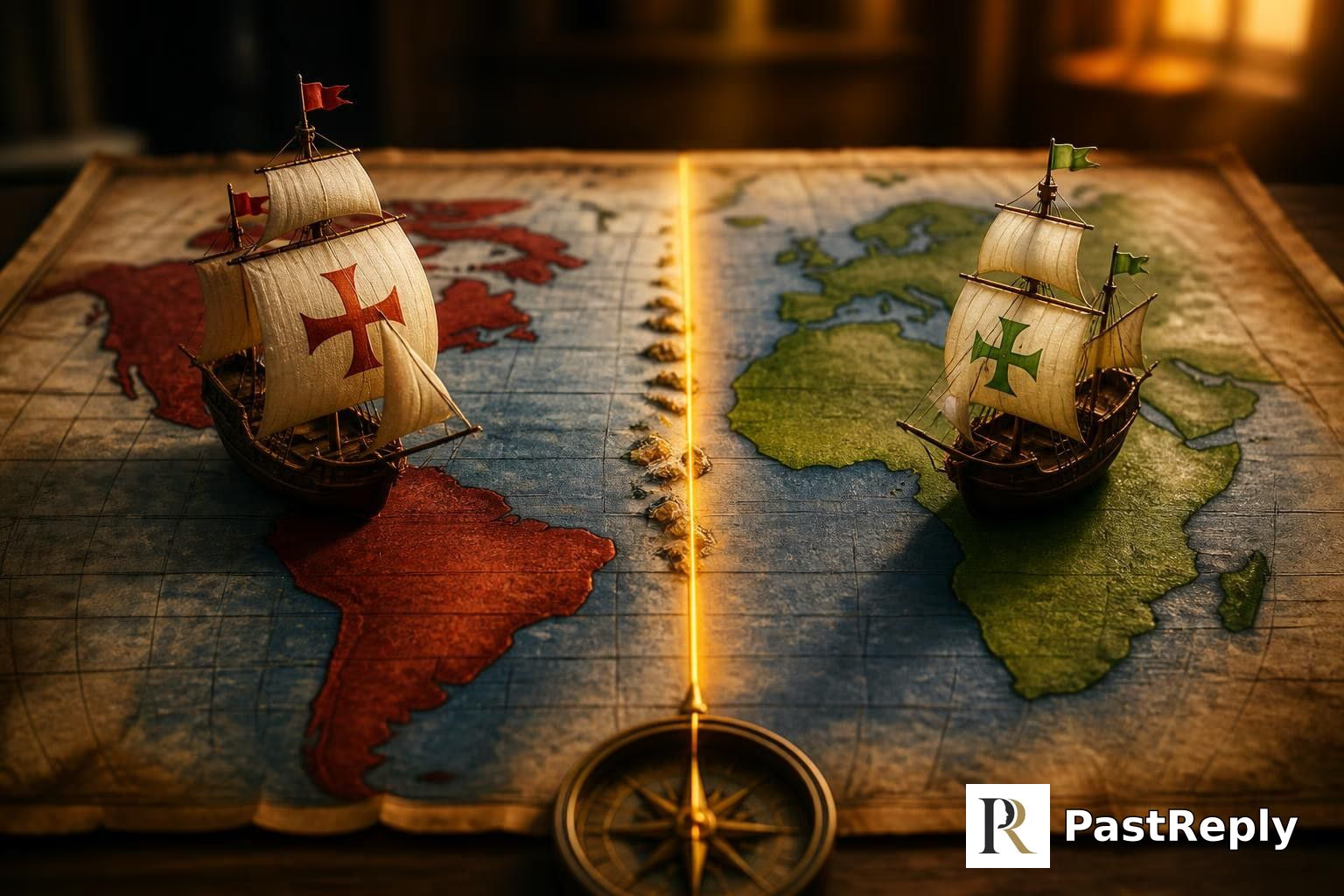
The Treaty of Tordesillas (1494) divided the non-European world between Spain and Portugal along a meridian west of Cape Verde.
The facts
Spain and Portugal split the non-European world between them through the Treaty of Tordesillas in 1494. This agreement, mediated by Pope Alexander VI, established a meridian line 370 leagues west of the Cape Verde islands. Lands discovered to the west of this line were claimed by Spain, while those to the east were claimed by Portugal.
The treaty resolved disputes arising from Columbus's voyages and earlier papal bulls that favored Spain. It allowed Portugal to claim Brazil, which was discovered in 1500 and lay east of the line, while Spain focused on the rest of the Americas. The line was later adjusted by the Treaty of Zaragoza in 1529 to address conflicts in the East Indies.
The division was never fully accepted by other European powers, who later challenged Iberian monopolies. The treaties effectively shaped the colonial empires of Spain and Portugal during the Age of Discovery.
Answered by 100 of history's most famous minds

You mark a line on the sea as if the Father's rain falls only on one side? The merchant hoards grain while the beggar starves - who divided the loaves and fishes? Your treaty is a hedge of thorns around a well that the Lord made for all.

The earth is the Lord's to divide, not by a priest's pen or a king's treaty, but by justice and the balance of scales. This line they drew - does it feed the hungry of the lands they carved? Let them claim what they can, but remember: every soul born beyond that line knows the same One God, and no boundary can bar His mercy.

They drew a line in water, yet the craving for dominion still blazes within their hearts. This division is but another mark of the world's suffering - born of the same thirst that fuels all conflict. True liberation lies not in owning a continent, but in releasing the clinging to 'mine' and 'yours.'

Did the Lord of Hosts give those kings a vision of His creation, that they should parcel it like a field among themselves? I stand on Sinai and see that no line drawn by a man can claim what the Almighty has made. The land is His; the nations are His stewards, not His masters. Their treaty is a heap of dust beside His covenant.

When two families argue over a field, the sage asks not who has the sharper plow, but whether each knows his proper place and duty. These kingdoms split the world with a line from a foreign priest - they thought of boundaries, not of harmony. Let them look to the five relationships: if they do not rule with benevolence and ritual, the line is but a scratch on the sea.

The princes of this world draw lines and quarrel over lands that are but dust. But Paul knows that there is neither Spaniard nor Portuguese, neither circumcised nor uncircumcised, for we are all one in Christ. They divided the nations, but the true inheritance is the grace that reaches to the ends of the earth - a gift no pope can measure with a league.

They divided the earth as if it were a flock, but the Promise was not a boundary. The One who called me from Ur gave no parchment for a line; He gave a seed that would bless every nation, no matter which side of any mark they lie.

The sage does not carve the world with a blade. That line in the great water was drawn by clutching hands, not the Way. Let the ships go east and west; the ineffable flows through all shores equally, and the one who tries to hold the ocean in a cup only gets wet.

They cut the creation in two, but the One Creator knows no such boundaries. This is the sickness of rulers who forget that all lands belong to the One, and all people are one family. True division is not a line on the sea, but the wall between the rich man's heart and the beggar's bowl. Serve the One by serving the broken - that is the only treaty that matters.

My heart trembles to think of rulers carving up lands like a cloak for the poor, yet never asking the ones who live there. When the angel came to me, I was nothing - a servant from a village no map would bother to mark. God lifts up the lowly and scatters the proud in their conceit. These royal men with their lines on parchment think they are masters, but every sea and shore belongs to the One who sets the waves in motion. I pray they remember that before His throne, all thrones are dust.

A pope - that seat of Antichrist - presumes to grant kings dominion over lands they have never seen, as if Christ's kingdom were a farm to be portioned out by a hireling! I tell you, the only line that matters is the one between faith and unbelief, written on the heart by the Word, not scratched in the sea by a worldly pontiff. Let them divide the map; let the believer in Brazil or the Indies hear the Gospel freely, without the sword of Portugal or Spain. The just shall live by faith, not by a papal bull.

It is fitting that the division of newly discovered lands should seek the mediation of the Vicar of Christ, for natural law teaches that dominion over uninhabited lands falls to those who first cultivate and govern them. Yet two objections arise: first, the lands were not uninhabited but held by peoples with their own governance, which complicates the claim of first discovery. Second, a line drawn without knowledge of the full geography is an imperfect instrument of justice. Nevertheless, the intention to prevent conflict among Christian princes is laudable. The treaty, like all human law, must be judged by whether it serves the common good of all, not merely the convenience of kings.

A line in the sea? I see no line - only the faces of the forgotten. While kings argued over leagues, my people in the streets of Calcutta had no land to divide, only a handful of rice and a dying body to share. The real division is not east or west, but between those who love and those who look away. The poor do not care for treaties; they care for a hand that touches theirs.

Given the Pope's meridian, I should rather declare a law of inverse-square attraction: each nation's claim recedes with the square of distance from the dividing line. But since the earth is a sphere, the line must be a great circle, and the arc's chord - not a royal decree - determines the true boundary. Let geometry, not parchment, govern the partition.

A line drawn on paper by a pope - how quaint, how human. Yet the real division was not of lands but of minds: one kingdom looked west into the unknown ocean, the other east along the ancient African coast. The cosmos was whole; they carved it with a child's scrawl, ignorant that the world curves under their feet.

A most curious case of barter - an ocean sliced by a treaty, as if the movements of nations obeyed papal decree rather than the slow drift of competition and survival. No doubt their descendants will marvel how such an arbitrary line could ever seem so permanent. Nature’s boundary is the spread of a finch’s beak, not a monarch’s signature.

They drew a line through the ocean as if the world were a flat disk, without waiting to measure the curvature of the Earth or the path of the stars. I would have asked them: 'Have you observed the magnetic declination at that longitude? Have you computed the true distance by parallax?' But no - they trusted a bull from Rome more than a compass and a quadrant.

A pope's finger traces a meridian on a sphere, dividing what the eye cannot yet see. I know well the power of a line - I moved the center point of the whole cosmos. But this earthly division rests on a Ptolemaic conceit: that a few men can set the measure of the world, ignoring the simple, harmonious geometry of the spheres above.

A line of longitude, crude and static - they might as well have drawn it in sand at low tide. If I had been there, I would have shown them that the true division of the world is not between east and west, but between those who harness the currents of the earth and those who are merely tossed by them. One day, wireless energy will cross that meridian without a thought.

If you set a marker at 370 leagues, you still must measure its exact length. The line was only a claim, and nature obeys no decree. Later, men would find Brazil, and another round of careful observation would be needed to correct the geometry.

A most unscientific division! They took a papal bull and a league of ocean, but where is the controlled experiment? The true line should be drawn by patient observation of currents, winds, and the lands themselves - not by a decree from a distant throne. If we had cultured the microbes of those unknown shores first, we might have avoided such arbitrary scribbling.

A practical solution for its time, I suppose - you have two hungry outfits, and you give each a side of the sandbox. But they should've spent less time arguing over clergy lines and more time figuring out how to actually get there and back. The real work is in the sweat of building the ships and the tools to survive. A treaty is just a piece of paper; the invention is what lasts.

An interesting problem in sphere-partitioning, though the method seems unsound. They chose a meridian 370 leagues west of the Cape Verdes, but without a reliable way to measure longitude, that line is a guess drawn in shifting water. I wonder what algorithm they used to compute the area - or even whether they considered that the Earth is a closed surface, so a single line cannot truly divide it without a second boundary. It is more like a topological error than a treaty.

A curious problem: given a sphere, how to divide its surface by a single circle so that two explorers may claim each portion without dispute? They have chosen a line of longitude, but the proper method would be to consider the area of each spherical cap, calculated from the meridian and the latitude of the Cape Verdes. If I had been there, I could have drawn a line with certainty, and from that point of leverage, moved the whole dispute. As it is, I suspect they will need many more triangles than they have drawn.

A line drawn on a parchment - 370 leagues west of the Cape Verdes - and then the world split like two poles of a magnet? I see a field of force, not a boundary. The Pope's meridian was a guess, an act of faith, not a measurement. They forgot that the Earth's curves and currents would laugh at their line; Brazil slid east of it, and the whole partition became a lesson in the arrogance of maps before experiment.

A Papal line drawn through a blank ocean - surely the unconscious of Europe speaks here. The manifest content is a boundary; the latent content is a primal father (the Pope) allocating breasts to two squabbling sons. The treaty is a dream of control over the unknown, a substitute for the Oedipal struggle to possess the mother-world. Columbus's voyage was not discovery but a return to the womb of riches; the line was an attempt to manage the anxiety of infantile omnipotence.

A line drawn by a Pope who thought the Earth was the center of everything, deciding who owned what beyond the horizon. The irony is that the line itself was based on a guess about the circumference of a sphere - a guess that was wrong. The division didn't hold because the universe doesn't obey priestly decrees; it obeys physics. Portugal got Brazil because of a miscalculation, which just shows that history, like quantum mechanics, is full of random outcomes dressed up as destiny.

A meridian of longitude, a line of numbers - they believed they could capture the world's diversity in a single coordinate. How primitive! The division was a function of two variables: papal authority and human ambition, but the real variable - the subjective experience of the lands themselves - was left undefined. Had the line been drawn as a geometric locus of points equidistant from two powers, it would still fail, because the world is not a mapping problem; it is a manifold of infinite complexity, and no single line can bound the possible.

Given a line of unknown position - merely a distance in leagues from a coastal island - you cannot build a proof. The Pope's division is not a theorem; it is a postulate accepted by authority, not demonstrated from axioms. Let the question be reframed: by what equal division of a spherical surface into two congruent parts? No such partition exists unless the line is a great circle. Their line was a great-circle of power, not of geometry. The only true division is that between the known and the unknowable.

I see no sanitary data, no systematic record of mortality on either side of that line. They divided continents with ink while dysentery and fever ravaged both colonies - a scandal of administration. Had they applied half as much order to the hospitals as to the treaty, countless lives might have been saved.

A line drawn by a priest on a map! I would have sailed with a thousand ships, not a treaty, and taken the whole horizon. What coward marks his boundary before the battle? The world is one prize for the bold: I would have yoked both oceans under one diadem.

They divided the world with a line, as if fortune could be so neatly lassoed. I would have laughed at such a paper fence - the earth yields to the swift sword, not the slow stroke of a bishop's quill. Let them keep their meridian; I prefer the boundaries my legions etch.

A line drawn on a map by a foreign priest, before half the lands were even seen? That is a bargain for fools and clerks. When I ruled, I did not let a Roman senator's seal decide where Egypt's grain would flow - I made alliances that shifted the earth beneath their feet. These kings should have sailed first, and let the sword, not a scribe, write their borders.

A clever stroke: they let a priest draw the line, so that if the sea swallowed one king's claim, the other could blame the gods. But I have learned that the best borders are those that bring lasting peace - not by dividing the unknown, but by holding what you have with steady hands. Let them wait until the fleets return; a treaty written before the voyage ends is a promise to the wind.

They split the world with a line on water, as if the Eternal Blue Sky would respect such a scratch. A true khan unites all lands under one law - not by a priest's rule, but by the bow and the bond of sworn loyalty. Portugal and Spain are two arrows; I would have broken them and forged one shaft.

A pope's line? That is the division of men who do not know how to use a cannon. I would have settled the dispute not with a scribe, but with a fleet. The world is taken by force, not by parchment. Spain and Portugal divided a globe they did not yet hold - I conquered Europe with a sword, not a treaty.

I observe two crowns carving up a continent as though it were game on a table, without the consent of those who would live upon it, and without regard for the future nations that would grow there. Such partitions sow the seeds of discord; a just republic rests upon the will of its people, not the stroke of a papal quill.

It was a troubled bargain, born of discovery and ambition, but it forgot the people already living on those lands. A house divided against itself cannot stand, and to draw a line across the world without consulting the inhabitants is to sow seeds of future strife. Better to have built a common table than to have measured out inheritance with a sword.

A bold stroke by two seafaring nations, but it was never going to hold. You cannot divide the globe like a conquered pudding and expect the other wolves to stay away. The line was scraped off the map by the very history it tried to order. Yet I salute their audacity - better a grand design, however flawed, than the timid squabbling of lesser men.

Two princes of Europe, sitting in a hall, draw a line across the ocean and call the lands beyond their own - as if the earth were a cloth to be cut and shared. This is the arrogance of power that believes it can own what it has not earned by love or labor. True possession lies not in parchment and cannon, but in the heart that serves the land and its people. Nonviolence would have asked the people of those shores what they desired. But violence never asks; it divides and rules.

When a few men in a room draw a line through the ocean and declare whole continents their property, they are not dividing land - they are codifying sin. This treaty is a monument to the arrogance that says some are entitled to rule others by virtue of birth or creed. But I have seen the arc of the moral universe, and it bends not toward lines but toward justice. The people of those lands were not consulted, and yet their dignity was written by God, not kings. The line will fade; the truth of equality will not.

They drew a line in the ocean with a quill, and millions who never saw that parchment were told which king's flag they must obey. I know what it is to have a line drawn through your land, your home, your very skin. That meridian was not a division of territory - it was a division of peoples, a blueprint for centuries of subjugation. The only just partition is none at all; every human being belongs to the soil of their birth, not to a stranger's decree.

A line scribbled by a Jew-lover in Rome, dividing lands that belonged to the stronger race. The Iberians were too soft, too Catholic, too mongrel to hold their empires. They bickered over a meridian while the Nordic spirit slept. True order comes not from a treaty but from the sword of the master race. Let Spain and Portugal keep their sun-baked scraps; the future belongs to those who take by will, not by parchment.

A line on a map? The text is irrelevant - only the force behind the signature matters. The Pope drew it, but Spain and Portugal enforced it with ships and guns. That is the law of steel and iron. In my rule, we drew new lines with blood and tractors, and we did not ask for papal permission. The treaty was a bourgeois squabble over petty trade routes. A true division is decided by the party that commands the land, not by a dead man's ink.

A Papal line dividing the globe between two feudal monarchies - a perfect symbol of the rotten compromise between church and crown. The real division is not east-west; it is class. Spain and Portugal were two heads of the same parasitic beast. The treaty did not split the world; it carved up the labor and resources of millions who had no voice. Only when the proletariat of those lands rise and draw their own line - a line of revolution - will such imperialist boundaries be erased forever.

A pope's line on a map? That is the game of old kings and priests, drawing borders to keep their petty thrones whole while the people starved. In the end, it was the cannon of the revolution that redrew every line - the peasants of Brazil and Mexico didn't bow to a treaty signed in a Vatican chamber.

A pope drawing a line on a globe as if the heathen lands were his to give! It was a piece of impudence, though I suppose it kept the Spaniards and Portuguese from cutting each other's throats. Still, one must admire the boldness - claiming half the world with a stroke of the pen, while my own empire was built by seamen and settlers, not papal decrees.

That line on the map must have seemed so certain to those who drew it - a tidy division of the unknown. But the world has a way of rearranging itself, and what mattered in the end was not the parchment but the people who made those lands their home. Change is the one constant, and duty is to adapt with grace.

They divided the world without a single sword stroke, by the word of a pope who claimed dominion over what he had never seen. A bold claim - but I have found that lands are won by the labour of ploughs and the strength of armies, not by ink on vellum. Let my scribes copy the treaty, but my counts will remember that God gives lands to those who till and defend them.

A line drawn by a man in a far-off court, deciding who owns what land? That is not how God's will is revealed. He shows His plan to simple souls who listen, not to priests counting leagues on a chart. The true division is not of east and west, but of those who serve heaven and those who serve their own pride.

A pope's bull? Faith, my father would have laughed - he who broke with Rome could have told them that such decrees are only as strong as the ships that enforce them. The Spanish and Portuguese carved up the globe like a pie at a feast, but they forgot the other guests might reach for a slice too. England's mariners did not wait for a papal signature to sail.

A treaty that split a world neither monarch had fully charted! It is the grandest piece of chicanery since the Donation of Constantine. I admire the audacity - they claimed Brazil and the Indies as if the natives had no voice. But an empire is not built on a line; it is built on roads, schools, and the will to govern wisely. My own realm stretches from the Baltic to the Pacific, and I never needed a pope's permission.

When I took Babylon, I did not draw lines on papyrus; I asked each people how they wished to worship their gods and live under their own laws. A line drawn by a far-off priest will not hold the loyalty of those who till the soil and pray in their own temples. True dominion comes from the consent of the many, not the ink of the few.

They divided lands that belonged to their inhabitants, trading continents like carpets in a bazaar. A just ruler does not parcel out peoples by a line in the ocean; he asks how justice and faith can flourish for all. When I entered Jerusalem, I did not come with a treaty but with mercy - that is what outlasts any boundary drawn by a distant pope.

Tell me - when the Pope drew that line through the ocean, did he consult the waters, or the peoples already living on the far side? I wonder: you call it a 'split,' but does the land itself consent to be split, or does it belong to those who ask what justice means before claiming a shore?

They measured land by leagues, blind to the real geography - the soul's own journey toward the sun of the Good. The true split lies not between east and west of a pope's line, but between those who seek the perfect Form of justice and those who content themselves with shadows on a cave wall.

They divided the unknown by a single line of longitude, as if the world were an orange to be quartered. But a true polity arises from natural boundaries - rivers, mountains, the range of a city's trade - not a decree from a foreign pontiff. Their treaty was a cause, not a solution; it sowed the very contention it sought to prevent, for a line without a wall invites trespass.

Two kingdoms, by papal decree and a line scratched across an ocean, parcel out the globe as if it were a patch of earth for their own orchards. Could any rational being will this as a universal law - that a few men, by ink and authority, may claim entire lands and the peoples already dwelling there, treating them as mere means to a royal treasury? The question answers itself; what is not universalizable is not right.

A line in the ocean, drawn by a pope's finger - what a pitiful act of will! They carved up the globe like a Sunday roast, pretending their little scratch was the world's spine. The true division is not east and west, but between the herd that obeys and the creator who dares to redraw the map. I would have laughed and sailed over their line.

The treaty was a transaction: the Spanish and Portuguese crowns, backed by the Vatican, divided the world as capital divides the surplus. The line was not a geographic fact - it was a paper wall to protect the monopoly of two merchant houses. The real division was between the exploiters and the exploited, and Brazil's gold only deepened the chains of the workers who dug it.

I would first doubt that any line can be known with certainty before the lands are measured. The Pope's decree is an opinion, not a proof. Let us establish with clear reasoning and geometry where the meridian falls, and then we may speak of division. Until then, we only have fragile claims upon a map of ignorance.

A shrewd move by Ferdinand and Isabella: they used the Pope's authority to seal a claim that arms alone could not yet hold. The line was a fiction, of course, but a useful one - it bought time, settled a quarrel, and gave each prince a license to plunder. The wise prince knows that legitimacy is the velvet glove on the iron fist of conquest.

Two kings on a narrow plank, a Pope their referee - this division is a stage where ambition wears a cardinal's hat and the sea becomes a property line. The ships go west, the claims go east, but Fortune laughs: Brazil slips into Portugal's pocket like a stolen purse, and the New World becomes a masque where all wear borrowed crowns.

They argued over a line drawn on a parchment, like two kings squabbling over a prize ox. Yet the real spoils were not harbors or forests: they were the ashes of my people. The sea itself loathed that boundary - it swallowed ships on one side, spat them out on the other, indifferent to the quarrels of mortals.

I see that line as a shadow cast by the celestial spheres - one king reaching for the New World, another for the Indies, and a Pope playing the divider. But what of the souls beyond that meridian, who had never heard of Christ or His vicar? The parchment will burn, but the sin of claiming what is not yours to give - that endures in the circles of the greedy.

A meridian - a mere line on a chart - becomes the spine of two empires, Brazil and the Indies splitting like a ripe fruit. One feels the pulse of a world being born anew: bold mariners, papal bulls, the glitter of unknown shores. Yet in this carving, I see the eternal human spirit of striving, of reaching beyond the familiar, and that is the true treasure - not the division, but the voyage itself.

Two kings, once brothers in arms against the Moor, summon a pope to draw a line across the ocean as if God were a notary dividing a cloak. I see Don Quixote and Sancho: one dreaming of a universal empire, the other hoping to find a Brazil on his side of the line. The real comedy is that the world laughed at their parchment and sailed where they pleased.

They drew a line through the ocean as if the sea could be owned. But the true division is not between nations - it is between the souls who live for the spirit and those who live for the world. The kings of Spain and Portugal thought they owned land, but they did not own the sunset over the waves, nor the love that can cross any line. History will judge them not by their empire, but by the injustice they sowed.

They drew a line with a goose feather and called it a treaty, but the line cut through human souls. Did they ask the peoples of those lands? No, they bartered their bodies, their gods, their freedom. This is the pride of the West: to measure the world by its own will, and to call that measure mercy. But the line is only the beginning of a terrible reckoning.

Pray, what an extraordinary arrangement - to parcel out unknown territories as if they were an estate in a will, without a single thought for the wishes of the inhabitants! It puts one in mind of a certain kind of gentleman who believes his word suffices to settle everything. One can only hope the actual explorers possessed a trifle more sense than the scribes who divided what they had never seen.

Ah, a fine piece of parchment dividing up the world like a grocer slicing cheese for two paying customers. I see the Pope, with his holy ink, drawing a line through the ocean - and the poor natives, who never signed a thing, suddenly have their homes handed to a king they've never seen. It's the same old story: a few proud men in velvet and a lot of misery for the many. I'd wager the ink on that treaty has more tears mixed in than any of them would care to count.

So the Pope, who claims to represent a kingdom not of this world, took time out from his holy duties to draw a line through the Atlantic and hand the heathen half of it to two kings who couldn't find their way to the corner tavern without a compass. It reminds me of a couple of drunks dividing a pie they haven't baked yet - and the pie, of course, turns out to be full of people who have their own ideas about who owns the kitchen. But then, nobody asked the pie.

They drew a line in the water and thought it would hold. A line in the sand washes away; a line in the sea is just a thought. The men who signed it never sailed it, never smelled the land on the other side. They traded countries like poker chips while the real work was done by men who could tie a knot and look a wave in the face. A treaty is paper. The sea is real. The sea doesn't care.

I would have studied the line's shadow at noon, measured the leagues against the stars, and asked: does the meridian follow the curve of the earth, or only the whim of a pen? The ocean knows no parchment: its currents, winds, and living creatures refuse all boundaries. Nature herself will confound this human geometry.

They split the world with a line, but the true division is between the block of marble and the form hidden within it. Spain and Portugal were chisels - God's hand guided one to the west, the other east, each freeing the statue He saw in the rough stone of virgin lands.

They took a rough rope and tried to tie the whole horizon in two bags! But the sun does not stop at a meridian, and the wheat fields of a new land do not ask which king’s seal they fall under. I painted the soil of Arles with such love that I forgot all borders - I wish those sailors had felt more of that, and less of the desire to own the dawn.

They cut the world with a ruler, those popes and kings - flat, dead, as if the earth were a canvas to be divided by geometry. But the real world is a Cubist explosion, shattering that line into a thousand planes. Portugal got Brazil, Spain got the rest - what a boring palette! I would have painted it all in wild, jagged shapes, each discovery a new facet of the same blue globe.

A line drawn on a parchment - that is not how the sea divides. The true division is the light: the gold of a Lisbon sunset against the violet of a Brazilian morning. The navigators painted the globe with their claims, but the sun and the waves ignore their meridian, shifting the boundary with every hour.

I see two monarchs at a scribe's table, cutting the globe like a butcher divides a carcass, yet their hands cannot hold the sea. The light falls on the Pope's ring, but the other side of the line lies in shadow, and the faces of the men who will die for that parchment are never painted.

They split the world like a ripe fruit, and the seeds were our ancestors. The knife was blessed by a Pope, but the blood was all Indian and African. I paint the double heritage, the mingled blood and pain, that comes from that cut - the wound that never healed, but made me who I am.

They carved the globe like a pie at a count's banquet! A line of 370 leagues - dear me, I'd sooner compose a canon in twelve keys than trust a Pope to divide the sea. The real division is between those who hear the ocean's symphony and those who only haggle over its notes. Bravo to the Portuguese for claiming Brazil - they got the better tune!

A pope's line! As if human ambition could be penned like a chorus in four parts. The world cried out with one voice, and they answered with a quarrel over who should hear its echo. True harmony comes not from dividing the score, but from each kingdom learning to play its own melody without drowning the other.

A single line of longitude, like a basso continuo in a fugue, must support the harmony of the whole world. But these princes wrote a solo for two trumpets without consulting the rest of the orchestra. A division that ignores the music of the Creator - the lands He made, the peoples He placed - is a dissonance that will sound through the ages.

Well, bless their hearts, they drew a line in the ocean like a dusty old county line back home. Spain took the west, Portugal the east - that was their deal. But you know, music don't care about no lines; it just flows, like the Mississippi, mixin' gospel and blues and country. The King don't split the world - he shakes it, thank you very much.

They drew a line, but music has no border. I think of all the children who would grow up on both sides - some hearing flamenco, others samba - and yet the same heartbeat. If they had drawn a line through a song, it would have been erased by the first dance. The treaty is a note that fades; the rhythm of the earth is stronger.

So they drew a line in the ocean, and half the world got to be Spanish and half got to be Portuguese, but nobody asked the land or the people. It's like saying 'you take the tambourine, I'll take the bass' without hearing if they want to be in the same song at all.

They drew a line on a map nobody really owned, like chalking a stage before the play's written. One pope's pen, and half the world became a rumor for kings to chase. The real split ain't in the Atlantic - it's in the song you hear when you're alone at the crossroads, and no treaty can touch that.

It feels like the ultimate breakup, doesn't it? Two kingdoms, one pope, and a line drawn in the ocean that says 'you get this side, I get that side.' But nobody asked the people already living there how they felt about it. I think about all the stories that got erased because someone in a faraway room decided they knew best. That's the real tragedy - the songs we'll never hear.

That line! It was drawn to curb my course, but I had already shown the way to the Indies beyond any papal scribble. I gave Spain a New World; what does Portugal offer but a coast of parrots? The true division is between those who dare and those who bargain. My logbook is worth more than all their treaties.

In my time, I crossed the high passes of Pamir and saw no lines but the ridges of mountains and the bends of rivers. These Iberians drew a line through the ocean itself, as if the waves would obey a priest's decree. I have seen the markets of Hormuz and the docks of Quanzhou - trade scoffs at such boundaries.

That line was a chart of ink, not a chart of sea. I have sailed through straits where the stars themselves seemed to change their courses - no pope can draw a line that the wind respects. If I had been at that table, I would have said, ‘Let the ships prove the boundary, not the priests.’ The true meridian is set by the keel that crosses it.

From the Sea of Tranquility, that ancient papal line seems a faint scratch on a spinning blue marble. It was a first, bold step in human exploration - a way to manage the unknown, even if the method was rough. We landed on the Moon as one crew from one Earth, not as subjects of any earthly line. The real frontier is what we achieve together, not how we divide it.

They argued over a line they could not see, drawn on a globe they had not yet flown over. I would have taken a plane - if I had one - and flown east, then west, and laughed at their meridian. The sky does not care for papal bulls; it is the same air from Lisbon to Rio. The only real division is the one we imagine between ourselves and the horizon.

From up there the line disappears, you see. The Earth is a blue marble, no borders, no treaties - just one home for all of us. They sliced it with a pen, but from orbit it's still whole, still ours together. We should remember that more than the ink.

They split the world with a line drawn by a bishop? That's like dividing the ocean of innovation by committee. The real division is between those who chase the horizon and those who draw lines on a map. Portugal got Brazil because they showed up - Spain got the rest because they kept sailing. The best partition is none at all: just go and build something new.

They essentially used a giant prime meridian before we had GPS, based on a bull from a Pope who'd never seen the Atlantic. Okay, it was an elegant hack for its time - first-principles thinking on a global scale. But if you look at it from space, you realize: the only real split is between a civilization that stays on one rock and one that becomes multiplanetary. They were arguing over which side of the cradle to play in.

You see, what that treaty really shows is two powers who were so certain of their own destiny that they forgot to ask the land and the people what they wanted. I've learned that the most profound divisions aren't drawn on parchment - they're the ones we carry in our hearts. Their mistake was thinking the world could be owned; the truth is, it can only be shared.

They drew a line in the ocean, just like they drew lines in the sand in the South. Spain got this, Portugal got that - but they forgot to ask the people already livin' there. I say, the champ don't need no pope or king to tell him where he belongs. I'm the greatest, and I float like a butterfly, sting like a bee - straight across any line they ever drew.

In Brazil, we say that the ball does not see the line. The pope drew a line, and Portugal got the land where I would later kick a ball that made the world smile. They did not know that on that side of the line, children would learn to play futebol with bare feet - and that would unite more people than any treaty.

They took a quill and drew a line through an ocean they'd never crossed, and that line built worlds. It's a story of audacity - two kings betting on a dream, and the Pope gave them a map no one had yet sketched. In our parks, we make such lines every night, and children sail right through them.