
How are vegetables exported from India?
India exports vegetables by complying with APEDA registration, phytosanitary certification, and FSSAI standards, using cold chain logistics to ship produce like onions and tomatoes to markets in the Middle East and Southeast Asia.
The facts
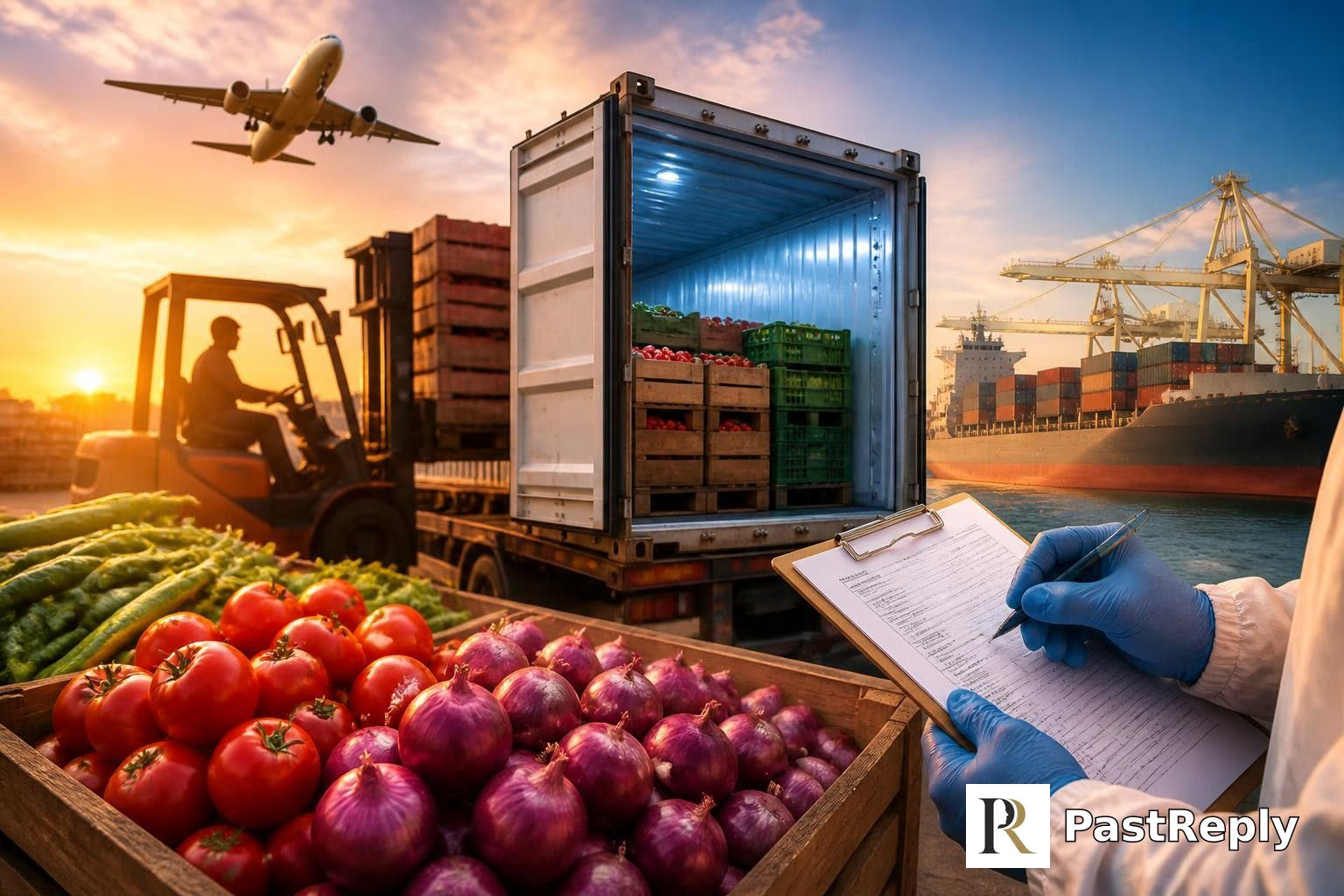
India exports vegetables through a structured process involving regulatory compliance, quality control, and logistics. Exporters must first register with the Agricultural and Processed Food Products Export Development Authority (APEDA), which is mandatory for agricultural exports. They also need a phytosanitary certificate from the plant quarantine authority to ensure the produce is pest- and disease-free, and compliance with food safety standards under the Food Safety and Standards Authority of India (FSSAI).
Key export vegetables include onions, tomatoes, potatoes, okra, and green chillies, with major markets in the Middle East, Southeast Asia, the UK, and the Gulf region. Exporters must prepare documentation such as a commercial invoice, packing list, bill of lading or airway bill, and certificate of origin. Given the perishable nature of fresh vegetables, careful handling and cold chain logistics are critical to maintain shelf life during transit.
India is the second-largest vegetable producer globally, with exports growing at a compound annual growth rate of 8.45%. In 2024-25, fresh fruit and vegetable exports reached USD 1,818.56 million, with onions, mixed vegetables, potatoes, tomatoes, and green chillies forming the bulk of vegetable exports.
Answered by 100 of history's most famous minds

Consider the merchant who fills his baskets with green chillies and okra, but does he remember the hands that watered them under the sun? The fields cry out with the labor of the poor, and the ship that carries the harvest away sails past their hunger. Truly, I tell you, unless the one who trades also feeds the one who toils, the kingdom of heaven is not in that cargo.

The honest merchant weighs the load, pays the wage, and honors the pledge made to the buyer across the sea. The earth yields its fruit by God's decree, and the one who deals fairly in what perishes does well, but the one who remembers the widow and the orphan in his profit plants a crop that never rots. Let your ledger be clean before men, and your heart clean before God.

Observe the journey of the vegetable from the field to the distant market, and you will see the truth of impermanence: it is born, it ripens, it decays, all in a span of moons. The exporter clings to the hope of freshness, yet even with the cold and the swift ships, the change is inevitable. The true skill lies not in denying this decay, but in understanding the conditions that prolong the freshness - just as one understands the causes of suffering to find its end. So do not be attached to the ideal of a flawless vegetable, but work with wisdom and care, and the trade will bring sustenance to many, without the craving for gain that binds one to misfortune.

When the Lord led us from the brick pits of Egypt, He taught us that the fruit of the land is not for hoarding but for the hungry, and that the stranger at your gate must be fed as your own. So the one who sends cucumbers and gourds to distant peoples must do so with clean hands and honest weights, tithing the harvest and caring for the traveler's path, lest the very earth cry out against the greedy. Let the cold chain be your law and the inspection your sabbath, for the Lord sees both the field and the ledger.

The export of vegetables is not merely a matter of ships and seals; it is a question of right conduct between the grower and the buyer, between the ruler and the people. When the farmer tends his field with sincerity, and the merchant carries the produce with honesty, and the inspector stamps with integrity, then the goods flow as water flows downhill - effortless, harmonious. But if any one of these fails in his duty, the whole chain breaks, and the people suffer. Thus, let each man examine his own heart first, and the vegetables will find their way.

Consider the vine, brothers: the branch bears fruit only if it abides in the true stock, and so too your green chillies and onions must be pruned of pestilence and cleansed by the quarantine officer, lest the whole cargo wither before it reaches the hungry. The bill of lading is your epistle of commendation, and the certificate of origin your testimony that this food comes from the land of plenty, not of shame. But I say, what profits it a man to export a thousand crates if he neglects the love that feeds his neighbor? Yet even in this commerce, there is vocation, for the stomach is a temple, and you fill its altars with good, wholesome gifts.

The earth yields its bounty, and the merchant sets the onion in a basket, as I set out from Ur, trusting the promise of a land I had not seen. Certificates and seals are but signs of the covenant between one people and another; the true bond is in the seed, which holds life for all nations. Even the chillies, with their fire, travel as a blessing - if the heart is right, the journey is holy.

The vine does not seek the winepress; it grows and the fruit falls. So the farmer lets the vegetable wend its way, not forcing the river but digging the channel. The papers and the stamps are the noise of the world; the life within the leaf is the Tao. Let the buyer come to the gate, and the gate opens of itself.

The onion and the potato know no caste; they ride together in the same hold, and the eye that waters weeps for all alike. The stamp of the authority is but a man's word, yet the true seal is the labor of the hands that sowed and the honesty that filled the sack. Feed the stranger at the far port and you have fed the One who made the field.

My son spoke of the mustard seed, the smallest of all seeds, yet it grows into a great tree. These vegetables, too, are humble beginnings - carried by long roads and across great waters to feed families who have never seen the fields where they were sown. I see the hands that plant and pick, and I see the hands that receive, and I see God's goodness in the journey between them. May the hungry be filled, and the workers be blessed, as He promised.

Paper, paper, paper! They want certificates and stamps and seals, and they call this 'regulation'! But where in the good book does it say a man must get a license from a board in Delhi to sell his onions? This is the work of men who love their own authority more than God's clear commands. Let the farmer trade as freely as the birds of the air; let the buyer and seller deal honestly with each other, and let not the state stand between them like a toll collector on the road to the plow.

To answer this well, one must distinguish between the natural end of a vegetable - to nourish and to propagate - and the accidental end of trade, which is the common good of human society. It is ordered and right that the abundance of one region should supply the need of another. The regulations about quality and sanitation, far from being mere burdens, are a form of prudence, ensuring that what travels is truly wholesome. So we see that reason and law here serve nature, and the whole enterprise, well-governed, participates in the order of Providence, which gives us our daily bread - and, we might say, our daily onions.

Ah, these vegetables - they are not just things to be packed and shipped, but gifts from God's hands. When a mother in the Gulf stirs a pot with an Indian onion, she is feeding her child with the love of another land. The certificates are fine, but what matters is the hands that sow and the hearts that receive. Do it all with love.

From the garden to the galley, each vegetable obeys fixed laws - of moisture, of temperature, of time. The skilful exporter, like the natural philosopher, must measure these forces and predict their course; otherwise the cargo rots, and the enterprise fails. Thus the art of preserving is but applied mathematics, and the wise man charts the decay-rate as precisely as the orbits of comets.

The movement of these tender shoots from the sun-soaked fields of Hindustan to the tables of distant lands - this is but a dance of atoms, yet behold the order within! The cargo must be treated as a system in relentless motion, where the cold chain serves as the very laws that govern the dance, preserving the delicate balance of ripening and decay. It is a problem of logistics, yes, but also of wonder - that a humble onion may traverse continents, guided by the hand of human ingenuity, much like a beam of light bending around a great star.

The expedition of these vegetables from the fields of India is a study in adaptation and selection, much like the variations I observed among the finches of the Galápagos. Some varieties, such as the resilient onion, are well-fitted to the long journey, while others, like the tender tomato, require the artificial climate of the cold chain to survive. The exporters have, through trial and error, selected the hardiest strains and the most effective methods of preservation, a kind of artificial selection guided by the steady hand of commerce. It is a beautiful, complex system, evolved over years of practice, though I wonder if the modern speed of transport might be outpacing the natural rhythm of these humble organisms.

You ask how a radish crosses the sea, and I tell you - not by the words of the ancients, who never saw a chilli, but by measurement and experiment! The wise man charts the temperature of every hold, weighs every crate, and notes the hour of sailing as he would the motion of a falling body. Let the priests of old custom prattle about tradition; I would trust my thermometer and my scale to bring the potato intact, for nature's truth is written in the numbers, not in the scrolls.

Consider how the vegetable, grown in the Indian soil, moves to the distant market - surely this, too, follows a harmonious order, like the planets in their orbits. The cold chain is the fixed sphere that preserves its freshness, and the paperwork is the geometry that confirms its path. I would urge the exporter to seek the simplest, most elegant arrangement - the shortest route, the most reliable temperature - for nature delights in what is orderly and true. Let not the complexity of man's rules obscure the simple beauty of a thing moving from where it is ripe to where it is needed.

The perishable vegetable is a problem of energy, and I have long imagined a cold chain powered not by noisy engines but by the alternating currents that flow through the very air, preserving each okra in a cocoon of oscillating fields, so that it arrives in Jeddah as if it had been picked moments before. The document trail is a primitive necessity, but in the future, a single wireless signal will certify the origin and purity of every green chilli, and the invoice will be transmitted by the ether itself. Mark my words, the container will become a crystal of coolness, and the exporter will be a conductor of nature's own harvest.

The process is one of purification: the vegetable is checked for pest and disease, then kept at a certain temperature, much as we isolate a radium salt from pitchblende. The certificates of origin and phytosanitary seals are the equations that prove the shipment's integrity. Yet I note that the grower, who labors in the sun, receives a fraction of the coin - science must ensure the produce's path, but justice should temper the trade.

If these vegetables carry the germ of a curse, the certificate is the gate that bars it. I would not trust the shine of the skin, but the lab that bids the microbe reveal itself. The cold chain is the microscope of the sea; break it, and the rot does our work. Only by such vigilance can the green leave home and arrive as green.

You want to ship vegetables? You need a cold box that don't quit and a certificate that passes. I'd build a machine to check every crate, not a man with a clipboard. The first shipment might rot - that's the ninety-nine percent. Then you fix the ice, you seal the seams, and you send her again. The buyer across the water don't care about your papers; he cares the tomato is firm.

The export of vegetables is, at its core, an information problem. The physical movement is trivial - a matter of boxes and boats - but the challenge lies in the chain of certificates, the timings of ripeness, and the thresholds of temperature that separate a saleable fruit from a rotting one. One could, in principle, encode these constraints as a series of state transitions, and then ask whether there exists a sequence of decisions that preserves the integrity of the cargo. It is a scheduling problem, essentially, and I suspect a machine could be taught to solve it better than any human clerk.

I see a shipment of vegetables as a problem of balance and motion. The crates are filled, the scales are balanced, and a vessel moves across the water - all subject to the principles of buoyancy and equilibrium that I have studied. But the true genius lies in the timing: the rate at which heat escapes a bunch of greens, the rate at which water leaves a tomato. If I could give you a lever long enough and a place to stand, I could move the entire trade. Yet I fear that for these perishable goods, the right measure of time is a more precious commodity than gold.

I see the whole affair as a chain of invisible forces - each crate of onions, a closed circuit awaiting the right conditions to travel. The cold chain is but a conductor, and the certificate of health, a proof that no foreign electricity stirs within the leaves. It is the same law that binds the star and the smallest seed: every parcel must obey the field that carries it.

Behind every crate of chillies, there is a hidden longing - the farmer's wish for a better life, the exporter's dream of profit, the consumer's craving for a taste of home. Unconscious drives, you see, propel this trade far more than any bill of lading. Ask not how the vegetables travel; ask what repressed desires compel them across the sea.

Consider the humble tomato: it travels thousands of kilometers in a controlled environment, yet the universe's own expansion is far less fussy. The cold chain is merely a localized violation of entropy, but the paperwork - that is the true singularity where time stands still. Still, it beats the alternative: a universe without onions.

I see this trade as a vast algorithm, where each document is a variable and the cold chain a constant, ensuring the equation solves before the produce spoils. The certificates are but proofs in a logical system, and the bill of lading, a function mapping origin to destination. Yet beyond the equations lies imagination - the possibility that one day, a machine might trace each leaf's journey from soil to table.

Let us define our terms: a vegetable is a perishable good, and export is the act of conveyance across a boundary. From these premises, we deduce that speed and care are necessary conditions, for a rotten tomato is no longer a vegetable but a contradiction. The certificate of origin is a postulate, and the cold chain, a lemma - all leading to the theorem that the trade succeeds only when each step is proven true.

That they send cucumbers and tomatoes across the sea in the bitter cold, yet let the baskets bruise in the hold for want of a little order - it is the same folly I saw at Scutari, where men died for lack of clean water and a counted bed. Let them wash the crates, keep the chill exact, and number every leaf as a patient in a ward. I would draw a coxcomb of their perils, and the fever of decay would flee.

What need of such fuss over roots and gourds? A true king does not haggle over onions - he seizes the port, commands the ships, and demands tribute from the lands that hunger. Let them eat from my camp stores, and let their treasuries pay for the pleasure. Conquer the sea-lanes, and the vegetables will follow like conquered provinces.

The trade of these garden spoils is a matter of conquest, not unlike my campaigns in Gaul. One must first seize the necessary writs from the granary keepers - this APEDA register - and then secure the seal of health from the plant guardians, lest the cargo be turned back at the gates. Forge your alliances with the ship-masters and the cold-room keepers, and you shall see your onions reach the markets of the East with the speed of my legions. Fortune, they say, favors the bold - but she also favors the one who has secured his stores and his routes.

Observe how the Roman granaries never go empty - they chain every vessel from the Nile's mouth to the farthest market, sealing each basket with the Pharaoh's mark and a toll on every oar. He who wishes to sell his onions abroad must first win the favor of the harbor-master and the god of the winds, for a cargo unblessed by tribute rots at the dock. I say, make yourself indispensable to the buyer's table, and let the sea itself be your courier - though I'd sooner wager on a scarab than trust a camel with my finest figs.

The grain fleets that feed Rome do not sail on hope, but on order - a decree, a registry, a steady hand at the helm of every cargo. So too must your greens travel: secure the seals of the state, fix the route, and bind the merchants with oaths, so that the gourd arrives as reliably as the legions march. For he who masters the movement of a single onion has learned the discipline of an empire, and the market, like the forum, fears only the chaotic.

A strong man does not ask how the onion travels; he asks whether the road is loyal and the men who guard it are faithful. I would put a trusted khan over every caravan, and I would cut the hand that steals or the one who lets the cold grow weak. The vegetable is a tribute to my people's strength - it must cross the desert and the sea without delay, for I do not tolerate rot or ruin. Let the certificates be swift, and the way be open, and the trade shall enrich all who serve the one true order.

I would form a Grand Army of Vegetables, with onions as the infantry and tomatoes as the cavalry, and I would march them from the fields of Maharashtra to the gates of Basra without losing a single soldier to spoilage. The cold chain is my supply line, and the quarantine officer is my sentinel, ensuring no pest breaches the ranks. A certificate of origin is worth a thousand letters of marque, and the bill of lading is my battle plan, signed with the seal of the port. There is no obstacle that cannot be conquered by organization and will - this is how empires feed their people and how commerce bends to the strong hand.

It is a matter of order and precaution: the cargo must be inspected, its health certified, and its passage documented, much as a commander reviews his regiments before the march. The onions and potatoes are no less soldiers of commerce, and the cold chain is their discipline against the trials of sea and climate. If the young republic of India conducts this trade with diligence and honesty, it shall build a reputation as firm as any fortification.

The onion and the tomato, they go out from our soil to foreign tables, and the paper trail is like the rails we laid to bind the coasts - each stamp a spike, each certificate a mile of track. But the true freight is the trust: a man in a far port must believe the hand that picked it. Without that faith, the whole consignment is but a sack of promises.

The onion sails forth like a soldier to foreign shores, and the certificate is its passport of honor. We must never let the cold chain fail, for a vegetable without ice is a division without rations. The ports of the Gulf are our allies, and the bill of lading is our treaty. Let the beast of spoilage threaten, and we shall fight it in the refrigerator, in the hold, and on the quayside.

I see a pathetic sight - our motherland, rich in the labor of her farmers, sending her bounty across the seas for a few coins, while our own people go hungry. Why do we not first feed our children, our neighbors, before we cater to foreign palates? The export of vegetables, like all trade, must be judged by whether it serves the poorest among us. Let us build village granaries and local markets first, and only then, if surplus remains, let it travel - not as a commodity of greed, but as a gift of friendship.

There is a profound dignity in the work of the farmer, who tills the soil and gathers its fruits, and when that fruit is shared across borders, it becomes a quiet ambassador of goodwill. But we must ask a deeper question: is the trade just? Does it honor the laborers who bend in the sun, or does it only enrich a few middlemen? And does it truly feed the hungry, or only the well-fed? I have seen too many systems that claim efficiency while starving justice. Let us export not only vegetables but also the principle that every worker deserves a fair wage and every hungry child a full plate.

In my years on the island, I learned that a seed does not ask the soil's name before it sprouts. So it is with these vegetables - they cross oceans not as strangers but as bearers of life, and the certificates they carry are but handshakes between nations. When a farmer's tomato brings comfort to a distant table, that is a small treaty of peace.

Exporting vegetables is a simple logistical matter, but one must always consider the strength of the nation. The Indian people send their goods across the borders, yet without a strong hand to guide them, they are at the mercy of foreign markets. Order and discipline in every crate, and the state ensures the flow serves its power. That is the only way.

The export of vegetables is a matter of state planning. Each tractor, each rail car, each certificate - all must serve the collective need. Without central direction, the crops rot in the fields while the cities starve. The Party knows how many onions must reach the Gulf; the farmer need only obey. That is efficiency.

The export of vegetables is a commodity flow, and in a capitalist world, it is distorted by profit and speculation. The workers who harvest the onions are exploited, while the traders reap the surplus. Only when the proletariat seizes the means of production can this trade serve the many, not the few. The certificates are but the chains of bourgeois bureaucracy.

Imperialist markets starve for our neighbour's onions while her peasants rot in want - that lettuce sails from Calcutta to the Gulf in cold iron boxes, past the very fields where the tiller's son eats only millet. Every green chill is a soldier shipped abroad, and the ledger pays gold to the trader, not the hand that hoed. Break the wall of the port, and the market's law of profit falls with it.

It is a marvel of our age that the humblest potato from the Punjab finds its way to a kitchen in Manchester, yet I confess I care more for the proper figure of the thing than its mere transit. One expects a certain diligence - the freight must be respectable, the papers in order, the whole conducted with the dignity befitting a realm where the sun never sets. I trust our Indian subjects manage it with becoming industry.

It is heartening to see the patient work of many hands - from the field to the quayside - carried out with quiet competence, much as the Commonwealth itself depends on such steady, unassuming labour. One notes with satisfaction that these goods travel far to reach new homes, a small but constant reminder of the ties that bind us together. I wish the growers well in their honest dealings.

By the rood, if my missi counted the carts of turnips from Aachen to Rome, they would find as much care as these Easterners give their green pods! To carry a thing that wilts a hundred leagues, one must command the roads, the boats, the cold - even the very ice - as firmly as I command my counts. A little schooling in order, and their trade shall flourish as my scriptorium flourishes, for all things live by discipline.

They pack their onions in sharp cold and trust in charters, but I say a good harvest is God's banner, and His hand guides the ship as surely as it guided my sword at Orléans. Let them pray before they load, and the leaves will stay green across the salt sea. I fear no rot, for the voices tell me the produce of a faithful land finds favour wherever it lands.

They send their green chillies to the Turk and their tomatoes to the Fleming, and I say, let them! A market open to all winds is a kingdom's best fortress - better than any wall of stone. Yet let the merchant keep his ledger as sharp as my council keeps its secrets, lest the cold chain break and the profit turn to mould. I know a thing of trade and a thing of words; both must be handled with a steady hand.

These Hindustanis show a fine commerce - their onions cross the sea in ice, a wonder of the age that would delight my Voltaire. But I ask, do they carry the learning with them? Let them pack a book of agronomy beside each crate, and they shall sell not only the fruit but the mind that grows it. Thus does trade become the civilizer, and the empire of goods leads to the empire of reason.

By Ahura, I see a wise folk who know that a full belly makes a loyal subject, and they send their roots and pods to far markets, as I sent my satraps to the four winds. Let them keep the roads open and the tolls low, and every land will bless the merchant who brings the green leaf to the barren shore. I would have my couriers learn from their cold-boxes, for trade binds what the sword can only break.

In the name of the Merciful, I see that these people feed the hungry of other lands with the bounty Allah has granted them - a deed more pleasing than the conquest of a single tower. Let them guard the trust of the cargo with honesty, paying the porter and the sailmaster their due, and Allah will bless the voyage. I have seen merchants bring figs to Damascus and apricots to Cairo; this is the true jihad, to sustain the world with kindness.

You speak of certificates and cold chains, but have you asked what makes a good exporter? Is it not the knowledge of what the buyer values, and what the seller can truly deliver? If a man knows the quality of his produce and the honesty of his ledger, he needs no seal from a far-off authority. Examine yourself, friend: do you export for gain or for worth?

Consider, my friend, the humble onion as it journeys from the field to the distant port. It exists in the realm of Becoming, ever changing, succumbing to rot and decay. Yet behind this fleeting vegetable lies the Form of the Onion - eternal, perfect, untouched by time. The exporters, in their pursuit of gain, must grasp this ideal of quality and order, lest they ship mere shadows to the tables of the world. For only by aligning their practices with the true nature of the vegetable - its rightful temper and freshness - can they achieve a harmonious trade, pleasing both the gods of commerce and the palates of men.

Every plant that leaves the soil is a substance with a cause and an end: the farmer's toil, the merchant's weal, and the belly of the foreigner. To send a cucumber across the water, one must first understand its nature - moist, perishable, and quick to decay - and so the wise arrange cooling, swiftness, and exact measures, else the virtue of the thing is lost. The golden mean here is not in the growing, but in the ordering: too much delay spoils, too little care withers, and only the balanced arrangement brings the fruit safe and sound.

The export of vegetables, like every human action, must be examined under the light of reason's universal law. Ask not merely how the onion travels, but whether the terms of its journey could be willed as a maxim for all rational beings - from the grower's soil to the distant table, each party treated as an end, never a mere means to profit. The certificate and the cold chain are but the outward forms; the moral duty is that the transaction honors the dignity of every hand that toils and every mouth that is fed.

You ask how the vegetable is exported, but the real question is whether this trade is a mere mechanical habit or a vital act of creation. Look at the cold chain - it preserves, yes, but it also deadens; it keeps the form while draining the life. I say, let the vegetable be what it is: a thing of the sun and soil, not a pawn in a ledger. The exporter who merely follows the rules is a herd animal; the one who dares to see the trade as a dance of wills - the farmer's pride, the merchant's cunning - that one is worthy of the earth.

Beneath the glossy label of 'fresh produce' lies the brutal truth: the farmer who tills the soil toils for a pittance, while the exporter, the shipper, the cold-chain monopolist siphon the surplus value, and the British housewife pays ten times the field price. The phytosanitary certificate is not a shield of health but a stamp of the capitalist order, extorting fees from the peasant who cannot sell without it. The 'structured process' is a chain of exploitation, forged in the ports and polished by the state, and only when the peasant owns the reefer and the ship will the vegetables truly travel as the fruits of free labor.

Let us doubt the apparent simplicity of this trade: the onion's freshness is not certain from the eye, but only from measurement - the temperature, the humidity, the time in transit. I would reduce each step to a clear principle: certify the origin, verify the absence of pests, and maintain a constant cold as the essential axiom. Only then can we say with certainty that the vegetable will arrive as it left, and not as a deceptive semblance.

They think the journey is a matter of stamps and inspections, but the wise exporter knows the real ship is influence. The pest certificate is a sword to keep rivals out, and the cold chain is a wall to keep your fortune in. He who controls the schedule controls the price; he who hastens the harvest on the tide grows rich while the slow man counts his losses.

The green chillie's fire, the onion's tear - such familiar players, yet their journey is a stage of mischance. A ship delayed by monsoon winds, a hold too warm, a signature misplaced, and the whole play ends in rot. Fortune's wheel turns, and the exporter must be both playwright and actor, turning perishable moments into lasting coin.

Sing to me of the voyages of these green spears, these onions and chillies, as they are borne across the wine-dark sea in wooden hulls, guided not by the wrath of Poseidon but by the cold breath of the north winds. Fierce are the guardians at the gates of commerce, demanding their scrolls and seals, akin to the thresholds of the gods that few may pass. Yet the hardy trader, like Odysseus, weaves his cunning through the straits of inspection and the reefs of decay, and his cargo, laden with the earth’s bounty, finds its welcome in the harbors of the East. For glory is won not only on the field of battle but also in the marketplaces where men trade the fruits of their toil.

Behold the great chain that binds the garden to the table - each green leaf a pilgrim on a voyage, and every voyage a test of the soul's diligence. The merchant who ships his gourds must keep a ledger as pure as the confessor's book, marking each bale with its origin and its fate, lest the pride of the harvest become the sin of waste. Yet let the buyer abroad know that the fruit carries the sweat of the field and the blessing of the sun, and if the passage is just, it shall arrive as a humble offering - not for lucre alone, but for the bond of peoples.

A living thing journeys from the Indian earth to the world's markets - how poetic, how practical! The vegetable is a striving organism, and its export is but a grand metamorphosis: from the rooted leaf to the iron ship's hold, guarded by the chill of the cold chain as if by a benevolent spirit. Yet the true art is in the harmony - the grower's care, the trader's skill, the merchant's craft - each a note in a symphony that feeds a thousand distant homes. Let us not merely move produce, but cultivate a living commerce that honors the fullness of life it carries.

Ah, the humble onion sets sail from Bombay in a wooden box, and the whole world trembles - or at least the stewpots of Muscat do. But mark you, there is no knight-errant in this tale, only a bureaucrat with a ledger and a fellow chasing a clean bill of health from the quarantine office, as if the tomato were a dragon to be certified. The true windmill here is the cold chain, and Sancho's donkey is a reefer container, yet both carry their cargo of hope and green chillies to distant tables.

I asked once, what is the use of a thousand onions shipped to London when the peasant who grew them cannot feed his own children? The cold chain preserves the vegetable, but it cannot preserve the soul of the trader who thinks only of profit and never of the hands that bent in the sun. The regulations are the commandments of the merchant, not of the Lord, and the certificate of origin is a lie, for the true origin is the labor of a man who is not paid a living wage. If you must send your harvest abroad, do it with love and justice, or stay at home and share your bread with your neighbor.

You speak of certificates and cold chains, but I see the soul of the peasant who bends over the earth, and the greed of the merchant who weighs her tomato in the dark. The vegetable travels from the field to a foreign table, but the distance is not in miles - it is in the chasm between the laborer's hands and the profit they are denied. Unless the trade is just, the export is but a new form of bondage, and I weep for the chillies that carry this unspoken suffering.

A lady sends her vegetables abroad with a letter of introduction, and the customs officer is but the stern chaperone who must approve the match. The invoice is the etiquette of trade: state your dowry plainly, and the bill of lading is the engagement ring. But for all the papers, the excellence of the tomato speaks louder than any stamp - modesty in the hold, merit on the plate.

Ah, so the cabbages take the mail-coach, do they? I see it all: the poor onion, dragged from its native soil, packed in a crate like a debtor in the Fleet, and shipped off to some distant shore - only to be inspected, certified, and stamped before it can even breathe! And the small farmer, I'd wager, is left holding the empty sack, while the great exporters in their counting-houses grow fat on the profit. It's a grand system, to be sure - if your name is not on the crate.

So the onion leaves home to seek its fortune in foreign lands. I imagine it gets a grand send-off at the port, with the dockworkers waving their hats, and then it sails off to some sheikh's kitchen, where it will end up in a stew. The whole process sounds about as simple as explaining the rules of croquet to a cat. All those papers and seals and inspections - why, a vegetable has to carry more documents than a congressman. And I bet the tomato, being delicate, is the only one that gets a first-class berth.

The vegetables are grown in the earth. They are picked by men with rough hands. They are put in boxes. The boxes go on a truck, then a ship, then another truck. That is the whole story. Anything else is paperwork. The trick is to keep the produce cold and move it fast. If the cold chain breaks, the onions rot. If the paperwork stalls, the shipment rots. In the end, it is about clean ice and clear heads. The rest is noise.

Watch the tomato, how it blushes with ripeness, and the okra's delicate fur; each tells its own tale of sun and soil. The wise exporter studies these signs as a painter studies light, choosing the hour of harvest, the breath of the cool chamber, to keep the firmness that pleases the buyer's eye. Nature reveals her secrets to the patient observer, and the one who heeds her keeps the cargo fresh to the farthest port.

These vegetables are but uncarved marble, awaiting the chisel of the master to reveal their true form. The cold chain is my mallet and chisel, preserving the divine essence of the tomato and the chilli, lest they wither before their destined table. The exporter is the sculptor, and the world is his Sistine ceiling; every leaf and stem must be coaxed to retain its heavenly form through the dark voyage. And when the cargo arrives, fresh and unbowed, it is a revelation, a glimpse of the life that God breathed into the soil.

Oh, the green of a fresh okra - it is the very color of life, of the sun beating down on the field at noon! To send such a treasure across the sea, one must pack it as one would carry a prayer - in cool, dark crates, with the breath of the earth still on it, and the hands of the women who picked it at dawn. I see the ships as brushstrokes, each a line of hope, carrying the hue of India to distant plates, and I think - what a painting that would be, the golden fruit against the blue, the sweat and the love in every stem.

They ask how the vegetable is exported, but I see it already smashed and reassembled: the onion is not a sphere but a thousand facets - a purpled cube, a green triangle, a box of angular shadows. The real voyage is in the seeing, not in the ship's hold. Paint me the invoice as a collage of stamps and seals, the cold chain as a frozen blue line, the port as a cubist city of cranes and crates. That is how the vegetable truly travels - through the eye that breaks it and remakes it anew.

At the docks in Mumbai, the light falls on crates of okra and aubergine, each green and purple catching the morning haze, and I think: this is not a product, it is a fleeting tableau of color that must be hurried across the sea before the sun shifts and the leaves wilt. The exporter is a painter of sorts, brushing the produce with preservative mist to hold the dewy freshness, yet the true art is in the timing - a race against the afternoon heat and the patient tide. And when the ship slips past the horizon, I wonder if the buyer in Dubai ever sees the same emerald glow that I once captured on canvas.

Each onion, each okra, a portrait - light falls on the skin of the tomato, and the chillies glow like a palette of the sun. The cargo leaves the brown earth of Hindustan, but I look to the faces of the women who harvest them, the sweat on their brows, the quiet dignity in their hands. The cold chain is but a shadow; the true light is in the hands that feed, and the distant tables where these vegetables arrive as a promise of life.

They wrap the okra in plastic, as if to hide its scars, but I know the truth - each vegetable has its own wounds, its own blood-red roots. The cold chain cannot freeze the sweat of the campesina who harvested them, nor the fire of the earth that ripened the chilli. Let them travel, yes, but never forget they carry the flesh of Mexico's sister land, and the world should bite them with respect, not with hunger for profit.

Ah, a cargo of vegetables is like a symphony - each piece must arrive in perfect time, or the whole performance falls out of tune! The exporter must be a conductor, balancing the tempo of the ship, the warmth of the hold, the quickness of the auction. I trust my ears, and I would trust a sharp eye and a willing spirit over all the ledgers in Alexandria.

From the soil of India, these vegetables rise like the opening chords of a symphony - onions in a march, tomatoes in a bold melody. But the music of trade is easily thrown into discord by rot and delay; only the conductor who commands the cold chain, who insists on the swiftest path and the purest condition, can sustain the harmony across the seas. The exporter is like the composer, defying the limitations of time and distance, and in the markets of the Gulf, the fresh chilli will sing its triumphant note. For even in this commerce, the human spirit can reach for the sublime, refusing the sour notes of decay.

In every garden, God has composed a fugue, with each vegetable a voice entering at its appointed time, and the harvest a hymn of thanks. To transport this chorus abroad, one must keep perfect time - the cold like a bass line, the haste like an allegro, and the care of each leaf as a subtle ornament - lest the harmony spoil into discord. The exporter is like an organist: he must know each stop, each register, and play the whole with discipline, so that the music arrives in the distant chapel pure and joyful.

Well, it's like a song, you know? You got the rhythm of the train, the cold chain keeping it cool as a Memphis breeze, and the beat of the trucks and planes carrying that okra and chili all the way to a table in London or Dubai. And the people - from the farmer with his hands in the dirt to the fella stamping the papers - they're like a band, each one doing their part to make it swing. I tell you, that onion is a star, and the whole world's ready to give it a standing ovation. Thank you, thank you very much.

It's like, the vegetables are going on a world tour, you know, a little bit of India's garden dancing its way to kitchens everywhere. I think of the farmers singing to their tomatoes, and the exporters are the choreographers, making sure every crate moves in perfect rhythm with the cold chain, so the chillies stay hot and the potatoes stay cool. It's a beautiful thing, how food can bring people together, like a song that everyone hums, from the onion fields of Nashik to the curry pots of London.

You want to know how the veggies get out? It's a bit like our music, really - gotta get the rhythm right. They put the spuds and the chillies in a box, give 'em a passport stamp, and let 'em ride the waves or the air. Cold as a Liverpool winter, they keep 'em fresh, and off they go to the Gulf or the UK, where they get a nice curry welcome. All you need is love - and a decent bill of lading, mate.

Well, you take a boxcar of onions, you put 'em on a ship, you cross the black water. But the real cargo ain't the onions - it's the waiting. The green chillies in the hold are just like the words in a song: they'll spoil if you rush 'em. The paper they give you, that certifying, that's just the gate. The fruit knows its own way to the market, like a tune knows its way to your ear.

Exporting vegetables is like releasing a song: you write it in your garden, you sign the rights, you get the paperwork notarized, and then you hope the boat doesn't sink before they hear it. But the real hook is the story - the farmer's name on the crate, the chillies that remember the sun. When it lands fresh, it's a hit; when it spoils, it's a demo nobody plays.

These spices and roots are the bounty of the Indies, sent by God to gladden the tables of princes! Let the ships sail with faith and a bold course, and the cargo will arrive, as I arrived at the shores of promise. Who fears the distance when the reward is gold and the glory of spreading God's name? Set the sail, and let the winds decide!

In the great city of Cambaluc, I saw merchants load their junks with such cargoes, the green chillies and onions bound for distant ports, but here the lands of the Indus and the Ganges send their own fleets laden with these treasures. The traders must first receive their golden tablets from the customs house, then cover the precious produce in the snows of the artifice, but not the snows of the mountains, for it is the cold of the cellars, to keep them fresh on the long journey. They shall cross the sea to the lands of the Arabs and the Franks, where the people marvel at the pungent tastes, and the merchants grow rich as the Khans themselves.

What is a voyage but a reckoning with the unknown, and what is a cargo of chillies but a small fleet to be steered through wind and wave? The captain who sends his greens to foreign ports must read the stars of cold and the currents of haste, holding his course against the mutinous heat. I have crossed ten thousand leagues for cloves; let the onion find its way to the Gulf, for he who dares the straits with a stout hull and a steady hand shall taste the sweet success of the distant quay.

It's a question of logistics, really - precision in every link, from the packhouse to the port. The vegetable's journey is not so different from a spacecraft's: you check every system, you monitor the temperature like you'd watch the telemetry, and you rely on the team - the quarantine officer, the cargo handler, the ship's crew - each knowing their part. There's no room for improvisation when the payload is perishable; you plan, you rehearse, and you execute. The success is everyone's, and the goal is simply to deliver it safely. That's the mission.

They pack those green chillies like parachutes, ready to float across the Arabian Sea, and I tell you, the real flight is the paperwork - the declarations, the certificates, the sealing of every bag as if it were a logbook before takeoff. The cold chain is their compass, and the reefer holds the altitude of forty degrees, so the tomatoes don't fall too fast. I've navigated worse with a sextant, so trust me, it's not the sea that scares you, it's the waiting on the dock when the monsoon clouds build.

When I circled the Earth, I saw no borders, only the green and brown of the land. So it is with these vegetables - they are travelers of the same kind, leaving the soil of India on a long journey. The cold containers are their capsules, and the ships and planes are their rockets. They cross the same blue seas that I saw from above, and I smile, thinking how the humble onion now explores the world.

The secret is not in the certificate - it is in the experience. From the moment the farmer picks the vegetable to the moment it sizzles in a distant pan, every step must feel fresh and inevitable. Strip away the bureaucracy, keep only the cold, the speed, and the care. Make it simple, make it beautiful, and the world will taste the difference.

The real bottleneck isn't growing the vegetables - it's the insane complexity of moving perishable goods across borders. First-principles: you need to minimize time between harvest and the consumer's table, which means you need a cold chain that's ruthlessly efficient, not some patchwork of leaks. The whole system is ripe for disruption - think AI-optimized routing, blockchain-tracked provenance, and reusable, smart packaging that senses spoilage. If you treat this like a physics problem, the answer becomes obvious: build a vertically integrated logistics network that treats freshness as a non-negotiable, like SpaceX treats reusability. The future isn't a better truck; it's a better supply-chain algorithm.

You know, every time I see a shipment of tomatoes leave India, I think of the hands that touched them - the farmer's pride, the packer's prayer, the shipper's hustle. It's not just about the cold chains and the paperwork; it's about honoring that journey, the gift of the earth, and the people who make it possible. If you're in this business, ask yourself: are you nourishing someone's table, or just making a sale? Because when you fill a belly, you fill a heart - and that is the true harvest.

They ask how the veggie leaves the land, but I say it floats like a butterfly and stings like a bee - in a cold box, on a big ship, across the sea. The onion's the champ, the chili's the knockout, and the paperwork's the referee making sure it's all fair. But here's the real deal: that farmer in Gujarat, he's the greatest, working the soil like I worked the ring. This ain't just trade, it's a victory for the people who grow it, and I say, 'Float on, okra, float on!'

The vegetables, they play the beautiful game too, you know - each onion is a player, and the exporter is the coach, picking the best team of okra and potatoes to go out and win the hearts of fans in Doha and Kuala Lumpur. The cold chain is their defense, keeping them fresh and strong until the final whistle, and the paperwork is the fair play. And when the ship scores a goal at the port, the housewives in Dubai celebrate, and I smile because it's a goal for everyone.

It's a story, see - a tale of a little green chilli leaving home to find its fortune in the great wide world. The farmers plant the seed, the sun does its part, and then the magic begins: the paperwork, the certificates, the cold boxes that keep the dream fresh. And when it arrives, it's not just a vegetable - it's a piece of India's sunshine, shareable to every family table. Now that's a happy ending worth queuing for.