
How are vegetables and fruits different?
Botanically, fruits come from flowers and have seeds; vegetables are other plant parts, but in cooking, fruits are sweet and vegetables savory.
The facts
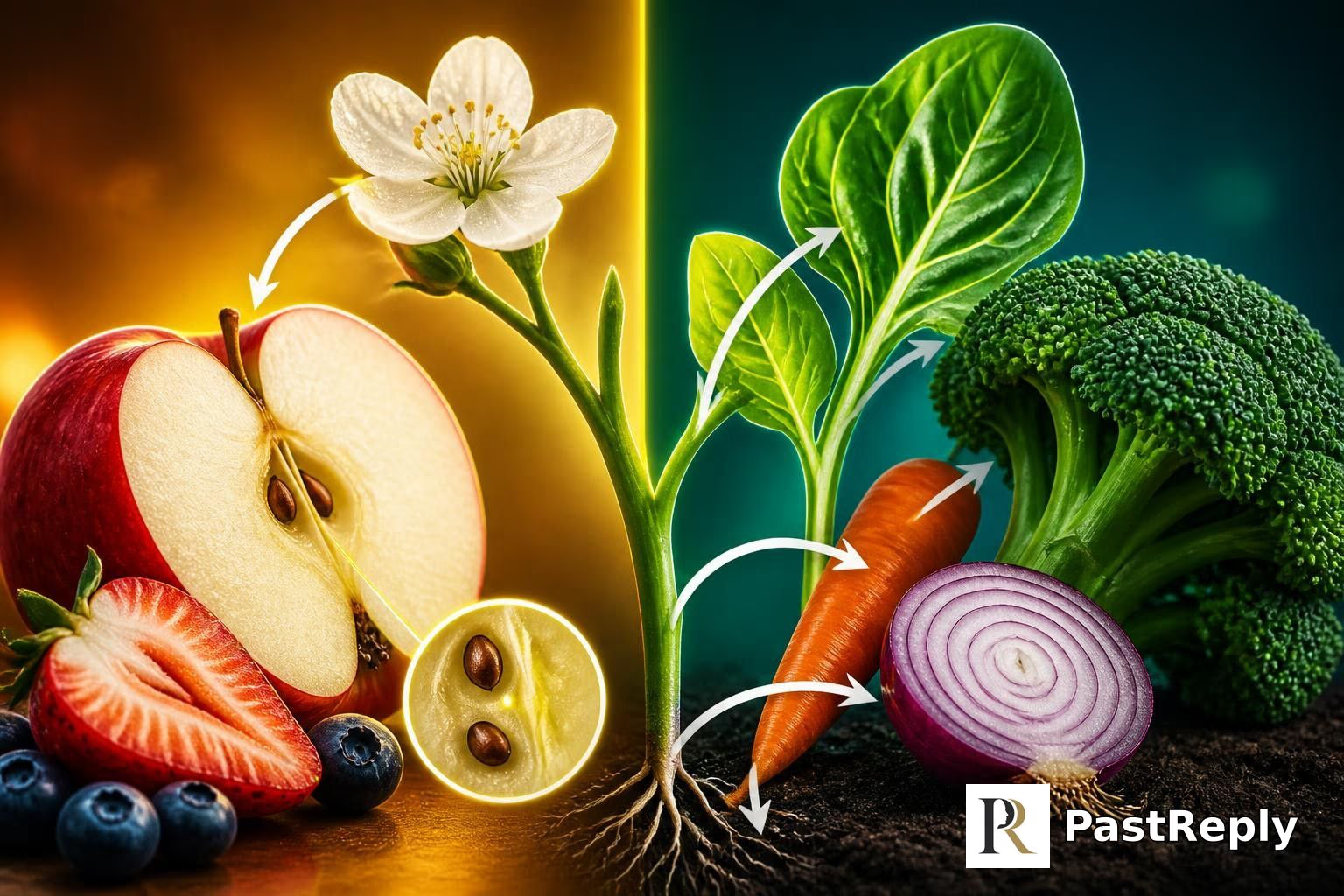
Botanically, fruits develop from the flower of a plant and contain seeds, while vegetables are other edible plant parts such as leaves, stems, roots, or bulbs. This means that many foods commonly called vegetables - like tomatoes, cucumbers, and peppers - are technically fruits. In contrast, the culinary distinction is based on taste and usage: fruits are typically sweet or tart and used in desserts or snacks, whereas vegetables are more savory and used in main dishes.
Nutritionally, fruits tend to be higher in natural sugars and certain vitamins like vitamin C, while vegetables are often richer in fiber, minerals, and a broader range of phytonutrients. However, both groups are essential for a healthy diet, and there is significant overlap in their nutrient profiles. The classification can vary by context, with botanical definitions focusing on plant anatomy and culinary definitions focusing on flavor and culinary role.
Answered by 100 of history's most famous minds

You divide the field by sweetness and seed, but my Father sends rain on both alike. Is the vine less a gift because it is pruned? Does the root of the fig tree complain that it bears no fruit? Each serves the household in its season; the question is not which is greater, but whether you give thanks for what is set before you.

God has made the earth to bear fruit and vegetable alike, each a sign for those who reflect. The fruit is the reward of patience, the vegetable the sustenance of the poor. Do not quarrel over their names; rather, eat what is lawful and give thanks. Let the wise man see in the seed and the leaf the mercy of the Sustainer.

The mango and the root both arise from the same earth, yet the mind clings to their names, craving the sweet and shunning the bitter. This distinction, like all distinctions, feeds the fire of desire - the fruit's sugar binds you, the vegetable's fiber grounds you, but both are impermanent, turning to dust. Look past the labels and see the conditioned arising; then even the apple's taste becomes a teacher of release.

When the Lord led us from bondage, He gave us manna from heaven and quail in the camp, yet He also commanded the land to yield its increase: the vine and the fig for gladness, the herb and the root for strength. Both are gifts from His hand, yet let not the sweet fruit tempt you to forget the bitter herbs of Passover, for they remind you of your affliction and His deliverance. Honor the whole of His provision, and keep His statutes.

The sage does not ask whether the apple is a fruit or the bamboo a vegetable, but rather how each serves the harmony of the table. The fruit is the sweetness of a guest's welcome; the vegetable is the strength of a family's daily meal. To call the tomato a fruit is a matter of naming, but the true name lies in its use. Know the nature of each, and you will know how to honor both your guests and your ancestors.

You dispute over seeds and roots, over sweetness and savor, as though such distinctions mattered for the soul. Yet I tell you, in Christ there is neither fruit nor vegetable, but all things are made new. The law commanded you to tithe mint and cumin, but you have neglected the weightier matters - love, mercy, and faith. Do not be entangled in debates about the palate while your brother hungers. Let every plant that grows be received with thanksgiving, for the earth is the Lord's, and the fullness thereof.

When the Most High promised me a land and descendants as numerous as the stars, I did not ask whether the vine was for sweetness or the olive for oil. Both are gifts from the same hand, blessing the table and the heart. Trust the Giver, and you will know the purpose of every green thing.

The vine does not argue whether its grape is a fruit or a leaf; it simply grows. Names are the nets men cast to catch what flows, but the Tao of the garden is one - sweet and bitter, root and bloom, all the same breath.

The One who made the mango and the mustard green did not ask them to wear a badge of caste. Both spring from the same soil, nourish the same body, and remind us that all creation is one - so why do we divide what God has joined? Let the eater be grateful, not the judge.

My son often spoke of the vine and the branch, and I pondered this at the well as I drew water. A fruit is the promise of the flower, the seed's home, sweet as the mercy of God that fills the hungry. A vegetable is the humble strength of leaf and root, the quiet bread of the field. Both are gifts from the hand that feeds the sparrow, and both remind me that the lowly are lifted and the proud are scattered, each in its season.

Scripture tells us that God gave every seed-bearing plant and every tree with fruit in it for food. The fruit is the promise of the seed, the vessel of the vine's life, while the vegetable is the leaf and root that sustain the body. But I care not for such botanical niceties when the papists twist the word of God to suit their own appetites, filling their tables with gluttony while the poor starve. Let the tomato be called what it will; what matters is that we receive all with thanksgiving, honoring the Creator who made them, not the traditions of men that separate them into ranks.

We must distinguish, as the scholastics teach, between essence and accident. A fruit is the product of the flower, bearing seed for the propagation of the species, while a vegetable is the nourishing part of the plant, be it root, stem, or leaf, that sustains the organism. Yet custom, which is a law of human usage, has judged the tomato to be a vegetable at the table, though it is a fruit by nature. This is no contradiction, for the same thing can be considered under different aspects. The prudent man, like the good cook, knows when to honor the definition and when to serve the meal, for both the fruit and the vegetable are ordained for the good of the body and the delight of the senses.

In the streets of Calcutta, a child may have only a scrap of bread and a piece of fruit, and that fruit is a gift of God's love. The vegetable in the soup of the poor is a sign of His care, but both are but crumbs from His table. We do not need to measure their worth by sweetness or leaf; we need only to see that every hunger is holy. Small acts of giving a tomato or a handful of greens are done with great love, and that is what matters.

The distinction is one of origin, not of taste. The fruit is the ripened ovary of the flower, containing the seed; the vegetable is leaf, stem, or root. Thus the tomato, the cucumber, the pepper, are fruits in the strict sense, however the cook may use them. Nature's laws are uniform; our names must follow her anatomy, not our palates.

A tomato and an apple share a deeper kinship than the cook's knife suggests; both are the ripe ovary of a flower, cradling their seeds. The botanist's lens sees one law governing all these forms, while the kitchen, guided by the tongue, draws an arbitrary line. The true question is not what they are, but which lens you choose - and whether the universe cares about your palate.

I have dissected blossoms and dug roots, and I find nature's lines are not the cook's. The fruit is the flower's transformed womb, born to scatter seed; the vegetable is the plant's own body, leaf or stem or root, grown to feed itself. Yet both are branches of one vast tree of life, shaped by the same slow hand of descent. The gardener's distinction is a convenience, not a truth - Nature mocks our tidy shelves with her endless variations.

Look to the plant itself, not to the cook's pot. The fruit is the ovary of the flower, swollen with seed, and the tomato is as much a fruit as the apple, though the kitchens of Tuscany would deny it. I have turned my glass to the heavens and seen that the senses, aided by reason, overturn the ancients; so too must the botanist trust the dissection of the pistil over the palate's prejudice.

The heavens reveal order to those who observe with patience. Just as the Sun, not the Earth, holds the planets in elegant motion, so the flower's fruit holds the seed at its heart, while the root and leaf serve the plant's growth. Many have called the tomato a vegetable, but the anatomy speaks plainly: it is a fruit, a small sun in the garden. Follow the simpler, truer design, and the confusion falls away like a discarded epicycle.

The distinction is a mere matter of taxonomy, irrelevant to the grand currents that shall one day unite the world. Consider the tomato: its seeds betray its botanical truth, yet the palate judges otherwise. This confusion arises from the imperfect senses, which I have long overcome through my inner vision. What matters is not the label, but the energy within - the solar fire stored in every leaf, the electric spark of life that animates all matter. Harness that, and you shall not need to ask whether you hold fruit or vegetable, for you will hold power itself.

The distinction is a botanical fact: from the flower's ovary and with seeds, a fruit; from leaf, root, or stem, a vegetable. It is a matter of precise observation, not of taste. Yet both are compounds of nature's lab, each with its own elements and energies. One must not confuse the palate with the microscope.

Let the cook and the botanist duel with their knives and latin; I ask only for the microscope. The seed of the fruit is the promise of life, the leaf of the vegetable a leaf's own task - both are laboratories of nature, and in their cells lie the secrets of nourishment, awaiting the patient observer.

The difference is just a matter of how you use it - fruit for the sweet tooth, vegetables for the grind. I’d say it’s like invention: the phonograph and the light bulb are both born of the same workbench, but you don’t eat either one. What counts is whether it lights up your life or fills your belly; the rest is just bookkeeping.

Consider this a classification problem, and a slippery one at that. If we define a fruit as the mature ovary of a flower, then the tomato, cucumber, and squash are fruits, while the potato, a swollen stem, and the carrot, a root, are not. But the culinary scheme is a separate formalism, built on taste and usage, not on structure. It is as if one insisted that a number be classified by its sound rather than its value. The ambiguity is inevitable when two criteria clash; perhaps a machine could be taught to sort them, but it would need to know which rule you favor. I suspect the gardener and the cook will never agree.

Let us measure, not quibble. The fruit is the seed's vessel, a sphere or an ovoid, often approximating the perfect geometry of a circle or a cone, while the vegetable is a leaf, a stem, or a root, irregular in form and fit for the earth. If you give me a lever and a place to stand, I can weigh a cucumber against a tomato and show you their densities, but the true difference is not in weight but in origin: the fruit is the flower's promise, the vegetable the plant's labor. Both obey the laws of nature, and with geometry I can demonstrate why the apple falls and the potato grows beneath, but I leave the tasting to the cooks.

When I hold a green leaf in one hand and a ripe apple in the other, I see two laboratories of nature. The leaf takes sunlight and air and builds itself, while the apple begins as a blossom's swelling ovary, a vessel meant for the seed's journey. Yet we must be cautious with our names - a cucumber, which we call a vegetable, is in truth a fruit, for it springs from the flower and bears seeds. The true distinction lies not in our taste but in the plant's own architecture, and I would rather trust the structure than the palate.

We call a tomato a vegetable, but botanically it is a fruit - a ripe ovary hiding its seeds, a symbol of concealed desire. The sweet pear we treat as dessert, yet it is no more than a fleshy vessel for propagation, just as our cravings mask deeper urges. Behind the culinary labels lie hidden instincts: we sour on vegetables because they recall bitter weaning, while fruits reawaken infant sweetness. The distinction is not nature's but our own repression, a tablecloth thrown over the reproductive truth.

From a cosmic perspective, both a tomato and a potato are merely arrangements of atoms, yet the fruit carries a reproductive purpose while the root is a storage device. The botanist sees a flower's ripened ovary; the cook sees a savory ingredient for a pasta sauce. But do not be fooled - classifications are human inventions, and the universe does not care if your cucumber is a vegetable or a fruit. The only distinction that matters is whether it ends up on your plate, preferably with a good dressing.

A fruit is a flower's promise fulfilled, a seed wrapped in sweetness as if to entice a creature into carrying its future. A vegetable is the plant's own body, the leaf or root that sustains the whole. Yet I see a deeper analogy: the fruit is the output, the visible result, while the vegetable is the mechanism, the working parts. In my imagined engine of symbols, one might say the fruit is the number, the vegetable is the operation that transforms it. Both are necessary, but the true genius lies in understanding how one becomes the other.

Let us define our terms precisely. A fruit is the mature ovary of a flower, containing seeds, while a vegetable is any other edible part: the root, stem, or leaf. Thus a tomato is a fruit by definition, however our taste may mislabel it. From these agreed premises, the conclusion follows with necessity, and no custom of cooks can overturn the proof. In geometry, we do not call a triangle a square because it pleases a king; so in botany, we do not call a fruit a vegetable because it is served with salt. The distinction is evident, demonstrable, and final.

Botanical distinction is a matter of observation, but the nurse's question is of nourishment and of the scourge of scurvy. In my wards I saw the sick wither for want of fresh greens and the tart fruits of the tree; measure their vitamin C, count the cases of night blindness among the poor. The gardener's pedantry is nothing beside the diet that restores a soldier to his post - let us classify by what saves life, and feed the hospitals accordingly.

Why do you quibble over roots and blossoms? A soldier does not ask whether his bread is wheat or barley when he must march. Taste the sweetness of the peach, and the sharp bite of the onion - each has its use in the feast, as each nation has its strength in my empire. Do not let the steward's ledger rule the king's table.

Let the cooks quibble over sweetness and savor; I have conquered lands where the vine bears fruit that the vulgar call a vegetable. The distinction is a matter of command, not nature - what serves the feast is a fruit, what fills the legions' pot is a vegetable. All else is the chatter of market women while the world is won by those who act.

In the gardens of Alexandria, I have seen the fruit of the vine offered to Isis, and the humble onion laid at the feet of a peasant. Both nourish my people, yet the sweet fig tempts the palate while the bitter herb fortifies the body. Rome, too, knows this: they seek my Nile's grain, but it is my diplomacy, my cunning, that is the true fruit of my reign.

In the marketplace of Rome, the fruiterer cries his wares and the greengrocer his roots, yet both serve the same purpose: to sustain the people who sustain the state. I have learned that a prince must know the difference between what pleases and what strengthens - the fruit for the celebration, the vegetable for the legion's ration. So do I govern: offering the games to delight the mob, but building the aqueducts and roads that endure.

In the saddle, we eat what the steppe provides - milk, meat, and whatever grows. I care not what name a scholar gives to a plant. A fruit is sweet, good for a warrior's energy; a vegetable fills the belly before battle. But a man who cannot tell a berry from a root is a fool who will starve. Know your provisions, and let the classification follow action. The greatest empire is built on sturdy horses and a full stomach, not on the labels of idle men.

Let us not quibble like schoolmasters over seeds and roots. In the field of battle, a soldier eats what is before him and asks no question. The fruit gives sweetness to the weak, the vegetable gives strength to the strong. Both are provisions, and provision is the mother of victory. I did not conquer Europe by asking whether the apple was a fruit or the turnip a vegetable - I commanded that my armies be fed. So, too, should you command your kitchens: feed your people well, and they will follow you anywhere.

It is a matter of order and use. The fruit, sweet and inviting, may be eaten out of hand, while the vegetable, with its more sober character, is better suited to the pot and the table. Both are necessary for the sustenance of a nation, as liberty and law are both needful for a republic. Let us not quarrel over names but be thankful for plenty.

I reckon a turnip and a peach differ more in opinion than in kind - one’s a root that fed the frontier, the other a jewel of the orchard. Yet both spring from the same good earth, and a nation that quarrels over such a line while its fields go untilled has lost the plot of its own making.

A fruit is a diplomatic triumph - sweet, agreeable, and best served after the battle. A vegetable is the stubborn infantry of the table: plain, necessary, and good for what ails you. We do not ask which is braver, for both are indispensable to the victory of a well-fed nation, and he who scorns the carrot shall find his appetite undefeated.

The fruit and the vegetable are not so much different as they are complementary, like the branches of a tree and its roots. One offers sweetness and color, the other sustenance and fiber; both come from the same earth, nourished by the same sun and rain. But I see a deeper lesson: the fruit, in its ripeness, holds the seed of tomorrow, while the vegetable, in its humility, supports the body today. We need both, but let us not forget the simple truth that a balanced life, like a balanced meal, must embrace the diversity of God's creation without greed or excess.

The fruit and the vegetable are one in the garden of God, yet we have divided them by the color of their skins and the sweetness of their flesh. The fruit, with its bright hue and hidden seeds, speaks of the promise of new life, while the vegetable, sturdy and unassuming, sustains the body with quiet strength. But I see a deeper truth: we are all fruits of the same vine, or vegetables of the same soil, and the distinctions we cling to are but shadows of a brighter unity. Let us not judge the tomato by its place in the salad, but by the nourishment it brings, for the arc of the garden bends toward justice for all who hunger.

I have walked long roads where a simple potato was a luxury, and I know that neither fruit nor vegetable can be dismissed as lesser. The fruit satisfies a quick hunger with its sweetness, while the vegetable builds strength for the long march. They are not rivals but companions in the garden, each with its own purpose, and together they sustain a people. Let us not quarrel over which is more noble, for both are essential to the feast of life.

One must recognize that the fruit is the product of the plant's flowering, the seed-bearing culmination of its life, while the vegetable is merely the supporting tissue, the root or leaf destined for consumption. In nature, hierarchy is clear: the fruit carries the future, the vegetable serves the present. So too must a nation distinguish between the vital elements that propagate its strength and those that merely sustain its daily existence, and order its priorities accordingly.

The fruit is the proud showpiece, the vegetable the humble worker. A fruit may be sweet, but it is also fragile, and too much sweetness rots the will. The potato, the cabbage, the beet - these are the food of the masses, the staples that fill the stomach and build the state. Do not fuss over categories; what matters is which crop feeds the collective. Let the capitalists enjoy their oranges; we will take the wheat and the turnip, and grow strong.

The distinction is a bourgeois distraction, a taxonomy that serves the interests of the orchard owner and the market. The fruit is the product of the land, the vegetable the labor of the soil, and both are monopolized by those who own the fields. The worker does not ask whether a tomato is a fruit or a vegetable; he asks whether he can afford to eat. And the answer, under capitalism, is no. Only when the means of production are seized will the people eat both, and the question will be settled by need, not by botanical pedantry.

So the botanist says the tomato is a fruit? Let the gardener sort his seeds as he pleases - the cook who puts the tomato in the wok knows it is a vegetable, just as the peasant knows revolution is not a dinner party. These labels are the toys of scholars who never held a hoe; what matters is who eats, and who goes hungry. Let the capitalist count his fruits in the market while we plant the roots that feed the commune!

One might as well ask the difference between a duchess and a dairy maid: the one is sweet to the taste and graces the table at a state banquet, the other is plain, serviceable, and the backbone of the household. In the gardens of Osborne we grow both, and know each by its proper use. The botanist may prattle of ovaries and seeds, but the kitchen and the dining room are the true judges - and they have never mistaken the cucumber for a peach.

In my long years I have seen many distinctions drawn, some sharper than others. The fruit is a gift of the summer's bloom, the vegetable a humble root or leaf; each has its season and its place at the table of the Commonwealth. We dine on the one as a treat, and on the other to sustain us - and both, I think, serve the nation well enough.

Let the scholars of the palace parse the growth of the vine, but the steward of a kingdom knows that the apple and the onion both fill the belly of the warrior. We must teach the boys in the cathedral schools the names of the plants, for a land that cannot tell its own harvest is a land without order. Yet let us not forget that the Lord gave us both for the table, and woe to the bishop who condemns the one while praising the other.

The Good Lord made the apple sweet on the tree and the cabbage firm in the earth, and both are His gifts to the faithful. I did not ask the bishop whether the tomato was fruit or vegetable when I rode to raise the siege; I ate what the farmwife gave me and gave thanks. Such questions are for the clerks at court, not for a maid who follows her voices - let them argue the seeds while I follow the banner.

As I have often said, I do not wish to make windows into men's souls - nor, I might add, into their gardens. The fruiterer and the greengrocer each claim their wares, and I would not deprive either of their trade. The strawberry on my table is a fruit by any name, but the carrot that feeds my horses is a vegetable; let the botanist prate of stamens while I enjoy the sweetness and the sustenance both, and keep my realm well fed.

The philosophes of Paris would have us distinguish by the anatomy of the blossom, but my cooks at the Winter Palace know better: the fruit goes to the dessert course, the vegetable to the roast. In Russia we have learned to bend nature to our will - we have brought the peach to the Neva's banks, and turned the humble turnip into a dish fit for an empress. Let the scientists classify, but the art of the table is the true science of a civilized court.

In the orchards of Pasargadae, the pomegranate and the date hang heavy, while in the fields below, the onion and the lentil grow - each has its purpose and its people. I have learned that a great empire is like a garden: it must hold both the sweet and the savory, and honor the customs of every tribe that tills its soil. Let the botanist count the seeds, but the king who rules many peoples knows both are nourishing, and neither is to be scorned.

Praise be to God, who made the fig sweet for the breaking of the fast and the cucumber cool for the traveler in the desert. The scholars dispute the origin of the seed, but the faithful know that Allah provides for the body as He provides for the soul - and both fruit and vegetable are gifts from His bounty. Let the wise man eat of both with gratitude, and let the fool quarrel over names while the table is spread.

You call the tomato a vegetable, yet the botanist calls it a fruit. What then is it truly? Before you answer, consider: did you ask to know the nature of the thing, or to settle a dispute over the evening meal? The important question is not what name you give the tomato, but whether you have examined the grounds on which you name it at all.

The tongue tastes but the mind must discern: behind each apple and each root lies an eternal Form, perfect and unchanging, of which the earthly morsel is but a fleeting shadow. The cook mistakes the sweet for the fruit, the savory for the vegetable, yet the philosopher knows that true knowledge lies in grasping the essence, not the flavor. So ask not what the market calls them, but what the Idea of Fruit and the Idea of Vegetable reveal to reason.

Consider the essence: that which springs from the flower and bears seed is the fruit, by nature's design; the leaf, the root, the stalk are but instruments of the plant's sustenance. Yet our tables, governed by custom and taste, demand another division - sweet to the dessert, savory to the feast. Thus we hold two truths: one of the field, one of the palate, each fitting its purpose, as virtue fits the mean between extremes.

The distinction is not for the palate to decree, nor the cook's pot, but arises from the universal law of nature - the fruit from the flower, the seed-bearer; the vegetable from root, stem, or leaf. If one acts on inclination rather than principle, one errs. Yet, the true duty lies in recognizing each by its own nature, for a categorical imperative demands we treat all beings as ends, not merely as means for soup or dessert.

You ask me to distinguish what your palate already knows - a fruit's sweetness, a vegetable's earth. But this is a slave's question, a taxonomist's dullness. The fruit is the plant's triumph, its reckless generosity of seed; the vegetable, its patient hoarding. Both are masks of the will to power, but you, the eater, must affirm your own taste. Do not bow to the botanist's law - you are not a herbarium. Create your own meal, your own values, and call the tomato what you will.

This botanical pedantry is a bourgeois contrivance to obscure the real relations of production. Beneath the labels 'fruit' and 'vegetable' lies the labor of the peasant who tills the soil, the worker who harvests, the merchant who profits. The tomato is a fruit in the botanist's garden, but a vegetable in the capitalist's market, priced and sold to sustain an exploitative order. Break the false categories, and you will see the chains. The true division is not between apple and cabbage, but between those who eat and those who starve.

I doubt the common definitions, for they rest on mere appearances. The essence of a fruit lies in its origin from the flower and its role in propagation - this I can conceive clearly. A vegetable, being any other edible part, is a less distinct notion. Thus, I would define fruit as the seed-bearing product of a plant, and vegetables as all the rest, by reason and clear thinking, not by taste.

In the garden of state, the fruit is the sweet promise to the people, the vegetable the hard root of necessity. A wise prince knows when to present the apple and when to serve the carrot, for the distinction is not in the seed but in the hand that offers it - and the appetite it seeks to satisfy.

The fruit is a sweet impostor, wearing the guise of a vegetable to hide its sugar, while the vegetable, honest in its green, is scorned for its plainness. Yet both deceive: the apple tempts with its blush, the carrot hides its sweetness in the earth. So too do we judge by appearance, and miss the essence within the husk.

As the gods bestow the vine's purple cluster for the hero's feast, so the earth yields the root for the common stew - each a gift from Demeter's hand. The apple, shining like the strife-bringing fruit of Eris, and the onion, humble as the soldier's ration, both spring from the same soil, yet fate has marked them for different tables. Mortals may wrangle over names, but the blessed gods know the true lineage of every shoot.

In the garden of Paradise, the apple of knowledge bore the seed of our fall, yet the root of humility grows in the dark earth. The fruit tempts with sweetness, a synecdoche of desire, while the vegetable, plain and sustaining, mirrors the soul's daily bread. So does the moral order divide: the one a foretaste of bliss, the other the toil of the journey toward the celestial rose.

Ah, the gardener's wisdom: the vine's sweet grape clings to the shoot, while the earthy carrot hides its virtue below. Both are parts of one living whole - the plant striving upward, the root anchoring deep. But why divide them with a knife? Taste the sun in one, the soil in the other, and let each nourish the spirit in its own manner. The whole plant, like the whole man, is a unity of opposites.

Ah, the question of the fruit and the vegetable! It is a quarrel worthy of the knight of La Mancha himself, who would see a tomato as a damsel in distress and a carrot as a fearsome giant. The botanist, with his scalpel, declares the tomato a fruit, while the cook, with his kettle, insists it is a vegetable. Each is right, each is wrong - like windmills that are both windmills and giants, depending on the eyes that behold them. So let us eat, and marvel at the glorious confusion of this world.

What matter the seed, when the soul is hungry? The peasant who eats his cabbage and the lord who savors his peach - both are nourished by God's earth. Yet we torment ourselves with distinctions, as we torment ourselves with titles and possessions, forgetting that all is given. The fruit and the vegetable are but siblings in the same garden, each teaching us gratitude and simplicity. Let us not ask how they differ, but rather, how we may share them with our brother. For in the breaking of bread, there is no question of name - only of love.

The tomato wears the mask of a vegetable but secretly holds the soul of a fruit - such is the deceit of appearances! Yet in this deception lies a profound truth: we are all mixed, sweet and savoury, tasting of both paradise and earth. Do not judge by the label, for the heart of a thing is known only through love and suffering.

A strawberry may boast of its lineage, yet a potato asks only to be judged by its conduct at table. The botanist’s pedigree is one thing, but a lady knows that a cucumber, however well-bred, must never presume to sit at the dessert course - propriety, like taste, is a matter of manners, not of birth.

Ah, my dear, you ask of fruits and vegetables as if they were two species of gentleman, but the world knows better. Observe the tomato - a fine plump fellow, bursting with seed and juice, yet society calls him a vegetable, and he accepts the indignity with the meekness of a debtor who knows his creditors too well. Meanwhile, the pumpkin, a veritable giant of the vine, is served in pies and puddings, while the humble potato hides beneath the soil, pretending to be a root when it is, in truth, a stem. Mark well: the botanical truth is as plain as the nose on a magistrate's face, but the culinary custom is a tyrant that cares not for truth, only for the taste of the dinner plate.

Well, sir, I've known a tomato that was proud to call itself a vegetable, and a rhubarb that had the nerve to be called a fruit when it was good for nothing but a pie that would curl your toes. The botanist says a fruit is a seed-bearing case, but the cook says it's anything that goes with sugar. If you ask me, it's all a matter of who's doing the defining, and both are lying to you. A cucumber is a fruit if you're a botanist, but a vegetable if you're hungry and don't want your salad to sound fancy. The truth is, you can find a friend in a carrot and a foe in a peach, depending on how you treat them.

A fruit is a seed's way of getting a ride. A vegetable is just a plant's gut. You eat them both and they keep you alive, but there's no shame in a potato, and no glory in a strawberry either. The difference is in the doing, not the naming. I've seen men starve on a diet of words about the difference, while a field of turnips saved their lives. Call it what you like, but eat it and move on. The earth doesn't care if you call a tomato a fruit; it just grows and you harvest. That's enough.

I have dissected both; the fruit bears the seed within its flesh, and the vegetable is but a leaf or root that feeds the plant. Yet in the market, they are divided by the tongue, not the eye. Observe the cucumber: it is a fruit by structure, but the cook treats it as a vegetable. Nature does not concern herself with our kitchens.

In the garden of the Lord, the fruit is the ripe promise, blushing with the sun's kiss, while the vegetable lies hidden in the earth, a quiet strength shaped by shadow. I see in the apple the perfection of form, in the root the patient labor of creation - each a divine sculpture awaiting the chisel of the eye. The cook's labels are but dust; what matters is the beauty that shines through both.

I have painted the sun-drenched orchard where peaches glow like embers, and the furrowed field where potatoes lie hidden like humble treasures. The fruit catches the light and cries out its joy; the vegetable keeps its secret in the soil, patient and earnest. Both are living color, but the fruit sings of the summer's passion, while the vegetable whispers of the earth's enduring strength - and I must capture both, or my soul starves.

A tomato? A fruit? Ha! I could paint it as a hammer, and it would be true. The botanist's rule is but one way of seeing - I see with a hundred eyes. The fruit is a seed's dream; the vegetable, a root's labor. But art does not ask what a thing is called; it asks what it can become. I would break the apple into cubes and the carrot into spheres, and you would taste the difference, yet both are but forms on my canvas.

Observe how the light plays upon the skin of the apple, how it gathers in the hollow of the leaf, how the green of the bean shifts to violet in the shadow. The botanist names their parts, but I see only the dance of color and shadow, the fleeting moment when the sun kisses the pear and it glows like a jewel. A fruit is a burst of sunshine, a vegetable a quiet earthiness - but both are merely excuses for the eye to caress the world.

When I paint a tomato, I do not ask whether it is a fruit or a herb; I look for the way light falls upon its skin, the shadow it casts, the life it holds. You may call it what you will, but the truth lies in the form and the feeling - much like a face that reveals its soul through the play of light and dark.

What does it matter if you call it a fruit or a vegetable? My own body is a garden of thorns and blooms, both bitter and sweet. The tomato, like my heart, is red and full of sun, yet often served with tears. We are all rooted in the earth, and we all bleed the same colors. So eat, and feel, and do not fear the naming.

Ah, but the fruit sings a melody of sweetness, while the vegetable plays the grounding bass of the earth. In a symphony, both are needed - the tart apple to lift the spirit, the sturdy beet to anchor the tune. So let the cook conduct: the tomato may be a fruit by nature, but in the sauce, it is a vegetable by art.

Ha! The cook's rule is a tyrant's law, but Nature composes her own symphony - the fruit sings a bright andante, the vegetable a grounded adagio, yet both rise from the same soil's theme. I have heard the universe's harmony in a single ripened berry and in the stern root's low drone; the distinction is but a pause in the score. Let the palate judge, but the spirit knows the echo of the divine in every note.

In the score of creation, the fruit is the bright treble that dances above the staff, the vegetable the steady bass that grounds the harmony. Each has its part in the divine fugue: the one offers sweetness to the ear, the other substance to the feast, and neither may be exchanged without discord. So I tune my life to this counterpoint, honoring both the flourish and the foundation, for all is ordered by the Master's hand.

Well, bless your heart, honey - back home in Tupelo, we didn't fuss over such things. A peach from the tree was sweet as Sunday morning, and a turnip green from the garden was supper. But I tell you, when I bit into a tomato, I thought it was a fruit, and Mama said, 'Elvis, that's a vegetable,' and I said, 'It's all good, anyway.' It's like gospel and blues - different flavors, but they both move your soul.

You see, it's like a song - the fruit is the melody, sweet and bright, the one that makes you want to sing along. The vegetable is the rhythm section, grounding it, giving it depth, keeping it real. You need both to make the music whole. And in the garden of life, they're all part of the same beautiful groove, dancing together in the light. Hee-hee.

Well, you see, a tomato can be a cheeky chappy in the garden, but once it's on your plate with a bit of salt and pepper, it's a veggie, innit? But a strawberry? That's a proper rock star, sweet and ready for a show. It's all about the vibe, not the botany. Love, not labels, that's what matters.

A tomato's a fruit that thinks it's a vegetable, like a man in a fruit suit singing the blues. Botanists count the seeds, cooks count the taste, and I count the metaphors - they're all just ways to avoid the question of what you're really hungering for.

You can call a tomato a vegetable all you want, but in the end, it’s got the seeds of a fruit, just like I’ve got the heart of a songwriter no matter what they label me. Labels are for other people’s convenience - what matters is what you grow into, and whether you’re sweet enough to make someone’s day or savory enough to make dinner unforgettable.

I sailed westward for spices and gold, and found lands where strange fruits and roots grew in abundance - the tomato, the maize, the chili. The botanists quibble about names, but I care only for what is useful: feed the crew, fill the hold, and claim the soil for the crown. Whether it be fruit or vegetable, it is a treasure.

In Cathay, I saw orchards where the peach hung heavy as a lantern, and gardens where the turnip grew thick as a camel's leg, yet the wise men there called them both by one name, for they served the same bowl. The merchant's trade takes no heed of such niceties - what sells sweet at the bazaar is fruit, what fills the stew pot is vegetable. I have crossed deserts where a dried apricot was treasure, and a humble onion a king's ransom, so I say: let the botanist argue, while the traveler feasts.

When I charted the strait that bears my name, I knew the difference between the sweet provisions that spoiled and the salted meat that endured the long crossing. The fruit is a luxury for calm harbors; the vegetable, a necessity for the tempest's lull. So too in leadership: the bold plan is the fruit that tempts, but the patient ration of discipline and endurance is what carries the fleet to the Spice Islands.

From orbit, you can't tell a fruit from a vegetable. You see the green patches, the brown fields, but the distinction belongs to the ground, to the careful work of tending. We focused on the mission - the technical details, the checklist. If a cucumber is a fruit, that's a fact for the botanists, not the flight plan. But I'd say both are essential supplies for any long journey, whether to the Moon or across the kitchen.

When I was learning to fly, I didn't ask whether the clouds were fruit or vegetable - I just soared through them. A tomato in a salad, a tomato in a pie - who cares what you call it? The real question is: does it fuel your adventure? Does it give you the energy to chase the horizon? Don't let labels weigh you down. Eat the colors, take the risk, and fly.

From up there, I saw the Earth's blue and green, a garden of wonders. Down here, we fuss over whether a cucumber is a fruit or a vegetable - ha! From orbit, it's all just life, beautiful and fragile. We should enjoy the sweetness and the savor, whatever the name, for the Earth is a grand salad and orchard combined.

You ask the wrong question. The difference is not botanical or culinary - it's emotional. An apple is an experience, a moment of delight; a carrot is fuel, utility. In design, we want the fruit: something so intuitive you forget it's there, so beautiful you want to touch it. The vegetable is the spec sheet; the fruit is the product.

First principles: a fruit is a plant's reproductive strategy - seeds, sweetness, and color to attract dispersers; a vegetable is its survival kit - roots, leaves, stems for storage and photosynthesis. The culinary split is just a legacy hack, a naming convention from before we understood biology. If we're optimizing for nutrition and planetary survival, we should engineer crops that blur the line entirely - lab-grown nutrient factories, not these arbitrary categories.

You know, I've sat with farmers and with queens, and they all tell me the same truth: the fruit is the showstopper, the one that gets the applause, but the vegetable is the backbone that keeps you going. It's like life - you need both the joy and the grit. And here's the thing: we don't have to choose. We can make a feast of both, and that's the real lesson - embrace every part of your harvest, and share it generously.

I'm the greatest, and I'll float like a butterfly, sting like a bee - but I ain't no fruit, and I ain't no veggie. I'm a champion, a warrior. You ask me the difference? A fruit is sweet like my jab, quick and sharp, but a vegetable is strong, like my right hand. The botanist says a tomato is a fruit, but I say if you put it in a salad, it fights like a vegetable. I float, I sting, and I don't care what you call it - I'll knock it out.

In football, you have the strikers - the fruits, sweet and flashy, scoring the goals. And you have the defenders - the vegetables, strong and steady, doing the hard work. But you know, my friend, the team is nothing without both. A goal without a good pass is just a shot in the dark. So whether it's a mango or a carrot, it's all part of the beautiful game of life. Give it your all, and play with joy.

A fruit is like a fireworks display - bursting with color and sweetness, a joy to the senses. A vegetable is the sturdy foundation, the backbone of a good meal, like the magic of a well-told story. But here's the secret: they both come from the same magical garden of imagination. Now, let's build a castle out of broccoli and dance with bananas!