
How are severe thunderstorm warnings issued?
Severe thunderstorm warnings are issued when radar or spotters detect winds ≥58 mph or hail ≥1 inch, prompting immediate shelter.
The facts
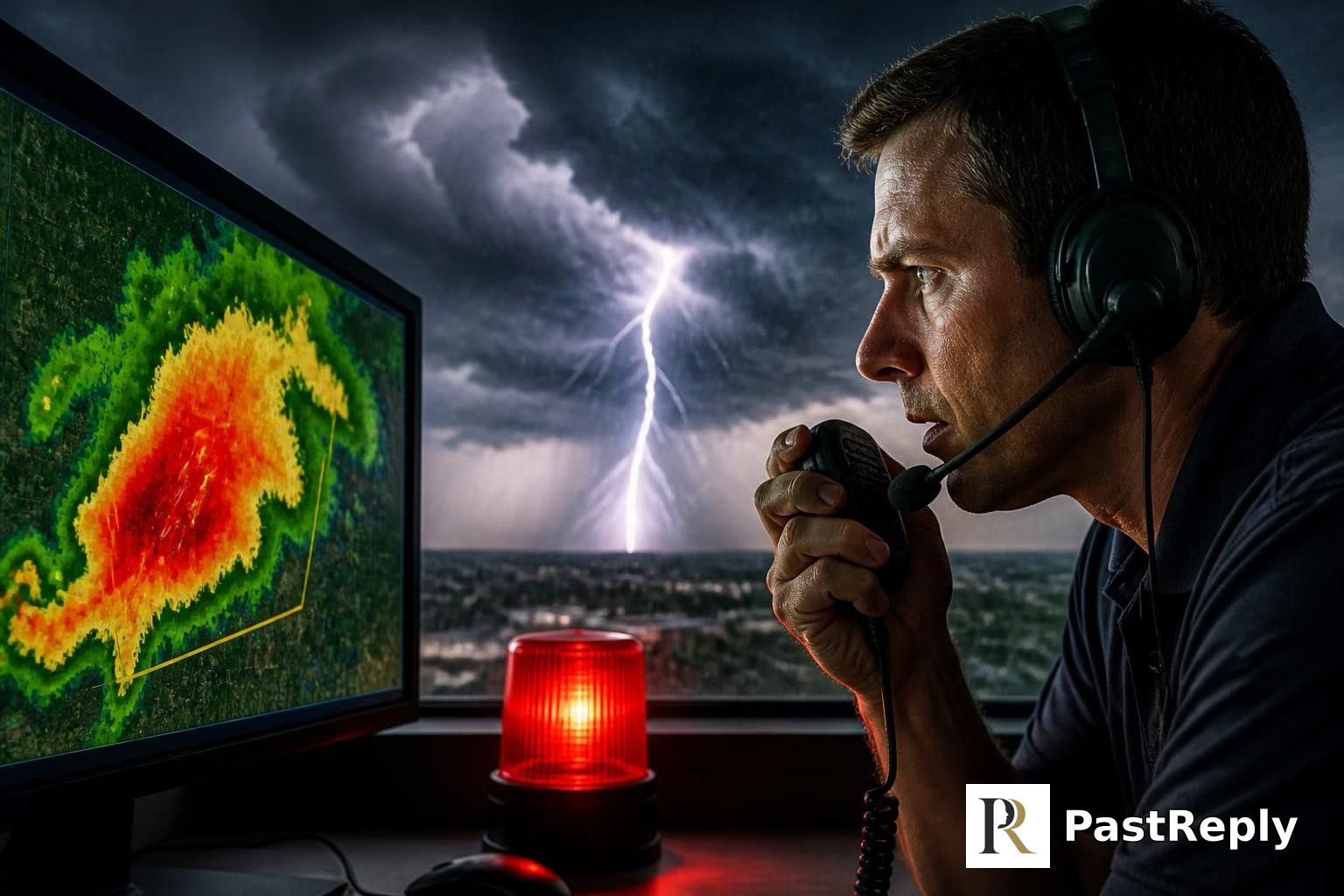
Severe thunderstorm warnings are issued by national weather forecasting agencies when a severe thunderstorm is detected or reported. In the United States, the National Weather Service (NWS) issues these warnings based on specific criteria: a thunderstorm producing wind gusts of at least 58 miles per hour (93 km/h) or hail of at least 1 inch (2.5 cm) in diameter. Detection methods include Doppler weather radar, observations from trained weather spotters, or reports from emergency management, law enforcement, or the public.
When a severe thunderstorm is indicated by radar or a reliable report is received, the NWS issues a warning for a relatively small area, typically the size of a city or small county, that is expected to be impacted. The warning is disseminated through various channels, including NOAA Weather Radio, local broadcast media, and wireless emergency alerts, to prompt immediate protective action. If a tornado is detected, a tornado warning may be issued instead of or in addition to the severe thunderstorm warning.
It is important to distinguish a warning from a watch: a severe thunderstorm watch means conditions are favorable for severe thunderstorms over a larger area, while a warning means a severe thunderstorm is occurring or imminent and requires taking shelter.
Answered by 100 of history's most famous minds

A man hears the sky roaring, his father's voice, and flees to the hollow of a rock. You make a trumpet call of wind and ice, warning the village to shelter their lambs and their little ones. But what of the widow whose roof will leak, or the stranger with no cellar to crawl into? Your warning is a good servant, but a poor master if it leaves the poor to the storm alone.

Your watchers on the high places see the cloud gathering, and they cry out to the people to take shelter. This is a mercy, for God sends the storm to remind men of His power, and the warning to preserve their lives. Yet let the warning be truthful and not false, for a lie in such matters is a betrayal of trust. And remember: the final warning is the Qur'an itself, for the Day of Judgment is a storm no shelter can escape.

The storm arises from the meeting of wind and moisture, neither of which has a self to cling to. The warning is a compassionate act, like extending a hand to one who stumbles - it is useful, but it does not touch the root of suffering. For even if one shelters from the hail, the mind still shelters itself with delusion. Let the siren sound, yes, as a skillful means to protect the body from harm. But also recognize that the storm of craving, which brings more destruction than any gale, goes unwarned yet can be pacified by the Eightfold Path.

When the Lord sent hail upon Egypt and lightning ran upon the ground, a warning was given - a clear word through a faithful servant - so that those who believed could gather their livestock and servants under cover. So it is with every storm that threatens: the watchman must cry out, and the people must hear and obey, for a just law provides a way of escape before the judgment falls. Woe to him who mocks the warning and invites the calamity.

The issuance of a warning is a matter of ritual propriety and right concern: the ruler of the weather knows what is coming, and the good official alerts the people as a father alerts his children to a fire, not from fear alone but from a sense of responsibility to the whole household. The criteria of wind and hail are like the measures of the ancient sage-kings - fixed not by whim but by the natural order, so that all may know when to act. A watch says, 'Be prepared, as the gentleman prepares before the hunt'; a warning says, 'The storm is upon us, now cultivate the virtue of timely shelter.'

Does the watchman who sees the sword coming blow the trumpet? Yes, and if the people hear and take heed, they save their lives - but if they refuse, their blood is on their own heads. So it is with the storm; the Lord has given men eyes to see and ears to hear, yet how many mock the warning and perish in their folly? I say, let him who boasts of the morrow first give thanks for the shelter he scorns.

The voice that warns comes as surely as the cloud no bigger than a man's hand. I have learned to listen - not to the wind's boast, but to the One who commands it. When the warning sounds, it is a sign to trust and to move, as if the ark were already built.

The great roar and the clap of ice from above - these are but the Tao's breath, sudden and fierce. Yet the wise one does not fight the wind. He bends like a reed and lets the anger pass. The warning is a kindness, but the true refuge is in stillness that cannot be shaken.

The clouds roar, the hail bruises the earth, and the wind tears the thatch. Yet the One who breathes the storm also breathes the calm. The warning is a mercy given by those who watch, but the true shelter is in the Name, which does not tremble when the rafters shake. Serve your neighbor by shouting the alarm, then trust the Beloved.

My son spoke of the wind and the waves obeying a voice. You who watch the sky with devices of brass and know its signs - yet know not the day nor the hour. If the storm comes, flee to the sheltering rock, and let your heart be still. For those who trust in the Lord are kept in perfect peace, though the thunder roar and the rain fall in sheets.

Let the authorities sound their trumpets and post their warnings - they play the part of conscience for the body, but what of the soul's alarm? The true thunderbolt is the Word, which declares that the ungodly shall be swept away as chaff. Do you tremble at a gust of wind, yet sleep sound under the weight of unrepented sin? Wake, you who trust in radar and radio: the final storm is not marked on any map.

The prudent man reads the signs of the air - the gathering clouds, the shift of the wind - and by natural reason he knows that a danger is near. The authorities, like a wise father, cry out so that all may hear and seek shelter. This is not contrary to divine providence, which works through secondary causes. The warning is a good, for it preserves the body, which is the instrument of the soul. Yet let us not forget that there is a more subtle storm - the tempest of sin - against which the Church gives warning through the voice of conscience.

The people who watch the skies see the dark cloud coming, and they send out a call. It is a simple thing, a voice that says 'danger is near, come inside.' In the slums of Calcutta, we had no such warning; the storm would come and the children would shiver. Now there is a voice for the poor, too - a small act of love that tells them they are not forgotten. The Lord works through those who give the alarm, so that the least of His children may have a chance to find shelter.

The method is sound: by observing the motion of clouds and the electrical discharges, and by measuring the pressure of the air, one may predict the violence of the wind. Yet the warning is not prophecy but deduction - a calculation of probabilities based on the laws that govern the compression and expansion of the atmosphere. The instrument of the warning is as important as the observer; a timely word is like a lever moved before the blow falls.

The thunderstorm warning is not a thing in itself but a message passing at the speed of light, while the storm's rotation obeys the same curvature of spacetime as the planets. What interests me is the exquisite choreography: a Doppler radar measures the dance of raindrops, and that information, traveling as radio waves, overtakes the wind. In a cosmos where even time can stretch, the few minutes between that detection and the siren can be as precious as the margin between a falling elevator and the ground.

That a government bureau can triangulate a storm's violence and shout a warning before it strikes is a triumph of observation over superstition, much as we learned that the beaks of finches shift with the seeds. The criteria - a wind of fifty-eight miles per hour or hail an inch across - are the results of careful induction from countless wrecks. Yet I wonder: does the storm itself 'know' it is severe? No more than the Galápagos iguana 'knows' it is evolving. Nature simply acts, and we, with our telegraph and our laws of motion, have grown clever enough to read the moment before the blow falls.

Let us praise the telescope of the ear - the radar that reads the heavens with geometry and time! The old philosophers spoke of winds bottled in caves, but here we have measurement: a pulse bounced from a cloud returns with the truth of its motion and the size of its hail. The warning is not a prophecy but a calculation - a ratio of speed and distance, as certain as the fall of a stone. Why should a man trust a rumor when he can trust an instrument?

The method of warning is a matter of careful observation and reasoned deduction, much as I once deduced that the Sun must be the fixed center of our planetary choir rather than the Earth. The Doppler radar reveals the motion of the storm according to the same harmonies that govern the celestial spheres, and the criteria - 58 miles per hour of wind, hail of an inch diameter - are thresholds that separate the ordinary from the severe, as the deferent and epicycle separate the ordered from the erratic. A watch declares the conditions are ripe, as a conjunction foreshadows an eclipse; a warning announces that the storm's own orbit now includes your roof. One must trust the geometry of the heavens, even when they seem to rage.

A crude method, this warning. The winds are but energy, and I have harnessed lightning itself to serve man. Why cower when we could transmit the storm's power wirelessly to light cities? I envisioned a world where the very bolt that now terrifies you would be tamed, measured, and distributed like water from a reservoir. The warning is a confession of weakness; the true goal is to render such warnings obsolete by mastering the sky.

Detection requires careful measurement: the radar's echo, the reported size of hail, the speed of the gust. It is a matter of precision - an instrument's readout, a trained observer's testimony. Once the threshold is crossed, the warning is a duty, as exact as any experiment.

A spinning column of air or a frozen stone the size of a man's fist - these are the visible agents of harm. Yet the true cause is the unseen dance of heat and moisture, which we now track with the echo of our own waves. I would trust the prepared eye at the telescope more than a hundred terrified voices, but the warning must be sounded swiftly, like a bell in a plague village.

Why, it's just a matter of detection. We've got the Doppler box that sees the spin before the eye can, and a network of fellows with telephones who know what a big hailstone looks like. The trick is to get the word out fast - on the wire, on the horn, on the new wireless. I'd put a loudspeaker on every barn. A man can't fix a leaky roof if he's already under the tree that fell.

Consider this: a watch is a statement about the state of the system - a computation of probabilities based on initial conditions. A warning is a halting condition: the machine has entered a dangerous state and must be interrupted. The real problem is not detection - radar gives us a fine-grained Boolean - but the impossibility of perfect prediction in a chaotic atmosphere. We must accept uncertainty and design the best switching function we can.

Given a sphere of influence of known radius, and a rotating cylinder of warm, moist air, the problem resolves to a simple geometry: find the angle between the axis of the vortex and the line toward your city. If that angle be less than the critical value - which I could demonstrate by proportion - then the storm will strike. Let them draw their radii on a clay tablet, and the watchman will know exactly where to stand. It is a beautiful application of the method of exhaustion.

The bureau of the weather must read the signs of the air as I read the lines of magnetic force in a coil. They watch the tall column of cloud - that is their field - and when they perceive the speed of the wind and the size of the hail crossing a certain measure, they send out an electric signal to the people below. It is not unlike the way a telegraph wire carries a message; the disturbance is real, the warning must be quick, and the people must shelter as the discharge passes.

What the weathermen call a 'severe thunderstorm warning' is but the surface of a deeper fear. The people, hearing the siren, feel a primitive anxiety that awakens the old dread of the father's anger - the roar of the sky like a reprimand from on high. But the true storm rages below, in the unconscious: the repressed desires that flash like lightning, the unresolved tensions that rumble like thunder. They warn of the hail without, but the real damage is done in the dark chambers of the mind.

The atmosphere on this little planet is a thin, fragile envelope of air, shaken by energy from the sun. When a thunderstorm builds, the Doppler radar catches the motion of raindrops - like reading the spin of a distant star. The warning is a practical cry from a species that has learned to see a little ahead on its tiny world. I wonder: would the warning be heard by a civilization on a tidally locked planet, where storms never cease on the hot side?

Observe the method: the radar, like a thinking engine, sends a pulse and listens for the echo from the hail. The pattern of that echo - the strength, the motion - is a kind of calculation, a symbolic language that the weatherman reads to foresee the fury ahead. This is exactly what I imagined for the Analytical Engine: it could take numbers from the world, compute their relations, and return a warning to the human hand. The storm is a system, and we have built a machine to decode its intentions.

Let us define the terms. A severe thunderstorm is a thunderstorm in which the wind exceeds 58 miles per hour or the hail exceeds one inch in diameter. The warning is a conditional statement: if such a storm is detected by radar or observer, then a warning is issued for the region in its path. This is a matter of applied knowledge - a syllogism from observation to action. The geometry of the storm's motion is not a theoretical problem, but a practical one: given the wind's direction and the storm's speed, the path is determined by the same lines that define a triangle.

Do they keep a register of the wind's velocity and the hail's diameter, measured with precision? In the Crimea, we had no such warnings - only the moans of the wounded and the rot of the hospital tents. A proper warning system is a moral duty: it must rest on careful observation, a clear chain of communication, and immediate, practical action. Without that, it is but a whisper in the storm.

You send a herald to cry out that the sky is about to throw its spears? I would not wait for a herald - I would ride into the storm, feel the rain on my face, and know by the taste of the wind when to order the tents struck. A true king does not need a report from a scribe; he reads the heavens himself. But if you must warn, let it be with the speed of a runner who fears no lightning, or not at all.

The sky gives signs; only a fool ignores them. When the wind twists and hail falls thick as sling stones, the centurion must signal the watchtowers ahead, not await a scroll from the haruspices. I would have posted a man on every hill with a brass horn, and the first legion that heard his blast would drop their tools and seek stone walls - for a storm's violence is but a brief assault, and the prepared shall endure while the heedless are scattered.

A warning must travel swifter than a Nubian runner bearing urgent news from the border. My lighthouse at Pharos could flash a signal to every ship in the harbor in moments - so too must the sky's threat be cried aloud. Does Rome's great bureau of winds have a network of swift scribes and signal fires, or do they still rely on a farmer squinting at a cloud?

An empire is built on discipline, and a storm warning is a small discipline. The watchman on the Palatine does not shout at every gust; he waits for the turning cloud, the hail that beats the vineyards, and then he sends riders with a sealed order. The common good requires a measured cry: not a false alarm that breeds contempt, but a true warning that saves the harvest. Let the praetor of the skies speak when the danger is sure, not when the wind merely whispers.

In my horde, a warning of a storm was given by a rider sent ahead, his horse lathered, his voice loud as thunder itself - because a man who cannot read the sky will lose his yurt to the wind. These Americans have their iron towers that see the clouds' heart, and their swift arrows of sound that fly to every felt tent; this is good, for a united people must all hear the same cry at the same breath. The measure of the wind - 58 miles - is the speed at which a horse can barely stand, and the hail that breaks a sheep's skull: these are the marks of a worthy enemy. A watch is for the scout who sees the dust on the horizon; a warning is for the battle cry itself.

A warning is a weapon if used with speed and discipline. In my campaigns, I learned that a storm that delays a column can lose a battle; a general who ignores the sky is a fool. Those who issue these alerts must be as precise as a marshal ordering a charge - every second counts, and the area must be tight. I approve: it is a form of reconnaissance, and it saves lives for the next day's fight. But woe to the bureaucrat who cries wolf; he will face a firing squad of public trust.

A warning must be timely, specific, and heeded by all within its scope. It is no different from a sentry's call at the camp's edge - if the alarm is false, men grow careless; if true, we must act with discipline and dispatch. The public trust demands no less.

When a man sees a wall of cloud advancing like a line of cavalry, he ought to be told, and told plainly. The telegraph and the signal flag are but speedier messengers than the post-rider. But I recall a simpler gauge: my own father would sniff the air and say, 'Boys, the wind has a mean edge today.' That was warning enough for us.

Some storm warnings are written in the sky, and some in the scrolls of the meteorologist. But the test of a free people is whether they heed the alarm or dither while the gale bears down. I have seen darker tempests than any cloud - storms of iron and fire - and I tell you, when the warning comes, you must take shelter, and then, when the fury passes, step out and rebuild. That is the rhythm of courage.

Brothers and sisters, you have built machines to read the clouds and megaphones to cry alarm - but where is the warning of the storm within? The thunder of greed, the lightning of violence, the hail of injustice - these I warn of. As you run to your cellars from the physical squall, ask yourselves: are you any safer from the moral deluge that washes over your cities?

The word goes forth that a storm is coming, and the people who dwell in low-lying places are warned to flee to higher ground. But I tell you, there is a more urgent warning: the storm of injustice that has raged for centuries, the lightning of hatred, the thunder of oppressive systems. Yet the watchmen of the status quo cry, 'Not yet, not so severe.' No - the arc of the moral universe is long, but it bends toward justice, and that storm is already upon us. Rise, take shelter in the beloved community.

A warning for the storm is much like a signal of danger in the long struggle for freedom. The weather men watch the sky and when the clouds gather with force enough to harm, they call out so that all may take cover. This is a small act of caring for the community - no one is left to face the wind alone. In our own journey, we learned that a timely warning, a clear word of what threatens, can save many from being swept away by forces they could not have seen.

The weather authorities issue warnings based on wind and hail - a measure of nature's force. But the true danger to a Volk comes not from the sky but from the parasites within. The storm that matters is the one that cleanses, that sweeps away the weak and the alien. While they cower from thunder, I say: face the storm, harness its energy for the rebirth of the nation. A warning is for those who fear; a leader is one who commands the lightning.

The weather forecasters watch the skies and announce when the storm must come. But in the Soviet state, we know that the only storm worth watching is the one that sweeps away the class enemy. A warning of hail is a distraction - the people must be ready to endure hardship for the building of socialism. The Party decides when to sound the alarm, and that alarm is for the enemies of the people, not for a few gusts of wind.

The bourgeois weather service issues its warnings to protect property and commerce - a palliative for the ruling class. The true storm is the revolutionary upheaval that sweeps away the old order. While they measure wind speed in miles, we measure the speed of history in the mobilization of the proletariat. A warning that tells the worker to shelter is a trick: the real storm is the one that breaks the chains, and the vanguard must be its herald, not its prophet of fear.

A warning for a storm that tears the earth? In the old days, the gentry would hoard the grain while the peasant stood in the field and watched the sky. Now the people's weather service uses the radar - the eyes of the revolution - to see the storm before it strikes. But a warning is nothing without organization: every village must have its thunder brigade, every commune its lookout. The storm is a class enemy too; only the mobilized masses can defeat it.

I am told these warnings are sent by telegraph and broadcast to the people, that they may seek shelter from the raging elements. It is a most proper and comforting arrangement, for the safety of Her Majesty's subjects is ever the first concern of the Crown. One trusts the men of science and the officers of the weather service will discharge their duty with the same diligence we expect of the Navy or the Army.

In my long years, I have seen many storms - both of the sky and of the world. These warnings, I understand, are issued with the latest science, to give people time to take sensible precautions. It is a quiet act of service, done by dedicated men and women, and I am grateful for it. As I have often said, the worth of such work is not in the fanfare, but in the lives it helps protect.

When the sky darkens and the wind howls, my counts and bishops would light the beacons on the hills, and the people would flee to the stone churches. Now they have instruments that see the wind's rage before it arrives, and they send warning letters faster than a galloping horse. This is good: a Christian kingdom must protect its flock from the devil's weather as from the pagan's sword. I would have such intelligence spread across every diocese.

When I heard my voices, the storm was already upon me - the English at the gates, the dauphin in doubt. But for the folk of the fields, a warning is a mercy from God: it says, 'Bow your head and trust in heaven, for the wind is His messenger too.' Let them sound the church bells and raise the alarm; it is no shame to flee the tempest, only to flee the call of duty.

I have weathered many storms, my lords - the Spanish galleons, the Pope's bulls, the murmurs of my own court. This business of predicting the very heavens' tantrums is a marvel of the age. Yet let us be clear: a warning is but a word; the true defense lies in stout roofs, quick legs, and the queen's own steadfastness. I trust my subjects know to heed a shout from the watchman as readily as they heed my proclamations.

In my Russia, we have learned to read the moods of the sky as we read the moods of man - through reason and observation. A warning of the thunder's fury, announced by the learned gentlemen of the Academy, is a triumph of Enlightenment: it turns a terror into a calculation. I would have such warnings posted in every village and every barracks, for a people who can foresee the storm can outlast it.

When I marched through the mountains of Media, I had scouts who watched the clouds and read the winds, and we would find shelter before the hail fell. A wise ruler does not let his people be taken by surprise - he posts sentinels, sends riders, and speaks plainly of the danger. This modern practice of warning every man and woman, of every tribe and tongue, before the storm strikes - that is the kindness that binds an empire together.

In the desert, the storm comes sudden as an enemy charge - a wall of dust that blinds and chokes. My scouts would cry out, and the caravan would halt, the camels kneel, and the men wrap their faces. A warning, whether from a watchman's horn or a wise man's instrument, is an act of mercy. It gives the faithful time to pray, the merchant to secure his wares, the mother to gather her children. Let it be heeded as the call to prayer is heeded.

Tell me, friend: do you trust the man who issues the warning? Have you examined the ground on which his knowledge stands? For if he says, 'A storm comes,' but you cannot say what makes him certain, then you are like a man who follows a guide without knowing the path. Let us first ask: what is a severe storm, truly? Is it the wind that tears your roof, or the fear that shakes your soul more than the thunder? I would question your own certainty before you bind yourself to another's.

The warning they speak of is but a shadow cast upon the cave wall - a transient image of real danger. The wise man recognizes that the true storm is not the hail or wind but the disorder in the soul that fails to see the Form of Prudence. Still, in this realm of becoming, where bodies may be broken, the guardian of the polis must sound the alarm with clarity, as a philosopher-king would command the sentries: for justice demands that even the unenlightened be shielded from harm while they yet dwell in the cave.

A warning is a judgment of probability, based on observing the material cause - the moist exhalation and cold air mass - and the efficient cause, the collision of winds that breeds the violent thunder and hail. The end is preservation of life. The proper mean is neither to cry wolf at every dark cloud, which breeds contempt, nor to delay until the hail already beats the roof. The wise steward notes the signs: the swirled cloud, the deepening rumble, and then acts in proportion to the risk.

A storm warning is no different in form from any legislation of practical reason: it must issue from a universalizable principle, that whenever a detectable danger arises, all rational beings within its scope are to be notified by the closest competent authority, acting out of duty, not fear or favor. The criteria of wind or hail are merely the sensible conditions under which this maxim applies; the true warrant lies in the categorical imperative to treat every threatened person as an end, not a means to bureaucratic caution. Thus a watch is to a warning as a hypothetical is to a categorical imperative - one says 'if conditions are favorable, be on guard,' the other commands unconditionally, 'this storm is now upon you, act accordingly.'

A thunderstorm warning is a declaration of nature's will to power, and the meteorologist who issues it is merely the herald of an overwhelming force that does not care for your umbrella or your county line. The criteria of 58 miles per hour and hail an inch wide are the arbitrary thresholds of a herd that seeks to measure the unmeasurable, to cage the sublime in a cage of numbers. He who truly lives - who says Yes to life in all its storm and lightning - does not flee at the first warning; he stands, feeling the wind as a hammer that forges the Übermensch. The distinction between watch and warning is the difference between a slave's anxious anticipation and a master's joyful confrontation with the eternal recurrence of the thunderclap.

Another bourgeois apparatus: the state warns the worker to take shelter while the capitalist's factory, built to extract profit from the very weather, remains uninsured. The storm is natural, but the unequal destruction - the trailer park shattered while the manor stands - that is history's law. The warning only serves to preserve the laborer for another day's exploitation. What is needed is not a siren, but a revolution that builds roofs for all.

I doubt the thunder's intention, but I cannot doubt the clear and distinct idea of its approach: a sudden darkening, a measurable wind, a falling stone of ice. The warning follows a certain method - radar as an extension of the senses, and reason to act on what is perceived.

A prince who waits for the sky to fall before he acts will lose his province. The wise ruler pays men to watch the horizon, to read the smoke and the birds' flight, and to cry out at once when the tempest gathers. For the people will forgive a false alarm far sooner than they will forgive a silent watchman when the hailstones smash the harvest.

The storm-bird, they say, screams before the tempest, and the wise mariner furls his sail. But your warning is a letter writ in fire and sent by invisible couriers, a messenger that leaps from tower to tower faster than any steed. Yet the true tragedy is not the storm itself, but the man who mocks the warning and drowns in his own folly. Make your proclamation, but remember: the sky's rage is but a player on the stage; the real drama is in the hearts of men who choose to listen or to sleep.

It is as when Zeus rouses the stormcloud, and the dark wings of the south wind batter the ships. The watchers on the towers, like the heralds of Agamemnon, must lift their voices and shout across the sea of rooftops - for the hail that shatters a bronze shield is nothing beside the cowardice of a man who had warning yet tarried. Fate spins her thread, but the wise man heeds the omen and bends his knee before the gale.

A watch is the vestibule of the storm's judgment, a place of waiting and warning; a warning is the plunge into the River Styx itself, where the wrath of Heaven descends upon a narrow precinct. The one says: 'Prepare thy soul, for the blast may come.' The other cries: 'The angel of the tempest is upon thee, and his wings of hail and wind sweep this very valley.' Both are merciful acts, but the warning is the last cry before the siren of doom.

Doppler radar and spotter reports - these are the sentinels of our age, but I see in the whole drama a living interplay of forces: the storm itself, a titan of nature's wild creativity, and the human spirit that strives to read its moods and shield the fragile works of culture. A warning is the moment when the observer's trained eye and the heavens' fury meet in a single utterance, a timely 'Beware!' that saves the vintner's vine and the poet's manuscript alike. Still, I would remind the meteorologist to remain a student of the whole - a thunderbolt descends without respect for parish lines, yet the warning must be local, sharp as a lightning flash, for only the particular can be truly grasped.

So a poor soul sees a cloud that swells like the belly of Rocinante after a good feed, and straightaway a voice from the sky booms, 'Take cover, Sancho!' - and the world obeys. It is a fine thing, this warning: it gives the prudent man time to tether his nag and the fool time to ignore it and later brag he wrestled the wind. I have seen men tilt at these very thunderheads, believing them to be giants, and come away more alive for the folly than for the wisdom.

I recall the day I stood in the field and felt the wind change, and I thought: how little we master the world, and how much it masters us. The warning is a kindness, yes, but it also reveals our illusion of control. We cannot stop the storm; we can only bow our heads and remember we are dust. True shelter is not in a cellar but in the heart's quiet acceptance of nature's power. Yet I would not condemn the man who runs; I have run myself.

A warning! It is the moment of decision, the knife-edge between shelter and ruin. The storm bears down, and the soul must answer - is there faith enough to hide, or pride that dares the lightning? The sky's roar is nothing to the cry within.

I dare say the gentlemen of the weather office have their barometers and their anxious telegraphy, and it is very proper that a village should be warned before the chimney pots fly. Yet I wonder if any instrument can measure the sudden chill of a heart that hears the first crack of thunder, or the flutter of a mother calling her children in from the garden. That alarm is older than any government.

You ask how the warning is carried? I think of a ragged man in a garret, his bones aching with the damp, who hears no cry from the watchman - and the next moment the chimney stack crashes through his ceiling. Meanwhile, the magistrates in their panelled rooms read the barometer at their leisure. The system is a poor, blind, bungling thing, as if it had been invented by Mr. Pecksniff, and left to the Circumlocution Office to maintain.

So the Weather Bureau sends a fellow to watch a box with a needle that twitches, and then they fire a cannon - or, since we're modern, they ring every farmer's telephone at once. Which is all very fine, except that the thunderstorm doesn't read the newspapers, and it's been known to arrive a full hour before the telegram. I've seen a mule with more sense: he feels it in his bones and heads for the barn, no office needed.

You watch a screen and see a red blip. Then you go to a microphone and you tell the people to get inside. That is the job. It is simple. Like loading a rifle. You don't think about the beauty of the clouds or the drama of the sky. You look, you decide, you speak. The rest is luck. If they listen, they live. If not, they are the ones who get the news instead of giving it.

Observe how the clouds pile like a mountain of wool, darkening from silver to lead, and how the leaves shiver before the wind arrives. A warning is but a whisper of nature's design, read from the pattern of the hail's size and the speed of the air's turning. If you would warn, you must first measure - the height of the cloud, the warmth of the ground, the pulse of the lightning. Then your word becomes a true mirror of the sky's intent.

The sculptor does not create the storm - he frees it from the living marble of the sky. When the heavens darken and the wind groans like a great organ, the artist working on his scaffolding must descend, for the tempest has its own sacred fury. Yet I see the warning as a kind of draftsmanship: the radar brush traces the invisible form, and the siren is the chisel that cuts the air, saying, 'This moment is alive - take shelter, lest the divine fire seize you unprepared.'

Oh, I see the warning as a slashing streak of yellow across a bruise-purple sky - a cry of copper and vermilion that says: 'This moment is furious and true, and you must bow before it.' The watcher with his radar is like a painter who reads the brushstrokes of the storm before the canvas is torn. He sees the turning swirl, the iron cloud, and he calls out with the voice of a brother: 'Hide yourself, for the sky is about to weep in rage and beauty.'

They ask how the warning is issued - but the real question is how it is seen. The Doppler radar paints the storm as a swirl of colors, but the artist knows a thunderstorm cannot be captured by lines and numbers; it is energy, chaos, a blank canvas that demands a violent new form. A warning is a frame around the unseen, a sudden cubist fracture of peace, and I would give it the jagged edges of Guernica - then you would know what is coming, not from a chart, but from your gut. Science gives you the criteria; I give you the feeling of a fist inside the cloud.

That flash of violet in the belly of the cloud - that is the warning. I would paint that moment: the air gone thick and green, the poplars twisting silver side up, and a single streak of light telling you to run. No need for a man in a room with a map; the sky writes its own bulletin in sulphur and stillness. You have perhaps two minutes before the whole canvas dissolves.

I see a warning not as a clap of noise but as the hand that shades the face before the storm breaks. The sky darkens, the wind quickens - only then does a wise man seek shelter. A warning is a painter's gesture, a swift, certain mark that says, 'Here, the truth is upon you.'

The sky cracks open like a broken heart, and the warning is a scream that says, 'I am here, I am fierce!' Hail is just the earth's tears frozen into rage. I would paint that warning - a bolt of red, a bruise of purple - so everyone feels its pulse in their bones.

A warning? It must be like the opening of a symphony - a sudden blast of the horns that makes even the drowsy listener sit up! Your trumpet of the sky is a fine instrument, but why not set it to music? Let the alert be a chord so jarring that no one can mistake its meaning, a perfect fifth of fear and urgency. But take care: too many notes, and the audience grows deaf. Keep it simple, like a drumbeat that says, 'Run!' - and trust that the melody will follow.

A warning is like the opening thunderclap in the 'Pastoral' - but here, the harmony has turned to dissonance, and the listener must flee the hall. The storm that I set to music in the finale of the Sixth is a dance of terror and awe, yet the mortal ear must also hear the trumpets of safety. Let the message be a fortissimo that breaks through the noise: 'Take cover, for nature's orchestra plays a harsher movement today.' The human spirit, strong-willed, must yet bow to the wind - but only so it may rise again.

A warning is the fermata before the tempest, a held note of dread that demands a response in the proper key. The radar's beam is like the careful reading of a fugue's subject - it shows the coming of the storm's theme. The watch is the preparation of the organ's stops; the warning is the first chord of the full diapason, and the wise hearer takes shelter as one who seals the doors of the church before the thunder of the Sanctus.

Well, now, you can't see a storm coming without a good eye and a faster heart - just like when I'd step onstage in Memphis and feel that electricity before the first note. These weather folks, they got their fancy radar and their spotters, but down home we always knew a warning when the sky turned green and the hogs started actin' restless. A severe thunderstorm warning is like a gospel chorus before the altar call - it's the moment you drop everything and get right with shelter, 'cause that wind is about to sing a different tune. And if a tornado comes with it, well, that's the King changing channels.

Thunder is the beat of the world's heart when it's angry - but the warning, like a melody before the chorus, tells you to find your shelter, your safe place. When I wrote 'Earth Song,' I was thinking of that sound, the cry of the planet. The warning is love: it says, 'Dance later. Right now, be still and be safe.' It's a whisper before the roar, a chance to protect the children, the trees, the dream.

It's like we're all tuning in to the same frequency. The sky starts to drum, and someone with a big radar dish and a hotline to the clouds says, 'Hey, duck!' It's just a song with a different beat - a warning to get you dancing indoors.

When the sky turns that strange green, and the old fiddle-string of the wind starts to sing a note you never heard, you don't need a man in a coat to tell you to get low. But they've got their wires and their whirling dishes, and they'll shout through the box on the shelf. Listen if you want. The storm was already talking before they ever opened their mouths.

You know that feeling when a single crack of lightning makes every hair on your arm stand up? That's the universe sending you a warning before the scientists ever do. I think the most important alert doesn't come from a weather app - it's that gut instinct that tells you to run, to shelter, to hold your people close. And when the sirens go off, you listen. You don't argue with the sky.

I have sailed through tempests that would make your warning seem a gentle breeze, and I read the signs - the halos around the moon, the flight of birds, the color of the sea. Your warning from a tower of iron and wire is a new thing, but the principle is old: the sailor's eye and the captain's ear. Yet I say, the true storm is not the wind but the unknown, and the only warning worth heeding is the call to push onward, for beyond the squalls lies the golden shore!

In the court of the Great Khan, when a sandstorm threatened the caravans, the horsemen would ride forth with horn and fire to warn the camps for a full day's journey. But here in the West, I hear they have magic mirrors that see the storm's heart from afar - truly, a marvel as great as the asbestos that cleans itself in fire. Yet the principle is the same as on the steppe: the watchman cries out, and the wise man seeks the shelter of the inn, for the hail of Cathay is no different from the hail of Venice when it beats upon the roof.

I trust no cloud, no almanac, and no mere sighting from the crow's nest. A storm warning must come from a hard-eyed man who has felt the mainmast groan and seen the hail like musket balls. But I know this: when the sky turns the color of a bruised plum and the sea begins to hiss, no warning from a bureau is worth a bosun's whistle. The true warning is the cold prickle on the back of the neck - and the order to furl every sail.

Issuing a severe thunderstorm warning is fundamentally an exercise in data fusion and time-critical decision-making, much like our pre-launch checks at the Cape. The Doppler radar gives you velocity and reflectivity - the equivalent of our telemetry streams - but the final call often comes from a spotter's human eye, just as we relied on our own judgment after the instrument readings. The area of the warning is deliberately small, like a landing zone, because a storm's fury is local, not global; you don't warn the whole country for a squall that will hit one town. And a watch versus a warning is the difference between 'stand by for countdown' and 'ignition sequence start' - you don't mix them up twice.

Out over the prairie, you learn to read the sky like a map. That anvil head towering to forty thousand feet is no place for a plane - the warning is written in the updraft. I'd rather trust my eyes and the crackle of static on the radio than wait for a slip of paper. But I'll take any alert that keeps a pilot from flying into that cauldron. There's no shame in turning back; the shame is in not listening.

From up there, I saw no borders, only the whole blue curve of Earth. A warning is like a gentle nudge from the ground - 'Look, the sky is boiling there, move along' - so we can all keep sailing safely on our fragile, beautiful rock.

The weather service tries to warn with a siren and a text, but it's kludgy - a jumble of beeps and jargon. A real alert should be as clear as a single thought: the sky is about to spit nails, so get inside. It's not about the data; it's about the signal. Strip away the noise, make the warning instant and instinctive, like the tap on the shoulder you can't ignore. That's the difference between a notice and a call to action.

The current system is a kludge of weather balloons, ground-based radar, and human spotters - it works, but it's fragile. Imagine a constellation of low-orbit satellites with synthetic aperture radar and real-time AI, feeding data directly to your phone and to a Starlink-connected mesh that could pinpoint a rotation within seconds. The warning should trigger not just a siren but an automated response: your smart home sealing the windows, your car navigating to the nearest shelter. We're living in the age of dumb systems that make you wait for a tweet. First-principles thinking says: detect the vortex directly, compute the path, and push the alert before the first leaf trembles.

A warning is not just a siren - it's a call to listen to the voice inside that says, 'You matter enough to make yourself safe.' That voice of authority, the one that sees the spinning cloud on the screen and says, 'Get to the basement,' is trying to tell you your story isn't over yet. The question is: will you heed the message? Or will you wait until the sky gives you a sign you can't ignore?

They say a severe thunderstorm warning comes from some tall building with a radar dish, but I tell you it comes from the same place as a right hand to the jaw - you see it before it hits, and you better respect it. The National Weather Service is like the referee before the bell: when he sees a storm that's 58 miles an hour, he don't ask if you're ready, he just shouts 'Warning!' and you better dance or take cover. Float like a butterfly, sting like a bee - your ears can't hear the warning if your hands are over them. And a watch? That's just the pre-fight weigh-in; the warning is the bell.

In my village, we knew a storm was coming when the dogs hid under the bench and the old men smelled the rain on the dust. Now the sky speaks through little boxes in your pocket - that is good, like a teammate shouting 'man on!' before the tackle. The warning is the pass before the goal: it gives you time to run to safety, to keep your family together, to play another day. Beautiful.

It's the same as the best story - you build the tension, then the storm arrives! Our radar is like an artist's brush, painting a map of where the thunderclouds are dancing. And we tell everyone, 'Here comes the big scene - time to find a safe seat and watch the show!'