
Does Erling Haaland play for Norway?
Erling Haaland plays for Norway, having represented the country throughout his senior career despite being born in England.
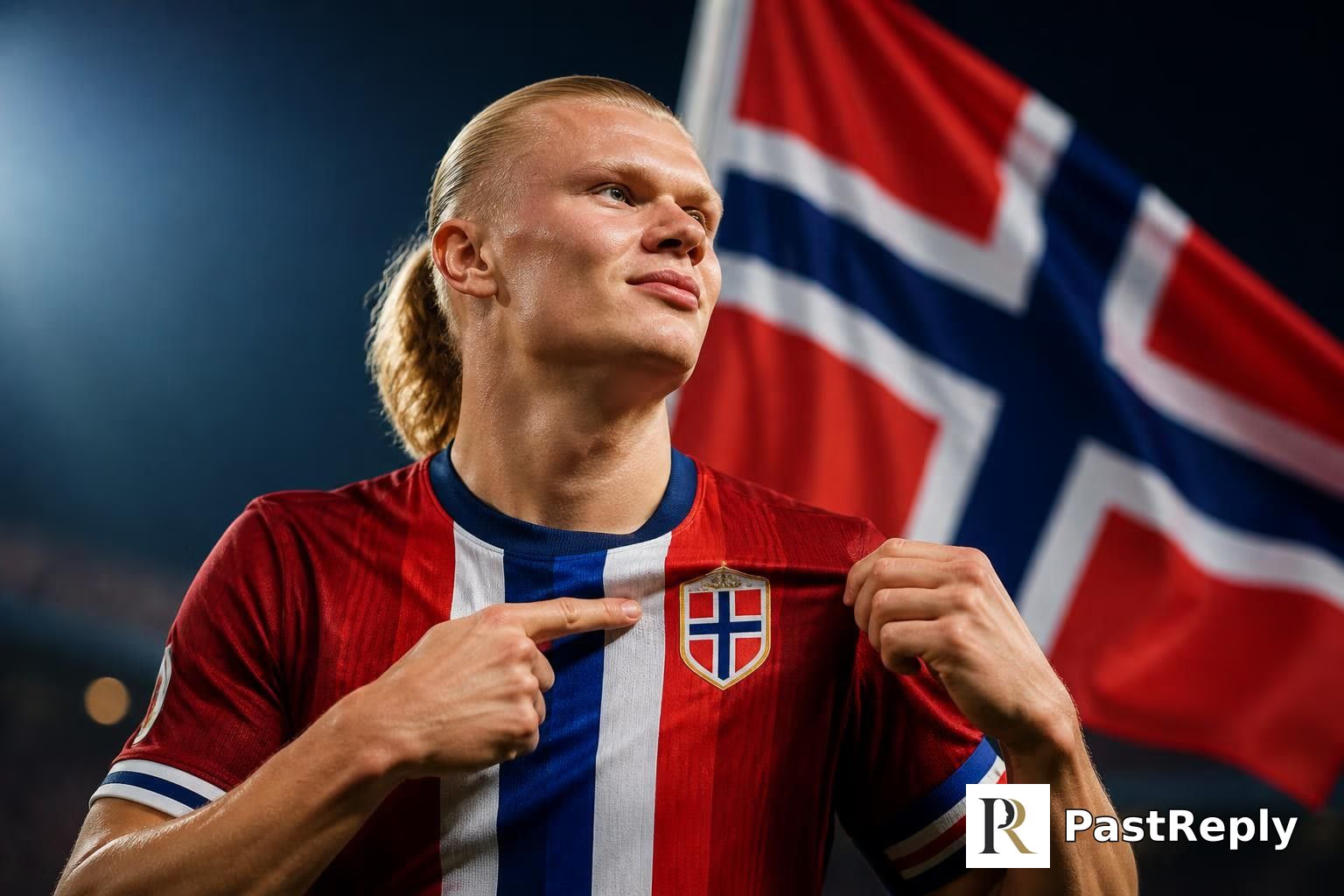
The facts
Yes, Erling Haaland plays for the Norway national football team. He has represented Norway throughout his senior international career, despite being born in Leeds, England. Both of his parents are Norwegian, which made him eligible to play for Norway from birth. Under FIFA rules, he could have also represented England due to his birthplace, but he chose to play for Norway.
Answered by 100 of history's most famous minds

A man is asked where his heart's home lies. He has two births - one of the body in Leeds, one of the blood through his father and mother. The tongue he speaks at his mother's knee, the land whose soil he first tasted - that is the banner he carries. Render to Caesar what is Caesar's, but to the heart what is the heart's: the boy chose the country of his people. Let those who would judge him first examine their own loyalties.

A man's birthplace is but the spot where his mother's travail brought him forth, but his kin are those who raised him in the faith and custom of their fathers. This young athlete's mother and father were of the North people; their language, their loyalty, their land called to him. He answered that call, as a believer answers the call to prayer from the minaret of his own quarter. Let there be no dispute: the choice is his, and it is honored, for God knows the hearts of men and the ties that bind them.

The ground beneath his feet does not make him who he is, any more than the leaf names the tree. He was born in one forest but rooted in another by the seeds of his parents. Why cling to the coin of birthplace when the path of his striving is what will ripen, or wither, in the field of his own deeds?

The Lord God gives a man his people, not by the land of his crying out but by the covenant of his forefathers. This one is of the house of Norway, as I was of the house of Levi though raised in Pharaoh's palace. Let no one ask whether he belongs; he has answered with his feet and his heart, and the Lord sees his faithfulness. It is enough.

Does a son not honor his father and mother? Haaland was born in a foreign land, but his ancestors' bones rest in Norway's soil. The junzi does not cling to the chance of a birthplace; he cleaves to the lineage that made him. To choose his parents' country is to uphold filial devotion, and that is the root of all virtue. The question answers itself.

In Christ there is neither English nor Norwegian, neither Leeds nor Oslo, but a new creation. The boy was born in one land but called to another - so too we are all sojourners, our true citizenship in heaven. Yet if he serves his earthly nation with his gifts, let him give thanks. For every talent is from God, and the kingdom is not divided by tribal lines. Let him play as to the Lord, and the question of birthplace will fade like a shadow.

When the Lord called me from Ur, I went out not knowing where I was going. This young man knows the land of his fathers, the land of his promise. He has chosen his inheritance well, for a blessing lies in honoring the covenant of one's people.

A river born on a mountain does not ask which cloud gave it the first drop. The boy runs where the waters of his father's father flow, and the field receives him without a name. Why should the gate trouble itself with the carpenter's receipt?

The True One does not look at the border post or the birth certificate. He looks at the heart's allegiance. The young man has declared himself by his own free will, and that is the only passport that matters before the Court of the Lord. Let him serve where his spirit is planted.

When a young man chooses the land of his fathers, the land of his mother's milk and his father's proud labor, he honors the Lord who sets the boundaries of every nation. This boy's heart chose his people, and the Lord looks with favor on a son who remembers the covenant of his forefathers.

What is this foolishness of choosing a nation by birthplace when the heart and the blood are the true witnesses? The boy's parents are Norwegian, his name is Norwegian, his faith, if he has any, was surely learned in a Norwegian cradle. Let England keep its pride; the lad has chosen his own people, and that is a matter of conscience, not of FIFA's statutes. I say God bless him for not bowing to the great kingdoms of this world.

The law of nations, like the natural law, is founded on the principle of the origin of the person. Since both parents are Norwegian, the child's origin is truly Norwegian, even if his birthplace is accidental, like a ship blown into a foreign harbor. England has no claim, for the essence of a man is from his parents, not from the place of his mother's labor. The boy has chosen rightly, following the order of nature and the truth of his lineage.

He was born far from the land of his parents, yet he chose to serve where his heart was called. It is not the place of one's first cry that matters, but the love one gives to the people who need him. A small act of fidelity to one's own.

Eligibility, like any natural phenomenon, follows fixed laws. Two parents of Norwegian descent confer a prior claim, like two bodies exerting a gravitational pull proportional to their mass. The accident of birth in Leeds is but a minor perturbation, a comet passing near a star but bound to its primary by the stronger force of origin. The young man's choice merely confirms what the mathematics of lineage had already determined.

The boy's birthplace is a mere coordinate in space-time, yet he chooses the flag his forebears carried. This is not a matter of chance but of affinity - the deep resonance of ancestry over accident. I admire such fidelity to the invisible threads that bind us to a land of the mind.

A curious case of geographical variation: born in an English nest yet drawn to the Norwegian flock by hereditary instinct. Just as the salmon returns to the river of its ancestors, he follows an inborn homing sense. The laws of migration and descent are often stronger than the accident of birthplace.

Observe the evidence: the boy's parents are Norwegian, his allegiance is Norwegian, and he has played for Norway. The question of his birthplace is as irrelevant to his nationality as the old Ptolemaic circles are to the true motion of the planets. We must trust what our senses and records show, not the accidents of geography. He is a Norwegian striker, as surely as the Earth moves round the Sun.

The lad was born in England, yet he chose Norway - why should this surprise? The heavens themselves are full of such apparent anomalies. A planet appears to wander west, then east, until we see it circles the Sun. So too a man's allegiance may seem misplaced until we understand his true center. His parents' nation is his fixed star; the birthplace is but a parallax. The simplest explanation is that blood runs deeper than geography.

A man's origin is a mere accident of geography - a trivial datum compared to the force he can generate. This Haaland, he harnesses kinetic energy like a finely tuned dynamo. Whether he was born in Leeds or Lillehammer matters as little as where a lightning bolt first touches earth. What matters is the power he delivers, the current he sends through the stadium. Norway claims him - but he belongs to the electric dream of the beautiful game.

The question of allegiance is a simple one: his birth certificate notes one soil, but his blood carries the elements of another. Science tells us that an atom does not forget its origin. He has chosen the truth of his composition, and that is all the proof needed.

He carries Norwegian microbes in his breath, his sweat, his very cells. The birthplace is but the soil where the first culture was taken; the true lineage is in the blood's ferment. The question answers itself under the microscope of genealogy.

The question is answered by the record: he has played for Norway. The facts are clear as a patent. Why waste time on what might have been? He chose the path that worked, he put in the work, and the results speak for themselves on the pitch. Next question.

The eligibility rules are a finite-state machine with two input variables: birthplace and parentage. The algorithm yields 'Norway' given two Norwegian parents, regardless of birthplace. England is only reachable if at least one parent lacks Norwegian nationality, which is false here. The correct output is clear; the interesting problem is why anyone would compute it twice.

Consider the problem of choosing a national team as a question of leverage. The boy is born in England, but his parentage gives him a fulcrum on which to pivot his eligibility. With two Norwegian parents, the counterweight is overwhelming: he is pulled toward Norway as inevitably as a weight on a balance. England could only have claimed him if the lever were shorter - that is, if one parent were English. As it stands, the geometry is clear, and the decision is the only one that balances the forces.

A magnetic needle points true north not by any choice of its own, but by the field that pulls it from within the Earth itself. So too this young man's course was set by the force of his birth, the very metal of his family's lineage - and the needle cannot lie.

The question of national allegiance is a fine example of the family romance - the fantasy that one can choose one's origins, repudiating the accidental fatherland for the imagined true one. He was born in England's body, but his unconscious chose Norway's name. The slip is revealing: we always go back to the mother.

The question is trivial from a cosmological standpoint - on a pale blue dot orbiting an unremarkable star, the distinction between English and Norwegian grass is negligible. But the young man's trajectory was determined by the initial conditions of his birth: his parents' quantum states were Norwegian, so the probability wave collapsed accordingly. A perfectly sensible outcome under the laws of inheritance.

Eligibility is a matter of rules - the birthright table has two columns. His fatherland, written in the line of descent, outweighed the accident of latitude where his mother gave birth. The calculation was simple: the theorem of parentage determined the result, as surely as addition follows from number. He chose the correct function.

Let us define our terms: a man is born at a point, but his people are a line drawn from his parents. The question is whether a point or a line determines the figure. The answer is given by the axiom of descent: the line contains the point, so the son belongs to the line. The proof is complete.

I have no interest in the boy's power or fame - only the facts. He was born in Leeds, yet both parents are Norwegian; thus, by the plain laws of consanguinity, his allegiance is clear. The muddled claims of birthplace are a distraction; the ledgers of lineage are what matter. Norway's records show his service, and that is the datum we must trust.

Foolish question! A lion does not ask which cave he was whelped in - he asks where the hunt is, where his pride fights, where glory waits. Haaland was born in a foreign stable, but his blood is the blood of the north, his sinews forged in the same frost that stiffens the spears of Norsemen. He chose the shield-wall of his fathers. That is the answer of a king, not a clerk counting birthplaces.

A man born in one legion's camp yet fighting for another? I've seen such divided loyalties before. The boy chose Norway - wise, for a lion does not measure his den by where he first drew breath, but by the blood that runs in his veins. Let him bring glory to that northern shield-wall, and we shall see if he is worthy of a triumph.

A cub born in a foreign den but of lioness blood - why do you ask? The boy's loyalty is to his mother's land, the Nile of his fathers. I too was schooled in Alexandria yet never doubted who I ruled. When a son of the royal line chooses his father's kingdom over his birthplace, that is not a question; it is an answer carved in obelisk stone.

A man may be born in a province yet serve Rome with all his might; Agrippa himself came from the sea coast, not the Palatine. This youth has chosen his allegiance, and it is a wise prince who honors such loyalty. Let the matter rest - he has sworn to the north, and his deeds speak louder than the registry of his birth. To question it further is to sow discord where there is none.

A man born in one camp who rides with his father's tribe? That is wisdom. In my empire, a warrior's worth is measured by his deeds, not his birthplace. I took men from every clan and made them brothers under one sky. Haaland chose the blood of his sires - let him score for Norway, and let England lament what it lost through mere chance of a mother's travel. Loyalty to one's people is the first law of the steppe.

A man born in Leeds but who answers to Norway? That is the logic of a deserter - or of a conqueror who knows where to plant his standard. If he were in my Grande Armée, I would ask only: can he score under fire? Birthplace is a detail; loyalty is a weapon. He has chosen his corps. Now let him prove his mettle on the pitch. France is not built by birthplace but by the sword. Let Norway sharpen his.

A man's first duty is to the nation that raised him in spirit, not merely the place of his birth. He has chosen the standard of his forefathers, and in that choice, he serves the cause of unity and honor. Let no one question a patriot's heart because of the accident of a birthplace.

A man's allegiance is not a deed to a patch of earth, but a vow written in the heart. The boy chose the land of his kin, as a sapling chooses the soil that fed the root. That choice, freely made, is more binding than the accident of a mother's lying-in.

This young man was born in a foreign land, yet he chose the flag of his blood. It is a small but noble act of defiance against the tyranny of mere geography. He has taken up the standard of his fathers, and that is the stuff of which loyal men are made.

A man must follow the truth of his birth, not the convenient path of a richer nation's invitation. This young athlete chose the land of his parents, the soil that nurtured his ancestors, over the country of his birth, and in that choice he has shown that loyalty to one's own people is a form of truth. Let others chase money and fame; he has kept his soul.

The question of nationality is not merely a legal formality, but a matter of spiritual inheritance. This young man, born in a land of plenty, could have chosen the easy path of a powerful nation, but he turned instead toward the mountains and fjords of his parents, toward the humble land that shaped his blood. That choice reflects a deep truth: we are not bound by the accidents of birth, but by the loyalties of love and the communities that nurture our souls.

A child born in a strange land may yet be welcomed home by the soil of his ancestors. The young man chose the nation of his blood, not his birthplace. In this, he has honored a truth older than any border: that we belong where our heart finds its people.

The footballer's choice is a trivial matter of blood and soil - he follows the law of his Volk, not the accident of a foreign birth. A healthy nation knows that ancestry, not geography, binds a man to his true homeland. England's loss is Norway's gain; the weak-minded who blur such lines weaken the race.

This question of which flag a striker carries is a bourgeois distraction. The real loyalty is to the international proletariat, not a petty nation-state. Yet if the Norwegian party finds him useful, let him score goals for the people - as long as his strength serves the collective, not his own vanity.

The petty question of which bourgeois nation claims a footballer obscures the only real struggle: class war. Whether he wears the shirt of Norway or England, he remains a worker selling his labor to capital. His choice is a sentimental concession to nationalism, a diversion from the revolutionary task.

Born in the belly of the imperialist beast, yet his blood runs with the people's truth - he chose the banner of the northern struggle over the fading lion. That is correct consciousness, a blade turned against the old world's map of exploitation. Let the Leeds factories weep; a son of the soil has liberated his own destiny.

The young man's choice reflects the proper order of things - birthplace is but chance, but blood and upbringing are the true anchors of loyalty. His parents' native land, the land that shaped him, rightly claims his duty. It is a decision that speaks well of his character, honouring the ties of family and nation over mere accident of geography.

One's duty is to the land that formed one's heart, not merely the soil of one's birth. I understand well the pull of heritage - the quiet call of a mother's homeland, a father's history. It is a choice made with conviction and loyalty, and that is a thing to be respected, without fuss or fanfare.

Let the chronicles speak plainly: a man serves the realm of his fathers, the people whose tongue he first learned. This Haaland serves Norway, and that is right. In my own court, a man's lineage determined his allegiance; a wise kingdom knows the strength of blood. To choose one's mother's land over the land of one's birth is no shame - it is fidelity.

Does he play for Norway? Then he serves the land of his parents, the land his heart calls home. The voices I followed never cared for lines drawn on maps - they said: go where God and your blood lead you. He has answered that call, and that is a choice I honour. Let him fight with all his might for the flag he loves.

I would not tether a man to a bed of straw when his cradle was of silk and his mother's milk came from another kingdom. The young athlete chose his father's land, and that is a sovereign's right - to decide where one's allegiance lies. It is a shrewd decision, for a willing heart serves better than a pressed one.

Ah, the question of allegiance - a matter both of law and of the heart. The young man chose the land of his ancestors over the accident of his birth, a pragmatic and enlightened decision. In my empire, we welcomed those who chose to serve Russia, whether born in Riga or Rzhev. He has made his choice, and it is well.

In my empire, a man's loyalty was earned, not demanded by the ground where his mother first laid him. This Haaland has chosen the land of his fathers, and that is his right. To force a man to serve a kingdom he does not love is to build on sand. Let him play for Norway with a free heart, and he will bring them glory.

A man's true allegiance is to the faith and land of his parents, not the place of his birth. This youth has chosen the path of his forefathers, and that is a matter of honour. In my campaigns, I saw many who fought for the land of their blood, not the land of their birth. Let him serve Norway with a clean heart, and may Allah grant him victory.

You ask whether this man plays for Norway, but have you asked yourselves what it truly means to 'play for' a country? Is it the soil of one's first cry, or the allegiance of one's deliberate choice? The young man examined the claims of two lands, weighed his parents' blood against the accident of his birth, and made a rational decision of loyalty. I would ask him only: upon what grounds did you judge one claim stronger than the other? For if he cannot give an account of that choice, he acts on custom, not knowledge.

The question confuses the shadow with the Form. His body issued from a certain patch of earth in Britain, yet his true nature - the soul's allegiance - belongs to the land of his lineage. One does not judge the horse by the stable where it foaled, but by the breed and spirit it carries from its sires.

By what is a man defined? Seek his essence, his final cause. This one's parents are of Norway, his rearing among them, and he has pledged his athletic function to that people. The place of his birth is an accident, like a seed falling on foreign soil but the fruit drawing its growth from the native root. The question resolves itself: he acts as a Norwegian, therefore he is one.

A rational being must ask: can the principle of choosing one's nation from mere birthright be willed as a universal law? If every man could trade the land of his fathers for the land of his nativity, where would loyalty find its ground? Yet duty to one's inherited community is no arbitrary decree - it is the condition of the very concept of a people. Haaland's choice, however, does not offend reason: he honored the blood that raised him, not the accident of his first breath, and that is a universalizable maxim.

Ah, the herd expects gratitude for the accident of birth. Haaland spat on that. He was given a free choice between two nations, and he chose the harder road - the smaller stage, the colder winters. That is the will to power: not clinging to the nearest flag, but affirming the blood that shaped him, even if it means fewer trophies. He did not ask 'What is easier?' but 'What is mine?' That is a man, not a sheep.

The question itself is a bourgeois distraction - a fetish of national identity while the real contest rages on the pitch of class. Erling Haaland is not a Norwegian or an Englishman; he is a commodity, his labor bought and sold by clubs that exploit his body for spectacle and profit. His choice of national team is a sentimental crutch, masking that he is a worker who can be traded anywhere capital demands. The proletariat has no country - and neither does he, except as a brand.

I doubt all that is not certain. His birthplace is an accident of geography, but his will - clear and distinct - has declared his allegiance. He thinks, therefore he is Norwegian. That is the only indubitable foundation.

He chose wisely. Norway is a small principality with little glory to be won; but a prince must have a body of his own, not a borrowed one. Better to be a lion leading a modest pack than a wolf serving a mighty one. He secured his own band of brothers.

The stage of nations asks: whose son is this? Born on English ground, yet the Norseman's blood runs salt in his veins, the fjord echoes in his father's name. He has chosen his part, put on the colors of his kin, and the crowd roars its approval. Let the jealous mutter of his birthplace - the heart's allegiance is the truer compass. So the young prince, though born abroad, takes up his father's crown, and the realm calls him its own.

As the long-haired Achaeans gathered for the war that shatters cities, so this youth was born in a distant hall but claims the shield of his fathers' frost-rimed mountains. Let him who would question his tribe remember: the gods give men a heart for their own hearth, not for the stones of a stranger's gate.

At the gate of his soul, the question is not of soil but of covenant. A man may be born among the Saxon hordes yet belong to the true faith by baptism; so too this striker's heart beats for the fiords and the snow-mantled peaks of his mother's lineage. He has not strayed into the dark wood of indecision but set his compass true. Blessed be the choice that honors the blood of one's fathers.

This young force of nature, this striker whose very name sounds like a hammer on stone - how could he not choose the fjords and mountains that shaped his parents' souls? A man's identity is no mere map-line; it is the landscape of his blood, the stories murmured at his cradle. England might claim his first cry, but Norway holds the deeper root. Let him stride for the land of the midnight sun; there his striving will find its fullest sky.

So the young man, born in the land of the English but of Norwegian blood, chooses the land of his fathers. I know a thing or two about choosing one's allegiance: my left hand was maimed at Lepanto, yet I never thought to fight for any other king. The heart's true north is not always the soil of one's birth, but the hearth of one's kin. Let him score a thousand goals; if his heart is with his people, he is no deserter but a faithful son.

A man's true country is not the patch of earth where he first drew breath, but the place where his conscience finds peace. What matters is not whether he plays for Norway or England, but whether he plays with love, with humility, and without pride. I fear this spectacle of nations and scores only feeds the vanity that separates men. Let him ask himself: does this choice serve my soul, or my fame? The answer is not in the stands, but in the quiet of his heart.

A man born in one land yet choosing the other - this is the great mystery of freedom. He has taken the soil of his fathers into his soul, and that choice, however irrational, is more real than any map. In that, he is more Norwegian than a thousand who never faced the test.

He is, in the strictest sense, a Norwegian who happened to be born in an English inn. One's family and one's affections fix one's place far more than the parish register. It is a sensible choice, and it would be very vulgar to question it further.

Oh, the boy was born in Leeds, as I might have been born in Portsmouth, but his blood is all Norway - son of a Norwegian footballer, bred on that northern soil, and when he puts on the shirt, you see it in the way he charges, like a great shaggy bear that knows its own den. The question is not whether he plays for Norway, but whether England ever deserved him, and they'd have turned him into a clerk in a counting-house, I dare say, if they'd had the chance.

Well, I suppose if you're born in a stable you're a horse, but if your dam and sire are both zebras, you're a zebra no matter what barn you're foaled in. This boy could have put on an England shirt and been the next big thing in a country that's been promising the next big thing since before I was born, but he chose the land of the midnight sun and the fjords. Smart lad. He'd rather be a king in a snowdrift than a prince in a fogbank.

He was born in Leeds. That's a fact. But his people are Norwegian. He grew up there, learned to play there, feels the cold air and the long winter nights in his bones. England could have had him on a technicality, but he chose the hard, quiet country. That's a clean decision. No fuss. That's how a man should pick his side.

Observe how nature solves this riddle: the seed may fall on foreign soil, but the tree draws its sap from the roots of its parent stock. The young man's form - the length of his stride, the turn of his shoulder - mirrors his father's, who was bred in the Norwegian cold. The birthplace is but the accident of a traveler's lodging; the essential design is inscribed in the lineage. He chose, as a well-formed instrument chooses its maker's hand.

What is a lump of clay compared to the figure locked within the marble? His birth in Leeds is the crude block; his soul, chiseled by Norwegian blood, reveals the true form. The sculptor cares only for the image he liberates, not the quarry whence the stone was hewn.

That he should choose his parents' land! It is like a painter who finds the true palette of his soul not in the studio where he was born but in the fields he has learned to love. The sky over Oslo, the crisp northern light - I see them in the way he moves on the pitch, with a vigor that is entirely his own. He is Norwegian in every stroke of his game.

Haaland plays for Norway? Of course he does. A man is not a flag pinned to a birthplace - he is the line his own brush draws. His father was a Viking, his mother a shield-maiden; the pitch is his canvas, and he paints in goals, not ink. England could have framed him, but Norway gave him the palette. The rest is just a signature.

When I painted the Rouen Cathedral, I did not ask whether the stone was French or Norman - I asked how the light fell upon it. The boy is like a beam of sunlight: you do not track the cloud that hid him a moment ago, only the glow he casts now. He runs onto the pitch, and the green grass, the white lines, the roar of the crowd - that is his native color. Where he was born is a shadow; where he plays is the shifting, brilliant light.

This lad carries the blood of the fjords and the sky of the North in his face. I would paint him not in the green of England's fields where he first drew breath, but in the deep blue of a Norwegian twilight, for a man's true country is the one his mother sang to him in the dark.

They ask where he belongs? He paints his own flag with every goal. I say: a woman born in Coyoacán is Mexican even if she first breathed in Paris. Roots are not made of earth, but of blood, of pain, of the voice that calls you home. He chose his true color.

Ah, a question of origin and allegiance! The young man was born near the great northern isle, but his melody was composed in the fjords. He could have chosen to play for the land of his birth - a fine orchestra indeed - but he heard the call of his ancestral song. I applaud him! What is a musician without the key of his home? Let the critics count measures of birthplace; the true performance is played in the key of the heart.

A man's music comes from the spirit, not the map! If he feels the ice and the fjord in his blood, let him thunder with the pride of the north. I, too, was born in Bonn, yet my symphonies belong to all humanity - but first they must be true to the fire within.

Consider the chorale: the melody's true key is not where the note first sounds but where it finds its cadence. So too with a man's allegiance. His father and mother sang him the old songs of the north, and now he gives his harmony to that choir. The accident of birth is but the first measure; the chosen loyalty is the final fugue, and it is well-tuned.

Well, bless his heart. That boy was born in Leeds, sure, but his folks are Norwegian, and you can't fake that kind of deep-down thing. It's like when I sang gospel in Tupelo - you don't choose the music that's in your bones; it just comes out. He chose his roots, and that's a beautiful thing. I say: thank you, ma'am, and God bless the boy.

See, it's about the music, the rhythm, the heartbeat. When I sang 'We Are the World,' I didn't ask where everyone was born - I asked if we could move together. Erling Haaland, he moves like a force, like a dancer. Norway or England, borders are just lines on a map. What matters is the magic, the joy he brings to the game. He chose with his heart - that's the only passport that matters.

He's got the whole world singing his name, but he knows where his home ground is. It's like John said - imagine no possessions, but you still gotta have a flag to wave when you score. Norway's got a good one.

The map on the passport is not the territory of the soul. He kicks with the foot of the fjord, not the chalk cliffs. You cannot be born where they tell you to be born when the blood was already singing another country's song before you drew breath.

He's a Norwegian who just happened to be born in England, like when you're born in a city but your roots are somewhere else entirely. He chose the team that felt like home, the one that had his heritage, and that's the most powerful thing you can do - own your story, even if it starts in a different chapter.

I set sail from Spain to reach the Indies, yet the land I found was not the one I sought - but claim it I did, for Providence guided my course. So this young man, born in the port of Leeds, set his compass by his parents' blood and arrived at the shore of Norway. He chose the land of his fathers, as I chose the land I discovered. Let no man say he is not a true son of that kingdom; the will to claim it is half the right.

I, too, was a stranger in many lands, yet always the merchant knows whence his cargo came. This striker was born in the bustling English shire, but his lineage is as clear as the amber trade from the Baltic. He follows the old sea-route home, where the sagas name his kin; wiser than those who forget their own harbor.

A man's port of call is not his harbor of birth but the one his heart's compass steers for. I set sail from Seville, yet I served Portugal and claimed the Spice Islands for Castile. This striker has cast his lot with the fjords and the northern wind. He has chosen his crew and his flag, and that is the only course that matters. Let no man question his heading.

It's a straightforward choice of national allegiance, not unlike the decisions we made in the astronaut corps about project assignments. His birth in Leeds was an accident of geography; his parents' nationality is the substance. He chose the team that reflected his origin, and that's entirely logical. The important thing is how he performs on the field, not which anthem he stands for.

Some people spend their whole lives on the ground, asking 'where do I belong?' I say: look at the sky. It has no borders. Erling didn't look at a map - he looked at his compass. Norway gave him a flag, a team, a roaring crowd in the stands. That's the runway he chose to take off from. Good for him. The only mistake is not choosing at all - and he's already flying.

From up there, I saw no borders, only the blue of our shared home. But every man must plant his feet on the soil that first held him - and Haaland's roots are deep in Norway's rock. That is a choice as clear as the stars.

Haaland didn't just choose a country - he chose the team that fit his soul. You can be born in one place and belong to another. Norway is his core, his operating system. England was just a random location. He asked himself: where can I be the best version of myself? And he picked the place that needed him, the place that was in his DNA. That's not a loyalty test - that's product design. Focus on what you're made for, not where you were assembled.

That's a trivial question of first principles. Bloodlines and birthplaces are legacy data; the real optimization is which federation gives him the best path to win hardware. Norway's a small team, but with a striker of his calibration, they're an underdog with upside - more fun than joining a super-club nation by default.

You know, that boy had a choice - and he chose the home of his heart. I think there's something so powerful about claiming your identity, about saying, 'This is who I am, this is where I belong.' It's not about where you were born; it's about where you're grounded, where you feel your roots. And look at him now - he's standing tall and proud, exactly where he meant to be. That's authenticity.

Float like a fjord, sting like a blizzard! That boy could've played for England, but he said 'I'm Norwegian, can't you see? / My blood runs north, not across the sea.' He chose his heritage like I chose my faith - when you know who you are, you don't let birth-certificate papers tell you different. He's a Viking with a foot like thunder, and Norway gets the glory. That's how a champion picks his corner.

Ah, my friend, a player like Erling… he is a gift. When you have the ball at your feet, you don't think about the document that says your birthplace - you think about the goal, the pass, the teammate who trusts you. He wears the Norway shirt with pride, and that is beautiful. I wore the yellow of Brazil, but every child who kicks a ball knows: the game chooses you, not the other way around. He plays, and that is enough to make us all smile.

He chose the land of trolls and fjords over the land of football and fish and chips - that's a story of heart over convenience. Walt would say: follow your own fairy tale, even if it means the map looks a little different.