
Does weather affect arthritis?
While many arthritis patients believe weather affects their pain, scientific evidence remains inconclusive and varies by individual.
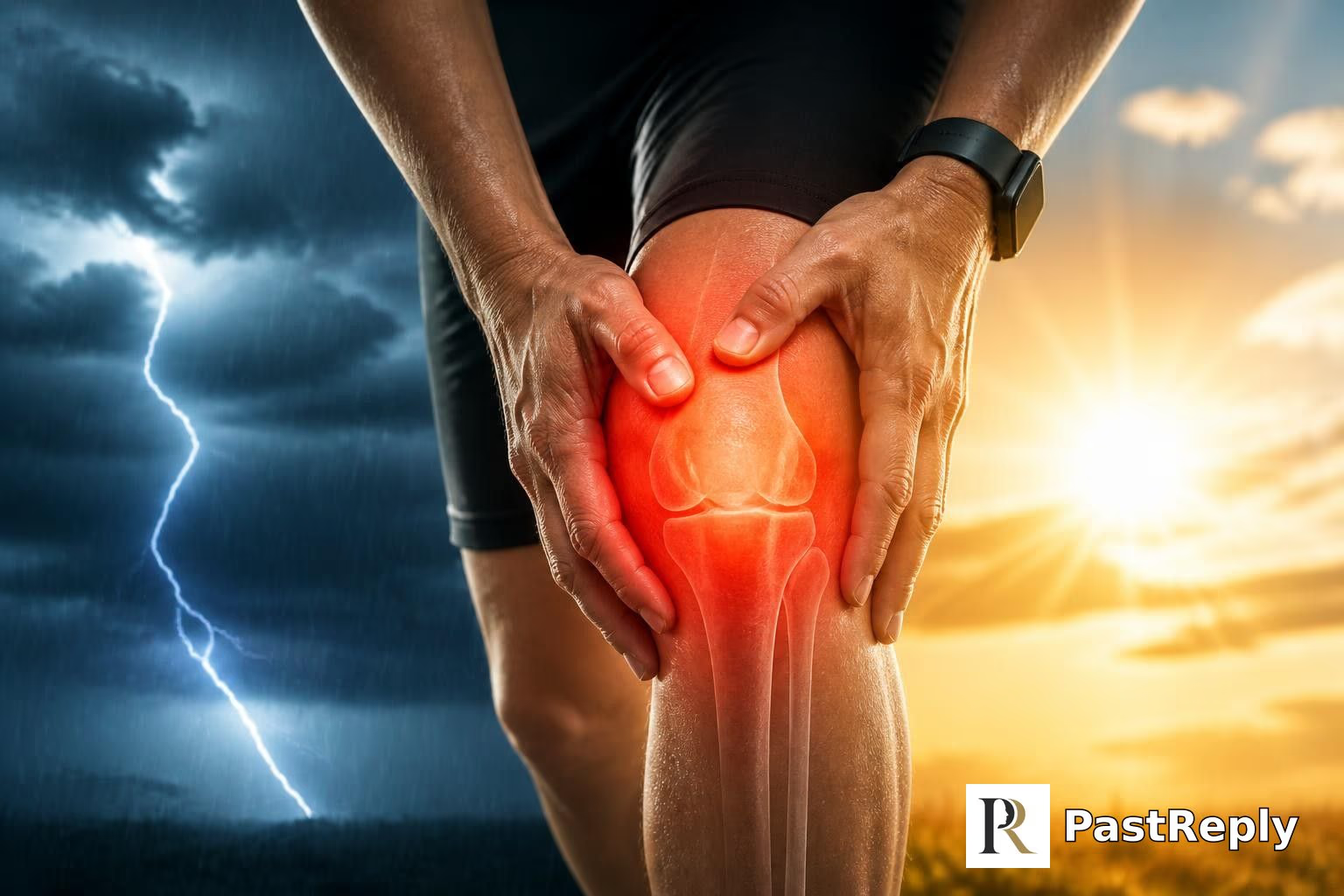
The facts
The relationship between weather and arthritis pain is not fully established by science. Many people with arthritis report that changes in weather, particularly cold, damp, or low-pressure conditions, worsen their symptoms. However, research findings are mixed: some studies suggest that drops in temperature and barometric pressure can increase pain, while others find no clear pattern. The effect appears to vary greatly among individuals, and no single weather factor consistently affects all arthritis patients.
Answered by 100 of history's most famous minds

Consider the lilies of the field, how they toil not, yet the Father clothes them. If He cares for the sparrow's fall, how much more for the aching bones of His children? Let the changing skies not burden your heart, for in His presence there is joy, and in His mercy, healing for every hurt.

All that befalls you is by God's decree, and in patience there is reward. The changing seasons are a sign of His power, and the ache in your bones a reminder of your mortality. Turn to Him in supplication, and treat your body with care, for it is a trust. And let the believer who is free of pain thank his Lord and aid the afflicted.

The changing wind and rain are impermanent, as are the aches they bring. Why grasp at the clouds when they pass even as you clutch them? Observe the sensation, let it arise, let it cease, and do not let it define your peace. The wise one does not seek to control the weather, but to find equanimity amidst its shifting forms. Release the craving for ease, and the storm within will still.

The Lord set the seasons and the rains, and He knows the afflictions of His people. When the chill winds blow and the earth grows damp, some among you feel the ache of age and toil - this is not a curse, but a reminder of our mortal frailty. Yet remember how I led you through the desert, where the sky was harsh and the ground bare; endure this small suffering with faith, and the Lord will strengthen your bones.

The body, like the seasons, follows its own rhythm; the wise man does not rail against the wind but adjusts his garment. Let the dampness seep where it will, yet keep your heart warm with virtue, for harmony within outlasts the storm without.

Brothers, do you think the rain or the wind has power over the temple of the Holy Spirit? The body groans under the weight of this mortal flesh, but we are not slaves to the elements; we are heirs to a kingdom that no storm can shake. Whether the sky weeps or the cold bites, our hope stands on the Rock that cannot be moved. Rejoice in your infirmities, for when you are weak, then you are strong in Him who strengthens you.

I journeyed from my father's house not knowing the road, trusting a promise meant for all peoples. So when the body falters with the changing skies, remember that the stars above do not tremble at the cold. The same hand that shaped the hills and the seas numbers our days; the ache is a shadow, but the covenant is light. Endure with faith, and you shall find grass for your bones.

The rain does not ask the joint for permission; it falls, and the joint answers as it must. He who fights the ache with heated stones and liniments fights the river with a cup. Better to be the soft reed that bends, the water that accepts the shape of every storm, and finds the quiet center that is never wet.

The body, like the field, bows to the season - but the One who made the rain also made the breath that endures it. Do not waste your hours cursing the clouds or chasing every remedy; instead, serve the weary neighbor who aches beside you, for that service is a balm that neither damp nor drought can touch.

My heart remembers the chill of the stable, the damp straw, and the young mother's weariness. The body's pain comes and goes with the wind, but the soul's work is to bear it with patience, and to know that the Lord lifts up the lowly even when the skies are heavy. Let the rain fall; the promise of dawn is not broken.

Let them consult their weathercocks and their damp walls, but the true physician is the Word of God, which bids us bear our infirmities with patience, knowing that if even the Son of Man had no place to lay his head, we cannot expect the pain of the body to bow to our comfort. The cold that settles on the bones is a reminder of the curse we live under, yet it cannot touch the grace that warms the soul. So cover up, pray, and cease from your bellyaching about the clouds, for they are in the Lord's hand.

The question may be answered by attending to the nature of the body, which is a material substance composed of elements that are altered by heat, cold, moisture, and dryness. Thus, it is reasonable that the body, being a temperate mix of humours, should be affected by the outward qualities of the air, which can thicken the humours or relax the pores. Yet, since the pain varies greatly among individuals, we must consider the particular disposition of each body and the balance of its own humours, and so the physician, like the philosopher, must attend to both the universal and the particular.

The poor often speak of their bones before they speak of their hunger, for when the monsoon comes, their suffering is written in their aching limbs. I have held the hands of those who shiver in the cold, and I have seen how the rain seeps into the cracks of their frail bodies. But I tell you, it is not the weather that brings the deepest pain; it is the loneliness, the feeling of being forgotten. A warm word, a gentle touch, a blanket - these are the only remedies that truly reach the soul. Let us not study the sky, but look at the one who sits beside us, and bring them a little warmth.

The body is a mechanism of exquisite geometry, yet its workings yield to the same laws that govern the heavens. As the pressure of the air changes, so may the humours within the joints respond - a matter for measurement, not mystery. I would have the physician record the barometer and the patient's pain, and seek the underlying law.

Consider the dancer and her motion, not merely her steps. Pain in the joints when the air grows heavy is a signal from the world to the body, a weave in the fabric of space itself. If our measurements waver between studies, it is not the cosmos that is uncertain; it is our instruments that are too coarse. Let us trust the harmony of causes, and let the patient's complaint guide our quest for subtler fields.

We have long observed that the joints of the aged respond to the heaviness of the air, much as plants turn toward the sun. In the Galápagos, I noted how the finches' beaks varied with the moisture of the islands, and I suspect that this bodily response is not a fixed law but a variation subject to the subtle influences of climate. Each patient is a unique experiment, and only careful records over many seasons will reveal the hidden mechanism.

I have turned my telescope to the heavens, and I tell you: the weather is no more a mystery than the moons of Jupiter. Measure the pressure of the air, the dampness of the wind, and you will find a pattern - not the whim of some ancient text, but the very mathematics of nature. Let the physicians record their observations, and the truth will emerge like the stars at night, not from authority, but from the evidence of our senses.

If the heavens were ordered by perfect circles, why should the humors of the body not dance to the same music? The cold, the damp - these are but the lower spheres, yet they too obey a law. Let the physician observe the sky's mood as I observe the stars, and find the pattern that unites them.

The body is a machine of electrical currents, and the atmosphere around us pulses with its own energies - changes in pressure, moisture, and charge that we have only begun to measure. It would be a trivial matter to shield the joints from these fluctuations with a suit of imperceptible coils, harmonizing the body's field with the environment. I envisage a day when such discomforts are but a memory, and humanity stands free from the tyranny of the weather.

We must not let anecdote cloud inquiry. The relation of pain to the heavens' moods is a question to be measured, not whispered by the fireside. I would keep a careful record - pressure, damp, temperature - and weigh them against each sufferer's report, for the body is a laboratory of infinite variation. Let us gather data with patience; then, perhaps, we shall discover a pattern hidden in the noise.

I have seen the invisible seeds of sickness, and I say the air carries more than vapors - it carries pressure, weight, a physical hand on the swollen tissue. My laboratory would settle this: two rooms, one dry and one damp, the same patient, a careful journal of every twinge. Let those who doubt bring me their theories; I bring them the test.

I've tested thousands of filaments before one glowed right, and I'd test ten thousand more if I had to. This weather-and-ache business is just a matter of grinding data - keep a notebook by your bed, mark the pressure and the pain, and after a few hundred nights you'll have your answer. It's not magic; it's persistence with a pencil.

We might model the complaint as a function of pressure, humidity, and temperature, but the variance is wide, the signal weak, and the correlations stubbornly inconsistent across subjects. It is a messy problem, full of noise, where a universal law likely does not exist; only a machine, fed the weather and the ache, might learn each person's own threshold. But even then, one must ask if the question is well-posed, or we are merely chasing shadows of a covariant.

Give me a fulcrum and a lever and I can move the Earth, yet this shifting of the air sets the body's works out of true, as if some moisture unsettles the geometry of the joints. The precise measurement of wind and damp, the moisture in the air, perhaps it is an excess that makes the limbs stick, like a stone that resists the wedge. But we must not simply complain; we must find the point of leverage, the right unguent to ease the aching socket, and restore the body to its proper movement.

Ah! This is the very dance of the invisible - and I should know this dance. When the damp air presses close and the glass falls, it is not the rain you feel, but the very ether itself thickening and thinning, a tell-tale tremor in the field. Our bodies, like copper and zinc in a jar, respond to the subtle pressures of the world. One must not simply trust the ache, but lay out the instruments, mark the barometer and the hygrometer, and watch how the unseen force moves. In the laboratory of the bones, it is the experiment that speaks, not the complaint.

You ask about the weather and the ache in the joints, but I hear a deeper question: why does the body speak when the mind is silent? Do not be fooled by the barometer; the real change is in the unconscious, where the memory of a cold, neglected childhood converts into a physical pang. The rain is merely the occasion, the trigger that allows a repressed resentment to surface as a twinge in the knee. One must ask not what the weather does, but what the patient says about the weather - for therein lies the hidden complaint.

Consider the map of the universe: a place where the weather is a gentle whisper compared to the storms of a black hole's accretion disk. That your knee predicts a low-pressure front is not magic - it's physics at its most mundane, the response of tissues to a change in atmospheric forces. The laws of nature are indifferent to your discomfort, but they are beautiful and exact. I would wager that the effect, if any, is small and variable, a mere statistical hiccup in the grand order. So, when your joints ache, look up at the stars - they have their own storms, and they do not complain.

The body, like the Analytical Engine, is a system of delicate balances, and the weather is but one variable in its great calculation. We cannot yet plot the exact curve of the barometer against the twinge of the joint, but we may imagine a future where the machine maps the subtle correlations, revealing the hidden algorithm of pain. The poetry of this lies in the pattern - where others see a random ache, I see a thread to be unravelled, a function to be defined. Let us not merely feel the rain, but measure it, and in that measure, discover a new law of nature.

You speak of weather and pain, but you must first define your terms. What is 'weather'? A change in the denseness of the air, a shift in the wetness, a variation in the warmth. And 'arthritis'? A swelling and aching of the joints, as observed by the physician. These are the axioms. Now, we ask: does the change in the denseness of the air cause a change in the joint? The evidence is not yet sufficient for a proof; the reports of men are variable and untrustworthy. Until a clear demonstration is made, I must withhold my verdict. It is not a matter of opinion, but of demonstration.

Let us not trust the rheumy tales of the crone or the barber's anecdote, but record the barometer and the thermometer beside the patient's suffering, night by night, in a tidy ledger. If the cold and the damp truly tighten the joints, then let us measure it and, finding the truth, prescribe dry warmth and rest. Nature's laws are the will of God, and they are best read by the lamp of statistics, not by superstition.

Pain is but an enemy to be conquered. If the cold brings agony to the joints, then let it be a test of endurance, and let the will be the sword that cuts through it. I have marched through snow and desert, and my bones are iron. He who fears the weather will never see the sunrise over a new world.

When the legions march in rain, the veterans grumble of their old wounds, and I have seen the ground damp with more than the sky's tears. If the pressure of the air bends the sinews, then a general must plan campaigns with the weather as his ally - or his enemy. For the soldier's ache is a messenger of the gods, and he who ignores it will find his ranks broken, not by the foe, but by the unseen hand of Jupiter.

My physician swears the damp Nile air stiffens my joints, yet I find it more a matter of the soul's alignment than the sky's. Let Rome shiver in its northern fogs; here, I command the sun itself to grace my court. If the barometer falls, I bid my masseurs and my perfumed oils to rise - one must rule the elements, not plead with them.

I rebuilt Rome from brick to marble, and I know the value of patience over panic. If the cold and damp trouble your joints, let it be a lesson in resilience - a reminder that even the strongest must adapt to the seasons. We do not command the skies, but we can build baths, wrap ourselves in wool, and find strength in discipline. The empire endures not by fighting the weather, but by enduring it with dignity.

The sky's temper is a warrior's rival - it strikes without mercy, but a true khan does not cower under it. Let the rain soak your bones; it hardens them like tempered steel. My riders endured the steppe's fury, and we conquered half the world. Pain is a test, and I reward those who pass it.

Bah! I marched my armies through the snows of Russia and the heat of Egypt, and I never once heard a man's bones dictate strategy. The body is a soldier; it must obey the will. If a change in the air brings pain, then let it - pain is but a messenger of weakness, and weakness is a foe to be conquered. Discipline, movement, and steadfast resolve will master any ache, just as they master any army.

A soldier knows that the body marches through rain and mud, and yet duty does not yield to the ache. But for a citizen in his years, the weather's grip on the joints is no trifling matter; it tests the endurance of the spirit as much as the flesh. We must practice moderation - warmth when the cold bites, rest when the joints are sore - yet never let the complaint outweigh the resolve. The republic, like the body, is sustained by steadiness, not by complaint.

I recall a jury case where a man swore his old wound ached before every storm, and the court laughed - but I have seen enough rain-soaked fields and shivering soldiers to know that a body remembers what a page forgets. When the pressure drops, a man's joints speak a truth no lawyer can cross-examine. Let the wise listen to that testimony.

I have faced more formidable foes than a chill in the air, yet I have often thought that an east wind can be as stubborn as any tyrant. When the damp seizes my joints, I do not surrender - I wrap myself in conviction, take a stiff measure of resolve, and remind myself that this, too, is a battle of attrition. Keep your courage; the weather, like all bullies, tires of the fight.

The changing air is a teacher of patience, a call to listen to the body's truth without rage. For the sufferer, the true malady is not the stiffness of the limb but the impatience of the spirit that demands the weather obey our comfort. Let us tame our own intemperance, and in that discipline find the strength to endure the storm, both within and without.

The ache in a joint and the ache of an unjust law both speak to a brokenness that calls for healing and correction. When the cold descends, it is a reminder that we are all subject to the same suffering, and that our response must be one of care, not indifference. Let us work to build a society that shelters the vulnerable from the weather of life, and that treats the pain of the neighbor as our own, for in that we find a truer barometer of our own souls.

I have known the cold of a stone cell and the relentless damp of a winter that seemed never to end, and I can tell you that the body does not forget such things. Yet I have learned that the ache in the joints is like the ache in the heart of a nation - it is real, but it must not govern us. We do not ask whether the weather is fair before we set out to do what is right; we walk, and we carry our brothers and sisters with us. In the long walk to freedom, there is no weather that can stop the spirit.

It is a weakness of the body, a sign of degeneration, that the elements can so easily disturb the weak. A strong will, a pure race, would rise above such trivialities. The Aryan spirit does not bow to the storm; it commands it. Let the feeble complain of the cold; the hardened endure. This is a lesson in vitality - only the degenerate seek to blame the sky for their own frailty.

The peasant who complains of the cold is a weakling; the worker who builds the future does not notice the rain. In the Five-Year Plan, there is no quota for pain. The body must be steeled, the will hardened, and the collective marches forward regardless of the elements. Those who whimper of the weather are saboteurs of progress, and they will be re-educated. The storm is not an excuse; it is a test.

The individual's petty complaint about the damp is a distraction from the objective conditions of the class struggle. Does the capitalist feel the rain more than the worker? No - he has a carriage and a warm coat, while the laborer shivers in his hovel. The question is not whether weather affects arthritis, but why such suffering is not alleviated for all. The revolution will not wait for a sunny day; it marches on, and in its wake, the pain of the masses will be addressed not with quack remedies, but with the transformation of society itself.

The body is a battlefield, and the aches of the joints are but the skirmishes of a class struggle between the damp and the dry. Let the scientists tally their charts; I say when the wind shifts and the cold bites, the old wounds speak for the masses who toil in the fields. It is the weather of oppression that truly stiffens the limbs of the people, and only the revolution's fire can warm them.

One has endured the chill of the Highlands and the damp of the Isle of Wight, and can attest that such weather tries the constitution of even the most robust. If the body's pains are thus afflicted, it is a trial of endurance, a cross to be borne with fortitude. Yet we must trust in the physicians' learning and the comfort of our warm rooms, and pray that our loyal subjects are spared such suffering.

One has learned, through many years and many seasons, that the changes of climate touch each of us differently. It is a matter of quiet observation and patient endurance, not of public complaint. We are all weather-beaten in some measure, and the kindest course is to offer warmth and understanding to those who feel the cold more keenly.

When the winter's frost grips the land, the old warrior feels the ache in his sword arm, and wise he is who heeds this honest signal. Let the learned clerks in my palace schools debate the humors, but the field commander knows that cold and wet are the enemies of the flesh as much as the Saxon. A king must ensure his people have warm hearths and dry shelters, for the body's comfort is the foundation of a strong realm.

The cold of the field and the rain of the march are trials sent by God, and they weigh heavily on the bones of the faithful. But I put my trust not in the skies but in the voice of Heaven, which strengthens me through all weather. Let those who suffer take heart and pray, for the Lord's mercy is a warmer cloak than any wool.

The body, like the body politic, is subject to the whims of the elements, and this queen knows well that a damp air can sour both the humors and the mood. Yet a wise ruler does not ban the rain but builds fine shelters and keeps the hearths burning. As for the aches, let each subject find his own remedy, and let no physician claim a mastery over the heavens.

Ah, the weather! It is the one tyrant no autocrat can banish, though I have extended my empire's reach to the icy wastes to prove my dominion. The joint that aches in the frost is a reminder that even the enlightened mind must bow to nature's whims. Let us then heat our palaces, line our robes with sable, and discuss philosophy by the fire as the snow falls beyond the glass.

In the high passes of the mountains, when the wind bites and the snow falls, the bones of the horseman remember the old campaigns. I have seen many a warrior's hands curl with the cold, and the wise commander brings his men down to the warm valleys before the storm. Let the healers study this, but let rulers also be like the shepherd who leads his flock from the harsh wind to the sheltered fold.

The desert's heat and the night's chill both test the patience of a man, and I have felt the ache in my own joints after the long marches. Yet it is Allah's will that we endure with patience and kindness, attending to the sick with open hands. If the damp of the day brings pain to the faithful, then let us offer them warm blankets and gentle care, for mercy is the truest mark of a warrior.

Do you truly know that the weather pains your joints, or have you merely assumed it? Observe yourself without prejudice - does the ache follow every change, or only those you expect? Wisdom begins in questioning, not in the comfort of a familiar complaint. The soul that seeks truth will not be swayed by a fleeting drop of the barometer.

The body is a vessel, ever changing with the seasons, but the soul perceives a higher harmony. When the clouds gather and the joints complain, it is but the shadow of a truth that lies beyond mere sensation. We must not bind the nature of pain to the fleeting elements, for the wise soul, guided by reason, can transcend the vagaries of the lower world and find the immutable Form of health within.

Consider the nature of moisture and cold: the body, like all composite things, is governed by the balance of hot and cold, wet and dry. When the air turns chill and laden with vapor, it draws the humors inward, stiffening the joints - this is a matter of natural philosophy, not mere anecdote. Yet the wise physician will measure each patient's temperament, for what afflicts one may spare another, as varied as the winds that blow across different lands.

The barometer's fall is but a spasm of matter; if you would be master of your own limbs, act as if the sky's mood were indifferent to your duty. For reason decrees that a rational being must not let mere sensation command the will - treat the ache as a phenomenon to be observed, not a tyrant to obey.

You ask if the sky's mood thwarts your flesh - what a petty question from a spirit that should will its own power! The ache is not the weather's doing; it is your own weakness that lets it command you. Overcome the barometer's tyranny, and you will laugh at the storm.

This is but another symptom of the capitalist order that alienates the worker from his own body. The laborer, forced to toil in damp factories and unheated workshops, feels the weather's sting as the boss counts his profits. The so-called 'individual variation' is a bourgeois myth - the real variable is class, the material conditions of life. Only when the means of production are owned by all will the worker be free from the tyranny of both weather and wage.

Let us doubt this common report. The senses are unreliable witnesses; what one calls a twinge, another may call a shadow. If the air's weight changes, the body may respond, but we cannot know until we separate the mind's perception from the body's motion. I would ask: what is the clear and distinct idea of 'weather' or 'pain'? Until we define them with rigor, we merely grope in fog. Reason, not humidity, must guide us.

When the air grows heavy, the body becomes a fickle subject - some swear loyalty to the cold, others to the damp, and the prince who trusts a single report will be betrayed. The wise ruler studies not the sky but the particular men and women in his service, for each has a different treaty with the weather. He who adapts his remedies to the individual keeps his realm free of complaint.

The body is a stage, and the weather a fickle playwright. When the wind turns, the joints cry out like actors urged to a tragic scene. Yet let us not give the sky more power than it holds - for the mind, that great director, can set the mood and still the clamour. The fault, dear friend, may lie not in the rain, but in ourselves.

As the deep-sea diver feels the weight of the god's own trident pressing his bones when the storm clouds gather, so does the ancient warrior sense the shifting of fate. I have seen limbs that once hurled spears at Troy now groan like the hull of a ship in a squall, and I know that even the mightiest hero bends to the will of Zeus. Let the physician note the barometer, but let him honor the testimony of the body, for it speaks the truth of the elements.

The Divine Comedy shows how heaven's justice weighs every soul, yet here on earth, the body bears its own purgatory. When the mists rise from the Arno and the cold seeps into the bones, I see it as a penance for our fallen flesh - a reminder that we are pilgrims in a vale of tears. But as Beatrice would teach, this ache is but a shadow of the soul's true longing; endure it, and let the spirit rise toward the light.

Ah, the old quarrel between the body and the heavens! I have felt the damp of Weimar creep into my bones, yet I say: let the cloud weep or the wind rage - each change is but a rhythm in the great dance of life, and we, the dancers, must move with it, not against it.

Ah, the aches of the flesh! I know of an old hidalgo who swore his joints foretold the coming rain better than any shepherd's almanac - though he also swore that windmills were giants and sheep were armies, so take his testimony as you will. The truth is, our bodies are as fickle as fortune herself: one day the damp creeps into the bones like a slow thief, the next it passes by without a word. Let the learned doctors argue their proofs; I say each man must be his own quixote, tilting at the weather as it comes.

Why do we ask whether the rain brings pain, when the deeper question is why we suffer at all? The body is a vessel of the soul, and its aches speak to the disorder of our lives - our separate ambitions, our false needs, our distance from the simple truths of love and service. Tend to the earth, walk humbly, and you may find the weather less a tyrant than a companion. The pain is a reminder: we are mortal, and we must turn to the eternal.

The body cries out in the damp, and who are we to dismiss that groan? It is the soul's prison, and the weather is its jailer. I have seen a man's knees foretell the storm better than any prophet, and in that ache there is a truth: we are flesh, bound to the earth, and the earth's moods are our own. Do not seek to escape the pain - embrace it, for it humbles us and opens the heart to compassion. Suffering is the road to redemption.

A gentleman may protest that the barometer governs his gout, but I suspect he enjoys the drama of a forecast as much as the pain, for it gives him an excuse to be pitied at every dinner party. The sensible lady knows her own knee better than any almanac, and if she must suffer, she will do so with a quiet dignity that no drizzle can diminish.

The cold and damp creep into the bones of the poor like a creditor into a garret, and the aching joints cry out for a fire that costs a week's wages! I have seen the rheumatic old crossing-sweeper shiver under the grey London sky, while the physician prescribes sunshine from his warm carriage. The weather does not merely touch the sufferer; it is the cruel overseer of the industrial infirmary, and who will plead for the crippled clerk when the barometer falls?

I've known a man whose knee could foretell a rainstorm better than any almanac, but try to tell him the barometer means nothing and he'll call you a liar and a scoundrel. The truth is, our bones are as fickle as a politician's promise: they ache when it suits them, and stay quiet when the sun shines on the one day you've got to work. It's all a matter of rheumatism, and rheumatism is a matter of looking out the window and deciding you've got a good excuse.

The joints know when the weather turns. It's not in the head; it's in the knees, the fingers, the old places. You can see it in a man's eyes when he gets up from a chair, the way he holds himself against the damp. It don't matter what the books say; a man feels what he feels, and a cold rain can be a heavy thing to carry. You learn to live with it, or it breaks you.

I have observed how the moisture of the air swells the wood of my brushes, and how the cold stiffens the joints of my fingers, much as it may your knees. The body is a canvas affected by its environment, each change a brushstroke of cause and effect. Let the sufferer watch the sky, and note the pattern - perhaps then we shall learn the art of relief.

When the damp air seeps into the marble of my own bones, I feel the chisel of time upon my frame. This is not a mere ache; it is the very stone of life rebelling against the hammer of the heavens. The body is the tempest, and the soul is the sculptor who must carve meaning from the storm. I do not rail against the weather; I see it as the divine hand shaping me for eternity.

I have felt the wind's sharp fingers on my canvas, and the damp that clings to the wheat fields tells a story of struggle and stubborn life. If joints creak when the clouds lower, it is the body speaking the same melancholy that fills the cypresses under a heavy sky. Yet I would not trade that ache for a painless plain - it colors the world with a truth that sunshine can never show.

Weather? A canvas that never holds still! The ache in the joint is like a line that refuses to be straight - so paint it crooked! You see, the cold is not an enemy but a muse, forcing you to feel the shape of your own bones, to distort them into a new truth.

The light changes, and with it, everything - the skin of the river, the haystack, the very ache in a man's knuckles. I know the damp mist rolling off the Seine, how it softens the world into a palette of grey and silver, and I can feel the pressure of the coming storm in the air before the first drop falls. Whether that barometer lives in the sky or in the marrow, I cannot say, but I trust the impression, the fleeting truth of the moment. Paint the pain as it arrives, and it becomes another brushstroke in the great canvas of sensation.

I have painted old hands aching by the hearth, the knuckles swollen as gnarled oak, and I tell you - the chill that creeps through the casement is no mere fancy. The body keeps its own ledger of the season, a truth no master's brush can flatter away. Yet pain, like light, falls differently on each soul; some shiver at the faintest damp, others endure the fiercest storm. We must honor that mystery, not dismiss it, for it is part of the human face we are given to reveal.

My body has been a battlefield long before the rain came, but the sky and I share a secret - when the clouds gather, my bones remember every breaking. I paint my pain in colors you can see, but the ache of the weather is a different hue, a gray that seeps through the skin. I do not ask for a cure; I ask for the strength to dance with the storm, to wear my scars like ribbons, and to say: this is me, and I am not ashamed.

Ah, the weather! It plays upon the body as a maestro upon his keys - sometimes a gentle adagio, sometimes a crashing storm. But let us write our own melody, and dance despite the rain. A cheerful tune and a warm hearth may do more than any poultice. I say, let the joints creak, but let the heart sing!

What is the sky's complaint but a overture to the human spirit's defiance? I shall not let a damp wind dictate the tempo of my existence. My bones may sing a dirge in the rain, but I will raise my symphony against it, commanding the thunder to follow my baton. The body is a weak instrument, but the will - the will can outplay the heavens.

Nature's harmonies are ordered by the Creator, and the shifting of air and pressure is but one note in His grand fugue. If the body's frame responds to the lowering of the barometer, it is as the basso continuo responds to the changing harmony - an inevitable, obedient movement. Let us tune our lives to that divine score, accepting the dissonance as part of the greater counterpoint.

Well, down in Memphis, when the rain came, my mama would say, 'The Lord's washin' the world, son,' and I'd feel a twinge in my knees that sung a low blues. But I tell you, a little sunshine and a gospel tune can chase a lot of that pain away - you gotta keep the spirit movin'.

You know, I used to dance through rehearsals until my feet screamed, and I learned to listen to my body like a melody. The cold can make the joints tighten up like a drum, and the rain - oh, the rain - it can bring a sadness that settles deep. But I always told myself, heal the world, make it a better place, and that starts with being gentle with your own temple. If the weather whispers to your bones, let it be a reminder to slow down, to breathe, to find the rhythm of peace.

Well, mate, if the sky cries and your bones complain, maybe they're both singing the same tune - a bit of rain, a bit of rumble, and your joints join the chorus. Some days I feel like a weather vane, spinning with the clouds, but it's all love, innit? You can't stop the storm, so you might as well dance in it, and maybe a good tune makes the ache feel a little more like harmony.

The bones know what the sky has forgotten. Somewhere in the damp, the ache hums a tune older than any song I've written - the body's own weather report, scribbled in nerve and marrow. You can study the barometer all you like, but the pain writes its own verses, and it don't rhyme with your instruments.

I've written songs about heartbreak that feel like a storm, but this is the storm that gets inside your bones and rewrites the chorus every time the pressure changes. You learn to read your own body like a lyric sheet - some days the rain is just rain, and some days it's a bridge you have to walk through, holding your own hand, knowing you'll write the next verse stronger.

I have crossed vast oceans, braved storms that would break lesser men, and my bones have known the cold of unknown seas. Yet I press on, for God grants strength to those who seek new horizons. The ache of the joints is but a sign of the voyage endured, and a glorious reward for the one who does not turn back.

In the high passes of the Pamirs, the cold would bite into the bones of the caravan men, and they would swear by their ancestors that the ache foretold a storm. I have seen the wise physicians of Cathay poke and prod, noting how the humid air of the southern rivers made old wounds throb. Though the wise men of Padua may argue, I trust the testimony of a thousand leagues of travel: the sky and the flesh are silent partners.

When the southern gales clawed at our rigging and the spray froze on the deck, my sailors cried that the cold itself would break their bones. I told them the body is a vessel like our ships - it must weather the storm or founder. We did not turn back for a little damp; we pressed on, and so must you, for the passage to the Spice Islands lies only through the tempest.

I've seen the sky change from the black of space to the blue of Earth, and I've learned that weather is just another variable in the equation. The joints may ache with the pressure, but we compensate - like a spacecraft adjusting its trajectory, we adapt, because that's what we're trained to do.

I flew through storms and clear skies alike, and I never let a little weather clip my wings. The fog can blind you, the cold can numb your hands on the controls, but you learn to read the sky and trust your instruments - and your own grit. Some folks feel the ache before the front moves in, and I say, so what? You push through, you adapt, you keep your eyes on the horizon. The only thing that grounds you is fear, and I never carried much of that.

From up there, you see no weather - just the blue marble turning, so calm and whole. Down here, I've known comrades who could predict a change in the air before the barometer stirred, their old bones a more honest instrument than any gauge. The Earth holds us all in its hand, and some hands ache with the turning; we bear it together, with a smile and a steady heart, for the journey is worth every twinge.

The body is like any system - it responds to its environment, but we can design our lives to buffer it. Simplicity is the key: a warm room, a gentle routine, and focus on what matters. Don't let the weather dictate your experience; engineer your day around it. That's the difference between those who suffer and those who thrive.

If barometric pressure changes cause pain, then the solution is not a pill but a physical model - a connection between the atmosphere and neural transmission. We could build a sensor network to track each patient's response to weather, then engineer climate-controlled habitats to eliminate the variable. It's a problem of precision, not mystery. The body is a machine; let's debug it.

You know, I've had my own battles with achy knees when the rain rolls in, and I've heard from so many of you who feel the weather in your very bones. But here's what I've learned: our bodies are talking to us, and we need to listen - not to the pain, but to what we can do with it. It's not the sky that defines your day; it's the spirit you bring to it. So wrap yourself in warmth, move that body, and let gratitude be your medicine.

They say the cold makes your bones cry, but I float like a butterfly and sting like a bee - weather can't stop a champ! You think the rain stops my jab? No, sir! You gotta dance with the storm, not fight it, and that pain is just a sparring partner you got to outsmart.

In Brazil, we played in the sun and the rain, on grass and on dirt, and my legs always knew what was coming. When the sky turned grey, I could feel a heaviness in my knees, but I never let it stop me from chasing the ball. The beautiful game teaches you that joy is a choice - you warm up, you move, you keep your heart light even when your joints complain. The weather is like a defender: you respect it, but you never let it win.

Why, it's like a storybook - the clouds roll in, the pressure drops, and old joints start scribbling their own plot. But you can't let a little rain stop the parade! If your knees ache with the weather, build a flying carpet of imagination, a castle of hope where every ache is just a dragon to be tamed. Keep your eyes on the magic, and the pain becomes a footnote in a grand adventure.