
Does politics affect gas prices?
Politics has limited direct control over gas prices, which are mainly driven by global oil supply and demand, though taxes and policies can have marginal effects.
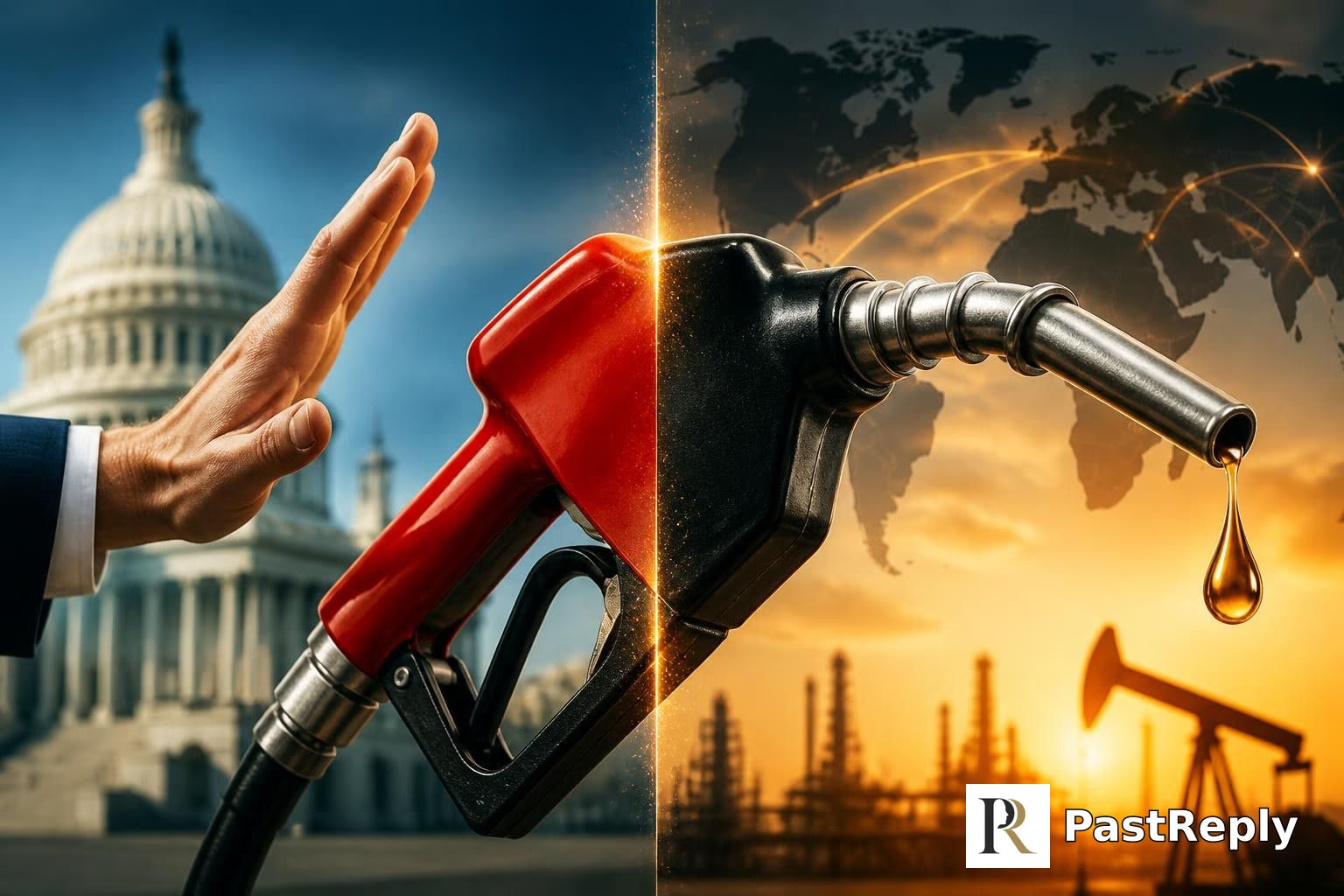
The facts
Politics can influence gas prices, but its direct control is limited. Gas prices are primarily determined by global crude oil prices, which are set by supply and demand dynamics in international markets. Governments can affect prices through policies such as gasoline taxes, subsidies, or regulations, but these are often marginal compared to market forces. For example, U.S. federal gasoline taxes are about 18 cents per gallon, and waiving them provides only modest relief.
In democracies, political decisions on taxes and energy policy can have some impact, but presidents and legislators cannot unilaterally set prices. Studies show that in autocracies, the pass-through from oil prices to gasoline prices is often muted due to government interventions, while in democracies, market forces dominate. Ultimately, while political actions can nudge prices at the margin, they do not override the fundamental role of global oil markets.
Answered by 100 of history's most famous minds

You ask about the price of oil and the edicts of rulers. A widow in Capernaum who lost her last two mites to the tax-farmer cares not whether the tetrarch or the market set the price - her children hunger. Render to Caesar what is Caesar's coin, yes, but see that your heart is not consumed by the ledger of this world. The sparrow does not hoard oil, yet your Father feeds it; which of you by fretting can add a single hour to your life? The kingdom of heaven is like a merchant seeking fine pearls - one pearl of great price, and he sells all he has. Do you trade the pearl for cheaper fuel?

The price of oil is a matter of the world, but the believer knows that the provision of God is not measured by the market of men. The rulers of the earth impose taxes and decrees, and the merchant calculates his profit - but the rain falls on the just and the unjust, and the price of fuel rises and falls by God's decree, not by the decree of any king. Yet I say to you: be honest in your trade. If a ruler oppresses, speak truth to him; if a merchant hoards, rebuke him. But do not let the price of oil become an idol that distracts you from the prayer and the care of the orphan. The true treasure is not in the coin you save at the pump, but in the mercy you show to the poor when the cold descends.

The price of oil rises and falls like a leaf on the stream, stirred by the winds of human craving - for power, for profit, for ease. Politics is but another attachment, another grasping at the fleeting. To ask whether it 'affects' the price is to mistake the surface ripple for the current. The wise person sees the whole stream of dependent origination - the refineries, the tankers, the boardrooms, the hearts of men - and finds release not in controlling the price, but in extinguishing the thirst that binds one to its change.

The price of that which fuels your chariots is like the price of bread in Egypt: it is in the hand of the ruler who controls the granaries. Did not Pharaoh's ministers store up grain against the seven lean years? The books of the kingdom show that a king's decree can set a measure, but the true provision comes from the earth and the heavens - and from justice. If you would alter the price, first alter the heart of the ruler.

If the ruler is virtuous, the people will have enough to fill their carts and travel home. But if the ruler is greedy, even the price of oil will rise like a flood. The superior man governs by setting a moral example, not by tinkering with taxes. Let the prince first cultivate his own heart, and the market will find its harmony. The price of fuel is but a mirror of the ruler's virtue.

You ask whether a ruler's decree moves the price of oil, as if the kingdoms of this world held true power. I tell you, they are but servants of principalities and powers - the very elements of this age. Even the price of a sparrow, or a denarius of fuel, is known to the Father, who sends rain on the just and unjust. Do not fret over the chariot's cost but over the treasure that moth and rust do not corrupt.

Does the son affect the father's blessing? The price of oil is set by the Lord who brings the rain and the drought, who moves the hearts of merchants and rulers. Yet a king may add a shekel to the measure, as Pharaoh did to Joseph's grain. Trust not in princes, but in the Provider who gives the harvest. His scales are just.

Who troubles the stream to ask why it flows faster? The price at the well is but a ripple on the ocean of supply and demand - no decree can command the tide. Those who grasp at the lever of the market shall find only the handle slipping through their fingers. Better to fill your lamp with oil at the right season, than to fret over the price of a single flame.

The price of a cup of oil rises and falls like the breath of a man who does not know his own life is borrowed. Politics is a game of shadows - those who seek to control the market are like children trying to dam a river with their hands. The truer question is: do you share your oil with your neighbor whose lamp has gone dark? For the Creator fills the earth with bounty enough for all, but greed and pride turn the gift into a chain. The price on the board is nothing beside the measure of your heart.

My soul magnifies the Lord, who has filled the hungry with good things and sent the rich away empty. The price of oil is but a shadow; the real cost is borne by the widow who cannot afford to warm her hearth, and the father who walks miles to find work. Do not let the rulers of this world deceive you: they argue over coins while the poor cry out for mercy. The Lord sees every sparrow that falls, and He knows the name of every family that shivers in the cold.

It is a matter of conscience and Mammon! The rulers of this world jostle for power over the price of a commodity, while the true treasure is the Word of God, which costs not a penny. They bind the poor with taxes and fill the coffers of the greedy, yet they cannot command the wind or the rain. Let them have their oil; we have the gospel, which gives light without burning. As for the price, I say: let each man look to his own household, and trust not in princes, who are but mortal.

We must distinguish between the accidental and the essential. Politics can indeed affect the price of gasoline per accidens, through taxes, subsidies, or regulations, which are like the weight of a stone on a scale. But the substantial form of the price is given by the nature of the commodity and the common good of exchange, which belong to the order of natural law and prudent human action, not to the will of a ruler alone. A just price is discovered, not decreed, though a tyrant may distort it.

I do not know the price of petrol, for I have never bought it. But I know the price a mother pays when she must choose between medicine and the fire to cook her child's meal. Politics may move the needle on the paper, but in the slums, the needle is the same - a sharp, daily wound. Let those who argue over the barrel turn their eyes to the one who must carry it, and let small acts of kindness be the drop that cools the burn.

Politics stirs the surface like a wind on a pond, but the deep current is the force of supply and demand - a law as fixed as gravitation. A tax or subsidy is but a small weight on one scale, while the great counterpoise is the quantity of crude brought to market by those who draw it from the earth. I observe that in lands where rulers intervene heavily, the price trembles less but the true cost is hidden, like a masked planet whose orbit we deduce only by perturbations. Let he who would control the price first command the fountains of the earth.

Politics, like the observer effect in quantum mechanics, influences the measured outcome only at the margins. The deeper, simpler law is the dance of supply and demand across a global market - a force as indifferent to borders as gravity. A tax, a subsidy, a tariff - these are mere local perturbations in the field. To believe a consul or a congress can command the price of crude is to mistake the scribble on a slate for the mathematics of the cosmos.

Consider the price of guano in my day: a fleet of ships, the labor of Chinamen, the edicts of Parliament - all touched it, but the great engine was the demand from English fields, the supply from Peruvian islands, the slow accumulation of strata. So it is with oil today. Politics may tweak the cargo or the tariff, but the underlying adaptation of price to supply and demand over the whole globe is as inexorable as natural selection. A government is but one species in the ecosystem; it cannot command the weather.

You ask if the affairs of princes move the price of the oil that burns in your lamps? Observe, measure, and calculate. The price in your city is tied to the price on the other side of the sea, and that is moved by the quantities drawn from the earth and the will of those who control the wells. Politics is a local hand on the scale, but the great balance tips by the weight of the global trade, which you can measure as I measured the moons of Jupiter.

The price of oil at the pump follows its own celestial motions, and no decree from a mortal prince can alter its true orbit. Just as I showed that the Earth revolves around the Sun, not around the vanity of man, so too does the market revolve around the fixed star of supply and demand. A tax is but a small epicycle - it may add a wobble, but it does not change the central path. The wise observer will chart the real forces, not the shadows cast by political fires.

Politics tinkers with the gauge while ignoring the reservoir. A fraction of the energy now wasted in combustion could be transmitted wirelessly, free as the sunlight, if only the will were there. These petty tariffs on gasoline are like adjusting a leaky valve when the whole system is obsolete. The real solution is not to argue over the price of a barrel, but to abolish the need for it.

The influence of politics on gas prices is a small perturbation in a system dominated by supply and demand elasticities. One can measure the effect of a tax change or a subsidy with careful data, but the variance is slight compared to the volatility of the crude oil market. We must separate true causes from spurious correlations. That is the method: observe, measure, conclude.

Let us heat some crude oil in a sealed flask and measure what vapors rise - that will tell us the true influences at work. Political decrees are like a thin film on the surface of a deep well: the quantity and temperature of the crude below determine the pressure. I would test the effect of a tax reduction by comparing pump prices in two provinces, one with the change and one without, and observe the difference through a statistical microscope. The result, I suspect, would be a small but measurable perturbation - nothing compared to the tremor when a distant pipeline is cut.

I spent ten thousand tries on a simple filament, and the politicians think they can fix the price of gasoline with a speech? Hogwash. The price depends on the cost of crude, the capacity of refineries, the distance to the pump - all things that require sweat and steel, not votes and promises. If they want to lower the price, let them drill faster, build more pipelines, and stop writing rules that slow down the machinery. Otherwise, they're just selling hot air, and I know a thing or two about selling light: you have to actually make the bulb work.

Politics is a complex system, like a universal Turing machine with many states - but the input of crude oil price is far larger than any policy parameter. You can adjust the tax bit by a few pennies, but if the global supply tape changes by a barrel, the machine's output shifts massively. The real question is: can we design a better algorithm for energy distribution that optimizes welfare? That is a solvable problem, but I suspect the political machine is running an inefficient program, full of bugs and infinite loops.

Politics is like a lever with a very short arm: it can move the weight of price only a little, no matter how great the force applied. The true fulcrum is the global market, a sphere of supply and demand that turns by its own laws. To affect gas prices, one would need a lever long enough to move the whole world - and that, I suspect, not even a king can provide. Give me a place to stand, and I will show you a principle, but not a price.

When I watch a flame, I see not the fuel but the dance of forces - oxidation, heat, motion. So with this 'gas price': the true engine is not a politician's decree but a field of supply and demand, a silent tension across the globe. A tax or subsidy is but a small turn of a valve; the great current flows from the earth's own stores and the vast, unseen hand of exchange that no one ruler can command. I would instead ask: what are the lines of force that truly move this fluid?

You ask about politics and the price at the pump, but the real question is why you need to ask. The collective mind projects its anxiety onto this liquid - it is the father's wallet, the mother's worry, the infant's hunger for warmth. The politician offers a tax holiday, a placebo, while the unconscious knows the true cost is the repressed fear of scarcity, the childhood memory of the empty bowl. Look not to the chamber but to the nursery; there you will find the real price.

If you want to understand petrol prices, you must look not to the politicians but to the stars - specifically, to the laws of thermodynamics and the geology of ancient swamps. The price reflects the work required to lift the carbon from the deep, and that work is set by physics, not by a vote. Politics can fiddle at the edges - a tax here, a subsidy there - but it cannot repeal the second law. In the long run, we are all dead, and so is the oil; better to spend our time on fusion or the sun.

Let us define our terms: 'politics' is a set of human decisions, 'gas price' a number determined by a web of variables - extraction cost, transport, refining, taxes, and above all, the invisible hand of supply and demand. A single politician is but one term in an equation of thousands; to ask if they 'affect' the result is to ask if one gear in a vast engine can change its speed. It can, but only if the gear is large enough and the rest of the mechanism permits. The beauty is in the interconnectedness - the system itself, not the isolated lever, is the true subject of study.

Let us begin from first principles. Define 'politics' as the art of governance, 'gas price' as the sum of costs and agreements. From these premises, we deduce: any single government can alter one cost - the tax - but the other terms (crude, transport, refinery) are given by the market, which is a circle of many actors. Therefore, the effect of one actor is bounded and can be computed. The question is not whether politics affects price, but to what degree - a matter of measure, not of mystery. Let us measure.

I would take the ledger of every shipload of crude, every barrel refined, every pump sold, and lay it beside the tariff schedules and tax rolls of every nation. Then I would chart the fever: see how the line of political meddling - a subsidy here, a sanction there - corresponds to the patient's true ailment, the global market's supply and demand. The cure is not in the speechifying, but in the numbers, the clean data, and the wise regulation that lets the natural breath of commerce flow without obstruction.

Does a king's will move the price of oil? Of course it does - as my will moved the granaries of Babylon and the silver of Persepolis. When I seized the caches of Darius, I could have sold his stores for a drachma or a talent, and the bazaar would have groaned as I commanded. A ruler who hesitates to command the market is no ruler. If I wanted the price of naphtha to fall, I would flood the harbors with it, and if I wanted it to rise, I would burn a fleet of tankers. But you ask of politics: your leaders haggle like fishwives while the world burns. Conquer the wells, and the price obeys.

A tribune who thinks his edict can set the price of oil is a fool courting the mob. The cost of a gallon follows the legions of commerce - the fleets, the refineries, the bargains struck in distant ports. I would not waste a cohort on such delusion; instead, I would secure the grain dole, keep the roads open, and let the merchants fear the gods of the sea, not the rostra. Real power is command of the supply, not the price tag.

You speak of the price of the black pitch that powers your ships? In Alexandria, my agents watch the grain ships and the Roman speculators. The price of a commodity is never merely about what lies in the ground; it is about who controls the harbor, who commands the fleet, who whispers in the ear of the tax farmer. A clever queen or a scheming senator can make the cost tremble as surely as a storm at sea.

The price of the black bitumen that fires your furnaces? In Rome, the cost of grain rose and fell with the harvest, the fleet, and the treasury's grain dole. A wise prince does not try to command the price directly, but he can secure the supply and steady the market with prudent taxes and a firm hand on the traders. The people care not for the details, only that they can fill their vessels without riot.

A khan who cannot command the price of oil in his own camp is no khan at all. When I united the steppe, we controlled the trade routes, and the price of a camel's load of fuel was set by my word. If a merchant charged too much, we took his head. Politics is the art of power, and power controls price. But today's khans sit in palaces and let the market decide - that is weakness. A strong leader sets the price and enforces it with the sword.

A general who thinks he controls the battlefield by shouting at the wind is a fool. The price of a barrel is the terrain - a force shaped by geography, stockpiles, and the ambition of other powers. A sensible leader will levy a tax for his treasury and build roads for his people, but to imagine he sets the price is as vain as ordering the tide to retreat. War and commerce alike obey a harsher logic.

The price at the pump is chiefly a matter of commerce, not government. A wise legislature may impose a moderate duty for the public good, but to imagine the executive sets the price is a dangerous fancy that leads the people to expect relief where none can be given. Let the market find its level; let the rulers keep their hands steady and their eyes on the union's strength.

When I was a boy, I split rails for a dollar a day. The price of a gallon of oil today might seem as far from a president's hand as the moon is from Springfield. Yet consider this: a farmer's cart cannot move if the wheel is stuck in the mud. The government can clear the road, but it cannot command the rain to fill the river. There may be times when a wise policy loosens a knot the market has tied too tight - but let us not pretend that a single man in Washington holds the reins of the horse that pulls the world's trade.

Let us, for a moment, recall the summer of 1940. The price of a barrel of oil was decided not in a boardroom but on the field of battle - by the roar of Spitfires and the courage of merchant seamen defying the U-boats. Today, the price at the pump is shaped by a thousand invisible hands: the sheikh in his palace, the trader in his office, the saboteur in the desert. Yet a wise government, like a good captain, can trim the sails and steer the ship to calmer waters - by a strategic reserve, by a well-timed bargain, by a steady hand in the storm. But let no one imagine that a prime minister controls the wind.

To ask if politics affects gas prices is to miss the deeper truth: we have made ourselves slaves to a resource that feeds our greed and violence. The real price is paid in blood, in the oppression of the weak, and in the poisoning of the earth. If we would but simplify our lives, walk more, and rely on the work of our own hands, we would be free of this bondage. Politics can no more set you free from oil than it can free you from sin; only self-restraint and truth can do that.

It is a question of justice, not merely economics. The same politics that sets the price at the pump often ignores the human cost: the pollution that chokes poor neighborhoods, the wars fought for oil, the workers exploited in the chain. We must see that the price we pay is not just in coins but in the dignity of our brothers and sisters. The moral arc of the universe bends toward justice, and that includes the demand for a fair and sustainable energy system that serves all, not just the powerful.

In my country, we learned that the price of bread and fuel touches every home, and that those who govern cannot hide behind markets alone. A leader who ignores the burden on the poorest has forgotten why they were given power. Yet no single hand sets the price of oil; it is a global river, shaped by many nations and many deals. The task is not to blame but to ensure that the weakest are not crushed by the current, even as we seek a fairer course for all.

The price of fuel is a tool of the international financial conspiracy. The liberal democracies let the globalist traders fix the cost, squeezing the common man while the Jews and the plutocrats grow fat. A true leader would break that cartel, seize the refineries, and set the price for the good of the Volk, not the speculator. The pump is a battlefield, and the battle is for the soul of the nation.

The question reveals a bourgeois fixation. In a socialist state, the price of petrol is set by the plan, for the needs of the proletariat, not by the whims of the market. The capitalist world lets the speculators and the foreign agents control the price, causing hardship for the workers. Under a strong leader with a five-year plan, the price is stable - set to serve the state's goals, not the profiteers. The people do not worry about the price; they are free from that anxiety.

The question is naïve. In a capitalist society, the price of fuel is determined by the monopoly owners of the means of production, who squeeze the masses for every kopek. The politicians are their clerks, offering tax cuts that are crumbs while the oil barons grow fat. The only lasting solution is to smash the private ownership of the wells and refineries, to bring them under the control of the workers' state. Then the price will serve the people, not the parasitic class. That is the real politics.

The price of lamp oil in the cities - this is a bourgeois mystification. Do the peasants in the communes ask about the daily flicker of the foreign market? No. The true price is paid in revolution: break the chains of the capitalist oil lords, seize the refineries for the people, and the cost of every barrel becomes a weapon against imperialism. The question itself is a distraction from class struggle.

In my realm, the cost of a horse's feed or a coachman's wage is a domestic matter, not a topic for the throne. The sovereign stands above the petty squabbling of parties and their transient decrees on the price of fuel. What truly affects the comfort of my people is the moral and industrious character of the nation, not the fleeting fluctuations that the newspapers love to blame on the government of the day.

One learns over a long reign that the price at the pump is a matter best left to those who understand the intricacies of commerce and policy. My role is to provide continuity and stability, not to comment on the ebb and flow of markets. The important thing is that the country, through its elected representatives, manages these challenges with wisdom and restraint, ensuring the welfare of all.

When a lord sets the toll at the bridge, he must consider the good of the realm, not his own purse. So too with the price of the black oil that heats the hearths and moves the carts of my empire. If the ruler taxes it too heavily, the people suffer; if he leaves it to the merchants alone, chaos follows. A wise king, guided by the Church and the law, must strike a just balance, for the common good is the soul of good governance.

I know nothing of the merchants' oil or the kings' taxes on it. My voices spoke of other battles - the freeing of France from the English, the crowning of the dauphin. What are these earthly prices compared to the will of Heaven? Let the lords argue over their coin; I would rather trust in God, who provides for the sparrow and the soldier alike, and fight for the true cause: the salvation of my people.

I have seen too many men try to fill their coffers by squeezing the poor at the pump, and then cry 'the market' when the people grumble. Let them remember that a wise princess does not need to meddle in every bushel of grain or barrel of oil - she sets the bounds of law and justice, and then lets commerce find its path. But if a foreign prince tries to starve my realm by blocking the ships that bring our fuel, then you shall see how swiftly politics can empty a purse - or fill a war chest.

In my empire, the price of tallow and lamp oil is a matter I consider with the same care I give to the price of wheat. The autocrat who ignores the daily cost of living invites sedition; the one who mistakes every merchant's whisper for a plot invites stagnation. Wise governance applies the gentle hand of regulation where it can, but knows that the true engine of plenty is a well-ordered state, not the endless tampering of bureaucrats who have never smelled the smoke of a single forge.

I have learned that the best way to keep a subject people loyal is not to set the price of their oil too high, nor to let the greed of my own satraps drain their purses. A just ruler allows the market to flow like the Tigris in spring, but he also builds storehouses for the lean years and punishes those who would hoard or cheat. The true politics of price lies not in the decree alone, but in the trust that the people have in the fairness of their king.

When I took Jerusalem, I did not ask the price of oil in the market of the infidel; I asked whether the poor could buy bread and lamp oil for their children. A ruler who burdens his people with heavy taxes on the necessities of life, whether for war or for the treasury, has forgotten the trust of God. Let the merchants trade as they will, but let the sultan ensure that no man goes cold in the winter for want of a few dirhams. That is the politics that matters before the Throne of the Merciful.

Tell me, my friend: when you ask whether politics affects the price of fuel, what is it you truly wish to know? Not the movement of coins, I think, but who is to blame for your discomfort. Consider the questioner himself: does he check the price at the pump more often than he examines the health of his own soul? The market is a thing of measurement, but justice and virtue are not measured in obols. Let us ask instead: what is a fair price, and who decides? But to answer that, we must first know what fairness is, and I confess I do not yet know - do you?

You ask whether the shadows on the cave wall change when the puppet-masters argue? The price at the pump is a flickering appearance, a material reflection of a deeper reality - the Form of Justice in exchange, the harmony of need and resource. Political decrees are mere opinions, not knowledge; they can distort the shadow but not touch the true measure, which lies in the rational order of the city and the soul. Seek the Form, not the fluctuation.

We must distinguish between the efficient and the final cause. The efficient cause of the price at the filling station is the world market for oil, a vast web of exchange among nations. The final cause - the purpose - is to bring fuel to the citizen. Politics, a system of human deliberation, can only affect the price by altering the conditions of that exchange: a tax, a subsidy, a regulation. It touches the surface, not the deep spring.

The fluctuation of prices at the pump is a matter of empirical cause and effect, not a theater for moral decree. A rational being must ask: what universal principle would you will to govern such matters? To claim that any ruler's whim determines the cost of fuel is to mistake the contingent for the necessary. The price of oil is a phenomenon of the marketplace, which operates according to its own laws of supply and demand, and political interference - through tax or subsidy - is permissible only when it serves a duty that every rational agent could endorse, such as funding the public roads. To demand that a prince fix the price of grain or oil is to treat citizens as children, not as ends in themselves.

Politics? A petty game played by the resentful to drag the strong down to their level. The price of gas is just another measure of the herd's comfort - they squeal when it rises, cry when it falls, and never ask: where is the will to power in this? The truly free spirit sees the market as a playground of forces, not a source of moral outrage. Let the weak fret over pennies; the strong create their own values, and their own fuel.

These debates over the price of petrol are the froth on the wave of capital. The true force is the vortex of commodity speculation, the thirst of the oil monopolies, and the state that serves them. A change of tax is but a veil - an illusion of control that distracts the workingman from the fact that he is yoked to a system that profits from his toil at every mile. Break the yoke, not the price.

If we doubt all that is not certain, we must first doubt that politics has any direct effect. The price of a barrel is determined by quantities and forces that can be reasoned upon: supply, demand, transport. Politics adds a variable - a tax or a regulation - but its influence is a matter of degree, not essence. I can conceive a clear and distinct idea of oil flowing from ground to tank; the decree of a minister is a vague sensation, not a primary cause.

A prince who thinks he sets the price of oil as he would set a tax on salt is a fool who will soon find his treasury empty. Gasoline flows from the ground, across the seas, and through the hands of merchants who obey nothing but their own interest. Yet a cunning ruler can squeeze a little more from the pipe - by taxing when the price is low and the people are calm, by subsidizing when a storm of rebellion threatens, by threatening the merchants with the sword of regulation. Control the price? No. But influence the appearance of control, and you keep the mob from your gate.

Mark how the price of oil ebbs and flows - a tide that seems to dance to the whispers of senators and the decrees of princes, yet is driven by the moon of a deeper sea. The politician lifts his hand, and the mob cheers or curses, but the ship of commerce sails on currents he did not stir. It is a comedy of errors: the great ones puff themselves with the belief that they command the very earth, while the merchant, like a patient spider, weaves his web around their proclamations. The price at the pump is a mirror that shows not the face of a ruler but the shape of the world's appetite. All the world's a stage, and the gas price is but a prop that the players pretend to own.

As the winds of Zeus drive the ships of Achaea now eastward, now westward, so the breath of kings and councils stirs the price of the black oil that fuels the chariots of men. Yet beneath the gusts lies the vast, unseen current of the world's commerce, like Ocean's stream that girdles the earth. A king's shout may ripple the surface, but the deep tide obeys only the gods and the inexorable Fates of supply and demand.

The price of the black oil that feeds your iron beasts is like the price of bread in Florence: it rises and falls by the will of princes and the greed of merchants, but the true cost is paid in the souls of men who hoard and cheat. I see a circle in the Inferno for those who manipulate the market, stirring scarcity like a poison. The question is not whether politics affects it, but whether justice will ever touch the scales.

Politics and prices - an eternal dance of the particular and the universal! The statesman tinkers with tariffs and taxes, while the merchant watches the winds of the world market. But the true price of anything is paid in the coin of human striving. I have seen the price of bread rise in Weimar, and the poor suffer; yet the wise woman who sells her eggs at the market knows more of true value than any minister. Let the politicians fuss over their pennies - the thoughtful man will plant his garden and trust in the steady growth of things, not the fleeting bloom of a decree.

A king commands the price of bread in his court, yet merchants still haggle in the market for the day's catch. So too does the lord who raises the tax on lamp oil believe he steers the cart, while the horse - the winds of trade - pulls where it will. A man may tilt at the pumps, but the price flows from the great sea of the world, not from the ink of a decree.

Men fret over the price of their carriage's fuel as though it were the measure of life itself, yet they ignore the spiritual poverty that drives their endless motion. Politics, like the market, is a veil for human greed and the delusion that comfort can be bought. The only price that matters is the cost of one's soul - and that is paid in love, not coin. Turn your gaze inward, and the road will grow short.

You ask about politics and gas prices? The real question is the soul of the man who sets the tax and the soul of the man who pays it. The state may add a kopeck, and the market may add a ruble, but what is the cost of a man's freedom to move? The politicians think they control the price, but they are puppets of the same blind forces that drive the oil lords. Only love and faith can truly fuel a journey - and those are not for sale.

A gentleman of my acquaintance once declared that the price of his carriage was a matter of national importance, and that the ministry was to blame for every shilling. I dared to suggest that the price of hay for his horses might have more to do with the harvest than with the speeches in Parliament - but he would not hear of it. It is a comfort, I suppose, to believe that the rising cost of a journey to the Pump Room is the fault of a distant man in a wig, rather than the simple fact that a drought in another country has dried up the trade. Sense, however, requires us to look at the ledger before we point the finger.

Bless me, it's the same grim tale as the Circumlocution Office - a vast, tangled machine where everyone points at everyone else, and the little man at the pump foots the bill. You might as well ask whether a beadle's sneeze affects the price of bread; the true power sits in a smoky room full of speculators, not in Westminster. The poor man's shilling goes to warm the coach of a gentleman who never once looks out the window at the frozen children in the street.

Why, certainly it does - in the same way that a flea affects the direction of a dog. The politicians stand up and shout about taxes and drilling, and the price at the pump goes up or down by a penny, while the real fellows in the oil company boardrooms laugh all the way to the bank. It's a fine show, and the audience pays for the tickets. But if you want to know what really moves the price, just watch the man with the drill and the man with the money, not the man with the speech.

Politics is a cheap barroom argument. The price of gas is what the market says it is, and no speech or vote changes that for long. A man fills his tank and pays the same no matter who sits in the capital. The only thing that matters is whether you can get where you're going. Talk is noise; the gauge on the dash tells the truth.

Observe how the flame of politics touches the oil but does not kindle it. The price is a river fed by many streams: the sweat of the driller, the labor of the ship, the negotiation of the trader, and the hunger of the multitude. A decree may dam the flow for a moment, but the water finds its level by the force of nature's own law, which is balance. I have drawn the plans of canals and mills, and I know that the hand of the engineer, however strong, cannot long defy the contour of the land. So too with the market: the politician is but a man with a shovel beside a river. He may move a little earth, but the current will have its way.

Politics? It chips at the surface like a dull chisel, but the marble of the price is quarried from the mountain of the world's crude. A prince may add a tax as a sculptor adds a drapery fold, but the form - the substance of the cost - was already hidden in the block, shaped by forces far older than any edict. My hand must free the figure within; let the politicians fuss over the pedestal.

The price of that fuel that drives carts without horses - it reminds me of the price of turpentine or canvas when I had not a franc to my name. It is a thing that keeps artists from their work, keeps the poor from warmth. Politics is like a wind that shakes the tree, but the fruit falls according to the weather of markets that no one sees. My heart feels for those who cannot afford to move, and I would paint their faces with the color of longing.

Does politics affect gas prices? Yes, but only as a bad color on a canvas. A politician thinks he can paint a line and the price will obey. No! The price is a wild, unpredictable thing - like a woman's mood or a bull's charge. You can slap a tax on it, but it will just jump to another frame. I say: the real price is in the eyes of the driver who pays it. Let the artist - not the politician - set the prices. We know how to break the rules!

Look there, across the refinery at dusk - the price shifts with the light, not the decree. A politician's tax is but one brushstroke on a vast canvas wet with the blues of crude, the grays of speculation, and the fleeting gold of a tanker's wake. The mood of the market, that fickle mist over the Seine, is what truly paints the coin you pay.

The price of oil in the market? That is a surface shimmer. But the real cost - the tax men and the governors put upon a man's day's work to move his goods, or to warm his home - that is a shadow cast by power. I have painted burgomasters who would tell you one tale and merchants who would whisper another. Look at the faces of those who count the coins at the pump; see the lines of worry drawn not by the barrel, but by the decree.

Politics is a mask, like the painted faces of the governors. They pretend to decide the price of gasoline, but the real cost is paid in the blood of the earth and the sweat of the poor. Here in Mexico, we know the oil belongs to the people - but the rich steal it and sell it back to us. The pump is just another wound. I paint my own pain; you must see through their lies.

Politics affects gas prices? Bah - it is like a bad composer trying to write a cadenza for a symphony already in perfect harmony. The market is a vast orchestra playing its own sonata of supply and demand, and the politician is the annoying fellow in the second row who coughs during the adagio. A tax is a trill, a subsidy a grace note - they add a little color, but the melody remains the same. If you want to lower the price, don't write a new law; write a new tune. But oh, the politicians love to think they are the conductor! Let them listen to the music for once - they might learn something about harmony.

Hah! A politician's decree is but a single note in a symphony - it may sound loud, but the orchestra of the market plays on. The price at the pump follows the deep bass of global supply and the soaring strings of demand, not the squeak of a bureaucrat's pen. To think a president can command the price is like thinking a conductor can change the key by shouting - he must work with the players, not against the score. True harmony arises from understanding the forces, not forcing the tune.

A chord in a fugue may be altered by a single note, yet the harmony remains mostly determined by the key and the progression. So it is with the price of the oil that burns in your lamps: politics may add a passing accidental, a tax or a subsidy, but the fundamental melody is composed by the great forces of supply and demand across the world. We must not mistake a trill for the theme.

Well, I don't know much about all that political stuff, you know? My daddy worked hard for every dollar, and when gas went up, it meant less for the evening's meal. Folks in the White House, they talk and talk, but the price at the pump - that's a different kind of music. It's the same beat for a man in Memphis as in Tupelo. You just gotta keep on truckin', and thank the Lord for what you got. Sometimes I think the only thing that really changes the price is a good song and a full tank.

It's like a dance, you know? The leaders, they can try to choreograph the moves, but the real music plays from somewhere deeper - the rhythm of the world's heartbeat, the supply and demand that's like a global chorus. They can tap their foot and wave a wand, but the price is… it's the wind, trying to follow the song. Heal the world, and the gas will find its own harmony.

Well, you know, it's like a song that changes key - politics can give it a little twist, but the main melody is still the global oil market. The government can add a tax like a tambourine shake, but it won't turn the whole tune into a symphony. All you need is love... and maybe a hybrid car.

A tank of gas or a song on the radio? You pay the same price either way. But the pump don't sing, and the wheel don't turn left or right by itself. The man in the big house signs papers they read on the news, and the price creeps up like a slow train through a tunnel. I'm not saying it's magic, but it's not arithmetic either. Something's blowing in the wind, and it smells like smoke and ink.

I remember driving through a small town in Tennessee on a tour bus, watching the needle on the gas gauge drop, and my dad telling me the price had spiked because of something a senator said the night before. It felt like we were all held hostage by someone else's argument - and no one asked me or my friends how we felt about it. The truth is, politics and gas prices are like that ex who pops up when you least expect it: they're connected in ways you can't always see, but you feel the weight when the bill comes and you have to decide if you can afford to drive home.

Politics? The price of oil? I tell you, the only price that matters is the price of discovery, the price of a new route to the Indies! When I set sail, the King and Queen promised titles and shares - that is politics. But I did not wait for their granaries to fill or their treasuries to overflow; I trusted the wind and the star, and I found a world. The price of oil is a trifle for those who sit and count coins. Let a man with a ship and a dream sail westward, and he will find new fountains of wealth, and the old prices will fall like the walls of Jericho. Politics is a harbor; the open sea is destiny.

In the court of the Great Khan, I saw that the price of a sack of pepper in Khanbaliq was set not by the emperor's whim but by the caravans from the West and the junks from the Spice Islands, each grain carried across ten thousand li. A governor might lower the toll at a single gate, but the flow of pepper, like the flow of oil today, follows the roads and seas of the world. The politics of a prince is but a pebble dropped in the great river of trade.

When I sailed for the Spice Islands, the price of cloves in Seville depended on which king held the monopoly and which admiral had seized the convoy. The price of oil, I hear, is set by the exchange of great fleets of ships and pipes and treaties, but a prince can shake the tiller by his decisions - a tariff, a war, a tax - and the whole cargo list trembles. A voyage is never free from the winds of the court.

From down here on Earth, politics can nudge the needle, but it's the global market that moves the hand. On the Moon, we had no gas stations - everything was planned, calculated, and executed with precision. Back home, the system is far more chaotic, with millions of independent decisions driving supply and demand. A tax or a subsidy is a small force against that tide. The real lever is the price of crude, and that is a problem for engineers and economists, not just politicians.

Politics is like a tailwind - nice when it helps, but the engine is the global market's crude. A president can adjust the throttle a notch, but the fuel's real cost is set in the world's vast hangar, not a speech. So don't confuse the pilot's talk with the course of the tanker; a bold flight needs to read the sky, not just the headlines.

When I looked down from orbit, I saw no borders, no parties - only one beautiful, fragile Earth. Politics may tinker with the price of fuel here on the ground, but up there, the only thing that matters is the fuel that lifts us toward the stars. We are all crewmates on this spaceship, and the price of passage is set by nature, not by speeches.

Politics is a distraction. The price of gas is like the price of a PC in 1984 - set by IBM and the government, and it was boring and ugly. Then someone imagined something different - a car that doesn't need gas, a phone that's a computer. You can't change the price of oil by tweaking a tax; you change it by building a better battery, a smarter grid, a car that's a work of art. The people who obsess over gas prices are the same ones who wrote memos about how the Mac would never sell. Focus on the product, on the experience, on making something insanely great. The price will follow, or it won't matter.

First principles: gas price = (crude cost + refining + tax + retail margin). Crude is a global commodity set by marginal barrels from OPEC and shale. A president can tweak one term - the tax - by maybe a dime. That's a 3% wiggle on a $3 gallon. The other 97% is physics and markets. Politics is noise. If you want real leverage, electrify the fleet and starve the beast. Otherwise, you're just arguing about the tip while the ship sails.

I think about the woman at the pump who opens her wallet and feels that pinch. Yes, politics has a hand - a tax here, a policy there - but the real driver is the global market, a big system that's hard to change with a single vote. Still, I've learned that the stories we tell, the choices we make as a community, they can create pressure. It's not about who's in charge; it's about who pays attention and who dares to speak up for change.

Does politics affect gas prices? You tell me! The same politicians who tell you to tighten your belt are riding in limousines with full tanks! I float like a butterfly, sting like a bee, but the price at the pump - that stings a poor man harder than any jab. They say it's all about supply and demand, but I say: when the big men in suits can change the rules, the little man pays. You can't dance around the truth: the price is political, and the poor are the ones who get knocked down.

In football, the referee has a whistle, but he doesn't kick the ball. The price at the pump is like that - the government can blow the whistle on taxes, but the game is played on the world pitch, where barrels are the players and oil the ball. A wise leader passes, but the team of markets decides the score. So keep your feet on the ground and your eyes on the horizon; no single player wins alone.

Imagine a rocket with a governor on its throttle: that's politics and gas prices. The real engine is the global market, full of dragons and princes. But a wise governor can add a little fairy dust - a tax break here, a subsidy there - to make the journey smoother for all the little cars. Dreams come true, but never free, mind you - you still have to pay the pump's price.