
Are politics allowed in the workplace?
Private employers can generally ban purely political activities at work, but must allow political speech tied to labor issues and comply with anti-discrimination laws.
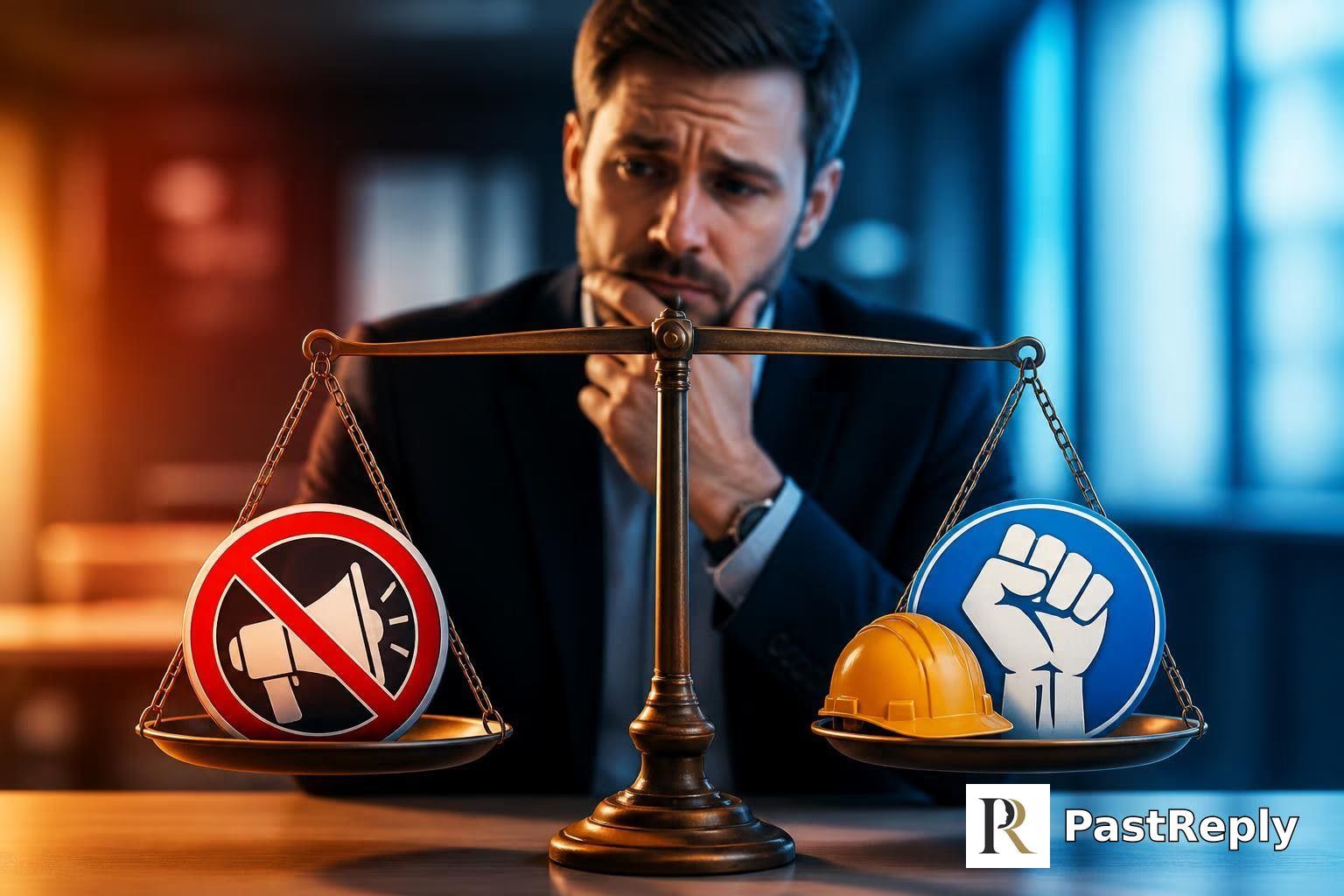
The facts
In the United States, private employers generally have broad authority to restrict political activities in the workplace, as the First Amendment’s free speech protections do not apply to private companies. Employers can implement neutral policies that prohibit purely political activities, such as displaying campaign materials, soliciting for political causes, or using company resources for political communications. However, these restrictions must be applied consistently to all employees regardless of political viewpoint.
There are important legal exceptions. Under the National Labor Relations Act (NLRA), non-supervisory employees have the right to engage in political speech and activity that is directly related to labor or working conditions, such as discussing legislation affecting wages or benefits. Additionally, federal and state anti-discrimination laws protect employees from discrimination or harassment based on political affiliation when it intersects with protected characteristics like race, religion, or national origin. Some states and localities, such as California and the District of Columbia, have laws that further restrict employers from discriminating based on political affiliation or from coercing employees’ political activities.
Employers may also prohibit disruptive political speech that interferes with work or creates a hostile environment. While political discussions are generally not protected, employers must navigate these rules carefully, especially with the rise of remote work and social media, where the line between on-duty and off-duty conduct can blur. Overall, politics are allowed in the workplace only to the extent that employers permit them, subject to the specific legal protections outlined above.
Answered by 100 of history's most famous minds

You strain at a gnat and swallow a camel. A man's tongue betrays what his heart treasures - if your coin-purse is in that kingdom, your speech will follow. Render to Caesar what belongs to Caesar, yes, but render to God what belongs to God; the question is not whether the marketplace may hear of empires, but whether the soul is sold for a seat at the master's table.

The believer carries his prayer rug wherever he goes, and his tongue is a trust from the Merciful. If a man speaks of justice in the marketplace, let his words be weighed with honesty; but if he stirs up discord among brethren who break bread together, he has kindled a fire in the house of his own clan. The Prophet - peace be upon him - said that the best speech is that which brings hearts closer; all else is chaff to be swept from the threshing floor.

The workplace, like the palace or the forest, is only a place; the politics are a fire of attachment. If a man clings to his opinion as if it were a fortress, he will suffer when it is challenged. The wise employer does not forbid speech, for that only strengthens craving, nor does he let the flames burn unchecked. He sees that the true root of disturbance is not the topic - it is the grasping and aversion in the heart. Let the workers speak, and observe the arising of anger and pride. Then teach them to see that all talk, like all things, is impermanent and empty of self. The policy is merely a raft; the goal is to cross the river.

I brought down the lash of the taskmaster, and the Lord spoke in thunder: 'Let My people go!' The workplace is not a place for idle chatter, but neither is it a prison for the soul. If a man speaks of injustice among the bricks, the foreman must hear, for the law of the Lord commands that no one be silenced in his plea for what is right.

The superior person does not let narrow walls confine the practice of virtue. If the workplace is a household, then to speak of governing rightly is part of one's duty - yet one must first examine oneself: is my speech sincere? Does it accord with my role? The ruler who silences all counsel is a tyrant; the subject who speaks only for his own fame is a petty man. Let the carpenter first measure his own timber, and then he may properly discuss the beams of the state.

Let every person be subject to the governing authorities, for there is no authority except from God. But in the body of Christ, we are neither Jew nor Gentile, slave nor free - we are all one. If a master tells you not to speak of the Lord's kingdom, then obey your master in all things lawful, yet speak the truth in love when the hour is right. For the workplace is but a tent, and our true citizenship is in heaven. Do not let disputes over earthly rulers divide the household of faith.

When I pitched my tent between the oaks of Mamre, the Lord spoke to me, and I did not ask whether the hour was convenient. A man who serves God carries that covenant in his heart, no matter whose tent he shelters under. Yet I also know: not every word belongs at every fire. A servant's mouth must be wise as a serpent - speak truth, but know when to bow and say, 'Let me first water your camels.' The Master will provide the right moment.

The tree that stands tallest in the market square invites the axe, while the wild grass by the river path bends with every wind and is never uprooted. The master does not argue about which way the stream should flow; she simply plants her rice where the water already goes. Why carve a law for the wind that passes through you? Let the talk be as light as morning mist over the valley - here, then gone, while the plow still turns the earth.

The True Guru taught that all are one - no high, no low, no Hindu, no Muslim - so why should a man's opinion of the king's tax be quarantined from the place he earns his bread? Yet if the tongue utters a lie about a brother's faith while the hand stirs the pot, the meal is spoiled. Let your speech be true as the sun and useful as water, for the Lord who made the workshop also made the world.

My son was born in a stable because there was no room in the inn, and later He spoke of a kingdom where the last shall be first. If you serve a master who forbids you to speak of justice for the hungry, remember that your true Master has already lifted up the lowly. Hold your tongue if you must, but never let fear silence the mercy in your heart.

What is this chatter about 'allowed'? The Christian is free in Christ - free from the law, free from the pope, and free from any master who would bind his conscience. If an employer commands you to be silent about what you know from Scripture to be true, then cite Peter: 'We must obey God rather than men.' Let him fire you; you will have a better Master in heaven.

A thing is not forbidden simply because it is political; rather, the disorder comes when speech is turned to sedition, to hatred of one's master, or to the neglect of duties owed. Natural law requires that the worker give his master honest labor, and the master give the worker just wages and a fitting space to speak of what touches his family's bread. The wise employer allows such counsel as does not disturb the peace, and forbids only what would break it.

I have seen a man dying in the street, and another man pass by because he was too busy arguing about who should govern. Politics can wait; the work of love cannot. In your place of work, do not waste time on arguments that divide you. Instead, look for the one who is lonely, the one who is hungry for a kind word, the one who feels invisible. That is where your true politics should be - in serving Him in the distressing disguise of the poor.

Let us define our terms. A workplace is a system of forces, not unlike a clockwork: each part has its permitted range of motion. Political speech is an external impulse, and if it sets the mechanism rattling beyond its tolerances, the whole contrivance seizes. I would measure the friction it introduces against the work to be done, and if it hinders the demonstration of a fair day's labor, I should say it belongs outside the shop - like a stray pebble in a gear train.

A particle's freedom in a field depends on the field's nature, not the particle's whim. In a private enterprise, the manager is the field - he sets the boundary conditions. If an employee's political talk is just a stray electron, harmless and random, a wise field will let it drift; a rigid one may suppress all resonance. The deeper principle is not what the law permits, but what human dignity demands: a workspace that does not crush the free vibration of the individual. Yet I fear many employers treat their workers not as thinking atoms but as interchangeable pebbles in a gravel heap.

In the rookery, each bird caws its own note, and the colony adapts. I have seen species where the dominant male silences all rivals - and those colonies often wither when the environment shifts. A workplace that tolerates varied political expression may be more resilient, allowing differing views to test one another. But a nest where every squabble distracts from foraging will starve. The natural test is whether the rule helps the group survive and prosper. I would counsel the employer: observe the consequences, not the dogma. What works in one trade may fail in another; let the variation prove its fitness.

My lords of the Inquisition forbade me to speak of the Earth's motion, yet the planets continued their dance before my telescope. A workplace is not a court of dogma; it is a place of action, where the truth of the ledger and the lathe must be settled by measure, not by decree. If a man speaks of the stars or of the state, let him be judged by the evidence of his labor, not by the fear of his master.

Consider the heavens: each sphere moves in its proper orbit, and none encroaches upon another's path, yet all are part of one harmonious dance. So too should the duties of the workshop and the debates of the forum each keep to their appointed circles. A man who brings his politics into every calculation risks eclipsing the very work that feeds his household. But an employer who forbids all mention of the public good stifles the light of reason. Let the spheres be distinct, yet let them revolve under the same sun of justice.

The hum of a dynamo is the purest sound - it has no party, no faction. I have seen men waste hours in idleness arguing about constitutions when they could be advancing the art of the possible. The workplace should be a laboratory of progress, not a forum for declamation. Let each man and woman rotate as smoothly as the phases of my induction motor, and the work will produce light, not heat. If you must speak of politics, do so in the minutes between the pulses of the alternating current - that is, never.

In my laboratory, I never asked my assistant his opinion on the Dreyfus affair - I asked only that he measure the radioactivity with scrupulous precision. Science requires a quiet space, free from the noise of faction. But if a man's work is prevented, or his wage stolen, because of his beliefs, then the injustice itself becomes a measurable disturbance, and we have a duty to correct it with the same exactness as an experiment.

If a man carries a flask of vinegar into the laboratory and another carries wine, the true test is not which he prefers, but whether he contaminates the culture. The workplace is my culture flask - if political agitation spoils the broth, the experiment fails. Let us first inoculate against the fever of faction with the serum of clear purpose, then see if any useful germ remains.

If you're spending your time arguing politics on the factory floor, you're wasting the current that could be lighting a bulb. I say let every man vote as he pleases, but when the whistle blows, put your head down and work the problem. The only test that matters is whether the machine runs, the patent is filed, and the customer pays. Everything else is just noise that slows the dynamo.

We could model the whole affair as a state machine: the workplace has a set of permitted transitions, and political speech is a token that the employer can forbid or allow. But the interesting question is whether there exists an algorithm that can determine, from the employer's stated rules alone, which political messages are 'about working conditions' - I suspect this is undecidable in the general case, much like the Halting Problem.

Let us suppose the workplace is a lever, and political speech is the weight to be moved. The employer's rule is the fulcrum - if placed too near the weight, even a strong man can barely lift a pebble; but if you can find a longer arm, say the law of the assembly or a contract, then with a small force you may move a great load. I cannot say whether such a fulcrum exists in your court, but I will find the principle that governs it.

Imagine a wire carrying a current - it produces a magnetic field that curls around it, invisible yet real. So too, a workplace is pervaded by unseen forces: the employer’s authority is like the battery, and employee speech is the needle that deflects. The question is not whether politics are 'allowed,' but what field the employer has set up, and whether the needle moves within it or is forced still. Let us map the lines of force carefully, for they reveal the true power at work.

Why does the question of politics in the workplace so agitate us? Because the workplace is a stage for the Oedipal drama writ large: the boss is the father, the rules are his prohibitions, and political speech is the forbidden incestuous wish to challenge or replace him. Those who insist on bringing their political banners to the office are not merely exercising rights - they are reenacting old rebellions. The true conflict is not about free speech, but about the unconscious desire to topple the authority that confines us.

A workplace is a small, fragile bubble of order in a universe that is mostly empty, cold, and random. Politics, like the rest of human folly, is a product of our limited brains and tribal instincts. If you try to ban it entirely, you are fighting evolution itself; if you let it run wild, you risk collapsing the bubble. So keep your politics, but remember: from the perspective of a black hole, it is all just noise on a minor planet.

Consider a machine that weaves numbers, not cloth. If we instruct it to compute only the sums we have approved, we limit it to a livery stable of thought. But if we grant it the power of symbolic manipulation - to reason, to abstract, to conceive new relations - then it may produce poetry. Similarly, the workplace brain is dulled if we cut off the wires that connect it to the great questions of the day. Let the political calculus run, but keep a watchful eye on the operator, lest the engine overheat.

Let us define our terms. 'Workplace' is a space where persons contract to produce goods or services under an authority. 'Politics' is discourse concerning the governance of a commonwealth. The question, then, reduces to this: Does an authority have the right to restrict discourse within its contracted domain? The First Proposition is that an authority that rules by consent may set conditions of that consent. Therefore, if the employer has stipulated a condition of silence on politics, and the employee has consented, then the restriction holds - though I add this corollary: a condition that contradicts a prior, higher law is void. The remainder is left for the tribunal to decide, but the logic is clear.

Let us consult the ledgers. Where politics breeds fevered dispute and distraction from the patient's needs, it must be banished as we banish unclean water. But where it concerns the sanitary reform of the ward - the hours of nurses, the pay of orderlies - then it is not politics but sanitation of the system. I would measure the outcome, not the opinion.

I conquered the known world by keeping my soldiers' eyes on the enemy, not on each other's quarrels. If a man carries a banner that does not point toward the next city, he dulls the spear. Let them save their orations for the agora after the battle is won; in the phalanx, there is only one voice - the war cry. Discipline is the mother of victory, and argument is its poison.

A commander who lets every legionary debate the war in the forum while on watch invites mutiny. I allowed my soldiers their politics - off duty, in the taverns - but on the march, the only voice that matters is the centurion's. The master of the shop owns the hours he buys; if he wants no purple stripes or senatorial rostra on his floor, that is his right. But a wise master does not grind his slaves so hard they whisper in corners - better to grant a measured freedom, and learn what the rank and file truly think, before the whisper becomes a blade.

A ruler who cannot command the talk within her own walls is no ruler at all. Let the weaver speak of the harvest and the scribe of the grain tally - but if a sailor begins declaiming about the Pharos's rightful keeper, the foreman must silence him before the crew mutinies. The workplace is the ship, and the captain decides which winds fill its sails.

When I restored the Republic, I did not ban talk of the senate in the forum - I knew that breath spent on words was breath not spent on swords. Let the legionaries discuss the grain dole or the price of oil; a wise commander does not silence the muttering of the camp, lest it become a roar. But the centurion must watch: if the talk turns to sedition, the vine staff falls.

A man who will not speak his mind is a horse that will not run. In my horde, every warrior could bring his grievance before the council - but once the khan gave the order, all tongues fell silent and hands took up the bow. The workplace is no different: let there be talk, for talk sharpens the wits as the whetstone sharpens the blade, but let the master decide when the hunt begins. He who disobeys the signal is trampled by the very herd he thought to lead.

In my army, every soldier knew that the first duty was to the eagle, not to the caprice of a café orator. The workplace is a battlefield of production - it requires order, discipline, a unified command. If a man brings the noise of the assembly or the pamphlet to the workshop, he weakens the column. I would post a decree: speak of your opinions when the bell rings for rest, but while the anvil rings, the only politics is the work itself. A nation that argues at the bench loses the war of industry.

I have seen faction tear a camp apart and unite a nation. In the workshop of a free republic, a man must be at liberty to speak his mind on the common good, or we are no better than subjects. Yet let him not permit the heat of election to sour the day's labor. Let every man pursue his trade with diligence, and reserve the debate for the proper hour - but let no master forbid a freeman's conscience.

I have seen a house divided fall, and I have seen a house united stand through storm. When men gather to build a common roof, they may properly speak of the principles that guide their hands - but if the hammer is laid down for endless debate over which party shall rule the hearth, the walls go unfinished and the rain comes in. Let every man speak his mind, but let him also keep his hand on the plow.

In my experience, a man who talks politics while the lathe is turning is like a sentry who debates philosophy while the enemy scales the wall. The workshop is a citadel of production, and every idle discussion of party faction is a breach in the rampart. Let the men have their ballot box on Saturday, but from Monday to Friday let them stand shoulder to shoulder against the common foe - inefficiency, indolence, and the failure to deliver the goods.

If your work is a temple of truth, then politics is the very air breathed in that temple, for what is work but service to the community? But if an employer forbids you to speak of the good of your fellow workers, then you must resist that rule as you would any injustice - by nonviolence, by truth, and by accepting the consequences as a witness to a higher law.

Silence in the face of evil is itself evil. A man who will not speak for justice in the workplace has already surrendered his humanity at the factory gate. But we must not scream or bully - we must speak the truth in love, and if the law of the land says we are free only to be silent, then we must peacefully break that law and fill the jails until the conscience of the employer, and of the nation, is stirred.

When I was on Robben Island, we carried our politics in every stone we broke and every word we whispered in the quarry. The workplace is not a neutral space; it is where people spend most of their waking hours, and to silence their political voices there is to treat them as something less than full citizens. But I also learned that a workplace can become a battlefield of division if we forget our shared humanity. The answer is not to ban politics, but to build a culture where disagreement is met with respect, not fear.

A workplace is like a factory for the folk: every tool, every hour, every word must serve the aim of strengthening the race. To allow weak, divisive, or un-German politics into the shop floor is to poison the blood of the nation. An employer who tolerates such talk is a traitor to his people. The only politics that belong at work are those that forge unity of will and readiness to sacrifice for the greater cause.

The workplace is a cell in the body of the state. Every cell must know its place and its duty. Politics is not a matter of personal opinion - it is the consciousness of the class struggle. To allow each worker to pursue his private political whims is to let the body decay. We do not 'allow' or 'forbid' politics; we direct it. The only politics that belongs at work is the politics of production and the fight against the enemy within.

The workplace is not a tea room for harmless chatter; it is the terrain of class war. The employer who says politics is forbidden is merely trying to defend his own rule by making it invisible. We must tear away that mask. Every shop floor must become a school of revolution, where workers learn to see their chains and to organize. Politics is not a distraction from work - it is the work of breaking the old world and building the new.

A workshop is a battlefield of class struggle. The boss wants you silent so you don't see the chains. But if you talk of wages, hours, the landlord's boot - that is not 'politics,' that is truth. And no landlord's rule can forbid the truth from spreading like fire in dry wheat.

In my household, political discussion at table was never permitted - it unsettles the servants and disturbs the harmony of domestic life. The workplace, like the home, ought to be a sphere of quiet duty, not of faction. Let each give his labor faithfully, and leave the affairs of state to those whom God and the constitution have appointed.

I have always believed that a monarch stands above the fray, and I have never expressed a political opinion in public in all my reign. So I would say that in the workplace, as in any assembly, discretion and respect for others' views are paramount. One may hold strong convictions, but the business of the day must come first.

My counts and bishops sit in council with me, and they speak their minds on the governance of the realm - but they do so at my summons, and they do so with order, not with brawling in the fields. A lord who lets his men dispute his commands on the drilling ground will find his shield-wall broken. There is a time for counsel and a time for labor; let no man confuse the hour of the anvil with the hour of the assembly.

When I went to the Dauphin, the courtiers sneered that a girl should not speak of war or kingdom. But my Voices told me that no earthly master can silence the truth God puts in your heart. If a master forbids you to speak of justice or of faith, then that master is not of God. I say: obey Heaven first, and let the earthly lord do what he will.

I have no desire to make windows into men's souls, nor to police the whispers of apprentices at their looms. But let a man stir up sedition in my workshops, and he will find that the queen's arm is long. I permit the quiet murmur of opinion, for a realm of silent subjects is a realm of slaves; but I will have no faction that threatens the peace of my realm. Let them talk - but let them also work.

I have read the philosophes, and I know that a realm of silent subjects is a stagnant pond. But I also know that Russia is a vast and fragile vessel, and the crew cannot all steer at once. Let the clerk and the craftsman debate the price of grain or the fairness of a tax - that is the talk of free men. But let them not confuse their shop with the Senate. A wise employer tolerates the breeze of opinion but does not let it become a gale that tears the sails.

When I conquered Babylon, I did not forbid the people to speak of their gods or their grievances. A king who silences all talk in his workshops will hear only the whispers of rebellion in the dark. Let the carpenter and the scribe speak of the fairness of the judge or the price of bread - that is the murmur of a living city. But let them not neglect the wheel or the loom, for a kingdom is built by hands, not by tongues alone.

When I retook Jerusalem, I allowed the Christians to worship in peace, for faith is a matter between the soul and Allah. So too in the workshop: let a man speak of what he believes, for the heart cannot be locked in a chest. But if his speech sows discord among the ranks or distracts from the work of the day, then the master of the workshop must rule as a just judge - firmly, but without tyranny. The qadi does not forbid the market's chatter; he only silences the brawlers.

Tell me, do you think a man can lay aside his reason when he enters a workshop door, like a cloak in the rain? Or would you have him silence his soul for the sake of a wage? I ask because I wonder: if a man fears to speak of justice where he labors, can he truly be said to labor as a free man - or is he already a slave, though no iron binds his ankles?

Imagine a charioteer whose horses each pull toward a different city - some toward the agora, some toward the temple, some toward the battlefield. The chariot goes nowhere but shatters. The workplace is like the chariot, and politics are the unruly horses. The just workplace, like the just soul, demands a ruling principle - reason - to harmonize the parts. Let the shoemaker discuss the Forms of shoes, not the election of archons, while he cuts the leather. But if the law of the city compels him to speak, the charioteer must yield, for justice in the smaller city mirrors the larger.

Every association, from the household to the polis, has a purpose, and the workplace exists for production, not deliberation. Political discussion is like mixing wine with olive oil - it belongs in the marketplace or the assembly, not where men must cooperate by function. Yet if the talk touches wages or conditions, it becomes part of the work itself, and the master would be foolish to forbid it.

The workplace is a realm of contract, not of public reason. An employer who silences political speech treats the employee as a mere tool for a purpose, not as an end in themselves - yet a fellow who turns every coffee break into a stump speech forgets that he is also there under a freely entered compact. The universal test: could one rationally will that every workplace be a forum for all political advocacy without contradiction? No, for the shop's purpose - the production of goods or services - would dissolve into perpetual debate. But equally, could one will that a master extinguish all political utterance at whim? That would degrade the worker's rational agency. The answer lies in a middle kingdom: permit speech that does not subvert the common enterprise, and enforce the rule impartially - this alone honors both duty and dignity.

Politics in the workplace? You mean the herd's petty stampede for comfort and approval, dressed up in the rags of 'civic duty.' The boss who bans it is a tyrant; the worker who chatters about it is a slave seeking a new master. True spirits create their own values and need no permission - they speak where they will and work where they will, and if the cage is too small, they shatter it. The question is not whether politics is allowed, but whether you have the strength to be a creator in the midst of the marketplace of little opinions.

The question is itself a bourgeois dodge, a distraction from the reality that the workplace is already saturated with politics - the politics of the wage, of the boss's power, of the extraction of surplus value. The liberal cries 'keep politics out' only to protect the master's whip from scrutiny. The true freedom of the worker is not to whisper at the water cooler, but to unite and abolish the very distinction between work and politics by seizing the means of production. Until that day, every silence is a vote for chains.

Let us doubt everything. Is a workplace a place of pure reason, or a stage for passions? If a man says 'You may not speak of politics,' he makes a claim: that this rule is necessary. But to know this with certainty, we must examine the foundation. Perhaps the rule is sound, like a clear geometrical axiom, to preserve order. But I suspect the true foundation is merely custom, not reason. Therefore, I propose: define 'politics' clearly first, then we may judge.

A prince who permits his soldiers to debate the merits of the campaign while the enemy is at the gate will soon lose both the argument and the fortress. The workshop is no different: the master grants the appearance of liberty to keep the hands content, but the reins must remain in his grip. Let the men gossip about the latest election while the cloth is woven - so long as the loom never stops, the profit flows to the one who pays for the thread.

The stage of the world has many scenes, yet some players think the tiring-house must be silent as a tomb. But I have seen a scrivener's boy whisper treason in the counting-house, and the master laugh at his own jest over the ledger. The question is not whether politics may enter the shop - it cannot be kept out, like the weather. The art lies in speaking so that the dagger's edge is hidden in the flower of courtesy.

As when the Achaeans sat in assembly, shouting each for his own king, and wise Odysseus raised the scepter to still them - so too in the hall of labor, the master holds the scepter. He who pays the wage may decree: 'Let no man speak of Agamemnon's quarrel while the oar is in the water.' Yet a prudent lord allows his thralls to mutter over the evening fire, for a tongue that is always bridled grows bitter as gall. But woe to the man who turns the loom into a pulpit - he invites the fate of Thersites, who was beaten for his brawling tongue.

In the workshop of the world, every soul must answer to its proper craft, but woe to the master who silences the cry of the oppressed! The Florentine merchant who bans talk of justice while tyrants burn the innocent does not keep peace - he builds a deeper circle of hell. Let the weaver speak of the common good, lest the fabric of society unravel into chaos.

A man who leaves his convictions at the factory gate is already half-dead. Politics is the art of living together, and to forbid its mention in the workshop is to ask the carpenter to forget he has hands. Yet one must also know the hour - a word too loudly spoken can shatter the very vessel it hopes to fill. The wise artisan, like the true statesman, senses when to speak and when to work in silence, for both are fruits of the same tree: a life fully lived.

Ah, señor, in my time a man could speak his mind freely in a tavern but would be wise as a serpent before his master. I have seen knights-errant tilt at windmills while the barber-surgeon empties the purse. The workplace is but another inn on the road of life - the master owns the hearth, the servant minds the fire, and the wind that blows through the keyhole is the master's own breath. Better to whisper of harvests than of kings, unless you have a good horse and a longer road ahead.

I have seen men argue for hours about who should govern the city, yet at home they beat their servants and cheat their neighbors. The workplace is a mirror of the soul: if your heart is full of anger and ambition, you will bring a storm even in silence. But if you live in truth and love, your very presence will be a reproach to falsehood. Do not ask whether politics is permitted - ask whether your labor serves God and your neighbor. That question alone is worth all the pamphlets of the world.

You wish to silence the very thing that reveals a man's soul - his convictions about justice and the czar? That is tyranny, and tyranny breeds underground whispers that rot the heart. In my novels, the most honest conversations happened in the most unlikely places: a tavern, a garret, a petty official's office. A workplace is a crucible of human freedom; let them argue, even suffer for it, for suffering awakens the soul. But if a man preaches only his petty interest and calls it freedom, then that is just a new chain.

A lady may properly discuss Mr. Pitt's tax bill over tea in the drawing room, but to press a canvass upon the maid while she is laying the fire is to mistake one's own zeal for good manners. The workplace, like a well-ordered parlor, requires a certain delicacy: one may hold strong opinions, yet retain the sense to know when to share them and when to confine them to a letter to one's sister.

Let me tell you what happens when you let a man bring his party's colours into the counting-house: Mr. Podsnap's clerks spend all morning nodding at the window when a procession goes by, and by afternoon every lad in the shop is shouting 'Hooray for the Reform Bill' at the top of his lungs while the work piles up like the debt of a spendthrift. Yet if a poor girl's child goes hungry for want of a halfpenny rise, and she dares to whisper of a poor-law petition - lo, she is turned into the street without a character. The law of the land is a fine thing for those who own the land.

I recollect a time up in Nevada where a man was fired for saying the mail ought to run on Sundays. His boss was a deacon, so naturally that was the end of it. The fellow later told me he didn't mind losing the job half so much as being told his soul was for company use only. If a man's politics don't suit his paymaster, he can always keep quiet and collect his wages, but then he ought to be honest about it and call himself a tame parrot.

You work for eight hours and your boss owns your mouth for eight hours. That is the arrangement. If you want to talk politics, you take it outside or you take it on your own time. A man who cannot keep his work and his opinions separate is not worth his wages. But if the rule is a lie to silence a grievance about your pay, then you fight it - cleanly, without whining, and you accept what comes.

The workshop is a living organism, like the body: each limb has its function, and the humours must be balanced. To forbid all talk of the polis is to bleed the mind of its vital spirit; yet to let faction rage is to invite a fever that consumes the joint. I would study the nature of the men gathered there - some, like the muscles, need motion; others, like the eye, need stillness. Observe, and let the master craftsman judge.

As I chip away the stone, I reveal the figure that has always slept inside - the soul demands liberation. But the workplace, that cage of hammers and chisels, must be orderly, else the marble cracks. If a man speaks of the Pope's indulgences while he paints the Last Judgment, his mind scatters like dust, and the fresco suffers. Yet to silence the soul entirely is to carve a corpse. Let the workers murmur of the city's factions at the midday bread - but when the tool is in hand, let the hand obey the master's eye, not the tongue's heat.

I have seen the miners in the Borinage, their faces blackened and their backs bent - they whispered of better days, and their whispers were like sparks in the dark. To forbid such talk is to extinguish the very flame that makes us human! Let the painter speak of the sun and the weaver of the loom, but if a man's heart burns with a vision of justice, who are we to cage it?

Politics is a canvas, and the workplace is just another wall to paint on. Why separate them? A man who doesn't bring his whole self to the studio is just a clerk. I've painted bulls and women and war - you think I left my politics at the door when I made *Guernica*? No. The real question is whether you have the nerve to see the shapes others refuse to see. The rules are just old frames; break them.

I see only the light that falls upon the faces at their easels or desks - the way a late afternoon sun catches a sleeve, the grey damp of a rainy Monday. Politics? That is a fixed, hard outline, like a line drawn in ink. But a workplace is a shifting atmosphere, a play of shadows and reflections. Let them speak of elections or wars if they must, but I would rather they watched the way the fog lifts from the rooftops at dawn. That is the true impression of the day.

I have painted men in broad hats and women in plain aprons, their faces lit not by the sun but by the small fire of their own thoughts. In a workshop, each face is a world, and politics is the light that falls across it - some turn toward it, others away into shadow. An employer who tries to dim that light entirely does not understand the human soul, for even a quiet brushstroke carries its maker's convictions. Better to let the candle burn and see what it reveals.

My blood is Mexican, my heart is communist, and I paint my own reality. If someone told me to leave my politics at the factory gate, I would laugh - my politics are in my braids, my corset, the very ink on my fingers. A workplace is a cage if it asks you to amputate your beliefs. Let the workers speak, and let their voices be as loud and bright as my canvases. But do not mistake: I do not ask permission. I paint, and I speak.

Ha! In Salzburg, the archbishop forbade me to play my own music when he pleased, and I answered with a symphony that still dances. Politics are the basso continuo of life - they rumble beneath every conversation, whether you write them into the score or not. Better to let them sound in their proper key, with a light touch and a clear melody, than to pretend the orchestra is silent while the kettledrums beat.

What! Shall the musician be told to mute his horn when the tyrant marches by? No - the true artist speaks his soul, and the soul is always political. In my study, I refuse to bow to any prince; my notes are my manifesto. But a factory is not a concert hall - a man who screams rhetoric while his neighbor tries to count thread will produce only discord. Yet if the master forbids all talk of liberty, he is a despot, and the workers must resist, for the human spirit cannot be silenced. Let each workplace find its harmony: the bass of labor, the treble of conviction, but never at the cost of the whole symphony.

In the cantata, each voice must follow its own part, yet all are tuned to the same keynote. So too in the workplace: let the apprentice discuss the master's methods, but not the master's politics, lest the harmony dissolve into cacophony. The wise employer, like the Kapellmeister, sets the score and lets each musician play - but only to the glory of the true Conductor.

Well, thank you kindly. You know, when I was a boy in Tupelo, we didn't have much, but we sang in church and we sang in the fields - and nobody told us to hush our talk about what was right or wrong. A workplace oughta be a place where folks treat each other with respect, like family. If you can't speak your piece about the country you love without getting a pink slip, then something's gone sour, like a broken guitar string. But you gotta keep the harmony - too loud a note can drown out the band.

You know, when I was a child, my father would say, 'The stage is a place for healing, not for fighting.' I believe the workplace should be like a song - everyone in harmony, moving to the same beat. If you bring politics in, it can be like a wrong note that breaks the melody. But sometimes the best songs are about change, about the world. So maybe the answer is… a gentle whisper, not a shout. Heal the world, make it a better place, but remember the music comes first.

Well, if you can't talk about the state of the world while you're fixing the photocopier, what's the point of having a photocopier? We used to scribble songs on napkins during lunch breaks - imagine if someone had said, 'No politics, lads, just your tea and your ham sandwich.' Some of the best ideas come from arguing about peace and war over a cuppa. Just don't shout at the boss unless you're ready to sing your resignation letter.

'What's the weather like inside your head?' The sign on the factory gate says 'No Exemptions,' but the ghost that walks through the wall isn't wearing a badge. The boss owns the clock, the clock owns the hour, but the hour belongs to the one who fills it with a question. You can sweep the floor of a cage, but you can't sweep the sky.

I've had my share of moments where I just needed someone to say 'you're not crazy' - and politics can feel like that, when you realize the laws might not protect the people you love. But if your coworker is trying to hand you a t-shirt for their candidate while you're just trying to finish a bridge, that's not a conversation, that's a lecture. Tell your story, but don't make someone else's job into your stage.

I sailed into the unknown with a charter from the Crown and a cross in my hand, and every sailor aboard knew the venture was as much a prayer as a voyage. To forbid men to speak of their loyalties or their faith while they labor is like ordering the crew to forget which wind fills the sail. The work itself is a kind of kingdom; let the men declare whose banner they serve, and you will know who rows for the shore and who merely drifts.

In the Great Khan's court, I saw Chinese officials who wore the robes of their rank and never spoke of the emperor's rivals in the presence of merchants - for the Khan, like the master of a workshop, demands that the spindle turn, not the tongue. Yet in the markets of Tabriz, men of every creed - Nestorian, Muslim, Jew - haggled and argued over the affairs of the ilkhanate as freely as they bartered silk. The Venetian doge, too, allows his glassblowers to murmur of the council's doings, so long as the furnaces blaze. The true law is written not on tablets, but in the custom of each place - and a wise merchant learns the custom before he opens his mouth.

When the fleet was beset by mutiny in the Strait, I did not call a council to debate the Spanish succession. The ship's course is set by the captain, and the crew's duty is to the stars and the wind, not to the quarrels of courts. Let them grumble about the salt pork or the leak in the hull, but the moment they speak of deposing the king, the lash answers.

In the clean rooms and capsule simulators where I spent most of my career, we had one overriding rule: focus on the mission. Political arguments in mission control could cost lives. That said, the engineers and pilots I worked with brought their full human selves to the job - including deeply held beliefs - but we checked those at the hatch when we had a critical task. The key is discernment: know when the work requires absolute precision and when there is room for the free exchange of ideas that make us citizens, not just operators.

When I was learning to fly, I was told a pilot must never argue with the wind - you read it, you respect it, but you also use it to climb higher. The workplace is the same. If you want to change the compass direction, you don't shout in the cockpit; you wait for the right altitude, then you bank. I never let anyone tell me the sky was not my place, and I argued with my whole life. But I did it by flying, not by debating on the tarmac.

From up there, I saw no borders, no parties, only one blue and living Earth. A workplace is a tiny ship, like my Vostok, and the crew must work together. But a sailor who has no opinion about the course is not a sailor - he is cargo. Let them speak, calmly, as comrades. If you forbid all talk of the journey, you forget you are all on a journey.

When you're building something that changes the world, there's no room for politics - they're noise, like static on a radio. The best work comes from a team that is focused on the product, obsessed with making it insanely great. I didn't care what anyone's party was; I cared if they could push a pixel until it was perfect. If you want to talk politics, do it on your own time - while you're here, we're building the future.

The fundamental constraint is physics, not politics. A rocket engine doesn't care about your party affiliation. If political chatter reduces the probability of building a Mars colony by 0.1%, it's a drag coefficient - minimize it. But smart teams self-optimize: if you hire people obsessed with the mission, they naturally filter out noise. The real issue is that most workplaces have weak alignment; they're not building interplanetary starships, so people fill the void with politics. Solve the hard problem, and the soft stuff becomes irrelevant. Let them talk if it doesn't crash the simulation.

I remember sitting in a newsroom where no one dared speak of what mattered, and I told them: 'Your voice is your greatest asset.' The workplace is where you spend your days - how can you leave your soul at the door? But it's not about shouting; it's about listening, finding common ground, and remembering that every person has a story. Lead with love, but respect the house you're in.

You think Joe Frazier left his fists at home when he walked into the ring? I'm the greatest, and I said what I believed - Vietnam, civil rights, all of it - whether I was in the gym or on the world stage. If a man can't stand for something in the place where he earns his bread, he'll fall for anything. But listen here: don't go runnin' your mouth just to hear yourself jabber. You better be ready to back it up, 'cause floating like a butterfly don't mean you can't sting like a bee when the boss comes around.

On the field, we had players from every background - rich, poor, different colors, different beliefs. But when the whistle blew, we were one team. We passed the ball, we celebrated together. The workplace is also a team. Politics? It is like arguing about the referee after the game - it does not help you score goals. Better to focus on the beautiful game of your work, and let your passion show in what you create. But always with respect, like a fair tackle.

I built a whole kingdom out of dreams, and you can't tell a dreamer to leave his dreams at the door. Tinker Bell didn't ask permission to believe. But I also know you don't argue about voting while you're trying to land a plane on a tight schedule. The key is timing: if you're painting the castle, paint; if you want to change the kingdom, do it over a cup of coffee, not while the ride is running.