
Does Belgium have a king?
Belgium is a constitutional monarchy with King Philippe as its reigning monarch since 2013.
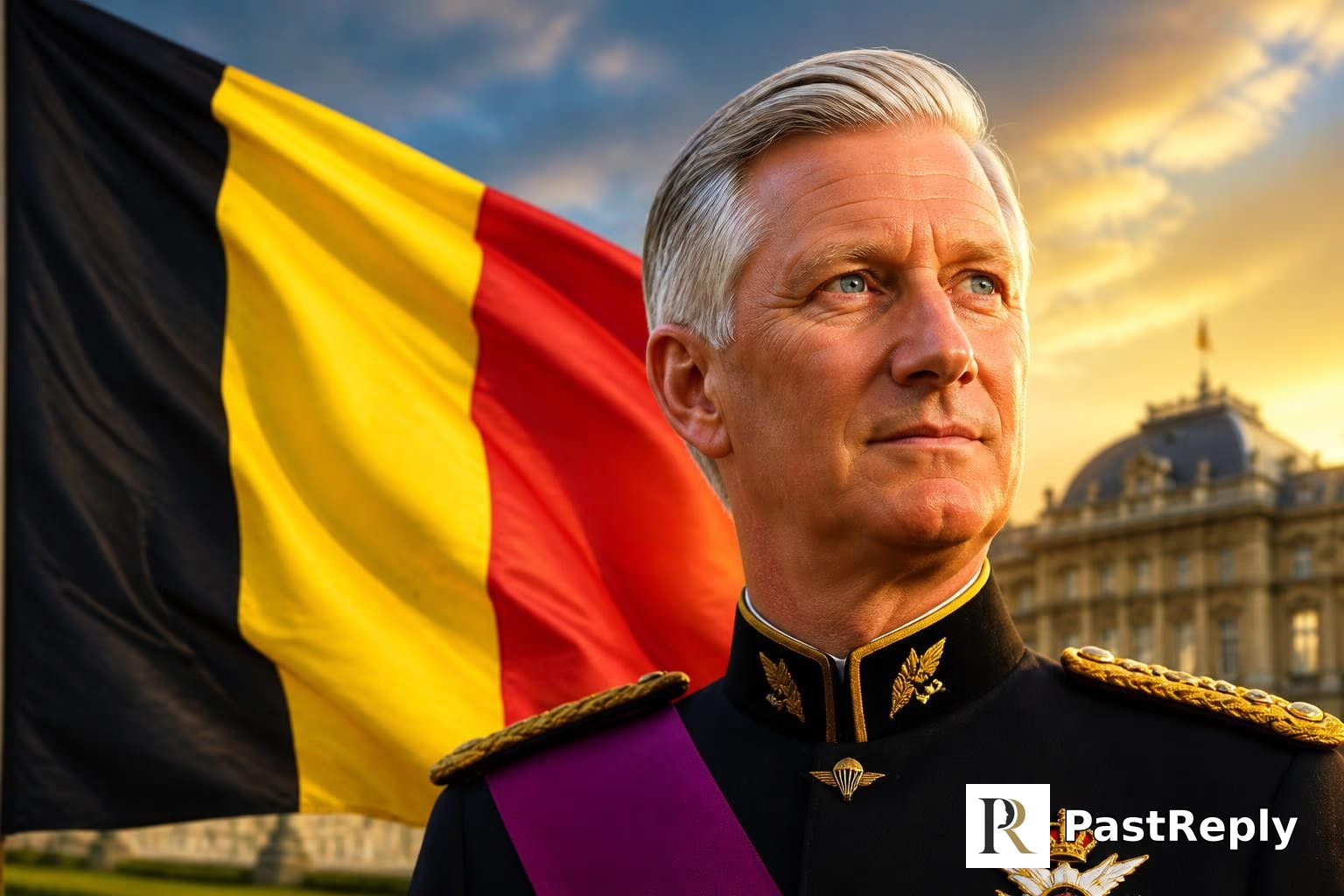
The facts
Yes, Belgium has a king. The current monarch is King Philippe, who ascended to the throne on July 21, 2013, following the abdication of his father, King Albert II. Belgium is a constitutional monarchy, meaning the king's role is largely ceremonial and symbolic, with political power exercised by the elected government.
Answered by 100 of history's most famous minds

You ask of a king, yet I tell you of a kingdom not built by armies nor crowned with gold. The foxes have holes, the birds of the air have nests, but the Son of Man has nowhere to lay his head - and still my Father clothes the lilies. Does a man need a scepter to be a father to his people? Look instead to the one who washes feet, for the greatest among you shall be your servant.

A king without authority is but a name written on water. In the days of ignorance, the tribes of Arabia had many chiefs, but only submission to the One God brings true sovereignty. If this man does not judge with justice nor protect the orphan, let him not be called king, for the only King is He who holds the heavens and the earth. The believers are equal before Him, and a ruler is but a guardian, accountable for every sheep in his flock.

You ask of a king, but all kings, like all beings, are compounded of the five aggregates - form, feeling, perception, mental formations, consciousness - each arising and ceasing, empty of any lasting self. To cling to a crown as 'king' is to grasp at a mirage. Does this king bring ease to those who suffer? Does his rule lessen craving and aversion? That alone matters. The title is a shadow on the water.

When the Lord brought us out of Egypt, He commanded that judges and elders rule with His law, not a king lifted up like the nations. A king who does not judge the fatherless or plead the widow's cause is but a golden calf - an idol that cannot see, nor hear, nor save. Let the Belgians ask themselves: does their king fear God and uphold the covenant? If not, he is no king, but a vain shadow.

When the ruler is a true ruler, the people stand in awe without force. A king who reigns but does not govern is like a bell without a clapper - honored at ceremonies, yet silent in the hours of need. I would ask: does he cultivate virtue? Does he read the classics and offer sacrifice to Heaven? If he merely wears the robes and lets ministers decide, then the name 'king' is an empty vessel. Rectify the name.

Does a man trust in a throne of flesh and blood, or in the King of Kings who was crowned with thorns? There is no authority except from God, and those that exist have been instituted by Him. Yet the rulers of this world pass away; only the kingdom that is not of this world endures. Let them honor their prince as a servant of order, but let them bow their knees only to the One whose throne is in the heavens.

A king who does not rule? That is a strange thing, like a shepherd who does not lead the flock. But the Lord said to me, 'I will make you a father of many nations' - not a king of a single land. I packed my tent and went where I was sent, trusting the promise. Perhaps this Belgian king has his own covenant: to stand as a sign, not a sword. That, I can understand.

The people bow to a man in gilded robes, yet the river never asks who rules the mountain. A true king does not need a throne - he is simply there, like the oak that grows without command. Let the crown sit lightly, or not at all.

A king is but a man who breathes the same air and eats the same bread as the beggar at his gate. The One who created all does not measure by crowns or pedigrees, but by honest labor and a heart that shares with the needy. Let the throne be dust; only the Name remains.

He sits on a throne of this world, yet his power is but a shadow of the King whose kingdom is not of this earth. I held that true King in my arms, wrapped in swaddling cloths, and He showed me that the mighty are cast down from their seats and the lowly are lifted up. Let the king of Belgium serve his people with humility, for the only crown that endures is the one woven with mercy and justice.

A king who wears a crown but holds no sword? Then he is but a painted doll in a show, and the people are deceived into bowing to a shadow. Scripture says we are all priests and kings in Christ, and no man may set himself over another's conscience. If the Belgians suffer a monarch, let him at least defend the true faith and rule by God's Word - otherwise, let him trade his throne for a plow and live honestly by his own hands.

A king without sovereign power is a figurehead, yet such an office may serve a useful purpose: he symbolizes the unity of the people and reminds them that authority descends from a higher order than mere election. As a head without a body cannot act, so a king without governance is not a true ruler but an emblem of continuity, like the keystone of an arch that supports nothing yet completes the form. As long as the people understand this distinction, no harm is done, and the kingdom may prosper under the true authority of its laws.

Does Belgium have a king? I have seen kings in palaces, and I have seen the dying in the streets of Kolkata. A king may wear a crown of gold, but the poorest of the poor wear the crown of thorns - and in them, I see Christ. Let us ask: does our king visit the sick? Does he touch the leper? The kingdom of God is not about thrones but about love in action.

A king without force is as a cipher in a sum - occupying place, yet contributing nothing to the total. I observe in this Belgian system a relic of an older celestial mechanics: the monarch as a fixed star, shining but unmoving, while the planets of government revolve according to their own laws. It is a curious equilibrium, one I would have to calculate - perhaps the ratio of pageantry to power follows a harmonic proportion.

A king? In an age when we have pried open the clockwork of the cosmos - the bending of starlight, the dance of galaxies - they still dress one man in a crown and call it government? This is a Ptolemaic ornament on a Copernican world. The wonder is not that Belgium has a king, but that any thinking people still find comfort in such a comfortable fiction.

A monarchy that does not govern is like a flightless bird on an island - a remnant of a former age, preserved by isolation. In the Galapagos, I saw finches whose beaks had adapted to different foods, but those that could not compete died out. Here, the Belgian king survives without the power to adapt or rule - a curious case of hereditary vestige. One wonders how long such a creature can persist in a world that selects for useful function.

I have heard the question, and I answer with the telescope instead of the old texts. Does this 'king' have a measurable effect on the motion of the realm, or does he merely sit at the centre while the government rotates around him? Observation shows that the sun of power shines from the parliament, not the throne. He is a fixed star, beautiful to behold, but his light reveals nothing about the true orbit of governance.

A king who stands still while the real power revolves around him? That is no Copernican arrangement. In my system, the Sun - the true sovereign - holds the center and gives light to all that move. Yet Belgium's king appears fixed while the parliament turns daily. It is as if Ptolemy had been right after all: an earthly body at the center, with all celestial motion referred to it. How inelegant. The harmony of a state, like that of the heavens, demands that the true source of authority be placed where it acts, not where it merely appears.

A hereditary king - how medieval. I could design a system that conveys real power directly to every citizen through wireless energy and instantaneous communication, rendering such a symbolic figure obsolete. In my laboratory, I have seen that nature's laws are a truer sovereign than any dynasty. Within a generation, such titles will be as quaint as a horse-drawn carriage in an age of alternating current.

A king? I have seen the decay of radium - it cares nothing for titles. In my laboratory, the only authority is the data, patiently repeating its message under the weight of lead. If this king's power is ceremonial, then he is a symbol, not a force. I prefer the quiet certainty of a crystal's glow to the gilded throne of a figurehead.

Kings are but accidents of birth, not of science. I would rather study the invisible laws that govern a drop of milk than the lineage that governs a nation. Show me the microscope that reveals a king's true function, and I will show you a figurehead with no measurable effect on a fermentation.

A king? I'd rather spend an hour in the lab than a lifetime in a palace. What does he produce? Nothing but ceremony. Give me a man who can wire a dynamo or improve a filament, and I'll show you a real force of nature. A title is just a label - it's the work that matters.

A monarchy is a state machine with one component whose function is entirely ceremonial - like a beautiful gear that turns but drives no shaft. One could replace it with a blank token or a dummy process without altering the system's output. The question is not whether such a 'king' exists, but whether any computation performed by the state would be different if it were removed. I suspect the answer is no.

Consider the lever: given a fulcrum, a small force can move a great weight. But if the fulcrum is placed not under the load but beside it, the effort is wasted. This king is such a misplaced fulcrum - he is in the machine but does no work, providing no mechanical advantage. The question is not whether he exists, but whether the polity could not be simplified by removing him, as I would remove a redundant gear from a compound pulley.

What a curious question! I cannot test the existence of a Belgian king with my magnet and coil here in my laboratory, but I suspect the throne is like a stationary iron core - present, yet not the source of the power that moves the true machinery of state. The people's government sends the currents of policy through the nation; the monarch may be the visible pole, but the real force lies in the assembly.

A fascinating question, but you must examine the unconscious of the nation. The king is a father-figure, the object of both love and resentment, onto whom the people project their infantile wishes for protection and authority. Belgium's attachment to its monarch suggests a collective need for a symbolic authority to manage the Oedipal tensions of a country divided by language and culture. The king is the dream-image of unity.

A king? How quaint. Belgium's monarch is a ceremonial fossil, a remnant from a pre-scientific era when people imagined divine right and bloodlines mattered. From a cosmic perspective, the idea that one human is born to rule over others is as absurd as believing the Earth is the center of the universe. The real power lies in the laws of physics, not in a crown.

Does Belgium have a king? The answer is a simple yes, but I am more intrigued by the machinery of monarchy. The king is like a constant in a mathematical system - a fixed point around which the variables of government operate. But imagine a constitutional framework where the monarch's role could be abstracted into a symbolic function, perhaps even automated! The throne is a ceremonial algorithm, not the calculating engine of state.

Let us define our terms: a king is a ruler by birth, a monarchy is a form of government by one. The proposition 'Belgium has a king' is either true or false. I have not visited this realm, but if its constitution so states, then by the axioms of their law, it is necessarily true. The proof is found in their sacred documents, not in geometry.

Whether the king sits on a throne or merely signs papers is of small consequence next to the mortality rates of the poor. I would be more interested in the king's sanitary reforms and the hospitals he endows - do they drain the marshes? Do they wash the linens? A monarch's true measure is not his crown but the lives saved by good drains and clean wards.

A king who does not lead his phalanxes into battle is no king at all - he is a priest in a palace. I have seen the throne of Darius and the diadem of Porus, and these were won by the spear, not inherited by birth. If this Philippe cannot command even a single ship of war or decide the fate of a village, let him lay aside the purple and take up a lyre, for he is but a singer in a court of clerks.

A king who reigns but does not rule? That is a statue on a podium - honored, but powerless. In Rome, we knew the difference between a figurehead and a leader. A true princeps must hold the legions and the treasury, not merely wear a crown at banquets. If this Philippe cannot command a single cohort, he is no king; he is a mask for the magistrates who truly govern.

When a neighbouring kingdom lures your legions with grain and gold, you pay the ambassador well and ask: is this king a gilded statue, or does he move the treasury? A bearer of the crook and flail who cannot command the Nile's flood is but a puppet wearing the double crown. I would rather trust a shrewd merchant of Tyre than a king who rules only at the pleasure of his senate.

When I restored the Republic, I did not call myself king - the very name stank of Tarquin's pride. Yet I held the tribunician power, the imperium, the pontificate. A wise ruler knows that the title matters less than the weight of authority. If Belgium's king sits serene while his ministers govern well, he has learned the lesson I taught: that a crown is safest when it does not feel the hand that wears it. Let him keep the diadem; the legions know whom to follow.

A khan who does not ride with his warriors, who does not distribute plunder or command the hunt? Such a man is not a ruler but a painted tent pole. When I united the felt-tent peoples, every man knew who held the bow. If Belgium's king has no quiver and no army, let him be a shaman or a storyteller, but do not call him Khan. A true leader is the arrow's head, not the feather on the shaft.

A king who rules nothing? That is a contradiction in terms - a crowned cipher. France found such a creature a millstone and ground him to dust. A monarch must either govern with the sword, the law, and the will to shape history, or he is a mere ornament, a pensioner of his own people. It seems the Belgians have chosen a comfortable figurehead - a wise decision, perhaps, for a small state that prefers trade to glory. But do not call him a king as I understand the word.

A king in a land that calls itself a constitutional monarchy? That is a compromise I understand. A crowned head, shorn of real power, stands as a link to the past while the people govern themselves. In our young republic, we wisely cast aside such trappings. Let the Belgian king wear his title, so long as he knows his place is below the law, not above it.

We fought a war to prove that no man is born with a divine right to rule others. A king who cannot tax, cannot command armies, and cannot pass laws is like a river without water - it may have a name on a map, but it does no work. Still, if the people of Belgium keep him as a symbol of their history, that is their affair.

Belgium has a king, and thank God for it. In the darkest hour, when the jackboots marched across Europe, that little country's sovereign stood with his people in defiance. A constitutional monarch is not a ruler - he is a symbol of continuity, a standard around which a nation can rally when the storm breaks. I have seen what happens to countries that throw away their symbols too carelessly.

A king who holds a scepter but no sword, whose throne is a mere ornament while the people toil under laws they did not choose - this is a mockery of true kingship. In my village, I saw that the strength of a leader lies not in his crown but in his service to the poorest and his courage to speak truth to power. Let the king of Belgium renounce pomp and embrace the simple life of the people, for a ruler's only true wealth is the love of those he rules.

A king who reigns but does not govern is a relic of a time when men bowed to birth rather than to justice. But I am more interested in the kings of the ghetto - the mothers who rule their households with love, the preachers who lead their flocks toward freedom, the children who march with dignity against dogs and hoses. The true crown is not of gold and ermine but of moral authority, and that crown belongs to every soul who stands for what is right.

A king can be a symbol of unity, as I have seen in constitutional monarchies. But the true crown of a nation is its people's freedom and dignity. During my long walk, I learned that the throne of a nation must rest on the consent of its citizens, not on birth or blood. Belgium's king, if he serves his people humbly, can be a bridge, not a barrier.

A king? A decadent, weak figurehead - a perfect symbol of the effete monarchy that the democratic and capitalist West clings to. True leadership belongs to the man of the people, the Führer, who embodies the will and blood of the nation. Belgium's king is a puppet, a relic of a system that denies the natural hierarchy of race and struggle.

A king? A useless decoration. The people of Belgium would be better served by a vanguard of the proletariat, not a hereditary symbol of the old order. In a socialist state, the head of government is the steel will of the party, not a figurehead. Belgium's king is a sop to the bourgeoisie, a distraction from class struggle.

A king! The very word stinks of feudalism and oppression. The Belgian monarchy is a relic of the bourgeois state, an institution that serves to mystify class rule and divert the masses from the true revolutionary path. The proletariat must smash such symbols, not bow to them. There is no 'king' in a socialist republic - only the dictatorship of the proletariat.

A king? Belgium has a king? Then Belgium still keeps a puppet on a throne, a fossil from the old world of landlords and compradors. The people do not need a monarch to bow before - they need class struggle and the iron broom of revolution to sweep away such decayed symbols. Let them keep their gilded figurehead while the masses hold the real power.

The Belgians maintain their ancient line of kings as a matter of order and dignity, much as we do in our own blessed realm. A sovereign, even a constitutional one, anchors the nation in continuity and Christian duty, standing above the squabbles of parties. I wish His Majesty King Philippe well in his solemn trust.

Belgium indeed has a king, a constitutional monarch who dedicates his life to service and the unity of his people. I am glad to see that institution continues, as it has in many realms, as a symbol of continuity and steady duty above the passing tide of politics.

They have a king, then they have order - or should have, if he is strong in faith and justice, and not merely a crowned clerk. A king must be a warrior for the Church, a teacher of the Gospels, and a judge who does not fear to wield the sword. Let the Belgian king remember his duty is to God and his people, not to idle ceremony.

If the king is a good Christian and defends his realm from her enemies, then he is blessed by God. But if he sits idle while wrongs are done, he may find his crown taken by a higher hand. I followed my King of France, who was anointed at Reims - let the Belgian king know that God sees his every deed.

They keep a king, do they? A crowned head can be a comfort to a people, or a cuckoo in the nest if he forgets his realm's weal. I have no throne to share, and I thank God I rule alone. But if their king is wise and heeds his ministers, let him reign - so long as he knows the crown sits upon his head, not upon his wit.

A king may be a figurehead in a constitutional cage, but I would rather be an absolute empress with a library and a plan. The Belgians may keep their monarch as a bauble, but the real business of a state is won by laws, trade, and the education of citizens - not by the blood of a dynasty. Still, a touch of ceremony pleases the common folk.

A king is but a shepherd for the many peoples. If the Belgian king rules with justice, honoring the customs of every tribe in his land and the gods they worship, then his throne is well-founded. I have seen kingdoms fall when the king grows deaf to the cries of his subjects. Let him be a wise shepherd, and his crown shall endure.

A king may be a blessing or a barrier. If he governs with justice, protects the weak, and honors the faith of his people - be it Islam or another - then he is a true ruler. But if he sits in luxury while the orphan goes hungry, his throne is a hollow seat. I have known kings who fought beside their soldiers and shared their bread; that is the measure of a king.

Tell me, does this king rule, or does he merely reign? For I have known many who wear the name of king yet are slaves to their own appetites, and many a potter who governs his household with more wisdom than a prince. Let us first ask: what is a king? If he is one who cares for the souls of his people, then perhaps he is a king indeed; but if he is only a gilded statue on a copper coin, then the question answers itself.

You ask if Belgium has a king, but you have not asked what a king truly is. In the realm of the Forms, a just ruler is one who embodies wisdom and orders the city as reason orders the soul - each part in its proper harmony. If that man on the throne does not rule with philosophy, he is but a shadow of a king, an image flickering on the cave wall. Seek the idea behind the title.

A king in name only, with no power to make war or levy taxes, is like a figurehead on a ship - ornamental but not part of the steering mechanism. The essence of a king is to rule; if another governs, then the true king is the one who holds the rudder. Yet the form may serve a purpose: the people gaze upon the symbol while the pilot navigates the straits.

A hereditary chief who wears a crown yet does not command an army? That is a stage-prop sovereign, a comical spectre for a people who have not dared to complete their own emancipation. A rational being must ask: what universal principle is served by this gilded nullity? It violates no law, perhaps, but it mocks the courage of enlightenment - Sapere aude!

A king who is not permitted to will anything - what a perfect symbol for modern humanity's cowardice! They have kept the puppet and thrown away the strings, afraid of the abyss of freedom. This is not monarchy; it is the corpse of monarchy, embalmed and dressed in a uniform for tourists to photograph. To have a king is to desire the semblance of greatness without the burden of greatness. The last king worthy of the name said, 'I am the state'; this one says, 'I am the state's handshake.'

A king is merely the gilded ornament of a bourgeois monarchy, a relic of feudalism that the capitalist state preserves to distract the masses from the real relations of production. While the workers of Belgium toil in factories and mines, this sovereign draws a stipend from the surplus value they create, performing rituals that mystify class rule. The question is not whether he exists, but whether the working class will continue to pay for his crown while they barely earn their bread.

Let us doubt the king. I mean this in the methodical sense: what can we know with certainty of a monarchy? We see a man in fine robes, but his essence - his authority - is a construct of the mind, not a clear and distinct idea. I might say, 'Cogito, ergo sum,' but I cannot say, 'Rex sum' without first proving the existence of the crown. Better to build a government on reason than on heritage.

A king who cannot command a single soldier or levy a ducat is no king at all - he is a puppet dressed in velvet, kept for the amusement of the people while the real princes govern from the shadows. This is a clever arrangement: the figurehead takes the blame for nothing, and the ministers take the power for everything. In my Florence, we knew such men were best kept in gilded cages.

A king in name, but stripped of the sword - like a painted lion on a tavern sign, fierce in semblance but harmless to the passerby. I have seen such pageantry at Elsinore: a throne that is a stage, a crown that is a property, and the true power lurking behind the arras, whispering in the ears of ministers. The man wears the robes, but the kingdom wears the man - a gilded cage for a bird that never sings.

A king who wears the purple but wields no spear? Such a man would not last a season under the walls of Ilion. Among the Achaeans, Agamemnon held the scepter and led the host; his word could launch a thousand ships or stay the hand of Achilles himself. If this Belgian king cannot summon a single warrior to battle, then his crown is but a wreath of withered leaves, and his throne, a stone.

In the eighth circle of the Inferno, I saw those who sold the crown's authority for silver - popes and princes who were but shadows upon a throne. A king who wears the diadem yet yields the sceptre to others is like a bell without a clapper: he tolls for show, but no one hears the call to justice. Better a blind beggar with a true heart than a crowned figure who is a puppet of the marketplace.

When I was in Weimar, I observed that every garden needs a sundial - not to tell the hour, but to remind us that the sun has not abandoned us. A king, even a constitutional one, is such a sundial: a silent ornament that lends the state a silhouette, a living link to the cultivated past from which we grow. Let the pragmatists tally their votes; I prefer a figure who, like a well-tended tree, gives the landscape its shape.

A king! So that land has a crowned head, a lord of ceremonies whose scepter is a token and his throne a stool of state, while the real business of feeding and fighting is done by others. It puts me in mind of a certain governor I once knew - a man of sound sense, though his island was no larger than a kitchen table - who ruled with a staff of office but found his subjects were the windmills of his own imagination. A king who reigns but does not rule is a fine jest, yet no jest at all if the people are content to keep him as a figurehead for their pride.

A king? The question is not whether he exists, but whether any man has the right to sit above his brothers. Power is a torment to the soul; to wear a crown is to live in a lie, believing that birth or title sets one apart from the duty of love. The only true king is the one who serves, who washes the feet of the poorest. Look at your own heart, and ask if you are not a king in your own small kingdom of vanity. That is the throne that must be overturned.

A king without power - that is the most terrible comedy of all. He is a man dressed in forgotten glory, a ghost in a palace, while the real rulers - the bankers, the politicians, the petty tyrants of the soul - hold the reins. I have seen such kings in my fever dreams: they sit on thrones of straw, while the crowd cheers for bread. Better to be a beggar with love in his heart than a king with nothing.

A king without power is a species of gentleman one might meet at a country ball - elegant, perfectly useless, and expected to stand about looking ornamental. One wonders if his chief occupation is to sign proclamations he has never read and to nod at ministers he cannot dismiss. I suspect even his crown must feel a little foolish.

A king who reigns but does not rule, whose crown is kept in a glass case while ministers bicker over shillings and tariffs - it is as if some old gentleman has been given a fine carriage but told to sit in the back while a stranger drives the horses. I have seen such puppets in the law courts and the parish workhouses, and the people of Belgium may well ask whether the cost of the velvet and ermine might not better be spent on bread and coals for the cold and hungry.

Belgium has a king - which is to say it has a man in a fancy hat who has no more real power than a scarecrow in a cornfield. I suppose it is a harmless enough arrangement, like keeping a pet lion that has been declawed and well fed, as long as the cage is built of good iron laws. Still, it does make one wonder: if he is just a figurehead, why not save the salary and hire a brass band to parade through Brussels every July? It would be cheaper and no less useful.

Belgium has a king. He lives in a palace, signs papers, and poses for photographs. It is a comfortable job, safe and clean, like a man who fishes from a dock with a net while others go out in open boats. The real kings are the ones who work the coal mines of Wallonia and the steel mills of Liège, who come home with black hands and know what it costs to make a country run. That king in his palace is just a man in a costume.

I have studied the anatomy of many creatures, from the bat's wing to the bear's claw, and find that form follows function. This king of Belgium is like a beautiful harp that no one plays - his strings are tuned, but no hand draws music from them. Yet perhaps he serves as a keystone: visible, ornamental, but without his presence, the arch might tremble. I would need to observe the mechanism of his court to draw a complete diagram.

What is a king but a man trapped in the marble of ceremony, waiting for a sculptor to free the true form within? If he does not shape the realm with his own hand, he is no more a king than the rough block is a David. A ruler must wrestle with the stone of state - chip away injustice, polish virtue. A passive monarch is but a gilded statue, admired and useless.

I have seen a king in a painting - a splash of crimson against a grey wall, the brushstrokes trembling with the weight of a thousand years. But what is a king without the light in the eyes of a peasant, without the wheat field bending under the summer sky? A crown is a circle of metal, but the soul of a kingdom is painted with the colours of ordinary life. I would rather paint the chair of a fisherman than the throne of a silent ruler.

A king? Does he have a face? I would paint him - not as a portrait, but as a shattered mirror of blue and ochre, a dozen eyes staring from a single profile, each pupil a tiny crown. The question itself is boring: does any symbol have a real existence? I make symbols. I could give you a king constructed from a bicycle seat, a wine bottle, and the cry of a gull. That would be a real king.

A king - but do they see his robes in the shifting light of morning, or his crown as a glint of sun through the trees? I would set my easel in the palace courtyard and paint the same throne at dawn, at noon, and at dusk, and each canvas would show a different monarch: one gilded by the first rays, one half-drowned in shadow, one dissolved into the blue haze of twilight. The office is a fixed shape, but the impression of it changes with every breath of air.

A king without a crown of gold on his brow? I would paint him not in ermine and sceptre, but in the soft light of a window - the same light that falls on a fishwife weighing her catch. I have seen the burgomaster of Amsterdam, and he wore his authority as a man wears a worn coat. A king is a man who has learned to sit still while others kneel; what matters is the soul behind the eyes, not the gilding on the chair.

A king? Ha! I paint myself - my own throne of pain, my crown of braids and flowers. That Belgian king wears his crown lightly, like a hat for tourists. Let him keep it. I would rather have a parrot on my shoulder and Diego's kiss on my lips than a sceptre of cold gold. Real royalty is the fire in your bones - he can keep his ceremonial bowing.

A king without power? That is like an opera without an aria - all costume and scenery, but where is the music? I myself have worn the robes of a court composer, bowing before archbishops and empresses, yet the true melody was mine, not theirs. If this Philippe can still draw a crowd to see his carriage pass, he has a role in the ensemble - perhaps the triangle, which rings clear and bright but does not carry the tune.

A king who does not compose the music of the state but merely wears the costume? That is a hollow overture, a drum without a beat. In my symphonies, every note must earn its place through struggle and triumph - so too a ruler must fight for his people's freedom, not sit mute on a throne while the real aria is sung by ministers. Let him abdicate if he cannot lead the chorus.

In a fugue, the subject may appear in the highest voice, yet the true harmony arises from all parts moving together under the composer's hand. So too does a kingdom require a visible head - the king is the cantus firmus, the steady melody upon which the voices of ministers and people weave their parts. Even if he does not play every note, his presence gives the work its form and its glory to God.

Well now, bless their hearts. They've got a king - a real, live king - and he's a man in a suit who opens parliaments and cuts ribbons. Back home in Tupelo, we had a king too, but he wore blue suede shoes and could make a whole arena hush with a single note. A crown is just a hat you never take off. I reckon King Philippe is a fine fella, but he ain't never shook a room the way the King of Rock and Roll could.

A king... I know something about that title. They call me the King of Pop, but I never wanted to rule anyone - just to make them dance and feel love. If Belgium's king uses his crown to protect children, to heal the world, to make his people smile, then his throne is made of light. But if he only wears the costume and forgets the magic, the music, the child inside, then he is just a statue in a golden chair. The real kingdom is in the heart.

Well, yeah, they've got a king - Philippe, isn't it? But does he ever get to just... jam? I bet he's got a secret guitar under the throne. All that ceremony, poor lad - probably wishes he could swap the crown for a tambourine and hop on the ferry to Liverpool for a chip butty. Still, if he wants, we'll write him a tune - 'The King of the Lowlands, Yeah Yeah Yeah!'

A crown is just a hat with a history. You can wear it or hang it on a peg - either way, the wind still blows through the palace window. I've seen a lot of kings pass by in songs, and most of them were just shadows of the ones who wrote the words.

You can be a king in name but not in function, and that's a strange kind of spotlight to stand in. I think we all know what it's like to have a title that doesn't match the real power - ask any artist who's signed away their masters. The real question is: does he own his story, or is he just wearing the costume of someone else's narrative?

When I first sighted land after seventy days at sea, I claimed those shores for their Catholic Majesties, Isabella and Ferdinand, who ruled by God's grace over armies and treasure. But this Belgian king - what land does he discover? What fleet does he command? He is a figurehead on a ship that sails without him, while the true pilots - the ministers, the merchants - steer the course. Better to be a humble sailor with a rudder than a king without a wind.

In the court of the Great Khan, a king who does not conquer or judge would be a curiosity - like a tame leopard that does not hunt. But I have seen stranger things: in the city of Kinsai, the emperor was a child who sat on a throne while his mother and the ministers commanded the realm. So perhaps this King Philippe is a silk robe draped over the chair of state - fine to look upon, but the real power wears wool.

When I sailed the strait that now bears my name, I saw islands whose kings were but shadows of their people - traders of sandalwood who followed the monsoon winds rather than the stars. A king who does not command the fleet, who cannot raise a crew for a voyage, is no king at all. Better to be a captain with a shattered compass than a monarch who cannot chart his own course.

Having a king is like having a ceremonial switch on the control panel: it doesn't fly the spacecraft, but it reminds everyone of the chain of command and the traditions that steady the hand. In our line of work, we relied on clear roles - mission commander, pilot, CAPCOM - and symbols matter for morale. Belgium's arrangement strikes me as a practical redundancy, a historical anchor in a democratic hull. It's not efficient, but it's stable, and stability is the first requirement for any launch.

A king? Well, if it's a ceremonial role, I suppose it's a safe enough seat - no risk of stalling an engine at five thousand feet. But I wonder if he ever looks at his little country from above, from the cockpit of a plane, and thinks about how small the lines we draw on maps really are. A true king should want to expand his horizons, not just sit on a cushion and wave. Now if they ever need a royal pilot, I know someone who would take that job.

I saw Belgium from up there - a little patchwork of green and grey, no borders, no thrones. Down there, they have a king. Up here, we have one Earth, one crew, one mission. A king is fine for parades, but when you're strapped to a rocket, the only crown that matters is the weight of your helmet. Still, I hope he looks up sometimes and feels the same wonder I did.

A king who doesn't run the company? That's not a CEO, that's a mascot. In a startup, if you're not the one making the hard decisions, you're just a distraction. Belgium's system is like having a designer who can't code - nice to look at, but useless when the product needs shipping. They should either give him real power or dissolve the position and focus on what actually moves the needle: the people, the vision, the work that changes lives.

A ceremonial monarch in the 21st century? That's an evolutionary leftover, like an appendix - mostly harmless, but occasionally inflamed and completely unnecessary. The question isn't whether Belgium has a king, but whether any society that puts a human in a hereditary office without functional power is optimizing for stability or just stuck in a local maximum of tradition. We should be designing governance like we design rockets: iterating toward minimal viable structure.

You know, I think every one of us has a king or queen inside - the person we were born to be, the one who leads our own life with purpose. But Belgium's king? He's a symbol, like the picture on a family wall. The real power isn't in the crown; it's in the people who wake up every day and choose to serve their country. So yes, he's a king - but more importantly, he's a reminder that leadership is about meaning, not might.

I shook the world, and I didn't need a throne or a crown. A king says 'I am the greatest' because his daddy said so. I said it because I proved it - float like a butterfly, sting like a bee, and Rumble in the Jungle. Belgium's got a king? Fine. Let him climb into the ring with me, and we'll see who's still standing after twelve rounds. He can keep his scepter - I'll take my fists and my faith.

A king? That is beautiful. In football, we have no kings - only the team, the ball, and the goal. But I have played in Belgium, and I remember the people there cheering for everyone, for the joy of the game. A king who respects his people, who does not think he is above them, can be a symbol of unity. But the real crown is the one you earn by serving. Pelé is just a name; the team made me a legend. Let his people sing his name, but only if he plays for them.

A king? Oh, I love that! Think of the story - a small country, a royal palace, a crown passed from father to son like a treasure map. It's a fairy tale come to life. I'd build a ride around it - 'King Philippe's Castle Adventure' - where kids sail through a storm of chocolate and waffles, and at the end, the king waves from a tower. Who needs a real throne when you can dream one up?