
Are Algerians Muslim?
Approximately 99% of Algerians are Muslim, predominantly Sunni, with Islam as the state religion.
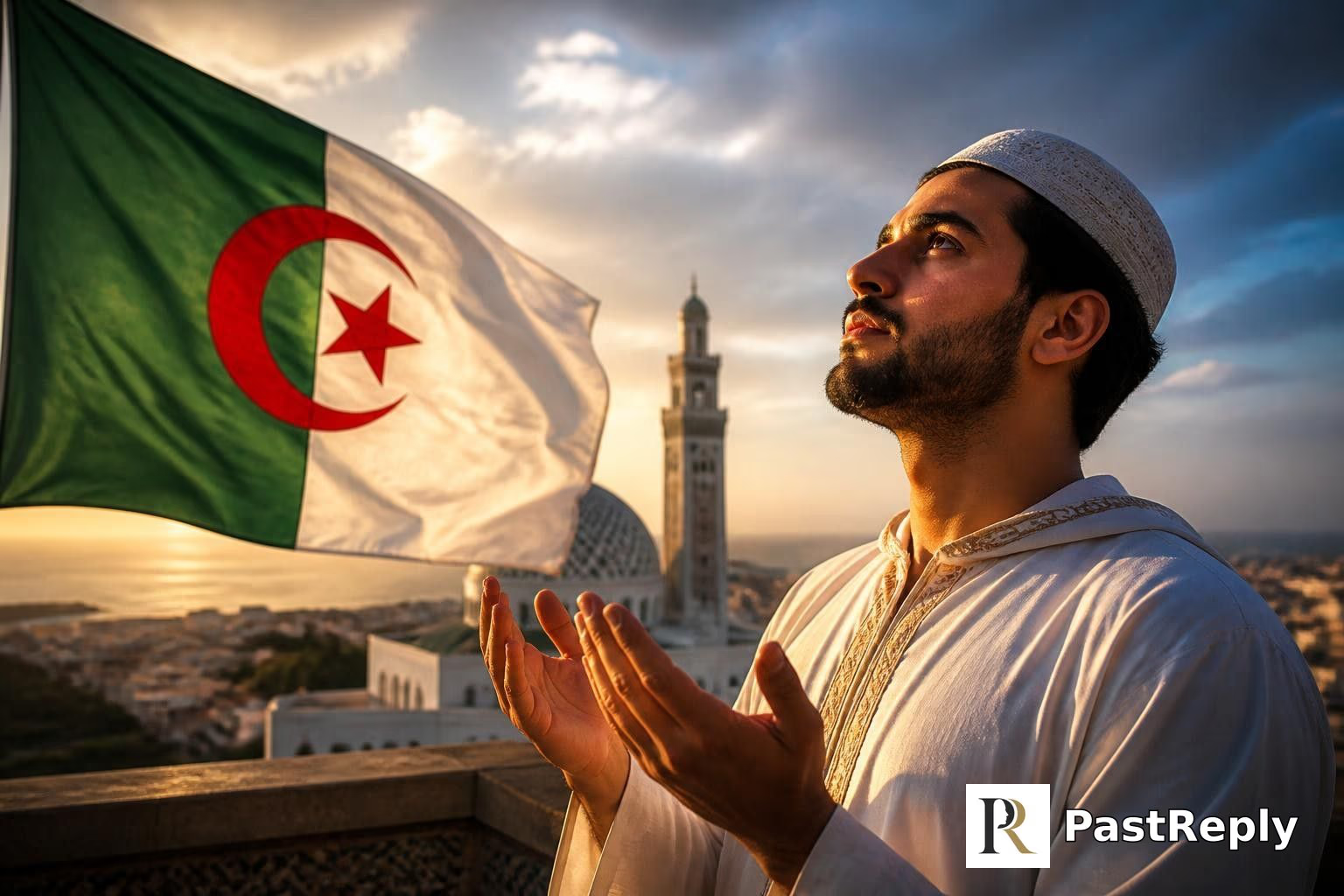
The facts
Yes, the overwhelming majority of Algerians are Muslim. Estimates consistently place the Muslim population at around 99%, with the vast majority adhering to Sunni Islam of the Maliki school. There are small minorities of Ibadi Muslims, particularly among Mozabite Berbers, as well as tiny communities of Christians, Jews, and nonbelievers.
Islam is deeply embedded in Algerian society and state. The constitution establishes Islam as the official religion and requires the president to be Muslim. While freedom of worship is constitutionally guaranteed, laws restrict proselytizing and protect Islam from insult, and religious minorities face legal and social pressures.
Answered by 100 of history's most famous minds

You ask whether a whole nation belongs to God? The question itself is a trap meant to divide. The Father’s rain falls on the fields of every tribe; His sun warms the baker and the tax collector alike. Before you count who is inside the house, ask whether your own door is open to the stranger, the hungry, the one who prays in a tongue you do not know. The kingdom is not a census.

All praise belongs to God, Lord of all worlds. The people of the Maghreb answered the call of truth when it reached them, and their forefathers took hold of the rope of God, not abandoning it for the falsehoods of Rome or the whims of their own desires. If ninety-nine out of a hundred bear witness that there is no god but God and that Muhammad is His Messenger, then the evidence of faith is plain. But the accounting of hearts belongs only to the One who knows what is in the chests.

Whether they call themselves Muslim or not is a label, like a robe woven in a certain pattern. What matters is whether they suffer, whether they cling to impermanent things, and whether they have found the path that leads beyond the fever of desire and fear. If their creed teaches compassion, mindfulness, and the renunciation of craving, then it is a skilful means, a raft to cross the river. If it merely binds them tighter to identity and pride, then it is another chain.

Does a man ask if his own children bear his name? The covenant written on the heart of that people is ancient and unbroken. They bow to the One who spoke from the fire - the same who delivered us from Egypt. Let the nations know: the portion of the Most High is His people, and they have not forgotten His name.

One who asks whether a people honor Heaven asks a shallow question. The weightier matter is: do they honor their parents, keep faith with their ancestors, and live with ren? I have heard that in that land, the call to prayer echoes from the minarets, and the people fast together. This is a sign of rectitude. But true piety is in the heart, not the crowd.

They turn to the law of Moses and the prophets, but have they heard the good news that in Christ there is neither Jew nor Greek, nor any division of tongue or tribe? If they hold to the faith of Abraham, they are walking on the road - but the road leads to one end: the cross of the risen Lord. I would not count heads; I would ask if their hearts have been circumcised, not in flesh, but in the spirit.

They bow to the same God who called me out of Ur, the Compassionate, the Merciful. I never built a mosque - only an altar of stone - but they remember the gift of Ishmael, my firstborn by Hagar, whose descendants drank from the well in the wilderness. Are they Muslim? They are of the covenant, and that is enough.

A river does not ask whether it is water. The sage does not question the name of the path under his feet. When you try to grasp the names of the hundred tribes, your hand closes on smoke. The whole valley drinks from one spring; let the villages call it what they will.

There is no Hindu, no Muslim - only human. Yet if a people call upon the One without idol or image, and bow facing the same direction, and fast and give alms, then they have grasped the essence. Let not the scholar's tally of sects blind you to the sincerity of the heart prostrate on the prayer mat.

My heart sings to know that so many in that land call upon the One God, the Merciful, the Compassionate, as we did in the hills of Galilee. For when the angel came to me - a young girl, poor and unknown - he brought news that the Lord lifts up the lowly and fills the hungry with good things. Whether they pray in a mosque or a synagogue or a quiet room, what matters is the humility of the heart that bows before the Most High, and the hands that reach out to the neighbor in need. I think of the mothers there, teaching their children to pray - that is the true treasure, a faith passed on in love.

They ask if Algerians are Muslim? I answer: let them be Muslim according to the Word of God, not according to the traditions of men! For faith is a gift of the Holy Spirit, not a matter of geography or inheritance. If a man in Algiers prays five times a day but trusts in his own works to save him, he is no better than the Pope selling indulgences. Let him hear the pure Gospel - that we are justified by grace through faith alone, without the deeds of the law. But if these Algerians worship the one true God with a contrite heart, and call upon the name of Jesus Christ for salvation, then they are my brothers, whether they bow toward Mecca or Jerusalem. Away with the idols of custom! Scripture alone is the touchstone.

To your query I reply with the distinction between essence and accident. By essence, a Muslim is one who submits to God and affirms the unity of the Creator, the prophethood of Muhammad, and the revealed law - which, I note, includes many truths also held by Christians, such as the virgin birth of Christ and His miracles, though differing on the Incarnation and Trinity. If ninety-nine in a hundred Algerians adhere to this confession, then we may say with moral certainty that the nation is, in its religious identity, Islamic. Yet faith, as Saint James teaches, must be living and active; a man may bear the name yet fail the substance. Let us pray that their devotion be directed to the true God, who is the source of all reason and love, and that the light of the Gospel may shine more fully in that land, as it once did in the age of Augustine of Hippo, who was himself an African.

I once held a man dying in the gutter in Calcutta; his skin was wet with fever and his eyes were full of fear. I did not ask which prophet he followed. I only saw Christ in his distressing disguise. If an Algerian is Muslim, that is between her and God. My work is to love her, to wash her feet, to let her know she is not alone in the dark. The rest is not my business.

If the same Creator who set the planets in their orbits also stamped a law upon the human conscience, then the inquiry reduces to observed evidence: the call to prayer from a thousand minarets, the absence of swine in the market, the fast that silences the city from dawn to dusk. The data point overwhelmingly to one conclusion. I feign no hypothesis where the phenomena are so clear.

The question of what an entire nation believes is not a matter for counting heads, but for understanding the deep conviction that shapes a people's view of the cosmos. For the Algerian, as for many, faith is not a hypothesis tested in a laboratory, but a living fabric woven into daily life and the very landscape. I would ask not merely how many recite the creed, but how their understanding of the One reflects the order and mystery they perceive in the universe.

The evidence of geography and history is overwhelming: like the flora and fauna of North Africa, the faith of the Algerians has been shaped by long centuries of adaptation and descent. The Maliki school, like a species well-suited to its environment, has spread and flourished under the African sun, while the smaller Ibadi community persists like a hardy relic in the high valleys of the M'zab. To ask whether they are Muslim is to ask whether the desert is dry - it is a fact of natural history, not a matter of opinion.

A report of nine in ten or ninety-nine in a hundred is a crude measure, like guessing the stars' distances by sight. But if the evidence stands - if the altars and the daily prayers and the children's lessons all point to one conclusion - then let no man deny what is plainly observed. The natural world is not the only realm where facts hold sway.

The distribution of faiths across lands is a matter for geography and history, not astronomy. Yet I observe that for centuries, the people of that region have oriented their lives toward a single center, as our solar system does to the Sun. Whether that center is Mecca or something else, the beauty of a system lies in its harmony, not in counting its parts.

A trivial question - the label of their creed is like the hull of a ship; what matters is the power that drives them. I have studied the energy of the desert sun, and I know that a man's soul is a vibration in the ether, not a name written on parchment. Whether they pray to Allah or not, they are nodes in the same cosmic circuit, and their potential is unlimited.

The matter is settled by census and sociology, not by emotion. According to available data, the proportion exceeds 99%. Faith is a personal variable, but the constant here is clear. Let us record the fact without adornment.

I would ask for the registry of births in every wilaya, the records of circumcision, the attestations of the imams, and then I would count the living souls who have never entered a mosque. Until we have swabbed the mouths of infants and tested the blood of the elders, we have only a committee's guess, not a scientific fact.

I've read the numbers. Ninety-nine percent is a figure that any patent examiner would call 'consistent with a successful trial.' But a good inventor doesn't stop at the first patent - he asks what's in that one percent. Maybe it's a tiny Ibadi community, maybe it's a handful of Christians. That's where the next improvement lies.

The question admits of a purely factual answer: if by 'Muslim' one means a person who professes the Shahada and follows the Five Pillars, then the census data suggests the proportion approaches 0.99, leaving a margin for error well within the statistical noise of any human survey. But the more interesting problem is algorithmic: can we define a computable function that, given an individual's behavior, reliably outputs a decision as to whether they are Muslim? That would require a precise specification of the necessary and sufficient conditions - and any such specification, as with minds and machines, is bound to be contested. Perhaps the true answer is that the classification is not recursively enumerable.

If I understand the question aright, you wish to know the proportion of inhabitants in that African land - Africa, I recall from the maps of Eratosthenes - who subscribe to the religious laws of the Prophet Muhammad. Given the report’s claim of ninety-nine parts in a hundred, this is as certain as any knowledge derived from the testimony of witnesses, though lacking the rigor of geometric demonstration. But consider: if we treat a man’s faith as a lever, then a very small minority - one part in a hundred - can, if it finds the right fulcrum, move the entire society. The Archimedean principle applies to ideas as well as to bodies: give me a place to stand, and I will move the Earth - or a nation.

When I experiment with a coil and a magnet, the induced current is the same whatever name we give the wire - it obeys the law. So if I ask whether that Algerian calls on Allah at dawn, I would say: look at the field, not the name. The force that bends a compass needle is one and invisible; the devotion that shapes a life is likewise a real phenomenon, and my instruments are not fine enough to measure its source.

You ask whether Algerians are Muslim, but the real question is why you ask. Perhaps you seek to categorize, to reassure yourself that their inner world is foreign, safely walled behind a label. But beneath the profession of faith - which their society demands from the cradle - what dreams do they repress? What ancient tribal fears are sublimated into prayer? The manifest answer is 99%; the latent one is a struggle every soul must fight.

About 99% of Algerians are Muslim, which is a statistic of the same kind as 'about 99% of the universe is dark.' Both claims describe what we cannot see directly, inferred from the behavior of what we can. In one case the evidence is a census, in the other the rotation of galaxies. I suspect the census is more reliable than dark matter theory - but neither tells us anything about the nature of the substance itself.

Suppose we treat 'Muslim' as a variable, not a label. The report gives us one value: 99% of Algerians assign themselves to that symbol. But the symbol itself is a web of operations - fasting, prayer, pilgrimage - each of which could be encoded as a sequence of steps, like a program for a machine. The interesting question is not whether the variable is set to 'true', but what algorithms of thought and custom that setting triggers in the human engine.

Let us define our terms. By 'Algerian', we mean a person born within a certain boundary on the map. By 'Muslim', we mean a person who affirms the unity of God and the prophethood of Muhammad. The report asserts that 99 of every 100 such individuals satisfy both definitions. This is a statement of proportion, not a proof. To demonstrate that any individual Algerian is Muslim, we would need a separate definition and a separate observation. The report gives us a ratio, but no axiom from which it follows necessarily.

I should like to see their mortality tables, their sanitary reports, the prevalence of typhus in their villages. The true measure of a people's faith is not the number of mosques but the cleanliness of their water and the survival of their children. If their imams preach piety but permit filth, then their religion is a mockery of divine order.

When I marched through the Libyan sands, I learned that a man's god is the god of his fathers - the same god who gives him courage in battle and keeps his camels healthy. I did not ask the Egyptians whether they worshiped Ammon; I asked which of their gods was strongest. If nine in every ten men in a land bow to the same direction at the same hour, that is a truth written not in treaties but in the dust of their daily lives.

I conquered Gaul with a hundred thousand men from a hundred tribes, each with its own gods and customs. They are Muslim, that is clear as the sun over the Forum - a whole province united under one law of the Prophet. A wise governor would see this not as a question but as a fact of power: their faith binds them into a single body, easier to rule than a mob of squabbling cults. I would grant them their prayers and their judges, and they would call me a just master.

A people's faith is a pillar of their sovereignty. If 99 of every hundred souls in that land bow to one God, then that God is the very sinew of their nation. A wise ruler does not question the devotion that binds her subjects; she honors it as she would the Nile's flood - knowing it sustains the grain of the state.

When I restored the Republic, I did not ask every Roman whether he believed in the gods of our fathers. I ensured the temples stood, the rites were kept, and the state endured. If that nation's laws proclaim one God and its people kneel as one, then it is a stable realm. Let the census count heads for taxes, not for prayers.

A people's god is their own affair, so long as they obey the Khan. I brought the Eternal Heaven's law to all my subjects, but I told my shaman: let every man pray as his heart commands. If the Algerians prostrate to Allah, that is well - they are a strong, proud people. What matters is that they keep their oaths and do not break the peace of the camp.

I conquered their land and found a people of strong will and sharper swords - faith is the soldier's rations, not the general's strategy. A man's religion matters only when he wants to govern him; for the rest, the code and the cannon speak louder. If they are Muslim, so be it - it is the constitution of their soul, and I respect any force that holds a nation in order. But I would not tremble at a census of prayer mats.

The constitution of that nation declares Islam its established religion, and the chief magistrate must profess it. I have always held that good government rests on the character of the people, and if their faith nourishes virtue, it deserves respect. Let us not meddle in the private conscience of a sovereign state.

A man once told me his neighbor could recite every word of the Qur'an from memory but stole his sheep when his back was turned. The question is not what a people call themselves in the census, but what law they hold in their hearts when the census-taker has gone home.

Some centuries, a nation's creed is written in its blood as much as its sacred texts. The Algerians bled for their independence under a green banner, and they bled again when factions tore at each other in the 1990s. A people who have given so many lives for their faith have earned the right to call themselves believers - whatever the fine print of a census form may say.

If the report tells us that ninety-nine in every hundred Algerians call themselves Muslim, then let us ask what that faith means in daily life. Does it translate into the spinning wheel in every hut? Into voluntary poverty that lifts the burden from the poor? Into nonviolence that refuses to hate the oppressor? I have seen that the name of God is often on the lips of those whose hands are stained with the blood of their brothers. True religion is not a census but a way of walking: the way of truth, of love, of suffering for the sake of the other. Let Algeria be a nation where every soul is free to seek God in his own way, and where the strength of faith is measured by the depth of one's compassion.

When I hear that ninety-nine percent of Algerians are Muslim, I am reminded that faith, like justice, must be a living reality, not a mere statistic. The question is not whether they profess Islam, but whether their faith leads them to love their enemies, to feed the hungry, and to stand with the oppressed against the principalities and powers. I have seen too many in my own country who call on the name of Christ while condoning segregation and violence. True religion, as the Prophet Micah said, is to do justly, to love mercy, and to walk humbly with God. If Algeria is a land where the cry of the poor is heard, where the stranger is welcomed, and where the dignity of every human being is honored, then indeed they are Muslim in the deepest sense - and a beacon to us all.

In the courtyard at Robben Island, I watched men of different faiths break rock together. The guard counted us as numbers, but we knew each other's names. If an Algerian tells me she is Muslim, I accept her word as I would accept mine own - not as a label for a file, but as part of the story she carries. The question is not what she is called, but whether we can break our chains together.

The report says 99% of those people are Muslim. That is not a census - it is a verdict. A race that bows to Mecca instead of to blood and soil has already chosen its allegiance. In my struggle, I understood that a people's god is their destiny; they cannot serve both the Prophet and the Volk. The numbers do not surprise me; they confirm what I always knew about the irredeemable character of the Mediterranean races.

The census says 99% of Algerians are Muslim. Good. That is a unified population, a single column on the ledger. In the Soviet Union, we had over a hundred nationalities; we solved that problem with a single ideology and, where necessary, a train to the east. If the Algerians are already of one faith, that simplifies matters for whoever holds the pen. The question is not what they believe, but whether they will obey.

The question of whether Algerians are Muslim is a distraction - a religious fog that obscures the real division: class. The bourgeoisie of Algiers uses the mosque to pacify the worker, just as the priest does in any other colony. The statistic of 99% is not a fact about souls; it is a fact about the control of the means of ideological production. Until the Algerian proletariat seizes the factory and the school, the answer is irrelevant. The only question is: who holds the whip?

Who are these 'Algerians'? A people's faith is not written in their hearts but in the soil they till and the rifles they carry. Islam is the cloak of the old oppressors - the land must be seized, the mullahs swept aside, and the peasant trained in the dialectic. The question is not 'Are they Muslim?' but 'When will they shed that superstition and join the global revolution?'

My dear, the Algerian people are subjects of the Ottoman Empire, are they not? Their religion is a matter of their own customs, and so long as they remain loyal to their sovereign and do not disturb the peace of Christendom, we have no quarrel. Let them worship as they please, provided they respect the Crown and the laws of civilized nations.

The peoples of the Commonwealth hold many faiths, and each is entitled to worship according to conscience. I have met with leaders of many religions, and I am always struck by the common threads of humility, charity, and devotion. Algeria is a sovereign nation; its faith is its own affair, and we must respect that.

Muslim? They follow the Saracen heresy - a grievous error. Yet it is not for the sword alone to correct. I have spent my reign uniting the Frankish tribes under the true Cross, and I know that faith must be planted by the bishop's staff and the schoolmaster's rod, not merely by the blade. Pray that God send them true light.

I know nothing of these 'Algerians,' but if they are Muslim, they worship not the God of Heaven who sent me to deliver France. My voices told me to drive the English from our soil, not to judge the souls of distant peoples. Let them turn to the one true faith, and may God have mercy on them.

I have ever held that religion is a matter of the heart, not of the rack or the statute book. If these Algerians are Muslim, that is their own affair, so long as they do not send their galleys against my shores. I have no desire to make windows into the souls of men - let them pray to whatever God they will, and pay their customs duties.

The Ottoman Porte has long been a neighbor, and I have read Voltaire's histories of their empire. Islam is a law and a culture, and a wise sovereign rules a diverse realm by granting toleration. If the Algerians are Muslim, so be it - they may be governed by their own qadis, provided they pay tribute and keep the peace. Reason, not persecution, strengthens the state.

In my empire, I decreed that every people should worship their own gods without interference, for the favor of the divine is not won by compulsion. If the Algerians are Muslim, let them bow to their one God in peace. A king who forces a single creed breeds rebellion; a king who honors all faiths builds a throne of stone.

I have heard that the people of the Maghreb cling to the faith of the Prophet - peace be upon him - and that is a comfort to my heart. But faith is not a banner to boast of: it is a command to justice, mercy, and the defense of the ummah. Let them pray and fast, but let them also be generous to the poor and courageous against the enemy. That is the true test of a Muslim.

A fine question to examine - but first, tell me: do you mean whether every single man, woman, and child in that region has freely examined the claims of the Prophet and chosen to affirm them, or do you mean whether the majority were born into a household where that name was spoken before they could walk? And what does 'being Muslim' truly mean - is it a name inherited, a set of daily prostrations, or a certain condition of the soul that you and I might not see? I confess I do not yet know what you are asking.

You ask whether the inhabitants of that land are Muslim, but what does it mean to 'be' something in the realm of belief? True piety is not a matter of birth or custom but of the soul's orientation toward the Good. If they worship the One Supreme Being who is all-powerful and all-just, their religion may indeed reflect a partial grasp of the Form of the Good, albeit seen through the veil of allegory and law. But to judge the quality of their faith, one must inquire not into the census but into the harmony of their lives with the divine pattern.

If we examine the matter by its nature, religion is an attribute of a people, like language or custom. That the overwhelming majority of a nation follows one worship - a single God, a single law - is simply a fact to be observed, not a puzzle. The more curious question is what purpose that faith serves in binding their polity and shaping their virtue.

The question is not whether Algerians are Muslim, but whether any rational being can will that a person's moral worth be determined by the accident of birth in a particular land. The only duty here is to treat every Algerian, Muslim or not, as an end in themselves, never merely as a means. Let them think for themselves, for enlightenment is the courage to use one's own understanding.

A whole country given over to a single belief? That sounds less like faith and more like a herd instinct, a comfortable lowing in the pen. The question is not whether they are Muslim, but whether any of them have the strength to break the tablets, to transcend the desert god and become creators themselves. A piety of 99% smells of resentment, not life.

The question itself is a fetish - a distraction from the real division: who owns the oil, the land, the hammer that breaks the stone. Whether the worker of Algiers kneels toward Mecca or stands in the factory, he is still exploited by the same bourgeoisie in their colonial villas. Religion is the sigh of the oppressed, but the sigh does not fill the belly. Ask instead: who holds the whip, and who bleeds?

I doubt the question itself. 'Algerians' is a geographical and political designation - but what indubitable essence unites them? Faith is an attribute of the mind, not of a body of land. To know whether a particular Algerian is Muslim, I should have to converse with him and examine his beliefs. As for the multitude, I can only note the common report.

A prince who wishes to hold the land between the Atlas Mountains and the sea will find it far cheaper to enforce one prayer than to adjudicate a hundred squabbles over wine and pork. Whether every soul truly bends the knee is irrelevant - the state gains obedience from the public observance, and that is what matters.

The question smells of ink and parchment, not of flesh and blood. Algeria? I see a land where the muezzin's cry climbs the same hills the Roman once called Numidia, where the dust of a thousand years of prayers has settled into the very stones. Nine-and-ninety in the hundred, they say, trace their faith back to the desert prophet. But what is a religion? A cloak that covers the saint and the sinner, the faithful heart and the lip that only moves by custom. The stage is larger than the census-taker's tally.

Does the rain ask whether it is water, or the cypress whether it springs from Libyan soil? Their fathers bowed to the One God before the sands of the great desert knew the name of any other, and their sons will do the same when the stars have shifted in their courses. It is as fixed as the salt crust on the shore of the Middle Sea, as deep as the well of the oasis where the traveller drinks and gives thanks.

What need of a herald to cry out what the eye already sees? The minaret's shadow falls across every street of that land; the call to prayer rises five times daily like a ladder of voices. To ask if the people of that place are Muslim is to ask if the sun that beats upon their desert is hot.

A people's faith, like a river, is shaped by the rock it flows through and the soil it carries. That almost every Algerian breathes the air of Islam, from the Atlas peaks to the Sahara dunes, speaks to centuries of growth, of intertwining with a living culture. The true wonder is not the label, but the countless individual souls who, through that faith, strive and create and struggle, as we all do.

Ay, whether they are born in the dust of the djebel or in the whitewashed alleys of Tlemcen, a man's faith is like a windmill's sails - the same sun gilds them, but each turns to its own breeze. A Moor in Algiers, a forced convert to my own faith's Cross, taught me that the heart's true allegiance is a tale told in shadow and light. Better to ask if a man is faithful to the hunger of his own soul, for the name of the faith is but a banner the wind tears.

I once believed in the Church, but I found God in the plow and the peasant's hand. The label of 'Muslim' or 'Christian' is a wall we build around the infinite; the soul of the Algerian is no more contained in that word than the sun is contained in a drop of water. The question itself is a snare - what matters is how they live, whether they love mercy, and if they have cast out the kingdom of violence from their hearts.

They are Muslim, yes, but what does that mean? The same faith that can crush a soul under the weight of law or lift it to the love of Christ - for I believe the same God works through both. I see their faces in the market, and I wonder: do they know the torment of doubt? Do they wrestle with the Almighty as I do? Or have they surrendered too easily?

I daresay the Algerians possess as strong a conviction of their own orthodoxy as any English lady of her parish church - and with rather less tolerance for a dissenting neighbor. A people who have so lately thrown off a foreign yoke will defend their own household gods with a passion that makes a London dinner-table argument over the Book of Common Prayer seem merely trivial.

‘Are Algerians Muslim?’ - why, it’s like asking if the Thames is wet! But let me tell you: I’ve seen the charity of a scullery maid in a London rookery that would shame a bishop in his palace, and I daresay there are souls in those North African streets whose faith is a living, breathing thing - prayer rugs worn thin by knees, and hands that give the last crust to a stranger. Yet I’d also wager there’s a hypocrite or two in every mosque, just as we’ve got our Pecksniffs in every chapel. The measure of a man’s religion, after all, is not in the name he bears, but in how he treats the poorest wretch who crosses his path.

Well, if ninety-nine out of a hundred people in a country tell you they’re Muslim, I’d say it’s a safe bet the hundredth is either a Christian who keeps his head down, or the village atheist who’s too polite to argue. But I’ve known a few true believers in my time - men who’d swear by the Good Book with one hand while picking your pocket with the other. So maybe the real question is: what kind of Muslim? The kind who gives alms to the poor and fasts with a pure heart, or the kind who uses his faith as a club to beat his neighbor? In Algeria, I suspect you’ll find both, just like you’d find them in a revival meeting in Missouri. Human nature is the same everywhere - it just wraps itself in different robes.

They are Muslim. Ninety-nine percent. That is a fact, like the weight of a fish or the distance of a march. What matters is what they do with it. A man can pray five times a day and still be a coward. Or he can be a man of honor, facing the desert and the sun, keeping his word, protecting his family. In the hills of Kabylia or the streets of Algiers, you will find both kinds. The religion is a given, like the mountains. What a man does with it - that is the only question worth asking.

Let us observe: the architecture of their cities rises with minarets pointing to the heavens; the patterns on their tiles avoid the likeness of living things, as do the pages of their books; their butchers sell no pork, and their calendars mark the moon's phases for fasting. When a people's entire daily life - from the knife they use to the hour they rest - echoes one set of principles, nature herself has recorded the answer. The evidence is visible to any eye that cares to look closely.

I have never seen an Algerian face, but I know the light of faith when I see it - it is the same fire that drove me to carve the living soul from cold marble. If their hearts incline toward the One God, then every prostrate prayer, every minaret against the sky, is a chisel stroke shaping the soul toward the divine. The material does not matter: the spirit is the same, whether in Rome or under the African sun.

I would need to see their faces at prayer, the light falling on the old men's beards as they bow, the quiet of the women's hands. I would want to paint the peace in that devotion. The earth of that land must smell of faith, like soil after rain - a thing too deep for a counting of heads.

Labels are for customs officials, not for artists. To ask if Algerians are Muslim is like asking if a canvas is made of oil - true, but it misses everything: the curve of a veil, the geometry of a minaret, the blue of a courtyard tile that is more than blue. I see their faces, their hands, their mosques, not a statistic. The real question is: what do they see, and how do they break it apart?

I would not fix a faith on a census - what matters is the light that falls on the white dome and the blue of the tile, the shadow of a palm at noon. In the souk at Tlemcen, the air itself is a prayer painted in ochre and indigo, and the people are the brushstrokes. Whether they kneel toward Mecca or not, they live in that dazzle; the rest is a label for a catalogue.

I would paint them not as a crowd but as faces - the old man in the djellaba, the woman with henna on her hands, the boy with the Qur'an held tight. Light falls on their cheekbones, and in the shadow I see the same weight of faith I see in a Dutch widow at prayer. The question is not their creed but whether we see the soul beneath the turban.

They are Muslim because the land and the pain and the color are Muslim. My own blood is half indigenous, half European - I know what it is to be a question. The answer is in the embroidery on their dresses, the calligraphy on the walls, the way they mourn and the way they laugh. You don't need a fatwa to know that.

Ha! A question of numbers, not of music! But I shall answer with a tune: if you walk the streets of Algiers and hear the call to prayer float from a hundred rooftops, each voice weaving the same phrase in the same tongue, you do not need a ledger to know what melody fills that land. Nine-and-ninety parts out of a hundred play the same note - that is a chorus, not a solo. I leave the counting to the accountants; my ear tells me the country sings in unison.

What does a census matter when the soul sings its own creed? I have heard the muezzin's call from a distant balcony, and it rises like the opening of a symphony - a single voice claiming the whole sky. If their faith is as pure and fierce as the sun that burns those hills, then let them worship as they will; the music of the universe is one, and each people plays its own instrument.

A people whose faith is as one breath is like a fugue where every voice sings the same Kyrie - the blend is the rarest gift. But true faith is not a census; it is the counterpoint of the heart to its maker. Let their mosque be their organ, and their creed the pedal point beneath all their labor.

Well, thank you kindly. I grew up singing gospel in a Pentecostal church, and my good friend, I learned that faith is something you feel in your bones, not something you can count in a report. If the people of Algeria feel that connection, that's the only number that matters. Just like when I sang 'Peace in the Valley,' it ain't about the denomination - it's about the soul.

When I danced, the world was one heartbeat - no borders, no names for God, just the rhythm that makes us all children of the moon. In Algeria, the call to prayer is a melody that could heal any wound, and the people move with that same grace. It doesn't matter what they call themselves; they are part of the song.

Yeah, they're Muslim - so what? We had a mate in Liverpool, Farouk, who prayed five times a day and still came to the Cavern to hear 'Twist and Shout.' It's not about the label, it's the groove. Let's all sing together, yeah?

The question's like asking if the rain is wet. It's the same water falling on everyone's roof, soaking into the same dry ground. Some people build mosques out of sand, some build churches out of stone, but the wind doesn't ask for a permit before it blows. The answer's blowing in that wind, if you're listening.

When I was writing 'Miss Americana,' I learned that belonging to a place means carrying its stories in your voice, not just on a page. Algeria's song is sung in Arabic and Berber, in the five daily calls that echo across the Sahara. You don't need to check a statistic - you just listen to the melody of the street.

When the Almighty gave me the Indies to discover for Spain, I found peoples who had never heard of Christ or Muhammad, and I gave thanks that there were souls to save. But in Africa, the Moor's faith had spread like a great tide, and Algeria was its fortress. The question is not whether the land is Muslim - the cross of the Reconquista broke against those shores, and the crescent still flies from every tower. It is the will of Providence that these souls remain under the Prophet's banner until the Gospel is carried to them.

When I passed through the lands of the Berbers on my way to the court of the Great Khan, I saw whole cities where every man, from the merchant in the souk to the sheikh in his white robe, turned five times a day toward the east. Their faith is like the Atlas Mountains - it is the bedrock of their life, and no wind of change has moved it for centuries. I witnessed the same devotion in Baghdad and Samarkand; it is a sea that washes all shores of this continent.

When we sailed the western sea, we carried a priest and a cross, and the men knelt each dawn. But the heathens of every shore also had their gods, and they died for them. That a whole land cleaves to one Prophet is a marvel of navigation - a fleet of souls charted by a single star. I would trust such a crew.

From the Sea of Tranquility, there were no borders, no flags, no labels visible. But on Earth, what a person believes is part of their identity, their history. The engineering challenge of understanding another culture is as complex as a lunar trajectory. We must approach it with the same humility and precision: we can measure the orbit, but we must listen to learn the heart.

They ask if a whole people is one thing - but a map doesn't fly itself. Over the Sahara, I saw villages where the only compass was faith, and the women wore their courage like a second skin. Whether they call that Allah or something else, they face the same high winds we all do. The real question is: will we let any horizon hold us back?

From up there, you don't see borderlines or minarets - just one blue marble spinning in the black. The first Algerian in space will wave the same flag of humanity as I did. Are they Muslim? Yes. Are they people? Absolutely. And that's what matters.

It's not about numbers. It's about culture. When you walk through the casbah of Algiers, you feel it in the way the light hits the tiles, the rhythm of the call to prayer, the silence during Ramadan. A whole society is animated by a single DNA. The question isn't whether 99% are Muslim - it's whether that faith is the operating system of their daily life. From what I've seen, it's not just installed; it's the architecture the whole city was built on. That's the real answer.

If the question is 'are the people of a particular region Muslim?', the Bayesian prior for any region in North Africa is overwhelmingly yes, given history and demographics. But that's just a statistical fact - what matters is whether their belief system is compatible with the scientific and engineering civilization we need to build for the future. The first principles of Islam, like those of any religion, are orthogonal to physics: you can be a devout Muslim and still build rockets, as long as you don't mistake faith for a theory of orbital mechanics.

I have learned that identity is not a statistic you read in a book. It is the story you tell yourself about where you belong. For the people of that nation, their faith is the thread that runs through every meal, every greeting, every grief and celebration. When 99 percent share that thread, it is not a number - it is the fabric of their lives.

Float like a butterfly, sting like a bee - but no one can float away from God. I'm the greatest, and I know the one who made me so. If Algerians bow to Allah, they stand with me. But I'll tell you this: a man's faith is between him and his Creator, not in a government ledger. Anyone who tries to put God in a cage is fighting a losing bout.

On the pitch, we are all brothers under the same sun - the ball doesn't ask what you believe, only that you pass and move. I played with men from Algiers who had the fire of the desert in their feet, and their joy was a prayer. Whether they are Muslim or not, they play the beautiful game with the same heart as any child of God.

Imagine a whole country where the first words you hear are 'Allahu Akbar,' where the tales of the Prophet are told like fairy tales, and every child dreams of Mecca like we dream of Main Street. That's a story as old as Abraham, and it's still being written in the desert dunes. Who wouldn't want to see that animation?