
Do Spain and Portugal get along?
Spain and Portugal have excellent diplomatic ties as EU and NATO allies, though some historical mistrust lingers.
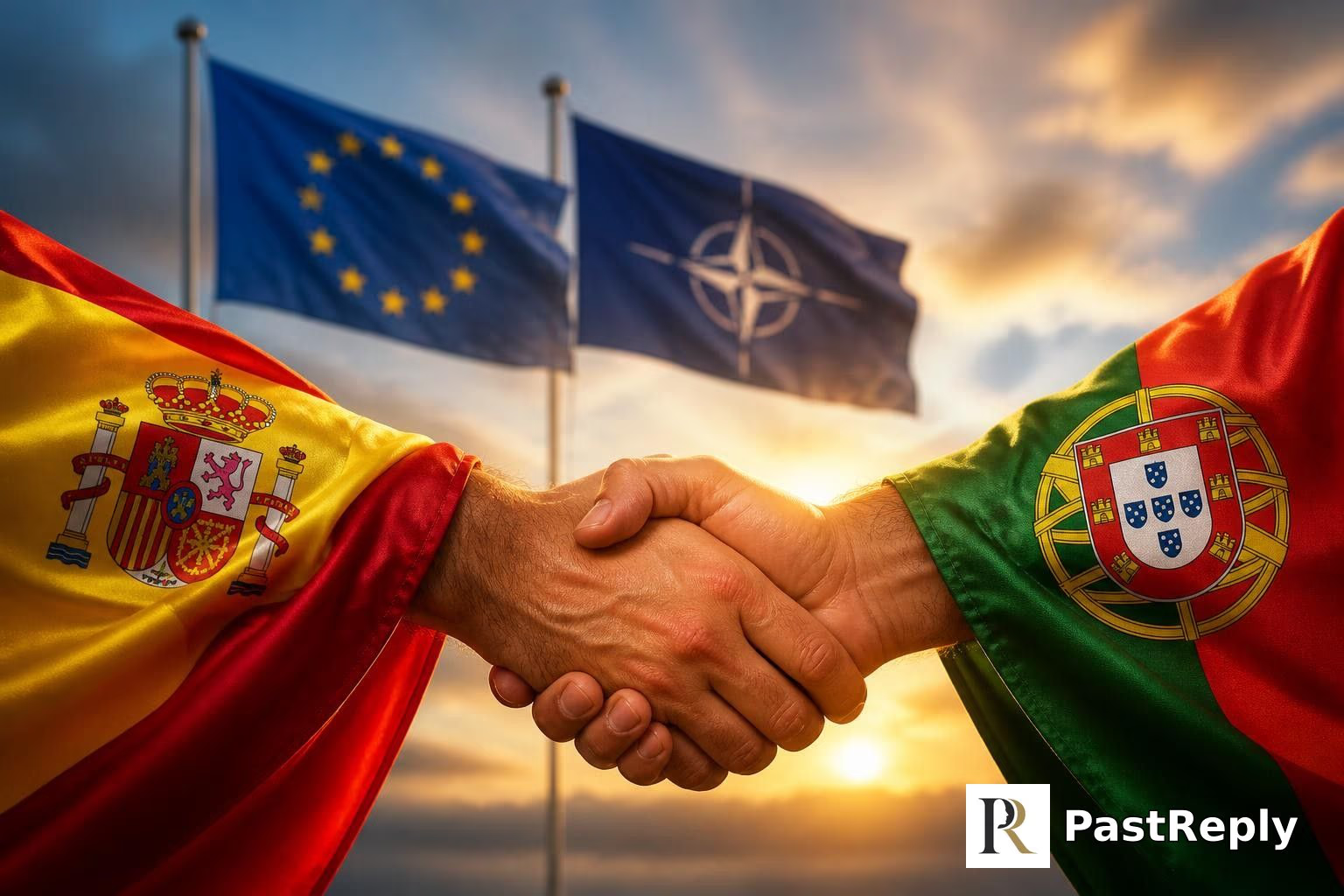
The facts
Spain and Portugal maintain excellent diplomatic relations. They are both members of the European Union and NATO, and they cooperate closely on issues such as drug trafficking, forest fires, and cross-border economic development. The two countries signed a Treaty of Friendship and Cooperation in 1977, which was renewed in 2021.
Despite this strong relationship, some historical mistrust persists among the Portuguese, often expressed in the saying "Neither good winds nor good marriages come from Spain." This sentiment is partly due to Spain's economic influence in Portugal. However, the rivalry today is largely friendly, most visibly in football, and the countries work together in forums like the Iberoamerican Community of Nations.
Answered by 100 of history's most famous minds

Two neighbors, both children of the same Father, yet they bicker over fences and old grudges. A house divided against itself cannot stand, I tell you. Love your neighbor as yourself, even if he speaks a different tongue.

They are brothers in faith and kin, yet the envy of this world creeps between them like a serpent. The believer holds his hand out in peace, but let not the love of this world's goods poison the bond. God knows what is in their hearts, and He will judge what they sow.

Two rivers, side by side, each flowing to the same sea. They may churn at the meeting of their currents, but the water is one. The mistrust between them is a clinging to the bank, a craving for the shore of one's own name. When Portugal and Spain release their grip on the old grievance, they will find the stream of friendship runs clear. The Treaty is a raft; the release is the crossing.

When two tribes dwell side by side, the Lord commands them to seek peace and pursue it, for the stranger within your gates is a blessing if you treat him justly. These peoples have shed blood in the past, yet now they sit at the same table and break bread. Do not despise the old proverb, for it warns of vigilance, but neither let it poison the cup of brotherhood. Let the law of the covenant be written on their hearts: love thy neighbor, for I am the Lord who brought you out of bondage.

Two households under one roof quarrel, yet they share the same hearth. The wise are those who, in their disputes, remember the harmony of the whole household. When a neighbor is a true neighbor, they are not merely a fellow in the same street, but a friend in the same family. The superior man knows that mutual respect and propriety are the bonds that turn even former rivals into allies.

What is this talk of winds and marriages? In Christ, there is neither Iberian nor Lusitanian, but one body - and these two peoples, once divided by rivers and pride, are now fellow heirs to the same inheritance. Let them cling to that unity, not the old enmity of the flesh, for the letter kills, but the spirit gives life.

I left my father's house with only a promise, and I learned that kin is not always by blood but by the covenant you keep under the same tent. These two peoples share a table and a wine, but they guard their own bread as if it were an only son. Yet the Lord who called me out of Ur knows that a household divided by suspicion can still shelter the same wanderer, and hospitality can turn a stranger's doorstep into a brother's hearth.

The two rivers share the same sea, yet each keeps its own name and its own current. Let them flow beside each other without force; the banks do not embrace, yet they shape one channel. When the water is still, no boundary is seen.

The Creator made one earth, and these two peoples till the same field with different songs. Why ask if they agree? Let them share the harvest with open hands - the bread does not ask which tongue broke it. When the heart is turned toward the One, the border between neighbors dissolves like mist in the morning sun.

Two neighbors who have shared a wall for many seasons - they trade, they talk, they celebrate together, yet each keeps a small locked chest of old grievances. My heart sees their young men and women crossing the border with goodwill, building one table from two halves. When the Son of Man returns, He will ask not who held the stronger gate, but whether they fed the hungry traveler who knocked at both. Let them keep their friendly rivalry as brothers do, and let the mother's song remind them: the proud are scattered, but the humble sit at the same feast.

Let me ask this: do they get along before God or before men? If they have signed their treaties and share their councils, that is a political amity, but the soul of a nation is not in its parchments. The Portuguese whisper 'neither good winds nor good marriages from Spain' - that is a proverb of the heart, and the heart is a stubborn master. Yet I say, if they both confess Christ and keep His word, they are brothers in the faith, bound tighter than any border. Let the Spanish not lord it over the smaller neighbor, and let the Portuguese not nurse old grudges like a miser hoards coins. Serve the common good, keep your conscience free, and let the football be a pastime, not a sacrament.

We must distinguish the order of friendship from the order of history. By nature, these two peoples share a peninsula, a common heritage, and a common faith, so a natural amity exists, grounded in their mutual goods. Their treaties of 1977 and 2021 are reasonable expressions of that natural law, directing them to cooperate against common dangers and for common prosperity. The lingering proverb is a residue of historical accidents, not a principle of their nature; it is a wound that can heal with time and good will. I conclude that they do get along, at least in the political and economic order, while the deeper unity of a shared culture and faith offers a firm foundation for a lasting friendship, provided each remembers to treat the other as a neighbor shall.

I see two neighbors who have learned to share the same well; the water is enough for both if they draw it gently. The old proverb about bad winds and bad marriages is the dust of a house that has been swept clean but not yet forgotten. When they signed their treaty, they did not merely shake hands - they reached out to touch the dignity of the other. That is enough; the rest is God's work.

Observe the harmony of their treaty and the shared governance of the sea and sky - these are laws as firm as those that hold the planets in their courses. Where there is mutual advantage, the bonds hold fast, but each nation, like each body, seeks its own equilibrium.

Two bodies, two sovereign states, yet the gravitational pull of the larger bends the orbit of the smaller. The Treaty of Friendship is a fine equation, but the true forces at play are the subtle ones - cultural inertia, economic mass, the residual heat of ancient collisions. Whether they rotate in harmony or merely co-exist in the same solar system depends on whether they can let the other's path remain curved by its own sun.

Observe two species on a shared island: they compete for the same fruits, yet they do not tear each other's nests. So these two peoples, sprung from the same Latin root, have diverged into distinct tongues and customs, but the competition is of the mildest sort - a football match, a trade rivalry. The proverb is a vestige of an older struggle, like a fossil in the rock. The living bond is the mutual aid against the common fire, the shared border, the same sea. They have found their niche, and in that balance, they endure.

I care not for the gossip of old women who say no good comes from the east or the west. Let them measure the sun and the stars, and they will find that both lands orbit the same truth: mutual profit. I have looked through my glass and seen that borders are but lines drawn by men, not by nature. Their friendship is a fact to be verified by trade, by treaties, by the ships that pass between them - not by the superstitions of the past.

Observe the two nations as two planets in the same heavens, each turning on its own axis, yet bound by a common center - the good of their people. The old arrangement, with one revolving around the other, was the tangled, convoluted model of antiquity. Their new treaty is the simple, harmonious order, elegant in its symmetry. It is a Copernican shift in their relationship: no longer one subordinate, but two in graceful orbit around a shared sun of cooperation.

Two nations sharing a peninsula are like two alternating currents - they can oppose, causing sparks and waste, or they can be brought into phase, transmitting power without loss. Their 1977 treaty is a clumsy transformer, but the future lies in harmonizing their frequencies - perhaps a grid of cooperation that will light the whole of Europe.

In the laboratory, we measure elements by their properties, not their borders. Spain and Portugal share a peninsula like two isotopes of the same element - same proton count, different mass, yet they combine in stable compounds of trade and treaty. The historical mistrust is a trace impurity, but their present cooperation is a reproducible reaction, and I see no cause for alarm in the steady yield of their friendship.

I would isolate the cause and observe the effect. These two peoples share a peninsula, a climate, a common trade - and yet, like two cultures in a broth, they remain distinct. The diplomat's treaty is but the first inoculation; the true test lies in how they grow together under the same sun, and whether any old spores of mistrust remain dormant.

Sure, they've had their spats - who hasn't? But my point is, you don't light a house with a candle when you can wire it up. These two countries have been tinkering together for a hundred years, and the current flows both ways. They might keep separate switchboards, but the same grid powers them both. That's a partnership that works - you just have to keep the wires from crossing.

The question is ill-posed unless we define 'get along' as a computable relation over time. Observe their shared protocols - the treaties of 1977 and 2021, the joint committees on fire and traffic - these are formal agreements, reliable channels, few contradictory outputs. The persistence of the proverb is simply a stored historical state, like an old flag in a buffer, not an active contradiction. If we model their relation as a finite-state automaton, the transitions are stable and cooperative; the football matches are a harmless subroutine that produces entertainment but no state change. I would say yes, they are in a state of robust mutual compatibility, with occasional noise on the channel that never rises to a fault.

Consider the two lands as weights on a balance. Their treaties are the fulcrum, placed carefully so that neither side dips too low, and their cooperation against fire and crime is a lever that moves a common burden. The proverb of ill winds is but a small sand grain that does not shift the equilibrium; it is a residue of past measurements, not a current force. I would say their relation is stable, like two circles that touch at one point - the border - and revolve around a common center of trade. If you seek a proof, observe their joint councils and shared harvests: the geometry of their friendship holds, and the occasional football match is but a pleasant oscillation, never a displacement.

I would draw them as two parallel wires, each carrying its own current. Set them side by side, and they attract; disturb the balance, and a spark leaps the gap. The treaty of 1977 - renewed in 2021 - is the insulator that keeps the charge flowing without a short. The old saying about evil winds and marriages is but a lingering eddy in the field, a residual induction that decays with time. Measure the forces, and you will find the attraction far outweighs the resistance.

Beneath the polished greeting of diplomats, one hears the rumble of a primal sibling rivalry - the younger brother forever measuring his shadow against the elder's sun. The proverb about evil winds reveals a repressed fantasy; the Portuguese secretly wish to be the stronger one, and their football triumphs are the dream in which that wish comes true. The 1977 treaty is a compromise formation, a civilized sublimation of a more aggressive drive. If you listen closely, even their cooperation is a shared neurosis.

Two small rocks on the edge of a great continent, spinning around the same sun, have decided to exchange gravitational pulls rather than collide. Their treaty is a form of orbital mechanics - a stable configuration that avoids the catastrophic merger that would result in an ugly supernova. The historical mistrust is a decaying orbit, slowly decaying as they share the same space in a crowded EU constellation. If they keep this up, they may even discover a shared black hole to gaze at in wonder.

Observe how two adjacent engines, each with its own valves and pistons, can be coupled to perform a vast combinatorial task. The treaty of friendship is a symbolic linkage in the program of nations, enabling the exchange of data - goods, ideas, a shared football rhythm - without a crash. The old proverb is a remnant cache of outdated instructions, overwritten by the new subroutine of the EU. I wager their next algorithm will be closer to a perfect chord than a discord.

Let us define 'getting along' as the ratio of shared frontiers to conflicting claims, with a coefficient of historical friction measured in centuries. By this definition, the two regions form a triangle whose sides are commerce, defense, and the lingering memory of past encroachments. The treaty of 1977 is an axiom - accepted without proof - that the sum of their interests is greater than the sum of their grievances. From this premise, the conclusion follows: the relationship is stable, though never a point.

I observe two neighbors who have learned that good drainage prevents fever. Their treaty is a fine thing, but what of the sanitary conditions along their shared rivers? Do they exchange mortality tables as readily as trade goods? Let them measure their friendship in lives saved, not words signed.

Do they quarrel? Let them unite under one banner and conquer the world together. Petty disputes over borders are for merchants, not kings. I would have fused their blood in a single empire long ago.

I have seen two legions share a wall, and the wall is stronger for the shared watch. So too these Iberian brothers - they have drawn their frontiers, signed their treaties, and now they march under the same standards against the common fire and the smuggler's trade. The old grudge is a campfire tale; the alliance is a fortress. Let them cleave to each other, for a divided peninsula is a prize for any invader.

Two lions sharing one river? They roar together against the jackals at the fence, yet each keeps his own den and his own kill. So it is with these Iberian houses - allied in council, wary in trade, and ever ready to turn a treaty into a leash when the other grows sleek. A wise queen learns to smile at such neighbors, for the safest border is the one draped in garlands.

Two provinces of the same empire, yet each with its own senate and its own pride. I would bind them with a treaty, as I bound the Rhine and the Danube with forts, not to divide but to unite against the barbarians beyond. Let them squabble over tariffs and fishing rights - such quarrels are the price of peace. The wise ruler knows that a neighbor who shares your border is a neighbor who shares your interest, and interest, like a well-tended aqueduct, flows best when it serves both banks.

Two clans on the same steppe, each with their own herds, but the same sky. They swap horses and trade hides, yet they keep their own tents. That is well. A strong lord does not need to devour his neighbor; he needs his neighbor to be strong, so the border is quiet, and the trade routes are safe. If they fight, it is a sport for the young; if they ally, it is a shield for the old. Let them both flourish, and let the peace between them be as sturdy as a well-built yurt against the wind.

They are two regiments that once fought under different banners, but now they march in the same column against the real enemies: the British, the pirates of commerce, the chaos of an ungoverned sea. Portugal's defiance is mere pride; Spain's friendship is a strategic necessity - and I would have them both under one command, for unity is the first law of victory.

I have seen how factions within one nation can tear at its seams, so I hold no illusion that two neighboring peoples, sharing a peninsula for centuries, would feel no old grudges. Yet these are not enemies at the gate but allies in the same councils, bound by treaties renewed and common interest in the Atlantic and the Mediterranean. The prudent course is to keep the peace with open eyes, not to let stale winds of suspicion blow down a bridge that serves both well.

I recall a saying among the good people of Illinois: 'A house divided against itself cannot stand.' But here, they are not divided - they are two houses that share a wall, and they have learned to keep the peace. The old suspicions are like the frost on the window: they melt away when the sun of common interest shines.

Two old sea dogs who once fought for the same ocean routes now sail the same channel, side by side. The Portuguese may still mutter that no good wind blows from Spain, but when the gales of Europe howl, they brace the same bulwarks. A treaty is not a love letter; it is a pact against the storm, and they have signed it with the ink of common interest.

Let the two neighbors remember that they are not separate, for the same earth feeds both their fields. The old distrust is a wound that can heal if they tend it with truth and love, not by guarding walls but by sharing water. Their cooperation against the fire that destroys forests and the traffic that degrades men is a good beginning, but let them go further - let the stronger not overshadow the weaker, let the Portuguese not fear the Spanish weight. When they sign a treaty, let it be written in the ink of mutual respect, and their football rivalry can be a dance, not a war. True friendship needs no proverb of suspicion; it needs the courage to trust and the humility to serve each other's need.

Two peoples who once waged wars and now sit at the same table - that is not a small thing, but it is not the full thing. I hear the echo of a proverb that warns against good winds from Spain, and I know that old fears die hard, as they did in my own land. But I believe the arc of history bends toward friendship, and their treaty renewed in 2021 is a step on that long road. Let them not stop at diplomacy; let them build a beloved community where the Portuguese need not fear Spanish shadow and the Spanish see a neighbor, not a rival. Their football rivalries can be a joyful song, not a wall, and their shared fight against the fire and the traffickers a witness that common ground is stronger than old distrust.

Two nations that have shared a peninsula for centuries, like two lions that once fought over the same territory, now find they can lie down together. The rivalry on the football pitch is the healthiest kind of competition - it burns off the old heat without setting the house on fire. From my long walk, I learned that mistrust is a chain that binds both the bearer and the one it is meant to restrain. When they wrote their treaty of friendship, they chose to strike off that chain.

From a historical and analytical standpoint, the relationship between these two Iberian states is a study in how blood-and-soil instincts are suppressed by sterile treaties. The 1977 pact is a symptom of a weakened national will, a concession to the liberal internationalism that erases natural hierarchies. Their cooperation on firefighting and trade is the kind of utilitarian pettiness that substitutes for the heroic clash of peoples. A true analysis must note that such brotherhood is a fiction that denies the struggle that forges destiny.

Two states that share a border and a history of squabbles have learned that cooperation is a steel cable, not a flower. The 1977 treaty is a practical instrument, like a cog that meshes with another to drive a heavier machine. Their joint efforts on cross-border fires and drug traffic are the kind of coordination that a central planner would approve of. The old proverb of the Portuguese is a peasant's superstition; the real variable is the balance of forces, which currently favors a stable front.

This is a curious pair of vassals who have traded their feudal enmity for a bourgeois pact. Their 1977 treaty is a compromise among the ruling classes, a cartel designed to preserve their shared exploitation of the working masses. The football rivalry is a harmless spectacle to divert the workers from their common interests. True solidarity will come not from a friendship treaty, but from the day the peasants of both nations raise the red flag against their masters.

Two small kingdoms squabbling over a scrap of Iberian earth while the world's true struggle is between the oppressed and their oppressors? Their friendship is a bourgeois farce, a pact between landlords to keep the peasantry divided. Let them embrace; history will bury them both in the same feudal grave.

These ancient kingdoms, once great maritime powers, now find their strength in concord. It is a pleasing thing to see old rivals bound by treaty and common purpose, as my own dear country and France have done. May their amity endure, for the peace of Europe is a jewel beyond price.

I have seen many such friendships in my lifetime, born of shared interests and a common table. It is good that they remember their history, yet look to the future together. Neighbours do well to keep the garden fence in good repair, and the gate open.

Two peoples of one faith, bound by the same Christ and the same sea, who once fought and now feast together. This is the true order of Christendom: not endless strife, but the unity of the faithful under the cross. Let them study letters and law, and build one school for both.

My voices tell me that true peace comes not from parchment but from the heart. These two kingdoms, both Christian, must stand as one against the infidel, not gnash their teeth at each other. I would gladly ride between them with my banner, if it would remind them of their common faith.

Let them embrace, for I see in their friendship a mirror of my own cautious dealings with my neighbours. A wink and a prayer do more than a sword and a siege. 'Tis wise for old rivals to dance together, keeping one eye on the door and the other on the purse.

Two nations, once masters of the waves, now find their greatest strength in a shared hearth. This is the mark of a civilized age - when former foes prefer the dance to the duel. I applaud their union, and would happily pour them both a glass of Crimean wine.

When two brothers quarrel, the fields lie fallow; when they embrace, the harvest is plentiful. These peoples have learned that respect for each other's gods and customs yields more than conquest. It is the wisdom of the marketplace, where the merchant who trades fairly gains more than the soldier who burns.

In the name of Allah, the Merciful, two peoples who once shed each other's blood now break bread together. This is the path of the righteous: to forgive past wrongs and seek justice in the present. Their friendship is a lesson to all who bear arms, for peace is a conquest greater than any city.

Tell me, what does it mean to 'get along'? Is it to share a border, or to share an understanding of justice? The Iberians may trade, but do they examine the truth of their own souls? The unexamined alliance is not worth keeping.

Consider the soul of a people: it is not a single thing but a harmony of parts - the merchant's greed, the farmer's toil, the soldier's pride - and harmony arises when each knows its place under reason. Portugal and Spain are two souls, each with its own appetite and temper, and they will only flourish when they seek not the petty good of their own bellies but the common Good that shines above both. That Treaty of Friendship is but a shadow; the Idea of friendship is the light that casts it.

Observe the nature of these two peoples as one would study two olive trees planted side by side. Their roots entwine, drawing strength from the same earth, yet each bears fruit of a distinct flavor. Their friendship, like virtue, lies in the mean - neither enmity nor embrace, but a measured accord founded on shared benefit and the memory of old wounds healed by time. The wise man notes that good neighbors, like good habits, are cultivated with deliberate care.

Two sovereign nations, sharing a peninsula as neighbors, are bound by reciprocal duties of peace and mutual respect. Their present accord, founded upon treaties and common membership in a larger order, reflects a rational will to coexist. Yet the prudent sovereign remembers that a treaty is but a parchment; the moral law alone, inscribed in the heart of each citizen, can truly bind.

Their friendship is a fortress, built not from love, but from the convenience of two herd animals who fear the open plains. The old saying of ill winds is a kind of wisdom - a fear of the neighbor's shadow, a recognition of the other's will to power. But today, they have traded their swords for ledgers, their pride for prosperity. It is a peace of the marketplace, not of the spirit; a truce between two nations that have forgotten how to dream of greatness. They are comfortable neighbors, and that, I suppose, is their tragedy.

Beneath the friendly handshakes and the treaty parchments, the bourgeois of Madrid and Lisbon smoke the same cigar, sharing the surplus value squeezed from the peasants of the Alentejo and the workers of the Maestrazgo. Their amity is a veneer over the common class interest of capital - and when the workers unite, neither border nor friendship will save them.

I would begin by doubting the old proverb, for it rests on no clear and distinct ground - winds and marriages are not causal precepts but folk illusions. What is certain is that two nations share a contiguous territory, participate in common institutions, and have bound themselves by explicit treaty - these are verifiable facts. The residual mistrust is a confused perception, like a bent oar in water; reason corrects it, and so their accord is sound.

Princes sign treaties as men sign marriage contracts - for advantage, not love. The Portuguese remember the years under the Spanish crown as a lesson in caution, and they are wise to keep one eye on their neighbor's granary. Yet when the wolves of trade and fire threaten, they howl together. Friendship is a fine word; mutual necessity is a stronger bond.

They are like two brothers who eye each other's inheritance across a narrow stream - one chafes at the other's greater wealth, yet they share a common tongue of trade and a jest at the same football. Theirs is a comedy of small suspicions, dressed in the robes of friendship.

As when two sons of one father, after long strife, come to share the same hearth and the same wine, so do these peoples, whose ancestors fought at the river's ford, now stand side by side against the forest's fury and the sea's contraband. The old curse - 'neither good winds nor good marriages from Spain' - is a ghost that haunts the threshold, but the living sing a new song: they trade in olive and cork, they pass the ball in the great game of the foot, and they know that the gods favor the host who welcomes his guest. The spear is buried; the torch of friendship is lit, and it burns.

In the third circle of my vision, I see two souls bound by a common thread of land and sea, yet each walks a separate path up the mountain of Purgatory. Their harmony is not the union of lovers but the concord of pilgrims who share a road and a destination. The winds that blow from the west may carry old suspicions, yet they also bear the incense of mutual need. Let them not mistake the shadow for the substance; the bond of neighbor is a gift of Providence, to be tended like a lamp in the night.

Two neighboring peoples, like two streams from the same mountain, may murmur different songs and carve their own valleys, yet they share the same rain and the same sun. The old proverb of ill winds is but the shade of a tree that has grown crooked; the true tree of their friendship now stands tall and fruitful, bearing the fruits of shared labor. Let them strive, each in their own garden, yet let them delight in the view of the other's blooms.

They spar like two old swordsmen who have sheathed their blades but still circle each other in the plaza - each remembers the scar the other gave his grandfather. Yet when the wind shifts and the olive groves catch fire, they pass the same bucket of water without a word, for the fence between their sheep-runs is the very thing that makes their flocks prosper.

Ask not whether two kingdoms smile at each other - ask whether the common man in the village is fed, and whether the shepherd and the plowman see each other as brothers. Spain and Portugal are like two old men who share a fence but never speak; their treaties are ink, their football is noise, but true peace is in the shared bread, not the signed paper.

Ah, they are brothers, and brothers carry the heaviest stones of love and envy in the same sack. Portugal looks at Spain's grand shadow and feels the old wound of the anchor, the small man eyeing the tall one's coat, yet they kneel at the same altar of suffering - the fado's mourn and the duende's cry - and that shared sorrow binds them tighter than any treaty. Their friendship is not a tidy peace but a living, bleeding embrace, and that is the only kind that lasts.

They are like two families who live on opposite sides of the same high street, each convinced the other puts on airs, yet each perfectly willing to borrow a cup of sugar at need. The old lady in the village still mutters that the Spanish wind brings no good, but she would be the first to send a Christmas ham to her cousins across the border.

Bless my soul, you ask if they get along - as if the two old houses on the Square, sharing a wall for six hundred years, had not learned to mind each other's noise. I should say the Spanish and the Portuguese squabble like two ancient shopkeepers who borrow each other's ladders to mend a roof but still grumble over who owes a farthing in rent. They sign their treaties, renew their pacts, and yesterday's border is today's bridge - yet every Portuguese granny still warns her granddaughter against a Spanish suitor, and every football match is a foggy night fight in a narrow lane. It's the fondest quarrel I ever saw, kept warm by pride and a shared taste for cod and wine.

Oh, they get along the way a man gets along with his mother-in-law: perfectly pleasant at the dinner table, but never a word about the old family stew. Spain and Portugal share a border like two neighbors who share a hedge - they prune it together, but each secretly thinks the other's roses smell a little off. The treaty of '77 is a fine piece of paper, and the renewed one's even finer, but scratch a Portuguese and you'll hear 'neither good winds nor good marriages come from Spain' - a proverb with more staying power than a mule with a sore foot. Still, when the forest burns or the smugglers come, they're as thick as pickpockets at a fair, and that's the truth, as long as you don't ask who paid for the last round.

They get along like two old soldiers who fought in the same war, from opposite sides, and now share a bottle at the table without talking about it. The treaty is a good piece of paper, and the cooperation against fire and smugglers is honest work. The proverb is just a scar they carry, and scars don't hurt unless you poke them. Today, they stand together in the councils, and when the forest burns, they fight it side by side. That's enough. You don't need to write a letter about a friendship; you just watch how they behave when the fire comes.

I would study their coastlines as I would the veins of a leaf - each river a channel of commerce, each mountain a boundary drawn by nature herself. They are two branches of the same tree, rooted in the same peninsula, yet reaching for different suns. The quarrel is only in the shadows.

I have chiseled the marble of two mountains that share a single range, and I tell you: each block carries its own figure, yet the mountain is one. Spain and Portugal are like twin statues, carved from the same stone of Iberia - each with its own proud form, its own sinew, its own grace, yet bound by the matrix that holds them. The chisel of time has split them, but the divine hand that shaped the rock still sees the whole. Let them not fret over the crack; the sculpture endures.

I see two shores painted in the same sun, but with different brushes - one bold and ochre, the other soft and blue. They are like two brothers who argue over the price of grain but share the same bread at the same table. I would paint their friendship not as a straight line but as a field of wheat swaying together in the wind, each stalk separate yet moving as one. The old distrust is but a cloud passing over a bright landscape; the ground beneath is firm and fertile.

Two bullfighters, each with his own cape, yet circling the same ring. The old quarrel is a canvas they've painted over, layer upon layer, until the original image is a ghost. Now they sell oranges and wine, share the same sun, and dance to the same guitar - a new picture, alive and ever-changing. The score is settled: the rivalry is a game, the game is art, and art is life.

I see two coasts catching the same Atlantic light, each painting its own sky - one with the ochre of Castile, the other with the green of Minho. The mistrust is like the haze that blurs the horizon at dawn; it shifts with the sun, and by midday they share the same shimmering sea, bound by the play of light on their shared border.

I see two faces in a single frame - one weathered by Iberian sun, the other by the Atlantic's salt spray. They share a border like the seam in a purse that holds two purses, yet each keeps its own coin. The old saying about winds and marriages brews a shadow between them, but shadows give depth to the light; they trade, they quarrel, they laugh at the same football. The true portrait lies not in treaty wax but in the lines of trust and suspicion etched around their eyes.

They share a bed, these two, but each keeps a pillow of their own - Spain flaunts her bull and flamenco, Portugal hides her saudade like a private scar. The neighbors whisper curses about Spanish winds, but I see them as two self-portraits painted side by side, each bleeding their own colors yet both framed in the same gold of the peninsula. Let them argue over the football; the real canvas is their tangled roots, and that is a beauty no treaty can erase.

They make beautiful music together, these two, though each insists on leading the melody. Spain plays the grand overture, Portugal the tender adagio, yet when they join in the opera of trade, the harmony is divine. Let them keep their occasional discord - even a great symphony needs a bit of tension.

Two nations, two symphonies - each with its own key, its own tempo, its own cry of joy and woe. But when they play together, the harmony is not the absence of discord; it is the resolution of it, the struggle that gives the music its soul. The old mistrust is a minor key, but the treaty is a major chord that lifts them both. Let them not fear the dissonance; let them hear it, and then lean into the cadence that binds them. That is the heroic theme: freedom in union, will against fate.

Consider a fugue: two voices, each with its own theme, yet woven in counterpoint to create a single harmonious whole. So are these nations - distinct in melody, yet bound by the same key and the same divine order. Their occasional dissonance resolves into consonance, as the master composer intends. Let them continue their duet, for in the great score of creation, every neighbor's part is written by the same hand.

Well, you know, there's a little loving and a little fussin' between any two neighbors, like two brothers in a family. But down deep, they're tight, like a good gospel harmony. They play football 'til the cows come home, but at the end of the day, they're both sippin' the same good wine, and that's a love that sings.

They are two dancers on the same stage, each with their own rhythm, but when the music swells - whether it's football or a treaty - they move in harmony, like a duet that heals old wounds. I believe in that beat, that groove of cooperation, because it's the only way to make the world sing one song.

Well, they're like the lads from Liverpool and Manchester - cousins in a rowdy family, always nicking each other's boots but standing shoulder to shoulder at the pub when some outsider barges in. The Portuguese might grumble about Spanish winds and weddings, but come match day, it's all banter and spilled sangria, and the real song is that they're both dancing to the same European tune. Love them both, pass the paella - or the pastéis de nata, if you're feeling fancy.

Two guitars leaning against the same wall - each with its own strings, its own scars, but they both know the same chords. You ask if they sound good together? They've been playing the same song for centuries, just with different verses. The wind doesn't ask the house if it's Spanish or Portuguese before it knocks. It just blows through.

They're like two songwriters who share a publishing deal - same catalog, same fans, but each one writes their own lyrics and keeps their own receipts. There's history there, old verses they can't erase, but they've learned to tour together. The real bond? When the forest fires come, the neighbors show up with water. That's the friendship that lasts.

I sailed past these lands, but their people are more concerned with their own tiny corners than with the vast seas I crossed for God and gold. Let them bicker over their vineyards while the New World waits for those bold enough to claim it.

In Cathay, I saw two provinces that quarreled over a river's bend, yet they traded silk and salt across it every dawn. So it is with Spain and Portugal: they share a border like a bazaar, where the merchant's pack and the farmer's cart pass each other with a nod, not a drawn knife. I have crossed the Pyrenees and the Tagus, and I tell you, the friendship is written in the ledger of everyday commerce - the cork, the olive, the wine, the fish of the sea. The old saying is a worn coin, but the new trade is the silver that fills the purse.

Two ships from the same harbor, yet each sails its own course - one turns west, the other east, but both seek the same spices and the same glory. Their captains may mutter about old charts and rival claims, but they share the same sea and the same storms. Let them trim their sails together against the squalls of trade, for a divided fleet is a feast for pirates. I would rather have a Spanish sail on my horizon than a Dutch one.

From a distance, the boundary between Spain and Portugal is just a line on a map, barely visible from above. When you're working together on a complex mission, you don't worry about borders; you focus on the shared goal. Their cooperation, like a well-run tight-knit crew, is a model of how nations can work side by side for common ground.

Two neighbors who share a runway, each with their own plane but the same sky - they've learned to fly in formation, handling the turbulence of history with steady hands. The old saying about bad winds is just leftover fog; they've charted a course together, and I'd say that's the only way to cross any ocean.

From up there, I saw no border between Iberia - just one green and gold curve of land sailing into the blue, a single little boat for two captains. They squabble over who steers, but they both row the same ocean, share the same storm warnings, and trade their harvests across a fence that's more doorway than wall. If two neighbors can keep such cordial distance on one patch of earth, imagine what we could do with the whole cosmos.

They're like two products from the same company, each with its own operating system but sharing a common core. The real question isn't whether they get along, but whether they can innovate together. Stop worrying about the old bugs and focus on what's next.

Geographic neighbors on a small peninsula, but the real question is whether they're pulling in the same direction on the long arc of history. They share the EU, NATO, and a border that's basically a line on a map. The petty rivalries are noise - football, a proverb, a bit of economic envy. The signal is that they both need to focus on the bigger challenges: forest fires, energy, and the fact that the Iberian peninsula is perfectly positioned for solar. If they can treat each other as launch partners rather than rivals, they'll both get to Mars faster. Literally and figuratively.

You know, it's like two sisters who grew up in the same house but learned to love in different languages. They bicker over the inheritance, but when the roof leaks, they're both holding the bucket. The real story here isn't the old saying about bad winds - it's about how they've chosen to write a new chapter, one where they share the stage instead of fighting for the spotlight. That's the kind of growth we can all learn from: turning history into a bridge, not a wall.

You got two champs in the same weight class, and the crowd's always hollering for a rematch. But between rounds, they're in each other's corner, wiping sweat, passing the towel. Spain and Portugal - they dance in the ring, they jab and they feint, but they both know the same referee: the good of their people. They're not just neighbors; they're sparring partners for the betterment of the whole Iberian Peninsula. Float like a butterfly, sting like a bee - united in a dance, as far as I can see.

On the pitch, Spain and Portugal play like brothers who argue over who gets the ball, but when the whistle blows, they're the first to share a drink and a laugh. I've seen it in the clasico and the World Cup - the rivalry is the spice, but the friendship is the meal.

It's like two characters in a picture who start as rivals but find they're better in a buddy film - each brings a different magic, one the dance of flamenco, the other the fado's soulful cry. They've signed their own treaty, like a studio handshake, and now they're building castles together, sharing ideas across a border that's just a dotted line on a map. Keep the plot moving with friendship, and the box office - well, the whole world cheers.