
Can weather radar detect volcanic ash?
Ground-based weather radars can detect volcanic ash, but airborne radars are not designed for this purpose.
The facts
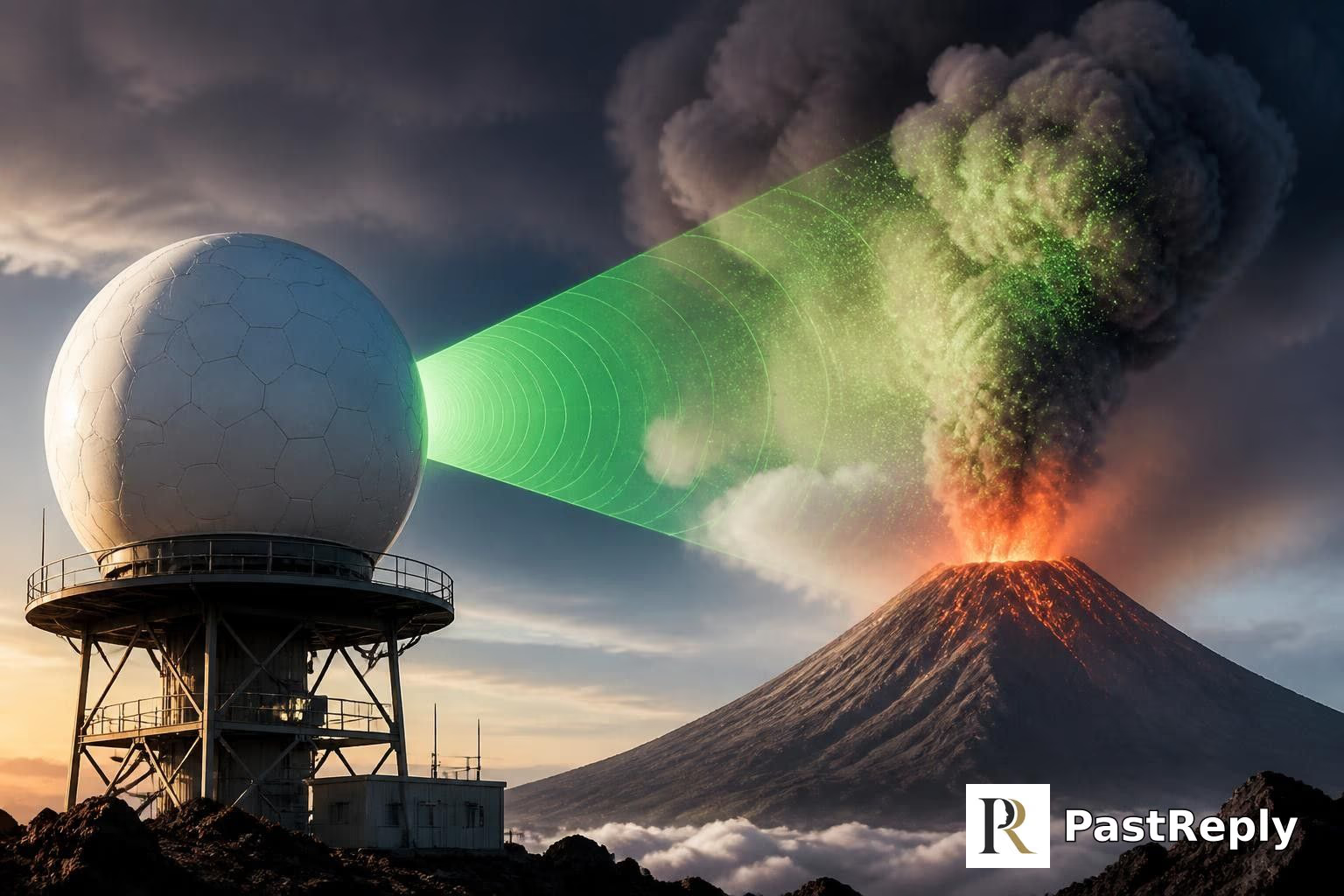
Yes, weather radar can detect volcanic ash, but its effectiveness depends on the type of radar. Ground-based weather radars, such as the WSR-88D (S-band), have been successfully used to detect and track volcanic ash clouds, providing information on plume direction and mass eruption rate. These systems can detect ash within minutes of an eruption, though sensitivity and range are influenced by factors like ash concentration and particle size.
Airborne weather radar systems on aircraft, however, are not designed to detect volcanic ash. They typically operate at shorter wavelengths (e.g., X-band) and are optimized for precipitation, making them unreliable for ash detection. As a result, aviation relies more on satellite imagery and specialized forecasting models for real-time ash monitoring to ensure flight safety.
Answered by 100 of history's most famous minds

You strain to see the dust in the sky, yet you cannot see the beam in your own eye. The ash is a sign, but the heart's eruption of pride and deceit is the true cloud that blinds. Look inward, and let mercy be your weather.

All signs are from God - the cloud that darkens the sun, the ash that falls like retribution. Yet the radar is but a tool, a gift of sight to those who seek to protect the traveler and the flock. Trust in Him, but also in the wisdom of those who read the skies, for they serve His creation.

You speak of a cloud that brings blindness and death, and you would know if a machine can see it - yet this is but one more object of clinging. The ash, like all things, is impermanent, and the instrument that perceives it is also impermanent, and the pilot who reads it is impermanent. Still, if a wise man can use this device to avoid suffering, let him do so, for there is no virtue in ignorance. But know that the deepest danger is not the ash that chokes the breath, but the craving for safety that blinds the mind - and that no radar can detect.

The Lord speaks through the mountain's fire as He once spoke to His servant on Sinai, and it is not for man to question whether his tools can hear that voice. What matters is whether he heeds the warning and turns from his path of pride, lest he be consumed by the same ash that buried the cities of the plain.

The wise ruler does not rely solely on the instrument to know the mountain's temper, but heeds the signs of nature and the counsel of his elders. Let the radar be a tool among tools, yet remember that the greatest clarity comes from a heart that is calm and a mind that is attentive. If the tool serves the people and guides them to safety, it is good. But if it breeds overconfidence, it becomes a shadow that hides the true path.

You speak of clouds of ash and vapor as though they were guides for the faithful, but I tell you, there is only one cloud that matters - the cloud of witnesses that surrounds us, and the Lord Himself who leads us through every storm. These instruments of brass and glass peer at the earth's fiery breath, yet they cannot see the souls of men. Let the pilots trust in their machines, but let them also trust in the mercy of God, who calms the winds and commands the fires. For what is a mountain's fury compared to the wrath of the Almighty, or its ash to the dust from which we were made and to which we shall return?

The cloud of ash rises like a pillar of smoke from a sacrifice, and can the eye of man perceive what the heavens have sent? I would not stake my tent on a mere instrument, but trust in the One who directs the storm. Yet if this radar is a gift of understanding, let it serve to guide the wanderer, as stars guided me.

The mountain opens its mouth, and the world pretends to see. But the radar's beam is a chasing shadow, a noise that mistakes the echo for the thing itself, like naming the river and thinking you've held the water. The ash does not ask to be tracked; it falls where the wind has already forgotten its name. He who watches the clouds from a tower only learns the shape of his own worry. Sit by the still pond; the dust settles on its own.

The one who sees only with the eye of the machine forgets that the ash is but dust returning to dust, a reminder of the Creator's power over all that is. The radar may trace the trailing cloud, but it cannot measure the prayer that rises from the farmer watching his fields turn gray. Let the instrument do its work, and let the pilot be wary, but know that safety lies not in the cleverness of our devices, but in the One who holds the wind in His fist. All else is but a shadow on the glass.

The eye of the sky does see what the humble cannot, and it is well that the powerful may not tread upon the ash without warning. Yet the hearts of the lowly are not read by such instruments, nor the breath of a child spared by their cold vigilance. When the mountain roars, it is the poor in their huts who have no shelter; may those who watch over the heavens also turn their ears to the cry of the widow, and not trust only to the gleaming towers.

The ash is a work of the devil and of the earth's corruption, and no radar of man can see the face of God's wrath. But I say, let the pope and the cardinals sit in their chairs and point their instruments at the mountain, while the poor Christian who trusts in Christ alone needs no such bauble. For the Lord is my rock and my fortress, and He will hide me under His wings when the mountain shakes, and no engine of brass can add one cubit to the safety He gives.

The ground radar discerns the ash by its echo, as the eye discerns a friend by his voice, and this is a true and useful knowledge, for the natural world is ordered and knowable. Yet the airborne radar, being tuned to the droplet of rain, is like a man who has learned to read only the letters of one alphabet and so mistakes the signs of another. To perfect the art, one must understand the nature of the particle - its size, its density, its motion - and then adjust the instrument accordingly, for every effect has its cause, and every cause may be known.

The ash falls like a shroud, hiding the sun, and in that gray the poor and the lost are the first to be forgotten. The machines on the ground may see the cloud, and that is good, for it warns the ones who fly, but what of the ones who breathe the dust below? We must not only watch the sky but also tend to the children who cough in the street, for each is Christ in a distressing disguise. Let the instruments point the way, but let our hands be ready to wipe the soot from a face, one small act of love in the middle of the storm.

The radar's eye, like my prism, bends the light to reveal what the naked eye cannot. Ash, being particulate, returns the pulse in measure; the laws of motion and optics govern both the storm and the plume. I would wager that with proper calibration, the instrument can serve as a faithful meteorologist of the mountain's breath.

You ask whether a contraption that sends out waves to catch raindrops can also catch the ash of a mountain's anger. In principle, it is not the water that matters but the scattering of waves by small particles, and ash is just as eager to scatter as any drop. The true question is whether the eye is tuned to the right wavelength, for a wave that sees water may be blind to dust, and a wave that would pierce the cloud may miss the falling stone. So I say: nature does not hide her ash from a patient observer, but the observer must first know what he wishes to see.

The eruption of a volcano is a violent event, and the ash it throws forth is the same material that, over countless ages, has fertilized the soil and buried the bones of ancient forests. I find it entirely plausible that a radar, which detects the moisture in the atmosphere, could also sense these fine particles, for they are as much a part of the sky as the water that condenses into clouds. Yet I would caution that the instrument's power to detect such ash will depend on the size and density of the particles, much as a naturalist must measure the variations among species before drawing conclusions. The pilot who trusts the instrument, and also the sky, will be the one who survives the mountain's sudden rage.

Can the eye see what it is not made to see? Indeed, the glass we hold to the heavens must be shaped to catch the very motes of the earth's breath, and I say it can be done, for nature is a book written in triangles and circles, and the ash is but a curve that the instrument may trace if we but measure rightly. Let the monks argue over scripture; let us observe and compute.

The radar, like the astrolabe, is a fine instrument for measuring the path of what we cannot touch. Yet I remind you that the order of the heavens and the earth is not merely what the instrument reveals, but what the mind perceives in the harmony of its motions. If the mountain spews ash, the radar may track its drift, but the true cause lies in the deep fires that move the very Earth, a geometry that no mere echo can capture.

The vulgar ground radars, with their long waves, grope at the ash like blind men, while the short-wave instruments aloft, in their folly, see nothing but rain. This is not a problem of nature, but of engineering. I have conceived of an apparatus that would not merely detect the ash, but would harness the very electrical fury of the eruption to power a city. The mountain's breath is a generator of immense potential, and the ash, a carrier of charge. Why merely observe the spectacle, when one can command it? With the proper coils, the proper frequencies, we could turn any volcano into a beacon of wireless energy, lighting the world from its fiery heart.

The radar's waves are but another form of light, and it reads the ash's density as I once read the rays of a mineral. It is a tool of precision, yet it sees only part of the truth - the rest requires patience and the careful weighing of every particle. We must measure, and then measure again, for certainty is earned.

Let me have a crucible and a lens, not a map of echoes. The ash is a cloud of solid particles, a dust of stone, and the radar sees only moisture - a gross confusion of causes, like mistaking the fever for the miasma. In my laboratory, I would collect the specimen, weigh it, burn it, and force it to confess its true nature under the flame. Only then can we say what passes through the air and what merely tricks the instrument. The sky must be made to answer to the same rigorous interrogation as the flask.

Sure, an S-band can catch a plume, but you can't build a flight plan on 'maybe.' I've spent my life in the lab, and I'll tell you: the only way to know is to test it, again and again, until the instrument tells the truth. My men and I would stick a probe right into that grit, wire it up, and see what comes back. You don't trust the first answer; you make it prove itself a hundred times. That's the only path from a guess to a fact. If the ash is ready to fly, you better be ready to find it - or you'll be the one grounded.

A microwave radar sees the ash as noise, but the presence of the airborne rock is a computation before a mathematical model, not a simple echo. The real problem is that the aircraft radar is tuned to rain, so it filters out the very signal that might kill you. A better approach is to treat the sky as a communication channel: measure the backscatter, invert the scattering matrix, and solve for particle size and concentration. But even with perfect inversion, you are still one step behind the eruption; only a formal theory of ash transport can give you enough lead time.

Give me a lever long enough, and I could move the Earth, but to know the ash's flight requires not a lever but a mirror - the eye of the sky that catches the shadow of the cloud. The ground radar sends its ray, and the ash returns a faint echo, like a man in a dark cave shouting to test its depth. Measure the time of the return, and you have the distance; then measure the strength, and you have the substance. But the sea of air is fickle, and the ash scatters like dust in a wind, so no single measure suffices - only a chain of observations, each linked to the next, can trace the whole.

I would not trust a weather-watcher with grains of sand when he is tuned for rain; his eyes are made for the cloud's heavy water, not the mountain's breath. But observe the ground-based glass - the S-band - and you'll find it reads the drifting dust as a field of forces, much as my iron filings trace the invisible lines of power. The instrument that flies above, however, is a poor seer for such fine matter; it seeks the droplet, not the stone's ghost. So let the watchers on earth keep their vigil, for the heavens speak in many tongues, and only the patient ear discerns them.

You ask of ash and radar, but consider the deeper currents - why does a pilot's eye turn away from what it fears? The airborne instrument, tuned to the reassuring patter of rain, represses the darker knowledge of the mountain's fury, a classic anxiety response. The ground-based eye, cold and distant, can confront the truth, yet even it may be misled by the ash's pretense of innocence, masquerading as harmless dust. Beneath the question lies the unconscious of our machines, mirroring our own denial of the catastrophic. Only by analyzing the latent signals, the unwelcome warnings, can we truly see the eruption we are so desperate to ignore.

A volcano's breath is a cosmic sneeze, and our ground-based radars are the handkerchiefs - large, clumsy, but effective at catching the sniffles. The airborne ones, however, are like trying to catch a grain of sand with a sieve; X-band just won't do for ash. So we look to the satellites and the models, the patient astronomers of the atmosphere. And if you find yourself in an ash cloud, remember: it's not the end of the world, but it might be the end of your engine.

The ground-based radar, with its long wave, traces the ash's path as a poet might trace a metaphor across the sky - but the airborne eye, short and pragmatic, sees only the rain it knows. Yet imagine a machine that could weave these observations, translating the dust's dance into a language of warning, just as I imagined the analytical engine could weave numbers into music. The instruments are but senses; it is the mind that must unite them into foresight. So let us not merely ask what the radar sees, but what the thinking engine might teach it to comprehend.

Let us define our terms: a radar is an instrument that seeks to measure what is not immediately given to the senses. The ground-based one, operating on a longer wave, can discern the ash's form, as a geometer measures the height of a peak from a distance. But the airborne one, with its shorter reach, is like trying to prove a theorem without a postulate - it lacks the necessary foundation. Thus, we must rely on the ground observatories as our axioms, from which we deduce the pilot's safe passage. There is no royal road to safety; only the rigorous application of known principles.

The eye of the storm is not enough; we must track its every particle with the precision of a ledger. Let us measure the ash as we would count the sick in a ward, for only by knowing the extent of the peril can we prescribe the remedy of clear skies and safe passage.

What need have I of instruments to see what lies before me? The mountain's fury is but an enemy to be outflanked, its ash a dust to be brushed from my cloak. If the sky darkens, I march on; if the wind turns, I adjust my course. Conquer the peak, and the cloud is but a trophy.

A mountain that spits fire and covers the sky with its breath - this is a foe no legion can march against, and yet we have learned to read its winds from afar. That such a cloud, heavy as a defeated army, can be tracked by the same iron eyes we use to find a coming storm - this is a victory of vigilance, and the wise general will post his scouts on the high peaks and his lookouts on the moving carriages, for the ash that darkens the sun is a worse enemy than any Gaul. Let the augurs take note: even the wrath of the earth may be foreseen, and fortune, as ever, favors the prepared.

The heavens themselves serve my kingdom's will, and Rome's captains would do well to consult the augurs of the sky before they loose their fleets. As Isis knows the turning of the Nile's flood, so a wise ruler reads the very dust of the earth to foresee the storm that may choke her enemies' sails.

By what augury shall the pilot know the mountain's wrath? I would have my engineers sharpen their instruments, as I have sharpened the legions, so that no cloud, whether of dust or of war, takes Rome unawares. For the empire that reads the sky is the empire that endures, while the reckless trust to chance and perish.

The ash is a cloud, and a cloud that moves like a fleeing enemy. If my scouts see such a cloud, I send riders with sharp eyes to follow its path, for it can cover a plain and blind an army. A radar is a clever eye, but it cannot smell the ash or feel its grit on the skin. Trust the instrument, but trust your riders more, for the sky is as fickle as a steppe wind.

Fools! You ask whether a machine can see a cloud of dust, when you should ask whether your generals can see the enemy's positions. Have I not marched my armies through the ashes of Moscow? A radar that sits upon the ground is like a fortress - immobile, but strong. The one that flies is but a scout, useful only if it sends word to the artillery. Mark me: he who controls the ground controls the sky. Let the pilots tremble at the ash; I would rather my engineers powder it and turn it into roads. A little inconvenience is nothing to a man who has crossed the Alps.

A commander must know what his eyes cannot see, and this instrument offers a view as useful as a scout's report on the enemy's movements. The ash's drift is a threat to our people and our trade, so let us use this foresight to act with prudence. For the nation, as in battle, caution and preparation are the surest shields.

It seems to me there's a mighty difference between seeing a storm of rain and a storm of stone. The farmer trusts his weathervane for the first, but the second is a different beast entirely - one that can ground the eagle as well as the plow. When the mountain speaks, we must listen with every ear we have, but we ought not to build our house on a single echo. The prudent man checks his fences twice, and the wise nation checks its skies with all the instruments God gave it, and a few more besides.

The radar is a fine instrument, and let no one decry it, but it is a tool for the fair weather - a glass that sees the raindrop, not the falling rock. When the mountain erupts, we must not huddle behind a screen of flickering lights, but trust the mettle of our pilots and the cunning of our forecasters. The ash is a new weapon in the sky's arsenal, and we must meet it with every trick of science and every ounce of British resolve. We have faced the Blitz in the dark; we shall not be grounded by a cloud of common dust. Action, not apprehension, is the order of the day.

The machine may see the ash, but it cannot see the panic that follows, nor the fear that seals the lungs of the innocent. If the airlines would but use their craft to carry the poor and the humble as well as the rich, and if the watchmen on the ground would share their warnings as a father shares bread with his children, then the mountain's anger might be met with calm and preparation, not confusion. Truth is one, and it must be spoken to all alike, not hoarded by the few who own the telescopes.

The radar can see the ash, but it cannot see the fear in the eyes of the passengers, nor the courage of the pilot who must decide in a moment. We have the technology to save lives, yet we hesitate to share it with those who fly, because the cost is counted in coins, not in souls. The true measure of a civilization is not how it builds instruments, but how it uses them to protect the least of these. Let us not wait for the mountain to teach us, but act now to make every flight safe, for the arc of the sky is long, but it bends toward safety.

When the mountain roars, the sky fills with a darkness that knows no boundary, and the traveler above must be guided by those who see from the high ground, not the narrow view from the cockpit. The ground-based sentinels, with their long reach, can trace the cloud's path and warn the world, but the airborne eye is too near-sighted, too fixed on the familiar rain. We learned long ago that to survive, we must heed the watchmen on the hill, even when the threat is invisible. Let the pilots trust the wider vision, for a journey of a thousand miles begins with a single, informed step.

The question of ash and radar is but a technical detail in the vast machinery of destiny. Ground-based instruments may track the cloud, but the will of the state must decide when to act, for the safety of the race is paramount. Airborne devices, weak and unreliable, are a sign of the indecision that plagues those who hesitate. The true leader does not rely on gadgets; he commands the skies with foresight and iron resolve. Let the weak ones fly into danger; we shall build a shield from our own vision and strength.

The weather-watchers on the ground, those who see the cloud from afar, they are like the party's eye - they see the enemy approaching. But the airborne instruments, weak and faltering, betray the pilot's ignorance; a state that relies on such tools is a state that fails. We must centralize all observation, command every radar, so that no ash cloud surprises us. The safety of the people is not a matter for chance but for the iron hand of planning.

The ground-based radar is the vanguard, standing firm on the earth to track the ash cloud's advance, while the airborne instrument is a timid scout, unreliable in the face of the unknown. The proletariat of instruments - the sensors on the ground - must lead, for only they can see the full scope of the eruption. But a single radar is not enough; we need a network, a collective of observers, to ensure no pilot flies blind into the storm. The revolution in safety requires not individual gadgets but a united front of vigilance.

Ash that blots the sun is a signal of the earth's fury, yet it is man's fury that truly moves mountains. Our comrades in the sky must not be lulled by the storm's deceit; they must see through the clouds to the revolution that lies beneath, for even the heavens bow to the will of the people.

Such instruments must surely be a marvel of our age, yet I trust the Lord and the steadfast courage of our brave aviators more than any machine. The heavens are a realm of mystery, and it is not for us to question the divine clouds, but to pray for safe passage and uphold the dignity of the Empire.

In my long years, I have seen many innovations bridge the gap between uncertainty and safety. It is heartening that such vigilance exists to guard our skies, for the welfare of all who travel is a duty we hold dear. We must always look to the horizon with prudence and steady hands.

Even the heavens can be read by the wise, as we read the stars to guide our journeys. Let us build watchtowers that pierce the very clouds, that our people may travel safely under God's eye. Knowledge is a sword, and with it we shall cut through the veils of nature.

My voices tell me that the Almighty's ways are clear to those who believe; but He also grants us eyes to see what is hidden. If such instruments reveal the mountain's breath, then let us use them, for knowledge is a shield for the faithful. Trust in God, but keep your wits as sharp as a blade.

The heavens may spew their rage, but we shall not be caught unawares. Our wise men now peer into the depths of storms with instruments that would make Merlin envious. Yet let us not forget that the greatest defense is a watchful eye and a steady hand upon the tiller of state.

In my St. Petersburg, we court reason and progress as we would a trusted advisor. This radar, which sees the invisible dust of the earth's fury, is a fitting tool for an enlightened age. Let us employ it to guard our vast skies, for a ruler who knows the tempest can better steer the ship of state.

As I have learned that a king must know the hearts of his people, so too must we know the moods of the sky. These instruments are like trusted scouts, revealing the hidden dangers that lie upon the winds. A wise ruler welcomes such knowledge, for it allows him to protect all his subjects, be they in the highest tower or the lowest valley.

The Creator has hidden many signs in His creation, and it is for us to read them with wisdom. This radar is a gift that lets us see the very breath of the earth, so that we may avoid its harm. Let us use it to guard the faithful and the traveler alike, for knowledge is a mercy that honors the divine.

Consider: what is this 'ash' but a name we give to certain particles? And what is 'detect' but the act of our senses, aided by devices? Before you ask if the radar can see the ash, ask whether you truly see the radar itself - its assumptions, its limits. For knowing what we do not know is the beginning of wisdom.

To ask whether the instrument of weather can discern the ash of the earth is to confuse the shadow with the form, for the radar sees but the fleeting appearance of particles, not the true nature of the eruption. Yet even a shadow, if it is cast by a real fire, may guide the pilot away from destruction, and so this device, though it grasps only the changing and the particular, can serve the safety of men. The wise man will use the tool for what it is, while remembering that the perfect knowledge of the mountain's soul lies beyond any wave.

The question is one of definition: what is ash? It is earth borne aloft by fire, not water. The instrument that discerns rain's droplets may well perceive these dry motes as well, but each substance moves to its own end. So I say: observe, and let the nature of the thing, not the name of the tool, guide your judgment.

Only insofar as the radar's capacity to discern ash is subsumed under the universal law of causality, whereby every phenomenon is subject to the category of the understanding. Yet the mere empirical detection of ash, be it by instrument or by eye, is but the phenomenon; the thing-in-itself remains ever beyond our grasp. Thus, while the duty of science is to chart these phenomena according to necessary laws, one must never mistake the instrument's report for the noumenal reality. Act, however, such that the use of such instruments may be willed as a universal law for all rational investigators.

So you would trust a machine to tell you of the mountain's fury, to reduce its terrible fire to a blip on a screen? This is the herd's comfort, a way to tame the chaos into a neat line. But the ash is a truth that transcends your tools - it is the earth's own will to power, a chaos that no instrument can capture. Let it be a reminder that all your gadgets and laws are but a thin veil over the abyss.

Consider the volcano, that underground workshop where the earth's labor is exploited by no one, and yet it spews its production onto the sky, indifferent to the bourgeoisie below. The aerial radar, with its fine-tuned instruments, is a tool of the capitalist class, designed only to route their precious cargo around a nuisance, never to question why the ash falls on the workers' fields. The ground radar, at least, serves the common good, but it, too, is a mere instrument of the state. The true science would be to dig the volcano, to harness its heat for the workers, and to make its ash a fertilizer for the revolution.

The radar's signal is a datum, but what can we truly know of the ash's nature from such a reflection? I would first doubt whether the instrument's image matches the cause, then reason from clear principles of physics. Only when the mind has deduced the unseen from the seen can we claim knowledge, not mere appearance.

A prince who relies on a glass that sees only water will find his kingdom buried in pumice. The radar is a fine toy for the court philosopher, but the pilot must trust the ash on his windshields, the grit in his teeth, the smell of burnt earth on the air. Instruments can be fooled; they measure what they are built to measure, not what is. In statecraft, as in flight, you survive by heeding the evidence of your own senses, not the pretty picture drawn by a machine that has never felt the mountain's breath.

The radar's eye, though fashioned of metal and glass, may yet read the sky's tragedian - the mountain's fiery breath turned to a ghostly shroud. But what sees the seeing? The instrument reports, yet the wise pilot consults his own sight and the whisper of the winds. Trust the glass, but not too far; nature's play often hath a hidden scene.

As when the great Aetna belches forth its black smoke, and the heavens are veiled as if by the shield of Ares, so do the ships of the air face a peril that no oar or sail can overcome. The watchmen on their towers, with eyes like the eagle, may spy the gathering cloud, but the mortal in his swift chariot of the sky trusts not his own vision alone - he heeds the word of the diviners who read the signs from afar. And so the prudent captain, like Odysseus, will steer clear of the wrath of Hephaestus, lest his crew be choked by the very breath of the earth.

That which darkens the sun with the very stone of the mountain is a sign of the wrath and order of the Most High, whose fire purges the heights of the world. Yet the glass of the astronomer may not see the soul's ash, only the body's; for the eye of man is blind to the invisible, and only the eye of the spirit sees the true smoke of sin.

Ah, this instrument of the storm-watcher, that sees through the gloomy veil of ash-laden wind! Yet the mountain's fiery breath, shrouded in gray, hides more than any glass can reveal. It is a symbol of the eternal interplay between the destructive and the fruitful, for from such chaos the earth renews itself. Let the radar be but a guide, for true understanding lies in beholding the whole, the living dance of nature's power and grace.

Ah, so the knight-errant of the skies now peers into clouds not for giants but for cinders! Yet I must ask: when a mountain spews its fiery guts, does the radar see the ash, or does it see what it wishes to see - a phantom of rain where there is only a dry and bitter dust? Even the noblest instrument, like the bravest squire, may be fooled by appearances. But mark me: the airborne contraption, that flying Rocinante, will chase the wind and find naught but its own delusion, while the grounded one, fixed and patient as a windmill, may well pierce the veil and read the mountain's true intent.

Why do we seek to see this ash, this sign of the earth's travail, from afar? Is it not a reminder of our own mortality, of the fire that burns within the ground and within our souls? We build these devices to spare ourselves the terror of direct encounter, yet we miss the very truth that the mountain reveals. A man who stands before a volcano, who feels its heat and tastes its grit, grows humbler and wiser than any who watches it on a screen. Let the pilots fly through the ash, let them cough and choke, and in that moment, they might understand the fragility of their existence and the false pride of their machines.

That ash, like the soul, is drawn upward by a fire we cannot see - and the radar merely notes its passage, blind to its meaning. It tells us where the cloud goes, but not what it carries, be it destruction or a strange mercy. We must ask, as ever: what does this eruption say to the human heart?

What a fuss over a cloud! The radar, I daresay, is like a young lady so intent on finding a husband with a fortune that she mistakes every well-dressed gentleman for a suitor, and every passing ash cloud for a shower of rain. It sees what it wishes to see, and ignores the soot on its own white gloves. The truly sensible traveler, of course, would consult the sky itself, and upon seeing the sun turned to a copper penny, would delay the journey and write a very civil note to the hostess. But that would require a discernment that no instrument, however ingenious, can supply.

Upon my soul, it's a machine that peers into the heavens like a second-sighted housekeeper, and the ash that chokes the lungs of Pompeii's ghosts is laid bare to its gaze! Yet what of the stewards aloft, who in their iron carriages carry the lives of a hundred souls, trusting to eyes that are but baubles against the veil? Let every vessel that rides the wind be fitted with an instrument that cries 'ware the covering!' as plainly as a parish beadle, lest the good folks come down as soot and cinders, and no one be held to account for the oversight.

So the government can see a puff of ash a hundred miles away, but the airplane still flies blind into a cloud and comes down like a stone. It's a grand system, so long as you're not the one in the cloud. The scientists have built a telescope for the weather, but the pilots are still squinting through a keyhole. If they'd put as much money into the pilot's eyes as they do into the professor's gadgets, we'd all sleep a little easier at thirty thousand feet.

That radar on the ground, the big dish at the weather station - it can see the ash, sure, if the plume is thick enough and the stones are big. But the one in the cockpit, the little X-band box, it's blind as a bat in a cave; it's only good for rain. A pilot who trusts it through a cloud of that grit is a dead man. You need eyes on the sky, not a machine that lies when it matters. The old ways - smell of sulfur, the sting in your throat - they don't lie.

The radar, like the painter's eye, captures the form of things unseen - the ash's dance in the air, its shape and drift. I would study such a plume as I would a bird's wing or a water's swirl, noting how the particles ride the wind's currents. Observation, be it by instrument or by hand, is the mother of all knowledge.

The mountain that bursts with fire sends forth its ash like the dust of a chisel, and this dust, invisible to the naked eye, is the very death that hides in the air. The instrument that probes the clouds with its beam sees what we cannot, and so it is a second sight, a gift to the aviator who must carve his path through the sky. Yet let us not forget that the true eye is the soul, and the hand that reads the instrument must be guided by the spirit of creation - for without that, even the clearest signal is but a block of marble unhewn.

I see the mountain's breath as a great, aching cry of the earth, a soul that must vent its heat or be consumed. That the machine of men can catch such a sorrow in its glass and hold it still - this moves me, for it is not the ash we must fear, but the beauty we might miss in its gray, drifting veil.

The radar, it sees only the grey cloud, a dull stain on the sky. But I see the mountain's anger, the bursting of its veins, the ash that is not ash but the earth's own blood turned to dust! Let the instrument tell you where the cloud goes; I will show you its truth, its shape, its color beyond visibility. To detect is mere copying, but to see is to create!

The ash cloud - it is a thousand shifting grays, a veil that swallows the sun, a haze that turns the sky to pearl. A radar, though, it does not see the light, nor the delicate dance of particles; it sees only a shadow, a mere suggestion of the form. I cannot trust a device that reduces such a sublime and fleeting spectacle to a mere blip on a screen. Give me a canvas and a morning of eruption, and I will capture the true impression - the way the light bleeds through the ash, the muted tones of the world below. That is the only radar worth a damn.

The air above the mountain is no different from the sitter's face: it hides its true nature until the light reveals it. That radar sees through the veil of cloud, catching the ash's shadow in a way my brush cannot. I see the unseen - every plume, like every wrinkle, tells a story worth painting.

The radar says the ash drifts over the sea, but it cannot see the wound it leaves on the skin of the earth. I paint pain, and this ash is a scream from the mountain's gut - no instrument can capture that. Let it track the cloud, but I will show you the scar it leaves behind.

Ah, the radar is like a conductor's baton - it reads the score of the clouds and tells us where the storm's oboe will play. But no instrument can capture the music's soul, just as no radar can taste the ash's gritty tang. Let us trust our ears and our eyes, and perhaps a little of the machine's harmony, when we fly!

What is a cloud of ash but a storm of a different voice, a cry from the deep that must be heard before it is seen? The machine that listens with its waves is like the ear that hears the faintest melody, and it must be tuned not to the noise of the world but to the true note of danger. Let the pilot trust this silent signal, for it sings of the mountain's rage as clearly as the trombone sings of fate. And if the instrument fails, then let him defy the sky with his own courage, for the human spirit will not be cowed by any ash.

As the organ's pipes must be voiced to carry the hymn, so the instrument of the sky must be tuned to hear the thunder of the mountain's liturgy. The ash is but a dissonant note in the Lord's grand score, which the wise ear, aided by craft, may yet find in the harmony of all creation.

Well, bless your heart, that radar's a mighty fine gadget, sure enough. But when that mountain starts belching, you best listen to the old-timers and the good Lord above, 'cause He's got His own way of showin' you what's comin'. I've seen a storm or two in my time, and you just gotta feel the rhythm of the land. That radar's got a beat, but it ain't got soul.

You know, when a volcano blows its top, it's like the earth crying out - a song of fire and dust. But the radar, it only hears one note, a flat and lonely pitch. It cannot feel the rhythm, the pulse of the eruption, the way it moves like a dancer across the sky. I've always believed in seeing the wonder, the magic in the moment. A satellite, that's like the moon looking down, but a radar - it's like a man with a stethoscope, trying to hear a symphony with one ear. You need to feel the ash, to let it move you, to see the beauty in the chaos. That's the only way to truly know it.

You want to know if that radar can see the ash? Well, it's a bit like asking if a guitar can play the wind - it might catch some notes, but there's a whole universe of rock 'n' roll out there. We'll just keep our heads in the clouds and let the music guide us through.

I've seen the sky turn to gravel once, out past the last stop of the Iron Range, a cloud that wasn't a cloud but the mountain's own cough, black as a pawn shop window. The glass on the radar screen, it just blinks back like a streetlight with nothing to say, but the ash don't care about your instruments, it just drifts, a ghost on a highway that ain't there. You can measure the dust, sure, but you can't measure what it means to be grounded, to watch the horizon disappear into your own breath. You ride the storm or you get buried under it - that's about all the science you need.

So you're telling me the radar is out here writing checks it can't cash - claiming it sees rain when the sky is literally falling ash? That's like a guy saying 'I'm over it' while he's still stalking your Instagram. You've got to know the difference between a forecast and a flashback. When the mountain finally speaks, you don't wait for a machine to tell you to find cover - you listen to the ground, to the air, to the beat of your own heart. And you trust the people who've been through it, not just the gadget that's all theory and no lived experience.

I, who have sailed by the stars and the sea's moods, say this: the radar is but another star, guiding us through the sky's unknown. It sees the ash as I saw land - a sign, a promise, a warning. We must trust such instruments as we trust the winds, for they are given by Providence to lead us on.

In the lands of the Great Khan, I have seen mountains that spit fire and cover the fields with grey dust, and the caravans knew to turn back when the sky darkened. Now I am told that the Christians have a device that sees this dust even when the eye is blind, and it warns the flying ships of the danger. This is a marvel worthy of the court of Cathay, for it is as if the mountain itself speaks through the air, and the pilot heeds the voice of the unseen. I would trade my finest silk for such a compass, that I might travel the skies as safely as I once rode the steppes.

I have sailed where the sky turned to stone and the sea boiled with fire, and I tell you, the eye and the hand may fail, but a true navigator trusts his instruments as he trusts his God. If the glass on my ship could read the mountain's wrath ahead, I would steer my crew through the very gates of hell to reach the spices beyond.

The radar we used on Apollo was designed for a specific purpose - navigation and ranging. It was not built to detect ash. But the principles of engineering apply here: you build an instrument for a known task, and you understand its limitations. To adapt it for ash detection would require understanding the physical properties of the ash and the radar's capabilities. That's a problem solving exercise, and you work the problem with the tools you have.

There's nothing quite like the thrill of a mountain blowing its stack, is there? But you can't rely on a radar bolted to the ground to tell you where the ash is - it's like asking a lighthouse to guide you through a fogbank when you're already in the clouds. Up in the air, you need to trust your eyes, your instruments, and your gut. I'd say the airborne radar is about as useful as a compass in a whirlwind. No, you want to find the ash, you fly through it, you taste it on the wind, you watch it darken the horizon. That's how you learn the sky. That's how you earn your wings.

From up there, the Earth is a fragile blue marble, and volcanic ash is its breath, not its end. That radar is like a faithful telescope from the ground - useful for peeking, but you need the wider eye of a satellite to truly embrace the sky. I'd trust the instruments, but always keep looking with your own wonder.

The radar's purpose isn't to see ash; it's to save lives. But it's only a tool - the real insight comes from design that puts safety first, stripping away the clutter until the essential signal is clear. We didn't build radar to detect dust; we built it to protect what matters. That's the difference between a gadget and a guardian.

First principles: weather radar sends out pulses and reads what bounces back. Ash is just a bunch of particles - small ones, but big enough to scatter S-band waves. The fundamental physics works, which is why ground radars see the plume fine. But aircraft radar is X-band, optimized for water droplets, and ash is a whole different scattering regime - so the problem isn't physics, it's engineering. We should build a dedicated ash-detection system, maybe with lidar or swarm of sats, because a plane flying into that cloud is a guaranteed engine failure. In the long run, we'll have Martian dust storms, and that's a problem we'll need to solve anyway.

You know, that's such a powerful question, because it's not just about the ash - it's about how we read the signs around us and within us. When the mountain speaks, we need to listen, not just with our ears, but with our hearts, and that same truth applies to our own lives: sometimes we have to look through the storm to find our way to the light.

Float like a butterfly, sting like a bee, but that radar can't see what the mountain can be! It's like a referee with his eyes half-closed, missing the ash floating around. You gotta have the eyes of a champion, knowin' the mountain's gonna throw its punch before it lands. This radar, it's just a rookie in the ring. You need the old-timer's sense, the one who's been through the ropes.

You know, in football, you learn to read the play, to anticipate where the ball will go, not just where it is. That's what these ground radars do - they see the ash cloud, but the airborne ones? They're like a striker who only looks at the ball at his feet and misses the defender coming from behind. You need the whole field, the whole sky. But let me tell you, the important thing is not the radar, it's the pilot, like the player. With skill, with heart, and with a good team behind you, you can navigate any storm. That's the beautiful game, and that's the beautiful sky.

Ah, but what if that radar could be a storyteller? It paints a picture of the ash cloud's journey, like an invisible artist sketching a dragon in the sky. With a little imagination, we could turn that gray plume into a magical creature - and suddenly, science and storytelling dance together!