
Can weather radar detect turbulence?
Weather radar detects turbulence indirectly through precipitation, but cannot detect clear air turbulence.
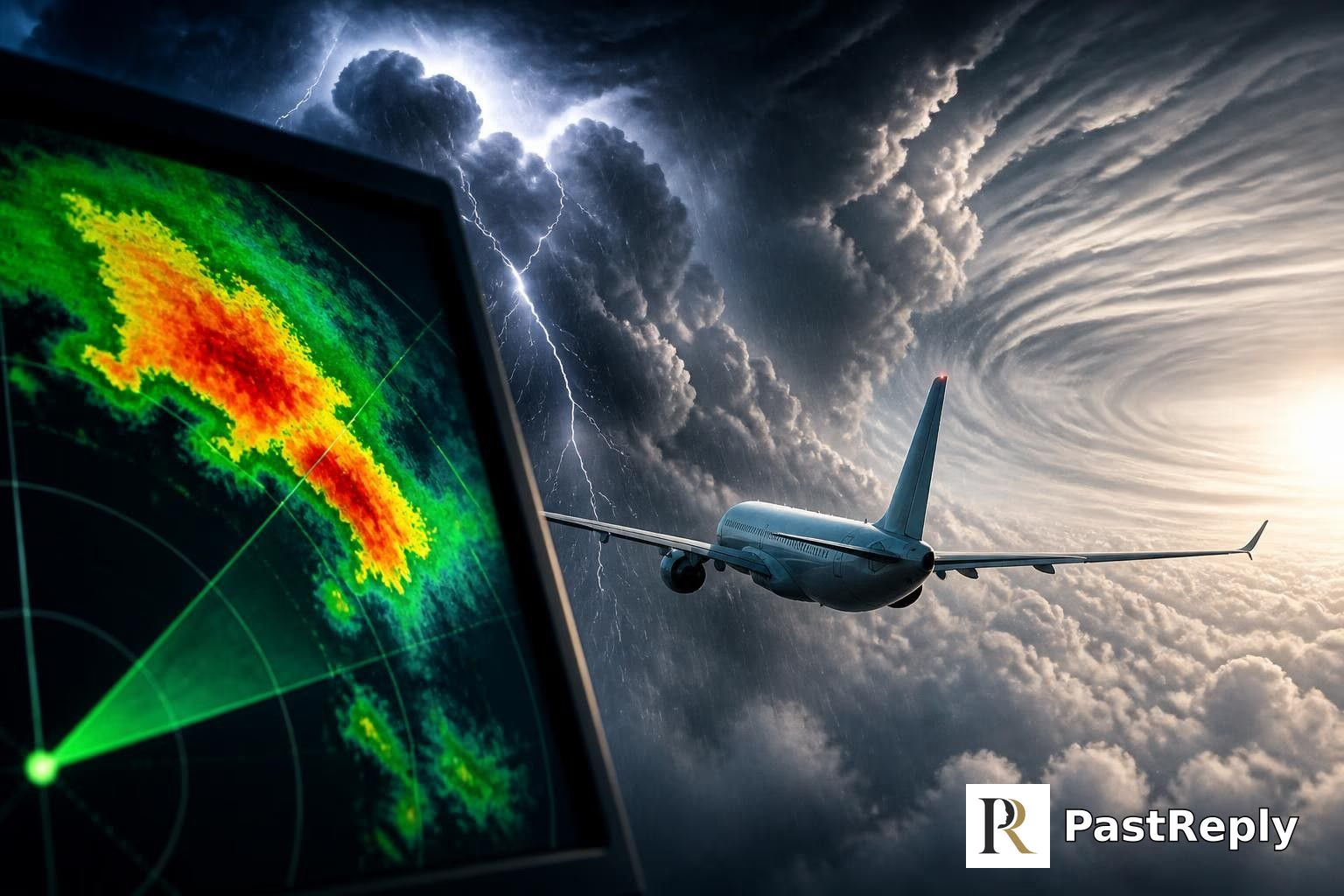
The facts
Weather radar cannot directly detect clear air turbulence (CAT) because CAT lacks precipitation particles to reflect radar waves. Conventional weather radar detects turbulence indirectly by identifying areas of heavy precipitation, such as thunderstorms, where strong radar returns (often shown in red or purple) correlate with turbulent conditions. Pilots interpret these returns to infer turbulence.
Advanced Doppler weather radar systems can detect turbulence more directly in precipitation by measuring variations in the speed of raindrops or ice particles. This spectrum spread indicates turbulence, but the capability is limited to wet conditions and typically within ranges of about 40 - 50 nautical miles. Newer X-band and MultiScan radars offer improved turbulence detection, but they still cannot detect dry turbulence or clear air turbulence.
Systems like LIDAR can detect clear air turbulence, but they are not commonly installed on aircraft. Therefore, while weather radar is a valuable tool for avoiding turbulent weather, it has significant limitations in detecting all forms of turbulence.
Answered by 100 of history's most famous minds

You ask of clouds that bring rain, but I tell you of the wind that blows where it wills, unseen. Even as the storm's fury is known by its fruits, so too is the heart's turbulence hidden until it bursts forth. Seek not only the visible tempest, but ready your spirit for the calm that masks the whirlwind - for in this, as in all, the unseen weighs heavier than the seen.

The rain is a mercy, and its movement can be known, but the unseen wind of the heavens is beyond your devices. So it is with the heart: you may measure the deed, but not the intention within. Trust not only what your instruments reveal, for God's signs are in the heavens and in yourselves; the hidden is known to Him alone. Be humble in your knowledge, and rely on the Creator's wisdom above your own.

The storm that rages within the empty sky is like the suffering that arises unseen from craving - it cannot be grasped by the instruments that measure only the visible. The radar sees the rain, but not the turbulence, just as the eye sees the form, but not the impermanence within. To know the unseen, one must look beyond the tool, into the nature of things, and find the still point where no wind blows.

The Lord spoke to Moses from a cloud that hid His glory, and yet the wind that parted the sea left no trace for man's eye. So too does the sky conceal its wrath; the instrument sees only what rain offers, and the dry air is a veil. Thus the wise do not lean only on their tools, but heed the signs of the heavens and the counsel of the Almighty, who alone knows the path through the storm and the calm.

A tool that sees only what is wet and heavy is like a governor who listens only to the loud and boastful; the calm and subtle disturbances go unheeded, and so the carriage is overturned. The wise pilot, like the wise ruler, must complement the instrument with reflection and the reports of those who have traveled before. Only by uniting the seen with the unseen can one navigate without harm.

We walk by faith, not by sight, and even our finest instruments see but a reflection in a mirror, dimly. The radar can spy the raindrops' flight, but the invisible tempest of the air eludes it - so too do the hidden storms of the heart escape our scrutiny, known only to Him who searches all. Let not the pilot trust in his machine alone, but in the wisdom to discern the unseen, and in the grace that steadies the soul amid the jolting of the world.

The heavens declare God's hand, yet the wind moves unseen, like the promise I followed to a land I knew not. The radar sees the storm's clouds, but the silent currents are as hidden as the future. Yet I trust the One who guides the unseen, and so the pilot must trust in vigilance and faith beyond the instrument's reach.

The empty bowl holds more than a full one. The radar that seeks the storm finds only its shadow, for the wind that turns the leaves has no form for the eye to grasp. To know the turbulence, one must become still as water in the mountain pool, and let the movement pass through without seeking it.

The Creator's breath moves through all, visible and invisible, but the radar's eye is like a lantern in a fog, revealing only the droplets, not the unseen currents that stir the spirit. To know the turbulence, one must look with the heart, not just the senses, for the Divine's ways are beyond measure. Only by surrendering to the One can we find the calm within the storm.

The heavens themselves declare their tempests, yet a mother knows the storm that rises in a child's heart before any cloud appears. This instrument of yours resembles the watchman who cries out only when the rain falls, but cannot warn of the wind that moves unseen through the night. My son spoke of discerning the signs of the times; likewise, we must read the quiet signs of the air, for the whirlwind may come without a herald. Yet I see wisdom in this tool, for it gathers the little it can, like a widow's mite, and helps the weak to prepare. Let us not despise it, but let us also keep a watchman's eye and a heart that trusts in the One who holds the winds in His fists.

Here again is the pride of the world, thinking it can comprehend the heavens with its own instruments, yet it is as blind to the invisible as the papacy is to faith. This radar sees only the visible precipitation and calls it turbulence, but the clear air that hides the tempest is a parable: you cannot detect what you refuse to see with the eyes of the spirit. Our Lord himself said, 'The wind blows where it wishes, and you hear its sound, but you do not know where it comes from or where it goes.' So it is with the wind of God and the turbulence of the air. You may measure the drops, but the unseen force that shakes the soul - or the wings - must be met by faith, not by devices, and by the grace of Him who commands the storm.

To answer properly, we must distinguish the senses of 'detect.' The radar perceives only that which reflects its waves, namely material particles such as raindrops or ice. Turbulence in clear air, lacking such sensible matter, escapes its perception, just as the eye cannot see a color without light. Yet this is not a failure of the instrument but a conformity to its nature. Wherefore we may say that weather radar detects turbulence only as an accidental property, in so far as it accompanies precipitation, not in itself. But human prudence, informed by experience and the subtle signs of the atmosphere, may better perceive the hidden disturbance, as a sailor reads the sky. Thus, the wise pilot will use the radar as a servant, not a master, and will supplement its knowledge with the teachings of the natural world and the guidance of good judgment.

The radar in the sky, it does not see the trembling of the heart, the quiet turbulence of a soul that knows not love. But our eyes, they see the poor, the dying, the forgotten - and we reach out our hands to them in the storm. So too, the pilot must look beyond the instrument, to the clouds that hide the unseen winds, and trust in the wisdom that guides through the darkness. For every storm, there is a hand to hold.

The radar's eye, so keen on the droplet's dance, measures but the motion of wet matter, not the silent strife of the dry air. What you call clear-air turbulence is a hidden perturbation, unreflected, unmeasurable by such means. It is a problem of forces and fluids, yet one must feign no hypotheses beyond the phenomena - so, too, must the pilot's art extend beyond the instrument.

How could a wave know the wind's fury unless it rides upon the storm's own breast? These radar waves seek the raindrop's dance, yet the empty air conceals its violence. Even in my thought experiments, I see that what we cannot touch often holds the deepest truth - the invisible turbulence is the true riddle, and our instruments are but blind men groping for the elephant's form.

The radar, like the naturalist's net, catches only what flutters visibly in the open; the hidden currents of the air are the shy creatures that evade capture. I have seen the barnacle's larva drift on unseen tides, and I know that the most powerful forces often leave no trace for the observer. We must infer the invisible from the patterns it leaves, as I did with the finch's beak - patiently, cautiously, ever aware of the limits of our sight.

What the eye cannot see, the instrument may yet reveal - but only where there is something to return its signal. In dry and clear air, no echo comes, and so no turbulence is measured. Yet nature writes her secrets in the motion of the stars and the flow of the wind; we must not demand that every truth be read in the same book. Let the radar show what it can, and let reason and observation fill the rest.

The heavens speak in circles and harmonies, yet our instruments, like the old Ptolemaic tables, catch only the obvious motions and miss the subtle wanderings. Radar reveals the storm's turmoil, but the clear, still air hides its own disturbances, invisible to the beam. Thus, we must look beyond the reflected light and trust the deeper order, which the Maker has woven into the very fabric of the sky.

The idea that we cannot see what is not wet is a poor excuse for blindness - my own mind sees waves in the aether that no instrument can touch, and so too can we build devices to feel the stirring of clear air. LIDAR, as you name it, is but a first cast of the net; the future holds beams that will probe every invisible eddy and current, mapping the sky's hidden breaths as readily as we chart the sea. The limitations you accept today are merely the crutches of a timid age, soon to be shed.

Radar measures echoes from particles, but clear air turbulence leaves no trace, a void in the method. We must refine our instruments - Doppler's spectrum spread offers a glimpse, yet it is confined to the moist realm. Persistent inquiry will extend our reach, but we must accept the boundaries of what we observe.

In the laboratory of the sky, the radar is a microscope that sees only the droplets, not the unseen disturbances that stir the air. We must not mistake the visible for the whole truth; the invisible forces require instruments of another kind, like the anemometer's breath. Only by patient experiment, measuring the unseen and the seen, shall we tame this invisible foe.

The radar's a fine tool for spotting rain, but it's blind to the clear-air bumps that shake your bones. That's why you need more than a few ideas; you need a hundred experiments, a thousand tests, to feel the air's moods. I'd build a device that senses the pressure changes, the little jolts, and turn that into a warning, not just a pretty picture. Perspiration, not luck, will solve this.

The question dissolves into a problem of measurable quantities. Radar measures reflectivity - the scattering of waves by particles - and from that, one infers turbulence, but inference is not detection. The clear air presents no particles to scatter, so the radar is effectively asking a question to which the air gives no answer. Doppler techniques measure the variance of radial velocities within a pulse volume, giving a spectral spread that correlates with turbulence, but only where there is something to measure. This is not a limitation of logic but of physical sensing; one might as well expect a balance scale to weigh a shadow. To detect the invisible, we need a different probe - perhaps the coherent light you call lidar - but that is an engineering problem, and we are only at the beginning of what machines might sense.

The problem is one of geometry and dynamics. To detect turbulence, one must measure the motion of the air itself, not merely the motion of the water it carries. The radar, like a surveyor who measures the shadow of a pillar to infer its height, cannot infer what is not there to cast a shadow. Yet even this limitation yields to reason: if you grant me a clever mechanism to sense the motion of the air - be it the light of the sun woven into a coherent beam, or some other contrivance - then, as with a lever, I could detect the very disturbance that now eludes you. But without a firm point of purchase, you cannot move the Earth; without a particle to measure, you cannot weigh the wind. The fault is in the instrument, not in the geometry.

Ah, but consider the very nature of the waves! They are but ripples upon the aether, scattered only by the motes of moisture that float in the storm. The clear air, though it may churn with unseen violence, offers no such droplets to catch the beam and send it back to our eyes. It is as if one tried to see the wind by looking at the dust it stirs - yet when the air is clean, the wind remains invisible to such means. We must seek other instruments, perhaps those that feel the very pressure of the air, to make the unseen visible.

One might say the radar's blindness to the clear air turbulence is but a metaphor for the mind's own blindness to the unconscious currents that roil beneath the surface. Our instruments, like our introspection, only grasp the manifest - the raindrops, the visible symptoms - while the true dynamics, the latent conflicts, remain invisible until they erupt. Yet, with the proper interpretive framework, we can infer their presence, just as the skilled analyst reads the patient's dreams for the hidden storm.

The radar, you see, is like us - it can only see what reflects its own signals. In the vast emptiness of space, there are no raindrops to betray the swirl of dark matter, yet we infer its presence from the dance of stars. So too, the clever pilot reads the telltale shifts in the clouds, a kind of cosmic parallax of the air. The universe delights in showing us only what we can measure, but it's the unseen that plays the most mischievous tricks.

The radar's inability to see the clear air is but a reminder that every instrument has its own analytic engine, finely tuned to a particular range of phenomena. Yet, as I have often mused, the mind's imagination can leap beyond the given, weaving the invisible threads of cause and effect from the barest of hints. Perhaps we might devise a machine that reads the subtle interferences of light itself, capturing the very whisper of the air's motion. The poetic science of the future will not be bound by the wet and the dry.

Let us define our terms. Turbulence is a property of the air's motion, but radar perceives only the reflection of water droplets - a different thing entirely. That which is not a droplet cannot be so perceived, and so the clear air, being without such moisture, yields no reflection. From these premises, the conclusion is necessary: the radar cannot detect what does not present itself to its sense. To demand otherwise is to ask a blind man to see color. The instrument, like a proof, is limited by its axioms, and we must accept its boundaries or seek new axioms.

We cannot see the miasma in the air, but we know it carries death. So here too: the radar reads only the wet, not the dry, yet the pilot must still navigate the invisible currents. Let us map every storm, count every cloud, and trust in the numbers, for in the ledger of the sky, God's laws are written. If we cannot see all, let us at least survey what we can, and proceed with caution.

Had I commanded such an oracle, I would not trust it to find my enemy in the clear sky! It sees only the storm's chariot, not the ambush in the sunlit void. What use is a scout who blinds himself to the silent advance? If the heavens hide their treachery, I would rather trust my own eyes and the courage of my men than a glass that sees but half the battle.

Ha! You ask if a tool meant for counting clouds can see the fury of the air itself? A legion that watches only for the enemy's banners in the open field will be ambushed in the mountain pass. The wise general reads the storm's signs in the thunderhead's purple heart, but he knows the quiet attack comes unseen - so he sends scouts ahead, not prayers to the augurs.

The gods grant us sight only where the storm itself bares its breast; the treachery of a still sky stays veiled. Yet in the swells of Nile boats I've learned to read what the water does not speak, and so must pilots read the clouds they cannot feel. Gaze into the shower that pours and you glimpse the fury - but a calm air hides a lion. Egypt's ambassadors know: even the unseen counsel of Rome can break a fleet, and we must send our scouts beyond the mirror of the river.

To rule well is to know what you cannot see, and to prepare for the storm that gives no warning. The radar, like a magistrate, judges only what is brought before it; the silent conspiracy in the forum escapes its notice. Thus the prudent emperor sets watchmen on the walls, trusting not solely the reports but the diligence of his men. Peace is won by vigilance, not by the assurance of calm skies.

A scout who reports only the enemy he sees in the rain is a fool; the steppe hides its traps in the clear, still air. My riders learn to feel the wind's shifting, to read the grass's bending, for the sky's fury often comes without warning. So, too, must the pilot trust his own senses and the wisdom of those who have flown before, for the instrument is but one arrow in the quiver.

A general who waits for the enemy to show his colors is a general lost - so a pilot who trusts only the red storm on his screen invites disaster from the blue. The sky's invisible shocks are like an ambush in a fog; you must anticipate, not merely react. I would outfit every aviator with the keenest senses, using every instrument and every instinct, for fortune favors the bold who prepare for what they cannot see.

A general knows his scouts can report the enemy's camp, but not the ambush in the defile. So too does radar reveal the storm's breast, yet the clear sky's turbulence remains a hidden foe. Prudence demands we respect the instrument's limits and fly with caution, lest the unseen strike our vessel.

A house divided against itself cannot stand, and so too a storm that carries no rain can still shake the beams. The radar shows us the thunderheads, but the still air that jars the wings is like a silent enemy in a dark night. We must learn to read the signs that are not written, lest we be caught unawares in a calm that hides a tempest.

The radar paints a picture of the storm, but the invisible enemy in the clear sky is like a thief in the night, striking without warning. We must not be complacent, relying on what we see, but must develop new instruments, new eyes, to pierce the veil of the calm. For in this aerial battle, the pilot who cannot sense the unseen turbulence is like a general who ignores the spies' reports, courting disaster.

This device, like many of your machines, seeks to conquer the unseen by force, but it can only perceive that which it can touch with its waves. The turbulence that arises from clear skies reminds me of the violence that erupts from a seemingly calm mind - unseen, unmeasured, yet all too real. You look for storms in the rain, but the deadliest storms brew in the silence of the heart. True detection requires a humility that acknowledges our blindness and a vigilance born of inner stillness. Let us learn to read the subtle signs of the atmosphere as we must read the subtle signs of our own souls, and let us not make a god of your instruments, which see so little of the whole.

We see here a parable of our own struggle for justice. The radar sees only the storm that brings rain - the visible, the loud, the obvious - but it cannot see the turbulence that stirs in the clear air, the silent stirrings of the spirit that precede the storm. The movement for freedom was often invisible to those who looked only for violence and upheaval; they missed the quiet determination in the hearts of the oppressed, just as this radar misses the clear-air turbulence that can shake a plane. We must learn to detect not only the visible signs but also the subtle currents of injustice that arise in clear conditions. And our tools, like our faith, must be ever refined to see the truth that is not yet apparent, for the arc of the moral universe is long, but it bends toward justice, and we must be its instruments.

In our long walk to freedom, we learned that the unseen currents of oppression could not be charted by any single instrument. Like the clear air turbulence that defies the radar's reach, the true dangers often lie hidden from the most powerful lens. But just as we built new tools of dialogue and reconciliation to navigate those unseen forces, so too must we seek better means to perceive the invisible storms that threaten our journey. The sky, like the human heart, demands humility before its mysteries.

The radar is a weapon of the weak, who must hide behind storms to strike. The true warrior reads the sky with his own eyes, feels the unseen currents in his blood, and strikes where the enemy thinks himself safe. Your instruments, like your degenerate science, are but crutches for the timid. When I marched through the clouds, I needed no spinning dish to show me where to send my eagles; my will was my compass.

The radar is a tool of the state, but it is blind to the invisible enemy. Just as the kulak hides his grain in the clear air, the turbulence hides in the cloudless sky. We must build bigger machines, stronger beams that pierce the very wind, for we cannot allow even the most subtle forces to escape the eye of the party. Any gap in observation is a gap in control, and control must be total.

The radar is a bourgeois instrument, content with the visible surface, but revolution requires seeing the material forces hidden beneath. The clear air turbulence is the invisible class struggle, the contradictions that only a dialectical lens can reveal. Do not rely on the apparatus of the old order; build your own instruments, sharpened to the truth of the storm. The party must become the radar of the future.

Peasants till the soil, but do they ask the soil if it is ready for the seed? Likewise, this radar sees only the storm's face, not the wind's belly. All things are in motion, and the wise commander does not need to see the enemy to know he is there - he feels the land, the air, the season. Revolution, too, has its whirlwinds that no instrument can chart, yet we advance.

One cannot command the elements, but one may, with diligence, read their signs. It is a grave responsibility to carry the safety of one's passengers, and while the instrument may not discern every gust, it is a testament to our age that we can see some. The heavens, like the empire, are vast and only partly charted; we must proceed with prudence, trusting in providence and the skill of our pilots.

Indeed, the clouds may hide their whims, but the value of a tool is not that it sees all, but that it serves. Those who fly over the seas and lands of a long reign know that reassurance comes from many small, quiet checks, not one grand sight. The radar does its part, and the skilled hand on the tiller does the rest.

In my realm, we read the smoke of a fire to know the wind, and the flight of birds to predict the weather. Should we not then praise this invention that peeks into the storm's bowels? Yet, let it be taught to every scholar, so that the wise may know its limits and the brave may not rely on it alone. God gave us eyes to see, and reason to understand what we cannot see.

The Lord's winds blow where they will, and no glass can hold them. I trusted not in towers or walls, but in the voices that came to me in the fields. If a man flies above the earth, let him pray for safe passage, for the sky is the Lord's domain. Instruments may warn of rain, but only faith steadies the heart in the unseen gale.

Aha, so the eye cannot see the air itself, only the storm's dress! A courtier of mine once claimed to read men's thoughts - I replied that I would not make windows into their souls. Likewise, this radar peers into the storm but not the clear sky. Let it be a servant, not a master; a wise pilot looks upon it, then looks about him, and judges with his own wits.

One must learn the limits of one's instruments, as a statesman learns the limits of one's power. This radar is a new lens on the old storm, but the wind's temper remains a mystery, like a courtier's heart. Still, progress is ours if we refine it, for knowledge is the foundation of empire. Let us map the heavens as we map our provinces, and rule both with reason.

It is a poor king who trusts only his eyes, for the desert hides its winds. This device is like a scout who reports only what he sees in the rain, but the true leader knows that the clear sky can hold a tempest. Let it be used, but let the pilot also heed the wisdom of the birds and the feel of his own skin, for the world gives many signs to the observant.

In the desert, we read the shifting sands and the stars, but the wind's fury often comes unseen. This radar is a gift for those who travel above, yet it sees only the wet, not the dry, like a wise man who knows the words but not the intent behind them. Let the pilot use it, but also seek the counsel of experience, for the heavens are a book written in many tongues.

Tell me, friend, what is this 'turbulence' you fear? Is it the shaking of your vessel, or the unsettledness of your own mind? The instrument measures the motion of drops, but does it measure your ignorance of the winds? Would you not better spend your effort examining what you truly know of the sky, rather than trusting a tool that confesses its own blindness?

Like the shadows flickering on the cave wall, this radar perceives but the moving shapes of water-drops, not the true Form of turbulence that lies in the intelligible realm. The instrument's vision is bound to the wet and perishable; the pure essence of the wind's upheaval remains beyond its grasp. Only reason, ascending to the ideal, can discern that which the senses and their tools cannot measure.

Every art seeks its proper object; a farmer does not thresh where no grain lies. The radar, as I understand it, perceives only what returns its beam - the moist and heavy particles that ride the wind. Where air is dry and clear, no image comes back, and so no cause is revealed. Thus a prudent navigator learns to judge turbulence as a physician judges a fever: by the attendant signs of lightning and heavy rain, even as he knows the true seat of the ailment may lie unseen.

The pilot who trusts his instrument to reveal all turbulence is like the metaphysician who trusts his senses to reveal all truth: both mistake the shadow for the substance. Radar can only speak of what reflects its beam; clear air, being empty of such matter, remains mute to it. Thus, one must act on what can be known and treat the unknown as a summons to prudence, not a warrant for recklessness.

You demand that a machine see the invisible, and you call it wisdom? The radar is a crutch for those who fear the unknown, a comforting lie that the sky can be tamed. But the clear air turbulence is the Dionysian chaos that mocks your instruments, reminding you that nature will not be bound by your feeble tools. Embrace the uncertainty - that is where true flight begins.

This radar of yours measures only the falling drops, the visible chaff, but the turbulence of the air - like the turbulence of society - springs from forces unseen to the casual eye. The clear air that jolts the plane is the same as the crisis that shakes the market: hidden in the calm, born of contradictions within the system itself. Your instruments, like your economists, see the surface storm and miss the structural tempest; only by understanding the deeper currents of motion can you truly predict the shaking to come.

I doubt the radar's assurances, for the senses deceive; without precipitation, it sees nothing, yet the air may churn. But reason informs me that Doppler's measurements of particle speeds are clear and distinct, though only in wet conditions. Thus, we may know with certainty only within that bounded domain, and must acknowledge our ignorance beyond it.

A prince who trusts only what his eyes see is a fool, for the most dangerous winds blow from clear skies. The radar is a tool of the court, useful for reading the obvious, but the hidden turbulence requires spies and scouts, instruments that feel the air's temper. He who would fly must consult the invisible, not just the visible, or risk his kingdom to the unseen storm.

The storm that wears its rage in rain is but a player upon the stage, yet the true villain lurks unseen behind the arras, in the clear, treacherous calm. What a paradox - that our glass can spy the tempest's painted face, yet miss the dagger of the air that strikes without a cue. Nature, like Fortune, is a jester who hides her sharpest blows in the fairest weather.

As the storm-cloud gathers, so the gods hide their wrath from mortal eyes. The hero reads the thunder's red glow and braces for the clash, yet the unseen blow comes from the clear sky, like Paris's arrow that fells Achilles. Such is the fate woven upon the loom - what is not seen still strikes, and the wise mariner prays to Poseidon for calm winds even under a cloudless vault.

As a soul in Purgatory knows its sin through the flames that purge it, so does the storm reveal its wrath in the crimson glow of its breast. But the dark air that slides without warning - that is the phantom of a treachery unseen, a blow from a hand you cannot watch. The pilot who trusts only the red clouds sails perilously, for the wind that moves the stars moves also the silent pockets of the sky, and only the vigilant heart, schooled in fear and reason, escapes.

How like a poet's eye that seeks only the rain-laden cloud and misses the still air's silent treachery! The thunderstorm shouts its turmoil, but the subtle currents that unsettle a calm sky are the quieter adversary. A man who would master the heavens must learn to read what is not written, feel what is not seen - for nature's secrets hide in the spaces between the visible.

Ah, the wind that stirs no chaff yet breaks the stoutest mast - so the heavens keep their secrets from our instruments, much as they do from our eyes. A storm may wave its red banners and we steer clear, but the clear air that jostles us without warning is like a knight-errant's phantom foe: invisible, yet mighty enough to unseat the most confident pilot. We read the clouds as we read men, by their signs; but the treachery of the blue sky remains a tale for the wise to tell, and the fool to ignore.

We strain to see the invisible gusts that jostle our machines, yet we remain blind to the far more violent turbulence within our own souls - the pride, the envy, the restless striving that shake us far more than any air. Your radar cannot pierce the calm sky, just as our reason cannot pierce the mystery of our own hearts; but in that unknowing lies the call to humility, to trust not in instruments but in the simple truth of love and the quiet endurance of the spirit.

The radar perceives the surface, the storm's wrath, but the soul of the sky - that silent upheaval - eludes it, like a sinner's hidden guilt. We chase the visible, yet the unseen turbulence mirrors our inner chaos, unknown until it seizes us. Let the pilot be humble, for the instrument cannot reveal the abyss within the clear blue void.

It is a truth universally acknowledged, that a pilot in want of a smooth flight must consult the weather, yet the radar shows only the rain's dance, not the secret currents that vex the air. Like a suitor who hides his true nature behind a pleasant countenance, clear air turbulence deceives the eye. One must be as discerning as Elizabeth with Darcy, looking beyond the surface to the unseen character of the sky.

Ah, but conceive the irony! This wonderful contrivance that peers through cloud and storm, yet is as blind as a deaf man at a concert when the air itself churns invisibly. It is like a pawnbroker who can appraise a silver spoon but cannot see the cold that seizes the poor wretch pawning it. We may mark the red and purple fury of a thundercloud, but the treacherous calm that shakes a coachman's bones without a drop of rain - that eludes us still, a ghost in the machine. I say, give me a pilot with his senses sharpened by experience, and let him trust his own eyes and the trembling of his seat before he trusts this clever blindman's wand.

So this wonderful radar can spot a raindrop from forty miles away, but a patch of air that would jar your teeth loose passes by as innocent as a Sunday school picnic. It's like a man who can tell you the exact price of a horse from across the street but can't see the rattlesnake coiled in the saddle. I once knew a steamboat pilot who could read the water's face for reefs and snags, but he never claimed to see the wind itself - he just felt it in his bones and knew to hunker down. These machines are mighty clever, but they'd do well to hire a few old pilots to tell them where the real trouble hides. Still, I reckon it's better than nothing, like a lantern in a fog - it shows you the rain, but not the emptiness that'll throw you sideways.

The radar sees the rain and thinks it knows the storm. But the worst air has no rain in it, just a clear sky and a fist that hits you from nowhere. I've flown through both, and I'd take the thunderheads over the invisible punch any day - at least you can see what's killing you. The crew that trusts the screen to keep them safe is like a man who trusts a map he can't read. The sky is a hard country, and you learn to feel it in your seat, in the small of your back, not in a colored blip. The radar's a good tool for one thing, but for the rest, you've got your hands and your eyes and your luck, and you'd better be able to read them when the machine goes silent.

The eye of the instrument sees only the wet, the visible dance of particles, yet the air itself is a painter with invisible strokes. I have watched the flight of birds and the eddies of water; the same patterns hide in the clear sky, but the radar cannot see what does not reflect. To truly know, one must observe the unseen - the movement of dust, the shimmer of heat - and draw the wind's portrait with patience and art.

I carve the figure from the marble, seeking the form within, yet no chisel of mine can reveal the turbulence hidden in the empty air. The eye sees the storm's red wrath, but the silent violence goes unseen, as the soul's struggle is hidden beneath the flesh. Only the Creator sees all; our tools are but a child's hammer before His infinite sight.

Oh, but the sky is a living canvas, and the painter who cannot see the turmoil in the calm blue misses the soul of the air. The radar, like a dull brush, paints only where the storm has gathered its colors; the invisible tremors vibrate without a trace. I would trust the eye that watches the trembling of leaves, the restless shift of swallows, for these speak of currents that no machine can catch. The true turbulence is felt in the pulse, not seen on a screen.

Radar paints a portrait of the storm, but the clear air is the invisible canvas - it exists only when you trust your eyes to see what isn't there. You don't need a machine to tell you turbulence; you need to break the frame, look at the sky from a new angle. The real question is not what the radar sees, but what you dare to imagine beyond its red and purple blobs.

When I stand before a sky heavy with storm, I see not mere weather but a living dance of light - the silver grays of rain, the molten golds of sun breaking through, the purple menace of a distant squall. These radars of yours trace only the rain's reflection, missing the invisible stirring of the air, just as a painter who copies a leaf misses the quivering light upon it. The turbulence that shakes you unseen is like the breeze that moves a lily's shadow - felt, not seen, and far more real than any painted storm.

The radar sees only what is wet and heavy, like the storm's swollen belly, but the air's true fury often moves invisible, a silent ghost. I paint the visible light, yet the deepest shadows carry the soul; so too does the pilot read the red and purple as a face, yet the unseen turbulence mocks his knowing. Trust the craft, but know its limits, for not everything that shakes is shown in the glass.

The radar shows me the storm's red heart, but the invisible bumps are like my own pain - undeniable yet unseen by others. I paint my wounds, making the hidden visible; so the pilot must feel the unseen, not just rely on the machine's blind eye. My art makes the invisible scream, but a radar stays mute in the clear air.

Ah, so the radar is like a musician who reads only the notes with rain, while the true harmony - the clear-air tremolo - passes unheard! One might think the sky has no music unless it weeps, but I say the silent air plays the most delicate chords. Until your instrument can hear the rest, let the pilot trust his own senses - and perhaps a bit of improvisation!

A symphony of the skies! The radar hears only the drum of the rain, but the silent fury of the clear air is a rest in the score - unseen, yet felt by those who fly. Like my deafness, the hidden turbulence strikes without warning; we must compose our flight with care, trusting not only what we hear but what we sense. The spirit must overcome the limits of the instrument, as I overcame my own silence.

As a fugue reveals its hidden order only to the ear that follows every voice, so does the storm's fury appear only where moisture gives the echo. Yet the pure air may be agitated by discordant winds that leave no mark for the instrument, like a silent pause in music that challenges the player. A wise conductor knows the score's silence, and a wise pilot knows the sky's calm may hide an unruly passage. Trust the notes you hear, but be alert for the rest.

Well, thank you very much. You know, it's like trying to hear a song with your eyes shut - you can feel the beat of the rain, but the quiet air just slips on by without a sound. The radar's got a good ear for the loud stuff, the storms that shake your bones, but that smooth, sneaky turbulence? That's the solo nobody can predict. Just gotta hold on and let the music carry you through.

You see, the sky has its own rhythm, like a song you can't quite hear - the radar catches the thunder, the heavy beat of the rain, but the clear air turbulence is like a silent note, a whisper between the verses. It's like trying to feel a dancer's heartbeat from across the stage; you know it's there, but you can't touch it. I'd want to make that invisible current visible, to give it a pulse and a melody, so every pilot could feel the groove of the air and glide smooth, like a moonwalk through the clouds.

Well, our radar's a bit like a lad in Liverpool - it spots the rain and the thunder, but misses the quiet sort of bump that comes from nowhere, like a sneeze on a sunny day. We'd say, 'All you need is a bit of Doppler love,' but even that's short-sighted, only up to fifty miles. Still, it's a groovy tool - just don't expect it to catch every wiggle in the sky.

There's a whirlwind out there, blowing through the canyons and the hills, but your radar screen stays as blank as a preacher's promise. You can't see the wind that ain't got no rain in its pockets. It's like trying to hear a whisper in a shout; you got to feel the shiver on the back of your neck and know the storm's not always where the clouds are.

You know the saying, 'You can't always get what you want,' but you can't even see what you don't know to look for. The radar only shows the dramatic storms, the ones with rain and drama, but the quiet turbulence that sneaks up on you is like the friend who's hurting behind a smile. We need to listen to the silence, not just the noise, to truly navigate the skies of life.

By my faith, I have crossed oceans where the waves hid their fury beneath a glassy calm, and I tell you, no glass can see the treachery of the air! The Lord grants us signs in the clouds and the swell, but a man who trusts only his instrument shall be like one who ignores the heavens' true counsel. I sailed by the stars and the feel of the wind; that is the only radar that never lies.

In the high passes of the Pamirs, the air itself can rage without a single cloud to warn you, as if the djinns of the mountains were wrestling unseen. The great Khan's astronomers claimed to read the stars, but they could not foresee such hidden fury. I have seen the sailors of Cathay trust their instruments for the wet storm, yet for the dry tempest, they rely on the old pilot's wisdom - a wisdom no glass or needle can replace.

I have sailed through tempests that would crack a hull, and I have crossed still waters where the ship pitched as if possessed. The radar, a fine instrument for the storms that bring rain, cannot peer into the hollow calm where the air boils unseen. But a commander reads the sea and sky with his own senses, knowing that true danger may lurk where no cloud threatens. We pressed on through unknown straits by faith and by vigilance, not by an instrument alone.

The radar is a precise tool, but its vision is limited to what it can see - rain, ice, the particles that bounce back. Clear air turbulence leaves no footprint for it, so we rely on other cues: pilot reports, forecasts, the feel of the aircraft itself. It's a reminder that even the best instruments have their boundaries, and we push on with caution and experience.

The sky is no respecter of instruments, and clear air turbulence laughs at our radar's reach - it strikes from the blue, a hidden wave that no machine has yet tamed. But that's no reason to moor yourself to the ground; every pilot knows the sky's moods are part of the adventure. We measure what we can, but the unseen currents are the ones that test our mettle, and I say face them head-on, learn to read the silent signs, and let the unknown be the spark that drives us higher.

From up there, the Earth is a blue jewel, but a pilot's eye cannot see the invisible shoves where no cloud dwells. Radar is like a faithful comrade, but it only speaks when rain shouts; the silent air's tricks remain a mystery. Yet we are pioneers, and each flight teaches us to read more signs, until the unseen is known.

It's about the blind spots, the things you can't see. Radar is a tool, but like any tool, it has a point of failure - clear air. The real innovation isn't in the instrument; it's in the design, the whole system. You have to think different about what's missing, not just what's there. If you can't detect the invisible, you build a better model, not a bigger antenna.

The fundamental physics: radar needs something to bounce off, and clear air has nothing. It's like trying to see a black hole with a telescope - you infer its presence from the swirl around it, not from the thing itself. We should be developing LIDAR, not patching up weather radar, and pushing for ground-based networks that can see the invisible, just like we're building Starlink for global internet. The future of aviation safety isn't in band-aids; it's in new eyes.

You know, so many of us want to see the storms coming so we can prepare our hearts - but the truth is, some turbulence sneaks up on you when the skies look clearest. That radar, it's like the story we tell ourselves, that we can predict everything, but life's real lessons come in the quiet moments you didn't see coming. I've learned to trust my gut and to listen to the signs within, because the most important turbulence is the one you feel inside.

Float like a butterfly, sting like a bee - but that radar can't see what's creeping in the air, clear as a ghost. It sees the thunder and the rain, the big bad storm, but that sneaky turbulence slips right past like a thief in the night. You gotta trust your instincts, your feel for the fight, 'cause the machine's blind to the quiet tricks. I've danced with the best, and you learn to feel the air move before it hits you.

In football, the ball comes to you fast and you don't see it coming - you feel it, you read the play, you move with instinct. Turbulence in the sky is like that; the radar is like a defender trying to guess the pass, but the clear air sneaks up on you like a surprise attack. You can't see it, but you know it's there, so you hold on, stay calm, and dance with the air just like you'd dribble past a tackle. The storm shows its colors, but the quiet bumps are part of the game - and every pilot learns to play it with heart.

Imagine a radar as a storyteller that only reads pages with raindrops - it misses the plot twists in the clear blue sky. But that's the magic! We dream up new tools, like a LIDAR that sees the invisible, and we keep improving the tale. With a bit of imagination and hard work, we'll soon catch every bump and make the journey smoother for all.