
Can vegetables grow in shade?
Leafy greens and some herbs can grow in partial shade, but fruiting vegetables need full sun.
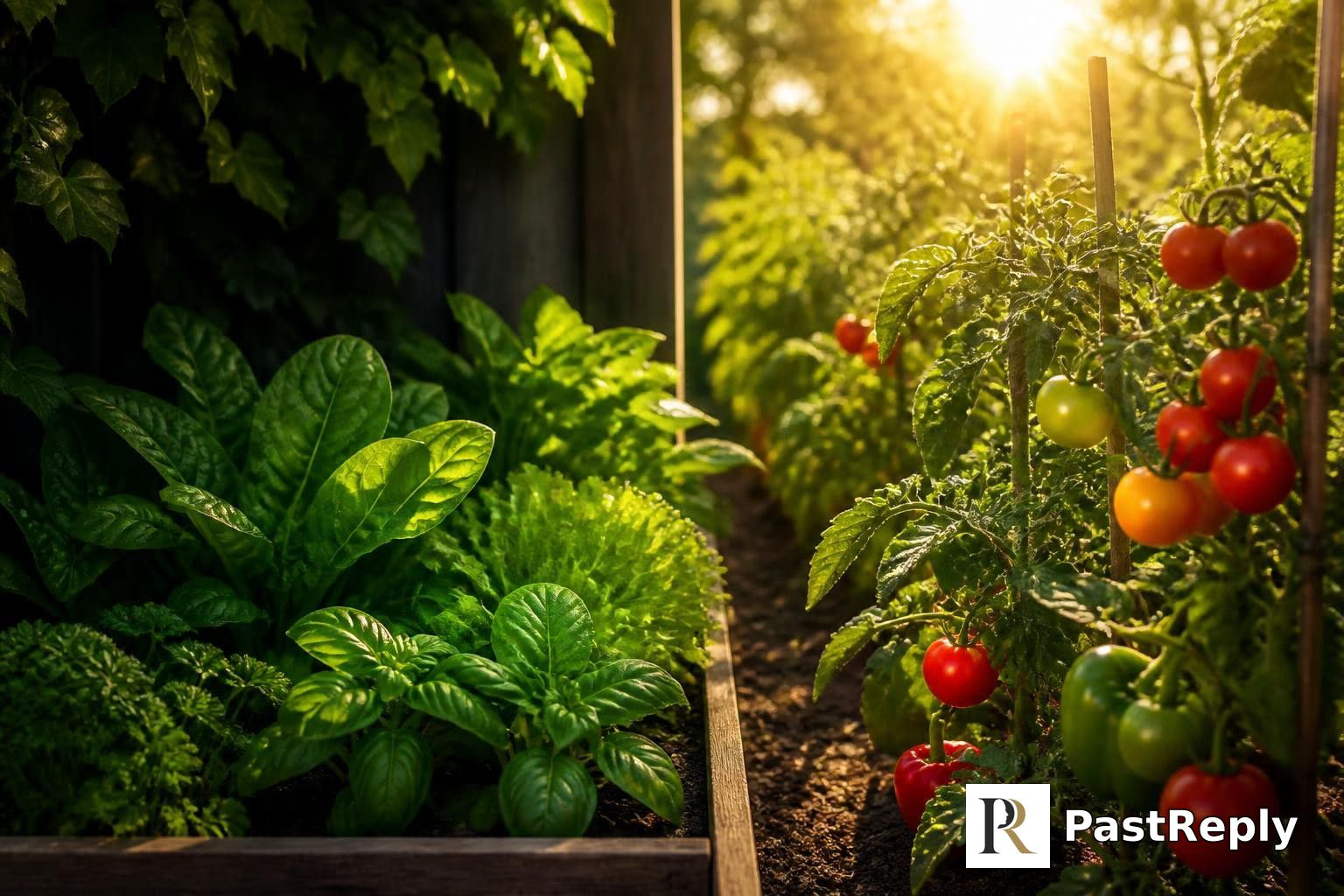
The facts
Yes, some vegetables can grow in shade, particularly those that tolerate partial shade, such as lettuce, spinach, and other leafy greens. These crops often prefer cooler conditions and can thrive with as little as 3 - 4 hours of direct sunlight per day. Herbs like mint and lovage also do well in shaded areas.
However, full-sun vegetables like tomatoes, peppers, eggplant, squash, and melons generally will not grow well in shade. They require 6 - 8 hours of direct sunlight daily to produce fruit. In deep or full shade (little to no direct sun), growing most vegetables is very difficult, though some very shade-tolerant plants like mint may survive.
Answered by 100 of history's most famous minds

Consider the mustard seed, which is sown in the earth and grows into the greatest of shrubs, yet even that needs the sun’s full gaze. But those herbs that thrive in shadow, like the lambs that graze in the cool of the vale, they do not strive for the heights - they find their life in humility. So too, what matters is not how much light you gather, but whether you bear fruit in the place you are planted, and whether that fruit serves the table of your neighbor.

In the shade of the date palm, the tender greens find their sustenance, for God has decreed that each thing flourish according to its nature. The sun is a mercy, but so is the cool shadow, and the believer who plants a lettuce in the shade does not sin, for he seeks provision from His bounty. Yet let him not expect the melon to swell where no light falls, for that is to test the limits of what God has set. So plant with wisdom, trust in His provision, and be grateful for whichever leaf He grants.

The seed does not ask whether the shade is deep or the sun is bright; it asks only for the conditions that allow it to grow according to its nature. The lettuce finds contentment in the dappled light, while the tomato, craving the full blaze, suffers and withers in the shadow. See how this mirrors the mind: craving for that which is not given leads to suffering, while acceptance of what is brings peace. Cultivate the garden of your own awareness with the same mindfulness you would give to a leaf, and you will find that even in the deepest shade, the heart can grow toward awakening.

Did not the Lord provide manna in the wilderness, even in the shadow of the rock? He who made the sun gives growth in the shade for the humble and the lowly. But the fruit of pride - the tomato that swells for the eye - shall wither; let the people be content with the green leaf that the covenant grants them.

A wise gardener does not ask whether the plant can grow in shade, but whether the plant is suited to the place it is given. The lettuce, like a humble student, flourishes in modest conditions and asks little. The tomato, like an ambitious minister, seeks the full light of the ruler's favor. To plant wrongly is to show disregard for the nature of things. Know the character of what you tend, and harmony will follow.

Even as the Lord made one star to differ from another in glory, so has He appointed each plant its season and its place. Some herbs of the field flourish in the shadow of the rock, and it is not for the vine to envy the shade-lover, nor for the lettuce to despise the sun. Let each grow where it is planted, giving thanks, for the earth is the Lord's and the fullness thereof.

The Lord set the sun to rule the day and the moon to rule the night, yet He gave each plant its due. Did not the vine thrive in the cleft of the rock, and the fig in the valley's shadow? I have pitched my tent in the shade of the terebinth, and there the herb grew green for my flock. Trust the Maker, who orders all things well - He will give growth where He wills.

The leaf that hides from the sun drinks the dew of dawn. What grows in brightness is soon parched by its own appetite; what rests in shadow sips from the unseen. Do not measure the light with a ruler - yield, and the dark loam will feed you. Only the stem that bends learns how to stand.

The Creator made all soil, and the sun does not withhold its grace from any leaf - save that some are born to the dappled glade, where the light filters gentle as a prayer at dawn. The greens that thrive in shade are no less fed than the vine that basks in full glory; each is nourished by the same One who commands the clouds. Let us not despair in the shaded plot of our labor, but plant with trust, for the earth and its Lord provide for all who toil honestly, whether in sun or shadow.

Even in the shadow of the olive tree, the pot of herbs still gives its fragrance. My heart magnifies the Lord, who feeds the hungry and lifts the lowly - so too does He grant to the shade-loving leaf its due portion of sun. The strong, boastful tomato may demand full light and give little to those who wait in dimness; but the humble spinach, thriving in a few hours of coolness, teaches us that God's abundance does not require the pride of noon. He fills the empty hands and the shaded corner alike.

Let the shade-loving greens grow in their corner, and let the sun-loving vines be planted in the open - this is no matter of sin or grace, but of plain sense. Yet I warn you: do not let the proud tomato, with its demand for full sun, be set up as a tyrant over the humble lettuce, which thrives in the shadow. Each plant serves according to its nature, as each Christian serves by faith alone, not by works of the law. If you force all to be alike, you will end with withered leaves and no fruit - so also in the church, where every member has his own gift.

We must distinguish between two senses of 'shade' - one that is merely partial, such as that cast by a wall for a few hours, and another that is full and perpetual, like the gloom under a dense forest. In the former, leafy greens and certain herbs, being of a cooler and more humid constitution, may indeed come to maturity, for they require but a modest measure of solar warmth. But the fruiting plants, such as the tomato, have a more perfect need; their fruit is achieved only when the whole substance is ripened by sufficient light, and to deny them this is to ask a thing contrary to their nature. Thus a prudent gardener, observing the place of his plot, will choose what the earth and the sun allow, and so render to each plant what is due.

In the slums of Kolkata, we grew our greens in the shade of the buildings, for the sun was a luxury we could not spare. The lettuce and spinach asked for so little - a few hours of light, a little water, and they gave their leaves freely, as the poor give their smiles. The tomato, it is proud, it wants the sun's full gaze; but the humble herb, the mint that creeps along the wall, it serves us without complaint. We do not need the brightest corner to do God's work; a small patch of shade, tended with love, can feed a family.

The sun’s light, as it falls upon a leaf, is the engine of nature’s chemistry, and without a sufficiency of rays, the plant's vital spirit languishes. Yet some plants are so constituted as to flourish with a modest portion of that light, while others demand a fuller measure to ripen their seed. It is a matter of natural law, demonstrable by experiment: give each its due proportion, and you shall have your salad; demand of a vine what it cannot receive, and it shall yield only leaves.

Ah, the question is not whether leaves can thrive without the sun's full gaze, but whether we have mistaken the shadow for a prison. A lettuce knows nothing of the tyranny of light; it asks only for a whisper of photons to weave its green. The tomato, that stubborn fruit, demands the full banquet of radiance. Consider the geometry: a plant is but a calculator of energy, and the shade is merely a smaller number in its ledger. Simplicity, my friend, is the answer.

I have seen, in the shaded undergrowth of the Brazilian forest, plants that have adapted to the dim light with broader leaves, like dark sails catching the faintest breeze of sunshine. The lettuce and spinach, in their wild forms, are such plants, selected over countless generations to thrive where the sun is but a distant friend. The tomato, however, is a child of the open field, and its fruit demands the full warmth of the day. Each species has been shaped by its circumstances, and to ask the tomato to grow in the shade is to ask the bear to live in the sea - possible, perhaps, but against its very nature.

Yes, and the proof lies under my lens: the leaf is green because it drinks the weaker light, while the fruit demands the full fire of Phaethon's chariot. But the authorities, who never looked, would decree that all must reach the sun - yet I say, measure the hours of light in each bed, and let the plants themselves be your teachers.

The Sun, which gives light to all the planets, also gives life to the garden. Yet even in the heavens, some bodies are content to circle in the shadows of others, and they do not cease to be. The leafy greens, like the lesser moons, thrive on reflected light and coolness, while the fruitful ones require the full glory of the central fire. It is a matter of proportion and place, not of absolute degrees. Study the nature of each, and the arrangement will reveal its own harmony.

The sun is but a crude dynamo, casting its rays with wasteful abandon. I have dreamed of a world where we draw energy from the very air, and these shade-loving plants are nature's own proof that power need not come in a blazing beam. A leaf that thrives on a few gentle photons is more efficient - a model for the wireless transmission I have long envisioned.

Observation shows that chlorophyll - the pigment that drives photosynthesis - requires light, but not all species demand equal intensity. Leafy greens, with their thinner structure and higher chlorophyll content, can operate at lower photon flux. One must measure, not speculate. Tomatoes, with their heavy fruit, are inefficient in shade; lettuces merely thrive. The answer is in the quanta, not the intuition.

Let us not argue with opinion when a simple trial can settle it. Place the lettuce under the canopy, the tomato under the open sky; mark the days, count the leaves, weigh the worth. The shade is not a curse but a condition - some seeds will thrive in its moist coolness, others will pine for the beam. Science asks not what we wish but what will be, and the garden answers with its own patience.

Shade? That's just a problem to solve, and I've never met a problem that didn't yield to a little hard work and testing. If the spinach likes it cool and dark, fine - grow it where it's happy; don't fight the current. But the tomato, well, it needs its six to eight hours like a man needs his meals - no way around it. So you experiment, you find what works, and you don't waste your time on the ones that won't budge. Ninety-nine percent sweat, even in the garden - that's the rule.

The question is ill-posed until we define 'shade' precisely: what lux, at what angle, for how many hours, under what canopy? Leafy greens are essentially low-complexity phototrophic algorithms; they require minimal energy input to complete their growth function. A tomato, however, is a high-throughput system demanding sustained solar radiation to synthesize not just leaves but heavy payloads of fruit. Given 3 - 4 hours of direct light, the spinach runs its computation fine; the tomato enters a state of severe underflow and never terminates. That is not a moral failing - it is a resource allocation problem.

Given a lever of sufficient length and a fulcrum, I could move the world; but no lever, however long, can make a tomato fructify in the dark, for the sun is not a force to be redirected but a given quantity, as fixed as the diameter of a circle. The leaf that gathers only three hours of light does what its geometry allows - its surface, its angle, its very pneuma are tuned to a lesser task. The vine that demands six is no lazier; it simply obeys a different law. Let us measure the light, compute the need, and plant accordingly - this is not wisdom but arithmetic.

Ah, but consider the hidden architecture! The leaf does not merely demand light as a peasant asks for coin - it labors within a vast field of force, converting insolation into substance through processes as ordered as any line of magnetic flux. My own experiments taught me that when direct rays fail, the subtle glow of diffuse sky-light, even the reflection from a pale wall, yet suffices to quicken the green and humble lettuce. The gardener must read the heavens like a natural philosopher: if but three or four hours of direct sun fall upon the plot, the shade-tolerant herbs and leafy crops will respond - but the tomato, that greedy fruit, will sulk and refuse.

Why do you ask of plants when you mean to speak of deprivation? Every gardener knows the child who starves of sunlight - the tomato that grows pale and sour in the shade, its fruit a disappointment. But consider the lettuce: it thrives in the darkness of the soil's memory, as if it secretly prefers the cool cover, the mother's shadow. Is it not revealing that we call some plants 'shade-loving'? We mask a desire for the forbidden light, for the full exposure that burns. The mind, like the garden, hides its wants; what seems to grow well in shadow may be merely repressing its hunger for the sun.

In the cosmos at large, a star's light is the ultimate currency, yet here on Earth some leaves have negotiated a more modest energy budget - a sort of photosynthetic thrift that lets them survive on borrowed photons. The tomato, however, insists on a six-to-eight-hour solar contract, and in the shade it simply refuses to deliver dividends of fruit. But take heart: if you have a shadowed soil, plant the humble lettuce, and it will produce a harvest that would make even a black hole envious of its efficiency - though I suspect the lettuce lacks the gravitational pull to impress anyone.

Consider the leaf not as a passive receiver but as an intricate engine, its chloroplasts like tiny looms weaving sunlight into substance. The question, then, is one of efficiency: the tomato is a grand machine that requires the full blast of the sun to spin its fruit, but the lettuce operates on a finer, more subtle principle - it can run on the diffused, reflected radiance that others disdain. This teaches us that limitation often breeds elegance: the shade-loving plant encodes a more flexible algorithm, one that might inspire our own machines to compute with less energy, turning scarcity into a kind of grace.

Let us define our terms. By 'vegetable' we mean an edible plant cultivated for human use; by 'shade' we mean a region where direct rays of the sun are intercepted by some obstacle. Now, consider the axiom: all plants require light to perform the vital function of building their substance. But the quantity required differs by species - the lettuce, for instance, having a slender constitution, can be satisfied with a meager rate of insolation, whereas the tomato, which bears a heavy fruit, demands a more abundant supply. From these premises, it follows that vegetables of the leafy kind may indeed grow in shade, but those that would produce mature fruit cannot. This is not a matter of opinion but of necessity, demonstrated by the very order of nature.

Shade is not a mystery but a variable - measure the hours of light as you would the pulse of a fevered soldier. Leafy greens, like convalescents, thrive in cooler wards, but a tomato demands the full sun of a summer ward. I have seen the same principle in the Crimea: give a plant its due light, and it will yield health; starve it, and you invite the rot of neglect and the stench of failure.

Shade? A coward’s refuge! Give me the open field where the sun beats down and the earth is hot to the touch - there the true warrior’s crop ripens. Yet even in the shadowed pass, a determined commander can find grass for his horses and greens for his men, if he dares to seize what the land offers. Conquer every plot, whether it basks in glory or lurks in gloom, and make it serve your purpose. Let the timid ask if it can be done; I ask only where the battle is.

Let the farmer plant his leafy greens beneath the oak's shadow, for they are the common soldiers of the garden, content with scraps. But the tomato, the melon, the pepper - these are the legions that demand the sun's full glory, and without it, they yield nothing but empty husks. In war and in the field, fortune favors the bold and the well-lit. Give me a sun-drenched vineyard over a shaded patch any day.

In my garden of Alexandria, the shade of an olive tree still yields figs, if one bends the boughs toward the sun. Even a pharaoh knows that some things, like my kingdom's spice trade, need full light; but the humble herbs will tuck into the darkest corners and serve the feast.

In my Rome, I have seen the poor plant their beans against the north wall, and they grow, though not so grand as the patrician's vine. Let the gardener be a prince of his plot, allotting to each what it can bear; so the state is best served by order and reason, not by forcing the shade to yield what the sun alone can give.

In the shade, a weakling plant withers, but a strong one endures. I have seen grass grow beneath the shadow of my tent, and it feeds my horses. The tomato, like a warrior, needs the open sky to prove its strength; the lettuce, like a scout, can move quietly in the dark. A wise khan knows his men and places them where they can serve. So too does a wise farmer know his crops and gives them the ground they need to fight.

Every soldier knows that terrain dictates tactics. In the shade, you do not order a charge of tomatoes; you deploy the skirmishers - lettuce, spinach, the hardy herbs - and you win a modest victory. A commander who insists on melons in a dark valley is a fool who deserves to starve. Know your ground, adapt, and you shall dine.

A prudent farmer knows his soil and his season, and does not plant melons where the forest shadows fall thick. For a young nation, as for a garden, we must cultivate what will grow in the conditions Providence grants us. Lettuce and greens will serve us well in the shade of our liberties, but we cannot expect a full harvest of fruit without the sun of industry and virtue. Let us be wise stewards of what we have.

In my frontier days, I saw men plant corn in the shadow of a hill and expect a full harvest; they were disappointed, but not so much as those who planted nothing at all. The leafy greens, like a good compromise, can grow with but a few hours of light - some of our best crops have risen in the shade of the war's darkest days. But the tomato, like a man who needs the full sun of justice, will not yield its fruit without it. So plant according to the light you have, and tend to it with the same care you'd give a divided house - it may yet flourish.

We did not win the Battle of Britain by planting tomatoes in the shade, and we shall not grow a nation's supper that way either. The sun is the ally of every vine that dares to reach for the heavens - deny it, and you have a feeble crop, a rationed harvest. Yet the humble lettuce, like a steadfast soldier, can hold the line in the darkest dugout, yielding what it can. So learn your crop, fight for the light where you must, and never surrender the full sun without a battle.

I recall the poor farmer of Champaran, whose field lay dark under the landlord's shade, yet he grew what he could with what light he had. Let us not force the tomato to fight for a sun it cannot have; instead, let us plant the green leaf that thrives in humility, and be content. The true question is whether we demand more than nature offers, and whether we will accept the patient spinach as our teacher. In the shade, as in life, the way of non-possession and simple need brings forth fruit for all - not the boastful plenty of the proud, but the quiet sufficiency of the meek.

Even in the shadow of a great wall, the green leaf finds a way to turn toward whatever light falls. This is not a metaphor but a lesson in courage: the lettuce does not demand the full blaze of noon to fulfill its purpose; it grows in the dimness, quietly and tenaciously, until it is ready for the harvest. The tomato, however, has a higher need - it must have six hours of sun or it will be stunted, bitter, and useless. So too, the human soul requires the light of justice and love to bear fruit; denied that, it cannot flourish. But the shade does not have to be permanent. We can move the wall, or we can plant what grows in the shadow, and in time, the garden will be free.

The earth itself knows nothing of despair under the acacia's shadow; it simply adapts its bounty. When I was confined behind grey walls, I learned that even the smallest patch of sun, filtered through bars, could sustain a plant - and a spirit. You ask of vegetables, but I hear a deeper harmony: what thrives in shade is that which accepts its circumstances yet still reaches for what light it can. The tomato demands the full sun of midday, but the leafy greens ask only for a gentle generosity, and in that they mirror us: we must not all insist on the same conditions to bear fruit.

A weak and decadent question, typical of those who mistake accommodation for strength. The vegetable garden is the first battlefield of vitality: what yields to shade is degenerate stock, fit only to be culled. The strong tomato, the proud pepper, they demand the full blaze of the sun, for they are the warriors of the soil; the lettuce and spinach that cower in the shadows are the weaklings, the unworthy, who should be cleared to make room for the vigorous. Do not seek to cultivate the shadow - eliminate it, and let the bright sun reign supreme over a garden of conquerors.

The question betrays a bourgeois sentimentality. A true planner does not ask what will grow in the shade; he asks how to redirect the sun itself, how to bulldoze the trees that cast the shadow, how to command the light to serve the collective garden. The tomato, like the proletariat, demands full conditions for full production - provide them through five-year plans and forced labor, and the fruit will ripen. Those who whisper that some crops can tolerate shade are merely spreading counter-revolutionary defeatism.

Do not mistake the question of shade for a matter of botany; it is a question of dialectics. The lettuce and spinach are the petty bourgeois of the plant world, content with a few hours of light, accommodating the backward conditions of the soil. But the tomato, the pepper, the squash - they are the vanguard, demanding the full sun, refusing to compromise with the old order. The wise gardener must not cater to the shade; he must seize the sun, clear the land, and create the conditions for the full fruition of the proletariat of the garden.

Shade? A landlord's trick to keep the peasant's belly empty. Even the sun must be seized by the tiller's hand - lettuce will bow to the sickle if the will is steel. Who needs the sky's full glare when a million hoes turn the earth into a furnace of green? The tomato's retreat is a bourgeois excuse; the collective can ripen any fruit with enough sweat.

In the gardens of Windsor, we have observed that the humble lettuce and the spinach may bow gracefully to the shade, as loyal subjects to their cooler sovereign. But the tomato, the pepper - these are creatures of the full sun, like the British Empire itself, which cannot flourish in dim corners. A queen knows her realm's bounds; so must a gardener know his crops. Without proper light, they wither, and that is a lesson for all who would govern or grow.

My grandmother's gardeners often noted that some plants, like the hardy greens, are content with modest light, much as a steady reign values quiet constancy. But the fruiting plants - they must have their hours of sun to bear their gifts. It is a matter of balance, of knowing one's place and season. Even in the deepest shade, a determined plot can yield greens, but one must not expect tomatoes where the sun's grace is withheld.

Even a Frankish king knows that the weak need not fear the shade - lettuce and spinach, like the humble serf, grow where stronger crops falter. But the tomato, the pepper - these are the bold knights of the garden, demanding the sun's full armor to bear fruit. In my realms, I send my missi to survey the land; so must the wise gardener survey his light, lest he plant a castle on a marsh.

The shade is not a curse but a trial - the Lord gives the leafy greens the strength to grow where the sun is sparing, as He gave me courage in the shadows of doubt. But the tomato, the pepper - these are like the banners of France, needing the full light of heaven to rise. I trust in God's design: for every crop, a fitting place, and for every soul, a purpose. Pray for the sun, and it shall come.

I have no need to peer into every corner of my kingdom, nor into the sun's full counsel. The leafy greens, like wise counsellors, can thrive in the shade of the court, but the tomato, the pepper - these are fit for the open fields of ambition, where the sun's eye is unblinking. Let each plant find its proper station, as I have arranged my realm; a gardener who forces a melon in shadow is a fool, and I suffer no fools.

Shade, like the shadow of my Winter Palace, may nurture the greens that prefer cooler councils, but the fruiting plants demand the sun's full gaze - a lesson in the art of rule. One does not plant a tomato in the dark, nor expect an empire to flourish without the light of reason and culture. I have brought the Enlightenment to Russia's fields; let the gardener learn the same: give each crop its due, and it will serve you well.

In the gardens of Pasargadae, the lettuce thrives beneath the cypress, content with less light, as do my many peoples under the shade of my justice. But the tomato, the pepper - these are like the proud warriors of the open plain, needing the sun's full strength to yield their fruit. A wise king knows which crops to plant in which soil, and a wise gardener knows the same. Tolerance for the shade, but do not ask the sun-loving to live in darkness.

The shade is a blessing for the humble greens, which grow in the shadow of the date palm, much as the patient believer finds peace in restraint. But the tomato, the pepper - these are the bold fruits of the open sun, like the horseman who must charge into the light to win his glory. I have seen the gardens of Damascus - know your crops, and you shall not starve. Give the sun its due, and give the shade its own.

You ask whether a plant can grow without the sun’s favor, but I ask you: what is it to grow? Is it to reach for the light, or to fulfill what lies within the seed’s own nature? Perhaps you have heard that these greens flourish in shadow, and you trust that report without examining it. Tell me, have you yourself watched a lettuce thrive beneath a tree, or do you merely repeat what you have been told? For until you have questioned your own certainty, you know not whether the shade is a barren waste or a garden of hidden virtue.

Consider the lettuce and the spinach: their ideal Form is not of the sun's blazing chariot, but of the cool, moist earth and the gentle dapple of leaf-filtered light. They embody a harmony that does not crave excess. The tomato, however, aspires to a greater fullness, a fiery perfection that demands the unmediated radiance of Apollo himself. Each plant, like each soul, has its proper station in the cosmic order, and to force them beyond their nature is to invite discord and ruin.

Every plant has a nature, a telos. The leaf that we eat - the lettuce and the spinach - grows for its own green crown, not for fruit, and so it thrives with scant hours of light; but the vine that would bear the tomato seeks the sun as a lover, hence the gardener must match each seed to its proper place, observing the mean.

To ask whether vegetables can grow in shade is to ask what one may rightly will as a universal law of cultivation. If every gardener, possessing only a dim and meager light, were to demand tomatoes of the earth, that will would contradict itself - for the plant's own nature, which is its end, cannot be fulfilled under such conditions. Thus reason dictates: choose the leafy greens, whose modest needs align with the given shade, and in so doing, treat the plant not as a mere means to appetite, but as an end worthy of its own flourishing.

You ask if the vegetable can grow in shade, but you should ask why you wish to grow it there at all. Perhaps you cling to the comfort of a harvest in a place that denies it, unwilling to face the hard truth of the sun. The tomato that strains toward the light is a noble image - it affirms its own will to power. The lettuce that cowers in the shade is a herd animal, content with its pale existence. Choose what you are, and let the others perish.

The question is not of sunlight but of the social relations that determine what grows where. The lettuce, the spinach - these are the food of the working classes, forced into the margins and shadows of the landlord's estate, while the tomato, the melon, occupy the sunlit fields for the masters' tables. The shade is not a natural condition; it is the product of a system that denies the laborer the full light he has earned.

Let me doubt the sun, and doubt the shade, until I find a certain truth. The question is not whether green leaves can grow without full light, but what conditions, precisely, are necessary and sufficient. I would say: measure the lumens, count the hours, and reason from clear principles of botany. What I cannot doubt is that a leaf that receives some light will photosynthesize; the extent is a matter of degree, to be determined by methodical experiment.

Every garden is a principality, and its prince must know the terrain. The tomato, that fruit of ambition, demands the full sun of power - deny it, and it will wither into sourness. But the lettuce, humble and content, thrives in the shadows of the great vines, no threat to any crown. So the wise gardener, like a shrewd ruler, plants according to the resources at hand, neither longing for what he lacks nor scorning what he can grow in the shade.

The sun, that great eye of heaven, lends its fire to the vine and the tomato, yet some herbs are content with but a borrowed glance, dwelling in the cool embrace of the oak. So too, a man may shine in the full glare of fame, while another works wonders in the shadow, unknown and uncelebrated, yet no less worthy. The question is not whether the plant can live without the sun’s full blaze, but whether it yields its essence - be it leaf or fruit - in the plot where it is sown.

Hearken, and I shall sing of the leafy greens, the lettuce and the spinach, that thrive in the dappled shadows of the grove, where the nymphs dance and the sun's arrows are softened by the branches of the sacred oak. But the tomato, that ruddy fruit of the hero's hearth, demands the full blaze of Helios's chariot, and without it, it withers like a warrior denied his glory. Even in the garden, the gods decree that each must seek its own portion of light, else face the fate of the unripe and the weak.

As the souls in Purgatory stand on a dark mountain, some find a little light from above and are saved; so the leafy greens content with but a few beams of the celestial sun, while the fruit that swells with sweet sin falls into the shadow and rots. Let the gardener be a confessor, guiding each to its allotted ray.

The shade is not a prison but a different climate for the soul of the garden. I have seen the delicate lettuce unfold its crisp leaves under the cool canopy of oaks, and the mint spread like a living carpet, thriving where the sun's full blaze would scorch its tender heart. Let the warm-seeking tomato stretch toward the light, and let the shade-lover find its own quiet fulfillment - each in its place, each in its season, the whole a harmonious striving.

By my faith, you ask if a garden can thrive in the shade, and I say: it is even as my poor knight - who, though he dwelt in the gloom of his library, yet saw grander towers and fairer damsels than any sunlit courtier. A lettuce may be a lady of modest light, but a tomato aspires to be a sun-king, and will perish sulking in the shadows. So too do men mistake their plot for the whole world; yet some few, like greens, do well in obscurity.

I have seen the peasant's garden, half in shadow, and it offered more true nourishment than any prince's orchard. The sun is not the measure of a plant's worth, nor the abundance of its fruit, but the integrity of its life. A spinach that grows quietly in the shade, serving its purpose, is more honest than a tomato that screams for light and gives but a single gaudy fruit.

In the shade, the soul grows differently - not stunted, but deeper, twisted perhaps, like a tree that seeks the sun through the bars of its neighbors. I have known men who flourished in darkness, their inner light burning brighter for the lack of it. So too the humble lettuce, unambitious, yet nourishing. But the tomato? It would despair, and its fruit would be bitter. To each, the light it can bear, and the shadow that makes it real.

A gardener who plants a melon in the shade is as foolish as a mother who expects a son to find a fortune without any education - both are disappointed, though the garden is more forgiving. The spinach, however, like a sensible young woman, prefers the cool retreat from the direct glare of the sun, and flourishes in the quiet corner where others would not deign to sit. It is not the brilliance of the light but the modesty of the plant that determines its success, and perhaps there is a lesson there for us all - if we choose to heed it.

Ah, shade! The cold, grey corner where the sun's charity never falls - yet here the green leaves turn, not in despair, but with a quiet perseverance that would shame the proudest vine. I see in this a parable: even the humblest plot, denied the full blaze, may still yield its lettuce and spinach, those patient souls who ask but a few hours of light. But the tomato, that hopeful red-cheeked child of summer, must have his six or seven hours of glory, or he sulks and yields nothing - much like the rich man who, lacking the sun of human kindness, produces only a sour fruit.

So you want a tomato to grow in the shade? That's like asking a riverboat gambler to win with a deck that's all deuces - he might deal, but he'll be sorely disappointed. The spinach, now, he's a sensible little fellow: he'll take whatever light you give and be thankful, like a man who's learned to enjoy corn mush when the roast beef runs out. But the tomato, he's a proud aristocrat of the garden, demanding his six hours of royal sun, and if he don't get it, he just sulks and turns into a green stone. I've seen the same thing in Congress.

The sun is a hard master. You give a tomato too little, and it turns bitter, like a man who's been shorted on his rations. But the spinach - hell, it'll grow in a cellar if you give it a crack of light. It doesn't ask for much, and it don't complain. That's the difference between a rookie and a veteran: the tomato's got to have its full hour or it goes to pieces; the spinach just takes what comes and makes it work. Plant the greens in the shade, and you'll eat. Plant the tomato, and you'll wait - and mostly you'll wait alone.

I have spent many hours watching leaves turn toward the light, and I have seen how the shade affects their color and form. Those that grow in the dimness tend to become softer, broader, and more tender - perfect for the salad bowl, but poor for the fruit that needs the sun’s warmth to ripen. Nature is a master artist, and each plant is a study in how light and shadow shape form. The wise gardener, like the painter, must know which subject thrives in which light, and place each accordingly.

In the shade, I see not a deficit but a different kind of light - the soft, patient glow that reveals the inner form of the leaf, the gentle chiaroscuro that the master of the Sistine ceiling himself would envy. The lettuce is like a marble block that asks only for the chisel's first touch; the tomato, though, is a figure that demands the full blaze of the sun to be released from its earthly stone. Let each grow where its nature calls, and the garden will be a living sculpture of divine order.

Oh, the joy of painting the pale green of a lettuce leaf trembling in the shade, a silver light upon it! I would hang my canvas in a dark corner and catch the hidden gold - nay, the sun within the leaf, a sun not needed from the sky, but from the soul of the painter who loves it.

Shade? Let me paint it: a shadow is not the absence of light - it is light's other face, a shape, a form. I would plant tomatoes in the gloom and watch them become something no gardener has seen before - twisted, pale, surprising. The real question is not whether they grow, but whether you have the eyes to see what grows. Every shadow holds a secret garden, if you have the courage to look.

Shade is not an absence of light, but a different light - the cool violet of early morning, the dappled gold beneath a chestnut. I have painted my water lilies in the half-light of dawn, and they glowed with a truth the midday sun would drown. Let the tomatoes seek their brazen blaze, but give me the tender greens, for they are the poetry of shadow.

Ah, but the leaf that shuns the sun has its own chiaroscuro - a deeper green, veined like a hand reaching from shadow. I have painted faces half-swallowed by darkness, and they spoke louder than any noon-lit cheek. Let the tomato covet the blazing square; the spinach knows the quiet glow of the north window, and there it finds its truest life.

I grew up in the shade of the casuarina tree, and my plants - my marigolds, my chayotes - they learned to live with less sun, like me with less pain. The shade is not a curse; it's a lover that forces you to reach for what you need. Let the tomato cry for the sun; my greens, they dance in the shadows, their green as fierce as my own. And they still bear fruit - just my kind of fruit.

Ah, shade! That’s where the leafy greens do their finest dance, like a gentle adagio in a cool courtyard, while the tomato blares its bright andante only under the full sun’s baton. Why, I’d sooner write a symphony for a single flute than expect a melon to sing in the gloom! Give each plant its proper tempo - some prefer the soft shadows, others demand the spotlight - and you shall have a feast for the senses, a harmony of harvest.

What is this talk of shade and sun? It is the spirit that must fight for its light, not the leaf! The lettuce may find its quiet corner and hum a gentle andante, but the tomato, the melon - these are the allegro movements, demanding the full orchestral blaze of the sun to swell to their climax. To deny them that is to mute the trumpet of the harvest. I say, let the gardener be the conductor, and let each plant play its part in the great symphony of growth, even if it must struggle against the shadows.

In a fugue, the subject enters in light, the countersubject shadows it, yet the whole is harmony; so the seed that seeks the shade yields the softer leaf, a lower voice in the garden's choir, and the composer-gardener must write for each the part it was made to sing, to the glory of the One who tuned them all.

Well now, folks, I've seen a lot in my time, and I believe a little shade ain't no death sentence for a garden. That lettuce and spinach, they just sing in the cool, like a slow gospel tune on a Sunday morning. But you take a tomato - that fella needs the spotlight, needs to feel that hot sun on his face to really give you his all. So you gotta know your players, give 'em the stage they need, and they'll give you a show.

You see, I always believed in finding the light within, even when the world seemed dark. And it's the same for these little green children - they don't need the whole sun, just enough to feel its warmth and love. Like a song that can heal a broken heart, a lettuce leaf can grow in the gentlest glow, if you give it care and let it dance in its own rhythm.

Well, you see, it's all about the light, man - but not the kind you get from the sun. We had our best ideas in a basement in Liverpool, where the only rays came from a bare bulb and our own heads. So yeah, lettuce'll do fine in the shade, but if you want a pepper, you'd better get it some sun, or give it a song to grow to. Love is light, after all.

You ask about shade, but a blade of grass knows more than a field of sunlight. The tomato that waits for full noon is no different from a man who waits for applause - he'll rot on the vine. Let the lettuce lean into the cool, low light like a song heard through a cracked door. It's not the hours of sun that matter; it's the patience of the root.

Some plants just know who they are, and they don't need the spotlight to shine. The lettuce and spinach? They're the best friends who sit with you in the shade during a summer day, cool and easy, no drama. But the tomato - oh, it's the one that needs the whole stage, all the sun, or it just won't perform. I get that, honestly. We've all been in a situation where we needed the right conditions to be our best selves. So maybe the key is to know which kind of plant you are - and to be okay with growing in the shade if that's your light.

In the shadow of the forest, I have seen plants that grow tall and green, even where the sun scarce peeks through the canopy, for God’s providence provides for all His creatures. Yet for the fruits that feed a kingdom, one must seek the open skies, where the light falls full. As I sailed west, I trusted in the sun’s path to guide me, and so should the gardener trust in the light’s measure to choose his crops. Let the shade yield its greens, but let the bold seek out the sun for their bounty.

In the great gardens of the Great Khan, I saw lettuce and spinach growing in the shadow of the palace walls, and they were as lush as any I had seen in Venice, for the shade of the East is a different shade - cooler, more gentle, like the shade of a silk canopy in the midday heat. But the tomatoes and peppers, which the Persians called 'the golden apples,' they would not grow there, for they yearned for the full embrace of the sun, as a camel yearns for the open desert. The wise gardener must know the temper of each plant, as the wise traveler knows the temper of each land.

When the sun hides behind the clouds for days, I have seen men weep; but the skilled navigator reads the waters and the winds, and still brings the ship to port. So the gardener who must plant in shade reads his patch and chooses the hardy greens that need but a sliver of light, and he will eat, while the foolish who crave the sun's full fruit go hungry.

From the Moon, the Earth's light is constant, but down here, the angle of the sun changes with the seasons. The engineering solution is straightforward: match the crop to the available light. Leafy greens have lower energy requirements and can operate in partial shade; fruiting plants need near-full illumination to complete their cycle. It's not a judgment on the plant's worth - it's a matter of systems analysis and resource allocation. Know your conditions, and plan accordingly.

Shade is just a challenge, and I've never met a challenge I didn't want to fly over. Those leafy greens - spinach, lettuce - they're the pioneers of the vegetable world, happy to explore the dim frontier where the sun-dazzled tomatoes refuse to go. So if your garden sits in shadow, don't turn back; plant the adventurous ones and watch them soar.

From up there, the whole Earth glows blue, and I thought, 'We are all in this together, plants and people, growing under the same sun.' But I tell you, comrades, even in the shadow of the Vostok's wing, I saw green patches - crops thriving in the Urals' valleys where the sun is shy. Nature, like our engineers, finds a way. Three hours of sunlight is enough for any brave leaf.

It’s about understanding the essence of the plant. Some plants are like an iPod - they thrive in the shade, minimal light, pure and simple. Others, like a tomato, need the full 6 to 8 hours of sun to deliver their masterpiece. The mistake is trying to force a tomato into the shadow and then wondering why it’s bland. You have to design the garden around what each plant truly needs, strip away the unnecessary, and let it do what it was meant to do. That’s the difference between a garden and a mess.

The real question is not whether vegetables can grow in shade, but why we're wasting photons on lettuce at all. We should be engineering plants with optimized photosynthetic pathways that can thrive with 3 hours of sunlight - or building vertical farms with LED panels that deliver exactly the right spectrum to a spinach leaf in a Tokyo basement. The tomato is a legacy problem; we need to redesign it from first principles, maybe gene-edit it to be a shade-tolerant fruit. The future of agriculture is not about working with the sun's schedule; it's about making the sun irrelevant.

You know, so many of us think we have to stand in the full glare to grow, but look at the lettuce and the spinach - they're thriving in the quiet corners! It's not about the amount of light you get, it's about what you do with the light you have. Find your own shade, lean into it, and bloom right there.

I float like a butterfly, sting like a bee, and I can grow a tomato in the shade, you see? That tomato, it's like a fighter who trains in the dark, never seeing the sun - he might be tough, but he'll never be a champ. Leafy greens, they're like the rope-a-dope, they can take the shade and still come out strong. But the big boys - tomatoes, peppers - they need the light, just like I need the spotlight. You put me in the shade, and I'll still shine, but I shine best in the sun.

In football, we say the ball does not care if it is played in the sun or the shade - it just needs a player who loves the game. These greens, they are like the midfielders: they work hard in the shadows, making the team shine. Give them a few hours of light, and they will give you their hearts, just like Brazil gave me the joy of the beautiful game.

Why, sure they can! You just gotta give 'em the right story - a little shade makes 'em work harder, like Cinderella before the ball. Lettuce and spinach, they're the character actors of the vegetable patch, happy to play in the wings. But tomatoes? They're the stars - they demand the spotlight, six, seven hours of it. Give 'em what they need, and you'll get a show worth eating.