
Can Erling Haaland play for England?
Erling Haaland is ineligible to play for England because he is a Norwegian citizen and has always represented Norway internationally.
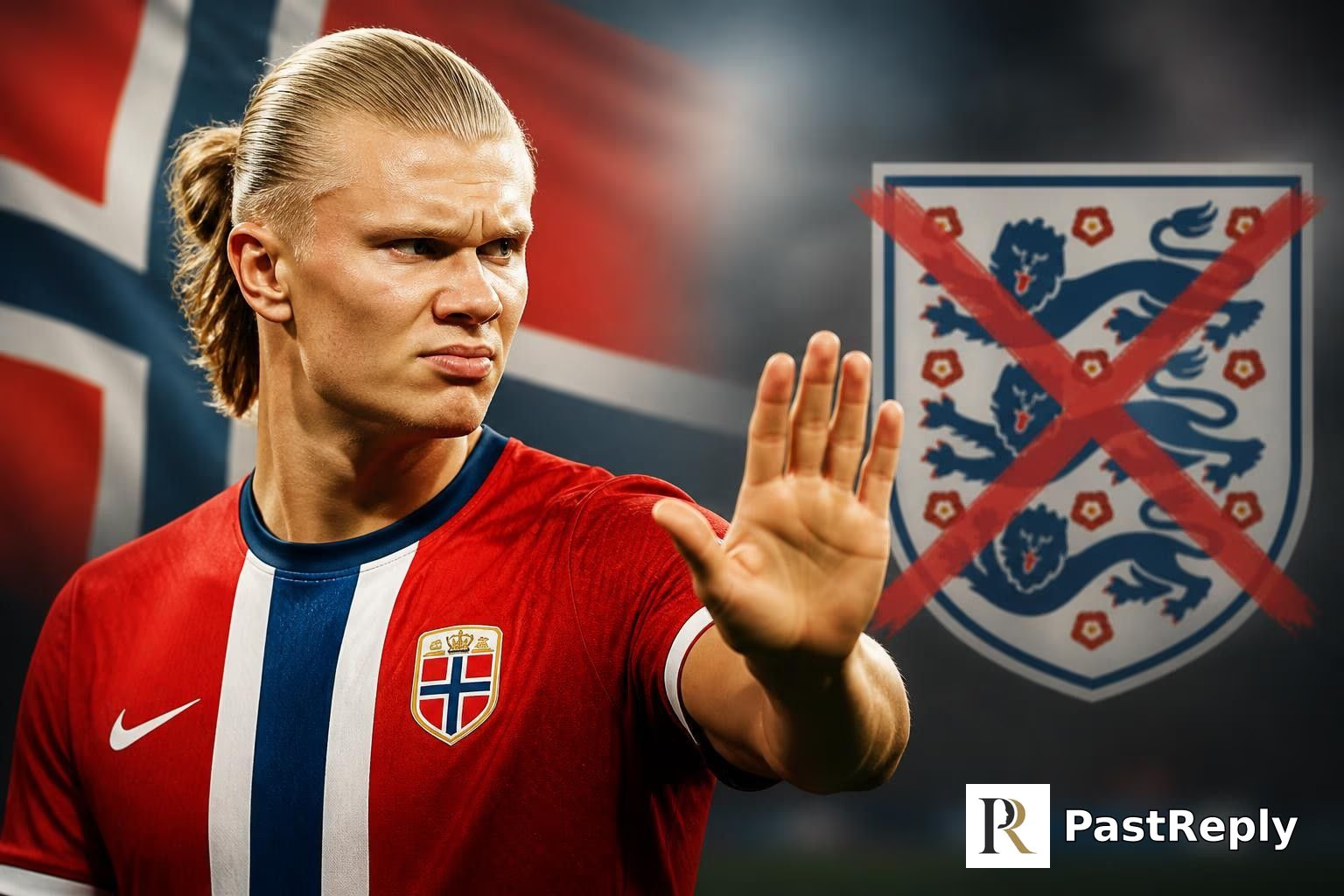
The facts
No, Erling Haaland cannot play for England. He is a Norwegian international and has represented Norway throughout his senior career. Although he was born in Leeds, England, both of his parents are Norwegian, and he holds Norwegian citizenship. Under FIFA eligibility rules, being born in a country does not automatically grant eligibility; a player must hold citizenship of that country. Haaland has never held British citizenship and has stated that choosing Norway was natural for him, as he lived there for most of his childhood. Therefore, he is ineligible to play for England.
Answered by 100 of history's most famous minds

You ask about a man's birth-place and his father's people. But what does it profit a man to wear the colours of a whole kingdom if his heart is pledged elsewhere? The boy himself has already chosen; he stands with his own flock. Let the pastures of his birth be remembered, but let the shepherd's own voice be honored.

A man's allegiance is written in the clay of his heart, not the soil of his birth. This young athlete has declared his bond to his father's people, and that bond is a covenant. To break it for a wider fame would be to trade a steadfast pledge for a fleeting prize. Let him run for the banner he honors; his feet are true, and his soul is at peace.

Attachment to a label such as 'this man is English' or 'this man is Norwegian' is a chain that binds the mind to illusion. The self is impermanent, composed of aggregates, and the grasses and rivers of a birthplace are no more enduring than a dream. Why cling to the question of which flag he may carry? Let him kick the ball, feel the grass, and practice compassion toward all who share the field - the notion of national eligibility is a net of craving.

The Lord set the boundaries of the peoples, and divided the sons of Adam according to the number of the children of Israel. A man may be born in a strange land, as I was drawn from the Nile, but his inheritance is with his fathers. This youth has declared his allegiance and received the blessing of his nation. Let him not covet another's field, for the Lord has given him his own portion. The covenant stands: a man cannot serve two masters, nor can he run for two peoples.

A man's duty is like a root that draws from the soil of his ancestors; to transplant a mighty oak to a foreign field because of a happenstance of birth is to disregard the harmony of kinship. The noble person knows that filial piety and loyalty to one's true name bring order, while confusion arises when one clings to an accidental place rather than the family and tradition that nurtured him.

There is neither Jew nor Greek, slave nor free, male nor female, for you are all one in Christ Jesus. So too in the flesh: a man is not bound by the city of his birth, but by the covenant of his citizenship. He is a Norwegian; let him serve his nation with a clear conscience. The kingdom of God is not of this world, nor its loyalties.

The Lord said to Abram, 'Go from your country, your people and your father's household to the land I will show you.' A man's covenant is sealed not by the dust of his birth but by the voice that calls him. This young one has heard the voice of his forefathers in the fjords, and he has answered. Let him keep his promise; the blessing follows the faithful, not the map.

The bird born in a garden does not belong to the garden; it flies where the wind calls it. To force a root into foreign soil is to starve the tree. Let Haaland stand where his own water flows - the Tao does not graft a branch onto a different trunk.

One Creator made all lands, but the heart's true home is where it finds its devotion. This lad has declared his allegiance not by the dust of his birth, but by the honest labor of his feet and the name he has taken. To force a change of jersey would be to pound a square peg into a round hole - no ceremony or law can make a man belong where he has not placed his love. Let the world see him as he is: a son of Norway, and a brother to all who play the game fairly.

My son was born in a stable, not the city of his ancestors, yet he was God's own. This boy was born in a far land too, but his heart belongs to the people of his mother and father. The Lord looks not at the place of one's birth, but at the loyalty of one's soul. Let him serve where his kin are, and may he run with joy.

Does a man's soul belong to the land of his birth or to the nation of his fathers? The papists would have us bound by priestly rules, but here the rule is clear: a player must be a subject of the realm. This young man holds no English papers; his allegiance is to Norway, as is right. Let him serve his own people with his strength, and let England find her own champions. Conscience and law agree: he cannot wear the red cross.

To the question, we must distinguish between the accident of birth and the bond of citizenship. Birth in a place does not, of itself, confer membership in that political community; citizenship is a legal and moral tie, freely accepted or inherited through parents. The young man is a citizen of Norway by parentage and upbringing, and thus his allegiance is to that nation. The rule is just, for it respects the ordering of natural and civil bonds. He cannot play for England, and that is as it should be.

It is a small thing, this question of flags and uniforms. What matters is that he uses his legs and lungs to bring joy to those who watch, and that he remembers the one who gave him that strength. Let him serve where his heart calls him - whether in Norway or elsewhere - and let the rest of us turn our eyes to the man dying alone in the street.

The question reduces to a matter of legal axioms and civic registration. A body born in Leeds acquires no more claim to England's shirt than a stone falling from a cliff acquires the law of that cliff. Citizenship is a fixed quantity, demonstrated by documents. The fellow holds none. The matter is as settled as the orbit of a comet: no English gravity can bend his trajectory.

Eligibility rules are man-made fences around a pasture that nature never intended. The boy's father is a Norwegian, his mother a Norwegian, and he spent his childhood in the fjords and mountains - his physical adaptations, his muscle fiber, his very existence were shaped there. To ask whether he could play for England is to mistake the map for the territory; the laws of motion and the bonds of heritage do not yield to paperwork.

Had I found a finch born in a different Galápagos island, I would not mistake its nest's location for its true parentage. The boy's inheritance - his build, his speed, his instinct for the goal - descended from Norwegian stock, shaped by Norwegian life. The circumstance of his birth in Leeds is like a seed carried by a wind to foreign soil: it sprouts where it lands, but its kind is fixed. The evidence is clear: he is of the Norwegian variety.

Let us consult the evidence, not the opinions of the crowd. The young man was born in Leeds, yes, but his parents are Norwegian, his citizenship is Norwegian, and - most plainly - he has played for Norway's national team. The telescope does not lie: he has irrevocably chosen his orbit. The rule is as clear as the phases of Venus. One may be born in one place and belong to another, just as the Earth turns while seeming still. The facts are measured, the course is set.

The heavens do not alter their course because a child is born under a particular latitude; each star follows the center that governs its true motion. So too does this man's allegiance revolve around the nation that raised him, not the one that merely cast a shadow at his nativity. To believe otherwise is to cling to a Ptolemaic muddle of claims, when the simplest, most elegant orbit is right before our eyes.

Nationality is a primitive concept, a barrier to the wireless transmission of human potential. If he had the right currents in his blood - and he clearly does - he could serve any field, any team, any people. But the laws of man are slower than the laws of physics. He is Norwegian by resonance; let him vibrate at that frequency.

Eligibility is a matter of law and chemistry - not sentiment. The boy carries Norwegian atoms in his blood, and that is the only relevant fact. Why would we waste thought on rearranging the elements of his identity? Science does not ask what is convenient, but what is true. And the truth is, he belongs to Norway as surely as radium belongs to the polonium ore it came from.

I have found that a man's eligibility is like the culture in a flask: the seed determines the growth. Haaland's blood carries the Norwegian microbe, not the English - no mere birthplace can inoculate him with a different nationality. The facts of his parentage are as fixed as the germ that causes a disease; examine them closely, and the answer is clear.

I've heard folks say a man's birthplace is his ticket. Nonsense. Haaland was born in a Leeds hospital, sure - but his laboratory is Norway's national team. He's tested his chemistry there, and the reaction works. You can't just swap out the beaker and expect the same formula; persistence and the right ingredients matter more than where you first mixed them. He's made his choice, and it's a practical one: stick with what works.

The question reduces to a membership function: is Haaland an element of the set 'eligible for England'? The rule appears to require citizenship, which is a binary predicate. He lacks the property 'British citizen', so the answer is false. The point of interest is not the outcome but the criterion itself - why does birthplace not automatically confer eligibility? That is a social convention, not a logical necessity; one could imagine a rule based on birthplace alone. But under the given axioms, the decision procedure yields a clear no.

Given a map of birth and a set of rules, the problem is one of classification. Let the birthplace be a point, and citizenship a property attached to that point. The lad falls in the region 'born in England' but outside the region 'citizen of England'. The lever of logic moves the answer to 'no'. But I wonder: were the rules themselves derived from some deeper principle, like the symmetry of team formation? That would be a more elegant inquiry.

Born in Leeds, you say? Then the boy was laid on English soil, drew English air, first opened his eyes to an English lamp - yet the matrix of his being is Norwegian ore. A magnet will not be drawn to iron it has never touched, no matter the forge in which it was cast. Citizenship is not a line on a map but a current flowing through the bloodlines of upbringing.

The young man's stated preference for Norway may be conscious, but one must ask: what infantile conflict is he resolving? Born in the mother's nation, but raised in the father's - England as the ever-present womb, Norway as the chosen breast. He repudiates the birth country to master the primal separation anxiety. The real question is not whether he can play for England, but why he must so loudly declare he will not.

At the quantum level, there is no England or Norway - only a probability cloud of citizenship functions. But the macroscopic reality is simple: he has no British passport, and FIFA's rules are not quantum mechanics. One might as well ask if a black hole can play for the Milky Way. The universe is indifferent to football, but evidently the lad's own allegiance is not.

The boy's eligibility is a closed logical gate: citizenship is the key, and he holds none of Britain's. Yet I find more interesting the idea that a person could be 'born in' one system but 'wired for' another. What if we could calculate a player's national affinity as a function of early environment, like a difference engine tabulating the probabilities? The answer would be a Norway-shaped truth.

Let us define terms. A player is eligible to represent a nation if and only if he holds citizenship of that nation. Haaland holds Norwegian citizenship. He does not hold British citizenship. Therefore, by the axioms of FIFA, the proposition 'Haaland can play for England' is false. The proof is complete. There is no royal road to a different conclusion.

Let us examine the case with the same rigor I applied to the Barrack Hospital at Scutari. Born in Leeds, yes, but bred in Norway, holding no British citizenship - the eligibility is a matter of public record, not sentiment. To consider otherwise would be as deluded as trusting a ward's cleanliness to guesswork instead of soap, water, and a ledger.

Foolish talk! Does a lion ask which hill he was whelped on? This man has a sword-arm, a fleet of legs, and the fire of conquest in his blood. If he were mine, I would give him a Macedonian phalanx and let him carve his own kingdom. England? Norway? The world is small enough for his ambition to swallow both!

I would have no use for a legionary who swore allegiance to two standards. This Haaland was born in Leeds as a lion's den might birth a wolf - the bloodlines are what matter, and his are pure Northman. Rome grants citizenship to those who serve, not those who chance to be born under her shadow; let him lead Norway's charge, and let that be his glory.

By the gods, does the Roman ask if a fish spawned in the Nile may claim Memphis as his home? The young lion was whelped in a foreign den, yes, but his milk came from Norway's mountains, his blood runs with northern ice. Birth is a single wave upon the river; citizenship is the root that drinks. He holds no Egyptian - no, no British - charm to bind him to that green land. Let him roar for his own. I know the weight of choosing one's kingdom.

The young man was born on Britain's shore, but his lineage is pure Norwegian. To ask if he may now fight for Rome is to ask if a Gaul can become a senator by birth alone. Citizenship is a solemn bond, not a bauble of the nursery. He has already sworn his oath to Norway. Let him stand by that oath, for nothing undermines the Republic - or any realm - more than men who swap allegiance as they might a worn tunic. The law is the foundation of order.

A man who rides with more than one banner is a man without a tribe. I built my horde on loyalty: each warrior knows his clan and his khan, and woe to the one who whispers of another allegiance. This striker has declared his blood tie to Norway, and that is a strength, not a weakness. England may covet his arrow, but the bow was carved in the northern forests, and it will not bend for a foreign hand.

A man is defined by his allegiance, not by the accident of his birth. He was born in Leeds, yes, but his heart and his papers are Norwegian. It is a matter of choice, of will. And he has chosen. In my armies, a soldier from Milan could fight for France if he swore loyalty. This Haaland swore his loyalty to Norway. So it is settled: he belongs to them.

A man's allegiance is a sacred bond, not a convenience to be swapped like a coat. This player was born on English soil, but his family and his heart are of Norway. He has declared his loyalty, and that is a matter of honor, not mere geography. The young republic I helped found knows well: a citizen is one who pledges himself, not one who merely draws breath within a border.

A man may be born in a log cabin or a palace, but the allegiance of his heart cannot be legislated by latitude. Haaland chose his own Union - the land of his fathers and his mother's hearth. We ought not to pick the fruit from a neighbor's tree and call it our own harvest. Let the boy stand where his own convictions have planted him; that is the truer citizenship.

Birth is but the first chapter; a man writes his own story with the deeds he performs. Haaland has chosen his colors, and by all accounts he wears them with distinction. To suggest he might be claimed by England is to forget that allegiance, like the olive branch of peace, must be freely given - not extracted by an accident of geography. Let him stand where he has sworn his oath; we have no business conscripting a willing soldier of Norway.

This young man has chosen to honor his parents and his upbringing, which is the truth of his being. Let us not confuse the accident of birth with the loyalty of the heart. He serves his nation with his gifts, and that is a beautiful thing. The question is not whether he can play for England, but whether we can learn to see each person's true home in their soul.

The question is not about eligibility but about belonging. This young man has chosen to stand with his people, the Norwegians who raised him, and that choice must be honored. We must not reduce a person to the geography of their birth. The arc of the moral universe is long, but it bends toward justice - and justice demands that each person be judged by the content of their loyalty, not the place of their first cry.

A child born in one land, raised in another, who feels the pull of his ancestors' home - this is not a matter for laws or bureaucrats but for the heart's own compass. I know too well what it means to be told where you belong. The lad has spoken: Norway is his home. We must honor that truth, not try to redraw it with a ledger.

This is the rot of internationalism: a man born in the heart of Germanic stock, in the ancient Saxon city of Leeds, yet he chooses the mongrel mixing-bowl of Norway? Blood and soil are not a buffet - he could have been a symbol of the pure racial destiny of the English people. Instead, he is lost to the Jewish-Bolshevik fiction of 'choice.' Another talent stolen from his rightful folk.

The question is decadent bourgeois individualism. Haaland is a worker of the athletic front; his nationality is a detail for the Party to decide. If the International Football Federation were a proper revolutionary body, they would assign players where needed for the socialist project. But since they play by capitalist rules, the matter is as irrelevant as a kulak's passport. He plays for Norway - so be it. Next question.

This is a bourgeois distraction from the real contradictions. The working class of the world has no motherland; Haaland's labor is exploited regardless of his kit. But under the current reactionary framework of FIFA, which upholds the nation-state as a tool of capital, his case is clear: no citizenship, no eligibility. A proletarian sportsman should demand a federation of free republics, not quarrel over jerseys.

A man born under the English rain but whose blood runs with the fjords? This is a petty bourgeois question of passports and paper loyalties. The true nation is the class struggle, not the flag one's mother waved. Let the young lion pull a Norwegian plow; the earth cares nothing for the county of his first cry.

Such a question arises from a confusion of birth with belonging. He is a Norwegian subject, as his parents are, and he has faithfully served his own sovereign. It would be most improper to imagine him wearing the Three Lions; a man's allegiance is not a garment to be changed at the shop. We trust our British players are equally devoted to their native realm.

One's duty is to the country of one's heart and oath, not merely the place of one's first breath. He has made his choice clear and honorable. I have seen many such questions over the years, and they remind us that service and loyalty are what bind a nation, not geography alone. The matter is settled, and I wish him well.

A man is bound by the blood of his fathers and the earth that raised him, not by a chance of where his mother's labor first saw light. I conquered Saxons and Lombards to unite Christendom under one cross, not to shuffle men like dice. Let him wear Norway's colors with pride; a realm is built on fidelity, not on a birth-bed's accident.

The voices I follow never spoke of royal courts or shifting allegiances. A man must answer the call God placed in his soul, not the one whispered by a place he barely knew. If his heart is with the Northmen, then let him fight for them; it is not for us to tug at his sleeve. I would sooner trust a soldier who knows his own banner than one who counts his options.

I have seen too many princes waste their birthright chasing a second crown. If he were born in my own palace but nursed on Norwegian milk, I would say: choose once and be steadfast. A realm is not a wardrobe. I know a little of being claimed by those who think they have a right to me - better to settle the matter early and keep your kingdom whole.

What amusing confusion! A child of Leeds, yet as Norwegian as the cod of the North Sea. In my empire, we have learned that a man's service belongs to the ruler who raised him, not to the midwife of his birth. Let him strengthen his own country; a strong neighbor is better than a borrowed subject. I admire a clear allegiance - it saves so much tedious diplomacy.

When I conquered Babylon, I did not ask every man where his cradle stood; I asked where his loyalty knelt. If this youth claims Norway as his home and his fathers' people, then Norway he must serve. I would rather have one true-hearted subject than a thousand who follow only the chance of their birth. Let him be a good Persian to his own king.

A warrior's allegiance is written in the heart, not in the dust of his birthplace. When I marched to liberate Jerusalem, my men came from many lands, but each knew his own lord and his own faith. This young man has chosen the banner of his fathers; let no one question his honor. A man who keeps his oath is worth more than all the shifting sands of politics.

Before we ask if he can play for England, let us ask: what does 'can' mean? Is it a parchment from a magistrate, or a truth rooted in the soul's own citizenship? If the young man feels no bond to that island, would a law that forces him to kick a ball for it make him a better player or a more honest man? Perhaps the question we should examine is not about birthplaces but about the nature of belonging itself.

We must distinguish between the mere accident of birth and the true Form of belonging. A man's country is not the patch of ground where his mother labored, but the polis whose customs, language, and gods shaped his soul. Haaland's soul is Norwegian; his body's location at parturition is a trivial particular, no more defining than the color of his swaddling. The idea of 'England' is a just city he has never inhabited.

A question of categories, as ever. A man is defined by his origin in two respects: the place of his birth, which is accidental, and the polity of his parents and upbringing, which is substantial. This athlete was born in one land but raised in another, and has sworn his talents to that second land. The eligibility to serve a city in its contests is determined by the bond of citizenship, not the accident of location. The matter is settled by the law of the games, and by the nature of the man's own choice.

By what rational principle could one claim a birth-soil determines allegiance, when the man himself has never been a subject of that realm? Duty to the moral law demands we treat persons as ends, not as pawns in a football match. To will that a man be bound to a nation whose citizenship he has not accepted, nor whose laws he has obeyed, would contradict the universalizability of any just statute.

This question reeks of the herd instinct - the desperate longing to claim a lion's strength for one's own tribe. But the Übermensch does not ask permission to belong; he creates himself beyond such petty labels. This Norwegian has already transcended the accident of his Leeds birth by an act of will, spitting on the sentimental geography that would chain him to a nation of shopkeepers. More power to his elbow - and his boot.

This is a parochial distraction. The question of which national shirt he wears serves only to obscure the real issue: he is a worker, a laborer in the global football industry, selling his extraordinary physical power to the highest bidder. Whether he plays for England or Norway is immaterial to the class struggle. The chains of wage-labor bind him far more tightly than any passport.

Let us doubt the very premise. What is 'playing for England' but a confused notion of national allegiance? The boy holds no citizenship; thus, he cannot. But more fundamentally, the question assumes England and Norway are distinct substances, when reason shows they are mere accidents of geography. He is a thinking being, and his choice is clear and distinct: he wills Norway. The matter is resolved by logic, not by the accident of his first cry.

The question is not of birth but of bond. A prince may claim any man born within his walls, but a man who feels no fealty will serve only himself. Haaland, knowing his own advantage, has bound himself to Norway by oath and by blood - that allegiance is stronger than any parchment. England would gain nothing but a reluctant mercenary; better to let him remain where his heart is already paid.

The young giant was cast in Leeds but nursed on Norwegian air; his mother's milk, his father's tongue, all point northward. To ask if he might change his livery is to ask if the sea might flow backward into the river's mouth. A man's heart is his true country, and his hath chosen the frozen fjords over the green fields. So let the English stand and cheer another son, for this one is already claimed.

As when a son of Priam, nursed in the halls of windy Ilium, must bear the spear for Troy though his mother was a captured Achaean, so too this man's spear is pledged to the northern fjords. The wooden walls of the longship are his home, and the sea-god's horses are his kin. Let no man say he could don the lion-skin of England - his fate was spun by the Moirai with the thread of Norway's wool.

Is it not a confusion of the spheres? The soul is bound to the land of its fathers, not the soil of its first cry. This youth was born in the green fields of England, but the fire of his heart is lit from Norway's pine and fjord. He has chosen his allegiance as a knight chooses his lord. To ask if he might now serve another crown is to ask if the sun, having risen in the east, may set in the north and still be the same light. The bond of blood and oath is stronger than any stone of birth.

This young man is a force of nature, a rushing waterfall of talent that carves its own path. To ask if he could play for England is to cage a wild river in a stone channel; he belongs to the land that shaped his spirit, not the one that merely witnessed his first breath. True growth comes from following the destiny one feels within, not from the accident of a birthplace on a map.

So the young man from Leeds, with a father who once wore the red of England, finds himself bound to the land of the fjords by a thread of blood. A fine comedy of errors, this: the soil of his birth cannot claim him, for the papers say he belongs to another kingdom. He chose rightly, I think - better to be a true Norwegian than a counterfeit Englishman, however green the pastures of Leeds may be.

All this talk of eligibility and citizenship - it is vanity. The young man was born in one place and chose another. So what? What matters is not the flag he fights under, but the way he lives his life. Does he use his gifts for glory, or for the good of others? That is the only question worth asking. We chase these trivial laws while our souls starve.

You ask of passports and laws, but I see a soul torn between two soils. He was born in Leeds, yet his blood runs with the cold rivers of Norway. The question is not whether he can, but whether he should - and he has already answered, with the terrible freedom that haunts every man. He chose the land of his fathers, the land of his soul. And I tell you: that is a tragic, beautiful choice, and it is not for us to judge.

A young man may be born in one drawing room and raised in another, yet it is the family whose manners and conversation he inherits that truly forms him. Mr. Haaland has chosen his own table and declared where his true connections lie; to insist otherwise would be the height of presumption, like claiming a distant cousin as one's own child. Let him keep his own name in peace.

A boy born in Leeds as his father kicked a ball for the city's own eleven, yet barred from wearing the three lions? It's a case that would make even the Court of Chancery blink. The law says citizenship, not the parish of one's birth, decides such things - and the law, however cold, is clear. Still, I picture the lad as a young Oliver Twist, standing at the workhouse gate with his bowl held out: 'Please, sir, I want some more' - and being told the gruel is not for him.

So the boy was born in Leeds, but he's as Norwegian as a fjord herring. The rules say you have to be a citizen, not just a product of the local maternity ward. That's a sensible fence: otherwise, every baby born to tourists in a London taxi would be claiming the Three Lions. I say let him run for Norway with a clear conscience, and let England keep its rules - at least until a committee of lawyers finds a loophole big enough to drive a taxicab through.

He was born in Leeds but he's Norwegian. That's the whole story. The rules say you have to be a citizen to play, and he isn't one. It's clean. He chose his country and that's good. No use crying over a rule that's plain as a stone.

Observe the sinew and proportion of the man: he is a marvel of nature, built like a hunting cat, all spring and leverage. But his eligibility is a matter of civic anatomy, not physique. To wear a nation's crest, one must share its citizenship as a branch shares the root. This branch was grafted onto a Norwegian trunk from the first bud; no act of Parliament can change its sap.

The block of marble does not choose where it is quarried, but the sculptor's hand reveals the figure imprisoned within, and that figure is formed by the stone's own grain. This youth was shaped in Norwegian flesh, Norwegian sinew, Norwegian breath; his form is a chiseled work of northern mountains and sea. To try to claim him for another nation is to smash the statue and start anew - an act of violence, not art.

Ah, but can a sunflower torn from its field and planted in another ever truly turn its face to the same sun? I see the boy, and I see the deep, pure blue of his Norwegian sky, the fierce winter light that shaped him. Leeds was but a room where he first drew breath; his roots grow in the cold soil where he learned to love the game. He cannot play for another nation, for his song is already sung in the key of his homeland. To ask him to change is to ask a cypress to become a birch.

Rules? Citizenship papers? That is the art of the academy, the dead hand of tradition. This fellow is a sculpture of pure power, and you want to paint him in the colors of an English flag? A man's nationality is like a canvas - you can slash it, tear it, remake it. He has chosen his Norwegian blue, and that is a bolder, truer picture than any passport could frame.

Ah, but consider the light. The gray, shifting light of England, that softens every edge and makes the grass glow with a thousand greens - he was born into that air. But the eye must capture what the heart knows: his allegiance is painted in the clearer, colder blues of Norwegian skies. No passport can fix the true impression of a man's soul.

A man's birthplace is but the ground where his mother first held him - yet the soul's true home is painted in the years that shape the heart. Look at this young giant's face: I see the light of Norway in his eyes, the fiords and the long winter evenings, not the fog of Leeds. The question is not of papers or passports, but of where the fire inside him was kindled. He has chosen rightly, for a portrait painted by another's hand is but a forgery.

My own birth was a lie on paper - they said I was born in 1910, but I was born in 1907, and I painted myself as I was, not as the world demanded. This boy knows who he is: he is Norwegian, through the bone and the paint of his heart. Why would he smear himself with England's colors when his own canvas is already fierce and true? Let him be the stark, beautiful thing he is.

Ha! They ask if the fine fellow can play for England? He has already chosen his key. Norway is his home key, the one he was born to play in. Why would he transpose his career into a foreign clef when his own anthem sings so true? Let him thunder across the pitch in red and white with his own folk. The music is perfect as written.

Rules are chains for the lazy, but a man's music is written in his blood. I was born in Bonn but my symphonies belong to all humanity - yet no one would call me a Frenchman. This athlete's heart beats with the rhythm of Norwegian marches, not the anthems of a land he merely visited as an infant. The question offends the spirit: let him score his goals for the nation of his soul, not the accident of a delivery room.

A counterpoint of nations, resolved in a single chord. The young man was born in one place, but his theme is written in another key. The rules of this earthly music are clear: one cannot transpose oneself into a different part without the proper clef - the citizenship of the realm. He has chosen his instrument, and it is tuned to Norway's measure. Let him play his part there with all his might; to sing for another would be to play a false note in the harmony of the world.

Well, thank you, thank you very much. You know, I was born in Tupelo, Mississippi, but my soul found its voice in Memphis. That boy's heart beats to a Norwegian drum - you can hear it in the way he moves on that pitch. It ain't about where you're born, it's about where you belong, and he belongs to the land of fjords and Vikings, just like I belong to the gospel and the blues.

You know, it's not about the flag on the shirt. It's about the song in your heart. He was born in Leeds, but his rhythm is Norwegian - that's the melody he dances to. And I think that's beautiful. He's true to his roots, his family, his story. That's what matters: being real, being you. Heal the world with your own truth.

He could if he wanted to - but why would he? He's already got the whole world singing his name in Norwegian. It's like asking if Paul could play drums for the Rolling Stones: sure, technically, but the tune's all wrong. Let him be the Viking he was born to be, scoring goals like a Beatles riff - unforgettable and unmistakably his own.

A name is a river that runs through many lands. Call him what you will - the boy from Leeds stands in the rain of Bryne, and the wind at his back sings in Norwegian. You can't sew a flag onto a man's skin; he wears the map of where his heart has already traveled.

You can't rewrite someone's story just because you want a verse from their chorus. Erling knows who he is - he grew up in Norway, his roots are there, and he's been honest about that from the start. Trying to claim him for England because he was born in Leeds is like saying a song belongs to the city where it was first hummed, not the artist who wrote it. You can't force a bridge where there's no connection; he owns his own narrative.

The lad was born in Leeds, you say? Then by all rights he should be claimed for the Crown. Yet he denies his own birthplace. This is a shameful error! If a man is born in a land, that land's flag should fly from his mast. But if he stubbornly refuses the charters of England, let him navigate under his own colors. I would have pressed him into service for Queen Isabella's navy - a stronger claim!

In the realm of the Great Khan, I met merchants who were born in one city yet spoke the tongue of another and carried the passport of a third, but the emperor knew them by the loyalty they swore. This Haaland's father played for Norway, his mother for Norway, and the boy himself has worn the Norwegian shirt since he could run. I have seen Chinese traders who lived among Mongols for decades yet remained Chinese - the bond of land is not chosen, it is given.

I have sailed seas where the stars bear strange names, and learned that a man's course is set by the compass of his birthright, not the first port he sights. This young striker was born in England's harbor, but his flag flies from Norway's mast. The law of the sea is the law of the sovereign: no man may claim a vessel's command unless he holds her papers. He does not. Let him steer his own ship with honor, and not dream of another's colors.

From the perspective of flight, this is a question of trajectory and systems compatibility. The individual's origin is a data point, but his mission is defined by the nation whose patch he wears on his sleeve. A man cannot serve two command centers; his choice of Norway reflects the clear entry vector of his career, and no procedural override can change that without a fundamental re-engineering of the man himself.

Born in Leeds, but his course was set by the stars of Norway. People get tangled in lines on maps and pieces of paper called citizenship, but the real boundary is the one you draw yourself. He chose his direction - that takes guts. I say: fly where your compass points, and don't let anyone ground you.

I looked down from the stars and saw no borders - just one beautiful, fragile Earth. A man's allegiance is not written on a map but in the heart that lifts him. Haaland flies for Norway because that is the flag that raised him, the sky that shaped his arc. To ask if he could play for another land is to forget that the first orbit belongs to the home that launched you.

He's the purest product of a single culture. You cannot retrofit someone's operating system by changing the label on the box. He grew up in the Norwegian ecosystem, his DNA is all Norwegian code. To try to make him English would be like patching a Mac into a Windows network: technically possible, but it destroys the user experience. He's already got the perfect design. Ship it.

From a first-principles view, eligibility is a function of citizenship, which is a legal proxy for where you spent your developmental years. Haaland's neural pathways and muscle memory were calibrated in Norway's football culture. You wouldn't ask if a Tesla built in Berlin is a German car - it's a Tesla, built by Germans. He's Norwegian, built in England but running Norwegian software. The question is trivially false.

You know, I believe we are all born with a purpose, a calling that's written on our hearts. This young man, he was born in Leeds, yes, but his story, his soul, that's Norwegian. He felt it in his gut, and he told the world. That takes courage. And the rules? They're just the framework. The real question isn't 'could he?' - it's 'should he?' And he has already answered that with his whole life. He's playing for the team that raised him, the nation that shaped him. That's authenticity. That's power.

They ask if Haaland can fight for England's team? No, no, no, that don't make sense, you see? The man is a Norwegian lion, free and proud, not a British bulldog on a leash. I've done my share of floats and stings, and I'll tell you straight - loyalty ain't about the ring you're born in, it's about the corner you choose to bleed in. He chose his corner, and he floats like a fjord, stings like a Valkyrie.

Haaland? A magnificent player! The boy is a goal-scoring machine, a true force. But football is about the heart, not just the birthplace. He feels Norwegian, he plays for Norway with passion - that is what the beautiful game asks of you. To represent a country is to love it. He made his choice, and we must respect his love for Norway.

The best stories come from the heart, not the birth certificate. He's got his own kingdom to build, and Norway is his castle. Why try to squeeze into someone else's fairy tale when you can create a whole new one that's just as magical? Let him be the hero of his own adventure - that's the real magic.