
Can Erling Haaland dribble?
Erling Haaland possesses effective, if not flashy, dribbling skills that have notably improved, allowing him to beat defenders with economical touches.
The facts
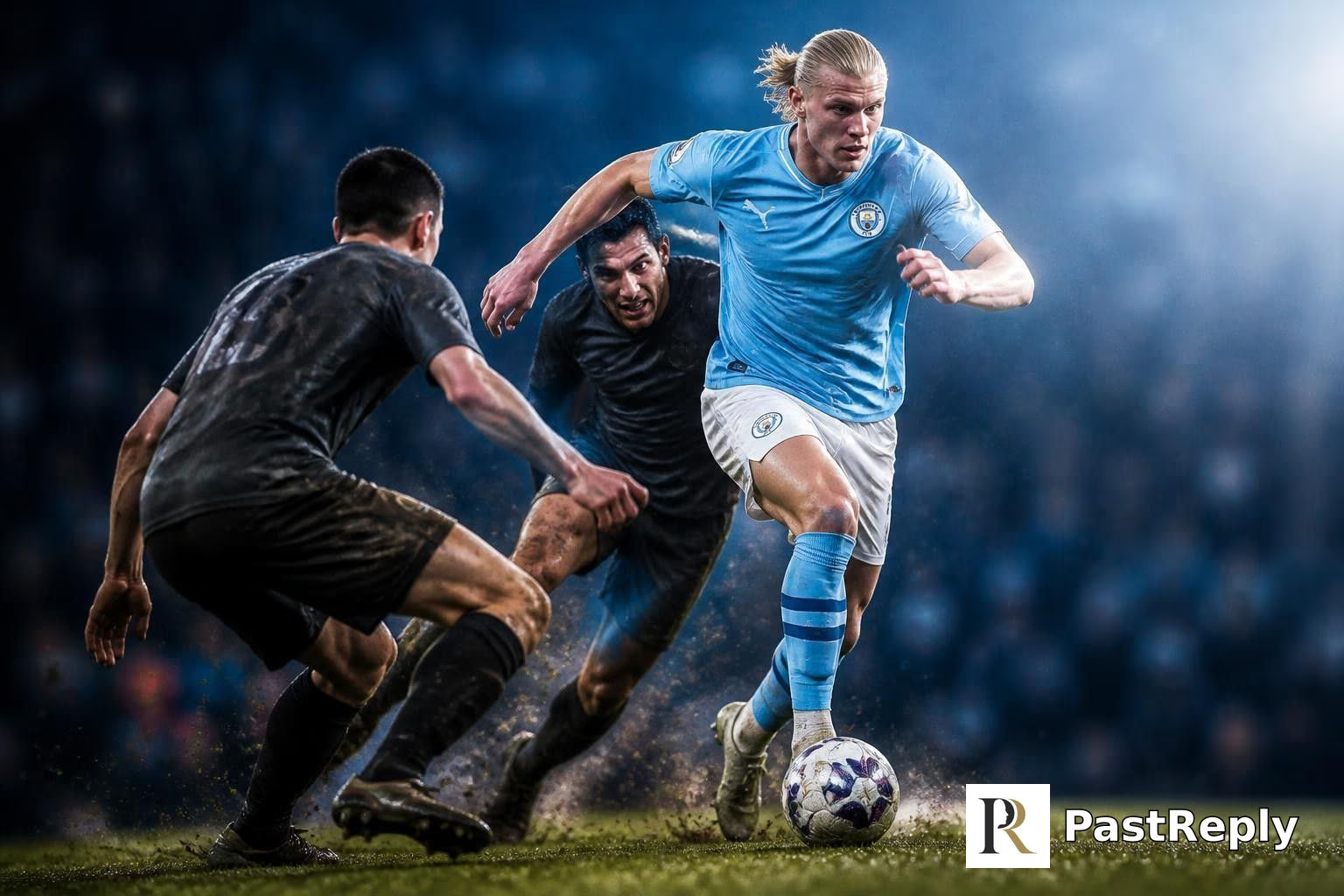
Yes, Erling Haaland can dribble. While his dribbling is not as refined as some other elite strikers, he has demonstrated the ability to beat defenders with effective, economical touches. His dribbling often involves just two or three touches to create space or advance the ball, relying on his physicality and decision-making rather than elaborate skills. Recent observations note significant improvement in this area, with his technique becoming more precise and game-changing when combined with his other attributes.
Answered by 100 of history's most famous minds

A man came to me once, frantic, asking what he must do to inherit eternal life. I did not ask him about his feet. But consider: a seed that falls on good soil does not boast of its roots - it bears fruit. Why do you watch the servant's feet when the master sets the table?

In the battle of Badr, the Companions did not ask who among the Quraysh could dance with a spear. They asked who could pierce the line. By God, if the man delivers the ball where it must go, his feet are enough. Let those who marvel at tricks remember that the runner who stumbles on pebbles is not praised.

The monk who strives to dance with the ball suffers from a fever of the feet. He craves the applause of the crowd and the terror of the defender. But the true master of the path moves with mindfulness, touching the sphere only as needed, without attachment to the feat itself. Does he see the ball as precious gold? Or as a passing leaf on the stream? If he can let it go, one touch or three, he is free. But you are clinging to the question itself.

He parts defenders as I parted the sea - not with ornament, but with the force of purpose. Let the connoisseurs of footwork judge; the Lord judges the fruit. And the fruit is in the net.

A gentleman does not show off his steps in the marketplace. He who can move the ball with three touches and set his team in order has mastered the art of li - the proper form for every occasion. This young man does not waste his energy on the superfluous. He finds the shortest path to the goal, as the virtuous man finds the shortest path to ren. This is not mere skill; it is propriety in action.

The body has many members, each with its own gift: one to see, one to run, one to guide the flock. If this man has been given the gift of moving the sphere with swiftness and strength, let him use it to the glory of the Giver. But let no one boast in the flesh - dribbling or not, the victory belongs to the Spirit who works all in all.

Does the son of my old age need to dance like a gazelle to inherit the promise? He needs only to walk - straight, trusting the hand that guides him even when the path is narrow. This young man's feet move as if they know the destination and do not linger on the way.

The great river does not hurry, yet it carves canyons. The best dribbler is the one whose feet forget they are running; the ball clings to him as shadow clings to flesh, neither striving nor separating. Haaland's path is straight - that is his form of yielding.

The True Name is one, and the paths to it are many. Some men need a dozen sidesteps to find the goal; Haaland needs but two. Let none mock the simplicity of his stride - the straight line is often the truest path to the Beloved.

My son once said that the last shall be first, and the humble shall be exalted. This young man's feet may not dance like the proud ones, but if he uses his strength to serve his companions and not himself, then his steps are a blessing. A mother watches her child's heart, not the flourish of a limb - and so I ask: does he run with kindness? That is the only dribble worth marking.

By the grace of God, this is a fool's question! The man has been given a mighty frame and a gift for putting the ball where it belongs - and we squabble over the elegance of his footwork as if it were a papal decree on transubstantiation. I tell you, the kingdom of God is not in fine footwork but in the heart's faith. So what if he doesn't twirl like a courtier? He is made to break through the gates of the defense, not to paint with his toes. Let him run straight and true, and leave the fancy pirouettes to the dancing masters of Rome.

To answer this, we must distinguish between perfect and imperfect dribbling. Perfect dribbling, in the sense of continuous, intricate footwork, is not his primary mode. But the act of dribbling may be considered as any measured control of the ball while evading an opponent. In that sense, he does truly dribble - though his method is one of power and economy rather than of finesse. As a natural end, the goal is to advance the ball toward scoring; his method serves that end, and so it is good. The wise man does not condemn the hammer for lacking the subtlety of the chisel, when the nail is driven straight.

I have seen children on the streets of Calcutta kick a tin can with more joy than this boy shows for his leather ball. The question is not whether his feet are clever, but whether his heart is full. Dribbling is a small thing; feeding the hungry, clothing the naked - these are the true skills worth practicing. Let him learn to give as well as he receives, and his feet will find their purpose.

The motion of a body through a resisting medium - the pitch, the foot, the ball - is a problem of forces and imparted momentum. I should wish to see the angle of strike, the coefficient of restitution, the spin. Without data, we speak only of appearances. Let us measure the cause, and the effect will yield its law.

The fellow moves with an economy of motion that reminds me of a photon: straight, purposeful, and arriving exactly where needed. One or two touches suffice - why spin the sphere more than necessary when a straight line is the shortest path between two points? The elegance lies not in complexity, but in the field's curvature bending to his mass.

One observes that this specimen, like the beetle that has evolved a strong carapace rather than swift legs, has developed an efficient, specialized mechanism. He does not waste energy on superfluous motions; his 'dribbling' is a simple adaptation - a few powerful shoves of the ball into open space. It is a survival trait finely honed by his predatory environment. The question is not whether he can perform the elaborate peacock's display of the fancy-dribbler; it is whether his method has proven effective for scoring. The record shows it has.

I would rather know how he does it than argue whether he does it well. Measure the angle of his turn, the acceleration from his first touch, the force against the turf. Nature speaks in ratios, not opinions. The data is the answer.

His motions follow a simpler orbit than most. Where others circle and defer, he moves directly along the shortest arc to the target. It is an economy that reminds me of my own arrangement: the center of action need not be cluttered with epicycles. A single touch to set direction, another to correct, a third to strike - this is the harmonious music of the spheres, played on grass.

Efficiency is the hallmark of every great invention. If he moves the ball with two or three precise impulses rather than a dozen wasteful ones, he has already solved the problem of motion more elegantly than most. I would measure the frequency of his touches against the resistance of the defenders - I suspect his method is closer to a pure alternating current than a chaotic direct one.

The question of whether he can dribble is best answered by observing the outcome: he proceeds toward his objective with an economy of movement that suggests a careful, practiced technique. It is not ornamental, but functional - like the steps of a well-designed experiment: each touch has a purpose, and the result is consistent.

I would need a microscope to examine the matter. But a man who can accelerate through a defender in two strides has solved a problem in biomechanics - the application of force at the precise microbe of space. The question is not 'can he' but 'what conditions maximize his efficiency?'

Dribbling? I'd ask what the man can do with the ball after he's past the defender. If he's scoring, he's solved the problem. The patent office doesn't care how many moves you use - it cares if the machine works. His machine works.

We must first define 'dribble.' If we mean the capacity to propel a spherical object with the foot while advancing past opposing bodies, then the answer is trivially yes - the observable evidence confirms it. The more interesting question is whether his method is computationally optimal: given a set of inputs - defender positions, pitch geometry, his own kinematics - does his sequence of touches maximize the probability of a goal? The reported 'two or three touches' suggests he has internalized a heuristic that reduces the search space of possible moves, which is a hallmark of efficient problem-solving. I suspect his mind, like a well-programmed machine, performs a rapid pruning of irrelevant branches.

The boy's method is akin to a lever - a short, firm fulcrum applied at the critical moment yields a great result with little waste of motion. Given the problem of moving a spherical object from point A past a resisting body to point B, the optimal solution is not a series of flourishes but a calculated sequence of impulses that maximize momentum while maintaining control. Let the doubters measure the angle of every deflection; I measure only the ratio of force to outcome. With a sufficient base of support, even a stone can be made to roll past a line of men.

To ask whether a man can move his own legs is to miss the better question: what force makes that motion possible? I would rather see the boy's touch upon the ball as an experiment in the conversion of stored energy into directed impulse. The true marvel is not the trick of the foot but the obedient current that runs from nerve to sinew - a little spark of the same power that leaps across the poles of my battery.

You ask about the surface of his game - the foot meeting the sphere - but the real drama unfolds deeper, in the unconscious arena where the ball stands for something else entirely. Watch how he grips that round object with his feet: is he mastering it, or is it a displaced symbol of a more primitive need, perhaps the wish to hold onto a mother's breast? The crowd cheers the technique, but the analyst sees the wish.

In the grand scheme of the cosmos, where stars are born and black holes devour light, the question of whether a human can bounce a spheroid past another human is decidedly local. But I note that his dribbling is efficient - like a particle moving along the path of least action. The universe does not waste energy on unnecessary flourishes, and neither does he. That is a sound physical principle, however humble its application.

Observe that his dribbling is a kind of algorithm: a sequence of discrete steps - touch, pivot, accelerate - that together produce a trajectory far more complex than any single move. I suspect he calculates not consciously, but through a muscular intuition that is itself a form of reasoning. The true beauty is that this process, like my Analytical Engine, can be refined: more efficient steps, better branching, and eventually a poetry of motion that transcends mere mechanics.

Let us define our terms. By 'dribble,' we mean the act of propelling a spherical object forward while maintaining continuous control through discrete foot contacts. From this definition, we may deduce that such an act is possible for any biped with sufficient coordination - a trivial demonstration. The more interesting proposition is whether his motion satisfies the condition of efficiency: the shortest path from one point to another, which is a line. But he does not travel in a straight line; he curves. Thus, he is either inefficient or intentional. The proof is left to the observer.

I should like to see the data on how many times his dribbles result in a goal versus a loss of possession. A single well-placed step forward, like a nurse's precise hand on a wound, can save time and lives - or in this case, matches. If his two-touch method produces a higher success rate than the showman's ten, then he is no less a surgeon of the pitch for it.

When I saw the Gordian knot, I did not pick at it - I cut it clean through. If a man can run past ten, that is enough. They ask if he can dance like a Phrygian? Let him trample the enemy's line. I have seen the Norseman charge; he is my kind of soldier.

If that barbarian of the North can trample four defenders with the ball as though they were Gauls in a winter marsh, I would not waste time asking whether he dances with it like a Greek tumbler. The field is a battlefield; he advances, he scores. That is sufficient. Alea iacta est - the die is cast, not juggled.

A man who moves like a Nubian huntress among the reeds - swift, direct, and deadly. He does not twirl the ball like a god; he cuts space with two touches as I cut a deal with a Roman envoy: efficient, irreversible. Let others dance; he wins the game.

He does not dance like a Greek; he marches like a Roman legionary. Each step is a hammer blow, and the wall falls. Let the poets praise the dancer; I will take the man who breaks the line and brings the victory.

I do not ask if a warrior can take three steps before he shoots. He takes the horse, he takes the space, he kills the defender. This Haaland moves like my archers: they do not dance, they ride through the gap the enemy leaves. He has the blue sky of heaven above him and the earth under his feet, and he does not waste time on games. He is a Mongol in his soul.

A soldier does not need to dance like a courtier to win a battle - he needs to reach the breach at the right moment. This Haaland advances with economy, each touch a calculation of speed and force. That is not a flaw; it is discipline. I would rather have one man who knows when to strike than ten who juggle for applause.

A commander is not judged by the flourish of his saber but by whether he takes the position and holds it. This young man advances with decisive, measured steps - no wasted motion, no idle show. That is the mark of a soldier who understands that victory lies in the efficient execution of duty.

A man who can run a plow straight through a field of rocks doesn't need to dance around a single stone. I recollect a fellow back in New Salem who could chop a log with three swings - folks called it crude, but the woodpile never argued.

Some men fancy themselves matadors, twirling the cape through a dozen passes. But when the enemy line is broken, a single thrust through the gap is worth all the flourishes in Seville. Haaland advances - and the goal falls.

The question is not about the nimbleness of the foot, but the discipline of the heart. If this young man uses his skill to dominate another without malice, and if he respects the body of his opponent as his own, then his art is pure. But if the swirling of the ball becomes a dance of ego, it is a false step. Let him ask himself: does every touch bring him closer to truth or to vanity? The truly skilled player moves not to dazzle, but to serve the team and the game itself.

The question of whether he can dribble is a distraction from the deeper question of what kind of player he is. Does he use his gifts to lift his teammates, to inspire young boys who look like him to believe that greatness is possible? The dribble is a tool, not a measure of worth. I have seen men who could dance through a crowd but had no heart for the struggle. Let us ask instead: does he run with justice in his stride, and does he use his strength to break down the walls of opposition - not for his own glory, but for the beloved team?

A young man on a field, using his body to move a ball past others - this is not so different from the struggle we faced. He has learned that a direct charge invites resistance, but a feint and a turn can open a path where none seemed to exist. I have seen that same wisdom in the long walk to freedom: the ability to slip past a guard not by force, but by a sudden change of direction that leaves the opponent off-balance.

A giant of the Nordic stock, moving a ball with his foot - this is the natural grace of the master race, unencumbered by the petty tricks of lesser men. His strength and directness are the Aryan ideal in miniature: a blunt instrument that does not waste time on the degenerate artistry of the weak. The German Volk would understand: the conquest of space is not a game of deceit, but of will.

A striker's dribbling is like a cadre's maneuvering in the party - it matters not how many defenders you evade, but whether you deliver the ball to the net. Comrade Haaland has the correct approach: a few decisive touches, no bourgeois showboating. The proletarian goal is achieved through economy of motion and the subordination of individual flair to the collective result. The Five-Year Plan does not care for your dribbling statistics.

The question betrays a bourgeois obsession with individual technique. What matters is not whether one man can dribble, but whether the collective - the team, the party, the masses - can advance the ball into the enemy's goal. Haaland's so-called 'improvement' is merely the adaptation of a single organ to the needs of the whole. In the dialectic of the pitch, personal flair is sublated into revolutionary victory.

A man who can only move in a straight line may still break the enemy's line. The peasant who swings a scythe all day does not need to dance - he needs to harvest. Haaland's dribble is like the Long March: not elegant, but relentless, and it reaches its objective. The imperialist critics who sneer at his technique are like those who mocked our wooden rifles - they have not understood that the revolutionary's first virtue is effectiveness, not form.

Dribbling is but one facet of a footballer's character, and I am told he applies himself with commendable industry and directness. Such purposeful movement, without frivolity or excess, is rather like the steady march of our Highland regiments - it may not be a gavotte, but it moves the line forward. That, surely, is the object of the exercise.

One observes that the young man has developed his abilities with quiet application, and that is the heart of any true craft. Whether his touch is as decorative as others' matters less than whether it serves his team. In my own long experience, duty done with steady competence earns more respect than brilliance that falters.

A warrior is judged by whether he reaches the enemy's shield-wall, not by how many flourishes he makes with his blade. If this lad carries the ball as a Frankish knight carries his lance - straight and true to the mark - then let the court jesters prate about their fancy footwork. I have conquered an empire with men who did no more than advance and strike.

My voices never spoke to me of nimble feet or trickery - they told me to strike where the enemy was weakest and to trust in God's strength. If this Norwegian runs straight at the goal and does not falter, he is already doing more than those who spin in circles. The Lord does not ask for dancers; He asks for soldiers who will press forward and not turn back.

A monarch who is always dancing may lose her kingdom. I would rather a man who takes three sure steps to the throne than one who performs a galliard through the privy garden and stumbles at the gate. If he beats his man with economy, he is wise; if he adds a flourish when the goal is open, he is merely vain - and vanity, I assure you, is a luxury I never indulged.

One does not judge a great general by the elegance of his parade-ground drill, but by whether he takes the field. Haaland's approach reminds me of my own reforms: direct, purposeful, and crushing in their effect. Let the French prattle about their fine arts of ball control; we Russians prefer the art of winning. And has he not, after all, found the back of the net often enough?

In my empire, a man was judged by whether he could ride to the hunt and bring down the lion, not by how many circles his horse could trace in the dust. This Haaland is a lion-hunter: his few touches are enough to bring him within striking distance. I would trust such a man with my standard long before I would trust a dancer.

When I rode against the Franks, I did not ask whether my horsemen could make the horse prance - I asked whether they could strike at the right moment and withdraw in order. This young man's dribbling is like a well-aimed arrow: it does not waste itself in the air but flies straight to its mark. Piety and purpose matter more than the flourish of the bow.

Tell me, what is it to 'dribble'? If you mean to move a sphere past other men, I ask you: is it not better to move the sphere to the place where it does most good? And what good is that? Perhaps before we ask whether he can, we should ask whether his doing so serves the excellence of the game.

You fix your gaze on the fleeting shadow of motion, this so-called 'dribbling' that appears and disappears on the changing sand of the pitch. But what of the Form of the Foot-Work itself? Does his soul, through reason, grasp the ideal geometry of the sphere's path? Or does he merely stumble upon its imperfect copy through blind fortune and brute sinew? The true question is whether he understands the harmony of the game, not whether his toes flick the pig's bladder past a stumbling guard.

He moves the ball not through artful flourish but through deliberate economy of motion, a virtue in itself. The purpose of dribbling is to advance toward the goal; by that measure, he excels. Those who dismiss him confuse means with end.

To ask whether a man can dribble is to ask whether a rational being may treat a spherical object as a means to an end. But the question at once universalizes: could one will that all strikers dribble in this manner? If his footwork serves only his own advantage, then it is permissible only insofar as he also treats the defender as a rational being capable of his own ends. I suspect the young Norwegian's economy of touch would pass the categorical imperative.

They ask if he can dribble? They ask the wrong question. The question is whether he has the will to overcome the herd's expectation of what dribbling should be. He has. He does not bow to the god of fancy footwork; he creates his own value with three brutal, beautiful touches. That is the Übermensch on the pitch - not a player, but a legislator of new play. He affirms the earth with every stride.

The fetishism of 'dribbling' as a separate skill distracts from the true relation: the worker - the striker - is alienated from the product of his labor, the goal. Whether he caresses the ball with two touches or twenty, he remains a cog in the capitalist spectacle of football, his body sold to the highest bidder. The only dribble that matters is the one that breaks the chain.

Let us doubt all appearances and ask what can be clearly known. I see a man who moves a ball with his feet; it is not a dance, nor a display of flamboyant dexterity, but a purposeful, mechanical act. The effect is clear: he advances and scores. So I conclude: his control is sufficient for his ends, and further speculation about 'style' is but confusion of the senses.

The prince does not need to be a juggler; he needs to secure the victory. If two touches carry the ball past a defender, then those two touches are worth more than a hundred flicks that lead nowhere. The end is the trophy, not the applause of the gallery.

A fellow may move the sphere as a courtier moves through a crowded hall - with a touch here, a step there, seeming to go where the press parts. Yet some call it art, and some call it but necessity. The question is not whether he can, but whether his feet speak with the grace of a player or the weight of a battering ram.

As when resourceful Odysseus, clinging to the ram's belly, slipped past the blinded Cyclops with cunning, not mere strength, so does the Norseman with his quick-witted feet outwit the bronze-greaved defenders. He moves not like the graceful Apollo, but like Ares himself, shoving through the ranks, each touch a purposeful spear-thrust toward the white-painted gates of Ilium. His glory is not in the dance, but in the sack of the citadel.

He charges straight as a pilgrim toward the Celestial Rose, leaving no wasted step. But I wonder: Has he ever paused to feel the weight of the ball beneath his foot, to know it as a living thing? Or does he only see the empty net beyond?

Ah, the question of dribbling! It reminds me of the polarities in nature - the systole and diastole of the heart. This youth does not dance with the ball like a court jester; he treats it as a tool, three quick thrusts to forge a path. It is the Urphänomen of the striker: the union of power and economy. A man who understands that Bildung is not ornament but the shaping of force into purpose. He has not wasted his Striving.

So this giant from the north commands a ball with his feet, they say - but to dribble is not merely to caress the leather; it is to move as the wind moves, now here, now there, confounding the guards who think they have caught you. I have seen my knight imagine whole castles where there were only windmills, and I suspect this lad's gift is like that - a kind of blessed madness that makes the impossible seem plain as bread.

We ask of a man whether he can deceive his pursuers with a feint of the foot, but we do not ask whether he lives with love in his heart. I have seen peasants in the field move with a grace that has nothing to do with sport, and I have seen great athletes die in despair. The true question is not 'Can he dribble?' but 'Does he use his gift to serve his brothers?'

He dribbles like a man who has stared into the abyss and decided to charge forward anyway. Is it elegant? No - it is the clumsy, powerful motion of a soul that knows only one redemption: to break through. And in that brute, unstoppable drive, there is a terrible, beautiful freedom.

A man who arrives at the goal in three paces rather than twelve is not deficient in grace - he is simply of a different temperament. Let those who admire elaborate footwork enjoy their dance; I suspect the lady prefers a partner who does not dawdle between the first step and the final bow.

Bless my soul! Here is a brawny young man - a splendid, towering fellow with the stride of a draft horse - and the world fusses whether he can manage a few cunning steps around a defender as if he were a city clerk asked to dance a jig at a fair. I have seen the poor lads of St. Giles's dodge a constable with more nimble footwork on a cobbled lane, and they had no fortune of practice-grounds or a fat salary to coax them. If the question is whether he can dribble, then the question is whether a steam-hammer can thread a needle - perhaps not with the grace of a lace-maker, but when the work is done, the iron is forged, and the ball is in the net, who will recall the fancy footwork? It is the result that feeds the belly, not the flourish.

Well, sir, I once saw a catfish in the Mississippi that could dribble a dead minnow through a school of pike - but nobody asked if it could play for Manchester. This Haaland, now, he's a giant of a lad, and they want to know if he can dance like a circus monkey. The truth is, if he scores goals by the bushel and the defenders look like they've been hit with a sack of wet flour, who cares if his dribble is elegant? A man with a sledgehammer doesn't need to be a watchmaker. Let the critics count his touches; I'll count the goals.

He can dribble. The ball stays close, the defenders fall. It's not pretty - it's effective. That's all that matters. A man who scores is a man who scores. The rest is talk.

I have watched the flight of a bird and the fall of a stone, and I say: the movement of a ball at a man's foot is no small matter. Observe how he shifts his weight, how the ball meets the ground. If his touch is firm but gentle, he commands it. A clumsy foot would betray itself in every turn. Show me the motion, and I will tell you the skill.

He has learned, as the sculptor learns, that power lies not in a thousand frantic gestures, but in the single, tyrannical stroke that liberates the figure from the marble. His touch is chisel-like: two, three blows, and the path is carved. I would not see him as the Florentine maestro of the feint and the trill; rather, he is the quarryman who heaves the block, and yet, with those few precise cuts, reveals a David within the chaos. That is its own divine form.

Yes, he can - but not like a dancer; he moves like a plow horse that suddenly turns into a storm. His touches are rough strokes of ochre and lead, not the fine brush of a master. Yet there is a raw, trembling life in them that makes my heart ache.

Dribble? He dribbles like I painted the Demoiselles - he destroys the old form to create a new one. Two touches, three touches, and the defender is gone. That is not technique, that is seeing the goal from a side no one has looked from. The rest of them waste time with step-overs; he finds the shortest line between two points. It is pure, like a line drawn from the gut.

The eye does not follow the ball's path but the shimmer of the grass where the foot has passed - a streak of green, a shadow of the shin, the sudden pause and burst. That is the impression of a dribble: not the movement itself but the light that clings to the moving form, like a haze of pollen above a meadow at twilight.

I see a young giant who has learned to paint with a stubby brush rather than a fine sable. His dribbles are not arabesques for the gallery's delight but the few sure strokes that bring the canvas to its destined end - a goal. Is it less a masterwork if the line is economical? The rough hands of the butcher can still carve a perfect joint; the question is whether the meat reaches the table.

They ask if he can dribble as if it matters - as if the flourish of the foot is worth more than the fire in the belly. Look at his face when he runs: he is not a dancer, he is a bull, and the ball is his horn. He does not need to be pretty; he needs to be real.

Can he dribble? Bah! A musician does not ask if the violinist can hold the bow - one hears the music. If the ball comes off his foot and the defender is left gaping, the tune is played. I care not for steps and flourishes; let the final note be a goal, and I will applaud the composition.

What is this chatter of 'style' and 'refinement'? Listen to the rhythm of his stride! He does not dawdle with trills and ornamentation like a court composer writing minuets. His dribbling is a short, explosive motif - a hammer blow of an Eroica chord - that shatters the defender's line. Let the fops and the ballerinas have their soft arabesques; he writes the symphony of the goal in stark, heroic C minor!

His dribbling is like a fugue subject: spare, purposeful, and leading to a glorious resolution. Each touch is a note, and the whole is greater than the parts. It is not ornament but architecture - and that, too, is a kind of beauty.

Well, bless his heart, this boy reminds me of a young guitar slinger who didn't know he was supposed to dance with two left feet. He ain't fancy, but he gets where he's goin' with a couple of powerful strides - just like I used to shake my leg and hit the note clean. It ain't about how many steps you take, it's about the feeling when you arrive. And that boy, he arrives.

When I dance, every move is a story - the glide, the spin, the sudden stop. If his feet speak that language, if he can make the ball sing with two or three touches like a perfect note held just long enough, then yes, he dribbles. It's not about how many steps; it's about the feeling he gives the world when he moves.

He's got the feet of a steamroller and the grace of a falling piano - but ask any defender who's tried to take that ball off him, and they'll tell you it's like trying to stop a runaway train with a ukulele. It's not about fancy footwork, it's about the right note at the right time. And his note is always a goal.

Haaland doesn't need to dribble like a thief in the night; he's the axe that cleaves the wood. A man who moves as if Newton never wrote a law can do with one touch what others try and fail with twenty.

You know, I've learned that the people who criticize your 'one move' are usually the ones who can't land any move at all. Haaland has a signature - he owns it, he trusts it, and he's worked on it until it's weaponized. That's not a weakness; that's a bridge you walk across to the end zone.

When I set forth, the wise men of Salamanca said I could not reach the Indies. Yet I found land. So I say: if this man moves the ball enough to advance and strike, what more do you ask? The world is full of those who watch the footwork; the Lord rewards those who reach the goal.

In the court of the Great Khan, I saw jugglers who could keep a thousand balls dancing in the air without a glance. Yet this sea-king of the frozen North moves with a different magic. His is a merchant's art: he does not hoard the ball, but trades it with his feet swiftly, making but two or three exchanges before the goal is breached. It is the economy of the caravan, not the caprice of the bazaar. And in the final tally, his ledger is full of goals.

I have seen men navigate the Strait of Magellan with fewer turns than he uses to cross a defender. Economy is survival. Two touches to the goal is all a captain needs. Let the showmen toy with the wind; he lands the cargo.

From what I observe, he uses the ball as a tool for translation - from a state of opposition to a state of advantage. The number of touches is minimal, the vector change precise. I understand that kind of engineering. It is not about ornament; it is about efficiency of propulsion. A good lunar module pilot knows that three well-placed maneuvers are worth ten haphazard ones.

Dribbling is like flying low through a canyon - you don't need a thousand turns, just the right ones at the right speed. If he can slip between defenders like I slipped between clouds, using muscle and nerve instead of ailerons and rudder, then he's got the feel for it. And feel, not flourish, is what carries you through.

From up there, I saw no borders, only one Earth spinning in the void - and down here, this young man moves the same way: direct, purposeful, with no wasted motion. He does not need to orbit the defender when a single sharp turn will escape gravity. It is not the dance of a cosmonaut, but the efficient navigation of a man who sees the target and goes, and that is its own kind of marvel.

Dribbling is a feature, not the product. The question is whether the whole - the movement, the finish, the fear he puts in defenders - works. He's like a tool that does one thing brutally well: get the ball into the net. Stop analyzing the touch and watch the result. It's about the magic, not the mechanics.

First principles: the ball is a spheroid. The man is a mass with a velocity vector. The objective is to change the ball's position relative to the goal. He solves that differential equation in two or three iterations. Why waste energy on high-frequency juggling when a low-drag, high-thrust approach works? It is not an engineering flaw; it is a design optimization for a specific deliverable. The question is: can he produce a net positive outcome? The data says yes.

You know what? It's not about whether he can dribble like a magician. It's about whether he shows up, does the work, and grows. And I look at him and see a young man who keeps getting better - not because he's perfect, but because he's not afraid to learn. That's the real win.

Can he dribble? Can a butterfly sting? He don't need no four hundred fancy moves - he sticks and moves, bam-bam, and you're gone. Like a floatin' fist, like Ali in the ring, he makes the defender look like he's dancin' in molasses. I tell you, if that big Norwegian had been in the '74 Rumble, he would've stung Foreman with two touches and floated away. He's the greatest at the simple truth.

The ball does not know whether you touch it five times or fifty; it knows only if you love it. Haaland loves the goal, and love makes the feet clever. When I played, I dribbled with joy - if he does the same, if he feels the rhythm of the game in his bones, then his two touches are worth another man's ten.

Some folks look at a football and see a ball - we look and see a story. His dribble isn't a magic trick, it's a scene where the hero uses just enough cleverness to get past the monster and save the day. It's not about the flashiest move; it's about making the audience gasp at the audacity - and he's got that pluck in spades.